in the population sciences published by the Max Planck Institute for Demographic Research Konrad-Zuse Str. 1, D-18057 Rostock · GERMANY www.demographic-research.org
DEMOGRAPHIC RESEARCH
VOLUME 17, ARTICLE 24, PAGES 705-740
PUBLISHED 20 DECEMBER 2007
http://www.demographic-research.org/Volumes/Vol17/24/ DOI: 10.4054/DemRes.2007.17.24
Research Article
The impact of origin region and internal
migration on Italian fertility
Giuseppe Gabrielli
Anna Paterno
Michael White
Special Collection 6: Interdependencies in the Life Course, edited by Hill Kulu and Nadja Milewski.
© 2007 Gabrielli, Paterno & White
1 Introduction 706 2 The Italian situation – an overview 707
3 Theory and operationalization 712
3.1 Model specification and hypothesis tests 713 3.2 Additional conceptual considerations 714
4 Data and methods 715
5 Descriptive results 716
6 Multivariate results 719
7 Conclusion 729
8 Acknowledgements 730
References 731
Appendix 1 736
Appendix 2 737
Appendix 3 738
The impact of origin region and internal migration
on Italian fertility
Giuseppe Gabrielli1,
Anna Paterno2,
Michael White3
Abstract
We examine the impact of population distribution on fertility in a nationally representative sample. We exploit detailed life-history data to conduct an event-history analysis of transition to first birth, examining mechanisms that might link migration and fertility: socialization, adaptation, selection, and disruption. Our multivariate analysis examines various socio-demographic traits, the place of birth, and interregional migration. Differences by region and migration stream are partly explained by compositional factors, such as female employment, union type, and education. The analysis presents much evidence for demographic selection and socialization and less for adaptation or disruption. The persistence of the region of origin differentials points to the continuing importance of the context.
1 Dipartimento per lo Studio delle Società Mediterranee, University ofi Bari, p.zza G. Cesare n.1, 70122 Bari, Italy. Tel:(+39) 080-5717547, Fax: (+39) 080-5717272. E-mail: [email protected]
1. Introduction
The effect of the place of residence and migration on fertility has been a long-standing concern in population studies (White et al. 1995, Chattopadhyay et al. 2006). This observation assumes a particular importance in Italy, a country that in the 1990s had the lowest fertility in the world and remains characterized by very low fertility (Billari and Kohler 2004). While the emergence and persistence of nations with ‘very low’ or ‘lowest-low’ fertility has often been noted (Kohler et al. 2002, United Nations 2006), the persistence of regional differentials in the level of fertility and the pace of change is scrutinized less often. Italy, moreover, remains characterized by the strong redistribution of the population inside its territory (Bonifazi and Heins 2000). This process involves both men and women of working and reproductive ages. Redistribution takes place among areas marked by sizable differences in demographic, economic, and social patterns.
Our motivation for this paper comes from a growing concern in demography for a better understanding of context in fertility outcomes. In this paper, we examine the relationship between population distribution (context as place) and fertility. We allow for the region of birth and migration itself (origin-destination combination) to influence childbearing outcomes. In addition to speaking to current concerns, we extend a long-standing literature investigating the way in which fertility is conditioned, in part, by migration and geographic setting. The influence of place and migration on fertility has been subject to numerous prior studies. Such studies draw on several potential mechanisms that might give rise to an association between migration and fertility: socialization, adaptation, selectivity, and disruption (Caldwell 1982). We discuss the relevance of these in the model we propose and investigate. In this paper, we emphasize the way in which changes in the predictive power of covariates help shed light on these mechanisms. We cannot fully disentangle all mechanisms, precisely because some characteristics remain unmeasured.4 We say less about disruption, because it is less likely to operate in a high-income setting (such as contemporary Europe) and, in fact, we find less empirical evidence for it.
Our approach analyzes the impact of geographical mobility and residential location on fertility in a large nationally representative sample of Italian women. We use longitudinal data drawn across several waves and with retrospective information. We examine the effects of age and cohort variables, several individual traits, the
characteristics of the origins and potential destinations, and the migratory event itself. In so doing, we test for the influence of geography and migration, and also examine the applicability of some existing theories on this topic to the Italian setting.
2. The Italian situation – an overview
The dynamics of fertility and internal mobility in Italy are very well-known phenomena. Although an appreciable literature describes these processes, we review some regional trends in order to shed light on their interconnections and to demonstrate the value of a comparative approach. Our intent is to show that fertility and internal migration are both characterized by appreciable geographic variation, and moreover, that these geographic differentials may be related.5 For available statistics, we rely on official data from the major Italian statistical agency, Istituto Nazionale di Statistica (ISTAT); some of these data are still unpublished. Regarding fertility, we choose two measures to express intensity and timing: the Total Fertility Rate (TFR) and median age at first birth (see Figure 1 and see Appendix 1 and 2). For our analysis of migration, we use data from the registrations and the de-registrations in the population register to calculate average annual rates of in-migration and out-migration (see Appendix 2 and 4) and net migration rates (see Figure 2).
For both processes, the overall 1955–2004 period can be divided into three different phases. The first phase – which corresponds to the 15-year period 1955–1969 – is characterized by an increase in the number of children born to women across nearly all Italian regions. The TFR for the whole country increased from 2.34 in 1955–59 to 2.57 in 1965–69. Yet, this national average masks considerable regional variation: Regional TFR values in the 1965–69 period varied between 1.97 (Liguria) and 3.42 (Campania), although most regions followed the national trends over the 15-year interval. Overall, fertility was higher in the ‘Mezzogiorno’ (Southern Italy) than in the rest of the Peninsula. In the same 15-year period, the national value of the median age at first birth (MAFB) shifted slightly, moving from 25.8 years in 1955–59 to 25.3 in 1965–69. During this last period, regional MAFB values ranged between 24.2 years in Molise to 26.1 in Sardegna.
Figure 1: Total Fertility Rate by Italian region and macro-area, from 1955–59 to 2000–04
0.9 1.5 2.1 2.7 3.3 3.9
1955-59 1960-64 1965-69 1970-74 1975-79 1980-84 1985-89 1990-94 1995-99 2000-04
T
F
R
Northern regions Central regions Southern regions
First phase Second phase Third phase
Year
Source: Calculations based on ISTAT data.
Figure 2: Net Migration Rate by Italian region and macro-area, from 1955–59 to 2000–04
-20.0 -10.0 0.0 10.0 20.0
1955-59 1960-64 1965-69 1970-74 1975-79 1980-84 1985-89 1990-94 1995-99 2000-04
N
M
R
Northern regions Central regions Southern regions First phase
Year
Second phase Third phase
Source: Calculations based on ISTAT data.
The 1955–69 increase in fertility has led some authors to label this period the Italian ‘baby boom’, although other work has indicated that successive cohorts were already lowering their childbearing rates (Santini 1995, Caselli et al. 2001).
In the same 1955–69 period, Italy was characterized by considerable population redistribution. The peak interregional gross mobility level (in plus out) was reached during the period 1960–64. During that time, seven of 20 regions recorded in-migration rates higher than 30‰, and 12 regions showed out-migration rates over 30 per 1000. The net migration rates show that three Northern regions ‘increased’ their population more so than other regions during that period, as a fraction of the average population during the interval: Piemonte (16.5‰), Liguria (13.6‰), and Lombardia (11.1‰). Lazio was the only region in the rest of the country to record more than 10‰ entrances than exits. Conversely, Basilicata (–17.1‰), Calabria (–13.9‰), Puglia (–9.8‰), and Sardegna (–9.8‰) experienced significant negative net migration rates during the early 1960s. In sum, there is a clear direction of the internal Italian flows from the Center and the South of Italy to the North-West. Several reasons underlie this redistribution. The most important one concerns economic development in the ‘industrial triangle’ (Turin, Genoa, and Milan municipalities). Moreover, high rates during the 1960–64 period are connected to ‘break free’ movements, which are in turn linked to the abolition of the Fascist Law on Urbanization, and with the corrections in the Population Register following the 1961 census (Casacchia and Strozza 2001). The internal redistribution also occurs during a time of international migration of the Italian population towards the countries in Central-West Europe.
moved to 26.6 and 29.8, respectively, in these same regions. There was a parallel movement, but the regional gap was retained.
The period between 1975 and 1989 was also characterized by a decline in mobility. In-migration rates and out-migration were below 30‰ in all regions throughout this time6. An explanation is considered to be the economic crisis following the ‘oil shock’ of 1973, which produced a setback in the economy, reducing the attractiveness of the Northern industrialized regions of Piemonte, Lombardia, and Liguria. Other determinants more social in nature included shifts in the cost of living across regions, housing availability, family ‘quality of life’ factors, and occupational opportunities. During the period 1990–94, in-migration and out-migration rates were above 20‰ in only four Northern regions (Valle d’Aosta, Liguria, Piemonte, and Lombardia). The decline of interregional migration does not imply a decline of geographic mobility overall, however. Starting from the 1970s, the percentage of migrants undertaking short or middle-distance moves has grown (Bonifazi and Heins 2000, Casacchia and Strozza 2001), linked to the relative growth of intra-urban moves (Bonaguidi and Terra Abrami 1996).
Finally, the third phase in the evolution of Italian fertility and mobility is quite recent. We note a slight increase in the birth rate, indicated by a national TFR that changed from 1.22 in 1990–95 to 1.28 in the five years of 2000–04 (reaching up to 1.33 children per woman in the single year 2004). In a remarkable reversal, the region with the lowest current fertility (TFR=1.04) was Sardegna, which had the highest TFR in 1960–64 (Kertzer et al. 2006). Conversely and also unexpectedly, Trentino-Alto Adige – together with Campania – now records the highest value among regions: 1.47 children per woman. Clearly, much has changed since 1995, when Italian national fertility reached the ‘memorable minimum’. The regions experiencing birth-rate increases are those located in the North and the Center. By contrast, fertility is still decreasing in the South. The net result is a national convergence to a moderate range of low fertility values. Note that this recent upturn in fertility has occurred without a corresponding decrease in the median age at first birth. Rather, the national MAFB in 2000–01 reached 28.7 years; it increased in almost all regions, although regional differentials persist. The women experiencing the earliest transition to first childbirth (aged 27) are Sicilians, while the ‘latest’ ones (aged 29.8) are Ligurians. This value seems to show no alteration of these traditional behaviors noticed in the whole country7. According to ISTAT, ‘the recent resumption of the fertility levels is due to, for about half of its value, the births delivered by foreign mothers. The other half, by contrast, is likely the result of the
6 We observe important differences over this time frame in international migration, too. In the beginning, immigration is low; then, return migration of Italian nationals is substantial. In the final phase, the immigration of non-Italian citizens begins.
recovery of the postponement of motherhood in generations of Italian women born between the second middle of the 1960s and the first middle of the 1970s’ (ISTAT 2006: 8).
Migration began to pick up again in the post-1995 period. In-migration rates exceeded 25‰ between 2000 and 2004 in almost all of the Northern regions (Trentino-Alto Adige and Liguria excepted) and in Emilia-Romagna. Out-migration rates exceeded 25 in Piemonte, Valle d’Aosta, and Lombardia. Further evidence comes from net migration rates. During the most recent years, the South has lost population equal to –3.2‰ on average; the North and the Center, by contrast, has experienced a net growth of 1.7‰ and 2.6‰ respectively. While the migratory flows still originate from the South, the new destination not only includes the North but also the Center. This change is likely due to the change of the axis of economic development from the conventional ‘industrial triangle’ to newer locations in the Center and North-East. Migrant selectivity by demographic characteristic surely operates to shape these flows. Presently, the young (20–34 years of age) and the more educated workers of the South are likely to migrate (Birindelli and Heins 1999). These shifts alter the human-capital composition of origin and destination areas, raising a host of questions, from ‘brain-drain’ in the regions of origin to migrant accommodation in the destinations. At the same time, other observers link migration to economic development and assert that this redistribution is beneficial and improves national social and economic integration (Bonifazi et al. 1999).
3. Theory and operationalization
The analysis of the connection between the geographic distribution and redistribution of the population and differential fertility has a long history in demography. Most of this work (among others, see Caldwell 1982, Carlson 1985, Kulu 2005) has focused on rural-urban differentials in developing or middle-income countries. This work offers a theoretical approach in population studies, within which our work can be seen. The approach typically identifies four theoretical processes that could link migration and fertility: selection, adaptation, socialization, and disruption. Our contribution is to use this framework, particularly the first three of these concepts, to test for variation by geography and migration experience within a contemporary high-income, low-fertility setting.
place over a period of time across generations (Kulu 2005). Under this hypothesis, one would expect that individuals manifest the fertility behavior of the childhood place and the behavior adapted during adolescent socialization, irrespective of residence during childbearing years. Disruption operates under spousal (partner) separation; it is less likely to be relevant in a high-income setting. Moreover, it may be hard to detect when contraception is prevalent and birth intervals are long.
In this paper, we investigate whether or not and, if so, how this theoretical framework can be applied to contemporary Italy. As we discussed above, Italy is characterized by significant internal geographic differentials in fertility and by varying rates of fertility transition across regions during the past few decades. We draw from this theoretical framework to test for the influence of geography – the place of origin and the migration-stream – in our event-history analysis of the transition to first birth in Italy. Selection will be indicated when regression adjustment for additional personal characteristics (age, education, etc.) reduces regional differentials. Socialization and adaptation are of large interest to us. Socialization will be indicated by the persistence of region-of-origin dummy variables, an outcome consistent with a pattern in which those whose childhood was spent in a particular region retained that region’s childbearing expectations into the reproductive years. (We cannot test for changes across generations, a subject of interest in discussions of socialization.) By contrast, adaptation would be visible in migration where the migrants’ fertility is closer to destination than to the region of origin. We will apply this comparison specifically to those who migrated out of the South (as it has the higher fertility) and those who remained. While we embed our analysis in this broad framework, our model specification will look more directly at the influences of origin and origin–destination migration as predictors of differential fertility.
3.1 Model specification and hypothesis tests
destination, net of controls for personal traits.8 In any case, the magnitude and significance of geographic and migration-stream indicator variables (and the predicted values that are calculated from them) are the chief indicators of the joint operation of selection and/or adaptation. We will get some indication of disruption in our analysis by looking at the timing of fertility after arrival. If the fertility is much lower soon after arrival at destination (net of all other effects), there is some evidence of disruption.
Thus, we espouse three hypotheses of socialization, adaptation, and selection: 1. Socialization: This will be indicated by the statistically significant effects of the region of childhood residence (dummy variable), even when controlling for other covariates.
2. Adaptation: This will be indicated by fertility patterns for migrants that resemble the destination patterns rather than the patterns displayed at origin. More specifically, migrants out of the Southern region should have lower fertility, ceteris paribus.
3. Selection: This will be indicated by a reduction in the magnitude of origin– destination coefficients when introducing controls for the personal traits of age, education, and employment status.
3.2 Additional conceptual considerations
Different disciplinary perspectives offer alternate views of the underlying mechanisms that drive socialization and adaptation. From the sociological perspective, social and cultural norms operating in the current residential environment influence childbearing intentions and outcomes (Caldwell 1982). The difference between socialization and adaptation would be one of timing, with adaptation being manifest relatively soon and socialization taking longer, usually working across generations. From the economic perspective, by contrast, socialization and adaptation are seen as being linked to household income and the cost of having children. Differences in wages for men, women, and children, the constraints of living costs and income in the destination area, and the variation in employment and educational opportunities change the real costs of childbearing, thus altering fertility behavior (Becker 1981). In sum, exposure to different socio-cultural norms and costs of childbearing will lead to changes in fertility behavior, so that the migrant population’s fertility rate will ultimately converge with that of the locals at destination (Kahn 1994, Mayer and Riphahn 2000).
A complete test of the temporal aspects of socialization and adaptation, even across generations, is beyond the scope of our analysis. Furthermore, the concept of adaptation is problematic. While adjustment of fertility is readily expected for migration from less developed areas to more developed areas, it is not clear exactly what the expectation is for individuals who move into the opposite direction. A strict and mechanical application of the adaptation notion would suggest that movers from high income (correspondingly low-fertility) areas to low income (and higher-fertility) areas should exhibit increases in childbearing, but this is a prediction about which one might harbor considerable skepticism. Hence, we espouse our adaptation and socialization hypotheses with the South as the region of origin.
Finally we comment on ‘disruption’, defined as separation from one’s place and family of origin, difficulties of insertion into the destination areas, and so on. Usually, disruption is expected to have the effect of lowering the fertility of migrants compared with that of stayers (Carlson 1985). The impact of disruption is seen mostly in the timing of childbearing and may only last for a short time (Gorwaney et al. 1998). Disruption does link geographic variation and migration to fertility: the act of migration is seen as inherently disruptive, as it often physically separates partners. In the case of internal migration in a highly developed, low-fertility setting, contemporary transportation and communication technology operate to mitigate the effects of separation. Thus, it is less likely that disruption operates to any detectable degree in Italy today.
4. Data and methods
The data analyzed comes from the ‘Indagine Longitudinale sulle Famiglie Italiane’ (ILFI) or Italian Households Panel, a nationally representative survey with a prospective panel structure. The ILFI covered about 10,500 male and female adults, aged 18 or above at the time of interview and born between 1900 and 1983. We use data from the first four waves of the survey, conducted in 1997, 1999, 2001, and 20039. Notable for its life-history detail, the ILFI collects complete information (from birth to the end of the most recent survey wave) on geographical or residential history, education and vocational training, work, social origins, family and fertility.
Our statistical approach is a discrete time event-history analysis. The ILFI data has provided us with annual information on fertility (birth of a child in that year) as well as on the region of residence. We have annual information on a number of other key traits,
as well, including the labor-force status, the employment status, and the marital status. Collectively, they constitute time-varying covariates. We model birth in a given year as a function of values of these traits lagged one year.10 In addition, we include birth cohort of the woman and region of residence at birth as time-fixed covariates. We include age as a time-varying covariate, as its value is, of course, predetermined at each year. The event-history approach allows us to examine the influence of these covariates in their correct temporal order for every year of exposure to the risk of childbearing (age 15 to the year of the current wave of the survey).
Crucial to our study is residential history. We include somewhat different measures of region of residence, depending on model specification. Basic to the approach is the region of residence at birth. We operationalize region to be one of three ‘macro-areas’ in the country overall (North, Center, and South); these are an aggregation of the 20 administrative regions in Italy. Macro-area is a basic indicator of exposure to a social setting during key childhood, and is thus a proxy for the setting in which childbearing views would be formed.
We define a ‘migrant’ to be a person who in the year of interest is living presently in a different administrative region (of the 20 administrative regions) than the region of his or her birth, for at least one calendar-year during her reproductive age. In the models of Table 2, we include dummy variables for migration out of the macro-area of birth. (There are three out-migration dummy variables versus the reference category of stayers.) The models in Table 3 have more details about the migration streams. We include a set of nine dummy variables to capture particular origin–destination migration patterns. Geographic moves between administrative regions, yet within a macro-area, are counted as migration. Thus, for example, the North–North migration dummy registers a move from one of the Northern administrative regions to another. (Return migrants are also considered as resident in their original region, thus they are stayers – no longer breaking the connection with the home region.) We make this choice to consider only the most important events in geographic mobility. That is, the regional boundary is the minimum geographic threshold to be considered a migrant.
5. Descriptive results
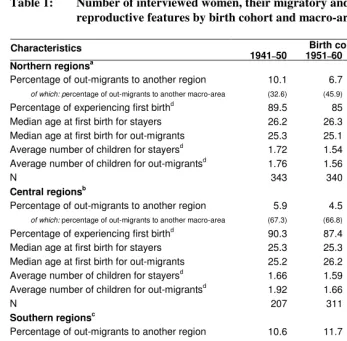
Table 1 presents the descriptive statistics for the sample women. The data are disaggregated by residence at birth. These details reveal the regional differences that motivate our analysis.
Table 1: Number of interviewed women, their migratory and
reproductive features by birth cohort and macro-area of residence
Birth cohort Characteristics
1941–50 1951–60 1961–70 1971–83
Northern regionsa
Percentage of out-migrants to another region 10.1 6.7 7.1 4.5
of which: percentage of out-migrants to another macro-area (32.6) (45.9) (58.9) (65.2)
Percentage of experiencing first birthd 89.5 85 61.4 14.2
Median age at first birth for stayers 26.2 26.3 31.3 30.1
Median age at first birth for out-migrants 25.3 25.1 30.8 29.8
Average number of children for stayersd 1.72 1.54 0.69 0.08
Average number of children for out-migrantsd 1.76 1.56 0.94 0.09
N 343 340 420 395
Central regionsb
Percentage of out-migrants to another region 5.9 4.5 3.9 2.1
of which: percentage of out-migrants to another macro-area (67.3) (66.8) (70.0) (72.7)
Percentage of experiencing first birthd 90.3 87.4 58.2 13.4
Median age at first birth for stayers 25.3 25.3 32.0 30.9
Median age at first birth for out-migrants 25.2 26.2 32.5 30.1
Average number of children for stayersd 1.66 1.59 0.78 0.06
Average number of children for out-migrantsd 1.92 1.66 0.67 0.09
N 207 311 351 362
Southern regionsc
Percentage of out-migrants to another region 10.6 11.7 7.1 2.1
of which: percentage of out-migrants to another macro-area (94.6) (94.3) (91.8) (100)
Percentage of experiencing first birthd 87.5 83.7 72.4 21.1
Median age at first birth for stayers 25.1 25.2 26.7 29.9
Median age at first birth for out-migrants 25.2 23.8 28.7 28.7
Average number of children for stayersd
2.34 1.99 1.32 0.19
Average number of children for out-migrantsd
1.94 1.8 1.23 0.29
N 296 301 341 346
Source: Calculations based on ILFI, waves 1997, 1999, 2001, 2003.
a- Northern regions: Valle d’Aosta, Piemonte, Liguria, Veneto, Friuli, Trentino, Lombardia.
b- Central regions: Emilia Romagna, Toscana, Marche, Umbria, Lazio, Abruzzo, Sardegna.
c- Southern regions: Molise, Puglia, Basilicata, Campania, Calabria, Sicilia.
d
Table 1 clearly recapitulates several key aspects of the time trend in the reproductive behavior of Italian women. Consistent with the literature, we observe an increasing median age at first birth11 on the order of about four years across the span of cohorts (see also Righi and Dalla Zuanna 1999). With this, we also see a decline in the average number of children ever born. The 1951–60 cohort exhibits lower completed fertility than the 1941–50 cohort. (These two oldest cohorts have virtually completed their childbearing exposure. The youngest, born in 1960, would be 43 years of age at the time of the most recent ILFI wave.) The 1961–70 cohort exhibits a much older age at first birth and appreciable lower fertility. While this cohort (age 33–43) in 2003 has not completed its childbearing, it is clear that completed fertility will remain well below the two prior cohorts. For the 1971–83 cohort, completed fertility is probably not a meaningful statistic, but we note that the age at first birth is on a par with the 1961–70 cohort.
Differences by macro-area of origin and migration status are also apparent in Table 1. The older cohorts originating and staying in the North and the Center macro-areas display lower fertility than women from the South. While the results are not as definitive for the two youngest cohorts, there too it appears that recent childbearing in the South exceeds that of the North and Center.
Of particular interest are differentials by migration status within the area of origin. For women born in the North, there is a notable difference (a maximum of 0.25 children for the 1961–70 cohort) between out-migrants from the region and those who remained behind, suggesting that migration itself is linked to the postponement of childbearing. For women born in the Center, out-migrants in the oldest two cohorts show slightly higher lifetime fertility, while those in the 1961–70 cohort have slightly lower (among already quite low) fertility. The most striking differences are among women in the South. First, women of the South, among all cohorts, have a higher fertility than women of corresponding cohorts in other macro-areas. Second, it is the Southern-born non-migrant women who have the highest fertility overall. In the oldest cohort this differential rises to 0.4 children over completed lifetime fertility. Our descriptive analysis thus confirms the existence of a clear regional bifurcation (South vs. elsewhere) in reproductive behavior and is consistent with the characterizations provided by others (e.g., Bonifazi and Heins 2000).
Table 1 also presents time trends in the migratory behavior of the women studied, and by extension, the population at large. The table indicates a decline across cohorts in the fraction of women not residing in the region of birth. To be sure, part of this is due to longer exposure (to the risk of an interregional move) among older cohorts. At the same time, it is consistent with the more detailed data on migration of the Appendix tables, which indicate a decline in province out-migration rates, calculated on the basis
of the resident-origin population, from the 1950s through the 1990s, with a slight upturn in the final decade. Regional differences in migration and population retention are also apparent in Table 1. In all origins, there is an increase in the fraction of interregional migrants who have departed the macro-area. This is consistent with the increasing national economic and social integration of Italy over the half-century of observation. Still, the differences are striking across the areas of origin. Almost all of those who depart from one of the six administrative regions of the South leave the macro-area altogether and move to the Center or North. In the North of Italy, migrations across administrative regions remain within the North macro-area. The case of the Center is intermediate.
6. Multivariate results
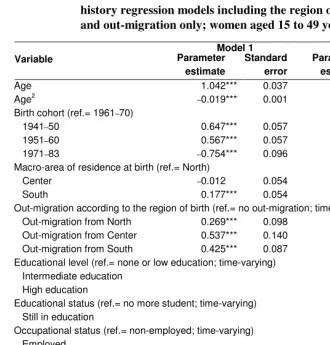
Table 2 presents our discrete time event-history analysis for duration to first birth for all women in the ILFI dataset during the period of reproductive exposure. Exposure begins at age 15 and continues to age 50. Exposure may be censored by the survey at a younger age. Table 2 presents two models. The first one presents the first estimates of the probability of birth as a function of age (in quadratic form), cohort, region of residence at birth, and region of origin for those who have departed from their origin region. The second model includes the same covariates and then adds several other individual, time-varying covariates: educational attainment (dummy variables for intermediate or high level of education compared to low education12), employed (vs. not), student (vs. not), and union status (civil marriage, cohabitation, not in union vs. religious marriage as the reference category).
Our first model with limited covariates gives the overall picture of the transition to first birth in the ILFI female sample. We observe that the probability of giving birth rises with age, but does so at a decreasing rate (the second-order term is negative), to a maximum of about age 28. There are sharp cohort effects. The oldest two cohorts (born 1941–50 and 1951–60) are much more likely to give birth than the cohort of 1961–70, the reference cohort. The youngest cohort, born 1971–83, is much less likely to bear children than all of the other cohorts. The overall change across the several decades is quite dramatic. Women born in the 1970s are only about one quarter (0.246=exp[– 0.754–0.647]) as likely to bear their first child in a year of reproductive exposure than women born in the 1940s, with all else being the same.
Table 2: Determinants of the transition to first birth: discrete time event- history regression models including the region of childhood residence and out-migration only; women aged 15 to 49 years
Model 1 Model 2
Variable Parameter
estimate
Standard error
Parameter estimate
Standard error
Age 1.042*** 0.037 0.468 *** 0.038
Age2 –0.019*** 0.001 –0.009 *** 0.001
Birth cohort (ref.= 1961–70)
1941–50 0.647*** 0.057 0.307 *** 0.064
1951–60 0.567*** 0.057 0.214 *** 0.062
1971–83 –0.754*** 0.096 –0.094 *** 0.106
Macro-area of residence at birth (ref.= North)
Center –0.012 0.054 0.068 0.058
South 0.177*** 0.054 0.291 *** 0.062
Out-migration according to the region of birth (ref.= no out-migration; time-varying)
Out-migration from North 0.269*** 0.098 –0.089 0.104
Out-migration from Center 0.537*** 0.140 –0.151 0.150
Out-migration from South 0.425*** 0.087 0.018 0.092
Educational level (ref.= none or low education; time-varying)
Intermediate education –0.153 *** 0.054
High education –0.015 0.092
Educational status (ref.= no more student; time-varying)
Still in education –0.391 *** 0.087
Occupational status (ref.= non-employed; time-varying)
Employed –0.347 *** 0.052
Type of first union (ref.= religious union; time-varying)
No union –4.148 *** 0.102
Civil union –0.222 ** 0.111
Cohabitation –0.715 *** 0.158
Constant –17.108*** 0.488 –7.169 *** 0.521
Person-years 47,953 47,953
R2 0.109 0.346
Source: Calculations based on ILFI, waves 1997, 1999, 2001, 2003.
The results in Table 2 confirm some broad regional differentials, but now also begin to bring geographic mobility into the picture. Women whose origin is in the South are much more likely to bear a child than their counterparts in the North (reference region) or the Center. The South is clearly a distinctive geographic area, since there is no significant difference in the regression equation between the Center and the North. We also capture the effects of migration, using the next three dummy variables. Migrants out of any of the three regions exhibit a higher fertility than stayers or return migrants. The differential for Southern-origin migrants leads to an odds that is about 50% higher than for other women of the same age and cohort.
In Model 2 of Table 2 we add socio-economic and marital-status traits. We note, first, that strongly significant age and cohort effects persist. Notably, however, the cohort effects are moderate in size, even though they operate in the same direction. Now, however, women born in the 1970s have odds of bearing their first child of about
two-thirds (0.670=exp[–0.094–0.307]) of the women born in the 1940s, with all else being the same. This is a much smaller difference than before and indicates that much of the cohort difference is working through marriage behavior. Since the second model controls for union type (as a time-varying covariate), the declining rates of entry into marriage across the several cohorts are responsible for part of the decline in the transition to first birth. It is noteworthy, however, that the adjustment for marriage does not remove the cohort effect altogether.
Model 2 also shows significant effects for education (intermediate level only) and labor-force participation. Women with moderate levels of completed education exhibit appreciably lower rates of transition to first birth, even if everything else (age, cohort, residential history) is the same. Oddly, women who have continued beyond high-school education (our ‘high’ category) exhibit no differential fertility, although the effects here may be working through continuing school enrollment (strongly negative) and employment. A large body of explanations of fertility decline – worldwide, not just in Italy – rest on the notion that women’s labor-force participation is a driving force behind decreasing age at entry into childbearing. We find evidence that is consistent with this notion: Working in the year prior to the year of exposure reduces the predicted probability of having a child by about 30%.
allow for changes in union formation over time, unlike some analyses, which are limited to status at the time of the survey or at a single earlier point.
In the models of Table 2 and Table 3 below, we elect to include women of all marital statuses, even those not partnered in the year of exposure and those never married. We do so for two reasons. First, this gives a comprehensive view of the overall picture of fertility in Italy. It shows, for instance, the way in which entry into marriage helps to explain some of the cohort decline in childbearing. In addition, the review of the two models helps to shed light on the behavioral intertwining of marriage and childbearing. In a country such as Italy, in which most childbearing has occurred within formal marriage, the decision to marry may be in part a decision to embark on a family-building trajectory. The ‘control’ for union type may be adjusting for something that is partly an outcome. Separating the two models helps clarify the relationship and allows analysts and readers to see how much difference alternative specifications make. We do estimate below another model (see Table 4), which includes only person-years of exposure from women who are currently in a union.
In Table 2 the coefficients on the geographic variables (region of origin and migration) do shift appreciably with the introduction of measures for the other personal traits. The South (as place of birth and presumed childhood socialization) remains highly significant, while the Central-region birthplace is still non-significant. Even after the introduction of all of these controls for personal traits, Southern-born women are predicted to have annual birth probabilities 34% above other women.
Migration effects are reduced to non-significance in Model 2. Migrants out of the North and Center are predicted to have somewhat lower rates of transition to first birth, but standard errors on these coefficients do not lend confidence at conventional levels. Migrants out of the South exhibit slightly higher fertility levels, net of other traits, but again, these have relatively large standard errors and we cannot reject the null hypothesis of no effect.
Taken together, the results are informative. Women who are born in the South and remain in the region exhibit an appreciably larger fertility than other women. The apparent differences of migrants and stayers in Model 1 are ‘explained away’ by the personal traits of education, union status, employment, and so on. Taken together, the results suggest true regional heterogeneity on the part of the South on the one hand, and migrant selectivity on the other. Migrants out of the South differ on several demographic traits related to fertility, but exhibit no further difference in fertility behavior once the analysis adjusts for these traits. Stated in other words, some of the regional/migration differentials we observed at first are due to the differential human-capital composition of the persons at origin and the migrants composing the flows.
regarding age, cohort, and the time-varying traits of education, labor-force attachment, and union status. Coefficient values for these traits are not far from those estimated for Table 2, and the levels of significance remain about the same, too. Our discussion concentrates on the differential specification and interpretation of the geographic variables.
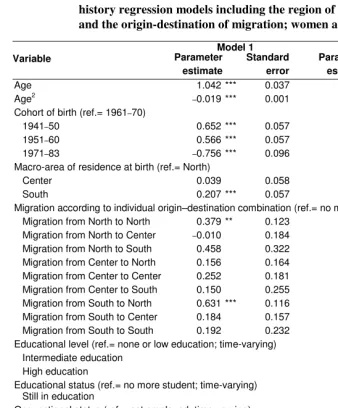
Our treatment of the region of origin – dummy-variable for residence at birth in the Center or South vs. North – remains unchanged. Now, however, we include specific dummy-variables for each origin–destination pairing. With three geographic macro-areas there are nine dummy–variable values to contrast with the implicit reference category of non-migrants. The inclusion of more detail on migrant flows increases the magnitude of the original region-of-origin coefficients; each value of South and Center is larger in absolute value in Table 3, Model 1, than the corresponding value in Table 2, Model 1. In Table 3 the regional contrasts of birth in the South (vs. North) remain strongly significant, with Southern women expected to bear children at rates about 37% above their Northern counterparts. The introduction of the full set of controls (Model 2) raises to marginal significance the coefficient on birth in the Center (vs. North). Thus, we observe that in Table 3 women who remain in the Center and the South macro-areas exhibit a higher fertility than do non-migrants in the North.
The predicted effects of being a member of a migratory flow are noteworthy, although not strong in terms of statistical significance. We find that most migrants (eight of nine cases) in Model 1 (lacking detailed socio-economic controls) exhibit a
higher fertility than non-migrants. Adding the time-varying socio-economic covariates in Model 2 generally reduces the magnitude of the values of the several migration origin–destination dummy variables. Such a change, in turn, demonstrates that the socio-economic traits are important and differentially represented in the streams of Italy’s interregional migrants. These socio-economic traits are strongly predictive of fertility and behave much as in Table 2, so we now concentrate on the migration coefficients themselves, with emphasis on differentials linked to the South.
Table 3: Determinants of the transition to first birth: discrete time event- history regression models including the region of childhood residence and the origin-destination of migration; women aged 15 to 49 years
Model 1 Model 2
Variable Parameter
estimate
Standard error
Parameter estimate
Standard error
Age 1.042 *** 0.037 0.469 *** 0.038
Age2 –0.019 *** 0.001 –0.009 *** 0.007
Cohort of birth (ref.= 1961–70)
1941–50 0.652 *** 0.057 0.298 *** 0.064
1951–60 0.566 *** 0.057 0.205 *** 0.062
1971–83 –0.756 *** 0.096 –0.094 0.106
Macro-area of residence at birth (ref.= North)
Center 0.039 0.058 0.112 * 0.063
South 0.207 *** 0.057 0.314 *** 0.065
Migration according to individual origin–destination combination (ref.= no migration; time-var.)
Migration from North to North 0.379 ** 0.123 0.086 0.131
Migration from North to Center –0.010 0.184 –0.310 * 0.195
Migration from North to South 0.458 0.322 –0.420 0.339
Migration from Center to North 0.156 0.164 0.102 0.178
Migration from Center to Center 0.252 0.181 0.066 0.193
Migration from Center to South 0.150 0.255 –0.039 0.279
Migration from South to North 0.631 *** 0.116 0.087 0.122
Migration from South to Center 0.184 0.157 –0.147 0.166
Migration from South to South 0.192 0.232 0.129 0.252
Educational level (ref.= none or low education; time-varying)
Intermediate education –0.155 *** 0.054
High education –0.010 0.092
Educational status (ref.= no more student; time-varying)
Still in education –0.387 0.088
Occupational status (ref.= not employed; time-varying)
Employed –0.355 *** 0.052
Type of first union (ref.= religious union; time-varying)
No union –4.151 *** 0.102
Civil union –0.234 ** 0.112
Cohabitation –1.718 *** 0.159
Constant –17.132 *** (0.488 –7.206 *** 0.522
Person-years 47,953 47,953
R2
0.109 0.346
Source: Calculations based on ILFI, waves 1997, 1999, 2001, 2003.
Thus, the South remains distinctive, even after the control for these several behavioral traits and the more detailed origin–destination migration patterns. Once again, the indication is that the migratory flows themselves are demographically selective. After adjusting for these measurable traits, there is little additional behavioral selection to be seen.
We have estimated this model for an alternative version in which the origin– destination migration indicator remains ‘on’ for five years at most. (The alternative model is not shown). If disruption were to operate strongly, we would expect the five-year-period-lag model to have highly significant coefficients on the migration dummy variables, but the full-exposure-time model to be less significant. A finding of strong effects in the model with five-year limits would suggest disruption. Given that we see no such short-term effect, and given that the pseudo-R2 remains almost identical to the full-exposure-time model, there is no support for disruption as a mechanism.
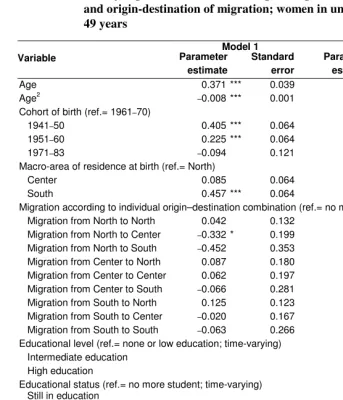
Table 4 presents our final set of regression analyses. We include the same covariate specification as we have done for Table 3, but we now limit the sample to the person-years of exposure contributed while in union. (We discussed this issue above.) From an accounting point this is not problematic, as almost all births occur within a union. Moreover, we exclude only three person-years from the reproductive span of an individual woman during which the woman is un-partnered. From a theoretical standpoint, such sample restriction asserts here that those in a union (religious, civil, or cohabiting) constitute the proper behavioral risk set for the transition to the first child. The sample restriction reduces the total number of person-years in our discrete time analysis to 11,022 from 47,953.
The results of this model parallel those we obtained earlier. We find broadly similar age profiles. In Table 4, Model 1 (omitting the detailed socio-economic covariates) the cohort effect is moderated considerably from Table 3, Model 1, on the larger sample of women. In the present table, the most recent cohort (born 1971–83) is not differentiated from those born in the reference cohort of 1961–70, but the 1970s cohort exhibits odds of childbearing of about 60% of the 1940s cohort. (The corresponding odds ratio in Table 3, Model 1, was 24% for the sample of all women.) This would suggest that much of the differences between the two cohorts we observed before are due to rates of transition into union rather than to first birth from those already in a union.
Table 4: Determinants of transition to first birth: discrete time event-
history regression models including the region of childhood residence and origin-destination of migration; women in union only, aged 15 to 49 years
Model 1 Model 2
Variable Parameter
estimate
Standard error
Parameter estimate
Standard error
Age 0.371 *** 0.039 0.396 *** 0.040
Age2 –0.008 *** 0.001 –0.008 *** 0.001
Cohort of birth (ref.= 1961–70)
1941–50 0.405 *** 0.064 0.342 *** 0.066
1951–60 0.225 *** 0.064 0.210 *** 0.064
1971–83 –0.094 0.121 –0.062 0.121
Macro-area of residence at birth (ref.= North)
Center 0.085 0.064 0.098 0.065
South 0.457 *** 0.064 0.318 *** 0.068
Migration according to individual origin–destination combination (ref.= no migration; time-var.)
Migration from North to North 0.042 0.132 0.090 0.132
Migration from North to Center –0.332 * 0.199 –0.364 * 0.201
Migration from North to South –0.452 0.353 –0.485 0.354
Migration from Center to North 0.087 0.180 0.114 0.181
Migration from Center to Center 0.062 0.197 0.072 0.198
Migration from Center to South –0.066 0.281 –0.015 0.283
Migration from South to North 0.125 0.123 0.077 0.123
Migration from South to Center –0.020 0.167 –0.099 0.168
Migration from South to South –0.063 0.266 0.011 0.267
Educational level (ref.= none or low education; time-varying)
Intermediate education –0.107 * 0.056
High education –0.032 0.095
Educational status (ref.= no more student; time-varying)
Still in education –0.254 * 0.091
Occupational status (ref.= not employed; time-varying)
Employed –0.362 *** 0.054
Type of first union (ref.=religious union; time-varying)
Civil union –0.204 * 0.112
Cohabitation –0.672 *** 0.159
Constant –6.015 *** –0.216 –6.095 *** 0.549
Person-years 11,022 11,022
R2 0.043 0.051
Source: Calculations based on ILFI, waves 1997, 1999, 2001, 2003.
We do examine the type of union for this sample of women in union. Women in civil unions still exhibited odds of first-birth transition of about 80% of those in a religious union. Transition rates for cohabiting women were considerably lower still – as we have found for the other cases above.
Regional differences in fertility are still apparent in Table 4. In fact, the South-vs.-North differential is more pronounced among this sub-sample of women in a union. Among regional stayers (setting all migration-flow dummy variables to zero in Model 1), women born in the South exhibit odds of first-birth transition about 60% higher than otherwise equivalent women in the North. Even when adjusting for these characteristics (Model 2), the differential odds remain 37%. The characteristics of education, employment, and union type offer only a partial explanation of these regional fertility differentials.
Several of the interregional migrant indicators (the nine origin–destination dummy variable contrasts) point to only modest fertility differentials between those who moved and those who stayed behind. In a model re-introducing broad out-migration groupings (not shown, but corresponding to Table 2), we also find a South-regional effect but no migrant effect. We can put the story together across the models. Recall that the first multivariate model (see Table 2, Model 1) found both a South-origin effect and a considerable South-out-migration effect. Working across subsequent models – adding behavioral time-varying covariates and restricting the sample to those in union only – reduced the migration effect to non-significance but not the South-origin effect.
Half of all internal migrations in Italy (among the person-year observations in our data) are out-of-South migrations, with 28% of total moves from the South to the North and another 22% of moves from the South to the Center. The importance of the region of origin and of the redistribution is shown in Figure 3, which presents a simulation of Table 4, Model 2 – the sample of women in a union. For covariates other than region or migration we set values to their mean across the person-years in the models of Table 4.13 We then simulate the probability of birth in a given year for non-movers in each of the three major regions and for two groups of migrants, those moving South-to-North and those moving South-to-Center.
Figure 3 recapitulates the strong regional differentials observed among stayers, especially women in the South, and makes clear that these differentials persist even after controlling for other socio-economic time-varying traits. The simulation of South– North migrants indicates a predicted fertility level about the same as women in the South who do not migrate. The predicted value for South-to-Center migrants is slightly
lower. Of course, these are predicted values; the formal test shows no statistical difference from regional effects alone for either of these migrant groups.
Figure 3: Predicted fertility for selected geographic profiles; women in union only, aged 15 to 49 years
0.00 0.02 0.04 0.06 0.08 0.10 0.12 0.14 0.16 0.18 0.20 0.22 0.24
North Center South South-North South-Center
Nonmigrants Migrants
Region and migration experience
P
re
d
ic
te
d
p
ro
b
a
b
ilt
y
o
f
b
ir
th
7. Conclusion
This paper informed both our understanding of the determinants of contemporary Italian fertility and the broader ways in which regional variation and interregional migration can help to understand the social processes underlying fertility dynamics. We employed contemporary event-history data, which allowed us to analyze the evolution of life events with proper timing and sequencing. Our micro-level analysis includes key demographic socio-economic covariates – age, cohort, education, employment, union status – and time-varying information drawn from a woman’s residence history.
At an aggregate level, our results chart the substantial decline in Italian fertility in recent decades. The descriptive results accord with a pattern of cohort decline in childbearing and in increasing age at first birth. The temporal decline is consistent with secular changes in Italian society affecting the position of women, such as increasing female education and female employment, which are implicated in the transition to first birth. Yet, these changes are only part of the story. Even after having adjusted for several of these personal characteristics, we find that recent cohorts (women born in the 1960s and 1970s) make the transition to first birth at appreciably lower rates than women of earlier cohorts, even women who were otherwise in the same socio-economic and age categories.
Crucial, perhaps, in our analysis is the way in which we demonstrated the interplay of geographic variation and social characteristics on the transition to marriage and childbearing. At first sight, our results showed strong regional differentials, especially in terms of the birthplace in the South versus elsewhere. The initial results also indicated differentials for migrant streams. Yet, once we controlled for time-varying personal traits, including education, student status, employment, and union status, the differences by migrant stream were largely reduced to non-significance. Nevertheless, our models that include the full set of personal traits still revealed a significant impact of the place of birth on the predicted reproductive behavior. Among women in union, the odds of a woman born in the South bearing a child are 1.37 times those of a comparable woman born in the North.
We find no real evidence for this; differentials for migrants are non-significant (when other characteristics are adjusted) and the predicted values do not necessarily lie in a direction consistent with adjustment toward the region of new residence. Future work may want to analyze data that have more precise and contextual geographic categories than the data available to us in the Italian Households Panel (ILFI) data.
Our third hypothesis concerns selection, where migrants differ by other observed social and demographic traits linked to fertility. We do find considerable evidence for selection. The magnitude of coefficients for migration and region-of-birth effects (dummy variables in our models) is reduced when covariates measuring socio-economic traits are introduced. Thus, the evidence indicates that these traits are differentially distributed among regions and migrant streams, and that demographic selection operates. Finally, we discuss disruption. We did not anticipate that disruption would operate in a high-income low-fertility setting, and what is more, other data might be preferred to detect it. In fact, we find no evidence of short-term differentials for migrants.
Since we have used detailed longitudinal data and controlled for a number of key characteristics, it is all the more striking that we find initial and persistent geographic differentials in the latter portion of the 20th century and into the 21st. Our results point to the continuing relevance of the socialization during childhood and early adulthood in later-life patterns of fertility and family formation. Our results also point to the challenging task of more precisely and definitively identifying the nature of contextual influences and how they operate at different scales of time and space.
8. Acknowledgements
References
Arru, A., and F. Ramella. 2004. (Eds.). L’Italia Delle Migrazioni Interne. Roma: Donzelli.
Barbagli, M., M. Castiglioni, and G. Dalla Zuanna. 2003. Fare Famiglia in Italia. Un secolo di Cambiamenti. Bologna: Il Mulino.
Becker, G. S. 1985. A Treatise on the Family. Cambridge: Harvard University Press. Bernardi, L., and G. Gabrielli. 2006. Between first and second birth in Italy, Acts of the
XLIII SIS Conference. Padova: CLEUP.
Billari, F. C., and H.-P. Kohler. 2004. Patterns of low and lowest-low fertility in Europe, Population Studies 58(2): 161–176.
Birindelli, A. M., and F. Heins. 1999. Il profilo per età delle migrazioni interne, in C. Bonifazi (Ed.), Mezzogiorno e Migrazioni Interne. Roma: IRP-CNR 10, pp. 207–235.
Bisogno, E. 1997. Le Migrazioni Interne in Italia Nel Periodo 1955–92 e il Loro Impatto Sulle Strutture Demografiche Regionali. Working-Paper presented at Giornate di Studio sulla Popolazione, Roma.
Bonaguidi, A., and V. Terra Abrami. 1996. The pattern of internal migration: the Italian case, in P. Rees, J. Stillwell, A. Convey and M. Kupiszewski (Eds.), Population Migration in the European Union. London: John Wiley & Sons, pp. 231–245. Bonifazi, C. 1992. Saldi migratori e studio delle migrazioni interregionali: osservazioni
sul caso italiano, Genus 1–2: 47–67.
Bonifazi, C. 1999. (Ed.). Mezzogiorno e Migrazioni Interne. Roma: IRP-CNR 10. Bonifazi, C., A. Chieppa, and F. Heins. 1999. Le migrazioni interne meridionali:
un’analisi a Livello Provinciale, in C. Bonifazi (Ed.), Mezzogiorno e Migrazioni Interne, Roma: IRP-CNR 10, pp. 53–95.
Bonifazi, C., and F. Heins. 2000. Long-term trends of internal migration in Italy,
International Journal of Population Geography 6(2): 111–131.
Bonifazi, C., and F. Heins.2001. Le dinamiche dei processi di urbanizzazione in Italia e il dualismo Nord-Sud: un’analisi di lungo period, Rivista Economica del Mezzogiorno 4: 713–747.
Casacchia, O., and S. Strozza. 2001. Le migrazioni interne e internazionali in Italia dall’unità ad oggi: un quadro complessivo, in L. Di Comite and A. Paterno. (Eds.), Quelli Di Fuori. Dall’emigrazione All’immigrazione: Il Caso Italiano.
Milano: Franco Angeli, pp. 50–88.
Caldwell, J. 1982. Theory of Fertility Decline. London: Academic Press.
Carlson, E. D. 1985. The impact of international migration upon the timing of marriage and childbearing, Demography 22(1): 61–72.
Chattopadhyay, A., M. J. White, and C. Debpuur. 2006. Migrant fertility in Ghana: selection versus adaptation and disruption as causal mechanisms, Population Studies 60(2): 1–15.
Cote, G. L. 1997. Socio-economic attainment, regional disparities, and internal migration, European Sociological Review 13(1): 55–77.
Dalla Zuanna, G., and A. Righi. 1999. Nascere Nelle Cento Italie. Comportamenti Coniugali e Riproduttivi Nelle Provincie Italiane Negli Anni ’80 e ’90.
Argomenti. 18, Roma: ISTAT.
Dalla Zuanna, G., and F. Michielin. 2003. Low Fertility, Persistent Strong Migration and Social Mobility. The Hidden Motive of the Italian Economic Development, The Second Demographic Transition in Europe. Euro Conference on Implication of Family and Fertility Change for Individuals, Families and Society, Spa Belgio.
Delgado Pérez, M., and M. Livi Bacci. 1992. Fertility in Italy and Spain: the lowest in the world, Family Planning Perspectives 24(4): 162–171.
Di Comite, L., and E. Moretti. 1999. Geopolitica del Mediterraneo. Roma: Carocci Editore.
Di Comite, L., and A. Paterno. 1999. Migrazioni e transizione demografica: un secolo ed oltre di esperienza italiana (1880–1998), in V. Gonzalvez (Ed.), Europa una Demografia en Trasformació. Alacant: Universitat d'Alacant, pp. 77–98.
Festy, P. 1979. La fécondité des pays occidentaux de 1870 a 1970, Travaux et Documents 85, Paris: Presses Universitaires de France.
Gabrielli, G., A. Paterno, and M. White. forthcoming. Migrazioni interne e fecondità: il caso italiano, Rivista Italiana di Economia Demografia e Statistica.
Goldstein, A., M. White, and S. Goldstein. 1997. Migration, fertility and state policy in Hubey Province, China, Demography 34(4): 481–491.
Gorwaney, N., M. D. Van Arsdol, D. M. Heer, and L. A. Schuerman. 1998. Variation in fertility and earning patterns among immigrants in the United States, 1970– 1980: assimilation or disruption?, International Migration Review 28(4): 451–475.
Guilmoto, C. Z., and S. Frederic. 2001. The internal dynamics of migration networks in developing countries, Population 13(2): 135–164.
ISTAT. 1997. La fecondità nelle regioni italiane. Analisi per coorti. Informazioni 35, Roma: ISTAT.
ISTAT. 2006. Natalità e fecondità della popolazione residente: caratteristiche e tendenze recenti. Anno 2004. Nota informative. Roma: ISTAT.
Kahn, J. R. 1994. Immigrant and native fertility during the 1980s: adaptation and expectations for the future, International Migration Review 28(3): 501–519. Kertzer, D. I., M. J. White, L. Bernardi, and G. Gabrielli. 2006. Toward a better theory
of very low fertility: Lessons from Italy. Working-Paper presented at Population Association of American 2006 Meeting, Los Angeles.
Kohler, H. P., F. Billari, and J. A. Ortega. 2002. The emergence of lowest-low fertility in Europe during the 1990s, Population and Development Review 24(4): 641–680.
Kohler, H. P., and J. A Ortega. 2003. Below replacement fertility, in P. Demeny and G. McNicoll (Eds.), Encyclopedia of Population. New York: Macmillan Reference, pp. 405–409.
Kulu, H. 2005. Migration and fertility: competing hypothesis re-examined, European Journal of Population 21(1): 51–87.
Lesthaeghe, R. 1995. The second demographic transition in Western countries: an interpretation, in K. O. Mason and A. M. Jensen (Eds.), Gender and Family Change in Industrialized Countries. Oxford: Clarendon Press, pp. 17–62. Livi Bacci, M., and S. Salvini. 2000. Trop de famille et trop peu d'enfants: la fécondité
en Italie depuis 1960, Cahiers Quebecois de Démographie 29(2): 231–254. Mayer, J., and R. T. Riphahn. 2000. Fertility assimilation of immigrants: evidence from
Micheli, G. A. 1995. La Società del Figlio Assente. Voci a Confronto sulla Seconda Transizione Demografica. Milano: Franco Angeli.
Michelin, F. 2002. Fertility in an Urban Context. A Complex Phenomenon.
Dipartimento di Scienze Statistiche, Università di Padova [Ph. D. thesis]. Payne, G. 1989. Social mobility, The British Journal of Sociology 40(3): 471–492. Parish, W. L. Jr. 1973. Internal migration and modernization: the European case,
Economic Development and Cultural Change 21(4): 591–609.
Pugliese, E. 2000. L’Italia tra migrazioni internazionali e migrazioni interne, in Agenzia romana per la preparazione del Giubileo. Migrazioni. Scenari per il XXI secolo, Roma.
Pugliese, E. 2002. L’Italia tra migrazioni internazionali e migrazioni interne. Bologna: Il Mulino.
Righi, A., and G. Dalla Zuanna. 1999. Nascere nelle 100 Italie: comportamenti coniugali e riproduttivi nelle province italiane negli anni ’80 e ’90. Argomenti 18, Roma: ISTAT.
Salvini, S. 2003. La Bassa Fecondità Italiana: La Bonaccia delle Antille? Working-Paper presented at Conference on La bassa fecondità tra costrizioni economiche e cambio di valori, Roma.
Santini, A. 1995. Continuità e Discontinuità nel Comportamento Riproduttivo delle donne Italiane nel Dopoguerra: Tendenze Generali della Fecondità delle Coorti nelle Ripartizioni tra il 1952 e il 1991. Working-Paper, Dipartimento statistico dell’Università di Firenze 53.
Termote, M., A. Golini, and B. Cantalini. 1992. Migration and Regional development in Italy. Roma: IRP-CNR 4.
United Nations. 2006. Compendium of Recommendations on Internal Migration and Development. New York: Department of Economic and Social Affairs. Population Division, United Nations.
Van de Kaa, D. J. 1987. Europe’s second demographic transition, Population Bulletin
42(1): 1–47.
White, M., L. Moreno, and S. Guo. 1995. The interrelation of fertility and geographic mobility in Peru: a hazards model analysis, International Migration Review
Appendix 1: Total Fertility Rates by region in Italy from 1955–59 to 2000–04
Total Fertility Rate
Region 1955–59 1960–64 1965–69 1970–74 1975–79 1980–84 1985–89 1990–94 1995–99 2000–04
Piemonte 1.58 1.90 2.13 2.06 1.67 1.25 1.09 1.08 1.08 1.20
Valle d’Aosta 1.70 1.97 2.17 2.10 1.69 1.25 1.15 1.11 1.14 1.27
Lombardia 1.89 2.16 2.31 2.12 1.72 1.32 1.15 1.11 1.12 1.26
Trentino-A.A. 2.52 2.79 2.82 2.41 1.86 1.57 1.40 1.38 1.40 1.47
Veneto 2.34 2.54 2.55 2.31 1.80 1.35 1.16 1.11 1.13 1.25
Friuli V.G. 1.79 2.01 2.08 1.99 1.56 1.17 1.03 1.00 1.00 1.14
Liguria 1.47 1.78 1.97 1.85 1.42 1.07 1.00 0.99 0.97 1.09
Emilia-Romagna 1.71 1.93 2.01 1.94 1.51 1.10 0.97 0.99 1.03 1.23
Toscana 1.70 1.92 2.03 1.97 1.61 1.22 1.08 1.04 1.03 1.17
Umbria 1.84 1.97 2.02 1.95 1.72 1.42 1.23 1.14 1.11 1.22
Marche 1.99 2.09 2.14 2.06 1.78 1.42 1.23 1.17 1.13 1.21
Lazio 2.2 2.44 2.48 2.31 1.88 1.49 1.29 1.23 1.15 1.23
Abruzzo 2.29 2.54 2.44 2.33 2.00 1.68 1.43 1.33 1.18 1.17
Molise a a 2.54 2.40 2.11 1.75 1.54 1.37 1.20 1.14
Campania 3.19 3.36 3.42 3.11 2.64 2.22 1.92 1.74 1.53 1.47
Puglia 3.28 3.30 3.28 2.94 2.60 2.05 1.71 1.55 1.36 1.32
Basilicata 3.21 3.12 3.11 2.81 2.40 1.97 1.70 1.51 1.27 1.22
Calabria 3.37 3.35 3.22 2.87 2.49 2.13 1.84 1.61 1.33 1.25
Sicilia 3.02 3.06 3.01 2.81 2.44 2.05 1.86 1.73 1.47 1.41
Sardegna 3.56 3.39 3.20 2.89 2.39 1.81 1.45 1.23 1.03 1.04
Italia 2.34 2.51 2.57 2.37 1.98 1.58 1.37 1.30 1.22 1.28
Source: Calculations based on ISTAT data (several years).