the Acquisition of English Inversion Structures
Zia Tajeddin¹ & Shadab Jabbarpoor²¹Corresponding author, Allameh Tabataba’i University, [email protected] ²Islamic Azad University, Garmsar Branch, [email protected]
Received: 10/11/2013 Accepted: 09/02/2014
Abstract
This study investigated the effectiveness of individual and collaborative output-based focus-on-form instructional tasks on the acquisition of English inversion structures by EFL learners. Moreover, it explored the developmental trend of learners’ inversion acquisition. To this end, 60 homogeneous EFL learners were assigned to individual and collaborative output groups. They were exposed to texts encompassing inversion structures for 12 instructional sessions. The task included dictogloss in both groups where the texts were reconstructed either individually or collaboratively. A pretest, posttest, and delayed posttest design was used to examine the effects of the 2 tasks. The learners’ process of acquisition was examined by parallel tests of inversion development. Results showed that collaborative task implementation was advantageous over individual task performance in both immediate and delayed posttests. Results did not reveal a linear additive process for the collaborative output group; however, the findings suggest that collaborative language production can enhance grammatical acquisition.
Keywords: Collaborative Output; Dictogloss; EFL Learners; Individual Output;
Inversion Structures
1. Introduction
shown that morphosyntactic features can be acquired by form-focused instruction (e.g., Doughty & Williams, 1998; Ellis, 2002; Nassaji & Fotos, 2010).
The interest in focus-on-form partly stems from the suggestion that it can help learners develop linguistic accuracy (Doughty, 2001). Focus-on-form gives learners opportunities to divert their attention from meaning to focus on linguistic forms and notice them in the input; otherwise, forms may remain unnoticed. Such noticing, as Schmidt (1990, 1995, 2001) argues, is necessary for L2 learning. Focus-on-form provides opportunities for “pushed output” through which learners’ are required to produce language which is linguistically accurate (Swain, 1995, 2000; Swain& Lapkin, 1995). For these reasons, focus-on-form is seen as potentially beneficial for L2 learners.
Focus-on-form can be implemented through output-based tasks. Output-based focus-on-form tasks involve encouraging L2 learners to produce language. Through the act of production, learners may find problematic areas and decide what to attend in the input. The production process can be done either individually or collaboratively where peer feedback is also available. The present study, therefore, aimed to investigate the effect of individual and collaborative output on the acquisition of inversion as an English linguistic form.
2. Literature Review: Output Enhancement
The theoretical basis of the importance of output was first proposed by Swain (1985, 1995, 2000) in her comprehensible output hypothesis. Many SLA researchers argue that successful L2 learning does not only require comprehensible input but also comprehensible output (e. g., Izumi & Bigelow, 2000; Izumi, Bigelow, Fujiwara, & Fearnow, 1999; Pica, 1988; Swain & Lapkin, 1995). However, students’ output is sometimes limited as the result of the dominance of teacher talk in traditional classrooms. The proponents of the output-based tasks in the language classroom believe that providing learners with model input that immediately follows their pushed production enhances their sensitivity to the forms. It is hypothesized that learners would attend to form-meaning relationship through this task.
On the role of output in language acquisition, Swain (1995) argues that when learners produce pushed output, they are, in fact, involved in syntactic processing rather than semantic processing prevalent in purely meaning-based tasks. She proposed three roles for output:
1. Noticing: Learners realize that they do not know how to express themselves in the language. In other words, they notice gaps in their knowledge. 2. Hypothesis testing: Learners may formulate and test a hypothesis related to
3. Metalinguistic function: Learners’ reflection on their own production enables them to internalize the L2 linguistic knowledge and to control it.
Swain (1995) asserts that, in the vocal or subvocal production of L2, “learners may notice a gap between what they want to say and what they can say, leading them to recognize what they do not know, or know only partially” (pp. 125-126). Swain and Lapkin (1995) claim that it is through comparing the original output and the reconstructed one that L2 learning is facilitated. The cognitive process triggered by a pushed output stems in the communicative need engendered by an output task in which learners think about their produced forms. In this regard, Swain and Lapkin (1995) also argue that the cognitive comparison of the original and constructed output during reconstruction tasks is part of the process of language learning.
Many studies, affected by the theoretical underpinnings of the output hypothesis proposed by Swain (1985), have been conducted to examine the effect of output-based focus-on-form on the acquisition of linguistic structures (e.g., Nobuyoshi & Ellis, 1993; Swain & Lapkin, 1995). Takashima (1995), for example, exposed Japanese learners of English to a focus-on-form task to encourage them to modify their output. He found output-oriented treatment positively effective in the acquisition of past-tense forms (i.e., the L2 forms).
Swain (2000) formulated her output hypothesis within the sociocultural theory which asserts that collaboratively oriented scaffolding results in successful task outcome. In the sociocultural theory, learners achieve intersubjectivity by scaffolding each other’s attempts to perform tasks that are beyond their individual abilities (Ellis & Barkhuizen, 2005). Swain argues that any language production is a cognitive activity, mainly when learners use language through collaborative tasks as a problem-solving tool. This opinion made Swain adopt the sociocultural theory in her own research (Ellis, 2000).
Swain (2000) argues that when learners perform output tasks collaboratively, they are involved in social interactions, but whether these interactions contribute to language acquisition is still under investigation. It is claimed that “the coconstruction of a passage allows the learners to notice their strengths and weaknesses when attempting to coproduce the text” (Nassaji, 2000; p. 247).
forms are more amenable to output-based focus-on-form studies. However, contradictions are found in the results of these studies which can be attributed to individual factors, task nature as well as task implementation procedure, and the nature of the L2 form under investigation. Some of these factors are even unobservable. Still, the general conclusion is in favor of collaboration in task performance. A few of these studies that looked at collaborative output tasks as language learning techniques are reported below. The educational settings in these studies differ. For example, whereas Kowal and Swain (1994) looked at dictogloss tasks in French immersion classes in Canada, Storch (1998) investigated reconstruction and composition tasks in an Australian ESL context.
In an earlier study, Donato (1994, cited in Ellis, 2012) described the kind of scaffolding employed by groups of university students performing an oral task. His study showed that whereas individual participants in his investigation could not produce a particular grammatical structure, a group of learners could do it by joining forces. He further found that learners’ collaborations were frequently followed by independent use of language forms on a later occasion.
Other researchers have also paid attention to the importance of collaborative output in the process of L2 acquisition. Studies by Swain and her colleagues (e.g., Swain & Lapkin, 1998) investigate how task-based collaborative dialog leads to the internalization of grammatical features. Kowal and Swain (1994) and Swain and Lapkin (1998) proposed the use of tasks which required the learners to produce output collaboratively. The authors claimed that the task implementation required the learners to produce output collaboratively. In this way, they verbalized the problems they encountered and facilitated their attention to form through peer feedback.
In a rather recent study, Watanabe and Swain (2007) used a quantitative and qualitative method to explore the effect of patterns of interaction on L2 learning. The tasks performed by the learners consisted of three stages: pair writing, pair comparison (comparison between model and reformulated text), and individual writing. The findings showed that through collaborative patterns of interaction, the learners were more likely to achieve higher posttest scores even despite differences in proficiency levels among the peers.
3. Purpose of the Study
phrases, mostly with a negative or restrictive sense. Such phrases, when placed first in a sentence or clause for emphasis, are followed by the inverted form of the verb. Some of the most common adverbs and adverbial expressions that are followed by inversion are seldom, rarely, little, nowhere, scarcely, on no occasion/account/condition, in/under no circumstances only after, only when, not till/until, never, never before, neither/not/so, and so on. From a pedagogical perspective, inverted forms do not occur frequently in the input (e.g., in teachers’ talk or textbooks), and it is a grammatical feature that presents problems to Iranian EFL learners. Inversion is in the domain of word order, and the Persian language is fairly free from word order. Therefore, it is worth trying to investigate the saliency of this form for the learners with Persian as their L1.
Due to the need for research on output-based focus-on-form in an EFL context, this study employed a task-based output-oriented approach known as dictogloss to enhance the learners’ acquisition of English inversion structures. The differential effects of the two techniques of collaborative and individual dictogloss treatment were examined on the acquisition of inversion structures by university EFL students in this study. The following research questions were addressed:
1. What are the relative effects of individual output and collaborative output tasks on the acquisition of English inversion structures?
2. What are the developmental patterns of acquisition of inversion structures in individual output and collaborative output groups?
4. Method
4.1 Participants
First semester students majoring in the English language were selected as the main participants. Two main considerations informed the selection of the first semester students: (a) Focus of the study which was on grammar as one of the first courses to be taught to the students, and (b) lack of explicit/programmed exposure to the L2 structure in the learners’ previous high school studies.
the pretest measuring learners’ knowledge on inversion structures. No significant differences between the groups were observed [F(2/58) = 0.79]. All the participants in each group were exposed to treatment in inversion structures.
4.2 Instrumentations
Dictogloss as a reconstruction task was employed with little variation in its implementation (i.e., individual vs. collaborative reconstruction) in both individual and collaborative output groups. The effectiveness of dictogloss has been explored by Swain and her colleagues (Swain, 2000; Swain &Lapkin, 1998, 2001). These researchers suggest that dictogloss tasks have two functions: promoting meaningful interaction in the L2 and resulting in improvement in accuracy in the use of L2 forms. Kowal and Swain (1994) also found that the production of the L2 during such output-based tasks helped the earners notice gaps in their linguistic knowledge and search for the solution.
Six tests were used to investigate the learners’ trend of development: pretest, immediate posttest (IP), delayed posttest (DP) and three in-between the treatment tests. The IP was a version of the pretest with the same content but shuffled item sequences. The order was again reversed in the DP. However, the in-between the treatment tests were the same as the pre and posttest. These test tasks were made to assess the participants’ ability to produce the English structure. There were 20 items in each in-between the treatment test: 10 addressing the inversion structure and 10 non-L2 forms. The items were incomplete sentences: The participants were asked to use the verbs provided in parentheses to fill in the blanks with appropriate forms based on situation. Like the texts used as the treatment materials, the tests were highly structured to ensure that the participants would use inversion structures.
4.3 Treatment Procedure
original passage (i.e., the model text). They discussed the content and shared their ideas in order to reconstruct the text.
In order to find out what aspects of input the learners noticed as they compared their reconstructed version of the text with the model text, the learners in both groups were asked to recall the areas of differences between the two texts. This phase of the treatment was done in the learners’ L1. Using L1 in this free-recall task gave the participants an opportunity to easily write about the ideas without any concern for the form. Figure 1 illustrates the phases of dictogloss, as employed in this study:
Step 1
Step 4
Figure 1. Dictogloss Phases During the Output Treatment Introducing the main idea of the texts
Distribution of the original text copies
Drawing learners’ attention to the usage of the target form
Text reconstruction by learners
Individual reconstruction Collaborative reconstruction
Model text Model text
Learners’ free recall in L1 Step 2
The time allocated to task performance was 50 min in each session. Setting a time limit prohibited the participants to copy the whole content. Due to the infrequency of the L2 forms and no formal instruction on them, the amount of exposure to the forms between the pretest and posttest within a period of four months was minimal. The participants also reported to have no formal grammar instruction on the tested forms from the immediate to the delayed posttest within the three-month interval. A sample of a CO group’s reconstructed text from a session of the treatment appears below:
The model text: Never has the mobile phone been more popular among students
than it is now. Under no circumstances do they leave their phone at home. Secretly they use it in class. No sooner is the class over than they start calling each other again. Last week some students were found calling during the lecture. Not only did they irritate the lecturer but also the other students. It seems that not until the teacher punishes them do they realize how bad their action is. Only when they are punished do they start using their phones at the right time. I think it should be forbidden.
Reconstructed text (session 3): Never has the mobile phone has been popular
among students . . . . Under no circumstances they leave their mobile at home. They hide mobile in class. No sooner does the class over . . . last week some students found that they are calling each other . . . . It seems that a teacher doesn’t punish
until do they realize . . . after they are punished do they start . . . . It should forbid.
The reconstructed text shows signs of the use of inversion structures (e.g., Never has the mobile . . ., No sooner does the class . . .); however, the sentences were still deficient, and it seemed that the participants were uncertain about the word order. At this stage, the attention was drawn more to get the meaning across and less to the usage of the form.
The researchers traced the performance of the same group throughout the study up until the last session of the treatment. Another reconstructed text belonging to the same group of learners in the final phases of the treatment appears bellow:
Reconstructed text (session 10): Some students don’t have good study habits
because of this they aren’t successful at university . . . . Seldom do they plan ahead and they leave all the work until the last moment. No sooner do they realize that the
exam coming up that it’s too late . . . . Not only do they spend too little time under
study but they are also effciont . . . . The university has special course for some students like this.
5. Data Collection and Analysis
This study used a time series design. The data collection took place over a 14-week period. The experimental treatment started a week after the pretest session and continued for 12 weeks after which the posttest was administered. To ensure about the retention of the effect of treatment, a delayed posttest was administered three months after termination of the treatment. The two groups were matched for the amount of instructional time. Each test lasted approximately 45 min. The instruction was delivered during the participants’ regular class time.
For the purposes of this study, the participants’ performance was quantitatively analyzed in terms of developmental stages. Three parallel tests (i.e., T1, T2, and T3) as well as the pretest, the IP, and the DP were designed for this purpose. They were administered after each three sessions of the treatment in order to assess the pattern of development in the study groups. Descriptive statistics were used to measure the means of the groups for the acquisition of inversion structures. An independent samples t test was run before the treatment phase to ensure the homogeneity of the study groups in terms of their knowledge of inversion structures. Paired samples t tests were run to show the significance of the differences between the means in each pair of tests. Descriptive statistics as well as graphical representation were employed to investigate the developmental trend of the acquisition of inversion structures in the study groups.
6. Results
The first research question concerned the relative effectiveness of individual and collaborative output on the acquisition of the inversion structures. Table 1 illustrates the descriptive statistics for the means and SDs of the two groups in the IP as well as the DP. The mean values of the immediate posttest (MIO = 1.10;
MCO = 2.36) shows the advantage of the collaborative output group over the
individual output group. This advantage is clearly observed in the case of the DP, too (MIO = 1.60; MCO = 4.03):
Table 1. Descriptive Statistics for the IP and DP Across the Study Groups
Group Time Mean
Std. Deviation Std. Error
95% Confidence Interval Lower Bound Upper Bound
IO IP 1.100 1.93 .486 .134 2.066
DP 1.600 1.63 .469 .667 2.533
CO IP 2.367 2.89 .486 1.401 3.333
DP 4.033 2.72 .469 3.100 4.966
Table 2. Independent Samples t Test for the Pretest (Pr) and DP
*significant at p < .05
The results of Levene’s test show a nonsignificant mean difference in the pretest (p = 0.64) but a significant difference in the DP (p = 0.03). An equal variance t test failed to reveal a statistically reliable difference between the means of the inversion pretest for the participants in the individual output group and collaborative output group t(58) = .261, p = .795. However, in the DP, the difference was highly significant t(58) = 4.19, p < 0.05.
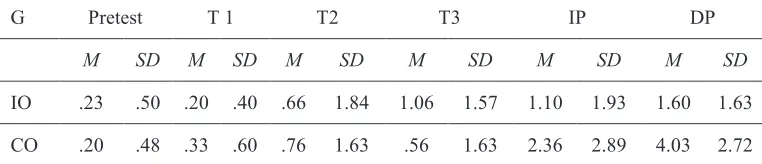
The second research question concerned the developmental trend of inversion acquisition by the participants. The time-series design in this study provided data on the trend of development from the pretest and onset of treatment up to the delayed posttest. Table 3 illustrates the descriptive statistics of the six administered tests. Tracing the development of the means from the pretest to the delayed posttest, one can find an upward additive trend in this process. With the exception of T1 in the individual output group, the minimum mean score is observed in the pretest (MIO = .23; MCO = .20), and
the maximum mean score appears in the delayed posttest (MIO = 1.60; MCO = 4.03):
Table 3. Descriptive Statistics for the Developmental Trend of Inversion Acquisition
G Pretest T 1 T2 T3 IP DP
M SD M SD M SD M SD M SD M SD
IO .23 .50 .20 .40 .66 1.84 1.06 1.57 1.10 1.93 1.60 1.63
CO .20 .48 .33 .60 .76 1.63 .56 1.63 2.36 2.89 4.03 2.72
Note: G = Group; IO = Individual Output; CO = Collaborative Output
Levene’s Test for Equality of Variances
t Test for Equality of Means
F Sig. t df Sig. (2-tailed)
Std. Error Difference
Pr
Equal Variances Assumed
Equal Variances Not Assumed
.209 .649 .261 58 .795 .128
.261 57.907 .795 .128
DP
Equal Variances Assumed
4.722 .034 -4.199* 58 .000 .580
Equal Variances Not Aassumed
The mean gain score for the individual output group was 1.37 from the pretest to the DP, whereas in the collaborative output group, the estimated gain score was 3.83. The difference in the gain scores shows the superiority of the learners’ performance in the CO group. Table 3 illustrates that as the means of the tests increase, the standard deviations also increase. This indicates variability enhancement among the participants in both groups.
The significance of the differences between each pair of tests in the individual and collaborative output groups is illustrated in Table 4:
Table 4. Independent Samples t Tests for the Developmental Trend of Inversion Acquisition
IO CO
Pairs df t Sig. Gain df t Sig. Gain
1 Pr-T1 29 .372 .712 -0.03 29 1.161 .255 0.13
2 T1-T2 29 2.088* .046 0.47 29 1.819 .079 0.43 3 T2-T3 29 2.845** .008 0.30 29 1.361 .184 -0.20 4 T3-IP 29 .092 .928 0.03 29 3.885** .001 1.80 5 IP-DP 29 1.055 .300 0.50 29 3.371** .002 2.66
*significant at p < .05
**significant at p < .01
As Table 4 shows, in the individual output group, a hardly significant improvement in pair 2 (p=.046) and a quite considerable improvement in pair 3 (p= .008) are observed. For the other pairs, the improvements were greatly nonsignificant. In the collaborative output group, pairs 1, 2, and 3 show nonsignificant improvements (p > 0.05), and in pairs 4 and 5, the p values are considerably significant:p4 = 001, p5 = 002,
respectively.
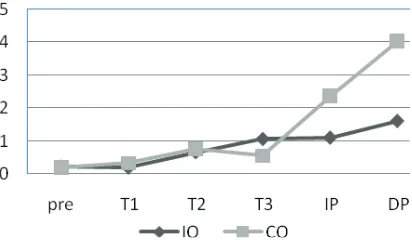
Figure 2 below graphically presents the trend of development of the participants in both groups across the stated time intervals:
Figure 2. Development Trend of Inversion Acquisition in IO and CO
where the line leaps upwards and soon overtakes the line of IO group to reach its peak performance in DP. A gradual slow rise is observed in IO group. Little constant fluctuations in performance are seen all throughout the study from the pretest to the DP. T3 in the present study seems to be a turning point for both groups because the performances of the participants fall apart from this point. Interpretation of the results will appear in Discussion section.
7. Discussion
This study set out to investigate the differential effects of individual output and collaborative output on L2 learners’ acquisition of English inversion structures. The pattern of development was also quantitatively investigated in the groups.
Regarding the first research question, the results revealed the superiority of the collaborative output task over the individual output task in the acquisition of the inversion structures. The results indicated that the output-based tasks could positively affect L2 learning when they had a specific linguistic focus. The relationship between the participants’ pretest and posttest scores revealed that many participants improved their production of the L2 forms. The participants’ outperformance in the collaborative output group might be due to the reception of immediate feedback from their peers on their linguistic choices. The results are in favor of Swain's (2000) collaborative dialog in which speakers are engaged in problem solving and knowledge building. The study supports the claim that the collaborative dialog is a useful unit of analysis to explore the process and product of L2 learning, which goes “beyond output” (Swain, 2000).
The results also indicate that dictogloss, when done collaboratively, could lead L2 learners to improve their knowledge on English inversion structures. The justification for this main effect could be the presence of different consciousness-raising techniques in a dictogloss task. Dictogloss prepares opportunities for learners to negotiate form and meaning simultaneously. The findings from the present study also lend support to Watanabe and Swain’s (2007) claim that when involved in the collaborative dialog, the learners are more likely to attain higher posttest scores regardless of the difference in their proficiency level. The results are also in line with Reinders’ (2009) belief that individuals’ output treatment is the most cognitively demanding task type in that the participants do not get help from a partner; therefore, task implementation in this case requires a greater amount of processing. As the results show the superiority of the collaborative output task, the study played its part in extending our understanding of how collaboration in doing language activities can be conductive in L2 instruction.
The DP was also included as part of the trend to measure the retention of the treatment effect over time.
One can clearly observe multiple fluctuations in the performance of the participants in the CO group throughout the treatment. The fluctuating behavior observed in this group shows that language learning, like any other type of learning, is not always a linear process. Learners may sometimes go through an early stage of development characterized by the use an L2-like feature. If this feature resembles an L1 feature, they replace it with a developmental L2 feature before they finally return to the correct L2 feature (Ellis, 1994). Segalowitz (2003) relates this phenomenon to the concept of automaticity. He hypothesizes that when the communicative situation is too demanding (as in the case of output in this study), control processes responsible for the learner selecting correct forms are not functioning. It may even be possible that new learning can lead to restructuring of existing linguistic knowledge so that some controlled process is no longer operative. When this happens, “background automatic processes that normally coordinate with controlled processes by detecting error potential situations now determine behavior alone” (p. 397), and the student makes the very error which she or he had appeared to have overcome. Therefore, a learner’s mastery of a particular language item is unstable, appearing to increase and decrease at different times during the learning process.
The collaborative output task paid off after T3 as the trend line leaps upward. It seems that interlanguage finally gets stabilized after multiple fluctuations in the collaborative output group. In the individual output group, the improvement was slow and constant without much fluctuations or nonlinear behavior. It can be assumed that the availability of the peer feedback in the case of the CO group enhanced the speed of the learners’ development and stabilization of their interlanguage. It is hypothesized that the trend line will continue to grow sharply by the CO and slowly by the IO group.
The final point is that, in some cases, learning gains by both groups were low, which might be attributed to the low proficiency level of the participants, lack of readiness for the acquisition of the L2 forms (Pienemann, 1989), or unfamiliarity of the participants with the task. It seems that word order is not a salient feature for Iranian EFL learners. This might be due to the structure of their L1. Persian is a language with a fairly free word order. A variety of orders may be permitted for a single sentence. This habit of taking the word order as a trivial matter may have been transferred to English learning by these EFL learners.
8. Conclusion
Possible reasons for caution in applying the findings to other populations include potential differences in motivation, reasons for learning, and assessment parameters. Another caution for the interpretation of the results of this study is the practice effect that may have affected the performances of the participants in the posttests. The participants were administered similar developmental and main tests throughout the study. Therefore, a follow-up study could have been conducted to examine whether gain scores in the posttests could be attributed to practice effects or not.
The L2 forms could be another important factor. If future research, indeed, demonstrates that only some forms are amenable to form-focused instruction in general and output-based instruction in particular, then instruction employing this type of technique should selectively focus on certain L2 forms. Further research should be carried out to compare the effects of collaborative output tasks in the acquisition of different features of the language. Furthermore, it is suggested that learners’ behavior throughout the process of task implementation be more carefully monitored and recorded, and the related language-related episodes (LREs) be analyzed in order to investigate what aspects of language the EFL learners are likely to notice.
DeKeyser (2005) contends that the level of difficulty of a form and the ease with which it is learnt are determined by the transparency of form-meaning relationships. The other factor is redundancy. Redundant forms are probably difficult to learn because the meaning can be conveyed simply by another form; therefore, they do not have contributions to the meaning. Probably, future studies in focus-on-form to compare the level of acquisition of different forms are welcome.
Finally, other collaborative output-based tasks can be devised to see the effects on the acquisition of form. Mcnicoll and Lee (2011) argue that the proficiency level of L2 learners should be taken into consideration when designing consciousness- raising tasks. Whereas higher proficiency levels learners benefit from cognitively demanding tasks like dictogloss, more concrete tasks like text-repair are probably better options for lower-proficiency level learners. Therefore, the relative effectiveness of different individually and collaboratively performed tasks on the acquisition of grammatical forms by EFL learners at different proficiency levels can also enrich the literature on task-based language learning and teaching.
References
DeKeyser, R. (2005). What makes learning second-language grammar difficult? A review of issues. Language Learning, 55(1), 1-25.
Doughty, C., & Williams, J. (Eds.). (1998). Focus-on-form in classroom second language acquisition. Cambridge: Cambridge University Press.
Ellis, R. (1994). Factors in the incidental acquisition of second language vocabulary from oral input: A review essay. Applied Language Learning, 5(1), 1-32.
Ellis, R. (2000). Task-based research and language pedagogy. Language Teaching Research, 4(3), 193-220.
Ellis, R. (2002). Does form-focused instruction affect the acquisition of implicit knowledge? A review of the research. Studies in Second Language Acquisition, 24(2), 223-236.
Ellis, R. (2012). Language teaching research and language pedagogy. Oxford: Wiley- Blackwell.
Ellis, R., & Barkhuizen, G. (2005). Analyzing learner language. Oxford: Oxford University Press.
Fortune, A. (2005). Learners’ use of metalanguage in collaborative form-focused L2 output tasks. Language Awareness, 14(1), 21-38.
Izumi, S., (2002). Output, input enhancement, and the noticing hypothesis: An experimental study on ESL relativization. Studies in Second Language Acquisition 24(4), 541-577.
Izumi, S., & Bigelow, M. (2000). Does output promote noticing and second language acquisition? TESOL Quarterly, 34(2), 239-278.
Izumi, S., Bigelow, M., Fujiwara, M., & Fearnow, S. (1999). Testing the output hypothesis: Effects of output on noticing and second language acquisition. Studies in Second Language Acquisition, 21(3), 421- 452.
Kowal, M., & Swain, M. (1994). Using collaborative language production tasks to promote students’ language awareness. Language Awareness, 3(2), 73-93.
Macaro, E. (2003). Teaching and learning a second language. London: Continuum.
Mcnicoll, J., & Lee, J. H. (2011). Collaborative consciousness-raising tasks in EAL classrooms. English Teaching: Practice and Critique, 10(4), 127-138.
Morgan-Short, K., &Bowden, H.W. (2006). Processing instruction and meaningful output-based instruction: effects on second language development. Studies in Second Language Acquisition 28(1), 31-65.
Nassaji, H., & Fotos, S. (2010). Teaching grammar in second language classrooms: Integrating form-focused instruction in communicative context. New York: Routledge, Taylor & Francis Group.
Nassaji, H., & Tian, J. (2010). Collaborative and individual output tasks and their effects on learning English phrasal verbs. Language Teaching Research, 14(4), 397- 419.
Nobuyoshi, J., & Ellis, R. (1993) Focused communication tasks and second language acquisition. ELT Journal, 47(3), 203-210.
Pica, T. (1988). Negotiated interaction as an aid to learner output. Language Learning, 37(4), 471-493.
Pienemann, M. (1989). Is language teachable? Psycholinguistic experiments and hypotheses. Applied Linguistics, 10(1), 52-79.
Qin, J. (2008). The effect of processing instruction and dictogloss tasks on acquisition of the English passive voice. Language Teaching Research, 12(1), 61-82.
Reinders, H. (2009). Learner uptake and acquisition in three grammar-oriented production activities. Language Teaching Research, 13(2), 201-222.
Schmidt, R. (1990). The role of consciousness in second language learning. Applied Linguistics, 11(2), 17-46.
Schmidt, R. (1995). Consciousness and foreign language learning: A tutorial on the role of attention and awareness in learning. In R. W. Schmidt (Ed.), Attention and awareness in foreign language learning (pp. 1-63). Honolulu: University of Hawai’i Second Language Teaching and Curriculum Center.
Schmidt, R. (2001). Attention. In P. Robinson (Ed.), Cognition and second language instruction (pp. 3-32). Cambridge: Cambridge University Press.
Segalowitz, N. (2003). Automaticity and second languages. In C. J. Doughty & M. H. Long (Eds.), The handbook of second language acquisition (pp. 382-408). Oxford: Blackwell Publishing.
Storch, N. (1998). A classroom-based study: Insights from a collaborative text reconstruction task. ELT Journal, 52(4), 291-307.
Swain, M. (1995). Three functions of output in second language learning. In G. Cook & B. Seidlhofer (Eds.), Principle and practice in applied linguistics: Studies in honour of H.G. Widdowson (pp. 125-144). Oxford: Oxford University Press.
Swain, M. (2000). The output hypothesis and beyond: mediating acquisition through collaborative dialogue. In J. P. Lantolf (Ed.), Sociocultural theory and second language learning (pp. 97-114). Oxford: Oxford University Press.
Swain, M., & S. Lapkin. (1995). Problems in output and the cognitive processes they generate: A step towards second language learning. Applied Linguistics 16(3), 370-391.
Swain, M., & Lapkin, S. (1998). Interaction and second language learning: Two adolescent French immersion students working together. Modern Language Journal, 82(3), 320-337.
Swain, M. & Lapkin, S. (2001). Focus-on-form through collaborative dialogue: Exploring task effects. In M. Bygates, P. Skehan, & M. Swain (Eds.), Researching pedagogic tasks: Second language learning, teaching and testing (pp. 99-118). London: Longman.
Takashima, H. (1995). A study of focused feedback, or output enhancement, in promoting accuracy in communicative activities. Unpublished doctoral dissertation, Temple University, Philadelphia, PA.
Watanabe, Y., & Swain, M. (2007). Effects of proficiency differences and patterns of pair interaction on second language learning: Collaborative dialogue between adult ESL learners. Language Teaching Research, 11(2), 121-142.
Williams, J. (1999). Memory, attention, and inductive learning. Studies in Second Language Acquisition, 21(1), 1-48.