127
Evaluating the consequences of the new standards on noise
conditions in ships
Bouzón, R.1, Costa, A.M.1, Roshan, G. 2*, Orosa, J.A.1
1
Department of Energy, University of A Coruña, Paseo de Ronda 51, 15011, A Coruña, Spain
2
Department of Geography, University of Golestan, Gorgan, Iran
Received: 1 Nov. 2014 Accepted: 11 Jan. 2015
Abstract: Noise is one of the main parameters to be considered to achieve a healthy indoor ambience in ferries. Therefore, the noise standards need to be more specialized and specifically based on real sampled data and case studies. In the present research, the noise levels in a ship, under different working conditions, were sampled and compared with those specified in the new and old standards. An initial study showed two main noise sources- clients and main engine- that influence other indoor environments, reducing the quality of life on board. The real-time data revealed that the maximum noise level limits set by the International Maritime Organization (IMO) in the older Resolution A.468 (XII) was mostly respected, except in areas where maintenance of the noise level was difficult, owing to the continuous influx of people, especially at the time of boarding and disembarking of the passengers and at the food self-service areas. In this sense, under the new Resolution MSC.337 (91), the maximum noise level allowed in the accommodation has been reduced by 5 dB (A), but this environment does not meet the standard. More results show that future standards must not only consider the noise level in a working place and add another variable, such as, the number of working hours, to obtain a representative equivalent energy, and they must also consider that a simple modification of this standard implies a redesign of most of the indoor ambiences onboard.
Keywords: case studies, noise regulations, shipping, Spain.
INTRODUCTION
Exposure to noise over a long period of time may affect both the physical and mental health of a person. Furthermore, noise can also cause health concerns such as, hypertension, digestive problems, respiratory problems, insomnia, stress, and hearing loss.
Recent studies have shown that along with temperature, noise can be considered as a parameter that affects the comfort conditions inside a vessel (Goujard et al., 2005). Moreover, noise is one of the
Corresponding Author E-mail: [email protected]
128 Analysis of the noise level onboard a ship reveals that the engine room is the nosiest area of the ship (Gaggero et al., 2013). Furthermore, the noise that occurs in other areas also affects the health of people and the safety of the vessel (Wysocki et al., 2006; Enda, and Eoin, 2014). This area-wise characterization has never been performed earlier and the recent standards tend to regulate this kind of indoor environment.
Sound is a wave that propagates through the air. It is characterized by its frequency, sound pressure level, and duration. Sound level is expressed in a unit called the decibel (dB) and it is used for expressing the sound pressure level using the Equation (1) given below.
2
0 log
10
P P
Lp (1)
where, P0 is the reference pressure (2·10−5
Pa) and P is the acoustic pressure (Pa) to which the crew were exposed.
Moreover, human ears have different levels of sensitivity to different noise frequencies, and therefore, various filters or rating scales should be used. The scale used to sample a sound level gives more importance to the mids, which is closer to the response of the ear to moderate noise levels. This scale is called “A”, and it is
represented by dBA or dB (A)
(Vasconcellos and Latorre, 2001; Wysocki and Ladich, 2005) and calculated in accordance with Equation (2).
2
0 log
10
P P
LpA A (2)
PA is the A-weighted sound pressure (Pa).
In this study, a real indoor environment was analyzed on a ship during navigation, at the port, and during the maneuvering of the ship, with the aim of guiding future researches on characterizing the indoor
environments in ships and the standards derived thereof.
MATERIALS & METHODS Main vessel characteristics
The ship under study had a length of 116.8 m, a width of 20.7 m, a mainstay length of 7.5 m, and a weight of 11,023 GT. The ship was built in 1992 and sailed under the Spanish flag. The maximum capacity of this vessel to carry passengers was 847, including 443 seats and 404 seats plus cabins. In addition, the ship could load 280 cars or 47 trucks and 34 cars. In certain deck zones of this ship, the noise levels were very high due to the concurrence of passengers.
The ship was propelled by two internal combustion engines MAN B and W 4T 12V 28-32 A, with a power of 7200 hp. The power plant consisted of four MAN B and W 4T 23/30 generators, with 750 rpm and 800 kW each.
Noise standards on ships
In Spain, the Spanish law of noise in the workplace, 1316/1989 Royal Decree of 27 October, states the guidelines for the protection of workers against noise and the risk of noise exposure during the work hours. However, the provisions of this rule were an exception to the crew members of air and maritime transport. An example of these mismatch vessels showed an establishment of the threshold limit value (TLV) for noise pollution in the workplace, based on a working day of 8 hours/day and 40 hours/week (Lesage et al., 1999; Lugli et al., 2003; Wysocki and Ladich, 2005).
In the sea, even when the workday is completed onboard, the crew members continue to be exposed to a noisy environment (Vasconcellos and Latorre, 2001; Megan et al., 2012), as a result, a period of 24 hours should be considered (Grundevik et al., 2009).
129 replacing the Royal Decree 1316/1989 as well the Spanish law Directive 2003/10/EC (McDonald et al., 2008; Grundevik et al., 2009).
Unlike the previous royal decrees, the current law also applied to personnel onboard ships sailing in the sea, and, in the maritime world, it was extended by five years, after which, since February 15, 2011, this decree applied to all ships sailing under the Spanish flag. In accordance with this new Royal Decree, the noise exposure of crew members should be considered over a period of 24 hours and the exposure levels to noise over a period of eight hours should not be > 87 dB (A). Furthermore, for cases in which the levels were > 80 dB (A) for eight hours, hearing protection should be used . In this sense, the level of the weighted equivalent continuous sound pressure for eight hours could be obtained by Equation (3) given below.
21
2
0 ,
1 log
10 t
t A T
Aeq dt
P t P T
L (3)
where, T = t2 − t1, which is the time of
exposure of workers to noise (Vasconcellos
and Latorre, 2001; Wysocki and Ladich, 2005; Eoin, 2014).
By applying the equivalent energy law to Equation 1, 80 dB (A) for 24 hours is equivalent to 85 dB (A) for eight hours.
As an international law that applies (Badino et al., 2012) to merchant vessels, November 19, 1981, the code on noise levels onboard was approved by Resolution A.468 (XII), with the aim of guiding the government in terms of maximum noise levels and exposure limits. Prior to this code, Resolution A. 343 (IX) was adopted, which was a recommendation on the methods of measuring noise levels at the Listening Posts in vessels.
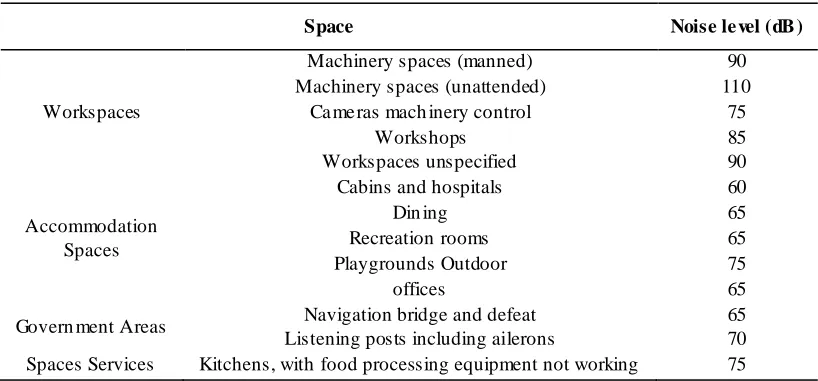
This new resolution about the noise levels onboard was structured in seven chapters and three appendices, describing the methods of measurement, the measuring equipment, the maximum exposure limit, and so on. The limits of the noise level in different spaces and in accommodation spaces have been a focus of the areas of study, as can be seen in Table 1.
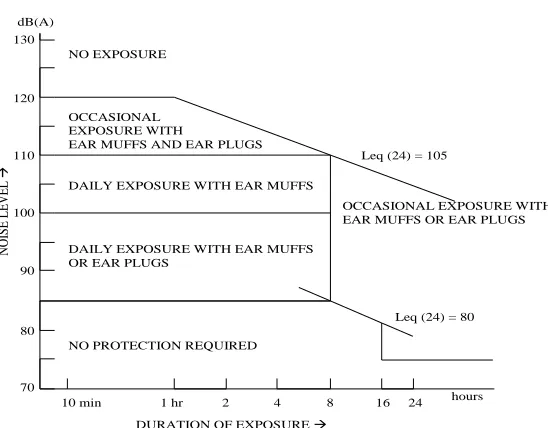
Furthermore, this new code shows that the established limits for an equivalent continuous noise exposure of a 24-hour period is not > 80 dB (A) (Fig. 1).
Table 1. Noise leve l limits A.468 (XII)
Space Noise le vel (dB )
Workspaces
Machinery spaces (manned) 90 Machinery spaces (unattended) 110
Ca me ras mach inery control 75
Workshops 85
Workspaces unspecified 90
Accommodation Spaces
Cabins and hospitals 60
Din ing 65
Recreation rooms 65
Playgrounds Outdoor 75
offices 65
130
NO PROTECTION REQUIRED DAILY EXPOSURE WITH EAR MUFFS OR EAR PLUGS
DAILY EXPOSURE WITH EAR MUFFS OCCASIONAL
EXPOSURE WITH
EAR MUFFS AND EAR PLUGS
OCCASIONAL EXPOSURE WITH EAR MUFFS OR EAR PLUGS NO EXPOSURE
DURATION OF EXPOSURE
NOIS
E L
EVEL
Leq (24) = 105
Leq (24) = 80 dB(A)
120 130
110
100
90
80
70
10 min 1 hr 2 4 8 16 24 hours
Fig. 1. No ise e xposure
After several revisions of the code on the noise levels, over the years, in the Resolution MSC 337 (91) adopted on November 30, 2012, the noise levels onboard ships was considered and it was put into force on July 1, 2014. This code was divided into seven chapters and four appendices that provided, among other things, the equipment to be used for
measurement, the maximum sound
pressure limits for noise exposure, the
characteristics of hearing protectors and signage, and the like.
This code not only applies to new ships of weight >1,600 GT, but it may also apply to the existing ships, as far as it is reasonable, and may similarly apply to new ships weighing <1,600 GT. Furthermore, it is a binding legal status and some provisions have been recommended, as described in Chapter 5. Table 2 shows the noise level limits set in Chapter 4 of the present code.
Table 2. Resolution MSC 337 (91) - Limits for noise levels (d B(A)) specified for various spaces depending on the size of the vessels
Spaces
Noise le vel (dB(A)) 1,600–10,000 GT
Noise le vel (dB(A)) ≥1,0000 GT
Workspaces
Machinery spaces (manned) 110 110 Machinery spaces (unattended) 110 110 Ca me ras mach inery control 75 75
Workshops 85 85
Workspaces unspecified 85 85
Accommodation spaces
Cabins and hospitals 60 55
Din ing 65 60
Recreation rooms 65 60
Playgrounds Outdoor 75 75
Offices 65 60
Govern ment Areas Navigation bridge and defeat 65 65 Listening posts including ailerons 70 70 Spaces Services Kitchens, with food processing equipment not
131 Comparison of the code on noise levels onboard ships, adopted by Resolution A.468 (XII) in relation to the spaces that have been studied previously, revealed that the names have been kept the same, but in the new code, a distinction has been made in the boundaries of the permitted noise level, based on the size of the ship (>10,000 GT or 16,00–10,000 GT). On the other hand, the difference observed between the two codes of the working areas and the spaces of accommodation was 5 dB (A). In this sense, these limits have been reduced to the permitted level with the new code, in the working spaces specified, for example, in the cabins, hospital, dining, recreation rooms, and offices, but only for vessels weighing >10,000 GT.
It is interesting to note that despite the fact that the Resolution MSC-337 (91) distinguishes the limits on noise levels depending on the size of the ship, the Royal Decree 286/2006 must be applied to all ships; it is more restrictive than the IMO standard. Furthermore, we must remember that the decree refers to the Spanish flag ships employing domestic and/or foreign workers. However, the UK has also applied the transposition of Directive 2003/10/EC to any ship landfall in the British territorial waters.
In this article, we studied the noise levels in spaces defined above, for the vessel under study, by comparing these levels with the limits allowed by the adoption of the new code of noise levels, MSC.337 (91) IMO, which came into effect on July 2014 and the limits set by the previous code on the noise levels, A.468 (XII).
Noise measurement instruments and procedures
The measurement was performed by using a sound level meter (999 PCE, Ibérica) with choices between two measuring ranges. The lower range was 30–100 dB and the higher range was 60–130 dB, with a resolution of 0.1 dB and 1.5 dB ± 94 dB and 1 kHz accuracy.
In accordance with the previous studies (ENISO,1998; ISO,1996), the sampling process of noise onboard considered the following:
1. The wind should not be > 4 Beafort scale, especially outdoors
2. Sea conditions must be calm 3. Rain
4. The depth of water under the keel should not be less than three times the vessel‟s draft
5. The presence of highly reflective surfaces near the microphone
6. Another sound source to be considered, for example, the noise of workers during their daily tasks
Additional noise sources were considered; for example, at the maximum boat speed of 16 knots, the main engine was running at its normal speed of 750 rpm and the turbochargers were running at 27,000 rpm. It was important to remember that the main source of noise was the engine room, as demonstrated in our previous study (Lois, 2004).
Sampling points
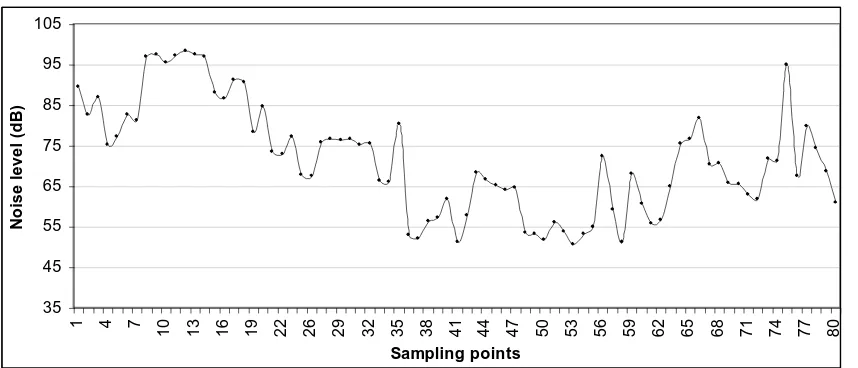
Sampling points were selected keeping in view the purpose of comparing the considered noisier areas with the zones in which there was a special interest, that is, conditions of comfort for the passengers and crew members, with reference to the measurements, for future amendments to the rules on ship noise. Figures 2–4 show the main sampling points that have been referred to in this research. For example, Figure 2 shows points 1–18 corresponding to the engine room.
RESULTS & DISCUSSION
132 of the cabins on deck 5 was 50.7 dB, whereas, the noisiest area of the ship had a
level of 98.3 dB at point 12, which was located in the auxiliary engine room.
1 2
3 4
5
6
7 8
9 10
11 12
13
14 15
16 17
18
Fig. 2. Spaces for noise measurements in engine roo m
Fig. 3. Spaces for noise measurements in deck 1
Fig. 4. Spaces for noise measurements in deck 6
35 45 55 65 75 85 95 105
1 4 7
10 13 16 19 22 26 29 32 35 38 41 44 47 50 53 56 59 62 65 68 71 74 77 80
Sampling points
N
o
is
e
l
e
v
e
l
(d
B)
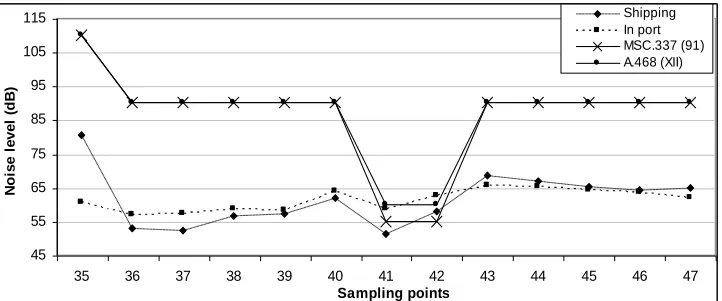
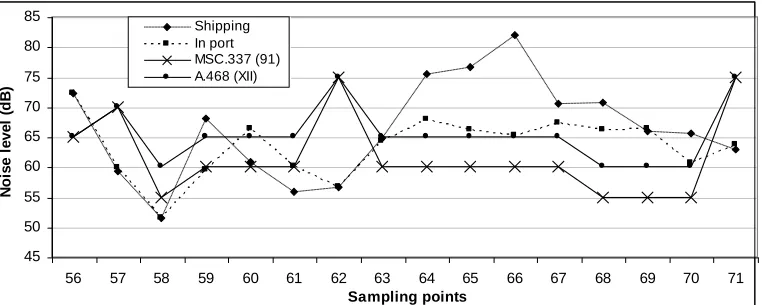
133 To verify compliance, a noise map of the different areas of the ship was prepared. The figures show the main ship areas and the noise levels reached in each of the areas during navigation and at the port. In addition, the maximum IMO permitted values in the new Resolution MSC.337 (91), as well as in the previous Resolution A.468 (XII), are illustrated for each of the measured areas.
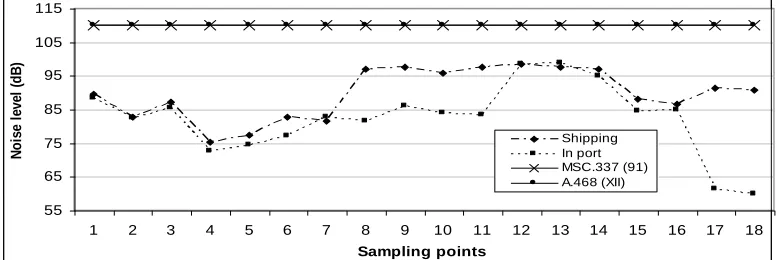
Figure 6 shows that higher noise levels achieved during navigation. In the main and auxiliary engine area, the standard indicates the need to wear protective gear at a noise level of >85 dB. In this case, both the previous Resolution A.468 (XII) and MSC.337 (91) set the limit value for the machinery spaces at 110 dB (A).
These values decrease significantly in the port, as the main engine is not working then; however, in the auxiliary engines, this decrease is not significant, as under both the operating conditions, the two auxiliary engines remain working. In Figure 6, point
13 in the area of auxiliary engines shows a slight increase, owing to the third auxiliary power demand of the bow thruster which is started during ship handling.
The engine control room adapts to the limits with the value obtained during navigation at 73.6 dB, with the maximum permitted value of 75 dB. This ship works with the Unattended Machinery Space (UMS) system, where work hours are between 8:00 and 17:00 hours, during which time, the officers and ratings of machines move through various spaces of the differentiated needs-maintenance teams, with the control room being a stable meeting point. It is important to include a space where the crew members can recover from the adverse conditions of the engine room (Lundh et al., 2011), for the proper control of machines. From 17:00 hours, the only person who goes to the machine room is the officer in charge of the alarms.
45 50 55 60 65 70 75 80 85
56 57 58 59 60 61 62 63 64 65 66 67 68 69 70 71
Sampling points N o is e l ev el ( d B ) Shipping In port MSC.337 (91) A.468 (XII) 55 65 75 85 95 105 115
1 2 3 4 5 6 7 8 9 10 11 12 13 14 15 16 17 18
Sampling points N o is e l e v e l Shipping In port MSC.337 (91) A.468 (XII) 55 60 65 70 75 80 85 90 95
23 24 25 26 27 28
Sampling points N o is e l ev el ( d B ) Shipping Special condition MSC.337 (91) A.468 (XII)
Fig. 6. No ise level in the engine roo m
Figure 7 shows a new condition called “special status,” which refers to the period of time when the ship is in a port- during the loading and unloading operation at the garages. Although noise values at this time are always below the permitted limits, the values are very different from the obtained values during the navigation period, owing to the noise produced by the volume of cars that enter the ship during this special condition.
The ventilation room, at point 35 of Figure 9, has a low value in port in
134 (XII), which has fixed the maximum allowed for the cabins at 60 dB (A). As per the new Resolution MSC.337 (91) and considering the weight of the ship at
>10,000 GT, the allowed limit is 55 dB (A), especially during the stay at the port. It must also be remembered that the ship was built in 1992.
55 60 65 70 75 80 85 90 95
23 24 25 26 27 28
Sampling points
N
o
is
e
l
e
v
e
l
(d
B
)
Shipping Special condition MSC.337 (91) A.468 (XII)
Fig. 7. No ise level on deck 2
55 60 65 70 75 80 85 90 95
29 30 31 32 33 34
Sam pling points
No
is
e
le
v
e
l
(d
B)
Shipping Special condition MSC.337 (91) A.468 (XII)
Fig. 8. No ise level on deck 3
45 55 65 75 85 95 105 115
35 36 37 38 39 40 41 42 43 44 45 46 47
Sampling points
N
o
is
e
l
e
v
e
l
(d
B
)
Shipping In port MSC.337 (91) A.468 (XII)
135 The points 48–55 depicted in Figure 10 refer to the values recorded in the areas of the passenger cabins on deck 5; these port values approach the limit set in the previous Resolution A.468 (XII), as seen in paragraph 52, referring to a stairway, on account of passengers in the area for the inlet and outlet of the passage, with the new Resolution MSC.37 (91) exceeding the limit of 55 dB, as previously mentioned for a ship of 10,000 GT (A).
Deck 6 (Fig. 11) includes the dining room, cafe, information, and passenger cabins. These indoor recreation areas, in general, have higher noise levels, which affect the passenger cabins on this deck.
The Resolution A.468 (XII) fixed the maximum noise level for these areas at 65 dB (A) and for the cabins at 60 dB (A). With the new Resolution MSC.337 (91), both the levels fall by 5 dB (A) so these sampling points are well above the permitted limit value.
Points 76 and 77 (Fig. 12) were placed in the dinning room and self- service of the passage, respectively, and points 79 and 80 (Fig. 12) were placed in halls; all these places had more than the permitted limit of noise values, as these places were popular points of congregation for passengers during navigation.
45 47 49 51 53 55 57 59 61
48 49 50 51 52 53 54 55
Sampling points
N
o
is
e
l
e
v
e
l
(d
B
)
Shipping In port MSC.337 (91) A.468 (XII)
Fig. 10. Noise leve l on deck 5
45 50 55 60 65 70 75 80 85
56 57 58 59 60 61 62 63 64 65 66 67 68 69 70 71
Sampling points
N
o
is
e
l
e
v
e
l
(d
B
)
Shipping In port MSC.337 (91) A.468 (XII)
136 55 65 75 85 95 105 115
72 73 74 75 76 77 78 79 80
Sampling points N o is e l e v e l (d B ) Shipping In port MSC.337 (91) A.468 (XII)
Fig. 12. Noise leve l Deck 7
40 50 60 70 80 90 100 110 120 130 EN G IN E R O O M D EC K N º1 D EC K N º2 D EC K N º3 D EC K N º4 D EC K N º5 D EC K N º6 D EC K N º7 N oi s e l e v e l (dB )
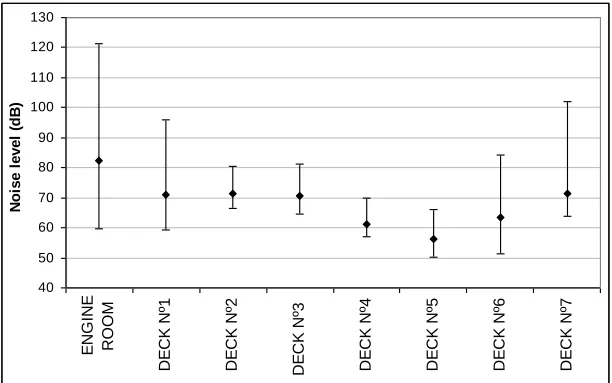
Fig. 13. Ma ximu m, min imu m, and average noise levels at all areas during navigation
40 50 60 70 80 90 100 110 120 130 E N G IN E R O O M D E C K N º1 D E C K N º2 D E C K N º3 D E C K N º4 D E C K N º5 D E C K N º6 D E C K N º7 N oi s e l e v e l (dB )
137 CONCLUSIONS
The present research study shows the current noise conditions onboard merchant ships and their related standards. This indoor environment is clearly considered as one of the most extreme, and despite this, there is a delay in applying the standards and technology there. Noise and temperature (Orosa and Oliviera, 2010), in particular, are the more extreme variables related to working conditions that are a risk to health. In this study, the noise level has been sampled at different points of departures of a merchant ship, in accordance with its different working conditions: In port and during navigation.
Prior to analyzing the sampled data, it must be mentioned that the limits specified in this article are the upper limits and not the desirable levels showed by the standards. In several cases, these limits are applied. Sound is considered annoying at a level >55 dB and a noise level of >85 dB has harmful effects.
An initial study of the sampled data showed that noise came from two sources in this ship: From people on deck 7 and from the main engine placed in the engine room, as can be seen in Figures 13 and 14, with them having the maximum measured noise level among all ship areas during navigation and in port, respectively. As a consequence, this noise source influenced the resting environments of decks 3 and 4, hence, an adequate control of these noises could improve the resting areas onboard. In this sense, the sampled data showed that the maximum noise level limits set by the IMO in the previous Resolution A.468 (XII) were respected, except in areas where the influx of people made it difficult to maintain an adequate level of noise, especially during times of boarding and disembarking of passengers, when the „people activity‟ was more, as well as in food areas, such as, the self-service.
In the new Resolution MSC.337 (91), the maximum noise level allowed in the
accommodation was reduced by 5 dB (A) for vessels weighing ≥10,000 GT, and as a consequence, the areas with a noise level in the limit values of the previous standards were quite different from those of the new limits.
In this study, the point at which >100 dB noise was recorded was at the bow thruster, and in a particular situation, during maneuvering, but no staff worked at these points, except when the situation demanded.
In order, the next points with near 100 dB noise were the engine rooms near the main and auxiliary engines and the pump and servomotor rooms. Therefore, in addition to using ear protection, it was recommended that the crew enter or remain in these areas only when necessary, such as, during engine failure or breakdown, which was to be followed by a period of hearing rest.
Finally, the results showed that future standards must not only consider the noise level in a working place, but also add another variable, such as the number of working hours, to obtain a representative equivalent energy, and that a simple modification of this standard implied a redesign of most of the indoor ambiences onboard. In consequence, it was recommended that a person exposed to a sound of 100 dB for 10 minutes should be allowed a hearing rest of 30 minutes for recovery.
REFERENCES
Abrahamsen, K. (2012). The ship as an underwater noise source. Proceedings of Meetings on Acoustics. Volume 17, 11th European Conference on Underwater Acoustics, ECUA 2012; Edinburgh; United Kingdom; 2 July
138 Gaggero, T. and Rizzuto, E. (2013). Noise on board RO-pax vessels: Measured levels on existing ships and new pre-normative requirements. Paper presented at the Analysis and Design of Marine Structures - Proceedings of the 4th International Conference on Marine Structures, MARSTRUCT 2013, 45-52.
Goujard, B., Sakout, A. and Valeau, V. (2005). Acoustic comfort on board ships: An evaluation based on a questionnaire. Appl. Acousti., 3,1063-1073.
Grundevik, P., Lundh, M. and Wagner, E. (2009). Engine control room - human factors. Paper presented at the RINA, Royal Institution of Naval Architects International Conference - Human Factors in Ship Design, Safety and Operation - Papers, 61-67.
Wysocki, L.V., Dittami, J.P. and Ladich, F. (2006). Ship noise and cortisol secretion in European freshwater fishes. Biol. conserv., 128(2), 501 –508. Lois, P., Wang, J., Wall, A. and Ruxton, T. (2004). Formal safety assessment of cruise ships. Tourism Manage., 25 (6), 93–109.
Lundh, M., Lützhöft, M., Rydstedt, L. and Dahlman, J. (2011). Working conditions in the engine department – A qualitative study among engine room personnel on board Swedish merchant ships. Appl. Ergonomics., 42 (2), 384–390.
Lesage, V.C., Barette, C., Kingsley, M.C.S. and Sjare, B. (1999). The effect of vessel noise on the vocal behavior of belugas in the St.Lawrence river estuary, Canada. Mar. Mammal. Sci., 15, 65–84. Lugli, M. and Fine, M.L. (2003). Acoustic communication in two freshwater gobies: ambient noise and short-range propagation in shallow streams. J. Acoust. Soc. Am., 114(3), 512–521.
Megan, F., Ross, R., Wiggins, M. and Hildebrand, J.A. (2012). Underwater radiated noise from modern commercial ships. J. Acoust. Soc. Am., 131 (1), 92-103.
Matveev, K.I. (2005). Effect of drag-reducing air lubrication on underwater noise radiation from ship hulls. J. Vib. Acoust., 127(4), 420–422.
McDonald, M. A., Hildebrand, J. A., Wiggins, S. M. and Ross, D. (2008). A 50 year comparison of ambient ocean noise near San Clemente Island:A bathymetrically complex coastal region off Southern California. J.Acoust. Soc. Am., 124, 1985–1992.
Orosa, J. and Oliviera, A. (2010). Assessment of work-related risk criteria onboard a ship as an aid to designing its onboard environment. Journal of Marine Science and Technology, 15, 16-22.
Spreng, M. (2000). Possible health effects of noise induced cortisol
increase. Noise and Health, 7, 59–63.
Tamura, Y., Kawada, T. and Sasazawa, Y. (1997). Effect of ship noise on sleep. J. Sound. Vibration., 205 (4), 417-425.
Tamura, Y., Horiyasu, T. and Sano, Y. (2002). Habituation of sleep to a ship‟s noise as determined by actigraphy and a sleep questionnaire. J. Sound. Vibration, 250 (1), 107-113.
Vasconcellos, J.M. and Latorre, R.G. (2001). Recreational boat noise level evaluation. Ocean. Eng., 28(3), 1309–1324.