R E S E A R C H A R T I C L E
Open Access
Design, synthesis and structural studies of
meta
-xylyl linked
bis
-benzimidazolium salts:
potential anticancer agents against
‘
human
colon cancer
’
Rosenani A Haque
1*, Muhammad Adnan Iqbal
1, Mohamed B Khadeer Ahamed
2, AMS Abdul Majid
2and Zena A Abdul Hameed
2Abstract
Background:Benzimidazole derivatives are structurally bioisosteres of naturally occurring nucleotides, which makes them compatible with biopolymers of living systems. This property gives benzimidazole a biological and clinical importance. In the last decade, this class of compounds has been reported to possess anti-allergic, anti-diabatic, anti-HIV, anti-hypertensive, anti-inflammatory, anti-mycobacterial, anti-oxidant, anti-protozoal, and anti-viral
properties. The researchers are now interested to explore their potential as anti-cancer agents. In the present study, an effort was made to further explore this area of research. Furthermore, in order to increase the solubility and efficacy of these heterocycles, the interest is now shifted to the salts of these compounds. With this background, we planned to synthesize a series ofmeta-xylyl linkedbis-benzimidazolium salts to assess their anti-proliferation efficacy on human colon cancer cell line (HCT 116).
Results:A number ofN-alkylbenzimidazoles were synthesized by reactions of benzimidazole with alkyl halides (i-PrBr, PrBr, EthBr, Pent-2-ylBr, BuBr, BenzCl, HeptBr). The subsequent treatment of the resulting
N-alkylbenzimidazoles with 1,3-(bromomethylene)benzene afforded correspondingbis-benzimidazolium salts. All synthesized compounds were characterized by spectroscopic techniques (Additional file 1: NMR & FT-IR) and microanalysis. Molecular structures of selected compounds were established through single crystal x-ray diffraction studies. All the compounds were assessed for their anti-proliferation test on human colorectal cancer cell line (HCT 116). Results showed that the compounds exhibited dose dependent cytotoxicity towards the colon cancer cells with IC50ranges between 0.1 to 17.6μM. The anti-proliferation activity of all compounds was more
pronounced than that of standard reference drug 5-flourouracil (IC50=19.2μM).
Conclusions:All the synthesizedbis-benzimidazolium salts showed potential anticancer activity. Out of them, some of these salts showed IC50value as low as 0.1–0.2μM. Based on the results it can be concluded that, the
bis-benzimidazolium salts could probably be the potential source of chemotherapeutic drugs.
* Correspondence:[email protected] 1
School of Chemical Sciences, Universiti Sains Malaysia, USM-11800, Penang, Malaysia
Full list of author information is available at the end of the article
Background
New drugs to fight cancer are constantly needed. Colon cancer (bowel cancer) is a cancer caused by uncontrolled cell growth in the colon, rectum, or vermiform appendix. It is the third most common cancer and the fourth most frequent cause of cancer deaths worldwide [1]. Every year, more than 945000 people develop colorectal cancer worldwide, and around 492000 patients die [1].
Benzimidazole is a heterocyclic moiety possessing wide spectrum of biological activities [2]. The biological im-portance of benzimidazole derivatives is due to their structural resemblance to the naturally occurring nucleotides, which allow them to interact with the biopolymers of the living system [2]. In the last decade some benzimidazole derivatives have shown some poten-tial anticancer activities, for example compound1 exhib-ited anticancer activity against MCF-7, HL-60, HT-29, and PD-3 cell lines (IC50value ranging from 7.0 to 100 μM) [3]. Compound 2 has shown 51% inhibition of tumor growth in mice implanted with HT-29 human carcinoma at 400 mg/kg orally [4]. Compounds3and4have shown anticancer (A-549 IC50 2.8 μM, HeLa IC50 5.1μM) and antitumor (EBV-EA) activities respectively [5,6].
1 2
3 4
Due to the aforementioned reasons, current study was conducted to synthesize a series of benzimidazolium salts (i.e.,9, organic salts) unlike benzimidazole derivatives (i.e.,
1–4, organic compounds) in order to increase the solu-bility and efficacy of these heterocycles. It was found that these bis-benzimidazolium salts have shown activity against human colon cancer cell lines (HCT 116). Azo-lium (imidazoAzo-lium, benzimidazoAzo-lium, triazoAzo-lium etc.)
salts are used as stable precursors to synthesize N -heterocyclic carbenes (NHCs) and metal complexes [7-9] (see Figure 1). N-heterocyclic carbenes (NHCs) are types of carbenes in which a divalent carbon moiety is flanked by twoπ-donor nitrogen atoms (for example,5and6) [9]. For details see [8,9]
To synthesize NHCs, the more common practice is substitutions of alkyl/aryl groups at nitrogens of azoles (imidazole, benzimidazole, triazole etc.) to synthesize azolium salts in which H-2 hydrogen becomes acidic which can be removed by addition of a base (e.g., t-BuOK, NaH etc.) [11,12]. There are numerous ways to generate free NHCs and their metal complexes [9,13].
Here in this article we report some meta-xylyl linked
bis-benzimidazolium salts of structure9with IC50values 0.1–17.8μM.
Results and discussions
Syntheses
All the N-alkyl benzimidazoles were synthesized by the method developed by starikova et al. [14] with minor modifications. Furthermore the reaction of two equivalents of N-alkyl benzimidazole with
1,3-(bromomethylene)benzene in 1,4-dioxane at 80-100°C for 24 h afforded the product in 29–94% yield (Scheme 1).
We have already reported [10,11,13,15-17] the synthe-sis of a variety of medium- and long-chain-derivatized
N NH (i) KOH in DMSO stirring at RT for 30 min.
(ii) Alkyl halide stirring for 2 h
R = 1(i-Pr); 2 (Pent-2-yl); 3 (CH2Ph);4 (Bu); 5 (Hept); 6 (Pr); 7 (Eth) X = Cl/Br
1 - 7
R X
N N R
N N R
2
Br Br
N N
N N
R R
Dioxane, reflux (80 - 100 oC)
12 h
.2X
-8 R = i-Pr, X = PF6; 9 Pent-2-yl, X = PF6; 10 CH2Ph, X = Cl; 11 Bu, X = PF6; 12 Hept, X = Br; 13, Pr, X = PF6
8 - 13 Step - 1
Step - 2
KX H2O
imidazolium and benzimidazolium salts by our simple, high-yielding, and general synthetic method. We pre-viously employed ethyl bromide, propyl bromide,i-propyl bromide, butyl bromide, benzyl chloride, and heptyl bromide as the electrophiles for 1,2-(bromomethylene) benzene [17] and now show that the use of these electro-philes on 1,3-(bromomethylene)benzene is also successful. The method adopted for the synthesis of title compounds is selective for the 1-position heterocycle, and the two-step process is essentially quantitative. Indeed, upon treating alkylbenzimidazole (1-7) with m-xylyl dibro-mide (1,3-(bromomethylene)benzene), respective
bis-benzimidazolium salt was observed, to give 8-13 in al-most quantitative yield. Selected compounds (9. 2Br,11. 2Br &12. 2Br) were converted to their respective hexa-flourophosphate counterparts via metathesis reaction using KPF6. This step is included for easier handling and better solubility. The PF6salts of all the compounds are soluble in acetonitrile, DMSO, and DMF but not soluble in methanol, ethanol, and water whereas the halide salts are soluble in methanol, ethanol, DMSO, DMF and water but not soluble in acetonitrile.
FT-IR spectra of the compounds
It is of much importance to study the spectral features in both near and mid IR spectra, for their strong correl-ation to vibrcorrel-ational structures of the molecules. Repre-sentative IR spectra of the compounds and the functional assignments for N-alkylated benzimidazoles are shown in Figure 2. For all synthesized compounds, two strong and sharp stretching vibrations (3380 –
3439 cm−1) appeared for the tertiary nitrogen of benzi-midazolium ring in the observed spectra. The pure modes of the C-H stretching vibrational bands in both, alkyl benzimidazoles and bis-benzimidazolium salts appeared at around 2900 to 3000 cm−1. This variation in the range is due to presence of C-H (sp3-s) stretching of alkyl chains and methylene (N-CH2-Ar) group. A strong and sharp intense band observed in the range 1400 to 1450 cm−1 ascribed to the stretching modes of vibra-tions of benzimidazole ring due to the presence of -HC = N- module [18]. It may be concluded that the reduction in the intensity of this band in benzimidazolium salts is probably caused by the conjugation of C = N bond with the benzimidazole ring and due to N-alkylation, where alkyl group acts as electron donating entity. In benzimida-zole, the modes due to the ring vibrations are characteris-tically strong near 1400 and 1460 cm−1as are absorptions [19]. The other ring vibrations are intense bands at around 1050 and 1220 cm−1.
FT-NMR spectra of the compounds
FT-NMR spectra of all the compounds have been ana-lyzed in d6-DMSO and d3-CH3CN over the scan range 0 to 16δ ppm for1H NMR and 0 to 200δppm for13C NMR studies. The attachment of N-alkylated benzimida-zoles (1-7) with 1, 3-(bromomethylene) benzene, to get final products (8-13), was confirmed by observing changes in specific chemical shifts for N-alkylbenzimidazoles and respective salts. For example, the downfield movement of “Hc” signals for N-CH2-R from 4.1 (in N-propylbenzimidazole, 6) to 4.5 (in its
4000.0 3000 2000 1500 1000 400.0
6.2 10 15 20 25 30 35 40 45 50 51.8
cm-1 %T
3416 3402
3424
3402
3409 3431
N-i-propylbenzimidazole (I) N-benzylbenzimidazole (III)
N-heptylbenzimidazole (V)
N-propylbenzimidazole (VI)
N-ethylbenzimidazole (VII) N-butylbenzimidazole (IV)
Legend
C-N stretch -C=C-H ring
stretch
N-alkylation (tert. amine) FT-IR of benzimidazole
bis-benzimidazolium salt, 13.2Br) and “He” for NCHN (acidic proton) from 7.94 to 9.90 respectively. The appearance of new signal “Hd” at 5.8 for N-CH2-Ar also supports the attachment of both the reactants (see Figure 3).
In 13C NMR spectra peaks appeared between 49 to 56 ppm (see Additional file 2: Table S1). These new sig-nals confirmed the attachment ofm-xylene to respective
N-substituted benzimidazoles (N-CH2-Ar).
In general1H NMR spectra of all the salts evidenced a sharp singlet in the range 9.88-10.27 δ ppm ascribed to the benzimidazolium ring (NCHN) acidic proton. These signals for imidazole based salts were observed in up field region, due to the absence of an electron withdraw-ing phenyl group [10]. Resonances of the aromatic pro-tons of benzimidazole as well as spacer were observed in the range 7.38–8.17 δ ppm as a broad multiplet, and doublet of doublet with comparable coupling constants. The signals caused by the methylene (N-CH2-Ar) group, which connects xylyl unit with benzimidazolium units, display sharp singlets in the range 5.40–5.82δ ppm. Fi-nally, the resonance of alkyl protons appeared in the range 0.80–4.54 δ ppm with comparable coupling con-stants (see Additional file 2: Table S1).
Similarly, the structural assortments of the salts were further confirmed by the 13C NMR spectral technique. The spectrum of all the salts evidenced a distinguished
peak in the most down field range 141.81- 143.30δppm ascribed to the benzimidazolium ring carbon (NCN). Resonances of aromatic carbons were found in the com-parable region around 113.86–135.72 δ ppm. Also, the methylene carbon (N-C-Ar) and alkyl chain carbon reso-nances were observed in the chemical shift regions 49.83–55.58 and 10.82–51.70 δ ppm, respectively (See Additional file 2: Table S1).
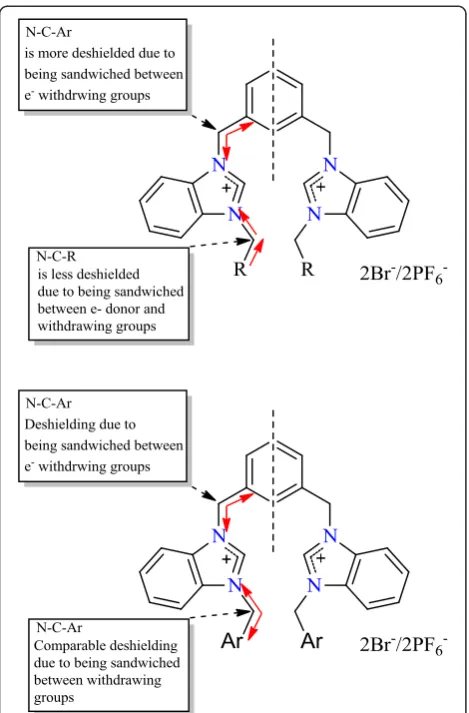
In addition it is evident that N-C-Ar carbon, in all cases, is more deshielded as compared to N-C-R carbon due to being sandwiched by two electron withdrawing groups because N-C-R group is attached to electron withdrawing and donor groups (Figure 4).
Crystallography
The molecular structures of the benzimidazolium salts Additional file 3: 10.2Br and Additional file 4: 13.2PF6 were determined by single crystal X-ray diffraction stu-dies. The crystals suitable for the diffraction studies were grown by slow evaporation method. Crystal refine-ment data, selected bond lengths and angles of salts Additional file 3:10.2Brand Additional file 4:13.2PF6 are tabulated in Tables 1, 2, 3.
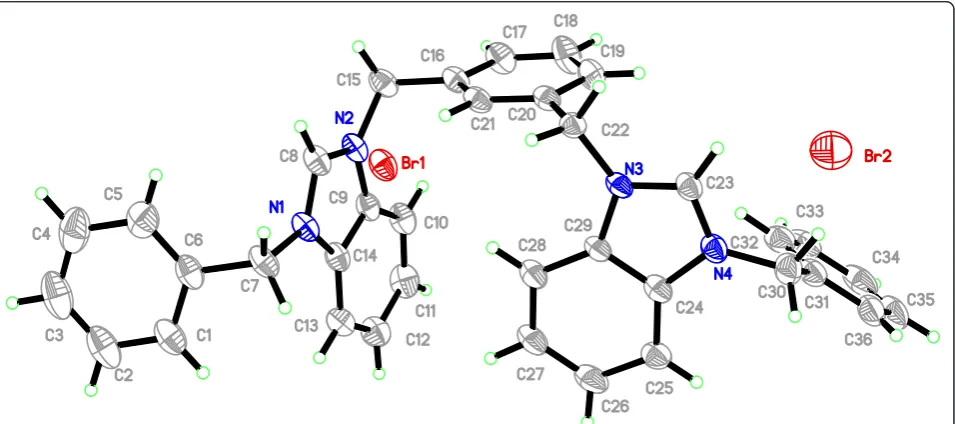
Salt Additional file 3: 10.2Br crystallizes in triclinic space group P-ī with one cationic bis-benzimidazolium core and two bromide counter ions. Crystal studies re-veal the existence of salt in a zig-zag manner having
1 3 . 2PF6 N -propylbenzimidazole (6 )
Hc
Hc
Hd
He
He
Downfield Chemical shift From 4.1 to 4.5
Appearance of new peak for methylene “Hd” Downfield chemical Shift
from 7.94 to 9.90
Ha
Hb Water peak
Hb Ha Solvent peak
Solvent peak Benzylic signals
benzimidazoles perpendicular to the plane of xylyl group as well as to their own planes. Similarly, the terminal phenyl groups are perpendicular to the planes of the benzimidazole rings. However, the shape of the entire molecule depends on the terminal N-alkyl/aryl substi-tuent which readily offers the rigidity and finite shape. The internal imidazole ring angle (N–C–N) at the car-bene center is 110.0(3)° for N1-C8-N2 and 109.9(2)° for N3-C23-N4, and these values are well within the range for similar benzimidazole based salts [16,20,21]. The bond angles between benzimidazole ring and xylyl were found to be N2-C9-C14 = 107.0(4) and N3-C22-C20 = 110.9 (3) from opposite direction. Similarly, the bond angles of terminal phenyl ring and benzimidazole were observed in the similar manner, viz., N1-C7-C6 = 111.5(4) and N4-C24-C29 = 106.9(4). In the crystal, the bromide anions link the cations with a three-dimensional network via the intermolecular hydrogen bonding C-H. . ..Br (2.829 and 3.040 Å) parallel to thebcplane. The contribution of dis-ordered solvent molecules were removed from the
diffraction data with SQUEEZE in PLATON [22,23]. A perspective view of the salt and its crystal packing are shown in Figure 5.
On the other hand, salt Additional file 4:13.2PF6 crystal-lizes in monoclinic space group Cc having one cationic
bis-benzimidazolium core and two hexafluorophosphate counter ions. The internal imidazole ring angle at the car-bene center is 111.0(2)°for N1-C4-N2 and 110.81(18)°for N3-C25-N4, and these values are well within the range for similar benzimidazole based salts [16,20,21]. The central benzene core makes dihedral angles of 111.95(16)°at N1-Figure 4Relative deshielding of methylene groups, attached
directly to benzimidazolium units in NMR spectroscopy.
Table 1 Crystal data and structure refinement details for compounds 10 and 13
10.Br 13.PF6
Formula C36H32Br2N4 C28H32F12N4P2
Formula Weight 680.48 714.52
Crystal System Triclinic Monoclinic
Space group Pī Cc
a, b, c [Å] 11.0707(3), 11.3028(3), 14.8929(3)
16.2520(9), 12.0683(7), 16.2980(9)
α,β,ϒ[deg] 84.963(1), 75.975(1), 87.924(1)
90, 103.064(10), 90
V [Ang**3] 1800.80(8) 3152.2(3)
Z 2 4
D(calc)[g/cm**3] 1.255 1.506
Mu(MoKa)[/mm] 2.278 0.236
F(000) 692 1464
Crystal Size[mm] 0.56 × 0.45 × 0.29 0.58× 0.36 × 0.30
Temperature (K) 90(2) 293(2)
Radiation [Å] MoKa 0.71073 MoKa 0.71073
θMin–Max [Deg] 1.41–28.95 2.11–30.070 Dataset −15:15;−15:15;−20 :20 −23:23;−16:16;−22:22
Tot.; Uniq. Data 33351 32572
R(int) 0.0308 0.0225
Nref;Npar 9480; 379 2023; 585
R, wR2, S 0.0472, 0.1376, 1.076 0.0226, 0.1293, 1.029
Table 2 Selected bond lengths and angles of salt 10.2Br C6-C7 1.513(4) C15-C16 1.515(4) N3-C23 1.331(3)
C7-N1 1.481(3) C16-C21 1.392(4) C23-N4 1.332(4)
N1-C8 1.330(4) C21-C20 1.383(4) N4-C30 1.465(4)
N2-C8 1.339(4) C20-C22 1.516(4) C30-C31 1.511(4)
C15-N2 1.478(3) C22-N3 1.464(3) C21-H21 0.9500
C6-C7-N1 112.0(2) C20-C22-N3 110.7(2)
C7-N1-C8 124.5(2) C22-N3-C23 126.1(2)
N1-C8-N2 110.0(3) N3-C23-N4 109.9(2)
C8-N2-C15 125.0(2) C23-N4-C30 125.6(2)
C11-C12 and 112.19(15)°at N3-C18-C16 with the pendant benzimidazole rings on either side. The extended structure of the salt evidenced the intermolecular hydrogen bonging between cationicbis-benzimidazolium core and two hexa-fluorophosphate anions. The anions link the cations with a three-dimensional network via the C-H-–F (2.638 and 2.897 Å) hydrogen bonding parallel to thebcplane. A per-spective view of the salt and its crystal packing are shown in Figure 6.
Anticancer activity
A wide variety of heterocyclic compounds based on imidazole, benzimidazole, pyrimidine, pyridine and pu-rine are being intensively studied as anticancer agents against various cancer cell lines [24,25]. Furthermore, imidazole and benzimidazole-based compounds appear to be very promising candidates for anticancer treat-ment. As reported in recent reviews there has been a
growing interest in the community of synthetic organic chemistry to examine the anticancer activities of differ-ent heterocyclic compounds with specific functional groups [26]. In this perspective, we have designed a series of bis-benzimidazolium salts with different coun-ter ions.
The results of the anti-proliferation test using MTT assay showed that all tested compounds exhibited a dose dependent effect. Figure 7 shows effect of different con-centrations of bis-benzimidazolium salts (8-13) on human colorectal cancer cells (HCT 116) after 72 hours treatment. Anticancer efficiency of all the tested com-pounds is tabulated in Table 4. All the tested comcom-pounds demonstrated potent cytotoxicity against HCT 116. In particular, compounds Additional file 3: 10.2Br and
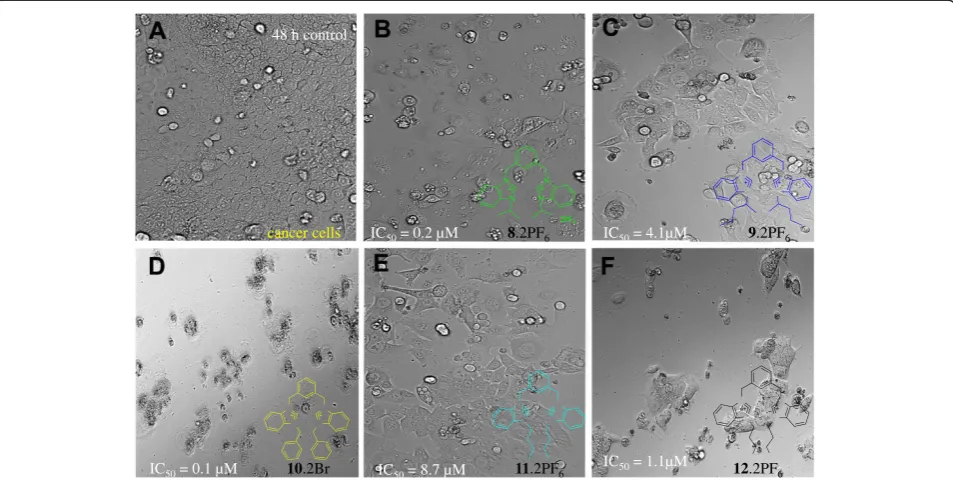
8.2Br were found to be the most notable examples of the series with IC50values 0.1 and 0.2 μM, respectively. The results showed that the activity of these compounds was found to be more potent than the standard refer-ence drug 5-fluorouracil (IC50= 19.2 μM). Figure 8 shows the picture of cells treated with Additional file 2:
10.2Br for 72 hours. Activity of these compounds is dra-matically higher than the standard used. Similarly, salts
12.2Br (1.1 μM) and 9.2PF6 (4.1 μM) also exhibited cytotoxic effect on HCT 116, which was also stronger than the standard 5-fluorouracil (19.2 μM). In addition, salts 11.2PF6 and 13. PF6 also showed significant anti-proliferation activity with IC50 values 8.7 and 17.6 μM, respectively, which is more or less equal to 5-FU.
The variation in chain length will affect not only the solubility of compounds but also influences the cytotoxic property of the compounds. Thus the results showed the
Figure 5The ORTEP picture of bis-benzimidazolium salt 10.2Br with displacement ellipsoids drawn at 50% probability.See Figure 6A for its Packing (Triclinic).
Table 3 Selected bond lengths and angles of salt 13.2PF6 C2-C3 1.466(7) C11-C12 1.516(3) N3-C25 1.317(3)
C3-N2 1.508(4) C12-C17 1.382(2) C25-N4 1.338(3)
N2-C4 1.325(4) C17-C16 1.384(2) N4-C26 1.470(3)
C4-N1 1.321(3) C16-C18 1.509(3) C26-C27 1.484(6)
N1-C11 1.468(3) C18-N3 1.474(2) P1-F1 1.506(8)
C2-C3-N2 112.4(4) C16-C18-N3 112.19(15)
C3-N2-C4 132.4(2) C18-N3-C25 126.18(18)
N2-C4-N1 111.0(2) N3-C25-N4 110.81(18)
C4-N1-C11 127.0(2) C25-N4-C26 107.9(9)
A
B
C
compounds 10.2Br (IC50= 0.1 μM) with N-methylene phenyl and 12.2Br (IC50= 1.1 μM) with N-heptyl substi-tutions revealed more potent cytotoxic activity than the compounds with smaller chain length and non-aromatic substitutions. In addition, an interesting phenomenon was noticed with the compounds having bromide anions (8.2Br, 10.2Br and 12.2Br) demonstrated significant cytotoxic activity with respect to the com-pounds (9.2PF6, 11.2PF6 and 13.2PF6) having the hexa-fluorophosphate anion. This data indicates that the longer alkyl chain and aromatic substitutions resulted
bis-benzimidazolium salts more efficient compounds against HCT 116 cells.
Conclusions
In conclusion, a series of bis-benzimidazolium salts was prepared in two steps. First, the preparation ofN-alkyl ben-zimidazoles by the reaction of benzimidazole with appro-priate alkyl halide in presence of potassium hydroxide. Second, the subsequent treatment ofN-alkyl benzimidazole derivatives with 1,3-dibromomethylbenzene in 1,4-dioxane
at refluxing temperature afforded the title compounds in good yields. Structures of selected salts were established through single crystal X-ray diffraction technique. All the synthesized salts were applied against human colon cancer cell line which showed dose-dependent cytotoxicity. Fur-thermore, the compounds with either bromide anion or
N-methylene phenyl andN-heptyl substitutions found to be more potent cytotoxic. Thus, studies on the synthesis of respective silver complexes to observe the change in activity against human colorectal cancer cell line are in progress.
Experimental
Reagents and instruments
Nuclear magnetic resonance spectra were recorded on Bruker 400 MHz UltrashieldTM and Bruker Avance 300 MHz spectrometers at ambient temperature. 1H and 13C NMR peaks are labelled as singlet (s), doublet (d), triplet (t), quartet (q), pentet (pent), sextet (sext), septet (sept) and multiplet (m), Chemical shifts were referenced with respect to solvent signals. Elemental analysis was carried out on a Perkin Elmer series II, 2400 microanalyzer. X-ray diffraction data were taken with Bruker SMART APEX2 CCD area-detector diffract-ometer available. The melting and boiling points were assessed by using a Stuart Scientific SMP-1 (UK) instru-ment. Chemicals and solvents were used as received without further purifications. All N-alkyl benzimidazole compounds were prepared according to the literature [14] method with slight modifications.
RPMI 1640 was purchased from ScienCell, USA. Tryp-sin and heat inactivated foetal bovine serum (HIFBS) 0
20 40 60 80 100 120
1.5625 3.125 6.25 12.5 25 50 100
%
inhibition of cell proliferation
Concentrations of Test Samples in µM
13 11 12 10 8 9 5-FU
Figure 7Anti-proliferation effect ofbis-benzimidazolium salts on HCT-116 was assessed by MTT-assay.The figure depicts
dose-dependent activity of all tested compounds. The activity of salts, 8, 9, 10 & 12 was more profound than 5-FU (values are represented as mean ± SD n=3).
Table 4 IC50Values of selected Compounds
Sample codes IC50Value
8.2Br 0.2μM
9.2PF6 4.1μM
10.2Br 0.1μM
11.2PF6 8.7μM
12.2Br 1.1μM
13.PF6 17.6μM
were obtained from GIBCO, UK. Phosphate buffered sa-line (PBS), penicillin/streptomycin (PS) solution, MTT reagent and 5- fluorouracil were purchased from Sigma-Aldrich, Germany. All other chemicals used in this study were analytical grade or better.
Syntheses
Synthesis of N-substituted benzimidazoles
Synthesis of N-isopropyl benzimidazole (1) Potassium hydroxide (0.84 g, 0.015 mol) was added to a solution of benzimidazole (1.4 g, 0.01 mol) in 20 mL of DMSO, the mixture was stirred for 30 min at 18–20°C, and isopro-pyl bromide (1.23 g, 0.01 mol) was added dropwise under vigorous stirring and cooling with a water bath. After 2 h, the mixture was diluted with 200 ml of water and extracted with chloroform (6 × 25 ml), the combined extracts was filtered through 5 plies of whatman filter papers twice to get crystal clear solution of required product. The solvent was evaporated under reduced pressure to collect product as a thick fluid. General reac-tion involved in the preparareac-tion of N-alkyl substituted benzimidazole is shown in Scheme 1.
Appearance: Yellow oil; Yield: 86%; Boiling point: 184–188°C.
FT-IR (liquid) cm−1: 3324 ν(Caliph-Nbenzimi), 3090 and 3066 ν(C-Harom), 2981 and 2955 ν (C-Haliph), 1045 and 1229ν(Carom-Nbenzimi).
1
H NMR (400 MHz, DMSO-d6) δ ppm: 1.49 (d, 6 H,
2 × CH3,J= 6.8 Hz), 4.68 (sept, 1 H,i-Pr-CH), 7.18 (pent, 2 H, Ar-H), 7.58 (d, 1 H, Ar-H,J= 8.8 Hz), 7.69 (d, 1 H, Ar-H,J= 7.2 Hz), 8.29 (s, 1 H, NCHN).
13
C NMR (100 MHz, DMSO-d6) δ ppm: 21.99
(2 × CH3), 46.95 (i-Pr-CH), 110.29, 119.37, 121.23, 121.99, 132.91 and 141.45 (Ar-C), 143.53 (NCHN).
Synthesis of N-pent-2-ylbenzimidazole (2) Compound
2 was prepared according the same procedure for 1, but instead of isopropyl bromide, 2-pentyl bromide (1.51 g, 0.01 mol) was added.
Appearance: Colorless liquid; Yield: 77%; Boiling point: 231–232°C.
FT-IR (liquid) cm−1: 3424 ν (Caliph-Nbenzimi), 3084 ν (C-Harom), 2966 and 2870ν(C-Haliph), 1052 and 1214ν (Carom-Nbenzimi).
1
H NMR (400 MHz, DMSO-d6)δ ppm: 0.75 (t, 3 H,
CH3,J= 7.2 Hz), 1.46 (d, 2 H, CH2, J= 6.8 Hz), 1.72 (m, 5 H, CH3& CH2), 4.52 (sept, 1 H, CH), 7.15 (pent, 2 H, Ar-H), 7.59 (d, 1 H, Ar-H,J= 9.6 Hz), 7.64 (d, 1 H, Ar-H,
J= 8.4 Hz), 8.21 (s, 1 H, NCHN). IC50= 0.1 µM
N N
N N
2PF6
-IC50= 0.2 µM 8.2PF6 IC50= 4.1µM 9.2PF6
10.2Br IC50= 8.7 µM 11.2PF6
48 h control
12.2PF6
IC50= 1.1µM
cancer cells
Figure 8HCT116 cell images were taken under an invented phased-contrast microscope at ×200 magnification with a digital camera at 48 hours after treatment with the samples. A) Cells from the control group showed fully confluent growth.B) Treatment with8.2PF6 showed marked inhibition in cell proliferation with IC50=0.2μM. The picture revealed the autophagic characteristic in the cells as all cells treated
with8.2PF6 showed abnormally large number of vacuoles (arrows) in cytoplasm.C) HCT 116 cells treated with the compound9.2PF6 exhibited significant cytotoxity (IC50=4.1μM) as the population of cells reduced drastically within the 48 hours of treatment.D) Photomicrograph depicts
13
C NMR (100 MHz, CH3CN-d3)δppm: 13.72 (CH3), 19.73 (CH2), 20.98 (CH3), 60.58 (i-Pr-CH), 111.17, 117.68, 120.28, 122.17, 122.85 and 142.14 (Ar-C), 142.82 (NCHN).
Synthesis of N-benzyl benzimidazole (3) Compound3
was prepared according the same procedure for 1, but instead of isopropyl bromide, benzyl chloride (1.71 g, 0.01 mol) was added. Compound appeared as white powder recrystalized by n-hexane/chloroform.
Appearance: Colorless crystals; Yield: 81%; melting point 84–86°C (Lit. mp 106–108°C [14]).
FT-IR (liquid) cm−1: 3402 ν(Caliph-Nbenzimi), 3077 and 3025 ν (C-Harom), 2937 ν (C-Haliph), 1023 and 1185 ν (Carom-Nbenzimi).
1
H NMR (400 MHz, DMSO-d6) δ ppm: 5.45 (s, 2 H,
CH2), 7.16 (pent, 2 H, Ar-H), 7.28 (m, 4 H, Ar-H) 7.46 (q, 1 H, Ar-H), 7.64 (t, 1 H, Ar-H, J= 4.6 Hz), 8.38 (s, 1 H, NCHN).
13
C NMR (100 MHz, CH3CN-d3)δppm: 48.53 (CH2), 111.56 (Ar-C), 120.38, 122.50 and 123.31 (Ar-C), 128.22, 128.59 and 129.54 (Ar-C), 134.54 (Ar-C), 137.76 (Ar-C), 144.46 (Ar-C), 145.09 (NCHN).
Synthesis of N-butyl benzimidazole (4) Compound 4
was prepared according the same procedure for 1, but instead of isopropyl bromide, n-butyl bromide (1. 37 g, 0.01 mol) was added.
Appearance: Yellow liquid; Yield: 75.1%; Boiling point: 256–258°C.
FT-IR (liquid) cm−1: 3416 ν (Caliph-Nbenzimi), 3077 ν (C-Harom), 2959, 2929 and 2863 ν (C-Haliph), 1048 and 1165ν(Carom-Nbenzimi).
1
H NMR (400 MHz, CD3CN-d3)δ ppm: 0.71 (t, 3 H,
CH3, J= 3.8 Hz), 1.39 (sext, 2 H, CH2), 1.82 (pent, 2 H, CH2), 4.20 (t, 2 H, N-CH2-R,J= 7.2 Hz), 7.09 (pent, 2 H, Ar-H), 7.38 (d, 1 H, Ar-H,J= 2.8 Hz), 7.56 (d, 1 H, Ar-H,
J= 2.8 Hz), 7.94 (s, 1 H, NCHN). 13
C NMR (100 MHz, CD3CN-d3) δ ppm: 13.20 (CH3), 19.27 (CH2), 31.34 (CH2), 43.77 (N-CH2-R), 109.97, 119.32, 121.18, 122.02, 133.64 and 141.57 (Ar-C), 143.59 (NCHN).
Synthesis of N-heptyl benzimidazole (5) Compound5
was prepared according the same procedure for 1, but instead of isopropyl bromide, n-heptyl bromide (1.79 g, 0.01 mol) was added.
Appearance: Yellow liquid; Yield: 88.3%; Boiling point: 246–248°C.
FT-IR (liquid) cm−1: 3424 ν (Caliph-Nbenzimi), 3077 ν (C-Harom), 2977 and 2856 ν(C-Haliph), 1045 ν(Carom -Nbenzimi).
1
H NMR (400 MHz, CD3CN-d3)δ ppm: 0.85 (t, 3 H,
CH3,J= 6.8 Hz), 1.22 (m, 8 H, 4 × CH2), 1.80 (pent, 2 H,
CH2, J= 7.2 Hz), 4.13 (t, 2 H, N-CH2-R, J= 7.2 Hz), 7.18–7.26 (m, 3 H, Ar-H), 7.44 (d, 1 H, Ar-H,
J= 9.6 Hz), 7.95 (s, 1 H, NCHN). 13
C NMR (100 MHz, CD3CN-d3)δppm: 14.08 (CH3), 22.76, 26.90, 29.00, 30.05 and 31.92 (alkyl chain-C), 45.12 (N-CH2-R), 110.59, 117.57, 120.15, 122.09, 122.93, 134.45 and 134.97 (Ar-C), 144.27 (NCHN).
Synthesis of N-propyl benzimidazole (6) Compound6
was prepared according the same procedure for 1, but instead of isopropyl bromide, n-propyl bromide (1.23 g, 0.01 mol) was added.
Appearance: Colourless liquid; Yield: 87.3%; Boiling point: 236–238°C.
FT-IR (liquid) cm−1: 3402 ν(Caliph-Nbenzimi), 3084 and 3055ν(C-Harom), 2966, 2929 and 2878ν(C-Haliph), 1030 and 1211ν(Carom-Nbenzimi).
1
H NMR (400 MHz, CD3CN-d3)δ ppm: 0.85 (t, 3 H,
CH3,J= 7.35 Hz), 1.82 (sext, 2 H, alkyl chain-CH2), 4.10 (t, 2 H, N-CH2-R,J= 7.05 Hz), 7.25 (m, 2 H, Ar-H), 7.43 (d, 1 H, Ar-H,J= 7.2 Hz), 7.68 (d, 1 H, Ar-H,J= 7.2 Hz), 7.94 (s, 1 H, NCHN).
13
C NMR (100 MHz, CD3CN-d3)δppm: 11.05 (CH3), 23.34 (CH2), 46.75 (N-CH2-R), 110.46, 120.22, 122.03, 122.90 and 134.53 (Ar-C), 143.84 (NCHN), 144.2 (Ar-C).
Synthesis of N-ethyl benzimidazole (7) Compound 7
was prepared according the same procedure for 1, but instead of isopropyl bromide, ethyl bromide (1.23 g, 0.01 mol) was added.
Appearance: Colourless thick liquid; Yield 91%; Boiling Point: 184–186°C.
FT-IR (liquid) cm−1: 3409 (Caliph-Nbenzimi), 3084 (C-Harom), 2981, 2929 (C-Haliph), 1037 cm-1 (Carom -Nbenzimi).
1 H NMR (300 MHz, CD3CN- d3): δ= 1.34 (t, 3 H,
CH3, J= 7.2 Hz), 4.19 (q, 2 H, CH2, J= 7.35 Hz), 7.18 (pent, 2 H, Ar-H), 7.47 (d, 1 H, Ar-H, J= 9.9 Hz), 7.65 (d, 1 H, Ar-H,J= 9.9 Hz), 8.24 (s, 1 H, NCHN).
13 C NMR (75 MHz, DMSO-d6): δ= 14.59 (CH3), 38.79 (N-CH2-R), 109.57, 119.17, 120.97, 121.80, 134.52, 142.70 (Ar-C), 143.68 (NCHN).
Synthesis of N-substitutedbis-benzimidazolium salts
Synthesis of 3,3'-[1,3-phenylene(methylene)]bis(1-isopropyl-benzimidazolium) dibromide (8.2PF6)
counterpart by metathesis reaction using KPF6(0.02 mol) in 50 mL of methanol. The mixture was stirred for 24 h and filtered. The white precipitates were collected and washed with distilled water (2 × 5 mL), then left to dry at ambient temperature. General reaction involved in the preparation of N-alkyl substituted bis-benzimidazolium salts is shown in Scheme 1. The bromide salt of title com-pound was used for anticancer study.
Appearance: White powder; Yield: 70.1%; Melting point: 165-168°C.
FT-IR (solid): 3431 (Caliph-Nbenzimi), 3166, 3099 (C-Harom), 2981, 2858, 2828 (C-Haliph), 1048, 1133, 1203 cm-1 (Carom-Nbenzimi).
1
H NMR (400 MHz, DMSO-d6): δ= 1.64 (d, 6 H,
2 × CH3, J= 6.8 Hz), 5.05 (hept, 2 H, i-Pr 2 × CH, J= 6.6 Hz), 5.75 (s, 4 H, 2 × N-CH2-Ar), 7.42-7.70 (br.m, 8 H, Ar-H), 7.78 (d, 2 H, Ar-H,J= 8.4 Hz), 8.12 (d, 2 H, Ar-H,J= 8.40), 10.03 (s, 2 H, 2 × NCHN).
13
C NMR (100 MHz, DMSO-d6): δ= 22.28 (CH3), 50.65 (CH2), 51.70 (i-Pr-CH), 114.58, 115.02 (Ar-C), 127.48, 127.53, 129.32, 131.57, 131.77, 135. 60 (Ar-C) and 141.80 (NCHN).
Anal. Calcd for C28H32F12N4P2: C, 47.07; H, 4.51; N, 7.84. Found: C, 46.92; H, 4.48; N, 7.55.
Synthesis of 3,3'-[1,3-phenylene(methylene)]bis(1-(pentan-2-yl)-benzimidazolium) bis(hexaflourophosphate) (9.2PF6) Compound 9.2PF6 was prepared according to the same procedure for 8.2PF6, but instead of 1, compound 2 (3.76 g, 0.02 mol) was added.
Appearance: White powder; Yield: 29.4%; Melting point: 182–184°C.
FT-IR (solid): 3431 (Caliph-Nbenzimi), 3151, 3092 (C-Harom), 2959, 2870 (C-Haliph), 1052, 1111, 1192 cm-1 (Carom-Nbenzimi).
1
H NMR (300 MHz, DMSO-d6): δ= 0.88 (t, 6 H,
2 × CH3, J= 7.5 Hz), 1.24 (m, 2 H, CH2), 1.63 (m, 2 H, CH2), 1.97 (m, 2 H, CH2), 2.36 (s, 10 H, CH3and CH2), 4.96 (sept, 2 H, CH), 5.40 (d, 4 H, N-CH2-Ar, J= 11.7 Hz), 7.46–8.17 (br.m, 12 H, Ar-H), 10.16 (d, 2 H, 2 × NCHN,J= 13.8 Hz).
13
C NMR (75 MHz, DMSO-d6): δ= 14.31 (CH3), 19.42 (CH2), 20.66 (CH3), 38.20 (CH2), 50.70 (pent-2-yl CH), 55.58 (N-CH2-Ar), 114.18 (Ar-C), 127.58, 129.32, 129.50, 130.62, 131.7 (Ar-C), and 135.56, 135.75 (NCHN).
Anal. Calcd for C32H32F12N4P2: C, 49.87; H, 5.23; N, 7.27. Found: C, 49.34; H, 5.19; N, 7.12.
Synthesis of 3,3'-[1,3-phenylene(methylene)]bis(1-benzyl-benzimidazolium) dibromide (10.2Br)
Compound 3(4.16 g, 0.02 mol) was added drop wise in a vigorously stirring solution of 1,3-dibromomethylene benzene (0.01 mol) in 50 ml of 1,4-dioxane and refluxed
for 24 h. The product precipitated after completion of the reaction, the solution was filtered to collect the sus-pended material, washed with fresh 1,4-dioxane (3 × 5 mL). The beige coloured lumps were air dried for 24 h and ground to fine powder. In this case, the bro-mide salt is stable and hence there is no need for the conversion into PF6salt.
Appearance: beige colored solid; Yield: 51.7%; Melting point: 120–123°C.
FT-IR (solid): 3409 (Caliph-Nbenzimi), 3121, 3025 (C-Harom), 2959 (C-Haliph), 1015, 1185 cm-1 (Carom -Nbenzimi).
1
H NMR (300 MHz, CD3CN-d3): δ= 5.74 (s, 4 H,
2 × CH2), 5.78 (d, 4 H, 2 × CH2, J= 4.00 Hz), 7.38-7.98 (br.m, 22 H, Ar 22 × CH), 10.18 (s, 2 H, 2 × NCHN).
13
C NMR (100 MHz, CD3CN-d3): δ= 51.11, 51.34
(CH2), 68.2 (CH2), 117.2 (CH), 119.5 (CH), 128.4 – 135.9 (Ar-C), 142.3 (NCHN).
Anal. Calcd for C36H32Br2N4: C, 63.54; H, 4.74; N, 8.23. Found: C, 63.15; H, 4.68; N, 8.16.
Synthesis of 3,3'-[1,3-phenylene(methylene)]bis(1-butyl-benzimidazolium) bis(hexaflourophosphate) (11.2PF6) Compound11.2PF6was prepared according to the same procedure for 8.2PF6, but instead of 1, compound 4 (3.48 g, 0.02 mol) was added.
Appearance: White solid; Yield: 46.5%; Melting point: 230–233°C.
FT-IR (solid): 3439 (Caliph-Nbenzimi), 3158, 3099 (C-Harom), 2929, 2959, 2870 (C-Haliph), 1052, 1111, 1203 cm-1 (Carom-Nbenzimi).
1
H NMR (400 MHz, DMSO-d6): δ= 0.95 (t, 6 H,
2 × CH3, J= 5.6 Hz), 1.39 (m, 4 H, 2 × CH2), 1.92 (m, 4 H, 2 × CH2), 4.50 (t, 4 H, 2 × N-CH2-R, J= 7.2 Hz), 5.75 (s, 4 H, 2 × N-CH2-Ar), 7.46-7.80 (br.m, 12 H, Ar-H), 9.83 (s, 2 H, 2 × NCHN).
13
C NMR (100 MHz, DMSO-d6): δ= 14.14 (CH3). 19.93 (CH2), 31.28, 47.51 (CH2), 50.64, 50.83 (N-CH2 -Ar), 114.52, 114.69 (Ar-C), 127.58, 129.32, 130.71, 132.22, 135.5 (Ar-C), 143.20 (NCHN).
Anal. Calcd for C30H36F12N4P2: C, 48.52; H, 4.89; N, 7.55. Found: C, 48.13; H, 4.48; N, 7.34.
Synthesis of 3,3'-[1,3-phenylene(methylene)]bis(1-heptyl-benzimidazolium) dibromide (12.2Br)
Compound 12.2Br was prepared according to the same procedure for 10.2Br, but instead of compound3, com-pound5(4.32 g, 0.02 mol) was added.
Appearance: Light brown coloured powder; Yield: 93.5%; Melting point: 249–251°C.
1
H NMR (300 MHz, DMSO-d6): δ= 0.82 (t, 6 H,
2 × CH3, J= 6.6 Hz), 1.22-1.32 (br.d, 16 H, alkyl chain 8 × CH2, J= 29.7 Hz), 1.94 (pent, 4 H, 2 × CH2), 4.54 (t, 4 H, 2 × N-CH2-R,J= 7.35 Hz), 5.82 (s, 4 H, 2 × N-CH2 -Ar), 7.45-7.68 (br.m, 8 H, Ar-H), 7.92 (d, H, Ar-CH,
J= 8.1 Hz), 7.93 (d, 2 H, Ar-H,J= 8.4 Hz), 10.27 (s, 2 H, 2 × NCHN).
13
C NMR (75 MHz, DMSO-d6): δ= 10.02 (CH3), 13.46, 18.57, 19.82, 26.50, 37.24 (alkyl chain 5 × CH2), 49.85 (N-CH2-R), 54.37 (N-CH2-Ar), 114.20 (Ar-C), 126.74, 128.48, 128.66, 129.77, 130.88, 130.95, 134.71, 134.90 (Ar-C), 141.40, 143.08 (NCHN).
Anal. Calcd for C36H48Br2N4: C, 62.07; H, 6.95; N, 8.04. Found: C, 61.70; H, 6.72; N, 7.97.
Synthesis of 3,3'-[1,3-phenylene(methylene)]bis(1-propyl-benzimidazolium) bis(hexaflourophosphate) (13.2PF6) Compound Additional file 4: 13.2PF6 was prepared according to the same procedure for8.2PF6, but instead of 1, compound 6 (3.2 g, 0.02 mol) was added. For characterization see [10].
In vitro Anticancer activity
Preparation of cell culture
Initially, HCT 116 cells were allowed to grow under op-timal incubator conditions. Cells that had reached a con-fluence of 70-80% were chosen for cell plating purposes. Old medium was aspirated out of the plate. Next, cells were washed using sterile phosphate buffered saline (PBS) (pH 7.4), 2-3 times. PBS was completely discarded after washing. Following this, trypsin was added and dis-tributed evenly onto cell surfaces. Cells were incubated at 37°C in 5% CO2for 1 min. Then, the flasks containing the cells were gently tapped to aid cells segregation and observed under inverted microscope (if cells segregation is not satisfying, the cells will be incubated for another minute) Trypsin activity was inhibited by adding 5 ml of fresh complete media (10% FBS). Cells were counted and diluted to get a final concentration of 2.5 × 10⁵cells/ mL, and inoculated into wells (100μL cells/well). Finally, plates containing the cells were incubated at 37°C with an internal atmosphere of 5% CO2.
MTT assay
Cancer cells (100 μL cells/well, 1.5 × 10⁵cells/mL) were inoculated in wells of microtitre plate. Then the plate was incubated overnight in CO2 incubator in order to allow the cell for attachment. 100 μL of test substance were added into each well containing the cells. Test sub-stance was diluted with media into the desired concen-trations from the stock. The plates were incubated at 37°C with an internal atmosphere of 5% CO2. After 72 hours treatment period, 20 μL of MTT reagent was added into
each well and incubated again for 4 hours. After this incu-bation period, 50 μL of MTT lysis solution (DMSO) was added into each well. The plates were further incubated for 5 min in CO2 incubator. Finally, plates were read at 570 and 620 nm wavelengths using a standard ELISA microplate reader. Data were recorded and analyzed for the assessment of the effects of test substance on cell viability and growth inhibition. The percentage of growth inhibition was calculated from the optical density (OD) that was obtained from MTT assay. 5-FU was used as the standard reference drug.
Additional files
Additional file 1:Labelled Spectra (NMR & FT-IR).
Additional file 2:Table S1.Some characteristic signals of bis-benzimidazolium salts in NMR Spectroscopy.
Additional file 3:CIF file of 10. 2Br.
Additional file 4:CIF file 13.2PF6.
Competing interests
The authors declare that they have no competing interests.
Authors’contributions
RAH designed and supervised the project. MAI synthesized and characterized the compounds and AMSAM, MBK, MAI & ZAH conducted the anticancer activity. All authors read and approved the final manuscript.
Acknowledgements
RAH thanks Universiti Sains Malaysia (USM) for the Research University (RU) grants (1001/PKI MIA/811157) and (304/PKIMIA/6511123). MAI is grateful to (IPS) USM for financial support [fellowship: USM.IPS/JWT/1/19 (JLD 6)] and fund [P-KM0018/10(R)-308/AIPS/415401] for a research attachment to University of Western Australia (UWA), Perth Australia.
Author details
1School of Chemical Sciences, Universiti Sains Malaysia, USM-11800, Penang, Malaysia.2EMAN Research and Testing Laboratory, School of Pharmacy, Universiti Sains Malaysia, USM-11800, Penang, Malaysia.
Received: 12 April 2012 Accepted: 18 July 2012 Published: 18 July 2012
References
1. Weitz J, Koch M, Debus J, Höhler T, Galle PR, Büchler MW:Colorectal cancer.Lancet2005,365(9454):153–165.
2. Narasimhan B, Sharma D, Kumar P:Benzimidazole: a medicinally important heterocyclic moiety.Med Chem Res2012,21(3):269–283. 3. Kumar D, Jacob MR, Reynolds MB, Kerwin SM:Synthesis and evaluation of
anticancer benzoxazoles and benzimidazoles related to UK-1.Bioorg Med Chem2002,10(12):3997–4004.
4. Vedula MS, Pulipaka AB, Venna C, Chintakunta VK, Jinnapally S, Kattuboina VA, Vallakati RK, Basetti V, Akella V, Rajgopal S,et al:New styryl sulfones as anticancer agents.Eur J Med Chem2003,38(9):811–824.
5. Huang S-T, Hsei IJ, Chen C:Synthesis and anticancer evaluation of bis (benzimidazoles), bis(benzoxazoles), and benzothiazoles.Bioorg Med Chem2006,14(17):6106–6119.
6. Ramla MM, Omar MA, Tokuda H, El-Diwani HI:Synthesis and inhibitory activity of new benzimidazole derivatives against Burkitt’s lymphoma promotion.Bioorg Med Chem2007,15(19):6489–6496.
7. Herrmann WA, Köcher C:N-Heterocyclic Carbenes.Angew Chem Int Ed Engl 1997,36(20):2162–2187.
8. Hahn FE:Heterocyclic Carbenes.Angew Chem Int Ed2006,
9. Hahn FE, Jahnke MC:Heterocyclic Carbenes: Synthesis and Coordination Chemistry.Angew Chem Int Ed2008,47(17):3122–3172.
10. Iqbal MA, Haque RA, Shukri S, Izzati T:Synthesis, Characterization and theoretical studies of xylyl linked bis-imidazolium and
bis-benzimidazolium salts.Journal of Chemistry2011,2(1):17–24. 11. Haque RA, Salman AW, Guan TS, Abdallah HH:New N-heterocyclic carbene
mercury(II) complexes: Close mercury–arene interaction.J Organomet Chem2011,696(22):3507–3512.
12. Baker MV, Brown DH, Haque RA, Skelton BW, White AH:Silver(I) and mercury(II) complexes of meta- and para-xylyl linked
bis(imidazol-2-ylidenes).J Inclusion Phenom Macrocyclic Chem2009,
65(Copyright (C) 2012 American Chemical Society (ACS). All Rights Reserved):97–109.
13. Haque RSMA:Metal complexes of N-heterocyclic carbene; Silver, mercury, ruthenium, and palladium complexes of N-heterocyclic carbene-linked cyclophane: Synthesis, molecular structures and characterization. 1st edition.: Verlag Dr Muller; 2009.
14. Starikova OV, Dolgushin GV, Larina LI, Ushakov PE, Komarova TN, Lopyrev TN:
Synthesis of 1,3-Dialkylimidazolium and 1,3-Dialkylbenzimidazolium Salts. Russ J of Organic Chem2003,39(10):146 147–1470.
15. Haque RA, Iqbal MA, Hemamalini M, Fun H-K:3,3'-[1,2-Phenylenebis (methylene)]bis(1-heptylbenzimidazolium) dibromide monohydrate.Acta Crystallogr E2011,67(7):o1814–o1815.
16. Iqbal MA, Haque RA, Fun H-K, Chia TS:3,3'-[1,2-Phenylenebis(methylene)] bis(1-propylbenzimidazolium) dibromide hemihydrate.Acta Crystallogr E 2012,68(2):o466–o467.
17. Haque RA, Iqbal MA:Synthesis and Characterization ofOrtho-Xylyl linked Bis-Benzimidazolium Salts.Asian Journal Chem2012,24(6):2625–2628. 18. Hranjec M, StarčevićK, PavelićSK, Lučin P, PavelićK, Karminski Zamola G:
Synthesis, spectroscopic characterization and antiproliferative evaluation in vitro of novel Schiff bases related to benzimidazoles.Eur J Med Chem 2011,46(6):2274–2279.
19. Galal SA, Hegab KH, Kassab AS, Rodriguez ML, Kerwin SM, El-Khamry AM, El Diwani HI:New transition metal ion complexes with benzimidazole-5-carboxylic acid hydrazides with antitumor activity.Eur J Med Chem2009,
44(4):1500–1508.
20. Haque RA, Iqbal MA, Budagumpi S, Hemamalini M, Fun H-K:
3,3'-[1,2-Phenylenebis(methylene)]bis(1-ethylbenzimidazolium) dibromide.Acta Crystallogr E2012,68(3):o573.
21. Haque RA, Iqbal MA, Ahmad SA, Chia TS, Fun H-K:3,3'-[1,4-Phenylenebis (methylene)]bis(1-propylbenzimidazolium) dichloride dihydrate.Acta Crystallogr E2012,68(3):o845–o846.
22. Spek A:Structure validation in chemical crystallography.Acta Crystallogr D 2009,65(2):148–155.
23. van der Sluis P, Spek AL:BYPASS: an effective method for the refinement of crystal structures containing disordered solvent regions.
Acta Crystallogr A1990,46(3):194–201.
24. Soderlind KJ, Gorodetsky B, Singh A, Bachur N, Miller G, Lown J: Bis-benzimidazole anticancer agents: targeting human tumour helicases. Anti-Cancer Drug Design1999,14(1):19–36.
25. Dinkova-Kostova AT, Abeygunawardana C, Talalay P:Chemoprotective Properties of Phenylpropenoids, Bis(benzylidene)cycloalkanones, and Related Michael Reaction Acceptors: Correlation of Potencies as Phase 2 Enzyme Inducers and Radical Scavengers†.J Med Chem1998,
41(26):5287–5296.
26. Zhang H-Z, Kasibhatla S, Kuemmerle J, Kemnitzer W, Ollis-Mason K, Qiu L, Crogan-Grundy C, Tseng B, Drewe J, Cai SX:Discovery and
Structure−Activity Relationship of 3-Aryl-5-aryl-1,2,4-oxadiazoles as a New Series of Apoptosis Inducers and Potential Anticancer Agents. J Med Chem2005,48(16):5215–5223.
doi:10.1186/1752-153X-6-68
Cite this article as:Haqueet al.:Design, synthesis and structural studies
ofmeta-xylyl linkedbis-benzimidazolium salts: potential anticancer agents against‘human colon cancer’.Chemistry Central Journal20126:68.
Open access provides opportunities to our colleagues in other parts of the globe, by allowing
anyone to view the content free of charge.
Publish with
Chemistry
Central and every
scientist can read your work free of charge
W. Jeffery Hurst, The Hershey Company.
available free of charge to the entire scientific community peer reviewed and published immediately upon acceptance cited in PubMed and archived on PubMed Central yours you keep the copyright
Submit your manuscript here:
![Figure 1 Synthesis of free NHC from benzimidazolium salt and orbital view of a benzimidazolium-based NHC [10].](https://thumb-us.123doks.com/thumbv2/123dok_us/417179.2039201/3.595.57.542.91.351/figure-synthesis-free-nhc-benzimidazolium-orbital-benzimidazolium-based.webp)