11
SYNOPSIS
SYNOPSIS
SYNOPSIS
12
SYNOPSIS
Thesis entitled “Toward the Synthesis of 2,3-Dihydroxytrinervitanes and Development of New Methodologies” has been divided into three chapters.
Chapter I: It deals with Antibiotic Molecules in medicinal practice, Isolation, Structure Determination and Biological Activity of Trinervitanes Skeletons and related compound. Chapter II: It deals Studies Directed towards the Synthesis of 2, 3-dihydroxytrinervitanes. Chapter III: This chapter describes the development of new methodologies using IBX and
based on Prins-cyclization. .
Section A: This section describes introduction on IBX, its applications in organic synthesis and IBX mediated facile conversion of 1,3 diols to 1,2 diketones by oxidative cleavage of C-C bond.
Section B: This section describes introduction of Prins-cyclization, its applications in organic synthesis and two methodology based on Prins-cyclization.
› B.1 Synthesis of 4-Chlorotetrahydropyrans via Prins- cyclization
13
Chapter I
Antibiotics and Clinically Used Antibiotic:
Antibiotic, the term came from Greek αντί-anti, "against" + βιοτικός-biotikos, "fit for life" was coined by Selman Waksman in 1942 to describe any substance produced by a micro-organism that is antagonistic to the growth of other micro-organisms in high dilution. This original definition excluded naturally occurring substances, such as gastric juice and hydrogen peroxide (they kill micro-organisms but are not produced by micro-organisms), and also excluded synthetic compounds such as the sulphonamides (which are antimicrobial agents).
In modern usage, the term "antibiotic" is more loosely used to refer to any chemotherapeutic agent or antimicrobial agent with activity against micro-organisms such as bacteria, fungi or protozoa.
14
Chapter II
Studies Directed towards the Synthesis of 2, 3-dihydroxytrinervitanes
We carried out quantum chemical calculations as our requirement of the cis-(α, α) –H and –CH3 of five member and six member ring fusion, for that we have taken the –OSiEt3 below the
plan i.e., α–OSiEt3 (Figure 1). and calculated the relative energies when the –OSiEt3 is below the
plane for the Pr-2 and Pr-4, calculations were done at AM1, PM3, MNDO and B3LYP/6-31G(d) level of theory.The relative energy difference is given were given in table 1.
Pr-2 (α, α) -OSiEt3 down Pr-4 (β, β) – OSiEt3 down
-1765.9314611 (0.0) kJ/ mol -1765.926501 (5.14) kJ/ mol
Figure 1
Table 1: Total energies and the relative energies (kJ/mol) at AM1, PM3, MNDO and B3LYP/6-31G (d) level of theory.
Structure AM1 RE PM3 RE MNDO RE B3LY/6-31G(d) RE PR-2 (α, α)
PR-4 (β, β)
-0.3426766 -0.33568337
0.0 18.3
-0.3438687 -0.3351724
0.0 22.8
-0.296908 -0.2912121
0.0 15.0
-1765.9314611 -1765.926501
0.0 5.14
15
The T2 can be synthesised by [4+2] intramolecular Diels-Alder cycloaddition (IMDA) from 3. α,β- unsaturated synthon 3 can be prepared by Julia-Kocienski olefination of sulfone 4 and aldehyde 5. The sulfone 4 can be synthesized from 9 by Sharpless epoxidation followed by Yadav’s protocol and formylation of the alkyne which has been described before. Homoalkyl aldehyde 5 can be prepared from 1, 6 hexane diol using Evan’s auxiliary.
OH OH H
BnO
OH OH H
TESO OH
H
2, 3 dihydroxy trinervitanes
BnO H
TESO O
H
T2
OTES
CHO BnO S
OTBDPS
OMEM N
N N
N
Ph
O O
3
OTBDPS
OMEM
4
HO
6
TBDPSO
OH
7
TBDPSO
O Cl
T1
9 8
CHO
OBn +
5
OBn O
O N
O Bn
1, 6 hexanediol 10
TBDPSO OH
Geraniol
16
Synthesis of sulfone (4):
The synthesis of sulfone fragment 4 was commenced with geraniol (Scheme 2). Hydroxyl groups of geraniol was protected as TBDPS (tert-butyl diphenylsilane) ether using imidazole and TBDPS-Cl in dry CH2Cl2 yielding 11 in 95%. Compound 11 was converted to epoxide 12 by
m-CPBA (77% in water) as addition in chloroform in 85% yield. The epoxide 12 was treated with periodic acid in THF-diethyl ether to yield the aldehyde 13. which was directly subjected to Wittig olefination with stable ylide carboethoxymethylenetriphenyl-phosphorane to produce
trans
α
,β
-unsaturated ester 14 in 87% yield over two steps. The chemoselective reduction of the ester group of compound 14 using DIBAL-H(20% in Hexane)as reducing agent furnished allyl alcohol 9 in 89% yield.EtO2C OTBDPS
OTBDPS OH
OTBDPS
O O OTBDPS
H a
b
c
d
11
12
13
14
OTBDPS HO
9
e
Scheme 2
Reagents and conditions: a) TBDPS-Cl, Imdidazole, CH2Cl2, 0 oC to r.t; b) m-CPBA, CH3Cl, 0 oC; c) H5IO6, Ether, THF, 0 oC to r.t; d) Ph3PCHCO2Et, CH2Cl2, 4 steps 60%; e) DIBAL-H, Ether, –78 oC.
Compound 9 on Sharpless asymmetric epoxidation using L(+)DIPT, Ti(OiPr)4 and TBHP
in CH2Cl2 gave epoxy alcohol 15 in 87% yield (94% ee)(Scheme 3). Chlorination of hydroxyl
group of 15 with TPP and catalytic amount of NaHCO3 in dry CCl4 at reflux temperature
17 OH TBDPSO
O
Cl TBDPSO
O
TBDPSO
OH
TBDPSO
OTBDPS
TBDPSO
OTBDPS OH
9
15 8
7 16
17
a b
c d e
TBDPSO
OTBDPS
OMEM
18
f
Scheme 3
Reagents and conditions: a) L(–)DIPT, Ti(OiPr)4, TBHP, CH2Cl2, –30 o
C, 87%; b) TPP, NaHCO3, CCl4, 90%; c) LiNH2,–78
o
C, 80%; d) TBDPS-Cl, imidazole, CH2Cl2, 92%; e) n-BuLi, THF, –78 o
C-rt, CH2O, 0 o
C- rt, 85%; f) ) MEM-Cl, DIEPA, CH2Cl2, 0 oC- rt, 87%.
Reductive ring opening of epoxychloride 8 to secondary propargylic alcohol 7 was achieved using the methodology developed by us, Li/liq.NH3 and catalytic amount of ferric
nitrate at –78 oC. This stereogenic center can set the platform for introducing chiral centers. The secondary hydroxyl group has been protected as TBDPS ether using TBDPS-Cl and imidazole in dry DMF yielding 16 in 92%. The formylation of propargylic system was achieved by n-BuLi in dry THF followed by addition of paraformaldehyde to get the product 17 in 85% yield. The primary hydroxyl group of 17 has been protected with MEM ether using iPr2EtN and MEM-Cl in
dry DCM yielded 18 in 87%. Now primary TBDPS of compound 18 was deprotected, using catalytic mount of CSA in MeOH and CH2Cl2 sovent system in 1:1 ratio yielding 6 (Scheme 3).
The allylic alcohol 6 was converted to the sulfide 19 by 1-phenyl-1H-tetrazole-5-thiol (1.2 eq.), Ph3P, DEAD, in dry THF at 0 oC to r. t. in good yield. The sulfide 19 was treated with catalytic
amount of ammonium molybdate (NH4)2MoO4, in H2O2, in ethanol at 0 oC to room temperature
18 HO
OTBDPS
OMEM
S
OTBDPS
OMEM N
N N N
Ph
S
OTBDPS
OMEM N
N N
N
Ph
O O
6 19
4
a b
c
18
Scheme 4
Reagents and conditions: a) CSA, MeOH: CH2Cl2 (1:1), 12h, 77%; b) DEAD, TPP, Tetrazol, THF, 80%; c) (NH4)2MoO4, H2O2, EtOH. 0 oC to r.t, 65%.
Synthesis of homo alkyl aldehyde (5):
One of the two hydroxyl groups of 1,6- hexane diol was protected as its mono benzyl ether using 60% NaH (1.5 eq.) and BnBr (1 eq.) in the presence of a catalytic amount of TBAI in dry THF at room temperature to furnish 20 in 76% yield (Scheme 4). Then primary hydroxyl group in 20 was converted to the carboxyl acid group to give 21 by the oxidation with catalytic amount of TEMPO and 2.5 equivalents of BAIB in 2:1 ratio of CH3CN/H2O. This was then
coupled with Evan’s auxiliary. N-Acylation of the chiral (S)-oxazolidin-2-one using the mixed anhydride conditions furnished 22 in 85% yields over two steps. Diastereoselective alkylation of the Na-enolate of 22 with NaHMDS at –78 oC followed by the addition of MeI afforded 10 in 80% yield. Reductive cleavage of the chiral auxiliary in compound 10 was achieved by using LiBH4 and catalytic amount of H2O in THF at 0 oC to give alcohol 23 as the only isomer in
86% yield which was subjected to oxidition using Swern conditions in CH2Cl2 to afford an
aldehyde, which was directly subjected to Wittig olefination with stable ylide carboethoxymethylenetriphenyl-phosphorane to produce trans
α
,β
-unsaturated ester 24 in 83%yield over two steps. The
α
,β
-unsaturated ester 24 underwent diastereoselective reduction using NaBH4, NiCl2.6H2O in methanol for 10 mins (Scheme 4) at 0 oC to provide the saturated ester,introduced to LiAlH4 reduction in dry THF at 0 oC for 1 hour to get the alcohol 25. The
conversion was tried using LiBH4 in THF but it took more than 2 days for 80% conversion from
19
(iodoxybenzoic acid) in minimum amount of dry DMSO and THF solvent system at ambient temperature to afford the aldehyde 5.
OBn O
O N
O Bn
OBn O
O N
O Bn
OBn
HO OBn
EtO2C
d e
f, g
OBn
O 21
HO OBn
HO 1, 6 Hexanediol
20
22 10
23 24
a b
c
OBn O
H
5
OBn OH
25
h, i
j
Scheme 5
Reagents and conditions: a) BnBr, NaH, THF, 0 oC to r.t, 90%; b) BAIB, TEMPO, CH2Cl2:H2O, (2:1), 88%; c) Piv-Cl, Et3N, LiCl, (S)-Oxazolidinone, –20
o
C, 83%; d) NaHMDS, MeI, –78 oC, 80%; e) LiBH4, MeOH (1drop H2O), 86%; f) (COCl)2, DMSO, Et3N, CH2Cl2, –78 oC, 90%; g) Ph3PCHCO2Et, CH2Cl2, 91%; h) NaBH4, NiCl2.6H2O, MeOH; i) LiAlH4, THF, 0 oC, 2 steps 85%; j) IBX, DMSO, THF, 87%.
Julia-Kocienski olefination:
The sulfone 28 and aldehyde 29 was mixed and cooled at –78 oC, and 0.5M KHMDS was added to get the Julia-Kocienski olefination product in 65% yield (Scheme 6). Rf value of
product and aldehyde was same even after three time runing in 20% of EtOAc in hexane. Then both the MEM and TBDPS ether were deprotected to get pure compound 26. The alkynediol 26 underwent Red-Al reduction using in diethyl ether for 30 min at room temperature to provide the allyl alcohol 27. The allyl alcohol 27 protected with triethylsilyl ether with TES-Cl and imidazole in dry CH2Cl2 at 0 oC to room temperature for overnight to provide diprotected
20
intramolecular Diels-Alder cyclization, the alcohol 28 was oxidized to aldehyde 3 by using IBX oxidation, ensuring that secondary TES did not deprotect, IBX oxidation at ambient temperature afforded the aldehyde 3.
OH
OH BnO
OH
BnO OH
26
27
OTES
BnO O
3 H
OTES
BnO OH
28
a, b S
OTBDPS
OMEM N
N N N
Ph
O O
OBn O
H 5
+
4
c
d, e
f
Scheme 6
Reagents and conditions: a) KHMDS, THF, –78 oC; b) 2N HCL, MeOH, 2 steps 60%; c) Red-Al, Ether, 85%; d) TES-Cl, Imdidazole, 92%; e) TBAF, 0 oC, 2 min, 75%; f) IBX, DMSO, THF, 1eq. NaHCO3, 82%.
Intramolecular Diels-Alder cyclization:
The aldehyde 3 on heating at 180 oC in toluene with catalytic amount of BHT for 1day in a sealed tube under went intramolecular Diels-Alder cyclization to afford T2, the five and six member ring of trinervitanes skeleton (Scheme 7).
CH3 H
TESO CHO
BnO
3
OBn CHO
TESO
H H H
T2
Toluene, 0.1 eq. BHT, 180 oC sealed tube, 20h.
21
Scheme 7
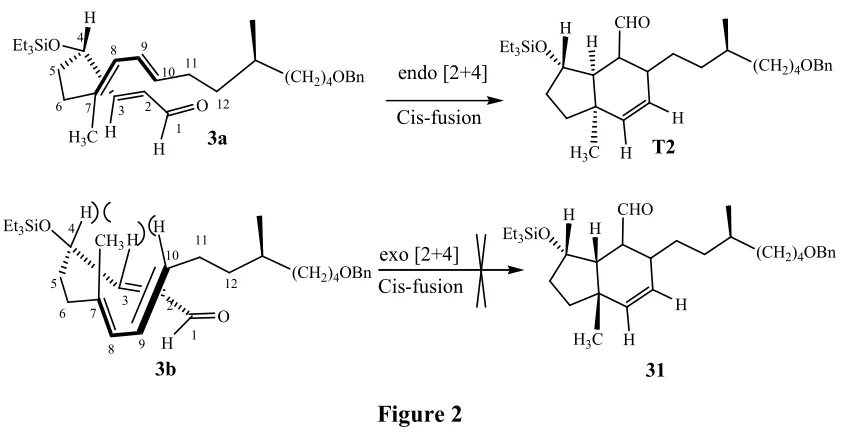
For cis five and six membered intramolecular Diels-Alder cyclization [2+4] half chair boat conformation is favorable, in which case intermediate 27a facing only C-3 H and C-7 CH3 steric
hindrance that also is five carbon-carbon bond away where as intermediate 27b facing strong steric hindrance between C-3 H, C-4 H, C-7 CH3 and C-10 H (Figure 2).
H3C Et3SiO
H
H
O H
(CH2)4OBn endo [2+4]
Cis-fusion
Et3SiO H
H3C
CHO
H H
(CH2)4OBn H
Et3SiO
H H
O
(CH2)4OBn
exo [2+4]
Cis-fusion
Et3SiO H
H3C
CHO
H H
(CH2)4OBn
H H
CH3
H
3a T2
3b 31
1 2 3 4 5
6 7 8 9
10 11 12
1 2 3 4
5 6 7
8 9 10
11 12
Figure 2
For further conformation we reduced the aldehyde T2 (Scheme 7) to alcohol 32.
H3C H TESO
OH BnO
H H H
32 T2
NaBH4, MeOH, 0 oC. 80%
22
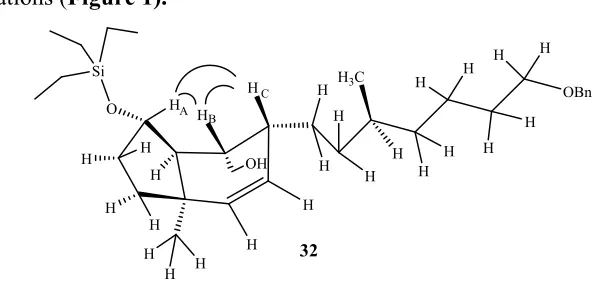
Further confirmed by NOESY interactions between the HA, HB and HC protons in 32
(Figure 3) gave full support in favor of the desired isomer which was also supported by quantum chemical calculations (Figure 1).
H H H H
O H H
H
H H Si
H H
H H OH
H3C
OBn H
H H
H
H H
H
H H
H H
H H
A B
C
32
Figure 3: NOESY interaction between the protons the HA, HB andHC.
In conclusion, we contructed stereoselective synthesis of the five and six member ring framework of the diterpene 2,3 dihydroxytrinervitanes with 19 carbon skeletons, where we used intramolecular Diels-Alder approach to contruct the core five and six member ring. We have executed highly stereoselective Julia-Kocienski olefination for the construction of the conjugated E-alkene , Sharpless epoxydation and Yadav’s protocol and Evan’s asymmetric alkylation to construct the chiral allyl aldehyde. The approach is thus feasible, simple and hopefully can be applied for first total synthesis of 2, 3 dihydroxytrinervitanes.
Chapter III, Section A
1,2-diketones have received a great attention because of their wide application in organic synthesis.
23
transformations with far-reaching synthetic applicability. However, there are no reports on the use of IBX for the conversion of 1,3-diol to 1,2-ketones.
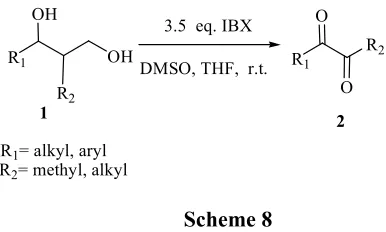
We have reported for the first time, the direct conversion of 1,3-diols to 1,2-diketones by an oxidative cleavage of C-C bond by using 3.5 eq. IBX in DMSO at ambient temperature (Scheme 8).
OH OH
R2
R1
O
O R1
R2
3.5 eq. IBX DMSO, THF, r.t.
R1= alkyl, aryl
R2= methyl, alkyl
1 2
Scheme 8
In efforts toward the synthesis of biologically active molecule (+) membrenone-C, (Figure 5) we attempted the selective oxidation of the primary alcohol in 1, 3-diol systems. Following the furan scheme we can get the compound A (scheme 25), followed by LAH reduction and protection deportations we can have the starting material 1b and 1c.
O O
O O
(+)-Membrenone -C
Figure 5
We found that 1b and 1c with an excess of IBX, the 1,3-diol systems underwent oxidative cleavage to afford 1,2-diketones. Theoretically we should get B, but in situ
24
O O
O O
H
O O
O
O
B
C
1).IBX(2 eq.) / DMSO, THF 2) (COCl)2 ,DMSO, Et3N, -780C
3) PCC, DCM,rt. :Reaction conditions : A
OH OH OBn OH
O
O O
OBn O O OBn OTBDPS
O OH
O OH
0 0C - rt, 4 hrs.
A
LAH, THF
OH
OH OBn
1b
TBDPSO
1c
O O
OBn DMSO, THF, r.t.
3.5 eq. IBX
2b 1b
TBDPSO
Scheme 9
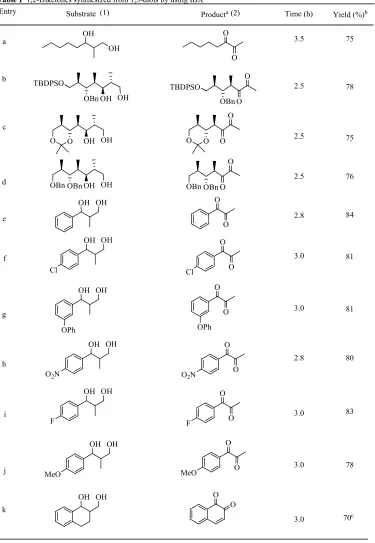
Noticeably, there were no considerable effect on the yield of products for simple aliphatic system or sterically hindered different type of hydroxy protecting groups present in 1,3-diols (entry a-d, Table 1) and aromatic systems (entry e-j, Table 1). Interestingly cyclic 1,3-diol 1k afforded unsaturated diketone 2k in 70% yield (entry k, Table 1).2-Alkyl substituted 1,3-diol such as other than methyl under same reaction condition such as 2-pentyl-1,3-butanediol gave compound 2a, less than 30% yield.
25
We were surprised to note that there was no hydroxy aldehyde in the mixture of the products formed. The products 2a, 3 and 4 were separated and further oxidized individually with 1 eq. of IBX. Thus, compound 3 was treated with 1 eq. of IBX to result in keto aldehyde 4 with diketone 2a. The keto aldehyde when further oxidized with 1 eq. of IBX resulted in only single product the diketone 2a. This experiment clearly revealed that 3 eq. of IBX will exclusively afford the 1,3-diol system to 1,2-diketone (Scheme 10).
C5H9 O
OH
3 DMSO, THF, r.t.
1 eq IBX
C5H9 O
O C5H9
O
O H
2a 4
C5H9 O
OH
3
C5H9 O
O
2a
DMSO, THF, r.t. 2 eq IBX
C5H9 O
O H
4
DMSO, THF, r.t. 1 eq IBX
C5H9 O
O
2a
DMSO, THF, r.t. C5H9
OH
OH C5H9
O
O
C5H9 O
OH C5H9 O
O
1 eq IBX H
1a 2a 3 4
Scheme 10
Plausible Reaction Mechanism
26 I O
O O R
O
H O
O
H
R
O H
OH I O
O O
OH R
O H
I O
O OH O
R
O H
OH
O O O
I OH R
O
H O
IO COOH R = alkyl, aryl
+
27 28
29 25
24
workup
+ HCOOH
OH
R OH
OH
R O O O
I
O O
H O
Scheme 11
27 OH OH O O O O OBn OH OH OBn OH OH O O OH OH
Cl Cl O
O O O OH OH OH OH OPh O OPh O OH OH
O2N O
O
O2N
OH OH F O O F OH OH MeO O O MeO OH OH O O O
O O O
OH OH OBn OBn O O OBn OBn a b f g h i 75 78 3.5 2.5
Entry Substrate Producta Time (h) Yield (%)b
Table 1 1,2-Diketones synthesized from 1,3-diols by using IBX
84 81 80 83 78 70c 81 2.8 2.8
a Reaction conditions: 1,3- diol (1mmol), iodoxybenzoic acid (3.5 mmol). b Isolated
yield. c 4.0 mmol of IBX was used.
28
Chapter III, Section B
B.1: Synthesis of 4-Chlorotetrahydropyrans via Prins- cyclization.
We wish to report a mild and efficient version of Prins-cylization for the rapid synthesis of halogenated tetrahydropyrans. Accordingly, treatment of benzaldehyde 1 with 3-buten-1-ol 2 in presence of 20 mol% of niobium chloride afforded 4-chloro-2-phenyltetrahydro-2H-pyran 3a in 92% yield (Scheme 12).
O
H Ph
O Cl
Ph HO
20 mol% NbCl5 +
r.t., 10-30 min
1 2 3a
1 2 3 4 5
6
Scheme 12
The stereochemistry of 3a was assigned on the basis of coupling constants of the hydrogens at C-2 and C-4 positions. The coupling constants of the benzylic hydrogens 2-Hc (δ
4.30, J = 11.3 Hz) ppm as well as the hydrogen on the carbon bearing the halide group 4-Hc (δ
4.18, J = 4.5 and 11.3 Hz) ppm in the 1H NMR spectrum showed a structure consistent with the phenyl group and the halide group being in the cis-configuration and equatorial position as shown in Fig. 1. The signal at δ 4.30 (2-Hc) ppm of 3a showed nOe correlation with the signal at
δ 4.18 (4-Hc) ppm.
(δ, 4.30, J = 11.3 Hz) O
H H Cl
H
Ph H
(δ, 4.18, J = 4.5, 11.3 Hz) nOe
Figure 6: Important nOe’s of product 3a
In a similar manner, various substituted benzaldehydes such as o-chloro-, m-phenoxy-, p-cyano-,
29
conditions (entries h, i and j, Table 1). The reactions are clean and the products were obtained in excellent yields with high diastereoselectivity. Like niobium(V) chloride, gallium tribromides (35 mol%) and gallium triiodide (35 mol%) gave the corresponding bromo- and iodo-adducts respectively, under similar conditions (entries g, k and l, Table 1, Scheme 13).
R O
H
O X
R HO
35 mol% GaX3 +
r.t., 10-25 min
1 2 3 X = Br, I
Scheme 13
In all cases, the reactions proceeded rapidly at room temperature with high efficiency. In the absence of catalyst, no reaction was observed between homoallyl alcohol and aldehyde. As solvent, dichloromethane appeared to give the best results.
HO O
R H
NbCl5
O Cl
R O
O NbCl4
R R O
+
+
- HCl
(+)
- [NbOCl4]
-Cl
Scheme 14
Among various Lewis acids such as InCl3, InBr3, InI3, CeCl3.7H2O-NaI and BiCl3 tested,
30
1.
Entry 3-buten-1-ol Producta
a
15 90
b
c
Table 1: synthesis of 4-halotetrahydropyran derivatives
O Cl
10 92
O Cl PhO CHO CHO PhO Aldehyde OH 12 95 O Cl Cl CHO Cl " " Catalyst
20 mol% NbCl5
20 mol% NbCl5
20 mol% NbCl5
Time (min) Yield (%)b
i)
j h
aAll products were characterized by IR, NMR and mass spectroscopy. bIsolated and unoptimized yields
k l 25 78 O Cl O Cl 20 82 CHO CHO O Cl Ph CHO Ph O Br CHO " " " "
30 80
15 87
O I CHO
" 25 82
20 mol% NbCl5
20 mol% NbCl5
20 mol% NbCl5
35 mol% GaBr3
35 mol% GaI3
15 89 10 93 d e O NC O Cl F CHO NC F CHO " "
20 mol% NbCl5
20 mol% NbCl5
12 91
f
g
O Cl
O2N CHO
O2N " 10 89 O I Br CHO Br "
20 mol% NbCl5
31
Chapter III, Section B
B.2: Gallium chloride catalyzed three component coupling of naphthol, alkyne and aldehyde: a novel synthesis of 1,3-diaryl-3H-benzo[f] chromenes via Prins- cyclization.
We developed a novel and efficient protocol for the alkenylation and alkylation of naphthols and phenols with aryl acetylenes and vinyl arenes using a catalytic amount of gallium(III) chloride. Initially, we attempted the hydroarylation of phenyl acetylene (2), with β -naphthol (1) in the presence of 10 mol% of gallium(III) chloride. The reaction proceeded smoothly in refluxing toluene to afford 1-(1-phenylvinyl)-2-naphthol 3a in 80% yield (Scheme 16).
GaCl3 Toluene, reflux
1 2 3
OH
Scheme 16
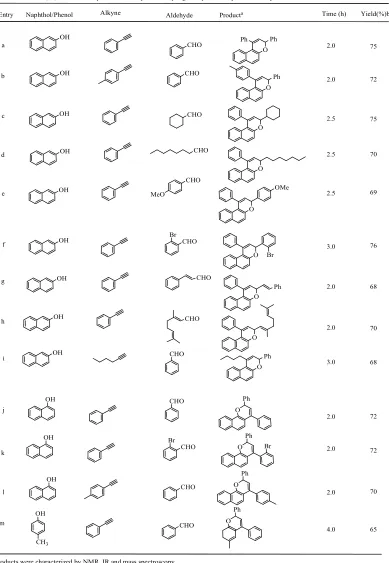
We reported a novel protocol for the one-pot synthesis of 1,3-diaryl-3H-benzo[f]chromenes by means of a coupling of naphthol, alkyne and aldehyde using a catalytic amount of GaCl3. Accordingly, we first attempted a three component coupling (3CC) of
2-naphthol (1) with phenyl acetylene (2) and benzaldehyde (4) using 10 mol% GaCl3 in toluene.
The reaction proceeded at 110 oC in toluene and the desired product, 1,3-phenyl-3H-benzo[f]chromene 5a, was obtained in 75% yield (Scheme 17).
OH CHO
O GaCl3
Toluene, reflux
1 2 4 5
32
This result provided incentive to extend this process for various substrates. Interestingly, a wide variety of aldehydes such as cyclohexanecarboxaldehyde, 1-octanal, 4-methoxy-benzaldehyde, 2-bromo4-methoxy-benzaldehyde, cinnamaldehyde and citral underwent smooth coupling with 2-naphthol and phenyl acetylene under identical conditions (entries c-h, Table 1). Other alkynes such as 1-ethynyl-4-methylbenzene and 1-octyne also underwent coupling with naphthol and benzaldehyde to give the corresponding chromene derivatives in good yields (entries b, l and i, Table 1). Besides β-naphthol, α-naphthol and p-cresol also participated in the 3CC reaction (entries j-m, Table 1). The products were fully characterized by NMR, IR and mass spectroscopy.
In the absence of catalyst, no reaction was observed even after long reaction time (12 h) under reflux conditions. Toluene appeared as a solvent of choice for the best conversions. The effects of various metal halides such as FeCl3, BiCl3, InCl3, ZnCl2, CeCl3.7H2O and metal
triflates like In(OTf)3, Bi(OTf)3, Sc(OTf)3, Yb(OTf)3 were screened for this conversion. Of
these, GaCl3 was found to be the most effective in terms of conversion. This is because of high
alkynophilicity of gallium. However, Brønsted acids such as montmorillonite K10, heteropoly acid and ion-exchange resins failed to produce the desired product. In the absence of aldehyde, only 1-(1-phenylvinyl)naphthalen-2-ol was obtained exclusively. It reveals that the reaction proceeds via arylation of alkyne followed by a subsequent cyclization with aldehyde would give the desired chromene (Scheme 18).
OH O
Ph Ga
H Ga(III)
O H
Ga(III) Ph
OH H H
Ph
OGa(III) Ph O H
O
Ph Ph
+
..
+
.. ..
Protodemetallation
33
The scope of this method is illustrated with respect to various aldehydes and alkynes and the results are presented in Table 1.6
OH O Ph Ph CHO O Ph CHO O CHO O MeO CHO O OMe Br CHO O Br CHO O Ph OH OH OH OH OH OH CHO
Entry Producta Time (h) Yield(%)b
75 70 b e f g c d a
Table 1: Gallium(III) chloride-catalyzed three component coupling of naphthol, alkyne and aldehyde
76 69 Naphthol/Phenol Alkyne 68 3.0 2.0 75 2.5 2.5 2.5
aProducts were characterized by NMR, IR and mass spectroscopy. bYield refers to pure products after column chromatography.