Limited potential of school textbooks
to prevent tobacco use among students
grade 1
–
9 across multiple developing
countries: a content analysis study
Junko Saito,1Daisuke Nonaka,2Tetsuya Mizoue,3Jun Kobayashi,4,5 Achini C Jayatilleke,1Sabina Shrestha,1Kimiyo Kikuchi,1Syed E Haque,6 Siyan Yi,7Irene Ayi,8Masamine Jimba1
To cite:Saito J, Nonaka D,
Mizoue T,et al. Limited
potential of school textbooks to prevent tobacco use
among students grade 1–9
across multiple developing countries: a content analysis
study.BMJ Open2013;3:
e002340. doi:10.1136/ bmjopen-2012-002340
▸ Prepublication history for
this paper are available online. To view these files please visit the journal online (http://dx.doi.org/10.1136/ bmjopen-2012-002340).
Received 13 November 2012 Revised 10 January 2013 Accepted 28 January 2013
This final article is available for use under the terms of the Creative Commons Attribution Non-Commercial 2.0 Licence; see
http://bmjopen.bmj.com
For numbered affiliations see end of article.
Correspondence to Dr Daisuke Nonaka; [email protected]
ABSTRACT
Objective:To evaluate the content of school textbooks as a tool to prevent tobacco use in developing countries.
Design:Content analysis was used to evaluate if the textbooks incorporated the following five core components recommended by the WHO:
(1)consequences of tobacco use; (2)social norms; (3)reasons to use tobacco; (4)social influencesand (5)resistance and life skills.
Setting:Nine developing countries: Bangladesh, Cambodia, Laos, Nepal, Sri Lanka, Benin, Ghana, Niger and Zambia.
Textbooks analysed:Of 474 textbooks for primary and junior secondary schools in nine developing countries, 41 were selected which contained descriptions about tobacco use prevention.
Results:Of the 41 textbooks, theconsequences of tobacco usecomponent was covered in 30 textbooks (73.2%) and thesocial normscomponent was covered in 19 (46.3%). The other three components were described in less than 20% of the textbooks.
Conclusions:A rather limited number of school textbooks in developing countries contained
descriptions of prevention of tobacco use, but they did not fully cover the core components for tobacco use prevention. The chance of tobacco prevention education should be seized by improving the content of school textbooks.
INTRODUCTION
Tobacco use is a significant public health
issue among adolescents. In developing countries, approximately 68 000 to 84 000 adolescents start smoking every day, which accounts for 80% of all adolescents taking up
smoking daily across the world.1
To prevent adolescents’ use of tobacco,
various initiatives have been undertaken in developing countries. Such efforts include
raising the taxation on tobacco products,
expanding smoke-free environments and
conducting the Global Youth Tobacco Survey
(GYTS) to understand adolescents’
behav-iour, knowledge and norms.2Another widely
implemented initiative worldwide has been school-based prevention education, which is recommended as an essential element of
tobacco control programmes by the WHO.3
The WHO has proposed guidelines outlining
six core components to prevent adolescents’
use of tobacco through school-based
educa-tion.3 These components include (1)
conse-quences of tobacco use, (2) social norms,
(3) reasons to use tobacco, (4) social infl
u-ences, (5) resistance skills and (6) life skills. In principle, school-based education has
great potential to prevent tobacco use
among adolescents. Though conclusive evi-dence of long-term effectiveness is still needed, school-based educational messages
ARTICLE SUMMARY
Article focus
▪ An analysis of the content of school textbooks about tobacco use prevention in developing countries.
Key messages
▪ The descriptions on prevention of tobacco use were contained in a rather limited number of school textbooks in developing countries. ▪ Key components of tobacco prevention education
were not fully described in the school textbooks.
Strengths and limitations of this study ▪ This is the first multicountry study to evaluate
the content of school textbooks about tobacco use prevention in developing countries.
▪ Investigation was not done on whether better school textbooks made a difference.
on September 22, 2020 by guest. Protected by copyright.
can reach large numbers of adolescents at the critical
time for uptake of smoking.4 Especially in developing
countries, the advantage of school-based education is
compounding as the enrolment of the official age-group
for a given level rapidly increases. In sub-Saharan Africa, for example, the enrolment rate increased from 56% in
the 1990s to 70% in 2006.5 While school-based
pro-grammes that incorporate the key components proposed by the WHO have been effective in reducing
adoles-cents’use of tobacco in the short term, long-term
effect-iveness has been found to be limited.6 However, if the
programmes were to include booster sessions that spanned the high school years, then they might arguably
register long-term effects as well.7 Moreover, recent
studies indicate a possibility to improve the effectiveness of school-based programmes by combining them with other programmes such as community interventions or
mass media campaigns.8 9
School textbooks are the most commonly used and crucial educational resources, especially in developing
countries.10 While various textbooks may contain
infor-mation related to health, such inforinfor-mation may in some
cases not be supported by scientific evidence.11
Accordingly, the Unesco has proposed ‘quality
develop-ment’of school textbooks as one of the key strategies to
achieve ‘Education for All’ by 2015.12 Yet school
text-books have been overlooked as a potential tool to prevent tobacco use among schoolchildren. Though some research has analysed the content of health-related
textbooks,11 13 14 little has been done to examine the
content of school textbooks related specifically to
tobacco use prevention. If the quality of school text-books is poor in this regard, it may detract from oppor-tunities to use them effectively in health education to avoid tobacco use among adolescents. The objective of this study was thus to evaluate whether the information in the textbooks being used for a cross-section of the developing world is covering the core components necessary for preventing tobacco use in these settings.
METHODS
Textbook collection
Textbooks were sampled between January 2009 and March 2010. We selected Bangladesh, Cambodia, Laos, Nepal, Sri Lanka, Benin, Ghana, Niger and Zambia for inclusion in the study because (1) tobacco control is still limited in these nine countries despite being a part of
the ‘Framework Convention on Tobacco Control’
inter-national treaty, (2) we have established relationships with local collaborators in these countries and (3) these local collaborators have forged strong partnerships with key education sector elements such as the Ministry of Education and the local education department. Local collaborators had knowledge of the textbooks used in public primary and junior secondary schools in the public sector. Some collaborators also contributed for reviewing of the textbooks. In Bangladesh, Cambodia,
Laos, Nepal, Sri Lanka and Zambia, there was only one textbook publisher that was authorised by the govern-ment to publish, so we decided to collect all the text-books published by the authorised body. By contrast, in Benin, Ghana and Niger, where there were multiple authorised publishers, we decided to collect the text-books deemed to be most commonly used in public schools on the basis of consultation with local experts. The collected textbooks covered all subjects including mathematics and language arts, as integrated health education is widely adopted in many countries. The
target grades were 1–9, which correspond to primary
and junior secondary school students in most countries. In Bangladesh and Nepal, however, as the junior
second-ary schoolsfinish at grade 8, we supplemented the grade
9 textbooks by adding textbooks from the first year of
high school in these two countries. Additionally,
although the final grade of the junior secondary schools
is grade 10 in Niger and Benin, our examination did not extend through the grade 10.
We obtained textbooks from bookshops, the Ministry of Education or through organisations authorised by the government to distribute textbooks to schools. In total, 474 textbooks were collected and included in the analyses; 70 textbooks came from Bangladesh, 37 from Cambodia, 63 from Laos, 69 from Nepal, 68 from Sri Lanka, 36 from Benin, 33 from Ghana, 57 from Niger and 41 from Zambia.
Textbook examination
Each of the textbooks was reviewed by two public health experts for content on the use of substances including alcohol, tobacco or drugs. The second reviewer checked
the first reviewer’s extracted information for soundness.
In cases where the original textbook content was written in French or a local language, public health experts in
each country identified relevant health-related contents
in the textbooks and translated those portions into English. When a content or translation discrepancy was
identified between the two reviewers, textbooks were
re-examined for clarification. Finally, content related to
tobacco use was selected for analysis. We categorised descriptions about general substance use as tobacco use descriptions only where the chapter included an
explan-ation that specifically mentioned tobacco use.
Content analysis
We conducted a content analysis using descriptive statis-tics, with proportions calculated from quantitative
research findings. We categorised the textbook content
using five core components defined according to the
WHO guidelines: (1) consequences of tobacco use(eg, heart
disease and cancer); (2) social norms (eg, to decrease
social acceptability and correct overestimation of peers’
smoking habits); (3) reasons to use tobacco (eg, a desire
for acceptance and stress reduction); (4)social influences
(eg, promoting tobacco use through peers, family and
the media) and (5) resistance and life skills (eg, to resist
on September 22, 2020 by guest. Protected by copyright.
such social influences and avoid tobacco use).3 The
WHO guidelines‘Information Series on School Health,
Tobacco Use Prevention’present six components
encap-sulating school-based strategies for preventing tobacco use among adolescents. Out of these, the resistance skills and life skills components were combined in this study, as these skills are typically taught together. For
instance, specific skills to resist pressure to smoke are
taught as the application of general assertive skills.15
After categorising the textbook content according to the
five core components, we developed subcategories based
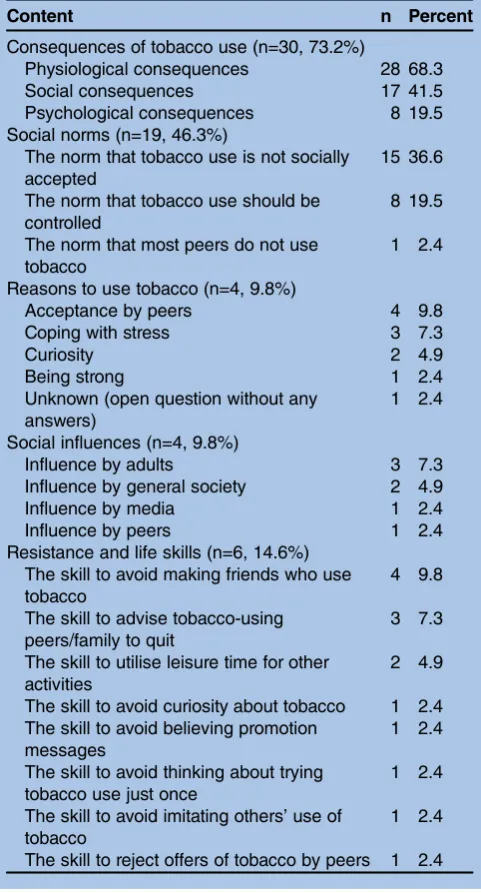
on the WHO guidelines and evidence from previous research into which the content was then divided. The number of textbooks containing each sub-category of the content and their percentages out of 41 textbooks were calculated (table 2). As one textbook can include several components/subcategories, the sum of all indi-vidual component/sub-category counts can exceed the total number of textbooks.
RESULTS
Characteristics of the target textbooks
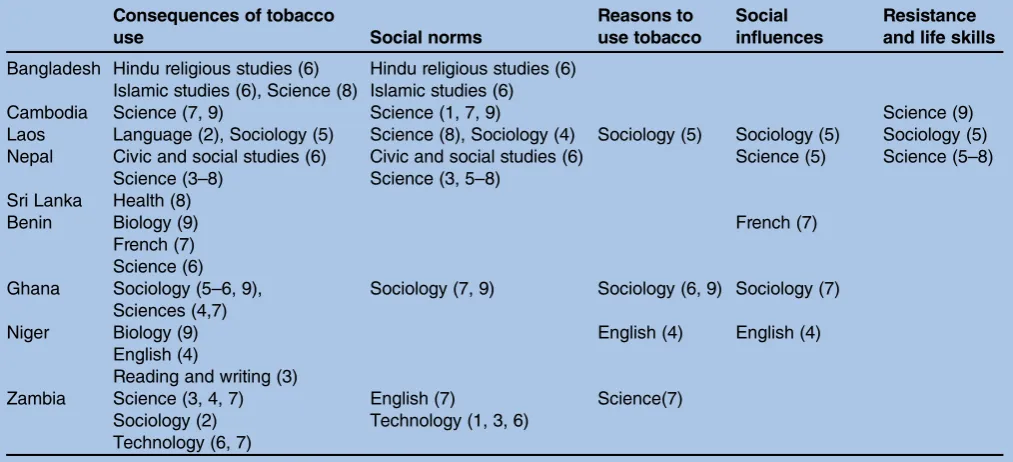
Out of the 474 textbooks collected from nine countries, 41 (8.6%) contained descriptions of prevention of tobacco use. Of these, 35 (85.4%) were in science-related subjects and six (14.6%) were in language-related or religion-related subjects (table 1). In each country, a text-book within at least one subject included content aimed at tobacco use prevention, ranging from one subject in Sri Lanka (Health) to four subjects in Zambia (Science, Sociology, Technology and English). Additionally, 16 of the 41 textbooks (39.0%) contained content falling
outside the scope of the five core components, such as
descriptions covering cessation of tobacco use.
The grade in which tobacco use prevention education was initiated varied widely among the target countries. The median was grade 3, but data points ranged from grade 1 in Cambodia and Zambia, to grade 8 in Sri Lanka (table 1). Regarding booster sessions, the consequences of tobacco use component and social norms component were taught in more than two grades in
eight countries and in five countries, respectively. The
other three components were not taught across multiple grades or were taught in only one country.
Characteristics of the textbook content
Among thefive core components of tobacco prevention
education (table 1), the average number of components covered in any textbook was three, ranging from one in
Sri Lanka to five in Laos. The consequences of tobacco use
component was contained in at least one textbook in all nine countries; the other components were only covered in some of the target countries. Regarding the
distribu-tion of each of the five components (table 2), the
conse-quences of tobacco use component was covered in 30
textbooks (73.2%) while thesocial normscomponent was
covered in 19 textbooks (46.3%). The other three com-ponents were incorporated in less than 15% of the
text-books (reasons to use tobacco: 9.8%;social influences: 9.8%;
resistance and life skills: 14.6%).
The distribution of content across the sub-categories
of each component ranged widely. Within the
conse-quences of tobacco use component, physiological
consequences such as ‘tobacco use can result in
exacer-bation of asthma’, which was included in 28 (68.3%)
textbooks, was the most frequently described
subcat-egory. Social consequences, such as ‘smoking can cause
a financial burden’, was the second most frequently
Table 1 Subjects and grades of textbook content with components for tobacco use prevention in the countries surveyed (number of grades)
Consequences of tobacco
use Social norms
Reasons to use tobacco
Social influences
Resistance and life skills
Bangladesh Hindu religious studies (6) Hindu religious studies (6) Islamic studies (6), Science (8) Islamic studies (6)
Cambodia Science (7, 9) Science (1, 7, 9) Science (9)
Laos Language (2), Sociology (5) Science (8), Sociology (4) Sociology (5) Sociology (5) Sociology (5) Nepal Civic and social studies (6) Civic and social studies (6) Science (5) Science (5–8)
Science (3–8) Science (3, 5–8) Sri Lanka Health (8)
Benin Biology (9) French (7)
French (7) Science (6) Ghana Sociology (5–6, 9),
Sciences (4,7)
Sociology (7, 9) Sociology (6, 9) Sociology (7)
Niger Biology (9) English (4) English (4)
English (4)
Reading and writing (3)
Zambia Science (3, 4, 7) English (7) Science(7) Sociology (2) Technology (1, 3, 6)
Technology (6, 7)
on September 22, 2020 by guest. Protected by copyright.
included sub-category in this domain; it appeared in 17 textbooks (41.5%).
DISCUSSION
Our results suggest that textbooks in the countries sur-veyed do not comprehensively cover or systematically integrate the core components necessary for effective youth tobacco prevention education.
The component found in the majority (30 of 41) of
textbooks was the consequence of tobacco use factor. This
finding suggests that knowledge-based education is still a
common type of tobacco prevention education in schools within the target countries. Knowledge about the consequences of tobacco use is one of the core com-ponents of tobacco use prevention laid down by the
WHO guidelines.3Yet such knowledge alone has limited
impact when it comes to reducing smoking behaviour
among adolescents.6 16 Adolescents tend to overestimate
the prevalence of peer smoking and their estimates can
impact on their smoking behaviour.17 18However, social
normsdescriptions were often lacking from the textbooks in the target countries, especially those covering the norm of correcting overestimation.
The remaining three components (reasons to use
tobacco, social influences and resistance and life skills) were described much less frequently in the textbooks. Even descriptions about peer pressure were included in only
12.2% of the target textbooks (‘Acceptance by peers’for
the reasons to use tobacco component and ‘Influence by
peers’ for the social influences component), despite peer
pressure being one of the strongest predictors of
tobacco using behaviour among adolescents globally.19
In addition, all of the descriptions of resistance and life
skills only explained the behaviour and none included any application of training methods, such as role-playing
activities, for developing these skills.20
The social influences approach has been considered to
be widely effective in reducing adolescent smoking preva-lence and initiation, and many tobacco prevention pro-grammes have employed this approach in the last three
decades.21 First, adolescents learn about the potential
influences on tobacco using behaviour they are likely to
receive through their peers, family members and the
media.21 Once students recognise high-risk situations,
they learn practical approaches to handling or avoiding
such social influences.21 Normative education promotes
a norm against tobacco use among peers, which is a necessary norm for skills training to deal with peer
pres-sures,22 and corrects their misperceptions that tobacco
use is common among peers. Knowledge-based educa-tion is expected to support this normative educaeduca-tion.
Thus, all of thefive core components need to be
system-atically integrated into the textbooks of certain subjects in order to reduce or prevent youth tobacco use.
In the case of Laos, although allfive components were
included in the targeted textbooks, each component was separately contained in the textbooks for several
subjects and grades. For example,social norms and
conse-quences of tobacco use components were contained in the textbooks of several subjects for different grades.
However, as knowledge about the consequences of tobacco
use is expected to support normative education, the
cor-responding sessions are expected to be linked within the
framework of‘tobacco prevention education’.
Content geared towards tobacco use prevention
appeared in primary school (grades 1–5 in Bangladesh
and Nepal, and grades 1–6 in the remaining countries)
textbooks in all of the countries surveyed except for Bangladesh and Sri Lanka. As school-based prevention education targets all students in the classroom, the education should be implemented before the onset of tobacco use. Notably, some students in developing coun-tries start using tobacco earlier than junior secondary school. In Ghana and Malawi, for instance, about 40% of
smokers aged 13–15 years had smoked theirfirst cigarette
Table 2 Content of descriptions regarding tobacco use among textbooks in the countries surveyed (n=41)
Content n Percent
Consequences of tobacco use (n=30, 73.2%)
Physiological consequences 28 68.3 Social consequences 17 41.5 Psychological consequences 8 19.5 Social norms (n=19, 46.3%)
The norm that tobacco use is not socially accepted
15 36.6
The norm that tobacco use should be controlled
8 19.5
The norm that most peers do not use tobacco
1 2.4
Reasons to use tobacco (n=4, 9.8%)
Acceptance by peers 4 9.8
Coping with stress 3 7.3
Curiosity 2 4.9
Being strong 1 2.4
Unknown (open question without any answers)
1 2.4
Social influences (n=4, 9.8%)
Influence by adults 3 7.3
Influence by general society 2 4.9
Influence by media 1 2.4
Influence by peers 1 2.4
Resistance and life skills (n=6, 14.6%) The skill to avoid making friends who use tobacco
4 9.8
The skill to advise tobacco-using peers/family to quit
3 7.3
The skill to utilise leisure time for other activities
2 4.9
The skill to avoid curiosity about tobacco 1 2.4 The skill to avoid believing promotion
messages
1 2.4
The skill to avoid thinking about trying tobacco use just once
1 2.4
The skill to avoid imitating others’use of tobacco
1 2.4
The skill to reject offers of tobacco by peers 1 2.4
on September 22, 2020 by guest. Protected by copyright.
before the age of 10.23 Although junior secondary school students are the main focus of research about
school-based prevention,24 the effects of smoking
prevention programmes during primary school have been
shown to survive the transition to secondary schools.25
A critical time period for implementation of tobacco prevention education in these countries might thus be primary school.
In addition, the content on tobacco use prevention was taught repeatedly in multiple grades. Such booster sessions have been shown to be effective only if the
pro-grammes include core components like social infl
u-ences, social norms and resistance skills, and if the same
content is boosted over multiple years.21 In the present
study, however, essentially only the consequences of tobacco use and/or social norms components were contained in the textbooks across multiple grades. In addition, the targeted subject of booster sessions in each
component was not always the same in each country—
an inconsistent approach unlikely to be effective.7These
results suggest that booster sessions in target countries might, in their current format, have a limited effect in
preventing tobacco use among students in grades 1–9.
Overall, our findings revealed that most of the
WHO-specified key components of tobacco use
preven-tion were not well reflected in the textbooks used in
grades 1–9 in the developing countries surveyed. Tobacco
issues need to be integrated into the curriculum within
the framework of‘tobacco prevention education’, because
the key components of tobacco prevention education were covered only partially in the existing textbooks for various subjects and grades. Booster sessions should also be encouraged and covered in the textbooks. Moreover, evidence shows that the combination of a school-based curriculum and mass media messages on tobacco industry manipulation has had a great impact in preventing
tobacco use among adolescents.9 Although evidence on
the effectiveness of mass media campaigns comes mainly from developed countries, a similar impact can also be expected among adolescents in developing countries, as
they are similarly receptive to tobacco marketing.26
Such insights must, of course, be considered in the
context of five primary limitations associated with this
study. First, investigation was not done into whether better school textbooks made a difference. In this study, we evaluated if school textbooks incorporate the core components as necessary to prevent tobacco use. However, we did not investigate the impact of such school textbooks which cover all the core components
on preventing or reducing adolescents’ use of tobacco.
Further study is necessary to assess whether the content of school textbooks actually makes a difference in tobacco use among students as well.
Second, the content of textbooks alone does not
necessarily reflect the reality of school-based education.
Other forms of educational resources designed to prevent tobacco use may also be available in schools beyond textbooks. In Cambodia, for example, an
international NGO has been providing school-based tobacco use prevention education through drama
per-formances.27 Nevertheless, school textbooks are a
central and important resource for teachers, especially in developing countries where such resources tend to be
limited.10 In addition, textbooks are available for all
schools nationwide and are more likely to be sustainable than educational resources provided by donors, which sometimes target limited areas of the country and may be associated with one-shot programmes.
Third, the study lacked data on high school textbooks. One of the key factors linked to long-term effects through school-based programmes is providing booster
sessions in high schools.7 Therefore, the results of this
study might include underestimations or overestimations of true content prevalence due to the somewhat limited reach of our data collection. However, because more than half of the children in the target countries, with the exception of Sri Lanka, do not go on to high school-level education, data on high school textbooks would seem to be of limited value.
Fourth, although two reviewers were involved in identi-fying the textbook descriptions about substance use, the review was not independently done; rather, the
second reviewer checked the first reviewer’s extracted
information for soundness. Thus, the results of this study might be biased compared to those produced by independent reviews.
Finally, the policy aspect of school regulations regard-ing tobacco use was not taken into account. The relevant factors in this vein might have included, for example, the implementation of tobacco use restrictions in schools. Since a well-implemented school policy is an important component of school-based health
promo-tion,28 further study is necessary to assess the influence
of school policy on tobacco use among students as well.
CONCLUSIONS
The descriptions of prevention of tobacco use were contained in quite a limited number of textbooks in the nine target countries. In addition, the content did not comprehensively cover the necessary core components as outlined by the WHO guidelines for tobacco prevention education. Furthermore, they were not integrated
system-atically with sufficient boosters across grades 1–9. Most of
the WHO-specified key components of tobacco use
pre-vention were limited in their inclusion in textbooks across the target countries, or were absent altogether. Thus, the poor content of tobacco use is, in effect,
squan-dering rare opportunities to educate students grade 1–9
in developing countries. Improving school textbook content could contribute to more effective prevention of tobacco use among students in these settings.
Author affiliations
1Department of Community and Global Health, Graduate School of Medicine,
The University of Tokyo, Tokyo, Japan
on September 22, 2020 by guest. Protected by copyright.
2Department of Parasitology and International Health, Graduate School of
Medicine, University of the Ryukyus, Okinawa, Japan
3Department of Epidemiology and Prevention, Clinical Research Center,
National Center for Global Health and Medicine, Tokyo, Japan
4Graduate School of International Health Development, Nagasaki University,
Nagasaki, Japan
5Department of International Medical Cooperation, National Center for Global
Health and Medicine, Tokyo, Japan
6UChicago Research Bangladesh Ltd, Dhaka, Bangladesh
7The Walter H. Shorenstein Asia-Pacific Research Center, Freeman Spogli
Institute of International Studies, Stanford University, Stanford, USA
8Parasitology Department, Noguchi Memorial Institute for Medical Research,
University of Ghana. Legon, Accra, Ghana
AcknowledgementsThe authors would like to thank their local collaborators as well as officials from the health and education sectors in the participating countries for their contributions and support.
Contributors JS performed the analysis and drafted the manuscript. DN, TM, JK and MJ conceived of the study and participated in its design and coordination. DN and MJ helped to draft the manuscript. DN, ACJ, SS, KK, SHE, SY and IA collected the data and helped to perform the analysis. All authors read and approved the final manuscript.
Funding This study was funded by the Ministry of Health, Labour and Welfare of Japan (research grant number: H21-chikyukibo-wakate-011) and the National Center for Global Health and Medicine, Japan (research grant number: 24S2).
Competing interests None.
Provenance and peer review Not commissioned; externally peer reviewed.
Data sharing statement No additional data are available.
REFERENCES
1. World Bank. Curbing the epidemic: governments and the economics of tobacco control. The International Bank for Reconstruction and Development 1999. http://www.usaid.gov/policy/ads/200/tobacco.pdf (accessed 20 Aug 2012).
2. Warren CW, Jones NR, Peruga A,et al. Global youth tobacco surveillance, 2000–2007.MMWR Surveill Summ2008;57:1–28. 3. WHO.Information Series on School Health: tobacco use prevention:
an important entry point for the development of a health-promoting school. World Health Organization, 1998. http://www.who.int/ school_youth_health/media/en/89.pdf (accessed 20 Aug 2012). 4. Park H, Dent C, Abramsohn E,et al. Evaluation of California’s
in-school tobacco use prevention education (TUPE) activities using a nested school-longitudinal design, 2003–2004 and 2005–2006.
Tob Control2010;19:i43–50.
5. UNESCO.Overcoming inequality: why governance matters. Education for all global monitoring report. United Nations Educational, Scientific and Cultural Organization, 2009. http://unesdoc.unesco.org/images/0017/001776/177683e.pdf (accessed 20 Aug 2012).
6. Thomas RE, Perera R. School-based programmes for preventing smoking.Cochrane Database Syst Rev2006;19:CD001293. 7. Flay BR. The promise of long-term effectiveness of school-based
smoking prevention programs: a critical review of reviews.Tob Induc Dis2009;5:7.
8. Longshore D, Ghosh-Dastidar B, Ellickson PL. National youth anti-drug media campaign and school-based drug prevention: Evidence for a synergistic effect in ALERT Plus.Addict Behav2006;31:496–508. 9. Brinn MP, Carson KV, Esterman AJ,et al. Mass media interventions
for preventing smoking in young people.Cochrane Database Syst Rev2010;11:CD001006.
10. Mohammad R, Kumari R. Effective use of textbooks: a neglected aspect of education in Pakistan.J Educ Int Dev2007;3:5. 11. Barrio-Cantalejo I, Ayudarte-Larios L, Hernán-García M,et al. Are
the health messages in schoolbooks based on scientific evidence? A descriptive study.BMC Public Health2011;11:54–64.
12. UNESCO.A comprehensive strategy for textbooks and learning materials. United Nations Educational, Scientific and Cultural Organization, 2005. http://unesdoc.unesco.org/images/0014/001437/ 143736eb.pdf (accessed 20 Aug 2012).
13. Nonaka D, Jimba M, Mizoue T,et al. Content analysis of primary and secondary school textbooks regarding malaria control: a multi-country study.PLoS ONE2012;7:e36629.
14. Nomoto M, Nonaka D, Mizoue T,et al. Content analysis of school textbooks on health topics: a systematic review.Biosci Trends
2011;5:61–8.
15. Botvin GJ, Griffin KW, Diaz T,et al. Drug abuse prevention among minority adolescents: posttest and one-year follow-up of a school-based preventive intervention.Prev Sci2001;2:1–13. 16. Botvin GJ, Griffin KW, Diaz T,et al. Smoking initiation and
escalation in early adolescent girls: one-year follow-up of a school-based prevention intervention for minority youth.J Am Med Womens Assoc1999;54:139–43.
17. Sussman S, Dent CW, Mestel-Rauch J,et al. Adolescent nonsmokers, triers, and regular smokers’estimates of cigarette smoking prevalence: when do overestimations occur and by whom?
J Appl Soc Psychol1988;18:537–51.
18. Ellickson PL, Bird CE, Orlando M,et al. Social context and adolescent health behavior: does school-level smoking prevalence affect students’subsequent smoking behavior?J Health Soc Behav
2003;44:525–35.
19. Tyas SL, Pederson LL. Psychosocial factors related to adolescent smoking: a critical review of the literature.Tob Control
1998;7:409–20.
20. Hansen WB. School-based substance abuse prevention: a review of the state of the art in curriculum, 1980–1990.Health Educ Res
1992;7:403–30.
21. Botvin GJ. Preventing drug abuse in schools: social and competence enhancement approaches targeting individual-level etiologic factors.Addict Behav2000;25:887–97.
22. Donaldson SI, Sussman S, MacKinnon DP,et al. Drug abuse prevention programming.Am Behav Sci1996;39:868–83. 23. Global Youth Tobacco Survey Collaborative Group. Tobacco use
among youth: a cross country comparison.Tob Control
2002;11:252–70.
24. Botvin GJ, Griffin KW. School-based programmes to prevent alcohol, tobacco and other drug use.Int Rev Psychiatry2007;19:607–15. 25. Crone M, Spruijt R, Dijkstra N,et al. Does a smoking prevention
program in elementary schools prepare children for secondary school?Prev Med2011;52:53–9.
26. Saito J, Yasuoka J, Poudel KC,et al. Receptivity to tobacco marketing and susceptibility to smoking among non-smoking male students in an urban setting in Lao PDR.Tob Control. Published Online First: 26 May 2012. doi: 10.1136/tobaccocontrol-2011-050125
27. Adventist Development and Relief Agency.Cambodia Annual Report 2001. http://www.adracambodia.org/annual-review/Review%202001. pdf (accessed 20 Aug 2012).
28. Evans-Whipp T, Beyers JM, Lloyd S,et al. A review of school drug policies and their impact on youth substance use.Health Promot Int
2004;19:227–34.
on September 22, 2020 by guest. Protected by copyright.