DEPARTMENT OF INFORMATION ENGINEERING AND COMPUTER SCIENCE ICT International Doctoral School
Understanding and Exploiting Language
Diversity
Khuyagbaatar Batsuren
Advisor
Prof. Fausto Giunchiglia
Università degli Studi di Trento
Abstract
Languages are well known to be diverse on all structural levels, from the smallest (phonemic) to the broadest (pragmatic). We propose a set of formal, quantita-tive measures for the language diversity of linguistic phenomena, the resource incompleteness, and resource incorrectness. We apply all these measures to lexical semantics where we show how evidence of a high degree of universal-ity within a given language set can be used to extend lexico-semantic resources in a precise, diversity-aware manner. We demonstrate our approach on sev-eral case studies: First is on polysemes and homographs among cases of lexical ambiguity. Contrarily to past research that focused solely on exploiting system-atic polysemy, the notion of universality provides us with an automated method also capable of predicting irregular polysemes. Second is to automatically iden-tify cognates from the existing lexical resource across different orthographies of genetically unrelated languages. Contrarily to past research that focused on detecting cognates from 225 concepts of Swadesh list, we captured 2.7 million cognates across 40 different orthographies and 335 languages by exploiting the existing wordnet-like lexical resources.
Keywords
Acknowledgements
Thanks to the professors and advisors (Fausto, and Gabor), families (Batsuren Togooch, Erdenedawaa Bal, Temulen Khishigsuren), members(Subashis, Mer-cedes, Enrico, Hanyu, Sajan, ...), former colleagues (Tsendsuren Munkhdalai, Meijing Li, Park Minghao, Keun Ho Ryu) etc..
Publications
• Giunchiglia, Fausto, Khuyagbaatar Batsuren, and Abed Alhakim Freihat. ”One World-Seven Thousand Languages.” In Proceedings of 19th International Conference on Computational Linguistics and
Intelligent Text Processing (CICLING-19), 2018. The best paper award
• Giunchiglia, Fausto, Khuyagbaatar Batsuren, and Gabor Bella.
”Understanding and exploiting language diversity.” In Proceedings of the Twenty-Sixth International Joint Conference on Artificial Intelligence (IJCAI-17), pp. 4009-4017. 2017.
• Giunchiglia, Fausto, Mladjan Jovanovic, Mercedes Huertas-Migueláñez, and Khuyagbaatar Batsuren. ”Crowdsourcing a large scale multilingual lexico-semantic resource.” (2015).
• Munkhdalai, Tsendsuren, Meijing Li,Khuyagbaatar Batsuren, Hyeon Ah Park, Nak Hyeon Choi, and Keun Ho Ryu. ”Incorporating domain knowledge in chemical and biomedical named entity recognition with word representations.” Journal of cheminformatics 7, no. 1 (2015): S9.
• Munkhdalai, Tsendsuren, Meijing Li,Khuyagbaatar Batsuren, and Keun Ho Ryu. ”Towards a Unified Named Entity Recognition System.” In Proceedings of the International Joint Conference on Biomedical
Engineering Systems and Technologies-Volume 3, pp. 251-255. SCITEPRESS-Science and Technology Publications, Lda, 2015.
• Khuyagbaatar Batsuren, Tsendsuren Munkhdalai, Meijing Li and Keun Ho Ryu. Keyword extraction using anti-pattern. In Proceedings of the 7th International Conference on the Frontiers of Information Technology, Application and Tools, 2014. The best paper award
• Tsendsuren Munkhdalai, Meijing Li, Khuyagbaatar Batsuren and Keun Ho Ryu. BANNER-CHEMDNER: Incorporating domain knowledge in chemical and drug named entity recognition. In Proceedings of the 4th BioCreative Challenge Evaluation Workshop vol. 2, 2013
• Khuyagbaatar Batsuren, Tsendsuren Munkhdalai, Li Meijing, Namsrai
Erdenetuya and Keun Ho Ryu. A novel method for SMS spam filtering using multiple features. In Proceedings of the 6th International
Conference on the Frontiers of Information Technology, Application and Tools, 2013. The best paper award
Contents
Abstract i
Aknowledgements iii
1 Introduction 1
1.1 The Context . . . 2
1.2 The Problem . . . 3
1.3 The Solution . . . 4
1.4 Outline of the thesis . . . 5
2 State of the Art 7 2.1 Lexical Resources . . . 7
2.1.1 Monolingual lexical resources . . . 8
2.1.2 Multilingual lexical resources . . . 8
2.2 Language Diversity in Lexical Semantics . . . 10
2.3 Databases for Comparative Linguistics . . . 11
2.3.1 Expert language classifications . . . 11
2.3.2 Cognate databases and word lists . . . 12
3 Universal Knowledge Core 15 3.1 Language and Concept Core . . . 16
3.2 Words, Synsets, and Concepts . . . 18
3.4 Lexical gaps . . . 24
4 Language Diversity in Lexical Semantics 29 4.1 Genetic Diversity . . . 30
4.1.1 Quantifying Genetic Diversity . . . 30
4.1.2 Phylogenetic Tree of Language Families . . . 33
4.2 Geographic Diversity . . . 33
5 Resource Quality 37 5.1 Incompleteness . . . 38
5.1.1 Quantifying Language Incompleteness . . . 38
5.1.2 Quantifying Concept Incompleteness . . . 39
5.1.3 Quantifying Ambiguity Incompleteness . . . 40
5.2 Incorrectness . . . 43
5.2.1 Quantifying Language Incorrectness . . . 44
5.2.2 Incorrectness distribution of UKC languages . . . 46
5.3 Summary . . . 47
6 Polysemy vs Homonymy 49 6.1 Lexical Diversity in Semantic Relatedness . . . 49
6.2 Method . . . 51
6.3 Results . . . 54
6.3.1 Algorithm Configuration . . . 54
6.3.2 Polysemy vs. Homonymy . . . 55
6.3.3 The Impact of Resource Incompleteness . . . 56
6.4 Summary . . . 59
7 Discovery of Lexical Relations 61 7.1 Backgrounds for Lexical Relations . . . 61
7.3 Result . . . 65
7.4 Evaluation . . . 66
8 Cognates 69 8.1 Method . . . 70
8.1.1 Lingtra - Mutlilingual Transliteration tool . . . 71
8.1.2 Etymological WordNet . . . 73
8.1.3 Algorithm . . . 73
8.2 Evaluation and Results . . . 77
8.2.1 Dataset Annotation . . . 77
8.2.2 Algorithm configuration . . . 77
8.2.3 Results . . . 79
8.3 Impacts of Internationalism . . . 80
8.3.1 Quantifying Concept Internationalism . . . 81
8.3.2 Analyses of Internationalism . . . 82
8.4 Summary . . . 83
9 Conclusion and Future Work 85
List of Tables
3.1 Language Distribution. . . 16
4.1 Language distributions across phyla. . . 34
5.1 Language Groups. . . 39
5.2 Ambiguity instances over the four language groups . . . 39
5.3 The most polysemous ten words in UKC . . . 42
5.4 Ten sample languages from ten phyla in Table 4.1. . . 44
6.1 An example of polysemy in English. . . 50
6.2 An example of homonymy in English. . . 50
6.3 An example of compound morphology in English. . . 51
6.4 Parameter configuration and comparisons. . . 54
6.5 Evaluated precision on polysemes and homonyms . . . 56
6.6 Language coverage and classification results. . . 58
6.7 UKC classification results from Figure . . . 58
6.8 Classification accuracy vs. ambiguity coverage. . . 59
7.1 Examples of lexical relations with LCA and DM values . . . 64
7.2 Precision of Discovered Lexical Relations . . . 66
7.3 The languages in UKC (with more than 600 lexical relations) . . 67
8.1 Comparison with the state-of-the art transliteration tools . . . . 71
8.2 Parameter configuration and comparisons. . . 78
List of Figures
3.1 A fragment of the semantic network of concepts and their synsets. 17
3.2 The UKC and the World. . . 20
3.3 Languages, Universal lexicon and World model(s). . . 22
3.4 Example of four siblings of one family with the semantic field of “sibling”. (MS is a male speaker and FS is a female speaker.) 25 3.5 Example of hypernym gaps for the concepts of rice. . . 26
4.1 A fragment of the phylogenetic tree. . . 31
4.2 A example of absolute genetic diversity computation of related languages. . . 32
4.3 A example of absolute genetic diversity computation of unre-lated languages. . . 32
4.4 The phylogenetic tree of language families . . . 33
5.1 Concept distributions per AbsConCov value. . . 41
5.2 A psycholinguistic mistake in Spanish. . . 43
5.3 Language Incompleteness vs Language Quality. . . 45
5.4 Language Incompleteness vs Psycholinguistic Mistakes. . . 46
6.1 Classification results vs. required minimal number of ambiguity instances. . . 57
8.1 The generated cognate sets of a concept ‘song’ . . . 79 8.2 Median Internationalism Measures to Concepts of UKC . . . . 82 8.3 Distributions of 4 different groups of cognates over two
dimen-sions of geographic distance (1 in 1000 km) and internationalism
Chapter 1
Introduction
The problem of language diversity is very well known in the field of historical linguistics and has been studied for many years. Language diversity appears at many levels. Thus, on the level of phonology, while the use of consonants and vowels is a universal feature, the number and typology of these vary greatly across languages [Evans and Levinson, 2009], e.g., from the three vowels of some Arabic dialects to the 10–20 vowels of the English dialects. In morphol-ogy, at one end of the spectrum one findsanalytic languages with very little to no intra-word grammatical structure, such as Chinese. In contrast,polysynthetic
languages, e.g., some Native American languages [Evans and Sasse, 2002], have sentence-words that other languages would express through phrases or sentences [Crystal, 2004]. On the level of syntax, the various possible orderings of sub-ject, verb, and object have been one of the earliest criteria in linguistic typology. Yet, it was shown that not even these three basic categories are truly universal [Aronoff and Rees-Miller, 2003].
1.1. THE CONTEXT CHAPTER 1. INTRODUCTION
of producing high quality large scale language resources. Large scale resources will always be very diversified across languages, more or less complete, more or less correct, more or less dependent on the subjective judgements and culture of the developers. The second is that this work has mainly focused on the syntactic aspects of diversity with much less attention on (lexical) semantics. Exemplar of the state of the art is the recent work in [Youn et al., 2016] which provides a quantitative method for extracting the universal structure of lexical semantics via an analysis of the polysemy of words. The study has been conducted on 22 basic concepts of Swadesh list [Swadesh, 1971] in 81 languages.
At the same time, with the Web becoming global, the issue of understanding the impact of diversity on (lexical) semantics has become of paramount impor-tance (see, e.g., the work on cross-lingual data integration [Bella et al., 2017] and the development of the large multilingual lexical resource BabelNet [Nav-igli and Ponzetto, 2010]). The successes in this area are undeniable, with still various unsolved issues. Thus, for instance, theEthnologueproject1, as of 2017, lists 7,097 registered languages while, to consider the most complete example, as from [Navigli and Ponzetto, 2010], BabelNet contains 271 languages. In this respect, it is worthwhile noticing that the languages of the so called WEIRD
(Western, Educated, Industrial, Rich, Democratic) societies, namely most of the languages with better quality and more developed lexical resources, cannot in any way be taken as paradigmatic of the world languages [Henrich et al., 2010], while many of the not so common minority languages, are disappearing from the Web with obvious long term consequences [Young, 2015].
1.1 The Context
The diversity of languages has fascinated researchers and laymen for centuries. More recently, the digital connectedness of the world has brought on needs of
CHAPTER 1. INTRODUCTION 1.2. THE PROBLEM
cross-lingual interoperability (in machine–machine, human–machine, and human– human configurations) that have been largely addressed from an AI perspective.2
At the same time, despite efforts for building multilingual systems, the divide between linguistichaves and have nots—dominant and minority languages and peoples speaking them—has continued to increase in terms of on-line repre-sentation and computational support. This trend is even accelerated by recent massively data-driven approaches that, once again, favour only those languages that can satiate their appetite for gigabytes of digital resources.
1.2 The Problem
To our knowledge, the notion of language diversity has so far been addressed by scientists in two fundamental ways: from a theoretical perspective, historical and comparative linguistics have tried to retrace the genealogical relatedness of languages. Even when using statistical methods, such research has traditionally relied on low quantities of sample data (lexical entries, parse trees, etc.) for the sake of ensuring its very high and controlled level of cleanliness, without which evidence of genealogical relatedness could not be separated from biasing effects of culture or environment. From an applied perspective, AI and more specifi-cally computational linguistics have dealt with language diversity through a one-by-one effort, by adapting generic methods to individual languages (e.g., ma-chine learning sequence labellers and parsers, lexicons, wordnets, or lately word embeddings). While the success of this approach has been undeniable for dom-inant languages, the cost of cross-lingual adaptation is generally very high and cannot be paid by all linguistic communities.
Specific subproblems of cross-lingual interoperability have been successfully addressed by automated efforts such as statistical machine translation (Google Translate) or the large multilingual lexical databaseBabelNet [Navigli and Ponzetto,
1.3. THE SOLUTION CHAPTER 1. INTRODUCTION
2010]. However, because of the fully automated and one-size-fits-all approach such resources tend to suffer from bias towards knowledge embedded in West-ern (mainly Anglo-Saxon) language and culture and from a general lack of ex-ploitable data for languages with lesser online presence [Vossen et al., 1999].
1.3 The Solution
Our research aims to provide the missing link between these two major view-points. We demonstrate that modern large-scale linguistic resources can be leveraged for the purposes of the analysis of linguistic diversity and, in turn, results of such analyses can help us overcome problems of incorrectness and in-completeness of resources by synthesisingnew, ‘diversity-aware’knowledge with a precise understanding of the range of languages to which it applies.
The core of our methodology is a formal, quantitative measure of diversity
of a set of languages. There are, of course, several manners one could define the notion of language diversity: culturally, geographically, based on their ge-nealogical relatedness, taking a synchronic or a diachronic perspective. We con-sider diversity as the combination several (cultural, geographic, etc.) factors and take a compositional approach to defining it; in this thesis we present a first ap-proximation that we plan to refine in further research. The diversity measure can be applied as a general device toexperimentson various linguistic phenom-ena, concluding on their universality or, on the contrary, locality to a subset of languages. This serves as evidence for the scope of applicability of automated methods that address problems of incompleteness or incoherence in existing re-sources.
CHAPTER 1. INTRODUCTION 1.4. OUTLINE OF THE THESIS
a research programme motivated by real-world applications [Giunchiglia et al., 2015].
In this thesis, among the many structural levels of language we turn our at-tention to lexical semantics: the diversity of word meanings across languages. In particular, we examine the universality ofsemantic relatednessbetween con-cepts. Our motivation is to use these results to extend lexico-semantic resources, such as the very widely used language-specificwordnets, and also to clean them from some of the noise introduced by previous automated approaches. In this way we address the two most common problems of multilingual lexico-semantic resources: incompleteness and linguistic bias.
1.4 Outline of the thesis
The rest of this thesis is organised as follows:
Chapter 2 represents the state-of-the-art work in different research fields that are related to this thesis work.
Chapter 3 describes the Universal Knowledege Core (UKC) that is a multi-lingual lexical resource, used in the experiments of our studies.
Chapter 4 describes a set of quantitative, formal measures of language diver-sity in different levels of attributes, namely: genetic diverdiver-sity and geographic diversity.
Chapter 5 represents a set of quantitative, formal measures of incompleteness and incorrectness of lexical resources. All those quantitative measures are being used in the next chapters of case studies.
Chapter 6 represents a longstanding problem of “polysemy vs homonym”, and how the quantitative measures are efficient to treat this problem.
Chapter 7 shows how more lexical relations could be discovered precisely by exploiting PWN.
1.4. OUTLINE OF THE THESIS CHAPTER 1. INTRODUCTION
Chapter 2
State of the Art
This PhD thesis work has a broad interdisciplinary research area. In this chapter, we presents the state-of-the arts in three main areas, namely: Multilingual lexical and semantic knowledge resources (Chapter 2.1), Universality of Languages in Lexical Semantics (Chapter 2.2), and Comparative Linguistics (Chapter 2.3).
2.1 Lexical Resources
2.1. LEXICAL RESOURCES CHAPTER 2. STATE OF THE ART
2.1.1 Monolingual lexical resources
For each language studied, these should provide us with a lexicon (as large as possible) as well as lexico-semantic relations across lexical entries such as syn-onymy, polysemy, derivational relatedness, etc. Well-known and widely avail-able such wordnets are [Isahara et al. 2008] in Japanese, [Lindén and Niemi, 2014, Lindén et al., 2012] in Finnish, [Huang et al., 2010] in Chinese, [Black et al., 2006] in Arabic, [Koeva et al., 2004] in Bulgaria, [Pociello et al., 2011] in Basque, [Pedersen et al., 2009] in Danish, [Garabík and Pileckytė, 2013] in Lithuanian, [Postma et al., 2016] in Dutch, and many more. Although we found 40 monolingual wordnet resources from Internet, a majority of the resources have a very low coverage in number of word, not greater than 5000 words. This incompleteness limitation, comparing with PWN, makes even harder to use those resources for multilingual semantic applications, and explains why NLP applications with those resources for the minority languages have poor perfor-mances.
2.1.2 Multilingual lexical resources
CHAPTER 2. STATE OF THE ART 2.1. LEXICAL RESOURCES
First. A few years ago, Global WordNet Association (GWA) is established as a free, public and non-commercial organization that provides a platform for dis-cussing, sharing and connecting wordnets for all languages in the world. GWA organizes the global wordnet conference biannually to bring together researchers to discuss the emerging issues around wordnets. The organization put a lot ef-forts to encourage researchers to make their private wordnets open and publicly available, and more importantly free to use for any purpose of research. In re-cent years, the community designated the Global WordNet Grid [Vossen et al., 2016, Bond et al., 2016] to capture a diversity of semantics of all languages on wordnets.
Second. BabelNet [Navigli and Ponzetto, 2010] is the largest and famous one on a type of multilingual lexico-semantic resources, obtained from the automatic integration of several language resources, namely: WordNet, Open Multilingual Wordnet, Wikipedia, and OmegaWiki. Currently, this resource covers 284 lan-guages, 6 million concepts and 785 million words. Its success on the semantic space of concepts is undeniably a huge contributions to many applications using this resource. However, a linguistic space of the resource is currently limited to the morphological relations of English as same as other multilingual resource s like OMW and IndoWordNet.
In this thesis, one of our main purposes is to enrich the linguistic space of the existing lexical resources. We focus to enrich the following linguistic dimen-sions:
• Polysemy vs Homonym: is described in chapter 6
• Morphological relations: is described in chapter 7
2.2. LANGUAGE DIVERSITY IN LEXICAL SEMANTICS CHAPTER 2. STATE OF THE ART
2.2 Language Diversity in Lexical Semantics
This field of lexical semantics is dealing with how concepts and meanings are expressed by words. Interestingly, to express new meaning in a natural language, the speech communities have no need to invent new words, but can extend ex-isting words beyond its core meanings by adding morphological patterns (mor-phosemantic) [Fellbaum et al., 2007], using same word (polysemy) [Srinivasan and Rabagliati, 2015] or multiwords (e.g. computer mouse) [Hsieh and Chang, 2014].
From this point of view, the verbalization process of new meaning is some-times systematically related to other meaning that relates to the meaning seman-tically. In this thesis, we want to investigate that a semantic relationship exists between two concepts if they share such properties in unrelated languages as diverse as possible, but our hypothesis have been questioned by whether such results exist across languages due to universal properties of human cognition, as opposed to the particulars of cultural history or local environments.
rela-CHAPTER 2. STATE OF THE ART 2.3. DATABASES FOR COMPARATIVE LINGUISTICS
tively small (of up to a couple hundred entries) but very carefully selected word lists expressing the same meaning across a large and unbiased language sample (e.g., theSwadesh list[Swadesh, 1971]). Our research, on the contrary, takes the results of experts on genetic relationships as granted for our diversity measures. Beyond understanding the diversity of the language sets we are working on— and thus evaluating the scope of cross-lingual applicability of our results—we have no a priori reason to exclude certain types of words or phenomena from our experiments and can leverage entire lexicons available to us. The intuition is that the scale of the resource will average out local biases.
The study of polysemy also has a long history, see, e.g., [Apresjan, 1974, Lyons, 1977]. In particular, various computational methods have been proposed for the prediction and generation of polysemy instances from regular (produc-tive) patterns [Buitelaar, 1998, Peters, 2003, Srinivasan and Rabagliati, 2015, Freihat et al., 2016]. Our study goes beyond the limitation of regularity as our goal is not to create rules to be applied over classes of concepts but, rather to find widely recurring polysemy patterns across multiple languageswith respect to specific concept pairs.
2.3 Databases for Comparative Linguistics
In recent years, many data resources for comparative linguistics have been re-leased in the machine readable formats. In the following subsections, we provide a sample of the most popular databases in this field that are publicly available and connected to our study.
2.3.1 Expert language classifications
2.3. DATABASES FOR COMPARATIVE LINGUISTICS CHAPTER 2. STATE OF THE ART
• Ethnologue is a web-based genetic classification database of 7,097 lan-guages. It also contains many supporting informations of each language, including countries, dialects, a number of speakers, linguistic affiliations, and locations. Although this database has extremely good quality, only a small part of the information is publicly available in a digital form.
• Glottologis a genetic classification of 7,943 languages and dialects, that are evidently linked to the bibliographic references of about 180,000 linguistic studies such as grammars, dictionaries, word lists, texts etc.
• WALS is a genetic classification of 2,679 languages and dialects, along-side with the supporting linguistic informations (phonological, grammat-ical, lexical), and geographic locations. The linguistic information of all languages are evidently linked to the bibliographic references of about a team of 55 authors.
2.3.2 Cognate databases and word lists
In this subsection, we review the popular cognate databases and word lists that are often used for automatic cognate identification methods.
• Automatic Similarity Adjustment Program (ASJP1) database [Wichmann
et al., 2010] is a collection of wordlist of 7655 languages and dialects for 40 basic concepts (e.g. sun, person, you). In overall, it contains 307,396 words that are given in form of phonetic transcription, but the words in original orthography are missing, and this restriction limits data integration with lexical resources.
• Indo-European Lexical Cognancy Database2 collected wordlists of 163 Indo-European languages for 225 basic concepts of Swadesh list. Word en-tries are given in both forms of orthography and IPA transcriptions, and also 1https://asjp.clld.org/
CHAPTER 2. STATE OF THE ART 2.3. DATABASES FOR COMPARATIVE LINGUISTICS
words are manually assigned cognate classes. Even though Indo-European phylum is orthographically rich , the database supports a very few of or-thographies including latin, cyrillic, and greek but not to arabic, hindi, urdu, odia and other indo orthographies.
• Austronesian Basic Vocabulary Databasecollected wordlists of 1467 pacific-region languages for 210 basic concepts of Swadesh list. A majority of the 1467 languages belongs to Austronesian phylum. Word entries are given in phonetic transcriptions, and also words are manually assigned cognate classes.
Chapter 3
Universal Knowledge Core
Our first goal in this thesis is to describe a multilingual lexical resource that we call theUniversal Knowledge Core (UKC).1 We have used this resource to
con-duct this experiments and test the method proposed in the following chapters. The UKC shares all the PWN design choices but one: thesynsetswhich in dif-ferent languages codify the same meaning are clustered intolanguage agnostic concepts. Furthermore, in the UKC, semantic relations link concepts, and not synsets, and create a language independent semantic network, that we call the
Concept Core (CC). So far, the UKC has evolved as a combination of importing of freely available resources, e.g., WordNets or dictionaries of high quality, and language development, see e.g., [Giunchiglia et al., 2017]. As of to day, it con-tains 335 languages, 1,333,869 words, 2,066,843 synsets and more than 120,000 concepts. Table 1 reports the distribution of words over languages where, more or less, 90% of the words belong to 50 languages.2
The existence of the CC makes the UKC not biased by any language and culture and, therefore, inherently open and easily extensible. For instance, lex-ical gaps, namely previously missing concepts lexicalized in a new language can be dealt with by adding a new concept, thus solving one of the difficulties
1The wordknowledgeinUKCis motivated by our focus on studying language notper sebut as a key component
of reasoning systems.
3.1. LANGUAGE AND CONCEPT CORE CHAPTER 3. UKC
Table 3.1: Language Distribution. #Words #Languages Samples
>90000 2 English, Finnish
>75000 4 Mandarin, Japanese, etc. >50000 6 Thai, Polish, etc.
>25000 17 Portuguese, Slovak, etc. >10000 29 Islandic, Arabic, etc. >5000 39 Swedish, Korean, etc. >1000 66 Hindi, Vietnam, etc. >500 85 Kazakh, Mongolian, etc. >0 335 Ewe, Abkhaz, etc.
which arise in the construction of multilingual Wordnets. This is crucial given that the languages of the so called WEIRD (Western, Educated, Industrial, Rich, Democratic) cultures cannot in any way be taken as paradigmatic of the world languages [Henrich et al., 2010]. Furthermore, it is also important to notice how the co-existence of synsets and concepts allows for the seamless integration of language dependent and language independent reasoning. Thus, on one side, any application using concepts will automatically run for any language supported by the UKC, see, e.g., the work on cross-lingual data integration described in [Bella et al., 2017], while, on the other side, as discussed in detail in Section 3, synsets can be used to keep track of the local language and culture. An exemplary appli-cation is the extension to multiple languages fof the work in [Deng et al., 2009, 2014] which uses Wordnet for the large scale classification of photos (what is depicted by a photo is biased by culture; compare, e.g., the photo of a home in Italy with that of a home in Mongolia).
3.1 Language and Concept Core
CHAPTER 3. UKC 3.1. LANGUAGE AND CONCEPT CORE
is being described, i.e., the world itself. The Concept Core (CC) is the UKC representation of the world and it consists of a semantic network where the nodes are language independentconcepts. Each concept is characterized by a unique identifier which distinguishes it from any other concept. The semantic network consists of a set of semantic relations between nodes which relate the meanings of concepts, where these relations are an extension of those used by the PWN (e.g.,hyponym, meronym).
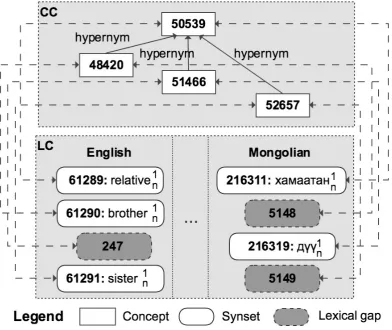
Figure 3.1: A fragment of the semantic network of concepts and their synsets.
We talk of theLanguage Core (LC), meaning the component that, in the UKC, corresponds to the PWN, namely the set of words, senses, synsets, glosses and
3.2. WORDS, SYNSETS, AND CONCEPTS CHAPTER 3. UKC
is univocally associated with one language and, within that language, with at least one word. Differently from the PWN, synsets are linked to concepts, and there is the constraint that each synset is linked to one and only one concept. There is, furthermore, the constraint that, for a concept to be created, there must be at least one language where it is lexicalized. Given the multilinguality of the UKC, there is a one-to-many relation between concepts and synsets. Figure 1 shows how synsets and concepts are related (“n” means that the reference word is a noun, “1” that that synset is associated to its first sense).
Glosses and examples are associated with synsets, as in the PWN. We have evaluated the possibility of associating glosses also to concepts. Ultimately, we decided that this should not be the case as such a description would be linguistic in nature and there is no universal language which could be used to describe all the concepts in the CC. One difference with the PWN is that, in the UKC, lexical gaps have glosses, even if they do not have examples (which would be impossible). The intuition is that the gloss of a lexical gap can be seen as “local” language dependent description of a missing synset. This choice has turned out to be pragmatically useful when one is interested in understanding the meaning of a lexical gap without knowing the language(s) which generate(s) them.
3.2 Words, Synsets, and Concepts
Humans build representations of what they perceive, what we usually call the world, as complex combinations ofconceptswhere, following [Giunchiglia and Fumagalli, 2016], we take conceptsto bemental representations of what is per-ceived. The recognition of a concept is taken to be the result of (multiple) en-counters, i.e., events, e1, ..., en, during whichsubstances manifest themselves to
a perceiver (e.g., an observer or a listener), where substances have two funda-mental properties:
CHAPTER 3. UKC 3.2. WORDS, SYNSETS, AND CONCEPTS
themselves to observers across multiple encounters and 2. this ability is an intrinsic property of substances.
Examples of concepts generated from substances are objects (e.g., persons, cars, cats), actions (e.g., walk, drive) roles (e.g., father, president); see [Giunchiglia and Fumagalli, 2016, 2017] for a detailed discussion about these notions and also [Millikan, 2000] for the early work in the field ofBiosemanticswhich introduced the notions of substance and encounter. Thekeyobservation is that we take con-cepts as representations denotingsets of encounters, rather thansets of instances
which share a set of properties, as it is the case in theDescriptionistic theories of meaning, e.g., Knowledge Representation or the “usual” logical semantics. Thus, for instance, the denotation of the concept car is the set of times a car has been perceived, e.g., seen by me, rather than the set of cars which, e.g., are in Trento. This shift allows us to treat concepts and words uniformly. We take words, like concepts, to be representations of the world; more specifically, to be mental representations of mental representations of the world (i.e., ofconcepts). As such, words, like concepts, are the results of sets of encounterse1, ..., en
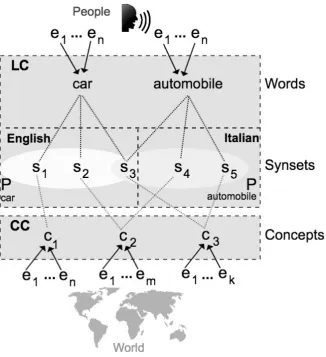
dur-ing which they are perceived by, e.g., a listener of reader, as produced by, e.g., a human speaker or written text. Thus, for instance, analogously to what happens for theconcept car, theword car denotes the set of input occurrences which are generated by looking at a set of documents and/or by hearing a set of utterances. We represent words, synsets and concepts and their respective roles as in Figure 3.2. Outside the UKC there is the world as we perceive it, e.g., via vision (bottom) or listening (top). At the bottom there are conceptsc1, ..., cn, while, at
the top, there are wordsw1, ..., wn (in Figure 2,carandautomobile), where both
words and concepts are perceived as the result of the encounterse1, ..., en.
Moving to the center of Figure 2, the synsets s1, ..., sn are linked to words
and to concepts, see, e.g., the word car in Figure 2. We call these two links
3.2. WORDS, SYNSETS, AND CONCEPTS CHAPTER 3. UKC
Figure 3.2: The UKC and the World.
makes clear what we mean. Notice how, as represented in Figure 2, both words and concepts are ambiguous representations of synsets, in the sense that there is a one-to-many relation between them and synsets. The sense of a word de-pends on the context within which it is perceived while the sense of a concept depends on the language used. Thus, as in Figure 2, the wordcarand the word
automobile denote the sets of synsets Pcar and Pautomobile, respectively, where
CHAPTER 3. UKC 3.3. WORLD, LANGUAGE(S), AND MODEL(S)
language. Notice also how there are words, e.g., automobile which are shared across languages, this being pervasive with languages with common roots, e.g., Portoguese and Brasilian Portoguese.
As a result the UKC implements the following stratified theory of meaning:
• the results of perception, i.e., words and concepts, denote the set of events during which they are perceived; they define the boundary between the UKC and the world;
• words denote sets of synsets, one per context of use;
• synsets denote concepts, where any concept is denoted by multiple synsets, one per language;
• Any triple ⟨wi, si;ci⟩, with si word sense of wi andci concept sense of si,
is a Causal connectionCC(wi, ci) betweenwi and ci.
CC(wi, ci) implements thecausal connection between words and concepts that
humans exploit in knowledge representation and reasoning. Given that media, e.g., photos and videos, are direct representations of concepts, the above or-ganization paves the way to integrated multimedia and multilanguage systems, extending the work in the integration of linguistic resources and media, so far done only for single languages, see, e.g., [Deng et al., 2009, 2014].
3.3 World, Language(s), and Model(s)
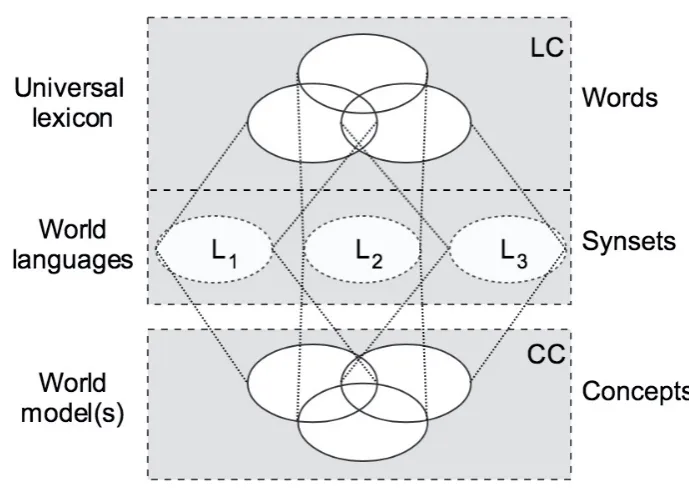
The three-layer organization of meaning into words, synsets and concepts, as represented in Figure 3.2, motivates a three layer design of the UKC, as repre-sented in Figure 3.3, with the first two layers inside the LC and the third inside the CC. We have:
3.3. WORLD, LANGUAGE(S), AND MODEL(S) CHAPTER 3. UKC
Figure 3.3: Languages, Universal lexicon and World model(s).
2. the Synset Layer, which stores theWorld Languages, and
3. the Concept Layer, which stores the World (mental) model(s), as repre-sented by the CC.
Word LayerandConcept Layerstore the results of perception while theSynset Layer implements the causal connection between words and concepts. In the
Synset Layer each circle represents a different language where all languages are mutually disjoint, this being a consequence of the fact that, differently from what is the case for words (see Figure 2), each synset is associated with one and only one language. On this basis, in the UKC, we formally define a Language as a set of synsets, in formulas
L = {si}i∈IL.
CHAPTER 3. UKC 3.3. WORLD, LANGUAGE(S), AND MODEL(S)
the absence of lexicalizations (which are probes for lexical gaps) and to study how polisemy and synonymy map to the underlying concept semantic network. The Word Layer stores the Universal Lexicon, namely the set of the words belonging to at least one language. Notice that a word, meant as the event by which it is perceived and recognized, does not a priori belong to any language. It is only a sign or a sound which may be used in more than on language and which is recognized as belonging to a language as part of the word sense dis-ambiguation process. Of course, as represented in Figure 3.3, it is possible to reconstruct the set of words of a Language from synsets using the inverse of the word sense relation.
The Concept Layer is a language agnostic representation of the world as we perceive it. But, a model generated by who? In the UKC, the world, as we perceive it, is taken to be a source ofperception events. By perception event we mean here the concrete sensing action, performed by a sensing subject, which generates concepts and words, and the causal relations linking them. This gives us the possibility to define the notion of world (as we perceive it) in terms of the subject(s) which actually perform the sensing actions enabling the perception events.
According to a first mainstream interpretation, the CC is the model of the entire world, as it is generated by all the people (speaking all the languages) in the world. However, according to a second interpretation, the CC can also be seen as the union of the models of the world as they are generated by the different people (speaking the different languages) in the world, as represented in Figure 3.3, e.g., the models of the 7,097 languages registered by theEthnologue project.3 Clearly these models intersect and are a subset (a subgraph) of the
overall CC. It is interesting to notice how this view can be easily pushed to the extreme by associating a different world model to any different sensing subject (e.g., any person). During the generation of a lexicon, lexicographers would
3.4. LEXICAL GAPS CHAPTER 3. UKC
choose from a “common pot” words and concepts, namely what we all share via perception, while, at the same time, they would be able to decide synsets and senses, namely the causal relation from words to objects that is unique to each of us.
In this perspective, notice howlexical gapsare core to our studies on language diversity as they provide evidence of the different worlds perceived by people speaking different languages. The notion of lexical gap is seemingly quite intu-itive: a lexical gap is a missing element in the lexicon. But, missing with respect to what? The approaches that we are aware of define this notion in terms of prop-erties of the lexicon. Thus for instance, [Kjellmer, 2003] defines lexical gaps as holes in the systematicity of languages while [Bentivogli and Pianta, 2000, Cvi-likaitė, 2006] define them as the lack of lexicalization detected when comparing two languages. [Lehrer, 1970] defines a lexical gap as a missing lexicalization of the semantic structure of a language, based on the analysis of the lexicon of that language. Our notion of lexical gap codifies directly the fact that a lexical gap is a missing link between a lexicon and semantics: a lexical gap is a concept for which a language is known not to have a synset. Notice how this definition relates directly to how different cultures generate, via language, different world models.
3.4 Lexical gaps
The absence of a certain concept in a language is motivated by two meanings. One is a lack of physical encounters that speakers of a language have very little or no experience to think of that concept. The second is a concept’s redundancy that in the languagel other concepts take its place of a semantic field.
Definition 1. Lexical gapA pair of concept4and language <c, l> is alexical
gap if and only if a lexicon of languagel lacks a word to express a concept c.
CHAPTER 3. UKC 3.4. LEXICAL GAPS
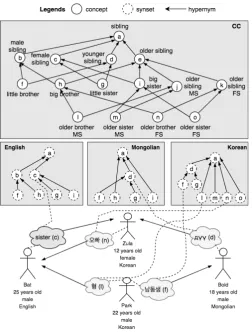
Figure 3.4: Example of four siblings of one family with the semantic field of “sibling”. (MS is a male speaker and FS is a female speaker.)
The definitions of lexical gaps are vary from one another [Lehrer, 1970] [Ben-tivogli and Pianta, 2000]. According to one definition , a lexical gap means that a language expresses a certain concept with a free combination of words. By that definition, it excludes many cases of cultural concepts where a language tends to directly borrow a foreign word to express a certain concept instead of coining a word or a free combination of words. For example, let’s suppose that a japanese sport 相 �/sumō/ is being introduced to English. In such case, a language speakers have often naturally borrowed a foreign word to express that meaning.
3.4. LEXICAL GAPS CHAPTER 3. UKC
of the language l lacks physical encounters on substances of the concept c. For example, a hundred years ago, a chinese martial art kung fu (功夫) were not introduced to many countries of today.
Definition 3. Representation gap A lexical gap g =<c, l> is a represen-tation gap if lexical encounters of the language l, representing substances of concept c, are pointing to one or more different concepts thanc.
Figure 3.5: Example of hypernym gaps for the concepts of rice.
Definition 4. Hypernym gap A representation gap g =<c, l> is a hyper-nym gapif least one hyponym or specific concept ofcis lexicalized in the corre-sponding languagel. For instance, a concept “rice” is a hypernym gap in Korean because in that language its more specific concepts are lexicalized by the words “�”(ssal - uncooked rice) and “�”(baap - cooked rice).
CHAPTER 3. UKC 3.4. LEXICAL GAPS
gapif any hyponym or specific concept of c is a lexical gap in the corresponding languagel.
Chapter 4
Language Diversity in Lexical Semantics
“A language is not just words. It’s a culture, a tradition, a unification of a community, a whole history that creates what a community is. It’s all embodied in a language.”
—-Noam Chomsky
The problem of quantifying the diversity of languages is not new, see, e.g., [Bell, 1978, Youn et al., 2016]. Our ideas build upon the work described in [Rijkhoff et al., 1993]. The main goal of this work was to construct balanced datasets with the goal of avoiding linguistic bias. Still sharing the same intu-itions, we work in the other direction. Namely, we have the data sets and we measure their diversity in order to exploit it in the solution of well-known lin-guistic problems.
Diversity has many causes. To name some: genetic ancestry (languages with common origins), geography (due to the influence of physical closeness), culture (effects of cultural dominance). In this thesis we present a first attempt at quan-tifying a global combined diversity measure in terms of genetic diversity and
geographic diversity. Given a language setL, we define its combined diversity measure as follows:
4.1. GENETIC DIVERSITY CHAPTER 4. LANGUAGE DIVERSITY
In the equation above β ∈ [0,1] normalizes the effects of genetic diversity over those of geographic diversity. We compute the Relative (Combined) Diversity
of two languages by taking |L| = 2 and we (generically) say that two or more languages are similar when they are not diverseand we extend this terminology to all forms of diversity. Let us define the notions of genetic and geographic diversity in the following subsections.
4.1 Genetic Diversity
Languages are organized in a Language Family Tree which represents how, in time, languages have descended from other languages, starting from the ances-tral languages [Bell, 1978]. A fragment of this tree is shown in Fig.4.1. This figure must be read as follows. The root is a placeholder for collecting all lan-guages. Labeled intermediate nodes are sets of languages (phyla or families) where the label is the name of the set. Unlabeled intermediate nodes correspond to missing names of language sets and serve the purpose of keeping the tree balanced (crucial for the computation of diversity, see below). Leaves denote languages. In general, we write T (L) to mean the family tree T for the set of languagesL (when clear we drop the argument fromT).
4.1.1 Quantifying Genetic Diversity
CHAPTER 4. LANGUAGE DIVERSITY 4.1. GENETIC DIVERSITY
Figure 4.1: A fragment of the phylogenetic tree.
its weight is 1 and where, below it, each phylum is weighted1/λ, then1/λ2, and so on. Furthermore we normalize GenDiv to be in the range [0,1]. More specif-ically, letT(E)be the family tree of a reference set of languagesE, which in our case we take to be the languages in the UKC. Let L ⊆ E be a set of languages for which we want to compute the diversity level and T(L) the corresponding
minimal subtreeofE. Then, the genetic diversity ofLis taken to be 0 if|L| < 2, and, otherwise, defined as:
AbsGenDiv(L) = ∑
n∈T
λ−depth(n) −1 (4.2)
GenDiv(L) = AbsGenDiv(L)
AbsGenDiv(E) (4.3)
where AbsGenDiv is what we call this function theAbsolute Genetic Diversity
exam-4.1. GENETIC DIVERSITY CHAPTER 4. LANGUAGE DIVERSITY
ples, assume we take λ = 2. Then AbsGenDiv(E) = 88.127and GenDiv(E) = 1, while, with L1 ={Hungarian, Italian, Polish, Russian, Basque} (the lan-guages in Fig. 4.1) we have AbsGenDiv(L1) = 3.469and GenDiv(L1) = 0.039. Similarly, if we consider a less diverse subset including only Indo-European languages, e.g., L2 ={Italian, Polish, Russian} we have AbsGenDiv(L2) =
1.531and GenDiv(L2) = 0.017. In this latter case, adding other Romance lan-guages, e.g., Spanish, Catalan, and Portuguese, to L2 would increase GenDiv only to 0.022.
Figure 4.2: A example of absolute genetic diversity computation of related languages.
CHAPTER 4. LANGUAGE DIVERSITY 4.2. GEOGRAPHIC DIVERSITY
4.1.2 Phylogenetic Tree of Language Families
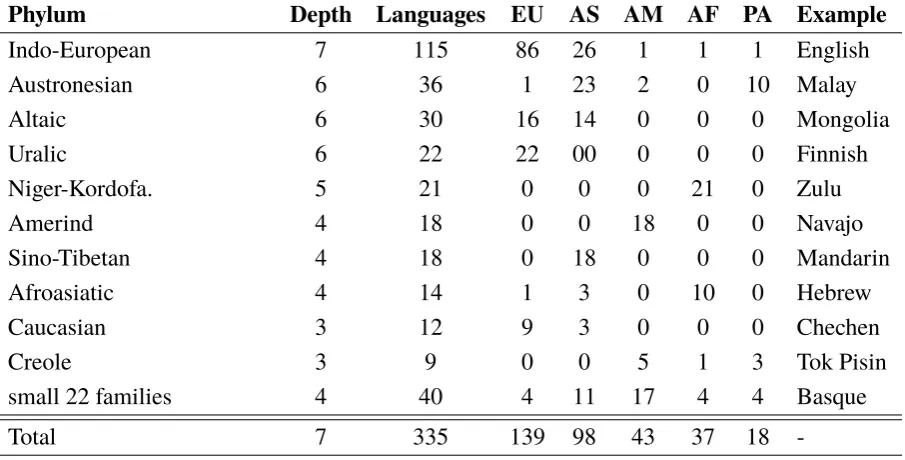
In order to evaluate the quantitative measure of genetic diversity, we manu-ally built the phylogenetic tree of language families by studying two language databases: WALS and Glottolog. The shortened version of the tree is displayed in Figure 4.4. As can be seen, each of second-level nodes in the tree represents an individual language family while a leaf node always accounts a individual language. Currently we built the tree storing 32 phyla and only 335 languages, designed to use UKC. The distribution of UKC languages in the tree is shown in Table 4.1.
Figure 4.4: The phylogenetic tree of language families
4.2 Geographic Diversity
4.2. GEOGRAPHIC DIVERSITY CHAPTER 4. LANGUAGE DIVERSITY
Table 4.1: Language distributions across phyla.
Phylum Depth Languages EU AS AM AF PA Example
Indo-European 7 115 86 26 1 1 1 English
Austronesian 6 36 1 23 2 0 10 Malay
Altaic 6 30 16 14 0 0 0 Mongolia
Uralic 6 22 22 00 0 0 0 Finnish
Niger-Kordofa. 5 21 0 0 0 21 0 Zulu
Amerind 4 18 0 0 18 0 0 Navajo
Sino-Tibetan 4 18 0 18 0 0 0 Mandarin
Afroasiatic 4 14 1 3 0 10 0 Hebrew
Caucasian 3 12 9 3 0 0 0 Chechen
Creole 3 9 0 0 5 1 3 Tok Pisin
small 22 families 4 40 4 11 17 4 4 Basque
Total 7 335 139 98 43 37 18
-Depthrepresents a depth of its corresponding phylum.
Languagesrepresents a number of languages existed in its corresponding phylum.
EU,AS,AM,AF,PAstand for continents, namely: Europe, Asia, Americas, Africa, and Pacific. Note: each phylum of small families has no more than 5 languages.
intuition by defining our geographic diversity measure based on the number of different continents on which the languages in the reference data set are spoken. Then, the geographic diversity of L is taken to be 0 if |L| < 2, and, otherwise, defined as:
GeoDiv(L) = |
∪
l ∈LcontinentOf(l)|
#Continents (4.4)
where continentOf(l) is the continent where l is spoken.
CHAPTER 4. LANGUAGE DIVERSITY 4.2. GEOGRAPHIC DIVERSITY
Chapter 5
Resource Quality
“Quality is never an accident. It is always the result of intelligent effort. There must be the will to produce a superior thing.”—-John Ruskin
5.1. INCOMPLETENESS CHAPTER 5. RESOURCE QUALITY
As from [Giunchiglia et al., 2017], our approach is to define a set of quan-titative measures and use them to evaluate the quality of a language and of the bias it introduces. We believe that the quality of the resources is evaluated by two fundamental measures: 1. incompleteness and 2. incorrectness.
5.1 Incompleteness
Every description of lexical elements (e.g. word, sense, ...) in UKC has an incompleteness issue, so that we propose a number of measures for the incom-pletenesses of language, concept, and lexical ambiguity.
5.1.1 Quantifying Language Incompleteness
The proposed notion of Language Incompleteness LanInc, with its dual notion of Language Coverage LanCov, is the direct extension of the notion of incom-pleteness of logical languages and theories. The idea is to exploit the fact that the CC can be taken as (a computational representation) the domain of interpre-tation of a language, defined as a set of synsets, and to count how much of it is not lexicalized by that language.
AbsLanCov(l) =|Concepts(l)| (5.1)
LanCov(l) = |AbsLanCov(l)|
|Concepts(UKC)| − |Gaps(l)| (5.2)
LanInc(l) = 1−LanCov(l) (5.3)
CHAPTER 5. RESOURCE QUALITY 5.1. INCOMPLETENESS
Table 5.1: Language Groups.
Groups Language Incompleteness #Words #Languages a LanInc(l)∈[0.00; 0.52[ W ∈[50,001; +∞] 6 b LanInc(l)∈[0.52; 0.82[ W ∈[20,001; 50,000] 15 c LanInc(l)∈[0.83; 0.99[ W ∈[501; 20,000] 64 d LanInc(l)∈[0.99; 1.00] W ∈[1; 500] 250 UKC LanInc(l)∈[0.00; 1.00] W ∈[1; +∞] 335
Table 5.2: Ambiguity instances over the four language groups
Groups Sample Languages #AmbIns AvgAmbCov
a English, Finnish, ... 714,437 10.2
b Dutch, Spanish, ... 1,969,436 12.8
c Zulu, Tswana, ... 117,213 18.4
d Ewe, Abakhaz, ... 1,725 35.5
UKC – 2,802,811 12.4
provides its values for ten selected languages. It is interesting to notice how LangInc(English) = 0.0. This is indirect evidence of the English bias present in the current linguistic resources. It is a consequence of the fact that most Word-nets have been derived by PWN and that, so far, the UKC contains only concepts lexicalized in the PWN. The second observation is that all the languages not spoken by WEIRD societies are highly under-developed, for instance we have LangInc(Navajo) = 0.98.
Table 5.1 (left) shows the level of incompleteness of the various languages of the UKC. This table organizes languages into four groups where groups (a), (b) are highly developed while groups (c), (d) are highly under-developed.
5.1.2 Quantifying Concept Incompleteness
5.1. INCOMPLETENESS CHAPTER 5. RESOURCE QUALITY
selected set of languages. Let, for any concept c, theLanguages of c be the set of languages where cis lexicalized, defined as:
Languages(c) = ∪
l∈L
{l|σ(c, l) > 0} (5.4)
where σ(c, l) returns either 1 or 0, depending on whether c is lexicalized in l. Then we define concept coverage and ofconcept incompletenessas follows:
AbsConCov(c) =|Languages(c)| (5.5)
ConCov(c) = AbsConCov(c)
|Languages(UKC)| (5.6)
ConInc(c) = 1−ConCov(c) (5.7)
In words: the absolute coverage of a concept is the cardinality of the set of languages where it occurs, its coverage is the absolute coverage normalized over the number of languages of the UKC (defined as Languages(UKC)with a slight abuse of notation), its incompleteness is the complement to 1 of its coverage.
5.1.3 Quantifying Ambiguity Incompleteness
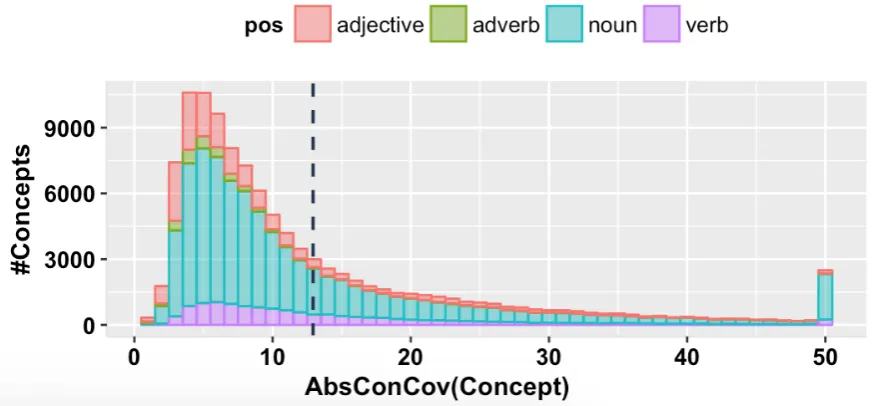
Figure 5.1 shows the distribution of concepts for each value of AbsConCov(c) with a concept c standing for the set of the concepts corresponding to the four parts of speech (i.e., adjective, adverb, noun, and verb). As it can be seen from the mean line, on average, concepts are lexicalised across about 12.93 languages.
CHAPTER 5. RESOURCE QUALITY 5.1. INCOMPLETENESS
Figure 5.1: Concept distributions per AbsConCov value.
words to denote more than one concept. This phenomenon gives rise to the phe-nomenon of lexical ambiguity, e.g., polysemy or homonymy. Let the 4-tuple
a =<w, c1, c2, l >be an ambiguity instance, where c1 and c2 are two concepts expressed by the same wordw in the languagel. We defineambiguity coverage
andambiguity incompleteness as follows:
AbsAmbCov(a) =|Languages(c1)∩Languages(c2)| (5.8)
AmbCov(a) = AbsAmbCov(a)
|Languages(UKC)| (5.9)
AmbInc(a) = 1−AbsAmbCov(a) (5.10)
5.1. INCOMPLETENESS CHAPTER 5. RESOURCE QUALITY
Let AmbInstances(L) be theset of ambiguity instancesin the set of languages
L and AvgAbsAmbCov(L) theaverage absolute ambiguity coverage, which we compute as follows:
∑
a∈AmbInstances(L) AbsAmbCov(a)
|AmbInstances(L)| (5.11)
Table 5.2 (right) reports the number of ambiguity instances and their average number for the four language groups plus the UKC. Notice how the average absolute ambiguity coverage is much higher for the under-developed language groups (c), (d). In other words language coverage increases when the average ambiguity coverage decreases, and vice versa: the more developed a resource is the less ambiguity instances we have. This fact, counter-intuitive at a first sight, is a consequence of the fact that, in practice, the first words added to a language are the ones which are most commonly used and therefore, the most ambiguous.
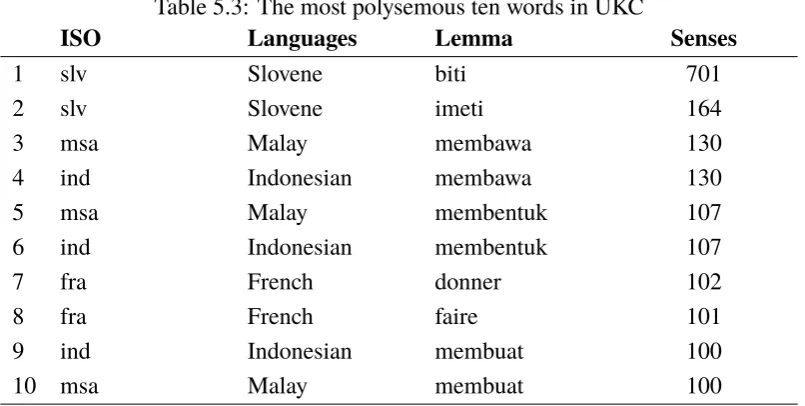
Table 5.3: The most polysemous ten words in UKC
ISO Languages Lemma Senses
1 slv Slovene biti 701
2 slv Slovene imeti 164
3 msa Malay membawa 130
4 ind Indonesian membawa 130
5 msa Malay membentuk 107
6 ind Indonesian membentuk 107
7 fra French donner 102
8 fra French faire 101
9 ind Indonesian membuat 100
CHAPTER 5. RESOURCE QUALITY 5.2. INCORRECTNESS
5.2
Incorrectness
The correctness of a language can be measured by several factors, e.g., transla-tion mistakes, wrong senses, and much more. In particular, the state-of-the-art multilingual lexical resources like BabelNet and Open Multilingual Wordnet in-tegrates many wordnets from several different sources while many of them were semi-automatically or fully-automatically built, and the rest of them in general employed a method of translating PWN to their target languages. As a result, all their issues and mistakes were migrated to the bigger resource like Babelnet. For instance, PWN is organized under the psycholinguistic principles based on the research of English language and psycholinguistic studies while wordnets in other languages tends to forgot those fundamental principles. And other exam-ple is a result of automatic integration method of dictionaries.
5.2. INCORRECTNESS CHAPTER 5. RESOURCE QUALITY
Table 5.4: Ten sample languages from ten phyla in Table 4.1.
Language ISO #PsyMis AvgDis LanInc LanQua
English eng 14 3.42 0.00 1.00
Malay msa 4,304 1.46 0.71 0.16
Mongolia mon 6 1.16 0.99 0.50
Finnish fin 7,471 1.22 0.01 0.27
Ewe ewe 0 0 0.99 0.59
Navajo nav 54 1.44 0.98 0.37
Mandarin zho 2,596 1.17 0.09 0.38
Hebrew heb 49 1.23 0.33 0.43
Chechen che 0 0 0.99 0.61
Tok Pisin tpi 22 1.68 0.99 0.28
5.2.1 Quantifying Language Incorrectness
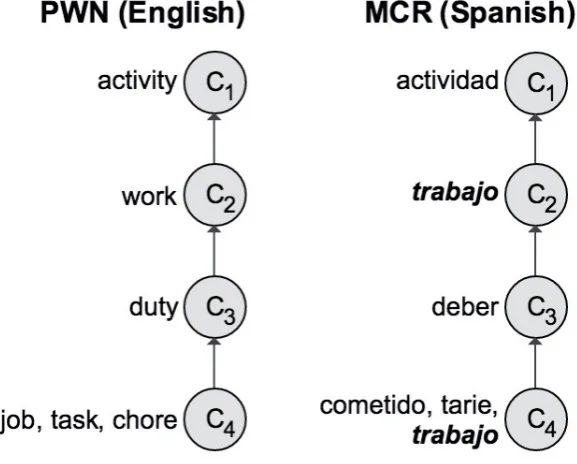
In the following, we analyze the problem of the psycholinguistic mistakeswhich we define as failures of adhering to the principle which, as from [Miller, 1990], states that“... superordinate nouns can serve as anaphors referring back to their hyponyms. For example, in such constructions as ‘He owned a rifle, but the gun had not been fired’, it is immediately understood that the gun is an anaphoric noun with a rifle as its antecedent.” Figure 5.2 provides an example of psy-cholinguistic mistake in the Spanish WordNet. We have the following defini-tions:
AbsLanQua(l) =−log10(|PsyMis(l)|+ 1
|Concepts(l)| ) (5.12)
LanQua(l) = AbsLanQua(l)
AbsLanQua(English) (5.13)
AvgDis(l) =
∑
x∈PsyMis(l)dis(x)
|PsyMis(l)| (5.14)
CHAPTER 5. RESOURCE QUALITY 5.2. INCORRECTNESS
LanQua(l) are the Absolute Language quality and the Language quality of l, respectively. The number of mistakes varies a lot, going from the fourteen mis-takes of the PWN English to the thousands of mismis-takes of other languages such as Chinese and Finnish. The Log-based definition of AbsLanQua is meant to alleviate this problem (see Tables 2 and 3). English is taken to be the reference to which we normalize the quality of the other languages. dis(x) is the num-ber of intermediate nodes between two concepts generating the psycholinguistic mistake x, for instance, in figure 5.2, dis(trabajo) = 2. The Average Distance
AvgDis measures the average distance for a language. As from Table 3, this dis-tance is around 1 for most languages with the exception of English where it is
3.42, which provides even more evidence of the large gap in quality between the PWN English and any other language.
5.2. INCORRECTNESS CHAPTER 5. RESOURCE QUALITY
5.2.2 Incorrectness distribution of UKC languages
Figures 5.3 and 5.4 compare the incompleteness and quality values of the lan-guages in the UKC, where the ten lanlan-guages in Table 3 are explicitly marked with their ISO names, as from Table 3.
Figure 5.4: Language Incompleteness vs Psycholinguistic Mistakes.
Figure 5.3 shows that most languages have a low quality, below0.4, and that the most developed languages (the ones with LanInc below 0.7), with the ex-ception of English, have even lower values. In other words, there are only few languages which are highly developed but they have much poorer quality (<0.42) than English (=0.99). It basically means that none of those lexical resources em-ployed the psycholinguistic principles, given by Miller.
CHAPTER 5. RESOURCE QUALITY 5.3. SUMMARY
5.3
Summary
Chapter 6
Polysemy vs Homonymy
“If a word exhibits polysemy in one language, one may be inclined, or forced, to dismiss its various meanings as coincidental; if a
corresponding word in another language exhibits the same, or closely parallel polysemy, it becomes an extremely interesting coincidence; if it displays the same polysemy in four, five, or seven genetically unrelated languages, by statistical law it ceases to be a coincidence at all.”—-John Haiman, 1974
6.1 Lexical Diversity in Semantic Relatedness
The issue of Lexical Semantic Relatedness has been extensively studied, see, e.g., [Budanitsky and Hirst, 2006]. However, all the work so far has mainly, if not exclusively, concentrated on its study within a single language while we fo-cus on how semantic relatedness propagates across languages. To get an insight into the problem, consider the three examples in Tables 6.1, 6.2, 6.3. These ta-bles provide examples of the types of semantic relatedness we consider. Notice that we distinguish between two types of morphological relatedness: compound-ing,1, namely the combination of free morphemes (as inkey + board→keyboard),
1We use the termcompoundingto cover also idioms and collocations where component words are separated
6.1. LEXICAL DIVERSITY CHAPTER 6. POLYSEMY VS HOMONYMY
Table 6.1: An example of polysemy in English.
# Language Concept 1 Concept 2 Types
1 English bar bar polyseme
2 Italian barra bar derivational
3 Mongolian different
4 Chinese 酒吧 酒馆 derivational
… … … … …
23 Finnish baaritiski baari compound
Types polyseme compound derivational different
Languages 11 1 5 6
Concept 1: a counter where you can obtain food or drink.
Concept 2: an establishment where alcoholic drinks are served over a counter.
Table 6.2: An example of homonymy in English.
# Language Concept 1 Concept 2 Types
1 English melody, air air homonym
2 Italian melodia, aria aria homonym
3 Mongolian different
4 Chinese 旋律 空气 different
… … … … …
38 Turkish melodi hava different
Types homonym compound derivational different
Languages 6 0 0 32
Concept 1: a succession of notes forming a distinctive sequence.
Concept 2: a mixture of gases (especially oxygen) required for breathing.
and derivationnamely the combination of a word with one or more derivational affixes (bound morphemes) (as in play + -er→player).
The key observation is that diverse languages represent the same semantic re-latedness in diverse ways. Thus, for instance, in Table 6.1, a polyseme in English corresponds to an occurrence of derivational morphology in Italian and Chinese, to an occurrence of compound morphology in Finnish and to two distinct words
CHAPTER 6. POLYSEMY VS HOMONYMY 6.2. METHOD
Table 6.3: An example of compound morphology in English.
# Language Concept 1 Concept 2 Types
1 English tennis tennis player compound
2 Italian tennist tennista derivational
3 Mongolian derivational
4 Chinese 网球 网球选手 compound
… … … … …
25 Korean 테니스 테니스선수 compound
Types polysemy compound derivational different
Languages 0 11 14 0
Concept 1: a game played with rackets by two or four players who hit a ball back and forth over a net that divides the court.
Concept 2: an athlete who plays tennis.
in Mongolian.
6.2 Method
Our goal is to establish whether any two concepts denoted by a single word are polysemes or homonyms. The algorithm we propose is based on the following intuitions:
• if two concepts are semantically related in diverse languages, then they are polysemes. In this case the diversity of the two languages is evidence of the fact that semantic relatedness derives from a property of the world, which is what all languages denote.
• if two concepts arenotsemantically related in diverse languages, then they are homonyms. The key idea is that the occurrence of a homonym in a single language, or in similar languages is a coincidence, a consequence of some local, e.g., contextual or cultural, phenomena.
6.2. METHOD CHAPTER 6. POLYSEMY VS HOMONYMY
homonyms. At the same time, the existence of polysemes and homonyms can be propagated across similar languages.
Algorithm 1:Lexical Ambiguity Classification
Input :x=<l, w, c1, c2>, an ambiguity instance
Input :R, a multilingual lexical resource
Output :label, an ambiguity class for the instancea.
1 LP ← ∅;
2 L ←LanguagesR(c1)∩LanguagesR(c2); 3 foreach languagel ∈ Ldo
4 foreach wordw1 ∈WordsR(c1, l)do 5 foreach wordw2 ∈WordsR(c2, l)do 6 ifw1 =w2 ormorphSim(w1, w2)then 7 LP ← LP ∪ {l};
8 LH ← L − LP;
9 ifComDiv(LP)>TD then 10 label←‘polyseme’ ;
11 else if ComDiv(LH)>TD andComDiv(LP)<TS then 12 label←‘homonym’ ;
13 else
14 label←‘unclassified’ ; 15 returnlabel;
But, how do we automatically recognize that two concepts are semantically related? The idea is simple: if we have a big enough number of diverse lan-guages where the two words denoting the two concepts are syntactically similar, then the two concepts are semantically related. A consistent use of the similar words is evidence of semantic relatedness, as it also the case in the examples in Tables 6.1 and 6.3. The resulting algorithm (see algorithm 1) takes in in-put an ambiguity instance x and a multilingual resource and it returns one of three classifications for x: polyseme, homonym or unclassified. This algorithm is structured as follows:
CHAPTER 6. POLYSEMY VS HOMONYMY 6.2. METHOD
occurrence of a polyseme (Line 1) and it collects in L all the languages where
c1 and c2 are lexicalized (Line 2);
Step 2. (Lines 3-7). It tries to recognize x as a candidate polyseme. This attempt succeeds if one of two conditions hold: (i) the two words are the same, i.e., we have discovered another case of polisemy in a new language or (ii) the two words aremorphologically related, as computed by the function morphSim. If it succeeds it addsl toLP.
morphSim(w1, w2) =
len(LCA(w1, w2)) max(len(w1),len(w2)))
(6.1)
Our current implementation of morphSim, is a (quite primitive) string sim-ilarity metric. For w1 and w2 to be related, morphSim(w1, w2) must return a value higher than a threshold TM. The function len() returns the length of its
input while the function LCA() returns thelongest common affix (prefix or suf-fix) of the two input words: for example, ‘compet’is the LCA for the words
‘compete’and‘competition’.
Step 3. (Line 8)It creates the set LH of the languages supporting the
occur-rence of a homonym. Notice howLH contains the languages where w1 and w2 are different words.
Step 4. (Lines