Implementation and Effect of Long Range RFID Technology at
Ultra High Frequency Band in Bus Detection System for Blind
People
N. R. Mohamad*
1, A. B. Jiim
1, A. Salleh
1,
N. M. Z Hashim
1, M. Z. A Abd.
Aziz
1, Z. Zakaria
1, N.A Ab. Hadi
21Center for Telecommunication Research & Innovation (CeTRI), Faculty of Electronic & Computer
Engineering, Universiti Teknikal Malaysia Melaka (UTeM), Hang Tuah Jaya, 76100, Durian Tunggal, Melaka, Malaysia
2Faculty of Engineering Technology, Universiti Teknikal Malaysia Melaka (UTeM), Hang Tuah Jaya, 76100,
Durian Tunggal, Melaka, Malaysia
I.
INTRODUCTION
Technology nowadays is so various and limitless. Every person not only for normal but also for people with disabilities can use technology anytime and anywhere. However, blind people live in a limited environment and have difficult to sense what happen around them. This matter will reduce their activities in several fields, such as education and transportation. Furthermore, as the population ages, the number of disabilities people has increased and statistic showed that 285 million people are visually impaired worldwide. 39 million are blind and 246 have low vision [1]. Hence, we need to make their life more comfortable by introducing a system that helps them enjoy transportation services independently and freely like ordinary people, without relying on others. So this project will make blind people’s more ease in certain ways. Normally, blind people find its hard to know which bus is coming to the bus stop. Unlike normal people, who are can easily know which bus is coming to the bus stop, but blind people need some assist to know which bus is coming. Usually, they will miss the bus and this will make their life more difficult because they need to go to work or go to an important appointment.
Generally, journey in a bus is a safe and comfort factor, but due to increase number of buses and passengers its going be tougher nowadays and it will be more difficult for blind people to travel in a bus at the bus stop as they cannot able to see which is coming on the bus stop. Passenger in bus stop who is waiting for the bus have to look at the bus in order to know which bus is coming. This could be a problem for blind people to know
ABSTRACT:
Public transportation provides people with mobility and access to employment, community resources, medical care, and recreational opportunities in communities across city. Generally, journey in a bus is a safe and comfort factor, but due to increase in number of buses and passengers its going be tougher now a days and it will be more difficult for blind people to travel in bus at the bus stop as they cannot able to see which is coming on the bus stop. Passenger in bus stop who is waiting for bus have to look at the bus in order to know which bus is coming. This could be a problem to blind people to know which bus is coming since they cannot see due to their flaw. They normally does not know which bus is stopping at bus stop. This report proposed a systems that can help blind people to know which bus is stopping at bus stop using long range Radio Frequency Identification (RFID) system. This system also will develop a General User Interface (GUI) which could provide information to passenger. A RFID tag which stored identification is installed at each bus which can read by a reader located at a bus stop. This system then will announce the bus destination to alert the blind people by using developed system GUI. The selected hardware for this system is active RFID reader and passive RFID tag which operated at 902-928MHz. The software that being used are Visual Basic and Microsoft Access. This system have total seven interfaces developed which able to identify the coming bus and provide bus information to passenger. The RFID tag also been analysis to study the performance of the tag being scan in one meter and three meter distances. As the result the tag were good being detect at both one and three meters which provide excellent performance for the system.much interaction [2]. In [3], they proposed system consists of two detection subsystems; one on the buses and the other on the bus stations, database system and a website. In addition, the system using RFID system already done, but in a short distance [4].This system could aid the impaired people in detection of incoming bus so they can live their life efficiently [1]. The purpose of this project is to invent a system that will help blind people to know which bus is coming to the bus stop. The system will use long range Radio Frequency Identification (RFID) technology to detect the incoming bus to the bus stop which operated at ultra high frequency (902-928 MHz). Then, they will be an announcement the number of the bus.
II.
METHODOLOGY
This part will explain more about the project development and the project path, how it is done and methods on how it has been made. This part also includes the project hardware and software development in a systematic ways. The purpose of using Visual Basic software is to create interfaces to interact with the RFID reader to announce the destination of the bus. Extra information also included in the interface about the name of the bus, starting point, destination point, the number of seats, and names of the drivers. Visual Basic (VB) is the third-generation event driven programming language and integrated development environment (IDE) from Microsoft for its COM programming model. VB is also considered a relatively easy to learn and use programming language, because of its graphical development features and BASIC heritage.
Firstly, the interfaces designs in form pages in VB. In this form there are many commands can be done. Each form can be included with all kinds of source code. In this system, there are total seven interfaces designed using VB. Each form can be included with boxes, button, text and tables. The background color and background image of each form also can be change according to the creativity of the user. All the action and behavior of each interface can be changed through source code.
Microsoft Access software is used by programmers and non-programmer to create their own simple database solution. This system used Microsoft Access to create a database of ID of tags, name of the bus, starting point, destination point, the number of seats and name of drivers. Basically, a database is created in table form in Microsoft Access. The interfaces and option in Microsoft Access look almost exactly like Microsoft Excel. After creating a complete database, the file need to be linked to VB. This database can be viewed by VB and the database also can be updated through VB or Microsoft Access itself.
Figure 1 UHF RFID Reader
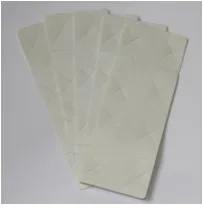
Next, the tag used to store information and act as a transponder. In this system we are using passive RFID tags that can operate in the same frequency band as the reader so that the reader can communicate with the tag efficiently. The standard for this tag is EPC-Gen2 which means the tag have global operations in the range of 860 to 960MHz which located same as the reader so it can interact with the reader. The generic longevity specifications for Gen 2 IC’s are 40 – 50 year data retention and 100,000 write cycle. The memory of the tag is 32bits tag identifier (TID) which identifies the manufacturer of the tag and also has read write capabilities. It has 96 bit EPC Number (Electronic Product Code) for purpose of read and write capabilities. The user memory for this tag is 512bit for personal storage purpose. The distance for read and write operation for this tag is in the range of 1-10 meters which is dependent on the reader itself. This tag have dimension of 110mm*45mm*0.3mm and the base material for the tag is thermal paper with self-adhesive paper so it can be stuck on the windshield of the bus. The material of the antenna in the tag is made of aluminium. The example of the tag is shown in Figure 2.
Figure 2 CF-TU9505 (Glass Tag)
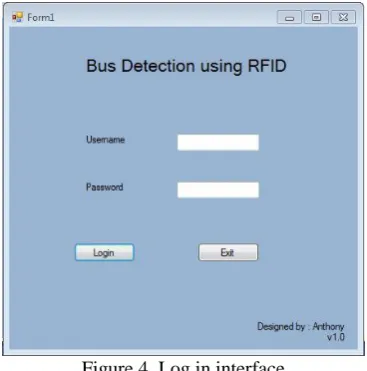
Figure 4 Log in interface
Figure 5 shows the interface after the correct username and password was typed in. The first option is to open the bus detection interface. This interface is for the detection of RFID tag located on the bus. Firstly, the port must be open by click “Open Port” button at the top right corner of the interface. Once the port was open, all port the connected port will list under “Port Available” button. After that the baud rate also needs to be chosen. The chosen baud rate for our reader is 9600. After the right port and right baud rate was selected, the system is ready to receive data from the reader. If the tag is detected, the ID of the tag will display in the box at top left corner of the interface. Then, the button “Announce” will announce the destination of the particular bus through a speaker. This interface also can check whether the detected ID is belong to this system or not. There are table contain information of ID, bus name, starting point, destination point, duration, the number of seats and driver’s name in the bottom of the interface. If the button “Check” is clicked it will display whether the ID is in the database or not. At the right bottom of the interface, there are “Main Menu” and “Setting” button. The Main Menu button will bring the user to Main Menu and the Setting button will bring the Setting interface. The detail interface is shown in Figure 6.
Figure 6 Bus Detection
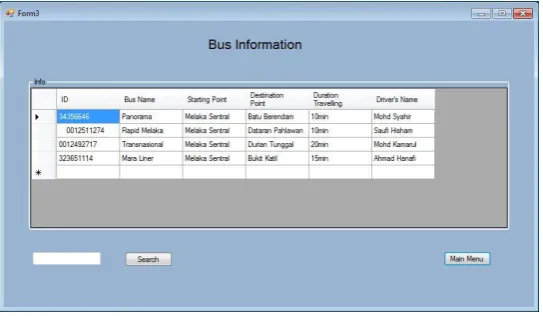
The Figure 7 shows the information to another passenger about information on the all buses particularly. The ID of the bus means the ID contain in the RFID tag inside the bus. There are also provided information about bus name, starting point, destination point, duration travelling and the driver’s name. This information could be useful to the passenger who wish to know more about all the busses.
Figure 7 Bus Information
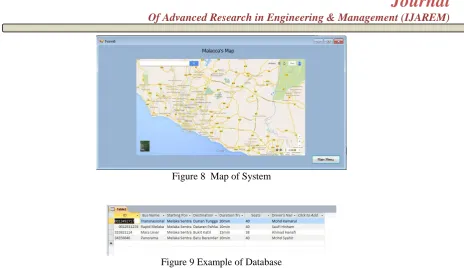
Figure 8 Map of System
Figure 9 Example of Database
Figure 10 shows the tag analysis for one meter distance. The reader detects the tag from 902.6 MHz until 911.8 MHz for a distance of one meter long. Each frequency the reader will scan the tag for 30 times. The graph in the figure above show percentage of tag detected versus range of frequency. At the starting frequency from 902.4 MHz to 906.6 MHz the percentage is 100%, which means the tag is more reliable to operate in those ranges of frequency. However, from 907 MHz to 910.6 MHz the percentage is unstable, which means at these frequencies the tags is not really reliable to operate. The percentage is back to 100% at frequency 911 MHz to 915.4 MHz. At 1 meter distance the tags are mostly reliable when the frequency is at 902. 6MHz until 911.8 MHz and 911 MHz to 915.4 MHz.
Figure 4.10 Tag Analysis for 1 meter
Figure 11 Tag Analysis for 3 meters
IV.
OVERALL
DISCUSSION
The Visual Basic software is the authoring tool that is easy to use to create or to develop the application especially when the application involves user interface. Using visual basic as a programming language, it is much easier to learn. Visual Basic included software tools to automatically create the detailed programming required by windows. These software tools not only create Windows programs, they also take full advantage of the graphical way that Windows works by letting programmers "draw" their systems with a mouse on the computer. This is why it's called "Visual" Basic. Visual Basic also provides unique and complete software architecture. "Architecture" is the way computer programs, such as Windows and VB programs, work together.The finished interface of this system was perfectly designed and fully functional according to plan. Each interface has their own significant function for the system. The system could really help blind people to know is the destination of the incoming bus to the bus stop. This system can announce the name of the destination very clearly and could be possibly understand by everybody including blind people.
This system is more efficient compared to other previous system because the detection of tag from a reader is very fast and long range. The reader could detect the tag up to 10 meters long. This means if the bus can be detected by the reader even if the bus still not arrived in front of the bus stop. The tag can be detected far away before it arrived to bus stop. This means that blind people can be alerted really early about the incoming bus. The other system usually needed the bus to stop directly in front of the bus stop, then it will announce the destination of the bus. This late arrived of information can be troublesome to the blind people. Besides that this system is really low cost, thus it will be much better in costing compared to other system. The tag only cost RM0.50 per tag. This system potentially has high commercialization value in the market because this system very easy to install and not time consuming. So it can be implemented at a local bus stop in our country. Besides that, this system can be proposed to the Ministry of Tourism because it’s suitable to implement in tourist bus so that it can announce when arrive at interesting place. Lastly, this system has sustainable value because this system used passive RFID tag which is very easy to dispose. Thus, it won’t affect the environment compared to active tag which are very hard to dispose.
V.
C
ONCLUSION[2] E. Zudor, Z. Kemeny, P. Egri, L. Monostori, The RFID Technology and Its Current Applications”,
Computer and Automation Research Institute, Hungarian Academy of Sciences Kende u. 13-17, 1111, Budapest, pp.29-36, 2006.
[3] Al Kalbani, Jalila, Rajaa Bait Suwailam, Arwa Al Yafai, Dawood Al Abri, and Medhat Awadalla. "Bus
detection system for blind people using RFID." In GCC Conference and Exhibition (GCCCE), 2015 IEEE
8th, pp. 1-6. IEEE, 2015.
[4] M. Husni Mubarak, Development of bus arrival time monitoring system using RFID technology, Universiti Teknikal Malaysia Melaka, Faculty of Manufacturing Engineerings, 2010.
[5] Salleh, A., N. M. Z. Hashim, N. R. Mohamad, N. A. A. Hadi, and MZA Ab Aziz. "Development of High
Performance and Low Cost Automatic Toll Payment System using RFID Technology for Malaysia
Environment." International Journal For Advance Research In Engineering And Technology 2, no. 10
(2014): 01-07.
[6] Salleh, A., N. R. Mohamad, N. M. Z. Hashim, MZ A. Abd Aziz, Z. Zakaria, and NA Abd Hadi.
"Development of Paddy Seed Management by using Long Range Passive RFID Technology at Ultra High