Improving Network Utilization for the 1GHz Band Using Multi Channel
Compression Framework
Maya Tapake
P.G. Scholar
Department of EXTC
JCOET Yavatmal, SGBAU Amravati, India
[email protected]
Dr. H. M. Baradkar
Principal
JCOET Yavatmal,
SGBAU Amravati, India
ABSTRACT: - A study of Sub 1GHz urban path loss
models is discussed. This particular frequency band provides optimal transmission characteristics for wireless communication and new WLAN standards may use the Sub 1GHz band for license-exempt data transmission in the near future. New WLAN use cases would be possible to design, such as wireless smart grid networks for meter data transmissions in urban areas. We discuss three urban propagation path loss models for carrier frequencies at 900MHz and we make statements about the performance of a proposed Sub 1GHz path loss model candidate for WLANs including a simulation study and discuss statistical shadowing effects at 900MHz.Congnitive Radio CR is upcoming technologies which allows for opportunistic spectrum usage. In this paper we simulate our proposed multi channel mechanism through network simulator -2 and analyze the performance i.e. energy utilization, throughput, delay etc.
Keywords:- Communication, Multi Channel, TDMA,
OFDMA, delay, AODV, energy utilization. I. INTRODUCTION
The European Commission has launched a Digital Agenda which aims to provide “fast” broadband with speeds above 30 Mbps for all Europeans by 2020 and
“ultra-fast” broadband with speeds above 100 Mbps for
50% of all European households by 2020. In October 2011 the Indian government published a National Telecom Policy which aims to reach broadband download speed of 2 Mbps by 2015 and speeds of at least 100 Mbps thereafter.2 Given that it is significantly more expensive to deploy fiber access networks compared to mobile networks mobile communication is set to be instrumental in fulfilling the Digital Agenda in Europe, and the Indian National Policy. The expansion of mobile data through smart phones and dongles makes spectrum to a key asset in the deployment of 4G (LTE). Moreover, the significance of spectrum will be reinforced by the introduction of spectrum aggregation when LTE Advanced will be available. The take-off for mobile broadband and mobile internet underscores the essential role spectrum plays for mobile operators, as it enables operators to provide coverage and capacity in their mobile networks. However, the conditions for the operators varies considerable as operators in Pakistan and India in average have access to just around 2 x 15 MHz while operators in Germany and Sweden in average have access to 2 x 70 MHz The enhanced role
for spectrum turns spectrum allocation into decisive events for mobile operators. One estimate for the marginal value of spectrum could be derived from auction prices paid by operators. The outcome of recent spectrum auctions for 800 MHz show that operators in Germany and France paid EUR 1.54 and EUR 1.35 per MHz/pop respectively, while the Swedish operators in average paid EUR 0.68 per MHz/pop. Prices for spectrum in the 2.6 GHz band reached EUR 0.30 per MHz/pop in Sweden, EUR 0.05 in Germany and 0.01 in the Netherlands. Interestingly enough, prices paid at the Indian 3G auction in 2010 for spectrum in the two main Indian cities are not far off from prices paid at European 3G auctions in the year 2000-2001. However, prices paid at the 3G auction in 2010 in India varies significantly between the four telecom service areas that India is divided into. Given that the price was EUR 0.91 per MHz/pop in Kolkata the average price in the Metro circle (which also consists of Delhi and Mumbai) was EUR 2.28 per MHz/pop [1-3]. The average price per MHz/pop in circle A, which comprise five states/regions with altogether 360 million inhabitants, reached EUR 0.56 per MHz/pop, the price in Circle B, which comprise eight states with altogether 525million inhabitants, was EUR 0.14 per MHz/pop, and in circle C, which consist of 4 states with altogether 205 million inhabitants, operators paid EUR 0.05 per MHz/pop In the previous work the researchers have worked mainly on improving the antenna structure for improving the bandwidth utilization in the 1GHZ bandwidth, or approaches for channel sensing have been proposed for the same. But these approaches need hardware or component changes which are usually not feasible. To remove these drawbacks we propose a protocol based approach for improving the channel utilization on the 1GHz band. In our approach we propose a compression based multi channel algorithm which will reduce the bandwidth needed for communication and thereby reducing the overall delay in the network. Once delay is reduced then more data can be sent over the same channel which improves the channel utilization and also increases the overall efficiency of the network. For compression we can use zipping techniques while for multi channel we can use streaming based approach [4-6].
II. PREVIOUS WORK ACCOMPLISH
Presented the multi dimension spectrum resources description method, and exploited the resource matching model. (2) Proposed a comprehensive dynamic spectrum allocation strategy based on system level. Both the fairness and the efficiency are taking into consideration. (3) Different kinds of cognitive networks (such as TDD OFDMA and FDD OFDMA system) are evaluated through simulation, which can provide some information to the practical application. [1].The major part of sub 1 GHz frequency band is earmarked for terrestrial TV transmission. TV Signals are of very low signal strength which makes the detection of TV transmitters challenging. [2].
Jul-Ki Seok presents the design and core algorithm of a spectrum-based ant wind up strategy for general PI-controlled systems. The proposed method, based on the frequency-domain analysis, allows automatically determining the condition to freeze the integral action. The concept of spectral-energy ratio is also introduced to guarantee the reliable operation against unpredictable noise sources. The proposed scheme can be packaged as automated-software applications that are used by field personnel with little or no control-theory background. After the proposed algorithm is installed on the line during a scheduled downtime, thereby, this gives a minimizing impact on product scheduling and production. The consistent performance of the proposed scheme assures a desired tracking response curve with minimal oscillation and settling time over the complete operating conditions [3].
Joonyoung Cho, Youhan Kim, Student Member, IEEE, and Kyungwhoon Cheun proposed an FHSS-MA network employing PN-MWSK and developed two Gases for the conditional error probability, given a hop is hit by interfering users. The effect of hits by interfering users hopping to neighboring frequency-hop slots was accurately taken into account. It was demonstrated that employing PN-MWSK significantly improves the network performance compared with employing MFSK. Finally, the effect of imperfect hop timing synchronization was analyzed [4].
Zhongliang Liang, Shan Feng, Dongmei Zhao, and Xuemin (Sherman) proposed work in Delay Performance Analysis for Supporting Real-Time Traffic in a Cognitive Radio Sensor Network (2011) talking about Traditional wireless sensor networks (WSNs) working in the license-free spectrum suffer from uncontrolled interference as the license-free spectrum becomes increasingly crowded. Designing a WSN based on cognitive radio can be promising in the near future in order to provide data transmissions with quality of service requirements. In this paper we introduce a cognitive radio sensor network (CRSN) and analyze its performance for supporting real-time traffic. The network opportunistically accesses vacant channels in the licensed spectrum. When the current channel becomes unavailable, the devices can switch to another available channel. Two types of channel switching’s are
channels is sufficiently large. Second, if neighboring clusters have to share the same set of candidate channels, their CHs may sense the channels in different orders so that they will find different available channels with a high probability. To further avoid the clusters to work at the same channel, the CHs may exchange information about their sensed available channels through the control channel. If neighboring clusters have to share the same frequency channel, simultaneous transmissions can be avoided by carefully coordinating the timelines of the clusters using similar models. We have analyzed the performance of a cognitive radio sensor network for supporting real-time traffic. Our results indicate that satisfactory average packet transmission delay performance can be achieved for both bursty and Poisson traffic. Extending the current work to multi-cluster CRSN net-works with both real-time and best effort traffic is underway. In the multi-cluster CRSN, data collected by the CHs from their associated sensors may traverse multiple hops in order to reach the sink, and both the intra-cluster traffic and the inter-cluster traffic share the available radio resources. For reliable transmissions, the CH sends back an ACK to the sensors for every correctly received packet. If a sensor does not receive an ACK in time after transmitting a data packet, it considers that the current channel becomes unavailable and stops transmitting immediately [9-12].
III. EXISTING SYSTEM
In the Existing system, they use trust for identify the uncertain reasoning. The trust model has two components: trust from direct observation and trust from indirect observation. With direct observation from an observer node, the trust value is derived using Bayesian inference, which is a type of uncertain reasoning when the full probability model can be defined. On the other hand, with indirect observation from neighbor nodes of the observer node, the trust value is derived which another type of uncertain is reasoning when the proposition of interest can be derived by an indirect method. Based on the model presented earlier, we evaluate trust values with direct observation on two malicious behaviors: dropping packets and modifying packets. In the direct observation, we assume that each observer can overhear packets forwarded by an observed node and compare them with original packets so that the observer can identify the malicious behaviors of the observed node. Therefore, the observer node can calculate trust values of its neighbors by using Bayesian inference, which is a general framework to deduce the estimation of the unknown probability by using observation.
IV. PROPOSED WORK
We propose the system for high performance of the wireless network through the link stability concept use of the routing algorithm. The issues are scalable to a large number of nodes, design of data handling techniques, localization techniques, real time communication, data availability, fault tolerance, etc.
Routing algorithms calculate the best path per destination in a distance vector or link-state basis. In a distance vector protocol, optimality is computed incrementally along a path. The sensors calculate the routes locally, based on their current, partial network state. By default, link-state protocols are more robust to network changes: they have sufficient state to route packets around broken links. Furthermore, sensors are usually immobile, or they move infrequently. Thus, they do not experience the thrashing of routing tables seen in mobile ad hoc networks. Traffic management is often overlooked. This application awareness of the communication stack matches the data aggregation paradigm in sensor networks. The goal is to minimize transmissions by eliminating data redundancy, if present, during the collection process. Each node discovers all the links with its neighbor nodes. Each node periodically floods a message containing its entire afferent links (Link State Message). Each node constructs a topology map of the network, in the form of a graph. Then, each node independently calculates the next best hop for every other node in the network using a shortest-path algorithm.
V. SIMULATION NETWORK
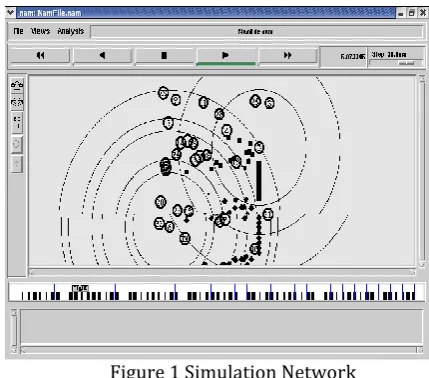
Here we represents every node that want to send their data first establish connection according to proposed algorithm with (AODV) routing protocol in MANET. First connection is established from source to destination through intermediate node. When strong connection is established then transfer their data packets through establish route. When all data packets are reached to destination then again new session will establish and communication will started. In this simulation scenario node zero drops the data due to congestion and bigger circle represent the radio zone of the nodes.
Figure 1 Simulation Network A. Uni-channel case delay Analysis
Figure 2 Uni-channel case delay Analysis B.Multi Channel Case Delay Analysis
Here we similar end-to-end delay are measure at the time of multichannel based communication and shows the delay of each packets where X-Axis shows simulation in seconds and Y-Axis shows delay in milliseconds. That delay is lower at the time of 25th to
30th seconds as compare to single or uni-channel
communication.
Figure 3 Multi Channel Case Delay Analyses C.Energy Comparison Between Uni-Channel Vs
Multi-Channel
The numbers of nodes in network continuous deplete their energy in transmission or receiving packets. The intermediate nodes are responsible for both transmission and receiving. The nodes that are take part in communication their remaining or persistent energy is mentioned in graph. The energy in case of proposed multichannel based routing is remains more because its utilization of energy is lower than single channel communication routing, most of the nodes energy is completely loss so the single channel communication energy consumption is more than the multichannel technique. So here the performance of multichannel channel technique is more superior then the single channel communication.
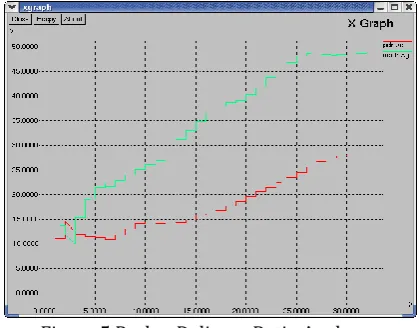
D. Packet Delivery Ratio Analysis
The percentage of packets are successfully received at destination are measured through packet delivery ratio. The more packets receiving at destination is provides
the better PDR and less packets receiving is provide the less PDR performance. In this graph we show the packet delivery ratio comparison between single and multichannel communication.
Figure 4 Energy Comparisons between Uni-Channel Vs Multi-Channel
Where X-Axis shows simulation time that is maximum 30th seconds and Y-Axis shows percentage of data
receiving by the genuine receiver. Graph concludes that multichannel technique case percentage of data receiving is garter than the single channel technique.
Figure 5 Packet Delivery Ratio Analyses E. Multichannel switching Analysis
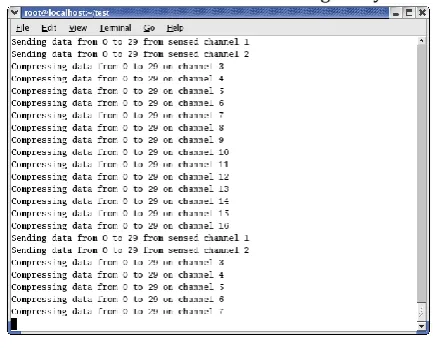
In this table shows the real time switching or utilization of multiple channels and sends compress data from source to destination so our energy utilization is lower than the existing single channel mechanism.
F. Throughput Analysis
Table 1 Multichannel switching Analysis
Uni-Channel:
Average Throughput [kbps] = 53418.70 Multichannel
Average Throughput [kbps] = 55171.22 VI. CONCLUSION
We have achieved better data transmission using the proposed spectrum sensing scheme. Our proposed system utilizes the unused channel frequency for its Secondary users. Using this we have achieved low delay and energy efficient transmission. We have also integrated trust management which provides malware free environment in the network. In future, we plan to extend our work on Cognitive radio networks with cryptographic security mechanism. Encryption and hash function schemes which provide authentication and data privacy, can detect internal node failures and provide false routing information, and identifies if a node does not cooperate with the other nodes in the network.
REFERENCES
[1].Y. R. Kondareddy and P. Agrawal, “Effect of dynamic
spectrum access on transport control protocol performance,” inProc. IEEE Global Telecommun. Conf., 2009, pp. 1–6.
[2]. A. M. R. Slingerland, P. Pawelczak, R. V. Prasad, A. Lo, and R. Hekmat, “Performance of transport control protocol over dynamic spectrum access links,” in Proc. 2nd IEEE Int. Symp. New Frontiers Dyn. Spectr. Access Netw. 2007, pp. 486–495.
[3]. W. Kim, A. Kassler, and M. Gerla, “TCP performance in cognitive multi-radio meshes networks,” inProc. 4th Int. Conf. Cognitive Radio Adv. Spectr. Manage. , 2011, p. 44.
[4]. M. D. Felice, K. R. Chowdhury, W. Kim, A. Kassler, and L. Bononi, “End-to-end protocols for cognitive radio ad hoc networks: An evaluation study,” Elsevier Perform. Eval. vol. 68, no. 9, pp. 859–875, 2011. [5]. S. Mascolo, C. Casetti, M. Gerla, M. Y. Sanadidi, and R.
Wang, “TCP Westwood: Bandwidth Estimation for
enhanced transport over wireless links,” inProc. ACM
7th Annu. Int. Conf. Mobile Com-put. Netw. 2001, pp. 287–297.
[6]. L. A. Grieco and S. Mascolo, “Performance evaluation and comparison of Westwood+, New Reno and Vegas
TCP congestion control,” ACM Computer. Commun.
Rev., vol. 34, no. 2, pp. 25–38, 2004.
[7]. K. Sundaresan, V. Anantharaman, H. Y. Hsieh, and R. Sivakumar, “ATP: A reliable transport protocol for ad
hoc networks,” IEEE Trans. Mobile Computer, vol. 4,
no. 6, pp. 588–603, Nov./Dec. 2005.
[8]. J. Liu and S. Singh, “ATCP: TCP for mobile ad hoc
networks,” IEEE J. Select. Areas Commun. vol. 19, no.
7, pp. 1300–1315, Jul. 2001.
[9]. D. Sarkar and H. Narayan, “Transport layer protocols
for cognitive networks,” in Proc. IEEE INFOCOM Computer Communication Work-shop , 2010.
[10]. C. Luo, F. R. Yu, H. Ji, and V. C. Leung, “Optimal channel access for TCP performance improvement in cognitive radio networks,” Springer Wireless Netw. , vol. 17, no. 2, pp. 479–492, 2011.
[11]. D. Katabi, M. Handley, and C. Rohrs, “Congestion control for high bandwidth-delay product networks,” in Proc. ACM Conf. Appl., Technol., Archit. Protocols Computer Communication , 2002, pp. 89–102. [12]. K. R. Chowdhury, M. D. Felice, and I. F. Akyildiz, “TCP