Teachers’ Perspectives on Educational Research
Karen Drill
American Institutes for Research, Researcher
Shazia Miller
American Institutes for Research, Managing Director
Ellen Behrstock-Sherratt
American Institutes for Research, Senior Researcher
Abstract
Based on two studies conducted in the Chicago metropolitan area in 2009 and 2010, we found that teachers do, in fact, use research, although they tend to seek it out under very specific conditions and circumstances. Namely, teachers tend to look to research in response to an immediate, pressing concern such as how to best teach fractions to English language learners (ELLs). Teachers also turn to research to address a specific content need, such as gathering information for an upcoming lesson. In terms of broader reviews of research, teachers sometimes review research they have used in the past, such as best practices for a particular topic or method. Finally, teachers may consult educational research when they participate in groups that use research findings to more broadly support their instructional practice (e.g., study groups, committees or courses on using research in the classroom).
Keywords: education research, teachers, best practices
Karen Drill has led and worked on local and national projects, including South Carolina Extended Learning, Striving Readers in the Chicago Public Schools, and the Texas Principal Excellence Program. Her primary focus has been qualitative and quantitative research within education, and has led the evaluation of three mentoring and induction programs in Illinois districts. Previously, Drill worked as the program coordinator for Northwestern University’s Center for Talent Development. She is currently pursuing a doctoral degree in educational psychology from the University of Illinois at Chicago.
Emaill: [email protected]
Shazia Miller has over 20 years of experience in evaluation, with an emphasis on high school transitions and data-based decision-making in schools. She lead or been a senior advisor to many initiatives to improve educational outcomes. Miller is currently the co-primary investigator of the IES sponsored randomized control trial of Indiana’s system of diagnostic assessment.to provide teachers with ongoing feedback on their students.
Ellen Behrstock-Sherratt has authored numerous articles, briefs, and reports on teacher and principal quality and is co-author of Everyone at the Table: Engaging Teachers in Evaluation Reform and Improving Teacher Quality: A Guide for Education Leaders. She led the development of the Educator Talent Management Framework. She has provided technical assistance to state and national educational bodies, and supported teacher effectiveness work at the American Federation of Teachers and the National Education Association.
The sources of educational science are any portions of ascertained knowledge that enter into the heart, head, and hands of educators, and which, by entering in, render the performance of the educational function more enlightened, more humane, more truly educational than it was before.
(Dewey, 1929, p. 76).
How can we improve education? The educational research community constantly aims to produce high-quality research that pushes the boundaries of our knowledge and creates a stronger education system. The volume of literature housed in the Education Resources Information Center (ERIC) database now exceeds one million articles. Linking the vast community of educational researchers is “a deep concern with the condition of children and schools” (Gardner, 2002, p. 72).
However, in spite of the large volume, educational research has sometimes been criticized as neither useful nor influential (Burkhardt and Schoenfeld 2003); some have gone so far as to say the reputation of research is awful (Kaestle, 1993). As described by Bransford, Vye, Stipek, Gomez, & Lam (2009), in 2003 Grover Whitehurst, the then director of the National Institute of Education Sciences, drew widespread attention to these concerns about whether the educational research field was producing useful work for the field. In a presentation at the annual meeting of the American Education Research Association, Whitehurst criticized some of the esoteric paper titles that are inaccessible to those outside a particular research niche, citing a made-up example paper entitled “Episodes of Theory-Building as a Transformative and Decolonizing Process: A Microethnographic Inquiry into a Deeper Awareness of Embodies Knowing.” Whitehurst further cited a survey of state and district leaders, 77 percent of whom believed educational research was overly theoretical and too academic in its orientation (Whitehurst, 2003).
Some researchers note that educational researchers may not be adequately prepared to disseminate research in ways that are useful to practitioners (Schoenfeld, 2009). But we do not know whether there are more fundamental criticisms to how research is being produced and disseminated. For teachers to make effective use of new knowledge being developed by the field, they must be able to identify and access high quality research. But what are the circumstances under which this occurs?
Much of the research on educational research’s usefulness to teachers has emerged from abroad, including Canada (Cooper, 2010; Lysenko, Abrami, & Bernard, 2003), Great Britain (Cordingley, 2000, 2009), Turkey (Beycioglu & Ozer, 2008), and the Netherlands (Bronkhorst, Meijer, Koster, & Vermunt, 2011). Hemsley-Brown and Sharp’s (2003) cross-national review of research on this topic in multiple English-speaking countries over the period 1988-2001 revealed that there were indeed barriers to teachers’ use of educational research, including lack of access to academic journals, the daunting amount of research, jargon and overly theoretical orientations, and distrust of the findings.
engaged in dialogue and collaboration, such as that provided by professional learning communities.
To address the disconnect between researchers and practitioners, we conducted two related studies in the Chicago Metropolitan area. For the first study, we held nine focus groups with 49 public school teachers in 2009. We chose focus groups for the first study because we wanted to explore teachers reactions to research directly through an in depth conversation. We asked teachers about the types of research they are most likely to use and about the resources they consult when looking for research. Based on the findings from the first study, which suggested that teachers are more likely to use research when it is filtered to them by fellow educators, we conducted a follow-up case study in 2010. In the second study, we were interested in whether the information teachers received in a course specifically designed to disseminate research to teachers translated into classroom practice. Here, we found again that if research is tied to a current classroom issue, teachers may use research to address the issue. However, teachers will not spend a lot of time seeking out research. Instead, the information needs to be presented in a way that is convenient and sensitive to their time. In this article, we present each of the studies, the findings, and implications for researchers and schools.
Study 1
Our first study focused on the extent to which the large body of educational research is useful to teachers’ instructional practice and how educational research might be made more appealing to teachers. In other words, is there a demand by teachers for research, and, if so, what, if anything, can the producers of research at universities and elsewhere do to ensure that what they are supplying meets this demand.
To further our understanding of this issue, we conducted nine focus groups with a total of 49 teachers from urban and suburban schools within the Chicago Metropolitan Area. Teachers were asked about:
• Whether they seek out research and why or why not
• What comes to mind when they hear the word “research” in an education context • What sources of research they rely on and how they judge its credibility
• What barriers prevent them from using educational research
• What type of research is useful and what would make using research more appealing • What type of preparation for using research they have received
Methods
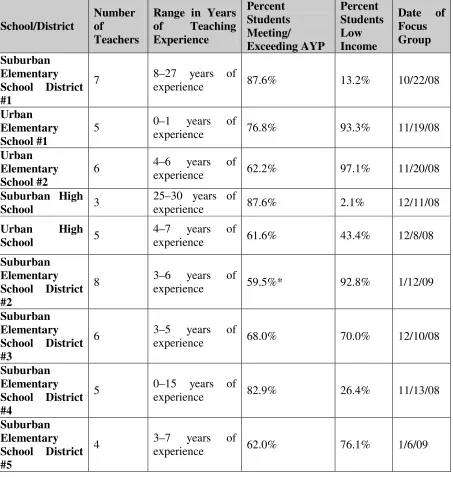
Table 1
District and School Sample
School/District
Number of
Teachers
Range in Years of Teaching Experience Percent Students Meeting/ Exceeding AYP Percent Students Low Income
Date of Focus Group
Suburban Elementary School District #1
7 8–27 years of
experience 87.6% 13.2% 10/22/08
Urban Elementary School #1
5 0–1 years of
experience 76.8% 93.3% 11/19/08
Urban Elementary School #2
6 4–6 years of
experience 62.2% 97.1% 11/20/08
Suburban High
School 3
25–30 years of
experience 87.6% 2.1% 12/11/08
Urban High
School 5
4–7 years of
experience 61.6% 43.4% 12/8/08
Suburban Elementary School District #2
8 3–6 years of
experience 59.5%* 92.8% 1/12/09
Suburban Elementary School District #3
6 3–5 years of
experience 68.0% 70.0% 12/10/08
Suburban Elementary School District #4
5 0–15 years of
experience 82.9% 26.4% 11/13/08
Suburban Elementary School District #5
4 3–7 years of
experience 62.0% 76.1% 1/6/09
capture the essence of the discussion. The focus group findings should not be interpreted as representative of all teachers, but rather as a useful starting place for future studies.
Findings
Based on data gathered from the focus groups, several key findings emerged about the ways teachers use educational research, the types of research teachers find most useful, and some of the barriers that prevent teachers from accessing and using research.
•Although teachers are not opposed to accessing and using research, research in general evokes a number of strong yet conflicting responses. The tension between using educational research to support instruction and the perceived gap between what researchers provide and what practitioners need emerged as a common theme in all nine focus groups, regardless of teachers’ years of experience, grade level taught, or school location in the greater Chicago area.
Teachers who held positive reactions to research viewed it as information about “what works” in the classroom. For example, some teachers indicated that research findings are a way to validate that educational practices are “tried and true” and have “proven to be successful.” Research findings, then, can provide an extra level of assurance that teachers are implementing strategies and practices that work.
However, not all teachers view educational research in a positive light. Many focus group participants also suggested that research can seem removed from everyday classroom realities. This sentiment was reinforced when teachers believed that the research environment is not an accurate representation of actual classrooms or of classrooms with similar student compositions to theirs.
•While there was a wide degree of skepticism about researchers and research findings per se, this skepticism can be reduced when research comes from a source that teachers trust and if the findings work their classroom. In general, focus group participants were more likely to trust research findings that came from a source they deemed credible, such as a colleague, administrator, professor of theirs, or a researcher with experience in the classroom. However, if the research is associated with promoting an educational product, the findings may be disregarded. In the end, teachers have to do what seems to work in the classroom, regardless of official best practices or other research guidance. Teachers also are more likely to trust their own experiences and feedback they receive from their students than suggestions made by a researcher. For some, a strategy that works with their students provides more evidence of success than what research might argue is effective. In addition, teachers may be more likely to accept research that confirms their current instructional pedagogy. Conversely, if applying findings does not work in their classroom, teachers will abandon the effort.
such as The Reading Teacher, or the Internet, starting with Google. Through these avenues, research and research-based information may be shared. Teachers report that they also will use educational research when they are part of a study group, committee, school initiative, or other work group that uses research findings to support learning more broadly.
•Teachers indicated nearly unanimously that, given competing demands on their time, both seeking and reading research are low priorities. This explanation was shared by teachers of all experience levels in urban and suburban elementary and high schools serving higher and lower-income students. In light of their limited time, teachers stated that they are less likely to read research when it is presented with overwhelming information and in a manner that is dry and difficult to decipher.
However, even though teachers stated that they often do not have or make time for educational research, some mentioned that they would be more likely to read research if administrators advocated for and provided sanctioned time to discuss research with colleagues. For example, one elementary school received a grant that supported a teacher study group focusing on professional development about instructional strategies. In addition, teachers suggested that they also would be more likely to read research if the massive volumes of research available were screened and filtered by school leaders or administrators.
The desire to receive research findings as a bulleted list, brief synopsis, or audio-visual media also was cited by an overwhelming majority of teacher participants as a way to access the research findings without taking large amounts of time away from students’ more pressing needs.
•Finally, teachers are less likely to use research if they do not see a connection between the population studied and its applicability to the students in their classroom. Some teachers suggested that the research setting is so controlled that they would be unable to replicate the program or practices in their classroom, while others believed that certain aspects of their own classroom, such as a high concentration of ELLs, make many research-based teaching strategies inappropriate for their students. If teachers believe their classroom does not reflect a study’s students, resources, or context, they will be less likely to try to read or apply the findings.
Summary of Findings
Study 2
A key finding from Study 1 was that teachers are open to using research if it comes from a trustworthy source, is relevant to their classroom context, and is presented in way that respects and values their time. The challenge is ensuring that these trusted sources are also good consumers of research and capable of sifting through documents of varying quality to accurately communicate the findings to teachers. Looking at these criteria, we asked ourselves if there were initiatives that provided teachers with research in ways that would be useful. One vehicle stood out as especially promising -- a professional development program run by the American Federation of Teachers (AFT).
The AFT, one of the two major teachers unions in the country, includes in its mission goals of:
• Strengthening the institutions in which teachers work; • Improving the quality of the services teachers provide; and • Bringing together all members to assist and support one another.
The AFT has addressed its mission in part by creating a number of professional development courses to help teachers improve their practice. Their line of professional development, Educational Research and Dissemination (ER&D), provides professional development in ways that meet the needs of teachers by providing information on research-based practices that have been field tested, with content delivery by their peers.
The AFT’s ER&D program was created in 1981, and in the past five years at least 7,500 teachers nationwide have taken an ER&D course. The ER&D program deliberately trains classroom teachers to create and deliver each course. Instructor training involves two distinct week-long training sessions, with requirements between sessions to practice and reflect on topics taught. The instructor training also involves a mock delivery of the course. Local course instructors are chosen for their content mastery and are often classroom teachers, teacher leaders, or coaches rather than administrators. ER&D offers courses on topics including managing anti-social behavior; reading instruction; reading comprehension; thinking mathematics; school, family, and community; and others. In 2010 the American Education Research Association gave the ER&D program highest honors for bridging the gap between research and practice.
To get a better sense of whether the information provided in an ER&D course translates into classroom practice, and whether it increased teachers use of research we conducted a case study of the ER&D course, Managing Anti-Social Behavior, in a Chicago suburb in Fall 2010.
Managing Anti-Social Behavior encourages classroom teachers to improve their practice and their students’ performance by:
•Becoming users of research;
•Exposing them to timely research-based principles, practices, and strategies; and •Teaching other teachers to share strong practices.
•Who are these students and what is antisocial behavior? •Effective classroom management techniques
•Behavior analysis
•Building social competence in the classroom •Behavior enhancement and reduction
•The acting-out cycle
•School-wide behavior support practices
In keeping with teachers’ interest in meeting with peers to discuss research and practices, participants meet for three hours, once a week, for seven weeks in the Managing Anti-Social Behavior course. Each session involves a lecture peppered with numerous opportunities for participants to ask questions and participate in tabletop and whole group discussions, thereby learning not only from the research, but also from trusted peers.
Teachers are also provided with a binder, assembled by course designers at the AFT headquarters, that consolidates high quality, timely, meaningful research. The course designers included articles with charts and images to help readers connect to the content. The course binder is updated every three years by national AFT experts who seek feedback from other course instructors to ensure that the research is useful to teachers. The course is then field tested for usability. In response to early feedback that the binder felt more like a research journal than a user-friendly resource, previous adjustments have included removing research articles that were not relevant, too dense, wordy, or jargon-filled. In line with principles of adult learning, activities were added to help readers identify with and internalize the content. Each of these efforts aligns with our previous findings that teachers are more likely to use research if it is provided in a clear, straightforward way, and filtered through a trusted source.
Methods
Using a case study approach, we followed two sessions of ER &D’s Managing Anti-Social Behavior course, presented in a Chicago suburb in the fall of 2010. Through pre- and post-event surveys, interviews, and focus groups with teachers and ER&D instructors and five course observations, we explored why course participants chose to take the course, the degree to which they use research to inform their practice, and the extent to which course participation influenced their research use. The course was facilitated by a school administrator.
Findings
Our findings suggest that when teachers are presented with research-based information, they use it, particularly when it is related to a specific classroom need. Several themes emerged from our case study on the Managing Anti-Social Behavior course.
classroom can have larger ramifications for student behavior later. Another teacher wrote in the post-event survey, “I have been reflecting on the way I address students.”
•Course participants left with increased knowledge about the medical, psychological, and cultural underpinnings of typical student behavior issues. Teachers told us that they left the course equipped with “techniques to deal with anti-social behavior” and a better understanding of “why students with anti-social behaviors act in certain ways.”
•The course did not influence teachers’ use of research. While participants enjoyed the course, and felt like they gained new knowledge and strategies for working with challenging students, most did not indicate that the course influenced how often they turn toward research or their intentions to seek out research on their own after the course ended.
Summary of Findings
This feedback from participants suggests that a targeted approach to using research can increase teacher knowledge about the topic at hand, and can have a direct effect on teachers’ use of research-based practices. At the same time for a course focused exclusively on research dissemination, we were surprised that participants and instructors did not emphasize using research regularly to inform practice. For example, little emphasis was placed on seeking out and assessing the quality of research. Neither the participants nor the course instructors received training on seeking out research beyond that which was given to them by the national course designers.
Conclusion
Our findings suggest that teachers use a different set of criteria to evaluate high quality research than researchers. They want research that is worth their time, attention and leads to possible change in practice. Researchers, on the other hand, are trained to judge quality based on key criteria such as internal validity, rigor of analysis, strong methodological design, triangulation of data and appropriate measurement. When forced to use shortcuts, the researcher is taught to rely on peer-reviewed journals as a first cut check of quality, followed by their own review of study methods, which are, not coincidentally, extensively presented in such journals.
Teachers, our study suggests, use an entirely different set of criteria to identify high quality research that they will consider integrating in their classrooms. And, even when presented with research through content-based professional development, teachers are still hesitant to seek out and incorporate research regularly in their practice. Given these findings, we offer several recommendations to educational stakeholders.
Recommendations
Recommendations for Researchers
Teachers genuinely want their students to benefit from the findings of good research. However, there is somewhat of a mismatch between the educational research that currently is supplied and what is demanded by teachers. This mismatch is not necessarily due to researchers’ carelessness or lack of concern; quite on the contrary, it may be largely due to researchers’ extreme care to present their findings as precisely as possible, a process that may lend itself to obscure language and lengthy discussions. In order to bring supply and demand into equilibrium, researchers should:
•Get to the point. Teachers are busy and want to see bulleted lists and brief synopses of the research findings. Not only does this help ensure that teachers will benefit from findings, but it also demonstrates to teachers that researchers understand and appreciate that teachers’ time is at a premium.
•Provide examples of the applicability of the research to real classroom situations. This may include illustrations and hands-on examples of how to put the research findings into practice. Also, many teachers consider themselves visual learners and have expressed a desire to access research through audio-visual technology that allows them to see the recommended instructional practices put into action.
•Write in an accessible manner. This does not mean that research findings should be watered-down; rather it means that unnecessary jargon should be avoided in favor of straightforward language and sentence structure. In addition, complex statistical analyses should be described in laymen’s terms.
•Emphasize how research findings can help teachers solve specific, immediate classroom problems or address students’ particular learning needs. The demands of teaching tend to prevent teachers from exploring future-oriented or higher order issues than those immediately at-hand; however, there was near consensus that research is consulted in response to pressing needs.
•Highlight the attributes positively associated with research. Teachers already appreciate that good research represents a trustworthy and solid basis for coming to conclusions about what works in the classroom. Research that reminds readers of these qualities and how they inspired the study is likely to be better received by teachers.
•Be clear about the context of the study and its applicability to other settings. Teachers are quite skeptical about the relevance of studies conducted in different contexts, especially when there are clear differences in grade level, ability level, socioeconomic level, class size, behavior, and culture. It is important to make clear which population was studied and, if it is believed that the findings are generalizable, to emphasize that point and explain why.
research may make it difficult, spending time in schools and with teachers, being available to present findings and answer questions about the research, and working collaboratively with teachers and teacher educators at each stage of the research process will make research more relevant and useful.
Recommendations for Teacher Preparation Programs
Teacher preparation programs play an important role in building the foundations for a research-oriented teaching career. As the gateway to the profession, they shape teachers’ views and approaches to using research to inform their practice. In some cases, they are also the closest source of access to research and researchers that teachers will receive during their careers.
•Be proactive about bringing teachers and researchers into contact. Bridging the gap between teachers and researchers requires that the two groups build trust. This can be accomplished through interaction from the early stage of their careers: their preparation. It might take on the form of joint seminars, coffee hours, or project work, for example.
•Prepare teachers to find the research they likely will need. A number of teachers mentioned difficulty in using search engines effectively, deciding which research is credible, and making decisions about which sources to trust when studies contradict one another. Those preparing teachers should ensure that they learn how to search for research effectively, how to evaluate the quality of research, and how to interpret the findings.
•Encourage and support teachers in accessing research once on the job. Teacher preparation programs cannot feasibly address all of the potential classroom experiences that teachers might encounter. It is important to make it clear that gaps between the knowledge gained during preparation and that which is needed to address particular needs they will face in their specific classroom contexts can be filled in part through access to research on the job. A few teachers attributed their current use of research to their continued contact with and guidance from former graduate school professors.
Recommendations for School and District Leaders and Policymakers
Leaders and policymakers in schools and government have an important role to play in facilitating teachers’ use of research by taking action to overcoming barriers to teachers’ access to research. This primarily involves the provision of time, encouragement, and resources. Specifically, they can:
•Ensure that teachers have enough structured time specifically intended for accessing, collaborating on, and reflecting upon research. The primary barrier to teachers’ use of educational research was simply not having enough time. By providing adequate planning periods and support staff to guide teachers toward high-quality research, this type of professional growth and learning can take place. Teachers should be provided with regular time to work with others in their subject and grade level to discuss research findings and how to coherently apply them to teaching the school’s curriculum. Teachers should receive both support from administrators and sufficient classroom autonomy in their implementation of research-based findings.
•Encourage and provide the time for teachers to access research through district initiatives or in collaboration with unions. Teachers appreciate time to discuss strategies and best practices that are backed by research and from trusted sources. Providing regular opportunities for teachers to participate in committees, lead departmental meetings, or participate in professional development that include discussions regarding research is likely to enhance teachers’ use of research.
•Provide professional development opportunities that include opportunities to learn about and reflect upon research. Some teachers cited high-quality, ongoing, job-embedded professional development workshops as among the most useful sources of research that encouraged them to put research to practice in the classroom.
•Encourage more best practices based professional development, similar to the programs provided under the ER&D model. Based on our findings, teachers enjoyed participating in the ER&D course, and felt equipped with new research-based strategies to apply in their classroom.
•Maintain high-functioning technology for accessing research. The Internet was the most cited source for accessing educational research. Yet in some cases, broken or slow computers, as well as blocked websites, presented a barrier to teachers who wished to access research.
•Create a library of educational research. Currently, teachers tend not to rely on libraries as a source of research-based information. Devoting a section of the school library or creating a staffroom library that houses articles, books, and digital media that exhibit the characteristics of research that are useful to teachers is one way to provide busy teachers with easy access to research.
Future Research
Our findings provide thought-provoking insights into the teachers’ use of research, insights that could be well worth exploring through additional studies. Future work might further explore these ideas in a variety of ways, including obtaining the perspective of educational researchers, exploring the role of social networks in disseminating research-based practices, and investigating the use of research by particularly successful teachers.
The Perspective of Educational Researchers
Although our studies examined teachers’ perspectives on educational research, if the desire truly exists to bridge the gap between researchers and practitioners, one possible next step is to hear directly from educational researchers: Do researchers view their work as a means to improving instructional practice? More specifically, do educational researchers have aspirations to disseminate findings in ways that that are useful to teachers, and, if so, are there barriers that prevent this from happening?
As one half of the researcher–practitioner divide, educational researchers provide a much needed perspective on research, its purpose, and the way findings are disseminated. Once the view of researchers is clarified, the two points of view can be compared for similarities as well as areas of disagreement. By identifying teachers’ and researchers’ perspectives, the two communities can be brought together to discuss ways to make research findings relevant and useful for both parties.
Social Networking
Our study participants indicated that they would be more likely to turn to colleagues for information about how to improve instruction before consulting research findings. Exploring how teachers use social networks to gather information may lead to a better understanding of how to more effectively disseminate research findings. A future study, then, could explore possible connections between group norms, social influence, and use of research. For example, how do group norms or school culture influence the way teachers use research? Do teachers in schools with stronger collegial networks influence whether their colleagues use or access research? Do teachers who are part of an organized cohesive group, such as a professional learning community, access research more frequently?
Effective Teachers and Use of Research
References
Beycioglu, K., & Ozer, N. (2008). Teachers’ views on education research. Poster presented at the European Education Research Association Conference, Göteborg, Sweden.
Bransford, J. D., Vye, N. J., Stipek, D. J., Gomez, L. M., & Lam, D. (2009). Equity, excellence, elephants, and evidence. In J.D. Bransford, N.J., Vye, D.J. Stipek, L.M. Gomez, & D. Lam. The role of research in educational improvement. Cambridge, MA: Harvard Education Press.
Bronkhorst, L., Meijer, P. C., Koster, B., & Vermunt, J. D. H. M. (2011). Collaboration as Means to Promote Research Use. Paper presented at the annual conference of the American Education Research Association. New Orleans, LA.
Burkhardt, H., & Schoenfeld, A. H. (2003). Improving educational research: Toward a more useful, more influential, and better funded enterprise. Educational Researcher,32(9), 3–14. Retrieved March 30, 2009, from
http://gse.berkeley.edu/faculty/ahschoenfeld/Schoenfeld_BurkhardtEdResearch.pdf
Cooper, A. (2010). Knowledge Brokers: A Promising Knowledge Mobilization Strategy to Increase Research Use in Education. Paper presented at the annual conference of the American Education Research Association. Denver, CO.
Cordingley, P. (2009). Using research and evidence as a lever for change at classroom level.
Paper presented at the annual conference of the American Education Research Association, San Diego, CA.
Cordingley, P. (2000). Teacher perspectives on the accessibility and usability of research outputs. Presented at the British Education Research Association Annual Conference. Cardiff, UK. Retrieved March 30, 2009, from
http://www.tda.gov.uk/upload/resources/doc/b/bera.doc
Dewey, J. (1929). The sources of a science of education. New York: Liveright Publishing.
Gardner, H. (2002). The quality and qualities of educational research. Education Week, 22(1), 49, 72. Retrieved March 30, 2009, from
http://www.edweek.org/ew/articles/2002/09/04/01gardner.h22.html
Hemsley-Brown, J., & Sharp, C. (2003). The use of research to improve professional practice: a systematic review of the literature Oxford Review of Education, 29(4), 449–470.
Retrieved March 30, 2009, from
http://www.standards.dfes.gov.uk/research/themes/cpd/researchfindingspractice/teachers useresearchfindings.doc
Kaestle, C. F. (1993). The awful reputation of education research. Educational Researcher, 22(1), 23, 26–31.
Laitsch, D. A. (2010). Surveying practitioner use of research. Paper presented at the annual conference of the American Education Research Association. Denver, CO.
Lysenko, L., Abrami, P. C., & Bernard, R. M. (2003). Researching research Use: An online study of school practitioners in Canada: Quantitative results. Paper presented at the annual conference of the American Education Research Association. New Orleans, LA.
Miller, S. R., Drill, K., & Behrstock-Sherratt, E. (2011). The bridge between researchers and teachers: Exploring the pathway to innovation in the classroom. Paper presented at the annual conference of the American Education Research Association. New Orleans, LA.
Nelson, S. R. (2011). An image of the truth: Exploring the role of research evidence in educational policy and practice. Paper presented at the annual conference of the American Education Research Association. New Orleans, LA.
Porter, A. (2007). Making connections between research and practice. Journal of Personnel Evaluation in Education, 20(3–4), 281–283.
Schoenfeld, A. H. (2009). Instructional research and the improvement of practice. In J. Bransford, N., Vye, D. Stypek, L. Gomez, & D. Lam (Eds.), The Role of Research in Educational Improvement (pp. 161–188). Cambridge, MA: Harvard Education Press.
Whitehurst, G. (2003). The Institute of Education Sciences: New wine, new bottles. Paper