C O M M E N T A R Y
Open Access
Evolution of the Journal and the Field of
Organization Design
John Joseph
Correspondence:[email protected] University of California, Irvine, 4291 Pereira Dr, Irvine, CA 92617, USA
Abstract
This commentary reflects on how the themes in theJournal of Organization Design have evolved along with the field of organization design itself. Using topic modeling of abstracts, I assess the key topics or themes in theJournal of Organization Design and compare them to themes underlying design studies in mainstream management journals. I propose some mechanisms behind the differences and similarities and offer some implications for the future of the journal.
Keywords:Journal of Organization Design, Founders’imprinting, Organizational goals, Topic models
The field of organization design appears to be in a growth period. The emergence of new organizational forms (ecosystems, platforms, business models), the spread of com-munications and information processing technology (machine learning, artificial intelligence), and the availability of big data have all increased the attention given to organization design as an area of scientific study. The Academy of Management is see-ing a greater number of sessions devoted to organization design, business schools are again offering courses on the subject, and the Journal of Organization Design (JOD) just published its 100th article (viz., Bodner and Capron2018).
Given JOD’s apparent advancements and the anecdotal evidence of a growing interest from both practitioners and the academic community, it is worth considering this ques-tion: How have the themes in JOD evolved along with the field of organization design itself? By“themes,”I refer to the issues or topics that inform the published articles, which thus reflect the evolution of the journal’s agenda—in terms of research priorities—and hence may serve to explain JOD’s place in the field. Three key mechanisms that can articulate this relationship are founders’imprinting on JOD, this journal’s organizational goals, and the themes observed in mainstream management journals.
Founders’imprintingrefers to the influence that founders’philosophies and styles of management may have on organizational identities, strategies, and action. This founders’ “blueprint”is thereby reflected in“certain premises that guide decision making”later on (Baron, Hannan, and Burton1999: 531) and may be embodied in the journal’s published output.
Organizational goalsserve as both a means for evaluating alternatives and for providing alternative courses of action to organizational actors (Simon1964). The organizational goals of a journal may therefore signal to prospective contributors
that particular types of submissions are especially welcome; they may also guide efforts by editorial board members to attract new manuscripts. As articulated in this journal’s“Aims and Scope,”JOD’s goals include publishing research by and
for both academics and managers—with an emphasis on research employing
future-oriented approaches (http://www.jorgdesign.net/about). Hence, JOD incorporates multiple article formats (e.g.,“Point of View,” “Organizational Zoo”), several of which are not found in mainstream journals.
Themes in mainstream management journals(e.g., theAcademy of Management Journal,Organization Science) reflect the field’s broader research agenda. These themes tend to incorporate the dominant theoretical paradigms, methodological approaches, and/or phenomena of interest, including organization design. In the field of management, central themes in research on organization design are likely to be included in JOD’s offerings because many of the same individuals sit on a number of different editorial boards and publish across journals.
Methodological approach
To assess the relationship between the themes evident in published JOD articles and the field of management more generally, I conducted a text analysis of abstracts from JOD and the top five management journals. This text analysis was based on a machine learning approach known as “probabilistic topic modeling” (Blei 2012). Topic models are algo-rithms that analyze the words in a set of documents to help identify the topics or themes that run through them. These algorithms are “unsupervised,” which means that (i) they do not rely on human “coding” of the texts and (ii) they allow for the analysis of large collections of documents (e.g., journals, 10-K reports, patents). For a more detailed explanation of topic modeling, see Wilson and Joseph (2015).
For the purpose of this analysis, I first developed a vocabulary list (96 words) using key organization design texts (e.g., Galbraith1974; Burton et al. 2015; Puranam2018). This list was augmented by “stemming” the words (e.g., hierarch* = hierarchical, hierarchies, hierarchy). Next, I collected abstracts from the Academy of Management Journal, the
Academy of Management Review, Administrative Science Quarterly, the Journal of Organization Design,Organization Science, and theStrategic Management Journal.These abstracts were collected from the start date of each journal, and this process yielded 2273 abstracts—1495 after manual cleaning and eliminating unrelated articles.
The third step consisted of refining the vocabulary and selecting the parameters. This procedure involved the removal of“stop words”—such as“and,” “or,”and“of”—as well as words appearing with high frequency (because they are less relevant for distinguishing themes) or with extremely low frequency. Words were also “stemmed” (e.g.,“frequenc” from “frequency” or “frequencies”). The topic model’s parameters were set as follows:
number of topicsK= 10; and distribution of topics α= 0.01. The latter value reflects a fairly uneven distribution of topics.
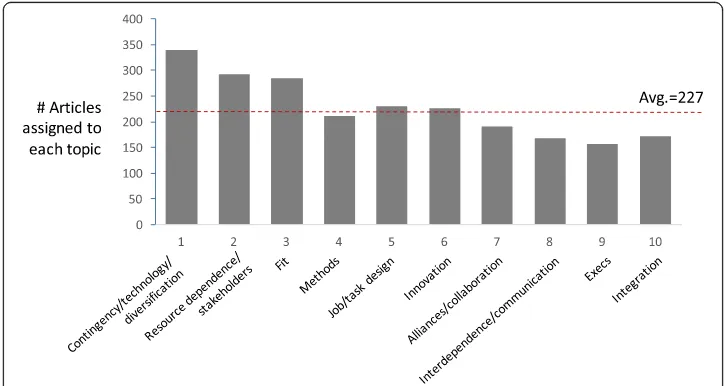
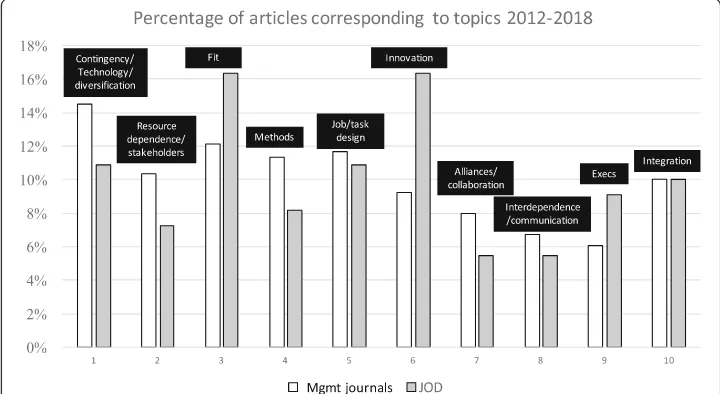
“alliance,” “logitudin,” “interorganiz,” “collabor,” and “cooper.” We therefore gave the nameAlliances/collaborationto this topic. For each abstract, I chose the most frequently occurring topic and then summed those topics across journals to arrive at a total count of themes over the period of study. The 10 topics listed in Fig.1and Fig.2compares JOD to mainstream journals in terms of those topics.
Patterns of themes observed in JOD
There are a few patterns worth noting. Topics are distributed far more evenly across the mainstream journals than in JOD, which is not surprising given that the latter is a specialty journal. Contingency/technology/diversification is the topic appearing most frequently in the broader management field. Contingency theory, which is largely due to the work of Lawrence and Lorsch (1967) and Thompson (1967), “remains, arguably, the most influential theory of organizations to this day”(Thompson1967: xxi).
Both Contingency/technology/diversification and Resource dependence/stakeholders are more prevalent in the overall field than in JOD. This particular difference may reflect that, by the time the latter was founded (in 2012), contingency theory and resource dependence had receded as a theoretical focus of organization design. In addition, resource depend-ence (unlike contingency theory) was not central to the theory of organization design.
The most prevalent topic in JOD is Fit. The journal’s relatively greater emphasis on this topic may well reflect the founders’ imprinting. Of course, the concept of fit was an important building block in theory construction in strategy. In particular, one of JOD’s co-founders—Charles Snow—was a prolific researcher on the subject of strategy, structure, and fit (see e.g., Miles et al.1978; Snow and Miles 1983). Borge Obel, JOD’s other co-founder, authored a well-known book on the subject of fit with Richard Burton (a JOD associate editor): Strategic Organizational Diagnosis and Design: The Dynamics of Fit, first published in 2004 (Burton & Obel,2004), now in its third edition. Since these authors initially drew on their extended social network to attract interest and manuscripts to JOD, it is not surprising that the co-founders’own interests fueled related submissions, and the journal reinforced founding philosophies.
Two other topics that have received disproportionate attention in JOD are Innovation
and Executives. Both of these topics may reflect JOD’s organizational goals. Thus, the emphasis on innovation is indicative of the journal’s “future” orientation and of the importance it ascribes to the relationship between organization design and technology evolution (e.g., ecosystems, platforms). In JOD’s very first issue, for example, Baldwin (2012) argued that the key problem for organization design is the management of distrib-uted innovation in dynamic ecosystems. Since then, a variety of JOD articles have focused on ecosystems, platforms, and other organizational features shaped by technology.
The greater relative emphasis that JOD places on executives reflects the journal’s decision to emphasizemanagersas well as academics. JOD always intended to publish articles that incorporated practical concerns and addressed organizational designers, managers, and entrepreneurs who faced design problems in their own organizations. Thus, JOD is one of the few journals in the field where practitioners are reasonably well-represented among authors and editors.
Because mainstream management journals are likely to continue publishing a stream of organization design research, that trend will naturally affect the themes observed in JOD articles. However, the journal’s diverse editorial board, distinct agenda (i.e., emphasis on different topics), and variety of article formats all strongly suggest that JOD will continue to deviate, to some extent, from such mainstream thematic trends. Given its structure, it is only natural that JOD will continue to provide a platform for a variety of perspectives and for the expression of design as an area of scientific inquiry that provides an important source of variation in the field of management. It is for these reasons that the Journal of Organization Design
will remain an important part of the field’s evolution.
Abbreviation
JOD:Journal of Organization Design
Acknowledgements
I would like to acknowledge the assistance of Luke Rhee, Assistant Professor, and John Kim, PhD student, both from the University of California, Irvine, for their assistance with data collection and analysis.
Availability of data and materials Journal abstract data is publically available.
Declarations
As per the submission guidelines, I attest that this paper does not share data with another under-review or published article.
Author’s contribution
This is a sole-authored commentary. The author read and approved the final manuscript.
Competing interests
The author declares that he has no competing interests.
Publisher’s Note
Springer Nature remains neutral with regard to jurisdictional claims in published maps and institutional affiliations.
Received: 19 July 2018 Accepted: 20 July 2018
References
Baldwin C (2012) Organization design for business ecosystems. J Organ Des 1(1):20–23
Baron JN, Hannan MT, Burton MD (1999) Building the iron cage: determinants of managerial intensity in the early years of organizations. Am Sociol Rev 64:527–547
Blei DM (2012) Probabilistic topic models. Commun ACM 55:77–84
Blei DM, Ng AY, Jordan MI (2003) Latent Dirichlet allocation. J Mach Learn Res 3:993–1022 Bodner J, Capron L (2018) Post-merger integration. J Organ Des 7:3
Burton RM, Obel B (2004) Strategic organizational diagnosis and design: the dynamics of fit, 3rd edn. Springer, New York
Burton RM, Obel B, Håkonsson DD (2015) Organizational design: a step-by-step approach, 3rd edn. Cambridge University Press, Cambridge
Galbraith JR (1974) Organization design: an information processing view. Interfaces 4(3):28–36
Lawrence PR, Lorsch JW (1967) Differentiation and integration in complex organizations. Adm Sci Q 12:1–47 Miles RE, Snow CC, Meyer AD, Coleman HJ Jr (1978) Organizational strategy, structure, and process. Acad Manag Rev 3:
546–562
Puranam P (2018) The microstructure of organizations. Oxford University Press, United Kingdom Simon HA (1964) On the concept of organizational goal. Adm Sci Q 9:1–22
Snow CC, Miles RE (1983) The role of strategy in the development of a general theory of organizations. Adv Strateg Manag 2(1):213–259
Thompson JD (1967) Organizations in Action. McGraw-Hill, New York