R E S E A R C H
Open Access
Responder analysis of a randomized comparison
of the 13.3 mg/24 h and 9.5 mg/24 h
rivastigmine patch
José L Molinuevo
1*, Lutz Frölich
2, George T Grossberg
3, James E Galvin
4, Jeffrey L Cummings
5,6,
Tillmann Krahnke
7and Christine Strohmaier
7Abstract
Introduction:OPtimizing Transdermal Exelon In Mild-to-moderate Alzheimer’s disease (OPTIMA) was a randomized, double-blind comparison of 13.3 mg/24 h versus 9.5 mg/24 h rivastigmine patch in patients with mild-to-moderate Alzheimer’s disease who declined despite open-label treatment with 9.5 mg/24 h patch. Over 48 weeks of double-blind treatment, high-dose patch produced greater functional and cognitive benefits compared with 9.5 mg/24 h patch.
Methods: Using OPTIMA data, apost-hocresponder analysis was performed to firstly, compare the proportion
of patients demonstrating improvement or absence of decline with 13.3 mg/24 h versus 9.5 mg/24 h patch; and secondly, identify predictors of improvement or absence of decline.‘Improvers’were patients who improved on the Alzheimer’s Disease Assessment Scale–cognitive subscale (ADAS-cog) by≥4 points from baseline, and did not decline on the instrumental domain of the Alzheimer’s Disease Cooperative Study–Activities of Daily Living scale (ADCS-IADL).‘Non-decliners’were patients who did not decline on either scale.
Results:Overall, 265 patients randomized to 13.3 mg/24 h and 271 to 9.5 mg/24 h patch met the criteria for inclusion in the intention-to-treat population and were included in the analyses. Significantly more patients were‘improvers’with 13.3 mg/24 h compared with 9.5 mg/24 h patch at Weeks 24 (44 (16.6%) versus 19 (7.0%);P< 0.001) and 48 (21 (7.9%) versus 10 (3.7%);P= 0.023). A significantly greater proportion of patients were‘non-decliners’ with 13.3 mg/24 h compared with 9.5 mg/24 h patch at Week 24 (71 (26.8%) versus 44 (16.2%);P= 0.002). At Week 48, there was a trend in favor of 13.3 mg/24 h patch. Functional and cognitive assessment scores at double-blind baseline did not consistently predict effects at Weeks 24 or 48.
Conclusion:More patients with mild-to-moderate Alzheimer’s disease who are titrated to 13.3 mg/24 h rivastigmine patch at time of decline are‘improvers’or‘non-decliners’i.e. show responses on cognition and activities of daily living compared with patients remaining on 9.5 mg/24 h patch.
Trial registration:Clinicaltrials.gov identifier: NCT00506415; registered July 20, 2007.
Introduction
The cholinesterase inhibitors (ChEIs), galantamine, done-pezil and rivastigmine, remain the predominant treat-ment for providing symptomatic relief for patients with mild-to-moderate Alzheimer’s disease (AD). To ensure the best outcome for the patient, it is important that use
of the available therapies is optimized over the course of disease progression; suboptimal dosing of ChEI therapy may be associated with a reduced chance of response [1]. Patients who ‘respond’ to treatment are generally regarded as those who demonstrate a clinic-ally meaningful benefit on an outcome measure. In neurodegenerative diseases, a treatment response refers to short-term improvement, longer-term stabilization or a slowed decline in one or more clinically relevant symptom domains [2].
* Correspondence:[email protected]
1
Alzheimer’s Disease and Other Cognitive Disorders Unit, ICN, Hospital Clínic i Universitari, IDIBAPS, Villarroel 170, Barcelona 08036, Spain
Full list of author information is available at the end of the article
The degree of impairment associated with AD is mea-sured by evaluation of cognitive factors, such as learning and memory. The Alzheimer’s Disease Assessment Scale–cognitive subscale (ADAS-cog) [3] is the stand-ard neuropsychological measure in trials involving pa-tients with mild-to-moderate AD [4,5]. It is important that functional decline is also measured to assess the ability to perform clinically meaningful activities of daily living (ADL). The Alzheimer’s Disease Cooperative Study (ADCS)-ADL scale is among the instruments most commonly used to assess function in AD-type dementia [6,7].
In clinical trials, outcomes may be measured as: the mean difference in the total score on a given scale be-tween active treatment and comparator groups; the delay to reaching specific milestones; or the percentage of
‘responders’ to treatment compared with a comparator treatment group or placebo. The criterion usually ap-plied for a‘responder’is a four-point or more improve-ment on the ADAS-cog [8], as this is generally accepted to represent a clinically relevant change on an individual basis in patients with mild-to-moderate AD [9]. In addition, for a population of patients who, without treat-ment, display continuous decline, achieving any im-provement or temporary stability on the ADAS-cog and other assessments may represent a significant thera-peutic benefit. Therefore, it is important to assess not just those who improve on the ADAS-cog, but also those who do not decline. On the ADCS-ADL, a re-sponder can be defined as a patient who improves or is stabilized in the course of a randomized clinical trial. It is also important to identify factors that may influence the likelihood of receiving a benefit from treatment, as patients may vary in their response to treatment accord-ing to their clinical characteristics [10,11].
Here, we present a post-hoc responder analysis of the instrumental domain of the ADCS-ADL scale (ADCS-IADL) data and the ADAS-cog data from the OPtimizing Transdermal Exelon In Mild-to-moderate Alzheimer’s disease (OPTIMA) clinical study (clinicaltrials.gov identi-fier NCT00506415). The aim of this analysis was firstly to identify the proportion of patients who demonstrated improvement or absence of decline with the 13.3 mg/24 h (15 cm2) versus the 9.5 mg/24 h (10 cm2) rivastigmine patch and, secondly to identify which patient characteristics are predictive of treatment response or non-decline.
Methods
Study population and study design
Detailed methodology of the OPTIMA study has been published previously [12]. Briefly, eligible patients were 50- to 85-years old, with a diagnosis of mild-to-moderate, probable AD according to the criteria of the National Institute of Neurological and Communicative Disorders
and Stroke, and the Alzheimer’s Disease and Related Disorders Association (NINCDS/ADRDA) [13] and a Mini-Mental State Examination (MMSE) score of ≥10 and ≤24 [14].
Patients who met pre-specified functional decline cri-teria (per physicians’ judgment) and cognitive decline criteria (≥3 point decline from baseline, or ≥2 point de-cline from the previous visit, in MMSE score) during up to 48 weeks of initial open-label (IOL) treatment with the 9.5 mg/24 h rivastigmine patch, subsequently en-tered a 48-week double-blind (DB) phase of the trial. In the DB phase, patients were randomized to treatment with either the 13.3 mg/24 h or the 9.5 mg/24 h rivastig-mine patch [12]. The OPTIMA study protocol was reviewed by the representative ethics committee for each participating center (see Additional file 1). The study was designed and implemented in accordance with Good Clinical Practice and the local regulations and ethical principles laid down in the Declaration of Helsinki [12]. All patients, or a legally acceptable representative, and caregivers provided written informed consent prior to participating in the study.
Of 1,584 patients enrolled into the IOL phase of the study, 567 met the pre-specified decline criteria during the IOL phase and were randomized into the DB phase; 280 to the 13.3 mg/24 h patch and 287 to the 9.5 mg/24 h patch [12]. The mean MMSE score ± standard deviation (SD) at baseline of the IOL phase, for those patients who declined during the IOL phase and, hence, were randomized into the DB phase, was 16.9 ± 3.6. At DB-baseline (DB-BL), the mean ± SD MMSE score was 14.1 ± 4.8 in the 13.3 mg/24 h patch group and 14.2 ± 4.6 in the 9.5 mg/24 h patch group, indicating that this represented a declining population [12].
Study outcomes and responder definition
The co-primary outcomes of the OPTIMA study were the change from DB-BL to Week 48 in ADAS-cog and ADCS-IADL scores. In this post-hoc analysis, responder analyses were conducted in each treatment group, on data collected during the DB-treatment phase, by apply-ing definitions for‘improvement’and‘non-decline’using ADAS-cog and ADCS-IADL criteria, in order to assess outcomes of both cognition and functional response. The percentages of patients with change from DB-BL in each responder category at Weeks 24 and 48 were com-pared between treatment groups (13.3 mg/24 h versus 9.5 mg/24 h patch).
DB-BL, or no change from DB-BL (that is, a reduction or no change from DB-BL in ADAS-cog score).
On the ADCS-IADL, where a decrease in points rep-resents decline: a lack of decline is assessed as no change or any improvement from DB-BL (that is, change from DB-BL≥0 points).
For the combined analysis, two groups were identified: those who improved on ADAS-cog and did not decline on ADCS-IADL (‘improvers’) and a wider group who did not decline on either scale (‘non-decliners’, which en-compasses the‘improvers’). Therefore, an‘improver’was defined as a patient who experienced an improvement from DB-BL in ADAS-cog score ≥4 points and no de-cline or a change from DB-BL in ADCS-IADL score≥0 points; a‘non-decliner’was defined as a patient who ex-perienced no decline or a change from DB-BL in ADAS-cog score ≤0 points and no decline or a change from DB-BL in ADCS-IADL score ≥0 points. Predictors of these combined response outcomes (‘improvers’ and
‘non-decliners’) were investigated at Weeks 24 and 48.
Analysis
Patient data were analyzed according to the randomized treatment (13.3 mg/24 h or 9.5 mg/24 h patch). The pri-mary analysis of this study was based on the intention-to-treat population in the DB phase (ITT-DB) using a last-observation-carried-forward (LOCF) imputation. The ITT-DB population with an LOCF imputation consisted of all patients who received at least one dose of study drug who also had at least one post-randomization assessment for both the ADAS-cog and ADCS-IADL.
Predictors of a combined response were investigated using a stepwise logistic regression model on both the combined criteria for improvement (‘improvers’) and the combined criteria for response (‘non-decliners’), with the following potential explanatory variables in addition to treatment: gender, ADAS-cog score at DB-BL, ADCS-IADL score at DB-BL, MMSE score at DB-BL of ≤12, and body weight category (<50 kg, 50 to 80 kg, >80 kg). Variables included in the final model were those with a P-value <0.15. Odds ratios (ORs) were calculated.
Results
Study population
In total, 265 patients randomized to the 13.3 mg/24 h patch and 271 patients randomized to the 9.5 mg/24 h patch met the criteria for inclusion in the ITT-DB popula-tion and were included in the present analysis.
Response on the ADAS-cog and ADCS-IADL when analyzed separately
A significantly greater proportion of patients receiving the 13.3 mg/24 h compared with the 9.5 mg/24 h patch demonstrated≥4 points improvement on the ADAS-cog
at Week 24 (n = 66 (24.9%) versus n = 39 (14.4%), P= 0.001) and at Week 48 (n = 42 (15.8%) versus n = 26 (9.6%),P= 0.020) (Figure 1A). A significantly higher pro-portion of patients receiving the 13.3 mg/24 h patch com-pared with the 9.5 mg/24 h patch showed no decline on the ADCS-IADL at Week 24 (n = 126 (47.5%) versus n = 102 (37.6%), P= 0.015). The difference at Week 48 was not statistically significant (n = 84 (31.7%) versus n = 68 (25.1%),P= 0.076); the difference was numerically in favor of the high-dose 13.3 mg/24 h patch group (Figure 1B).
Figure 1Responder analyses for the individual assessment
scales. (A)Compared with the 9.5 mg/24 h patch, the 13.3 mg/24 h patch was associated with a significantly higher proportion of patients with≥4 point improvement on the ADAS-cog at both weeks 24 and 48. *P<0.05, 13.3 mg/24 h versus 9.5 mg/24 h patch.
Combined response on both the ADAS-cog and ADCS-IADL
Baseline mean scores were comparable between the 13.3 mg/24 h patch and the 9.5 mg/24 h patch groups for the ADAS-cog (34.4 versus 34.9, respectively) and ADCS-IADL (27.5 versus 25.8, respectively). A signifi-cantly higher percentage of patients receiving the 13.3 mg/24 h patch compared with those receiving the 9.5 mg/24 h patch were ‘improvers’, demonstrating improvement of ≥4 points on the ADAS-cog plus no decline on the ADCS-IADL, at both Week 24 (n = 44 (16.6%) versus n = 19 (7.0%), P <0.001) and Week 48 (n = 21 (7.9%) versus n = 10 (3.7%), P= 0.023).
A significantly higher percentage of patients receiving the 13.3 mg/24 h patch compared with those receiving the 9.5 mg/24 h patch were‘non-decliners’based on the com-bined criteria at Week 24 (n = 71 (26.8%) versus n = 44 (16.2%),P= 0.002). A trend toward a higher proportion of
‘non-decliners’ was observed with the higher-dose patch compared with the 9.5 mg/24 h patch at Week 48 (n = 36 (13.6%) versus n = 24 (8.9%), P= 0.066).
Predictors of response
All covariates were available for all but four patients, leaving a total of 532 subjects (264 in the 13.3 mg/24 h
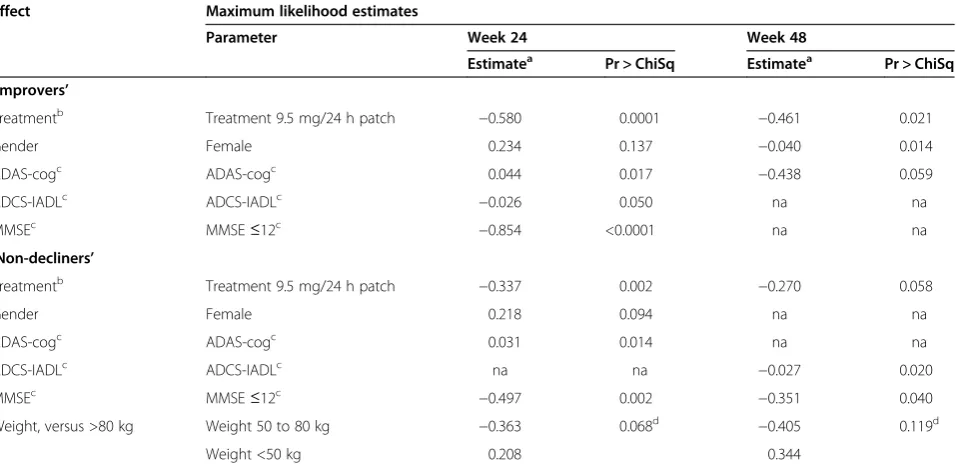
patch group and 268 in the 9.5 mg/24 h patch group) to be included in the stepwise regression model. Predictors identified as being relevant for a response on the combined ‘improver’ and ‘non-decliner’ criteria are summarized in Table 1.
The probability of seeing improvement at Week 24 was estimated to be higher for patients treated with the 13.3 mg/24 h versus the 9.5 mg/24 h patch (P= 0.0001). Higher ADAS-cog score and lower ADCS-IADL score at baseline (both indicating more severe impairment) also resulted in an increased estimate of probability of improvement (P= 0.017 and 0.050, respectively); con-versely, an MMSE score ≤12 at baseline led to a decreased estimate (P <0.0001). At Week 48, only male gender and treatment with the 13.3 mg/24 h patch were significant predictors (P= 0.014 and 0.021, respectively).
Similarly, the probability of seeing no decline at Week 24 was estimated to be higher for patients treated with the 13.3 mg/24 h versus the 9.5 mg/24 h patch (P= 0.002). At Week 48, a baseline ADCS-IADL score indicating a more severe disease status led to an increased estimate of the prob-ability of no decline (P= 0.020), while an MMSE score
≤12 at baseline reduced the estimate (P= 0.040); treat-ment with the 13.3 mg/24 h versus the 9.5 mg/24 h patch was borderline non-significant (P= 0.058).
Table 1 Predictors of response from a stepwise logistic-regression model on combined‘improver’criteria and combined‘non-decliner’criteria
Effect Maximum likelihood estimates
Parameter Week 24 Week 48
Estimatea Pr > ChiSq Estimatea Pr > ChiSq
‘Improvers’
Treatmentb Treatment 9.5 mg/24 h patch −0.580 0.0001 −0.461 0.021
Gender Female 0.234 0.137 −0.040 0.014
ADAS-cogc ADAS-cogc 0.044 0.017 −0.438 0.059
ADCS-IADLc ADCS-IADLc −0.026 0.050 na na
MMSEc MMSE≤12c −0.854 <0.0001 na na
‘Non-decliners’
Treatmentb Treatment 9.5 mg/24 h patch −0.337 0.002 −0.270 0.058
Gender Female 0.218 0.094 na na
ADAS-cogc ADAS-cogc 0.031 0.014 na na
ADCS-IADLc ADCS-IADLc na na −0.027 0.020
MMSEc MMSE≤12c −0.497 0.002 −0.351 0.040
Weight, versus >80 kg Weight 50 to 80 kg −0.363 0.068d −0.405 0.119d
Weight <50 kg 0.208 0.344
a
Positive estimate indicates increased odds of response when increasing the value of the covariate, or when in the given category. Negative estimated effect means reduced odds of response.b
Treatment effect compares 9.5 mg/24 h to 13.3 mg/24 h rivastigmine patch.c
At DB-BL.d
Discussion
According to the present analysis, the proportion of patients demonstrating a clinically relevant response (improvement of at least four points on the ADAS-cog and no decline on the ADCS-IADL) was more than two-fold with the high-dose rivastigmine patch (13.3 mg/24 h) relative to the lower dose (9.5 mg/24 h) at both Week 24 and Week 48. There was a significant difference between dose groups in the proportion of ‘non-decliners’ using the combined analysis (ADAS-cog and ADCS-IADL scales) to Week 24, but this difference was not significant by Week 48. At both time points (Weeks 24 and 48), the proportion of pa-tients classified as responders (showing improvementor non-decline) was more than 50% higher with the 13.3 mg/24 h compared with the 9.5 mg/24 h rivastigmine patch.
There was a robust statistical association of the 13.3 mg/24 h rivastigmine patch with a significantly greater likelihood of achieving improvement on combined criteria compared with the 9.5 mg/24 h patch, supporting the clinically meaningful benefit of this higher-dose patch. In a population where all patients steadily decline in cog-nition and function over the long term, the temporary sta-bility achieved with either dose of rivastigmine patch represents a valuable benefit to patients and their relatives and/or caregivers.
The current analysis provides insights into the primary analysis of the OPTIMA study. The primary study reported deterioration from DB-BL to Week 48 on the ADAS-cog and ADCS-IADL scale with both the 13.3 mg/24 h and the 9.5 mg/24 h patch [12]. Furthermore, in the primary ana-lysis, the 13.3 mg/24 h patch group had a significant bene-fit (statistically less deterioration) over the 9.5 mg/24 h patch group from Week 16 up to Week 48 on the ADCS-IADL scale, and showed a significant benefit at Week 24 (but not Week 48) using the ADAS-cog. When only
‘improvers’are considered, this post-hoc analysis shows a significant benefit for the 13.3 mg/24 h patch over the 9.5 mg/24 h patch on the ADAS-cog at Week 48. This benefit of the 13.3 mg/24 h patch for the subset of
‘improvers’was potentially masked by the much larger group of patients who were‘non-decliners’or non-responders (that is, showed deterioration) in the primary analysis. The oppos-ite is seen when the effect of treatment on the ADCS-IADL scale is considered. The post-hoc analysis (‘non-decliners’) found a statistically significant difference between treat-ment groups at Week 24, but not at Week 48, as was found in the primary analysis (total population). There-fore, the results from thispost-hocanalysis offer a valuable opportunity to evaluate the effect of different doses of rivastigmine on different patient types.
To maximize the therapeutic benefit with ChEIs, the optimal dose is tailored to each individual AD patient ac-cording to disease stage and other clinical characteristics [1]. Identifying the proportion of patients considered to
respond to different doses of ChEI therapy during the course of disease progression, as well as the characteristics of these‘responders’, will help physicians evaluate the clin-ical benefit of different treatment regimens and assist them in the choice of optimal therapy for their patients. In this analysis, the proportion of patients who were ‘improvers’ or‘non-decliners’was higher at Week 24 than at Week 48 post-randomization on both measurement scales–reflecting the progressive nature of the disease. The mean MMSE score was 14.1 for patients in the 13.3 mg/24 h patch group and 14.2 for patients in the 9.5 mg/24 h patch group, indicat-ing that a large proportion of patients had reached a moder-ate stage of AD by DB-BL [12].
Predictors of response analyses produced inconsistent results (Table 1). Worse cognition or functional ability at the start of the trial measured by the ADAS-cog or ADCS-IADL, respectively, was associated with a sig-nificantly greater chance of improvement (or lack of decline) with rivastigmine after 24 weeks; when patients declined to an MMSE score of less than 12 there was a significantly reduced chance of improvement. Conversely, the probability of response (or absence of decline) after 48 weeks tended to be higher with better cognition at DB-BL (as indicated by either ADAS-cog for improvement, and MMSE category for no-decline, respectively), again ac-companied by the opposite effect on the ADCS-IADL. This analysis was limited and biased by the design of the study. Prospectively planned analyses for predictors of response would be a useful approach in clinical trials of agents for treatment of AD.
Reduced function compromises the patient’s ability to live independently, is an important predictor of caregiver burden [15] and is a strong risk factor for nursing home placement or institutionalization [16-18]. In turn, nurs-ing home placement has a marked influence on the overall costs of dementia management [18]. By measur-ing both cognitive and functional decline, physicians gain a more complete picture of the likely impact of the disease and the available treatments on the patient, their caregiver and the healthcare system in general.
Conclusions
Additional file
Additional file 1:List of Independent Ethics Committees or
Institutional Review Boards.
Abbreviations
AD:Alzheimer’s disease; ADAS-cog: Alzheimer’s Disease Assessment Scale– cognitive subscale; ADCS: Alzheimer’s Disease Cooperative Study; ADCS-IADL: Instrumental domain of the ADCS-ADL scale; ADL: activities of daily living; ADRDA: Alzheimer’s Disease and Related Disorders Association; ChEIs: cholinesterase inhibitors; DB: double blind; DB-BL: DB baseline; IOL: initial open label; ITT: intention-to-treat; LOCF: last-observation-carried-forward; MMSE: Mini-Mental State Examination; NINCDS: National Institute of Neurological and Communicative Disorders and Stroke; OPTIMA: OPtimizing Transdermal Exelon In Mild-to-moderate Alzheimer’s disease; OR: odds ratio; SD: standard deviation.
Competing interests
JLM has received honoraria for acting as a scientific advisor, investigator, data monitoring board member or consultant from: Pfizer, Eisai, Janssen-Cilag, Novartis, Lundbeck, Roche, Bayer, Bristol-Myers Squibb, GE Healthcare, GlaxoSmithKline and Eli Lilly. LF has received honoraria for acting as a scientific advisor, investigator, data monitoring board member or consultant from: Astra-Zeneca, Axon Neuroscience, Eisai, Elan/Wyeth, Eli Lilly, GE Healthcare, Genentech/Roche, Janssen-Cilag, Kyowa, Lundbeck, Merz Pharma, Novartis, Pfizer and Schering-Plough. He has provided expert testimony to Apotex Inc. LF has received payment for the development of educational presentations including service on speakers’bureau from Novartis. GTG has served as a consultant for Accera, Baxter Bioscience, Forest Labs, Lundbeck, Novartis, Otsuka, and Takeda; has received research support from Accera, Baxter, Elan, Forest, Janssen, NIH, Novartis, Noven, and Pfizer; and serves on a safety monitoring board for Merck. JEG has provided consultation for Accera, Baxter, Eisai, Forest, Novartis, Pfizer and Toyama. He has received research funding from Accera, Bristol-Myers Squibb, MedAvante, Merck, Neuronix and Takeda. JLC has provided consultation to Acadia, ADAMAS, Anavex, Avanir, Baxter, Bristol-Myers Squibb, Eisai, Elan, EnVivo, Genentech, GlaxoSmithKline, Janssen, Eli Lilly, Lundbeck, Medtronic, Merck, Neuronix, Novartis, Otsuka, Pain Therapeutics, Pfizer, Prana, QR, Sanofi, Sonexa, Takeda and Toyama. JLC has also provided consultation to Bayer, Avid, GE Healthcare, MedAvante, Neurotrax and UBC. JLC owns stock in ADAMAS, Prana, Sonexa, MedAvante, Neurotrax, Neurokos and QR Pharma. He has participated as a speaker/lecturer for Eisai, Forest, Janssen, Novartis, Pfizer and Lundbeck. JLC owns the copyright of the Neuropsychiatric Inventory. JLC has provided expert witness consultation regarding olanzapine and ropinerol. TK and CS are employees and stockholders of Novartis Pharma AG. The OPTIMA study and current analyses were funded by Novartis Pharma AG, Basel, Switzerland.
Authors’contributions
JLM, LF and JEG were Principal Investigators of the OPTIMA study. All authors (JLM, LF, GTG, JEG, JLC, TK and CS) were involved in the conception, design and acquisition of data, interpreted the results, contributed to the content, drafting, critical review for important intellectual content, revision and approval of this manuscript. TK performed the statistical analyses on which this article is based. All authors read and approved the final manuscript.
Acknowledgments
Fishawack Communications Ltd, Oxford, UK, provided medical writing services. These services were funded by Novartis Pharma AG, Basel, Switzerland.
Author details
1Alzheimer’s Disease and Other Cognitive Disorders Unit, ICN, Hospital Clínic i Universitari, IDIBAPS, Villarroel 170, Barcelona 08036, Spain.2Department of Geriatric Psychiatry, Central Institute of Mental Health, Medical Faculty Mannheim, University of Heidelberg, Mannheim, Germany.3Department of Neurology & Psychiatry, School of Medicine, St Louis University, St Louis, MO, USA.4Center for Cognitive Neurology, New York University Langone School of Medicine, New York, NY, USA.5Cleveland Clinic Lou Ruvo Center for Brain Health, Las Vegas, NV, USA.6Cleveland Clinic Lou Ruvo Center for Brain Health, Cleveland, OH, USA.7Novartis Pharma AG, Basel, Switzerland.
Received: 18 November 2013 Accepted: 10 December 2014
References
1. Small G, Bullock R. Defining optimal treatment with cholinesterase inhibitors in Alzheimer's disease. Alzheimers Dement. 2011;7:177–84.
2. Burns A, Yeates A, Akintade L, Del Valle M, Zhang RY, Schwam EM, et al. Defining treatment response to donepezil in Alzheimer's disease: responder analysis of patient-level data from randomized, placebo-controlled studies. Drugs Aging. 2008;25:707–14.
3. Rosen WG, Mohs RC, Davis KL. A new rating scale for Alzheimer's disease. Am J Psychiatry. 1984;141:1356–64.
4. Rockwood K, Fay S, Gorman M, Carver D, Graham JE. The clinical meaningfulness of ADAS-Cog changes in Alzheimer's disease patients treated with donepezil in an open-label trial. BMC Neurol. 2007;7:26. 5. Green C. Modelling disease progression in Alzheimer's disease: a review of
modelling methods used for cost-effectiveness analysis. Pharmacoeconomics. 2007;25:735–50.
6. Galasko D, Bennett D, Sano M, Ernesto C, Thomas R, Grundman M, et al. An inventory to assess activities of daily living for clinical trials in Alzheimer's disease. The Alzheimer's Disease Cooperative Study. Alzheimer Dis Assoc Disord. 1997;11:S33–9.
7. Gauthier S, Bodick N, Erzigkeit E, Feldman H, Geldmacher DS, Huff J, et al. Activities of daily living as an outcome measure in clinical trials of dementia drugs. Position paper from the International Working Group on Harmonization of Dementia Drug Guidelines. Alzheimer Dis Assoc Disord. 1997;11(Suppl. 3):6–7.
8. Winblad B, Brodaty H, Gauthier S, Morris JC, Orgogozo JM, Rockwood K, et al. Pharmacotherapy of Alzheimer's disease: is there a need to redefine treatment success? Int J Geriatr Psychiatry. 2001;16:653–66.
9. Raina P, Santaguida P, Ismaila A, Patterson C, Cowan D, Levine M, et al. Effectiveness of cholinesterase inhibitors and memantine for treating dementia: evidence review for a clinical practice guideline. Ann Intern Med. 2008;148:379–97.
10. Sadowsky CH, Grossberg GT, Somogyi M, Meng X. Predictors of sustained response to rivastigmine in patients with Alzheimer's disease: a retrospective analysis. Prim Care Companion CNS Disord. 2011;13:pii = PCC.10m01101. doi:10.4088/PCC.10m01101.
11. Farlow MR, Doraiswamy PM, Meng X, Cooke K, Somogyi M. The effect of vascular risk factors on the efficacy of rivastigmine patch and capsule treatment in Alzheimer's disease. Dement Geriatr Cogn Dis Extra. 2011;1:150–62. 12. Cummings J, Froelich L, Black SE, Bakchine S, Bellelli G, Molinuevo JL, et al.
Randomized, double-blind, parallel-group, 48-week study for efficacy and safety of a higher-dose rivastigmine patch (15 vs. 10 cm2) in Alzheimer's disease. Dement Geriatr Cogn Disord. 2012;33:341–53.
13. McKhann G, Drachman D, Folstein M, Katzman R, Price D, Stadlan EM. Clinical diagnosis of Alzheimer disease: report of the NINCDS-ADRDA Work Group under the auspices of Department of Health and Human Services Task Force on Alzheimer's disease. Neurology. 1984;34:939–44. 14. Folstein MF, Folstein SE, McHugh PR. "Mini-mental state". A practical
method for grading the cognitive state of patients for the clinician. J Psychiatr Res. 1975;12:189–98.
15. Razani J, Kakos B, Orieta-Barbalace C, Wong JT, Casas R, Lu P, et al. Predicting caregiver burden from daily functional abilities of patients with mild dementia. J Am Geriatr Soc. 2007;55:1415–20.
16. Wattmo C, Wallin AK, Londos E, Minthon L. Risk factors for nursing home placement in Alzheimer's disease: a longitudinal study of cognition, ADL, service utilization, and cholinesterase inhibitor treatment. Gerontologist. 2011;51:17–27.
17. Wattmo C, Wallin AK, Londos E, Minthon L. Long-term outcome and prediction models of activities of daily living in Alzheimer disease with cholinesterase inhibitor treatment. Alzheimer Dis Assoc Disord. 2011;25:63–72.