VOLUME 36, ARTICLE 7, PAGES 227
−
254
PUBLISHED 12 JANUARY 2017
http://www.demographic-research.org/Volumes/Vol36/7/ DOI: 10.4054/DemRes.2017.36.7
Research Article
The influence of a supportive environment for
families on women’s fertility intentions and
behavior in South Korea
Soo-Yeon Yoon
©2017 Soo-Yeon Yoon.
This open-access work is published under the terms of the Creative Commons Attribution NonCommercial License 2.0 Germany, which permits use, reproduction & distribution in any medium for non-commercial purposes, provided the original author(s) and source are given credit.
1 Introduction 228
2 Background 229
2.1 Support to families and fertility in South Korea 229 2.2 Changing female-gender roles, institutional support , and fertility 231 2.3 Support from husbands in relation to fertility 233 2.4 Support from grandparents in relation to fertility 234
3 Data and methods 236
3.1 Data 236
3.2 Dependent variables: Fertility intentions and fertility behaviour 236 3.3 Independent variables: Supportive environments for the family 237
3.4 Control variables 238
3.5 Methodological approach 239
4 Results 240
4.1 Supportive environments for the family and fertility intentions 240 4.2 Supportive environments for the family and fertility behavior 242
5 Discussion and conclusions 244
6 Acknowledgements 247
The influence of a supportive environment for families on women’s
fertility intentions and behavior in South Korea
Soo-Yeon Yoon1
Abstract
BACKGROUND
Recent theories of low fertility emphasize the increasing importance of support for the family in changing gender roles toward egalitarianism. In a context of weak institutional support for families and low levels of gender equity, do family policies influence individual fertility? Moreover, might support from other sources, such as men’s involvement in the family or grandparental childcare assistance, positively influence fertility intentions and behavior?
OBJECTIVE
I examine the influence of three sources of a supportive environment for families – the state, husbands, and parents or in-laws – on women’s fertility intentions and behavior regarding second children.
METHODS
Using data from three waves of the Korean Longitudinal Survey for Women and Families, I measured supportive environments by knowledge of family policy, men’s involvement in housework and childcare, and grandparental childcare assistance. I then studied these factors with binary logistic regression analysis.
RESULTS
The findings suggest that supportive environments for the family have a stronger effect on fertility behavior than on fertility intentions. Women who are knowledgeable about childcare leave reserved for use by fathers are more likely to have a second child than women who do not know about it. Support from husbands for housework and childcare and intensive childcare assistance from coresiding parents or in-laws increase the likelihood of a second birth.
CONTRIBUTION
These findings contribute to our theoretical understanding of the interplay between the welfare state and the family in studies of fertility. Moreover, the findings have unique
implications for very low fertility in countries with limited and fragmented state support of families.
1. Introduction
There is a great deal of heterogeneity in fertility levels across advanced countries. Scholars have observed an upturn in total fertility rates in Western countries in the past decade (Goldstein, Sobotka, and Jasilionience 2009; Myrskylä, Kohler, and Billari 2009). In addition, the relationship between trends in female labor force participation and fertility trends changed from negative to positive at the national level in the 1990s (e.g., Brewster and Rindfuss 2000; Del Boca 2002; Morgan 2003; Rindfuss et al. 2007). However, East Asian countries, such as South Korea (hereafter Korea) and Japan, continue to be exceptions to this recent rebound in fertility levels. Scholars explain this cross-national difference in fertility rates in relation to the compatibility between parenthood and labor force participation, augmented by state support to families and gender equality (Billingsley and Ferrarini 2014; Esping-Andersen and Billari 2015; McDonald 2000; Mills et al. 2011; Myrskylä, Kohler, and Billari 2011; Thévenon 2011).
In a comparative study examining the cross-national variation in state support to families, Thévenon (2011) reveals that such support in Southern European countries, Japan, and Korea is characterized by a deficit of policies that enable a balance between work and family for women. Korea is markedly different from countries in the same group that offer similar levels of state support to families: It “clearly lag[s] behind the other OECD countries, whichever type of support is considered” (Thévenon 2011:64).
impact of such a source on fertility (Harknett, Billari, and Medalia 2014). Few studies have comprehensively evaluated varying sources of support for the family and how they relate to fertility decision-making in an analysis at the individual level.
I aim to fill in this gap in the literature by examining the influence of three sources of a supportive environment for the family on women’s fertility intentions and behavior. I situate the Korean case in a broader discussion on the nuanced relationship between access to family support and fertility in a context lacking institutional support for childrearing, embedded in low levels of gender equality. Using data from the three waves of the Korean Longitudinal Survey of Women & Families from 2007 to 2010, I examine whether three sources of a supportive environment for families – the state, husbands, and parents or in-laws – influence fertility intentions and fertility behavior for married women with one child. My analysis focuses on second births, given the cultural context of a rapid transition to first birth within the first years of marriage in Korea (Statistics Korea 2015).2 Moreover, this analysis enables me to examine the impact on second births of existing childcare support from the three sources of a supportive environment for the family (Thomése and Liefbroer 2013).
2. Background
2.1 Support to families and fertility in South Korea
Korea is marked by very high levels of human development and, concurrently, very low gender equality (World Economic Forum 2016). As institutional settings have not yet facilitated work‒family compatibility, the female labor force participation rate (FLFP) has remained slightly above 50% since early 2000 (Statistics Korea 2015). The FLFP follows an M-shaped curve, with its peak around women’s late 20s, decreasing during their 30s as a large proportion of women leave the labor force for marriage, childbirth, and childrearing, then increasing when women rejoin the labor market as their children reach school age. The traditional gendered division of labor still persists, even among dual-earner couples. The 2009 Korean Time Use Survey reveals that, on average, women in dual-earner couples do 4.2 times more housework and childcare than their husbands (Lee 2014).
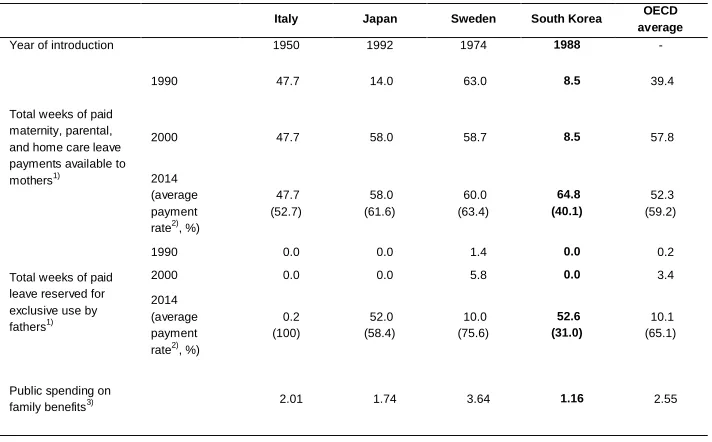
Table 1 provides information on trends in leave entitlement for childbirth in selected countries from 1990 to 2014. The Korean government introduced employment-protected maternity and childcare leave in 1988, offering mothers a total of 8.5 weeks, and maintained the same length of available leave for mothers until 2001. In 2006 the
2
Korean government announced a program called the Saeromaji Plan as a response to low fertility and population aging, and strengthened the role of the Ministry of Gender Equality and Family in developing and implementing gender equality policies. Korea currently gives working mothers 12.8 weeks of maternity leave and 52 weeks of childcare leave, with an income-replacement rate of 40% up to a maximum of 1,000,000 Korean Won per month (approximately US$850). Working fathers have had the right to 12 months of childcare leave since 1995. At 52.6 weeks, Korea now offers the longest paid leave reserved for fathers among the OECD countries, followed by Japan at 52 weeks. However, few fathers actually take childcare leave. No statistics are available for childcare leave by fathers until 2000, and a mere 2 fathers in the whole country took childcare leave in 2001.3 Over the decade after the enactment of childcare leave for fathers, the public was barely aware of its existence. In 2014 less than 5% of all workers taking childcare leave were male (Statistics Korea 2015). In comparison, in Sweden in the same year, approximately 25% of childcare leave was taken by fathers.4 At 1.16% of GDP, public spending on family benefits is very low in Korea, much lower than the OECD average and that of another relevant country with limited state support, Japan.
In Korea, the percentage of children aged two or younger enrolled in formal childcare and pre-school services has increased from 3% in 2001 to 35% in 2015 (OECD Family Database 2016). The enrollment rates for 3–5-year-old children reached approximately 92% in 2014. However, the majority of them are enrolled in private facilities because of the lack of public facilities (less than 5% of childcare facilities are public) (Ministry of Health and Welfare 2012). Moreover, reliance on grandparental childcare is considerable. The National Childcare Surveys reveal that the proportion of mothers of children aged 5 or younger receiving childcare support from grandparents increased from 22% in 2009 to 29% in 2012. The proportion of working mothers receiving childcare support from grandparents is much higher: 50% in 2012. Grandparents, usually grandmothers, provide intensive childcare, spending approximately 52 hours per week (Lee and Bauer 2010). Adult children heavily rely on childcare assistance from grandmothers as a form of instrumental support, under the influence of strong familism and the persistent traditional gender-role ideology in Korea (Lee and Bauer 2013).
3
Source: http://www.index.go.kr/potal/stts/idxMain/selectPoSttsIdxSearch.do?idx_cd=1504&clas_div=&idx _sys_cd=528&idx_clas_cd=1.
Table 1: Trends in childbirth leave entitlements, selected countries, 1990–2014
Italy Japan Sweden South Korea OECD average
Year of introduction 1950 1992 1974 1988
-Total weeks of paid maternity, parental, and home care leave payments available to mothers1)
1990 47.7 14.0 63.0 8.5 39.4
2000 47.7 58.0 58.7 8.5 57.8
2014 (average payment rate2), %)
47.7 (52.7) 58.0 (61.6) 60.0 (63.4) 64.8 (40.1) 52.3 (59.2)
Total weeks of paid leave reserved for exclusive use by fathers1)
1990 0.0 0.0 1.4 0.0 0.2
2000 0.0 0.0 5.8 0.0 3.4
2014 (average payment rate2), %)
0.2 (100) 52.0 (58.4) 10.0 (75.6) 52.6 (31.0) 10.1 (65.1)
Public spending on
family benefits3) 2.01 1.74 3.64 1.16 2.55
1) Figures refer to entitled weeks of paid leave as of April 2014.
2) The average payment rate is the proportion of gross earnings replaced by the benefits over the length of the paid leave for a
person with average earnings.
3) Public spending on family benefits refers to financial support for families and children, including child-related cash transfers to
families with children, public spending on services for families with children, and financial support for families through the tax system. Presented as a percentage of GDP, 2011.
Source: OECD Family Database (www.oecd.org/social/family/database.htm).
2.2 Changing female-gender roles, institutional support , and fertility
Recent investigations of cross-national variation in fertility reveal two groups of countries, those experiencing fertility recovery, such as in Scandinavia, and those experiencing no recovery, such as Italy, Spain, Japan, and Korea (Esping-Andersen and Billari 2015; Thévenon 2011). Several scholars explain this by emphasizing the role of support for the family from social institutions (e.g., family policy regimes) in enabling compatibility between work and family, which, in turn, reflects new expectations that gender-egalitarian family norms will bring pro-family outcomes (Billingsley and Ferrarini 2014; Chésnais 1996; McDonald 2000, 2013; Thévenon 2011).
findings. In her review of the literature linking policy and fertility, Gauthier (2007) reveals that evidence based on micro-level data supports a small positive impact of family policies on fertility, and this impact varies by country and parity. Several studies investigating cross-national variation in fertility among European countries find that family policies are positively associated with fertility (Billingsley and Ferrarini 2014; Harknett, Billari, and Medalia 2014; Kalwij 2010). Empirical case studies using data from European countries suggest inconclusive findings as to the extent to which different aspects of family policy influence fertility, depending on the national context. In addition, some studies categorize family policy into two dimensions, depending on the orientation of its family support model, and earnings-related leave and childcare provision are categorized as support for the dual-earner family model (Billingsley and Ferrarini 2014; Korpi 2000; Korpi, Ferrarini, and Englund 2013). Evidence from Scandinavian countries, including Finland, Norway, and Sweden, suggests that fathers’ parental leave has a positive impact on fertility (Duvander and Andersson 2006; Duvander, Lapperård, and Andersson 2010; Oláh 2003; Rønsen 2004). Earlier studies investigating the influence of childcare provision on fertility show varying results, from no significant impact in Germany (Hank and Kreyenfeld 2003) and Sweden (Andersson, Duvander, and Hank 2004) to a positive influence in Italy (Del Boca 2002) and Norway (Rindfuss et al. 2007; Rindfuss et al. 2010). However, the varying fertility effects of family policy arrangements may relate to changes in gender equality or changes in other factors that influence achieving women’s desired family size, such as support from husbands and individual characteristics (Hook 2006; McDonald 2002; Rindfuss et al. 2010).
Regarding family policy context, Thévenon (2011) shows that public support of families in Korea and East Asia more broadly is limited, based on cross-national analysis of state support in other OECD countries. Similarly, McDonald (2008) argues that very low fertility across East Asia indicates failing social models based on traditional models of families receiving little or no assistance from the state. A lack of information to make informed choices is another contributing factor in limited state support, leading to welfare failure (Esping-Andersen 2009). Yet the macro-level investigations do not give clear insight into 1) the level of public awareness of public support for families, and 2) whether family policies have an effect on fertility at the individual level in a country that has limited state support. These remaining questions lead me to posit my first set of hypotheses.
Hypothesis 1a: Support from institutions has a positive effect on women’s fertility intentions for second children.
2.3 Support from husbands in relation to fertility
Childbearing can seriously limit women’s opportunities in the labor market unless they have access to supportive environments for childbearing and childrearing. Family sociologists linking low fertility to the conflict between women’s roles as mothers and workers focus on the importance of support from husbands with housework or childcare (e.g., Goldscheider, Bernhardt, and Brandén 2013; Goldscheider, Bernhardt, and Lappegård 2015; Torr and Short 2004). In accordance with a theoretical framework centered upon changing gender roles and gender relations, Goldscheider, Bernhardt, and Lappegård (2015) emphasize the need for change in the private sphere of the family for the second half of the gender revolution, requiring more male involvement in the family. They posit that men’s increased involvement in the family generates pro-family outcomes, including increasing fertility. Many empirical studies linking gender equality (or equity) and fertility at the micro-level suggest that greater gender equity in the family, reflected in support from husbands with housework or childcare, positively influences women’s fertility attitudes and behavior.
Oláh (2003) supports the positive influence of more equal sharing of housework and childcare on the likelihood of intentions to have second children in Hungary. Similarly, Mills et al. (2008) show a negative association between an unequal division of housework and mothers’ intention to have second children in Italy. Evidence based on data from the United States (Torr and Short 2004) and from Italy (Cooke 2009) supports the positive influence of a more equal division of housework on the transition to a second birth. Using the European Generation and Gender Surveys, Neyer, Lappegård, and Vignoli (2013) also confirm the positive influence of men’s engagement in housework on women’s fertility intentions.
H2a: Support from husbands with housework and childcare has a positive effect on women’s fertility intentions for second children.
H2b: Support from husbands with housework and childcare has a positive effect on women’s giving birth to second children.
2.4 Support from grandparents in relation to fertility
Literature on grandparental childcare is extensive, especially in the case of the US, shedding light on aspects such as the cost and benefits of raising grandchildren and the heterogeneity of grandparent caregivers (e.g., Hayslip and Kaminski 2005; Vandell et al. 2003). One of the main themes arising from these previous studies is that grandparental childcare assistance is driven by need, including family structure and financial difficulties (Aassve, Meroni, and Pronzato 2012; Jappens and Van Bavel 2012). In addition, comparative studies using data from European countries show regional variations across Europe in the importance of grandparental childcare. Several studies suggest that parents’ need for informal childcare depends on their institutional context, such as the availability of formal childcare (Balbo and Mills 2011; Hank and Buber 2009; Hank and Kreyenfeld 2003; Philipov et al. 2006), cultural differences in family practices and norms (Jappens and Van Bavel 2012), and levels of trust toward non-familial institutions (Esping-Andersen and Billari 2015). These studies suggest that childcare support from grandparents is more important in countries that have limited welfare support and formal childcare, because in that context the level and frequency of grandparental childcare support is high.
Tanskanen et al. (2014), however, suggest that only paternal grandparental investment, measured by frequency of contact, correlates with the increased likelihood of having a second child – but not with higher parity births. In sum, a few recent studies differentiated support from maternal grandparents from that of paternal grandparents, but findings regarding the effect on fertility are inconclusive.
Previous studies on grandparental childcare assistance suggest that grandparents are the most important childcare providers in China and Taiwan (Chen, Short, and Entwisle 2000; Chen, Liu, and Mair 2011 for China; Chi and Hsin 1996 for Taiwan). Based on the East Asian patrilineal family system, previous studies using Chinese data also highlight the effects of coresidence with parents or (in most cases) in-laws on women’s fertility and present mixed findings. Using Taiwanese data, Chi and Hsin (1996) show that living with the husband’s parents exerted upward pressure on reproduction during the demographic transition, while Chu, Kim, and Tsay (2014) suggest that coresidence with in-laws delays women’s first births. Using data from a Chinese survey, Ji et al. (2015) find that neither coresidence with grandparents nor the availability of grandparental childcare support has an effect on fertility intentions. Empirical investigations of the role of grandparental childcare assistance on fertility in Korea are few, although findings suggest that mothers’ reliance on childcare provided by grandparents (mostly grandmothers) has increased.
How does the impact of support from grandparents on women’s fertility intentions and behaviors play out differently in a context with weak support from the state and from husbands? Coresidence with grandparents may provide a higher probability of receiving regular childcare support from them, but this leaves open the question of how the actual support transfers between generations. In addition, a limitation of previous studies is that they did not consider other sources of support to families when they examined the influence of childcare support from grandparents.5 Would childcare support from grandparents increase women’s fertility intentions and behaviors for second children, even controlling for other sources of family support? This leads to my third set of hypotheses:
H3a: Support from grandparents has a positive effect on women’s fertility intentions for second children.
H3b: Support from grandparents has a positive effect on women’s giving birth to second children.
5
3. Data and methods
3.1 Data
I used data from three waves of the Korean Longitudinal Survey of Women & Families (KLoWF), conducted by the Korean Women’s Development Institute in 2007, 2008, and 2010. The KLoWF is a social survey that collects information regarding family structure, family relationships, family policy, and fertility history. The survey asked questions concerning fertility intentions exclusively of women who were currently married, were younger than 45, and had at least one birth experience.
Based on multi-stage stratified sampling using data from 10% of 260,000 surveyed districts from the 2005 National Census, a total of 9,068 households, including 9,997 females aged between 19 and 64 from these households, were selected and surveyed longitudinally. To examine the relationship between family support environment and women’s second birth intentions and behaviors, I selected an analytic sample of currently married women under the age of 40, with one child, who responded to fertility intentions in Wave 1. I then traced childbirth responses for this sub-sample across Wave 2 and Wave 3. A total of 7,031 females responded to all three waves of the survey. Of the 7,031 respondents, I first excluded 3,611 women aged 41 or above in 2007. I then further limited my sample to married women, excluding 629 women who had never married and 78 separated, divorced, or widowed women. Then I excluded 1,938 women who had two or more children in Wave 1, 177 women who did not indicate the number of children they had given birth to, and 7 women who did not respond to the question about fertility intentions. My sample-selection process resulted in 591 married women with one child. Finally, I excluded 66 cases because of missing values for husbands’ income (n=58), for elderly care because of old age or illness (n=6), and for hours that husbands spent on housework and childcare (n=2). The final analytic sample thus comprises 526 women with valid responses for all model covariates. I adjusted model estimations for individual weights in an attempt to reduce potential issues of sample selection.
3.2 Dependent variables: Fertility intentions and fertility behavior
and responses of ‘no’ or ‘don’t know’ are coded 0. Fertility intentions serve as an independent variable for estimating fertility behavior. Fertility behavior is also a dichotomous variable that differentiates ‘had a second child’ (1) from ‘did not have a second child’ (0). I used the responses to a question, collected in Wave 2 or Wave 3, that asked, “Have you given birth to a child since the last interview?” to determine if a mother had a second child between 2007 and 2010.6
3.3 Independent variables: Supportive environments for the family
Based on responses from Wave 1, supportive environments for the family are classified into three categories, support from institutions, support from husbands, or support from grandparents. Demographers have used information on knowledge and attitudes to suggest implications for population policy (e.g., knowledge of, attitude towards, and practice of contraception). The assumption in using this approach was that improving knowledge about and access to family planning (contraceptive methods) can help women prevent unwanted pregnancies (Westoff 1988). I adopt this approach to examine whether or not knowledge about pro-natal family policy programs positively influences fertility intentions or fertility behavior (H1a and H1b). I hypothesize that women with more knowledge of family policy are more likely to have positive fertility intentions and have second children than women with little or no knowledge about this policy. I measured support from the institutions using respondents’ knowledge about childcare leave reserved for use by fathers.7 I used responses to a question that asked “Have you ever heard about childcare policy such as childcare leave for use by fathers?” Responses ranged from ‘never heard of it’ and ‘heard of it but don’t know it well’ to ‘heard of it and know it very well.’ I used ‘never heard of it’ as a reference category.
‘Support from the husband’ is based on women’s responses about their husbands’ participation in housework and childcare hours per day. Overall, the amount of time men devote to household tasks is low (mean = 1.18 hours, s.d. = .08).8 I coded support from husbands into quartiles to test its impact on fertility (H2a and H2b). I used the lowest quartile (< 25%) of support from husbands as the reference category. By employing quartiles I can capture the threshold effects of husbands’ time spent on housework and childcare.
6 The interval between Wave 1 and Wave 2 was 12 months and between Wave 2 and Wave 3 was 24 months. 7
I chose childcare leave for fathers instead of for mothers because of the M-shaped FLEP in Korea. Less than 30% of my sample was employed at the time of their initial interview in Wave 1. It is possible that a substantial proportion of women had already dropped out of the labor force after being married.
8
I constructed a categorical measure of ‘support from grandparents’9 that combines childcare support from parents or in-laws and multigenerational coresidence. The components are based on two questions that ask about childcare support from grandparents: “Does your father or mother look after your child for an hour or longer per week?” and “Does your father-in-law or mother-in-law look after your child for an hour or longer per week?” I also used two questions that asked about coresidence with parents or in-laws: “Does your father or mother live with you or your sibling?” and “Does your father-in-law or mother-in-law live with you or your husband’s sibling?” First, I dichotomized the response by classifying whether or not respondents’ parents or in-laws lived with the respondent. I then constructed a categorical variable by combining childcare availability and coresidence with parents or in-laws: ‘coresidence with grandparents providing childcare,’ ‘coresidence with grandparents not providing childcare,’ ‘no coresidence with grandparents providing childcare,’ and ‘no coresidence with grandparents not providing childcare.’
3.4 Control variables
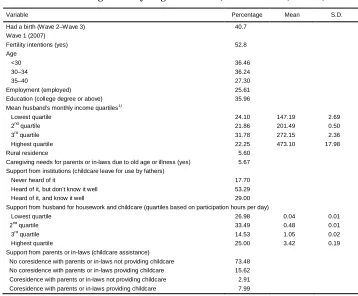
Guided by the literature, I included several demographic and socioeconomic variables, including respondents’ age, education, and employment, and husbands’ income. I used respondents aged less than 30 in Wave 1 as the reference category, and compared them with women aged between 30 and 34 and women aged 35 or above. Slightly more than one-third of respondents were less than 30 years old in Wave 1, approximately 36% of the respondents were between 30 and 34 years, and 28% were 35 or older. I compared highly educated women that had college degrees with women that had no college degrees. I compared employed women with unemployed women. I compared women whose husbands’ monthly income fell into the highest quartile with those whose husbands’ incomes were in the remaining three quartiles. The mean monthly husbands’ income for the highest quartile is 4,731,000 Korean Won, approximately US$3,900 (see Table 2). To control for place of residence, women residing in urban areas (95%, reference category) were compared with respondents residing in rural areas. To assess age-related capacity or illness of parents or in-laws that might affect the availability of grandparental childcare support, I used the following two questions: “Is your father or mother old or ill to the extent that he or she needs a caregiver?” and “Is your
law or mother-in-law old or ill to the extent that he or she needs a caregiver?” Respondents could answer yes or no. I constructed a dichotomous variable to compare respondents who had old or ill parents or in-laws with respondents who did not have old or ill parents or in-laws.
Table 2: Descriptive statistics of sample characteristics for married Korean women aged 40 or younger at Wave 1, KLoWF 2007 (N = 526)
Variable Percentage Mean S.D.
Had a birth (Wave 2–W ave 3) 40.7
Wave 1 (2007)
Fertility intentions (yes) 52.8
Age
<30 36.46
30–34 36.24
35–40 27.30
Employment (employed) 25.61
Education (college degree or above) 35.96
Mean husband’s monthly income quartiles1)
Lowest quartile 24.10 147.19 2.69
2nd quartile 21.86 201.49 0.50
3rd quartile 31.78 272.15 2.36
Highest quartile 22.25 473.10 17.98
Rural residence 5.60
Caregiving needs for parents or in-laws due to old age or illness (yes) 5.67 Support from institutions (childcare leave for use by fathers)
Never heard of it 17.70
Heard of it, but don’t know it well 53.29
Heard of it, and know it well 29.00
Support from husband for housework and childcare (quartiles based on participation hours per day)
Lowest quartile 26.98 0.04 0.01
2nd quartile 33.49 0.48 0.01
3rd quartile 14.53 1.05 0.02
Highest quartile 25.00 3.42 0.19
Support from parents or in-laws (childcare assistance)
No coresidence with parents or in-laws not providing childcare 73.48 No coresidence with parents or in-laws providing childcare 15.62
Coresidence with parents or in-laws not providing childcare 2.91
Coresidence with parents or in-laws providing childcare 7.99
Note:1) Unit for mean and standard deviation: 10,000 Korean won (approximately equal to US$8.50)
3.5 Methodological approach
and the birth of a second child occurring between Wave 1 and Wave 3, during the period of three years. I did not estimate event-history models as used by previous studies, because the duration across the three waves was only three years (e.g., Rijken and Thomson 2011; Thomése and Liefbroer 2013; Torr and Short 2004). For each of the variables concerning supportive environments for the family I created dummy variables based on responses collected from Wave 1. For my analysis of fertility behavior I took into account the influence of fertility intentions at the initial interview, since fertility intention is likely to be a predictor of an actual childbirth.
4. Results
4.1 Supportive environments for the family and fertility intentions
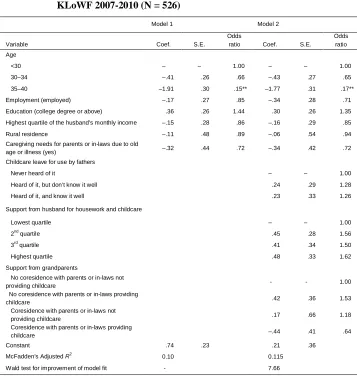
Table 3 presents the logistic regression results for a series of nested models examining the relationship between supportive environments for the family and fertility intentions among married women with one child. Model 1 incorporates control variables. Model 2 explores the importance of adding variables measuring family-supportive environments. Model 1 presents the clear and strong impact of age-related demographic factors, in line with the directions expected from previous literature. The effects of these variables stay significant across models. Women aged 35 or older are less likely to intend to have second children than women aged less than 30. Other socioeconomic control factors, including employment, education, husband’s monthly income, place of residence, and having old or ill parents or in-laws, show no significant impact on women’s fertility intentions for a second child.
overall model fit. These findings do not support my hypotheses concerning the positive impact of supportive environments for the family on fertility intentions for second children (H1a, H2a, and H3a).
Table 3: Logistic regression predicting patterns of fertility intentions for married Korean women aged 40 or younger with parity 1 at Wave 1, KLoWF 2007-2010 (N = 526)
Model 1 Model 2
Variable Coef. S.E.
Odds
ratio Coef. S.E.
Odds ratio
Age
<30 – – 1.00 ‒ ‒ 1.00
30–34 –.41 .26 .66 –.43 .27 .65
35–40 –1.91 .30 .15** –1.77 .31 .17**
Employment (employed) –.17 .27 .85 –.34 .28 .71
Education (college degree or above) .36 .26 1.44 .30 .26 1.35
Highest quartile of the husband’s monthly income –.15 .28 .86 –.16 .29 .85
Rural residence –.11 .48 .89 –.06 .54 .94
Caregiving needs for parents or in-laws due to old
age or illness (yes) –.32 .44 .72 –.34 .42 .72
Childcare leave for use by fathers
Never heard of it ‒ ‒ 1.00
Heard of it, but don’t know it well .24 .29 1.28
Heard of it, and know it well .23 .33 1.26
Support from husband for housework and childcare
Lowest quartile ‒ ‒ 1.00
2nd quartile .45 .28 1.56
3rd quartile .41 .34 1.50
Highest quartile .48 .33 1.62
Support from grandparents
No coresidence with parents or in-laws not
providing childcare - - 1.00
No coresidence with parents or in-laws providing
childcare .42 .36 1.53
Coresidence with parents or in-laws not
providing childcare .17 .66 1.18
Coresidence with parents or in-laws providing
childcare –.44 .41 .64
Constant .74 .23 .21 .36
McFadden’s AdjustedR2 0.10 0.115
Wald test for improvement of model fit - 7.66
4.2 Supportive environments for the family and fertility behavior
Table 4 summarizes the logistic regression results for a series of nested models of fertility behavior. I estimated fertility behavior models following the same procedure as for the fertility intentions model. Model 1 shows that control variables generally have a significant influence on women’s second births. As with the fertility intentions model, women aged between 30 and 34 (p < .10) and those aged 35 or above are significantly less likely to have second children than women aged less than 30. In addition, women with old or ill parents or in-laws are significantly less likely to have second births, net of other factors. Women who reside in rural areas are almost three times more likely to have a second child than women who reside in urban areas. As expected, fertility intentions in Wave 1 are a strong predictor of second births in the following three years. Women who intended to have second children in Wave 1 were six times more likely to have second children by Wave 3. However, other socioeconomic variables, including employment, educational attainment, and husband’s income, have no significant influence on women’s second births.
Results from Model 2 indicate that a supportive environment for the family has significant effects on women’s fertility behavior for a second child. All sources of supportive environments for the family show significant effects on the likelihood of second births, net of other factors, including fertility intentions in Wave 1. Women who are knowledgeable about childcare policy reserved for use by fathers are twice as likely to give birth to second children as women who have never heard of it (p < .10). These findings support my hypothesis (H1b) concerning the positive effect of support from institutions on fertility behavior, but the strength of this effect is relatively small.
Table 4: Logistic regression predicting patterns of fertility behavior for married Korean women aged 40 or younger with parity 1 at Wave 1, KLoWF 2007-2010 (N = 526)
Model 1 Model 2
Variable Coef. S.E. Odds ratio Coef. S.E. Odds ratio
Age
< 30 – – 1.00 – – 1.00
30–34 –.51 .28 .60+ –.52 .28 .59+
35–40 –1.63 .36 .20*** –1.47 .35 .23***
Employment (employed) –.45 .31 .64 –.70 .32 .50*
Education (college degree or above) –.28 .29 .76 –.49 .29 .62+
Highest quartile of the husband’s monthly income .33 .33 1.39 .33 .34 1.39
Rural residence 1.08 .55 2.95* 1.24 .57 3.46*
Caregiving needs for parents or in-laws due to old
age or illness (yes) –1.14 .55 .32* –1.33 .56 .26*
Fertility intentions in 2007 1.85 .27 6.38*** 1.93 .28 6.89***
Childcare leave for use by fathers
Never heard of it – – 1.00
Heard of it, but don’t know it well .29 .38 1.34
Heard of it, and know it well .83 .43 2.31+
Support from husband for housework and childcare
Lowest quartile - - 1.00
2nd quartile .65 .35 1.91+
3rd quartile .32 .44 1.38
Highest quartile 1.18 .37 3.26**
Support from grandparents
No coresidence with parents or in-laws not
providing childcare – – 1.00
No coresidence with parents or in-laws providing
childcare .41 .37 1.51
Coresidence with parents or in-laws not
providing childcare –.34 .82 .80
Coresidence with parents or in-laws providing
childcare 1.00 .40 2.70*
Constant –.79 .32 –1.88 .51
McFadden’s AdjustedR2 0.23 0.27
Wald test for improvement of model fit – 20.36**
Note:+ < .10; * p < 0.05; ** p < 0.01; *** p < 0.001. S.E. denotes standard error.
childcare assistance from parents or in-laws who do not live with them, and women with no childcare assistance from coresiding parents or in-laws, are both not more likely to have second children than women in the reference group. This finding offers partial support for H3b, which predicted a positive effect of grandparental childcare on childbirths.
Adding supportive-environments-for-family variables to the control model for predicting the likelihood of second births significantly improves the model fit (Wald test chi-square = 20.36, df = 8, p < .01). This suggests that a supportive environment for the family is a significant predictor of the likelihood of a second birth. I also explored interactions between supportive environments for family on the one hand and place of residence, respondents’ employment status, and educational attainment on the other. None of these interactions were statistically significant (model not shown).
5. Discussion and conclusions
Drawing on theories concerning support to families that enables women’s balance of work and family, I examined whether a supportive environment for the family from three distinctive sources – the state, husbands, and parents or in-laws – influences women’s fertility intentions and fertility behavior for second children. My findings suggest that a supportive environment for the family has more effect on fertility behavior than on fertility intentions. A supportive environment for the family increases the likelihood of having second children, controlling for sociodemographic factors and fertility intentions. Support from institutions, measured indirectly by knowledge about childcare policy reserved for use by fathers, indicates a weak positive impact on the likelihood of having a second child. Women who are knowledgeable about childcare policy for use by fathers are more likely to have second children than women who do not know about it. This finding is in line with evidence in Europe suggesting that family policy has a small, positive impact on fertility (e.g., Gauthier 2007). Yet for Koreans this small positive impact may be challenging to achieve, given the institutional and cultural context. Although Korea currently provides the longest period of paid leave for use by fathers among OECD countries, this does not mean that fathers use it substantively, or that the public has any awareness of the policy. As my descriptive findings indicate, nearly half of the respondents are not very familiar with childcare policy for use by fathers, and 20% of them do not know about it at all. This suggests insufficient accessibility to institutional support in Korea, which, in turn, may also indicate a failure of the welfare state (Esping-Andersen 2009).
likelihood of a second birth? My results show positive effects of support from husbands and grandparents on the likelihood of a second birth. Women whose husbands’ hours spent on housework and childcare are in the highest quartile are three times more likely to have second children than women whose husbands’ hours spent on housework and childcare are in the lowest quartile. Moreover, it is worth noting that husbands’ hours spent on housework and childcare matter only when they reach or exceed three hours per day. This suggests a threshold effect of male involvement in the family on Korean women’s fertility behavior (Yoon 2016). More generally, my findings buttress the argument that greater involvement of men in family care is an important source of a supportive environment for the family, contributing to increased fertility (Goldscheider, Bernhardt, and Lappegård 2015).
My results also support the positive effect of support from grandparental childcare assistance on having second children. Women who live with parents or in-laws who provide childcare support are more likely to have second children than women who do not live with parents or in-laws who do not provide childcare support. This finding is consistent with previous studies, pointing to the importance of grandparental childcare assistance, indicated by the effect of geographical proximity and the availability of grandparental childcare on subsequent childbirths in Europe (e.g., Bühler and Philipov 2005; Hank and Kreyenfeld 2003; Rijken and Liefbroer 2009; Thomése and Liefbroer 2013). Given the Korean context, marked by limited support of families by the state as well as low male involvement in family care, grandparental childcare assistance is a significant source of family support. My data reveals that grandparents who provide childcare to grandchildren, regardless of coresidence, provide intensive childcare to their grandchildren for at least 4.5 hours per day on average. This finding is in line with recent findings suggesting the importance of intensive daily grandparental childcare assistance on fertility in Southern European countries that have limited formal childcare provision, such as Italy and Greece (García-Morán and Kuehn 2013; Gessa et al. 2016).
More broadly, these findings contribute to our theoretical understanding of the interplay between the welfare state and the family in studies of fertility. As my findings suggest, Korean grandparents provide childcare support in times of need for their children, and the frequency and intensity of their childcare support is high. In contexts where state support is weak, the available childcare choices are limited and there is a strong preference for and reliance on childcare within the family (Gessa et al. 2016). By contrast, in countries that have greater state support for families, grandparental childcare assistance, often on a weekly or monthly basis, is an important supplementary source of support (García-Morán and Kuehn 2013; Thomése and Liefbroer 2013).
availability of public support concerning a few transitions throughout the life course may all contribute to a weak welfare state and persistent incompatibility between work and family. In this context, mothers’ employment opportunities are often restricted, so they tend to stay at home full-time. If mothers are employed they have to rely on support from extended family, usually grandmothers, on a regular basis (Hank and Buber 2009; Gessa et al. 2016). This interaction between the three sources of support for the family raises concern about the possible consequences of the low-gender-equity trap, which keeps increasing the family’s responsibilities over the life course. Korean families are forced to take care of their own members throughout their life course, instead of relying on ad hoc public support. As long as Korean families experience increasing challenges to balancing work and family, mostly relying on sources of support from their families of origin, the aggregate level of fertility in Korea will remain low. To strengthen Korean families it is necessary to integrate gender-egalitarian relationships and policies with market employment (Kaufman and Bernhardt 2012) and increase male involvement in the family (Goldscheider, Bernhardt, and Lappegård 2015).
Interestingly, my findings suggest a different picture from previous research regarding the role of a supportive environment for the family in fertility intentions and behavior. A supportive environment for the family from the three sources indicates stronger positive effects on fertility behavior than on fertility intentions for second children. This evidence is contradictory to previous findings in 20 European countries (Harknett, Billari, and Medalia 2014) and the United States (Rindfuss, Morgan, and Swicegood 1988) that the determinants of fertility intentions and behavior are relatively consistent. Although fertility intention itself is a strong predictor of fertility behavior, my findings suggest an inconsistency between fertility intentions and behavior (Harknett and Hartnett 2014; Morgan and Rackin 2010). In a context of strong societal norms regarding two-child family ideals and traditional marriage relationships, planning to have a second child may be normative. This may explain why only women’s age matters. By contrast, having second children is more contingent on the availability of resources that families can use, an availability that can provide either opportunities or constraints. Thus, even with the desire for a second child, it can be challenging for women to have such children without tangible support from institutions, husbands, parents, or in-laws.
Further, a qualitative study might shed more light on how women shape childbearing plans, and explore other factors in fertility decision-making. Finally, my study could not control for individual characteristics of grandparents nor divide them into maternal and paternal because of limited data availability. Grandparents’ employment and socioeconomic status could influence the availability of grandparental childcare assistance (Gessa et al. 2016). Since a few recent studies suggest opposing effects of grandparental support on fertility by lineage (e.g., Tanskanen et al. 2014; Tanskanen and Rotkirch 2014), studies investigating differences in grandparental support on fertility by lineage are needed.
Despite these shortcomings, this study offers new insight into the interplay between the state and the family with regard to achieving work-family balance and having a second child. My findings suggest that family-supportive environments provided by the state, husbands, and grandparents all have an effect on women’s second births. The findings have unique implications for very low fertility in countries that have limited and fragmented state support for families. This study points to the need for incorporating multiple sources of family support that are suited to the specific cultural and policy context.
6. Acknowledgements
References
Aassve, A., Meroni, E., and Pronzato, C. (2012). Grandparenting and childbearing in the extended family. European Journal of Population – Revue européenne de Demographie 28(4): 499–518.doi:10.1007/s10680-012-9273-2.
Andersson, G., Duvander, A-Z., and Hank, K. (2004). Do child-care characteristics influence continued childbearing in Sweden? An investigation of the quantity, quality, and price dimension.Journal of European Social Policy 14(4): 407–418.
doi:10.1177/0958928704046881.
Balbo, N. and Mills, M. (2011). The effects of social capital and social pressure on the intention to have a second or third child in France, Germany, and Bulgaria, 2004–05. Population Studies 65(3): 335–351. doi:10.1080/00324728.2011. 579148.
Billingsley, S. and Ferrarini, T. (2014). Family policy and fertility intentions in 21 European countries. Journal of Marriage and Family 76(2): 428–445.
doi:10.1111/jomf.12097.
Brewster, K.L. and Rindfuss, R.R. (2000). Fertility and women’s employment in industrialized nations. Annual Review of Sociology 26: 271–296. doi:10.1146/ annurev.soc.26.1.271.
Bühler, C. and Philipov, D. (2005). Social capital related to fertility: Theoretical foundations and empirical evidence from Bulgaria. Vienna Yearbook of Population Research 4: 53–81. doi:10.1553/populationyearbook2005s53.
Chen, F., Liu, G., and Mair, C.A. (2011). Intergenerational ties in context: Grandparents caring for grandchildren in China.Social Forces 90(2): 571–594.doi:10.1093/sf/ sor012.
Chen, F., Short, S.E., and Entwisle, B. (2000). The impact of grandparental proximity on maternal childcare in China. Population Research and Policy Review19(6): 571–590.doi:10.1023/A:1010618302144.
Chésnais, J-C. (1996). Fertility, family, and social policy in contemporary Western Europe. Population and Development Review 22(4): 729–739. doi:10.2307/ 2137807.
Chu, C.Y.C., Kim, S., and Tsay, W. (2014). Coresidence with husband’s parents, labor supply, and duration to first birth. Demography 51(1): 185–204. doi:10.1007/ s13524-013-0244-y.
Cooke, L.P. (2009). Gender equity and fertility in Italy and Spain. Journal of Social Policy38(1): 123–140.doi:10.1017/S0047279408002584.
Del Boca, D. (2002). The effect of child care and part time opportunities on participation and fertility decisions in Italy. Journal of Population Economics 15(3): 549–573.doi:10.1007/s001480100089.
Duvander, A.-Z. and Andersson, G. (2006). Gender equality and fertility in Sweden: A study on the impact of the father’s uptake of parental leave on continued childbearing.Marriage and Family Review 39 (1/2):121–142.doi:10.1300/J002 v39n01_07.
Duvander, A-Z., Lappegård, T., and Andersson, G. (2010). Family policy and fertility: Fathers’ and mothers’ use of parental leave and continued childbearing in Norway and Sweden. Journal of European Social Policy 20(1): 45–57.
doi:10.1177/0958928709352541.
Esping-Andersen, G. (2009). The incomplete revolution: Adapting welfare states to women’s new roles. Cambridge: Polity Press.
Esping-Andersen, G. and Billari, F.C. (2015). Re-theorizing family demographics. Population and Development Review 41(1): 1–31. doi:10.1111/j.1728-4457. 2015.00024.x.
García-Morán, E. and Kuehn, Z. (2013). With strings attached: Grandparents-provided child care and female labor market outcomes. SOEP Papers on Multidisciplinary Panel Data Research 610. The German Socio-Economic Panel Study.
doi:10.2139/ssrn.2365716.
Gauthier, A. (2007). The impact of family policies on fertility in industrialized countries: A review of the literature. Population Research and Policy Review 26(3): 323–346.doi:10.1007/s11113-007-9033-x.
Goldscheider, F., Bernhardt, E., and Brandén, M. (2013). Domestic gender equality and childbearing in Sweden. Demographic Research 29(40): 1097–1126. doi:10.40 54/DemRes.2013.29.40.
Goldscheider, F., Bernhardt, E., and Lappegård, T. (2015). The gender revolution: A framework for understanding changing family and demographic behavior. Population and Development Review41(2): 207–239.doi:10.1111/j.1728-4457. 2015.00045.x.
Goldstein, J.R., Sobotka, T., and Jasilioniene, A. (2009). The end of lowest-low fertility? Population and Development Review35(4): 663–699.doi:10.1111/j.17 28-4457.2009.00304.x.
Hank, K. and Buber, I. (2009). Grandparents caring for their grandchildren: Findings from the 2004 survey of health, ageing, and retirement in Europe. Journal of Family Issues30(1): 53–73.doi:10.1177/0192513X08322627.
Hank, K. and Kreyenfeld, M. (2003). A multilevel analysis of child care and women’s fertility decisions in western Germany. Journal of Marriage and Family 65(3): 584–596.doi:10.1111/j.1741-3737.2003.00584.x.
Harknett, K., Billari, F.C., and Medalia, C. (2014). Do family support environments influence fertility? Evidence from 20 European countries. European Journal of Population –Revue européenne de Demographie 30(1): 1–33.doi:10.1007/s106 80-013-9308-3.
Harknett, K. and Hartnett, C.S. (2014). The gap between births intended and births achieved in 22 European countries, 2004–2007. Population Studies: A Journal of Demography 68(3): 265–282.doi:10.1080/00324728.2014.899612.
Hayslip, B. Jr. and Kaminski, P.L. (2005). Grandparents raising their grandchildren: A review of the literature and suggestions for practice. Gerontologist 45(2): 262– 269.doi:10.1093/geront/45.2.262.
Hook, J.L. (2006). Care in context: Men’s unpaid work in 20 countries, 1965–2003. American Sociological Review 71(4): 639–660. doi:10.1177/000312240607100 406.
Ji, Y., Chen, F., Cai, Y., and Zheng, Z. (2015). Do parents matter? Intergenerational ties and fertility preferences in a low-fertility context.Chinese Journal of Sociology 1(4): 485–514.doi:10.1177/2057150X15614545.
Kalwij, A. (2010). The impact of family policy expenditure on fertility in western Europe.Demography47(2): 503–519.doi:10.1353/dem.0.0104.
Kaptijn, R., Thomése, F., Liefbroer, A.C., and Van Tilburg, T.G. (2010). How grandparents matter: Support for the cooperative breeding hypothesis in a contemporary Dutch population. Human Nature 21(4): 393–405. doi:10.1007/ s12110-010-9098-9.
Kaufman, G. and Bernhardt, E. (2012). His and her job: What matters most for fertility plans and actual childbearing? Family Relations 61(4): 686–697. doi:10.1111/ j.1741-3729.2012.00720.x.
Korpi, W. (2000). Faces of inequality: Gender, class and patterns of inequalities in different types of welfare state. Social Politics 7(2): 127–191. doi:10.1093/sp/ 7.2.127.
Korpi, W., Ferrarini, T., and Englund, S. (2013). Women’s opportunities under different family policy constellations: Gender, class, and inequality tradeoffs in Western countries reexamined. Social Politics 20(1): 1–40. doi:10.1093/sp/ jxs028.
Lee, C. (2014). The gendered division of housework in dual-earner households in Korea. (in Korean)Journal of Social Science40(2): 29–54.doi:10.15820/khjss. 2014.40.2.002.
Lee, J. and Bauer, J.W. (2013). Motivations for providing and utilizing child care by grandmothers in South Korea.Journal of Marriage and Family75(2): 381–402.
doi:10.1111/jomf.12014.
Lee, J. and Bauer, J. W. (2010). Profiles of grandmothers providing child care to their grandchildren in South Korea. Journal of Comparative Family Studies41(3): 455–475.
McDonald, P. (2000). Gender equity in theories of fertility transition. Population and Development Review26(3): 427–439.doi:10.1111/j.1728-4457.2000.00427.x.
McDonald, P. (2002). Sustaining fertility through public policy: The range of options. Populations57(3): 423–456.doi:10.3917/pope.203.0417.
McDonald, P. (2013). Societal foundations for explaining fertility: Gender equity. Demographic Research28(34): 981–994.doi:10.4054/DemRes.2013.28.34.
Miettinen, A., Lainiala, L., and Rotkirch, A. (2015). Women’s housework decreases fertility: Evidence from a longitudinal study among Finnish couples. Acta Sociologica 58(2): 139–154.doi:10.1177/0001699315572028.
Mills, M., Mencarini, L., Tanturri, M.L., and Begall, K. (2008). Gender equity and fertility intentions in Italy and the Netherlands.Demographic Research18(1): 1– 26.doi:10.4054/DemRes.2008.18.1.
Mills, M., Rindfuss, R.R., McDonald, P., and Te Velde, P. (2011). Why do people postpone parenthood? Reasons and social policy incentives. Human Reproductive Update17(6): 1–13.doi:10.1093/humupd/dmr026.
Ministry of Health and Welfare (2012). A national survey of child care: Household Survey (Publication No. 11-1352000-000961-12). Seoul: Ministry of Health and Welfare.
Morgan, S.P. (2003). Is low fertility a twenty-first-century demographic crisis? Demography40(4): 589–603.doi:10.1353/dem.2003.0037.
Morgan, S.P. and Rackin, H. (2010). The correspondence between fertility intentions and behavior in the United States. Population and Development Review36(1): 91–118.doi:10.1111/j.1728-4457.2010.00319.x.
Myrskylä, M., Kohler, H-P., and Billari, F. (2011). High development and fertility: Fertility at older reproductive ages and gender equality explain the positive link. Population Studies Center, University of Pennsylvania, PSC Working Paper Series, PSC 11–06.http://repository.upenn.edu/psc_working_papers/30.
Myrskylä, M., Kohler, H.P., and Billari, F.C. (2009). Advances in development reverse fertility declines.Nature460(7256): 741–743.doi:10.1038/nature08230.
Neyer, G., Lappegard, T., and Vignoli, D. (2013). Gender equality and fertility: Which equality matters?European Journal of Population29(3): 245–272.doi:10.1007/ s10680-013-9292-7.
OECD Family Database (2016). Paris: OECD. http://www.oecd.org/els/family/data base.htm.
Philipov, D., Spéder, Z., and Billari, F.C. (2006). Soon, later, or ever? The impact of anomie and social capital on fertility intentions in Bulgaria (2002) and Hungary (2001).Population Studies 60(3): 289–308.doi:10.1080/00324720600896080.
Rijken, A.J. and Liefbroer, A.C. (2009). Influences of the family of origin on the timing and quantum of fertility in the Netherlands. Population Studies 63(1): 71–85.
doi:10.1080/00324720802621575.
Rijken, A.J. and Thomson, E. (2011). Partners’ relationship quality and childbearing. Social Science Research. 40(2): 485–497.doi:10.1016/j.ssresearch.2010.10.001.
Rindfuss, R.R., Guilkey, D.K., Morgan, S.P., and Kravdal, Ø. (2010). Child-care availability and fertility in Norway.Population and Development Review36(4): 725–748.doi:10.1111/j.1728-4457.2010.00355.x.
Rindfuss, R.R., Guilkey, D.K., Morgan, S.P., Kravdal, Ø., and Guzzo, K.B. (2007). Child care availability and first-birth timing in Norway. Demography 44(2): 345–372.doi:10.1353/dem.2007.0017.
Rindfuss, R.R., Morgan, S.P., and Swicegood, G. (1988). First births in America: Changes in the timing of parenthood. Berkeley: University of California Press
Rønsen, M. (2004). Fertility and public policies ‒ Evidence from Norway and Finland. Demographic Research10(6): 143–170.doi:10.4054/DemRes.2004.10.6.
Statistics Korea (2015). Women’s lives through statistics in 2015. Division of Social Statistics, Statistics Korea. (in Korean)
Tanskanen, A.O., Jokela, M., Danielsbacka, M., and Rotkirch, A. (2014). Grandparental effects on fertility vary by lineage in the United Kingdom. Human Nature 25(2): 269–284.doi:10.1007/s12110-014-9200-9.
Tanskanen, A.O. and Rotkirch, A. (2014). The impact of grandparental investment on mothers’ fertility intentions in four European countries. Demographic Research 31(1): 1–26.doi:10.4054/DemRes.2014.31.1.
Thévenon, O. (2011). Family policies in OECD countries: A comparative analysis. Population and Development Review 37(1): 57–87. doi:10.1111/j.1728-4457. 2011.00390.x.
Torr, B.M. and Short, S.E. (2004). Second births and the second shift: A research note on gender equity and fertility.Population and Development Review30(1): 109– 130.doi:10.1111/j.1728-4457.2004.00005.x.
Vandell, D.L., McCartney, K., Owen, M.T., Booth, C., and Clarke-Stewart, A. (2003). Variations in child care by grandparents during the first three years. Journal of Marriage and Family 65(2): 375‒381.doi:10.1111/j.1741-3737.2003.00375.x.
Waynforth, D. (2011). Grandparental investment and reproductive decisions in the longitudinal 1970 British cohort study. Proceedings of the Royal Society of London Series B: Biological Science 279(1731): 1155–1160.doi:10.1098/rspb. 2011.1424.
Westoff, C. (1988). Is the KAP-gap real?Population and Development Review 14(2): 225–232.doi:10.2307/1973570.
World Economic Forum (2016). The global gender gap report 2016. Geneva: World Economic Forum. http://www3.weforum.org/docs/GGGR16/WEF_Global_Gen der_Gap_Report_2016.pdf.
Yoon, H. (2014). Factors that affect women’s intentions to have additional children: The role of the state, market, and family.Korea Journal54(3): 79–102.