DEMOGRAPHIC RESEARCH
VOLUME 35, ARTICLE 48, PAGES 1411
−
1440
PUBLISHED 29 NOVEMBER 2016
http://www.demographic-research.org/Volumes/Vol35/48/ DOI: 10.4054/DemRes.2016.35.48
Research Article
Equality at home – A question of career?
Housework, norms, and policies in a European
comparative perspective
Susanne Fahlén
This publication is part of the Special Collection on “Finding Work-Life Balance: History, Determinants, and Consequences of New Bread-Winning Models in the Industrialized World,” organized by Guest Editors Trude Lappegård, Fran Goldscheider, and Eva Bernhardt.
©2016 Susanne Fahlén.
This open-access work is published under the terms of the Creative Commons Attribution NonCommercial License 2.0 Germany, which permits use, reproduction & distribution in any medium for non-commercial purposes, provided the original author(s) and source are given credit.
1 Introduction 1412
2 Theoretical approaches to the division of housework 1413
2.1 Economic explanations 1413
2.2 Gender explanations 1415
3 Cross-national differences in the division of housework 1415
4 Work‒family policies and gender norms in different welfare states 1416
5 Hypotheses 1418
5.1 Individual-level hypotheses 1418
5.2 Country-level hypothesis 1420
6 Data and methods 1420
7 Results 1422
8 Summary and conclusions 1430
9 Acknowledgements 1433
Equality at home – A question of career?
Housework, norms, and policies in a European comparative
perspective
Susanne Fahlén1
Abstract
BACKGROUND
Dual-earner families are widespread in contemporary Europe, yet the division of housework is highly gendered, with women still bearing the lion’s share. However, women in dual-career couples and in other types of non-traditional couples, across and within different European countries, appear to handle the division of housework differently.
OBJECTIVE
The objective of this study is to examine the division of housework among various couple-earner types, by determining i) whether relative resources, time spent on paid work, gender attitudes, and family structure reduce variations in housework between different couple types, and ii) whether the division of housework varies between countries with different work‒family policies and gender norms.
METHODS
The study uses data from ten countries, representing different welfare regime types, extracted from the European Social Survey (2010/11), and employs multivariate regressions and aggregated analysis of the association between the division of housework and the contextual indices.
RESULTS
The results show that career couples divide housework more equally than dual-earner couples, relating more to the fact that the former group of women do less housework in general, rather than that men are doing more. The cross-national analysis shows tangible differences between dual-earner and dual-career couples; however, the difference is less marked with respect to the division of housework in countries with more institutional support for work‒family reconciliation and less traditional gender norms.
1
CONTRIBUTION
By combining conventional economic and gender-based approaches with an institutional framework, this study contributes to the research field by showing that the division of housework within different couple-earner types is contextually embedded.
1. Introduction
Dual-earner families are widespread in contemporary Europe as a result of women’s increased labour force participation, entailing a major challenge for many couples with respect to achieving a work‒life balance, as the division of labour becomes a major issue. Goldscheider, Bernhardt, and Lappegård (2015) argue that the increase in men’s involvement in the home has a strengthening effect on families in terms of reducing the risks of union dissolution and low levels of fertility, which they refer to as the second half of the gender revolution. Although there is evidence of men’s increasing involvement in housework and childcare (Aassve, Fuochi, and Mencarini 2014; Sullivan, Billari, and Altintas 2014), the division of housework remains highly gendered with women bearing the lion’s share of housework and childcare. Although the gender gap has diminished over time, this downward trend is mainly the result of women decreasing their share of unpaid work, rather than men increasing their share (Bittman et al. 2003; Evertsson and Nermo 2004; Hook 2010).
This study focuses on the division of housework among various couple-earner types across different European welfare regimes in regard to work‒family policies and gender norms. Studying different couple-earner types from a cross-national comparative perspective can provide important insights into how time allocated to housework is handled by couples across different institutional contexts. The questions addressed are as follows. Does the division of housework vary by different couple-earner types? Do relative resources within the couple, time spent on paid work, gender role attitudes, and family structure reduce the variations in unpaid work between different couple-earner types? Can we detect variations in the gender gap regarding the division of housework across different welfare regimes, with different work‒family reconciliation policies and gender norms? Due to data limitations, this study does not address the gendered division of childcare, although this is a very important issue in regards to gender equality in the labour market and within the household.
We begin with a review of theories and previous research on the division of housework, followed by a section on work‒family policies and gender norms. The last section presents the results of a) the analyses of the association between various couple-earner types and men’s share of housework and men’s and women’s housework hours, and b) a cross-country analysis of the gendered division of housework in relation to work‒family policies and social gender norms. The article concludes with a summary and discussion of the results.
2. Theoretical approaches to the division of housework
The literature on the division of labour has grown extensively since the 1970s and the results are consistent: women do more housework and childcare than men. However, explanations of the gendered division of housework diverge and can be divided into two general theoretical frameworks, an economic perspective and a gender perspective (e.g., Geist 2005; Greenstein 2000; Sayer 2010).
2.1 Economic explanations
premise is that the amount of time spent on domestic work is strongly affected by the time available for such tasks; hence the more hours spent in the labour market, the less time is available for housework (Coverman 1985; Greenstein 2000; Sayer 2010). This has been confirmed by several studies, i.e., full-time working women across different countries tend to spend less time on housework. However, the results are less consistent for men (e.g., Aassve, Fuochi, and Mencarini 2014; Bianchi et al. 2000; Fuwa 2004).
These perspectives have been challenged on many fronts. They are gender-neutral and consider households as a homogenous single unit whose members are assumed to have similar goals and preferences, and fail to take power relations into account (e.g., Agarwal 1997; Lundberg and Pollak 1996). Second, the causality is difficult to disentangle: whether women are doing fewer hours in the labour market because they are doing the majority of housework, or whether women are doing most of the housework because they are spending fewer hours in paid work (Evertsson and Nermo 2007).
2.2 Gender explanations
The gender perspective is referred to under several different labels (see Coltrane 2000 for an overview), such as “doing gender” or “gender display” (Berk 1985; West and Zimmermann 1987). The basic premise is that housework is a symbolic production of gender relations (Berk 1985; West and Zimmermann 1987). It is assumed that people’s behaviour is influenced by the expectations held by others (Bittman et al. 2003) and that the performance of unpaid housework is one way to ensure an expected gendered behaviour and to define gender relations within the household (Coltrane 2000; Berk 1985; Bianchi et al. 2000; West and Zimmermann 1987). This may be most evident in couples with children, where employed mothers tend to spend significantly more time on housework and childcare than fathers (Craig and Mullan 2010). The gender perspective has been useful as an alternative explanation to the gendered division of housework in households where the woman has the higher income or employment status yet is still performing the majority of the housework. In such couples, the couple tends to compensate for their less traditional economic relationship with a more traditional division of housework (Bittman et al. 2003; Brines 1994; Evertsson and Nermo 2004; Greenstein 2000).
A related perspective is the gender ideology approach. According to Greenstein (2000), gender ideologies are how people identify themselves with regard to intra-household roles: roles traditionally linked to gender. It is within the intra-household and within intimate relations that these ideologies are exhibited and played out. The assumption is that the division of housework is the result of shared values within a couple, and that more egalitarian gender ideologies will lead to a more equal division of housework (Greenstein 2000). This has been corroborated by previous studies (e.g., Bianchi et al. 2000; Crompton, Brockmann, and Lyonette 2005; Kan 2008; Treas and Tai 2016).
3. Cross-national differences in the division of housework
no gender-discriminatory policy (Fuwa and Cohen 2007). In addition, men’s unpaid work is higher in countries with higher female labour force participation, and fathers do more housework in countries where fathers are entitled to parental leave but do less in countries with long maternity leave (Hook 2010). Parents tend to share housework less equally, compared to non-parents, in countries with less public institutional support for work‒family reconciliation (Craig and Mullan 2010). Treas and Tai (2016) find that both men and women spend less time on housework in countries with more egalitarian gender norms, and Fuwa (2004) asserts that the equalising impact of gender ideology and time availability is stronger for women in more egalitarian countries.
4. Work
‒family policies and gender norms in different welfare states
Countries vary considering the extent to which work‒family policies reinforce gendered responsibilities for unpaid and paid work (e.g., Cooke 2006; Korpi 2000; Orloff 1993). Previous studies have shown that social support from the state influences mothers’ labour market participation and attachment (see Allen et al. 2013; Misra, Budig, and Boeckman 2011; Keck and Saraceno 2013). Pfau-Effinger (2012) argues that gender norms also explain cross-national differences in female labour force participation.
presents the parental leave systems2 and Figure 1 displays norms regarding women’s role in work and childcare in the ten selected countries.
Table 1: Parental leave and childcare in ten European countries (2010‒12)
DK FI SW DE NL UK ES CZ HU PL
Full-rate equivalent of paid leave benefit in weeks (1)
FRE of paid maternity leave 9.6 11.7 8 14 16 12.7 16 19.3 16.8 18
FRE of paid paternity leave 1.1 4.9 8 5.4 0.4 0.4 3 ‒ 1 2 FRE of paid parental leave 17.1 32.8 38.6 34.8 4.9 ‒ ‒ 39.4 79.6 19.4 Formal childcare for children under 3 years
Enrolment rate in formal day-care (2) 78 28 51 20 50 35 38 2 9 2 % attending childcare for 30 hours or
more/week (2) 68 20 33 13 6 4 18 0 8 0
Childcare fees per two-year old in % of average wage (formal childcare and education services) (3)
13.6 12.2 5 23.1 55.8 24.7 24.6 10.6 0 12.6
Country abbreviations: DK=Denmark, FI=Finland, SW=Sweden, DE=Germany, NL=Netherlands, UK=United Kingdom, ES=Spain, CZ=Czech Republic, HU= Hungary, PL=Poland.
Source: 1) OECD 2013a, 2) Eurostat 2014, 3) OECD 2013b [data from 2008].
The Nordic countries display less traditional gender norms. Here both policies and norms encourage a more equally shared division of responsibility for childcare and income, and the provision of formal childcare is regarded as a social right (Plantenga and Remery 2009). The total full-rate equivalent (FRE) of paid leave3 is relatively generous, and fathers in Sweden and Finland are entitled to a FRE of paid paternity leave for more than a month (as are fathers in Germany) (Table 1), which can be regarded as a relatively egalitarian leave policy. The Central Eastern European (CEE) countries display the most traditional gender norms (Figure 1). These are countries with low provision of formal childcare, which can be linked to long parental leave. The FRE of paid maternal/parental leave is relatively generous (Table 1), but with low provision of paid paternity leave. This policy combination can be regarded as less egalitarian as it encourages women to withdraw from the labour market for several years after having children (Saxonberg and Sirovátka 2006). Intermediate gender norms are found in Germany, the Netherlands, the UK, and Spain (Figure 1). These are countries with
2 The specific policies are those in place when the fifth round of European Social Survey was collected in 2010/11.
unpaid or short FTE of paid parental leave, low provision of paid paternity leave (Germany is the exception), and intermediate levels of childcare provision (Germany and the Netherlands), or expensive childcare provision (the United Kingdom and Spain), mainly on a part-time basis (Table 1). This is also mirrored in the relatively high proportion of part-time working women (Anxo et al. 2007) – with the exception of Spain, which has an overall low employment rate for mothers of pre-schoolers (OECD 2010). This policy combination can be regarded as less egalitarian than the policy combination in the Nordic countries.
Figure 1: Gender-role attitudes related to women’s role in work and family in
ten European countries – Proportion that agrees with the three statements (men and women aged 20‒65)
Source: European Values Survey (EVS 2008); European Social Survey (ESS 2010/2011. Author’s own calculation
5. Hypotheses
5.1 Individual-level hypotheses
According to the relative resource/bargaining approach and previous research (e.g., Aassve, Fuochi, and Mencarini 2014; Bittman et al. 2003; Davis and Greenstein 2004; Evertsson and Nermo 2007; Killewald and Gough 2010), we can expect that
(H1) dual-career couples share housework more equally.
0 10 20 30 40 50 60 70
DK FI SW DE NL UK ES CZ HU PL
A job is alright but what most women really want is a home and children (EVS 2008) A pre-school child is likely to suffer if his or her mother works (EVS 2008)
This is due to the fact that both parties have relatively strong resources in terms of occupational status and therefore have better bargaining positions, but also that they may face more time constraints caused by longer working hours, resulting in less time available for housework. When women are more dependent on their spouses the division of housework tends to be more traditional; hence we can assume that
(H2) the division of housework is more unequal in male-career and single-male earner couples.4
The relative resource/bargaining approach and previous research also suggest that a partner’s relatively higher occupational prestige can translate into a more equal division of housework (e.g., Evertsson and Nermo 2004). This suggests that
(H3a) the division of housework in female-career and single-female-earner couples5 is more equal.
However, according to the ‘doing gender’ approach, women with more resources tend to counterbalance their less traditional division of paid work with a more traditional division of housework (e.g., Bittman et al. 2003; Greenstein 2000). We would therefore expect that
(H3b) the division of housework in female-career and single-female-earner couplesis more traditional.
Higher socioeconomic status is usually accompanied by less time available for housework, higher education, higher income, and less traditional gender ideology: all factors that promote a more equal division of housework (e.g., Aassve, Fuochi, and Mencarini 2014; Evertsson and Nermo 2004; Fuwa 2004; Sullivan, Billari, and Altintas 2014; Treas and Tai 2016). Hence if the division of housework is mainly affected by time availability, gender ideology, and other relative resources, distinct from occupational position, we can expect that
(H4) the difference between various couple-earner types disappears when controlling for these factors.
4Male-career couples are defined as couples in which the man has the higher professional position, and single-male-earner couples are defined as couples where only the man is in paid work, regardless of his occupational position.
5.2 Country-level hypothesis
Previous studies have shown that the division of housework is embedded in societal and institutional contexts. In countries with strong policy support for work‒family reconciliation and less traditional gender norms, women are expected to be as equally integrated into the labour market as men and men to be more involved in the household. This institutional context may therefore weaken gender differences in the division of housework, especially among dual-working couples. In countries with weaker policy support for work‒family reconciliation and more traditional gender norms, women are expected to be the prime carer and men the prime earner. This institutional context may therefore reinforce gender differences in the division of housework. We can therefore expect that
(H5) strong policy support for work‒family reconciliation and more egalitarian gender norms generate smaller gender differences in the division of housework, and weaker policy support and more traditional gender norms generate larger gender differences.
6. Data and methods
The present study uses data from the fifth round of the European Social Survey (ESS) conducted in 2010/11, applied in 20 European countries.The sample is representative of all persons older than 15 years of age in each country. The present study uses data from ten countries and comprises 7,761 respondents aged 18-65, living with an opposite sex partner. Multivariate linear regressions are the tool of analysis.6
Three dependent variables are used to measure different aspects of the division of housework: 1) men’s share of all housework during a week, 2) women’s housework hours, and 3) men’s housework hours. Housework includes cooking, washing, cleaning, care of clothes, shopping, and maintenance of property. Childcare and leisure activities are not included in the ESS data. One person in the household answered questions about themselves and their partner.7 Given the fact that respondents generally overestimate their own housework contribution and underestimate their spouse’s contribution due to social desirability (Coltrane 2000; Kamo 2000), the variables are constructed so as to reduce bias in housework reporting: men’s share of the total housework is the man’s proportional share of both partner’s combined housework hours during a week.
6 Weights are used to correct for differences in sample design (ESS 2011). 7
Women’s housework hours are based on the female respondent’s account or the male respondent’s estimate regarding his spouse’s housework hours during a week. Men’s housework hours are estimated accordingly (see Känsälä and Oinas 2016 for a similar calculation).
The main independent variable of interest is couple-earner type, based on a combination of both parties’ occupational position. The variable is divided into six categories. Dual-career couples: both the man and woman have managerial or professional positions, based on the International Standard Classification of Occupation (ISCO88), major groups 1‒2 (ILO 2014). Dual-earner couples: neither the man nor the woman has managerial or professional positions, but both are in paid work. Male-career couples: dual-earner couples in which only the man has a managerial or professional position. Female-career couples: dual-earner couples in which only the woman has a managerial or professional position. The analysis also includes male-single-earner couples, regardless of the man’s occupational position, and female-single-earner couples, regardless of the woman’s occupational position.
Apart from the couple’s occupational positions, various indicators of time availability and other resources are included in the analysis. The indicator of time availability is the man’s and the woman’s working hours, each divided into three categories: 1) less than 35 hours per week, 2) 35‒40 hours per week, and 3) more than 40 hours per week. The indicators of resources are relative level of education and woman’s economic independence. Couple’s education is categorised as: 1) both have less than tertiary education, 2) both have tertiary education, 3) man has tertiary education but not the woman, and 4) woman has tertiary education but not the man. Woman’s economic independence is based on the stated proportion of household income provided by the respondent, with the variable ranging from 0 (none) to 6 (all). If the respondent is a man the scale is reversed, with a high value indicating that the woman’s economic independence is high.
Country dummies are included to account for country differences in the division of housework. Other control variables included are woman’s age, respondent’s gender, and family structure. Earlier studies have found that the presence of younger children and the number of children increase the time spent on housework (Anxo et al 2011; Davies and Greenstein 2004).
Two standardised indices are constructed to capture institutional differences regarding work‒family reconciliation policies (three indicators of statutory leave benefits – maternity, paternity, and parental leave – and three indicators of childcare for younger children) and gender norms (three indicators) (see Table 1 and Figure 1). Each indicator, in both indices, is transformed into z-scores, denoting standard deviations from the mean, and summarised into an index. In the work‒family reconciliation policies, maternity and parental leave are added together prior to the z-score transformation, as mothers use these types of leave the most often. High scores in work‒family reconciliation policies denote more policy support for work‒family reconciliation, and high gender-norm index scores indicate more egalitarian gender norms. The correlation between the two indices is 0.55 (Table 2).
Table 2: Standardised index scores of work‒family policies and gender norms
Work‒family policy index Gender norm index
Denmark 3.55 4.57
Finland 1.40 2.94
Sweden 4.68 3.20
Germany 0.39 ‒0.84
Netherlands ‒3.82 0.85
United Kingdom ‒2.86 ‒0.02
Spain ‒0.95 ‒1.04
Czech Republic ‒1.80 ‒2.53
Hungary 1.45 ‒3.47
Poland ‒2.04 ‒3.67
Correlation 0.55
7. Results
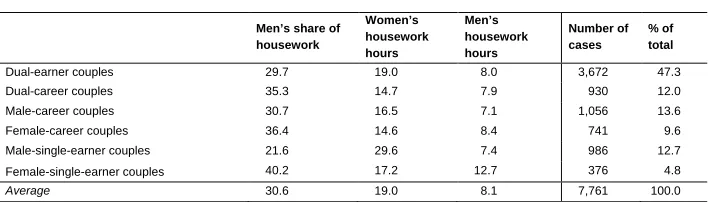
male-single-earner couples. Female-career-earner couples and female-single-earner couples divide housework the most equally. The most unequal division of housework is found among the male-single-earners. However, women do most of the housework regardless of couple-earner type (Table 3).
Table 3: Descriptive statistics of the independent variables by average and by
couple-earner types in the working sample (men and women aged 20‒65, living in a couple)
Men’s share of housework
Women’s housework hours
Men’s housework hours
Number of cases
% of total
Dual-earner couples 29.7 19.0 8.0 3,672 47.3
Dual-career couples 35.3 14.7 7.9 930 12.0
Male-career couples 30.7 16.5 7.1 1,056 13.6
Female-career couples 36.4 14.6 8.4 741 9.6
Male-single-earner couples 21.6 29.6 7.4 986 12.7
Female-single-earner couples 40.2 17.2 12.7 376 4.8
Average 30.6 19.0 8.1 7,761 100.0
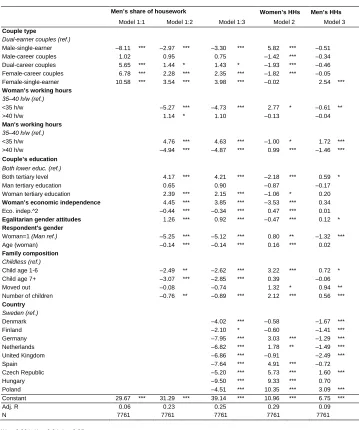
Multivariate linear regressions are conducted to investigate the association between couple-earner type and the division of housework, with separate analyses for the three indicators of the division of housework (Table 4). The first model (1:1), regarding men’s share of housework, includes only the couple-earner types. In the second model (1:2), working hours, relative resources, and gender role attitudes are introduced, along with respondent’s age, respondent’s gender, and family structure. This is to test whether these factors alter the association between couple-earner type and the division of housework. In the last model (1:3), countries are included in the analyses to account for potential variation in couple-earner types and other control variables by country, and to detect country differences in the division of housework that cannot be explained by variations in the other independent variables. To further examine the underlying causes of men’s share of housework, women’s and men’s actual housework hours are considered. These analyses are conducted in one step only (Model 2 and Model 3).
single-female-earner couples compensate for their less traditional division of paid work with a more traditional division of housework (H3b), is not supported. Instead, we find that men’s share of housework is higher in female-career couples (6.8 percentage points) and female-single-earner couples (10.6 percentage points) than in dual-earner couples, supporting the resource/bargaining approach which assumes that a partner’s relatively higher occupational prestige can translate into a more equal division of housework (H3a).
Table 4: OLS regressions of the division of housework, with separate analyses for men’s share of housework, women’s housework hours, and men’s housework hours (HH’s). Unstandardized b-coefficients
Men’s share of housework Women’s HHs Men’s HHs
Model 1:1 Model 1:2 Model 1:3 Model 2 Model 3
Couple type
Dual-earner couples (ref.)
Male-single-earner ‒8.11 *** ‒2.97 *** ‒3.30 *** 5.82 *** ‒0.51
Male-career couples 1.02 0.95 0.75 ‒1.42 *** ‒0.34
Dual-career couples 5.65 *** 1.44 * 1.43 * ‒1.93 *** ‒0.46 Female-career couples 6.78 *** 2.28 *** 2.35 *** ‒1.82 *** ‒0.05 Female-single-earner 10.58 *** 3.54 *** 3.98 *** ‒0.02 2.54 ***
Woman’s working hours 35‒40 h/w (ref.)
<35 h/w ‒5.27 *** ‒4.73 *** 2.77 * ‒0.61 **
>40 h/w 1.14 * 1.10 ‒0.13 ‒0.04
Man's working hours 35‒40 h/w (ref.)
<35 h/w 4.76 *** 4.63 *** ‒1.00 * 1.72 ***
>40 h/w ‒4.94 *** ‒4.87 *** 0.99 *** ‒1.46 ***
Couple’s education
Both lower educ. (ref.)
Both tertiary level 4.17 *** 4.21 *** ‒2.18 *** 0.59 *
Man tertiary education 0.65 0.90 ‒0.87 ‒0.17
Woman tertiary education 2.39 *** 2.15 *** ‒1.06 * 0.20
Woman’s economic independence 4.45 *** 3.85 *** ‒3.53 *** 0.34
Eco. indep.^2 ‒0.44 *** ‒0.34 *** 0.47 *** 0.01
Egalitarian gender attitudes 1.26 *** 0.92 *** ‒0.47 *** 0.12 *
Respondent's gender
Woman=1 (Man ref.) ‒5.25 *** ‒5.12 *** 0.80 ** ‒1.32 ***
Age (woman) ‒0.14 *** ‒0.14 *** 0.16 *** 0.02
Family composition Childless (ref.)
Child age 1-6 ‒2.49 ** ‒2.62 *** 3.22 *** 0.72 *
Child age 7+ ‒3.07 *** ‒2.85 *** 0.39 ‒0.06
Moved out ‒0.08 ‒0.74 1.32 * 0.94 **
Number of children ‒0.76 ** ‒0.89 *** 2.12 *** 0.56 ***
Country Sweden (ref.)
Denmark ‒4.02 *** ‒0.58 ‒1.67 ***
Finland ‒2.10 * ‒0.60 ‒1.41 ***
Germany ‒7.95 *** 3.03 *** ‒1.29 ***
Netherlands ‒6.82 *** 1.78 ** ‒1.49 ***
United Kingdom ‒6.86 *** ‒0.91 ‒2.49 ***
Spain ‒7.64 *** 4.91 *** ‒0.72
Czech Republic ‒5.20 *** 5.73 *** 1.60 ***
Hungary ‒9.50 *** 9.33 *** 0.70
Poland ‒4.51 *** 10.35 *** 3.09 ***
Constant 29.67 *** 31.29 *** 39.14 *** 10.96 *** 6.75 ***
Adj. R 0.06 0.23 0.25 0.29 0.09
N 7761 7761 7761 7761 7761
In the last model (1:3), countries are included. The results suggest that in regard to men’s share of housework, the variation in the division of housework across countries does not greatly alter the association between couple-earner types or the other independent variables.
To further unravel the mechanism underlying the diversity across couple-earner types, women’s and men’s actual housework hours are considered (Model 2 and Model 3). The results suggest that men’s more equal share of the housework in dual-career couples and female-career couples is related mainly to the fact that women in these couple types spend about 1.9‒1.8 hours less on housework than women in dual-earner couples (Model 2). The difference between couple-earner types in regard to men’s actual housework hours is only minor, except in female single-earner couples where men on average spend 2.5 hours more on housework per week compared with dual-earner couples (Model 3).
couples do less housework (Model 2), suggesting that a more egalitarian gender ideology mainly reduces women’s housework. Considering the family structure, having children clearly changes the division of housework. Men’s share of housework decreases with the age of the youngest child and the number of children in the household, compared to those without children (Model 1:3). This is mainly due to mothers increasing their hours of housework when a child is young or as the number of children increases (Model 2). This result also shows huge variation across countries. Men’s share of housework is larger in Sweden than in the other countries (Model 1:3). Women in Sweden, Denmark, Finland, and the United Kingdom spend the least amount of time on housework (Model 2), while men in Sweden, the Czech Republic, and Poland spend the most time on housework (Model 3). No significant interactions between countries and the other independent variables were found. The models were also tested for multicollinearity, especially in relation to couple earning types. The diagnostic showed no severe multicollinearity.
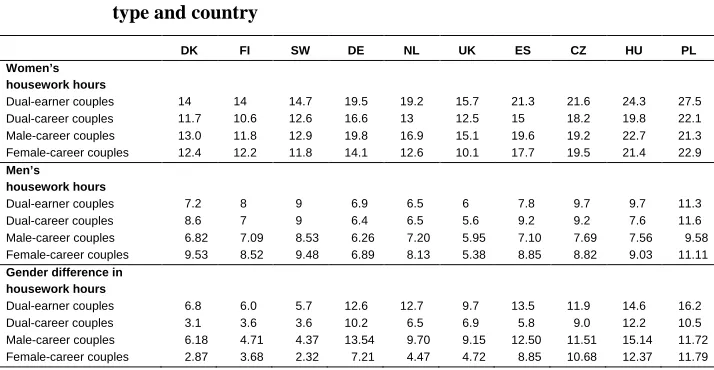
To explore the relationship between the institutional context and the division of housework, we look at the gender difference between women’s and men’s average housework, based on the unadjusted mean scores (Table 5). We already know that time availability, relative resources, gender ideology, and family structure affect the division of housework, and the unadjusted means scores capture the country-specific average regardless of these other factors. This section focuses on earner couples and dual-career couples only, as these couples likely face greater challenges in achieving work‒ life balance.
Table 5: Unadjusted mean of women’s housework hours, men’s housework hours, and gender difference in housework hours, by dual-earner type and country
DK FI SW DE NL UK ES CZ HU PL
Women’s housework hours
Dual-earner couples 14 14 14.7 19.5 19.2 15.7 21.3 21.6 24.3 27.5 Dual-career couples 11.7 10.6 12.6 16.6 13 12.5 15 18.2 19.8 22.1 Male-career couples 13.0 11.8 12.9 19.8 16.9 15.1 19.6 19.2 22.7 21.3 Female-career couples 12.4 12.2 11.8 14.1 12.6 10.1 17.7 19.5 21.4 22.9
Men’s housework hours
Dual-earner couples 7.2 8 9 6.9 6.5 6 7.8 9.7 9.7 11.3
Dual-career couples 8.6 7 9 6.4 6.5 5.6 9.2 9.2 7.6 11.6
Male-career couples 6.82 7.09 8.53 6.26 7.20 5.95 7.10 7.69 7.56 9.58 Female-career couples 9.53 8.52 9.48 6.89 8.13 5.38 8.85 8.82 9.03 11.11
Gender difference in housework hours
Dual-earner couples 6.8 6.0 5.7 12.6 12.7 9.7 13.5 11.9 14.6 16.2 Dual-career couples 3.1 3.6 3.6 10.2 6.5 6.9 5.8 9.0 12.2 10.5 Male-career couples 6.18 4.71 4.37 13.54 9.70 9.15 12.50 11.51 15.14 11.72 Female-career couples 2.87 3.68 2.32 7.21 4.47 4.72 8.85 10.68 12.37 11.79
Country abbreviations: DK=Denmark, FI=Finland, SW=Sweden, DE=Germany, NL=the Netherlands, UK=the United Kingdom, ES=Spain, CZ=the Czech Republic, HU=Hungary, PL=Poland.
The association between the work‒family policy index and gender difference in housework is curvilinear for all couple types, and most so for female-career couples, as seen in the R2 quadratic value when compared with the R2 linear value. Nevertheless, the association is strongest for dual-earner couples, indicating that the gender difference in housework is smaller in countries with stronger support for work‒family reconciliation (the Nordic countries), and larger in countries with less support for work‒ family reconciliation, such as Poland, Hungary, and Spain, followed by the Netherlands and Germany.
Figure 2: Work‒family policy index and gender differences in housework by dual-earner type and country (R2 value for linear and curvilinear estimates)
Dual-earner Dual-career Male-career
Female-career
R2 linear: 0.39 0.17 R2 linear: 0.20 0.14
R2 quadratic: 0.50 0.37 R2 quadratic: 0.47 0.47
Country abbreviations: DK=Denmark, FI=Finland, SW=Sweden, DE=Germany, NL=the Netherlands, UK=the United Kingdom, ES=Spain, CZ=the Czech Republic, HU=Hungary, PL=Poland.
In regard to gender norms, H5 receives the strongest support; i.e., that more egalitarian gender norms generate smaller gender differences in time spent on housework, while more traditional gender norms generate larger gender differences in the division of housework. The association between the gender norm index and gender differences in housework is very strong for all dual-earner couple types. Even though this association is strongest for female-career couples and dual-career couples, we can observe that the gender difference in housework is largest in countries with more traditional gender norms, such as the CEE countries, and smallest in countries with less traditional gender norms, such as the Nordic countries (Figure 3).
DK
FI SW
DE NL UK ES CZ HU PL DK
FI SW
DE
NL UK
ES CZ HU PL 0 2 4 6 8 10 12 14 16 18 20
-5 -3 -1 1 3 5
G ender di ff er enc e i n hous ew or k hour s
Work‒family policy index
DK
FI SW
DE
NL UK
ES CZ HU PL DK FI SW DE
NL UK
ES CZ HU PL 0 2 4 6 8 10 12 14 16 18 20
-5 -3 -1 1 3 5
G ender di ff er enc e i n hous ew or k hour s
Work‒family policy index
Dual-earner couples
Dual-career couples
Male-career couples
Figure 3: Gender norm index and gender differences in housework by dual-earner type and country (R2 value for linear and curvilinear estimates)
Dual-earner Dual-career Male-career
Female-career
R2 linear: 0.82 0.85 R2 linear: 0.73 0.90
R2 quadratic: 0.82 0.85 R2 quadratic: 0.74 0.96
Country abbreviations: DK=Denmark, FI=Finland, SW=Sweden, DE=Germany, NL=the Netherlands, UK=the United Kingdom, ES=Spain, CZ=the Czech Republic, HU=Hungary, PL=Poland.
8. Summary and conclusions
While women’s labour force participation has increased during the past decades, men have not increased their housework participation to a corresponding extent. The aim of this article is to examine the division of housework among various couple-earner types and to test whether relative resources within the couple, time spent on paid work, gender role attitudes, and family structure reduce variations in unpaid work between different couple-earner types. The objective was also to examine whether the division of housework varies across different welfare regimes in terms of work‒family reconciliation policies and gender norms.
The empirical analysis shows that dual-career couples, as well as female-career couples and female single-earner couples, share housework more equally than dual-earner couples. The difference in men’s share of housework across couple-dual-earner types decreases, but is not totally reduced, when controlling for time availability, relative
DK FI SW DE NL UK ES CZ HU PL DK FI SW DE NL UK ES CZ HU PL 0 2 4 6 8 10 12 14 16 18 20
-5 -4 -3 -2 -1 0 1 2 3 4 5
G ender di ff er enc e i n hous ew or k hour s
Gender norm index
DK FI SW DE NL UK ES CZ HU PL DK FI SW DE NL UK ES CZ HU PL 0 2 4 6 8 10 12 14 16 18 20
-5 -4 -3 -2 -1 0 1 2 3 4 5
G ender di ff er enc e i n hous ew or k hour s
Gender norm index
Dual-earner couples
Dual-career couples
Male-career couples
resources, gender role attitudes, family structure, and country differences. This indicates that these factors cannot explain the differences between couple-earner types.
The result also shows, consistent with previous research, that time availability, relative resources, and gender ideology have an important impact on the division of housework (e.g., Aassve, Fuochi, and Mencarini 2014; Evertsson and Nermo 2007; Fuwa 2004; Killewald and Gough 2010; Kan 2008). Nevertheless, the analysis indicates that occupational positions within a couple are relevant to understanding how time is allocated to cope with the demands of work and home.
To further examine the underlying causes that determine men’s share of housework, women’s and men’s actual housework hours were considered. These results indicate that the differences in men’s share of total housework across couple-earner types are mainly due to women’s actual housework hours, except for in female-single-earner couples. Women, especially in dual-career couples and female-career couples, perform less housework than women in dual-earner couples. Hence, the unexpected finding that male-career couples do not share housework more unequally is a reflection of the fact that working women in these couples spend less time on housework than working women in dual-earner couples, rather than that career men spend more time on housework, supporting the time availability approach.
These results confirm previous studies showing that the diminishing gender gap in housework is an effect of women decreasing their housework hours rather than men increasing their hours (Bittman et al. 2003; Evertsson and Nermo 2004; Hook 2010). These results do not totally corroborate the gender approach, which suggests that couples with a less traditional economic relationship, such as female-career couples and female single-earner couples, tend to compensate with a more traditional division of housework (Bittman et al. 2003; Brines 1994; Evertsson and Nermo 2004; Greenstein 2000). The fact that female-career couples divide their housework most equally lends support to the resource-bargaining approach. However, the gender approach applies when measuring woman’s economic independence.
In a comparative gender perspective, the institutional approach contributes to an understanding of the gendered division of housework. Indeed, the results show huge variations in the division of housework across the ten European countries, which also vary between dual-earner couples, dual-career couples, male-career couples, and female-career couples. The association between work‒family reconciliation policies and gender differences in housework is slightly stronger for dual-earner couples¸ indicating that men in dual-earner couples in countries with stronger support for work‒ family reconciliation do a larger share of the housework. It is here that we find the Nordic countries. The association is less straightforward for dual-career couples, male-career couples, and female-male-career couples, but still the Nordic countries stand out with smaller gender differences in housework. Nevertheless, this suggests that dual-earner couples and dual-career couples, and male-career couples and female-career couples face different challenges in regard to work and home demands and have different capabilities for coping with these challenges, especially in countries with weaker support for work‒family reconciliation.
An interesting finding is that gender difference is relatively large in the Netherlands and Germany among dual-earner couples. These are countries that support part-time work, mainly used by women, and part-time childcare, which shape an unequal division of paid work and translate into an unequal division of housework. By contrast, we find relatively small gender differences in housework among female-career-earner couples in the Netherlands and the United Kingdom, countries scoring lowest on the policy index. This suggests that within these policy contexts, women in female-career couples have greater bargaining power than women in dual-earner couples in regard to housework, despite relatively weak institutional support for work‒ family reconciliation.
The analysis also shows that the gender difference in housework is greatest in countries with more traditional gender norms. This holds true for all dual-earner couple types, but especially for female-career couples. This suggests that gender norms may be harder to challenge in these countries; hence women adapt to these norms by spending more time on housework. As a result, they are more vulnerable to a double workload.
This study has shown that institutional context shapes gender roles differently. This is clearest in regard to gender norms. However, in the Nordic countries – with policies encouraging a more equally shared division of caring and earning responsibilities – we see a relatively small gender gap in the division of housework. In contrast, the CEE countries – with policies promoting a more traditional division of paid and unpaid work – display a large gender gap in the division of housework.
emerging. However, this is happening at a varied pace across the different European welfare states, suggesting that the design of work‒family reconciliation policies may also have a role in shaping gender differences in housework across countries.
9. Acknowledgements
References
Aassve, A., Fuochi, G., and Mencarini, L. (2014). Desperate housework: Relative resources, time availability, economic dependency, and gender ideology across Europe. Journal of Family Issues 35(8): 1000‒1022. doi:10.1177/0192513X1 4522248.
Agarwal, B. (1997). ‘Bargaining’ and gender relations: Within and beyond the household. Feminist Economics 3(1): 1‒51. doi:10.1080/135457097338799. Aliaga, C. (2006). How is the time of women and men distributed in Europe? Statistics
in Focus, Population and Social Conditions 4/2006. Luxembourg: European Communities.
Allen, T.D., Johnson, R.C., Kiburz, K.M., and Shockley, K.M. (2013). Work–family conflict and flexible work arrangements: Deconstructing flexibility. Personnel Psychology 66(2): 345‒376. doi:10.1111/peps.12012.
Anxo, D., Fagan, C., Smith, M., Letablier, M.-T., and Perraudin, C. (2007). Part-time work in European companies. Luxembourg: Office for Official Publications of the European Communities.
Anxo, D., Mencarini, L., Paihlé, A., Solaz, A., Tanturri, M.L., and Flood, L. (2011). Gender differences in time-use over the life-course in France, Italy, Sweden and the US. Feminist Economics 17(3): 159‒195. doi:10.1080/13545701.2011.582 822.
Batalova, J.A. and Cohen, P.N. (2002). Premarital cohabitation and housework: Couples in cross-national perspective. Journal of Marriage and Family 64(3): 743‒755. doi:10.1111/j.1741-3737.2002.00743.x.
Baxter, J., Hewitt, B., and Western, M. (2009) Who uses paid domestic labor in Australia? Choice and constraint in hiring household help. Feminist Economics 15(1): 1‒26. doi:10.1080/13545700802248989.
Becker, G.S. (1993). A treatise on the family (Enlarged edition). Cambridge: Harvard University Press.
Berk, S.F. (1985). The gender factor. New York: Plenum Press. doi:10.1007/978-1-4613-2393-8.
Bianchi, S., Milkie M., Sayer, L., and Robinson K. (2000). Is anyone doing the housework? Trends in the gender division of household labor. Social Forces 79(1): 191–228. doi:10.1093/sf/79.1.191.
Bittman, M., England, P., Folbre, N., Sayer, L., and Matheson, G. (2003). When does gender trump money? Bargaining and time in household work. American Journal of Sociology 109(1): 186‒214. doi:10.1086/378341.
Brines, J. (1994). Economic dependency, gender, and the division of labor at home. American Journal of Sociology 100(3): 652‒688. doi:10.1086/230577.
Coltrane, S. (2000). Research on household labor: Modeling and measuring the social embeddedness of routine family work. Journal of Marriage and Family 62(4): 1208‒1233. doi:10.1111/j.1741-3737.2000.01208.x.
Cooke, L.P. (2006). Policy, preferences, and patriarchy: The division of domestic labor in East Germany, West Germany, and the United States. Social Politics 13(1): 117‒143. doi:10.1093/sp/jxj005.
Coverman, S. (1985). Explaining husbands’ participation in domestic labor. The Sociological Quarterly 26(1): 81‒97. doi:10.1111/j.1533-8525.1985.tb00217.x. Craig, L. and Mullan, K. (2010). Parenthood, gender and work‒family time in the
United States, Australia, Italy, France and Denmark. Journal of Marriage and Family 72(5): 1344‒1361. doi:10.1111/j.1741-3737.2010.00769.x.
Crompton, R., Brockmann, M., and Lyonette, C. (2005). Attitudes, women’s employment and the domestic division of labour: A cross-national analysis in two waves. Work, Employment & Society 19(2): 213‒233. doi:10.1177/ 0950017005053168.
Davis, S.N. and Greenstein, T.N. (2004). Cross-national variations in the division of household labor. Journal of Marriage and Family 66(5): 1260‒1271. doi:10.111 1/j.0022-2445.2004.00091.x.
ESS (2011). Weighting European Social Survey Data www.europeansocialsurvey.org /docs/methodology/ESS_weighting_data.pdf.
ESS (2010/2011) European Social Survey, Round 5. www.europeansocialsurvey.org/. EVS (2008). European Values Study, the 4th wave. www.europeanvaluesstudy.eu/. Eurostat (2014). Formal childcare by age group and duration 2010. http://epp.eurostat.
Evertsson, M. and Nermo, M. (2004). Dependence within families and the division of labor: Comparing Sweden and the United States. Journal of Marriage and Family 66(5): 1272‒1286. doi:10.1111/j.0022-2445.2004.00092.x.
Evertsson, M. and Nermo, M. (2007). Changing resources and the division of housework: A longitudinal study of Swedish couples. European Sociological Review 23(4): 455‒470. doi:10.1093/esr/jcm018.
Fahey, T., Nolan, B., and Whelan, C.T. (2003). Monitoring quality of life in Europe.
European Foundation for the Improvement of Living and Working Conditions. Luxembourg: Office for Official Publications of the European Communities. Fahlén, S. (2013). The agency gap: Policies, norms and working time capabilities
across welfare states. In: Hobson, B. (ed.) Worklife balance: The agency and capabilities gap. Oxford: Oxford University Press: 35‒56. doi:10.1093/acprof: oso/9780199681136.003.0002.
Ferrarini, T. (2006). Families, states and labour markets: Institutions, causes and consequences of family policies in post-war welfare states. Cheltenham: Edward Elgar Publishing.
Ferree, M.M. (1991). The gender division of labor in two-earner marriage: Dimension of variability and change. Journal of Family Issues 12(2): 158‒180. doi:10.1177/ 019251391012002002.
Ferrera, M. (1996). The ‘southern model’ of welfare in social Europe. Journal of European Social Policy 6(1): 17–37. doi:10.1177/095892879600600102.
Fuwa, M. (2004). Macro-level gender inequality and the division of household labor in 22 countries. American Sociological Review 69(6): 751‒767. doi:10.1177/000 312240406900601.
Fuwa, M. and Cohen, P.N. (2007). Housework and social policy. Social Science Research 36(2): 5112‒530. doi:10.1016/j.ssresearch.2006.04.005.
Geist, C. (2005). The welfare state and the home: Regime differences in the domestic division of labour. European Sociological Review 21(1): 23‒41. doi:10.1093/ esr/jci002.
Gornick, J., Meyers, M., and Ross, K. (1997). Supporting the employment of mothers: Policy variation across fourteen welfare states. Journal of European Social Policy 7(1): 45‒70. doi:10.1177/095892879700700103.
Greenstein, T.N. (2000). Economic dependence, gender, and the division of labor in the home: A replication and extension. Journal of Marriage and Family 62(2): 322‒ 335. doi:10.1111/j.1741-3737.2000.00322.x.
Gregory, A. and Milner, S. (2009). Editorial: Work–life balance: A matter of choice? Gender, Work and Organization 16(1): 1‒13. doi:10.1111/j.1468-0432.2008. 00429.x.
Gupta, S. (2007). Autonomy, dependence, or display? The relationship between married women’s earnings and housework. Journal of Marriage and Family 69(2): 399‒ 417. doi:10.1111/j.1741-3737.2007.00373.x.
Hook, J.L. (2010). Gender inequality in the welfare state: Sex segregation in housework, 1965–2003. American Sociological Review 115(5): 1480‒1523.
doi:10.1086/651384.
ILO (2014). ISCO, International Standard Classification of Occupations. International Labour Organization. www.ilo.org/public/english/bureau/stat/isco/isco88/index. htm.
Kamo, Y. (2000). ‘He said, she said’: Assessing discrepancies in husbands’ and wives’ reports on the division of household labor. Social Science Research 29(4): 459‒ 476. doi:10.1006/ssre.2000.0674.
Kan, M.Y. (2008). Does gender trump money? Housework hours of husbands and wives in Britain. Work, Employment & Society 22(1): 45‒66. doi:10.1177/09500 17007087416.
Keck, W. and Saraceno, C. (2013). The impact of different social-policy frameworks on social inequalities among women in the European Union: The labour-market participation of mothers. Social Politics 20(3): 297–328. doi:10.1093/sp/jxt005. Killewald, A. and Gough, M. (2010). Money isn’t everything: Wives’ earnings and
housework time. Social Science Research 39(6): 987‒1003. doi:10.1016/j.ssre search.2010.08.005.
Känsälä, M. and Oinas, T. (2016). The division of domestic work among dual-career and other dual-earner couples in Finland. Community, Work & Family 19(4): 438‒461. doi:10.1080/13668803.2015.1057105.
Leitner, S. (2003). Varieties of familialism: The caring function of the family in comparative perspective. European Societies 5(4): 353‒375. doi:10.1080/1461 669032000127642.
Lucchini, M., Saraceno, C., and Schizzerotto, A. (2007). Dual-earner and dual-career couples in contemporary Italy. In: Saraceno, C. (ed.). Dual-career couples. Zeitschrift für Familienforschung Sonderheft 3/2007 3/2007. Opladen: Verlag Barbara Budrich: 289‒309.
Lundberg, S. and Pollak, R.A. (1996). Bargaining and distribution in marriage. The Journal of Economic Perspectives 10(4): 139‒158. doi:10.1257/jep.10.4.139. Misra, J., Budig, M., and Boeckman, I. (2011). Work‒family policies and the effects of
children on women’s employment hours and wages. Community, Work & Family 14(2): 139‒157. doi:10.1080/13668803.2011.571396.
OECD (2010). Maternal employment rates. www.oecd.org/els/social/family/database. OECD (2013a). Key characteristics of parental leave systems 2011/12. OECD family
database. www.oecd.org/social/family/database.
OECD (2013b). Childcare support, 2008. www.oecd.org/els/social/family/database. Orloff, A. (1993). Gender and the social rights of citizenship: The comparative analysis
of gender relations and welfare states. American Sociological Review 58(3): 303‒328. doi:10.2307/2095903.
Pfau-Effinger, B. (2012). Women’s employment in the institutional and cultural context, international. Journal of Sociology and Social Policy 32(9/10): 530‒ 543. doi:10.1108/01443331211257634.
Plantenga, J. and Remery, C. (eds.) (2009). The provision of childcare services. A comparative review of 30 European countries. European Commission’s Expert Group on Gender and Employment Issues (EGGE). Luxembourg: Office for Official Publications of the European Communities.
Sayer, L.C. (2010). Trends in housework. In: Treas, J. and Drobnič, S. (eds.). Dividing the domestic. Men, women, and household work in cross-national perspective. Stanford: Stanford University Press: 19‒38. doi:10.11126/stanford/9780804763 578.003.0002.
Sullivan, O., Billari, F.C., and Altintas, E. (2014). Fathers’ changing contributions to child care and domestic work in very low–fertility countries: The effect of education. Journal of Family Issues 35(8): 1048‒1065. doi:10.1177/0192513X 14522241.
Treas, J. and Drobnič, S. (eds.) (2010). Dividing the domestic. Men, women, and household work in cross-national perspective. Stanford: Stanford University Press. doi:10.11126/stanford/9780804763578.001.0001.
Treas, J. and Tai, T. (2016). Gender inequality in housework across 20 European nations: Lessons from gender stratification theories. Sex Roles 74(11): 495‒511.
doi:10.1007/s11199-015-0575-9.