VOLUME 38, ARTICLE 24, PAGES 619
,
650
PUBLISHED 21 FEBRUARY 2018
http://www.demographic-research.org/Volumes/Vol38/24/ DOI: 10.4054/DemRes.2018.38.24
Research Article
A longitudinal examination of US teen
childbearing and smoking risk
Stefanie Mollborn
Juhee Woo
Richard G. Rogers
© 2018 Stefanie Mollborn, Juhee Woo & Richard G. Rogers.
This open-access work is published under the terms of the Creative Commons Attribution 3.0 Germany (CC BY 3.0 DE), which permits use, reproduction, and distribution in any medium, provided the original author(s) and source are given credit.
1 Introduction 620
2 Background 622
2.1 Teen motherhood and cigarette smoking 622
2.2 Selection into smoking and teen childbearing 623
2.3 Explanations for a relationship between teen childbearing and
smoking 624
2.4 Racial/ethnic heterogeneity in relationships between teen childbearing and smoking
625
2.5 Analytic plan 626
3 Methods 626
3.1 Data 626
3.2 Variables 628
3.2.1 Daily smoking at wave 4 628
3.2.2 Teen childbearing 628
3.2.3 Sociodemographic variables 629
3.2.4 Potential mediators 630
3.3 Analysis 631
4 Results 632
4.1 Associations between teen childbearing and smoking 632
4.2 Selection processes 632
4.3 Mediation of the teen childbearing-smoking relationship 635
4.4 Racial/ethnic heterogeneity in processes 635
5 Discussion 637
6 Acknowledgements 641
A longitudinal examination of US teen childbearing
and smoking risk
Stefanie Mollborn1
Juhee Woo2 Richard G. Rogers3
Abstract
BACKGROUNDTeenage motherhood and smoking have important health implications for youth in the United States and globally, but the link between teen childbearing and subsequent smoking is inadequately understood. The selection of disadvantaged young women into early childbearing and smoking may explain higher smoking levels among teen mothers, but teen motherhood may also shape subsequent smoking through compromised maternal depression or socioeconomic status, and race/ethnicity may condition these processes.
OBJECTIVE
This study examines the relationship between US teen childbearing and subsequent daily smoking, accounting for prior smoking and selection processes related to social disadvantage. Analyses investigate whether socioeconomic status and depression in young adulthood explained any relationship between teen childbearing and daily smoking, as well as examining racial/ethnic heterogeneity in these processes.
METHODS
Multivariate binary logistic regression analyses employ the National Longitudinal Study of Adolescent to Adult Health (Add Health; N = 7,529).
RESULTS
The highest daily smoking prevalence occurred among non-Hispanic White teen mothers, with lower prevalence among Hispanic and non-Hispanic Black teen mothers.
1 Department of Sociology and Health and Society Program, Institute of Behavioral Science (IBS), University
of Colorado Boulder, USA. Email:[email protected].
2 Department of Sociology and Problem Behavior and Positive Youth Development Program, Institute of
Behavioral Science (IBS), University of Colorado Boulder, USA.
3 Department of Sociology and Population Program, Institute of Behavioral Science (IBS), University of
Compared to other women, teenage mothers are 2.5 times as likely to smoke daily in young adulthood. Their greater likelihood of daily smoking is due in part to selection and is also mediated by socioeconomic status in ways that differ by race/ethnicity.
CONCLUSIONS
The findings suggest that preventing teen pregnancy or ameliorating its socioeconomic consequences may decrease daily smoking in this vulnerable population. Reducing teen smoking, especially during pregnancy, could improve teen, maternal, and infant health and thereby increase US health and longevity.
CONTRIBUTION
This study provides new, nationally representative information about selection, mediation, and heterogeneity processes in the relationship between teen childbearing and subsequent smoking.
1. Introduction
Both cigarette smoking and teen childbearing are considered urgent contemporary health issues in US society and other countries around the world. Despite recent declines, compared to peer countries (Sedgh et al. 2015), the United States has a relatively high teen birth rate at 22.3 births per 1,000 girls aged 15–19 in 2015 (Martin et al. 2017). In high-income nations, smoking is the largest cause of premature mortality (Centers for Disease Control and Prevention 2008; Rogers et al. 2005), and “smoking during pregnancy is considered the largest preventable cause of fetal and infant ill health and death” (Delpisheh, Brabin, and Brabin 2006: 389). Smoking typically begins in late adolescence: Cigarette use in the past month increased from just 4.0% among 15-year-olds to 23.8% among 19-15-year-olds in United States in 2015 (Center for Behavioral Health Statistics and Quality 2016). Given the public health concerns around teen pregnancy and cigarette smoking and calls for research on their association (e.g., McDermott and Graham 2006), it is surprising that relatively little research has been conducted. Our study addresses that gap by estimating the relationship between teen childbearing and subsequent daily smoking.
Kearney and Levine 2015; Wodtke 2013) and smoking (Chassin et al. 1996; Lawrence, Pampel, and Mollborn 2014). In other words, young women who become smokers and those who become teen mothers are not evenly distributed throughout the population, and in many cases they disproportionately come from the same segments of the population. Because teen motherhood and smoking are strongly related to social disadvantage, they are likely associated with each other in ways that may not be causal. Furthermore, there may be heterogeneity in the relationship between teen childbearing and subsequent smoking, with different associations for different groups. This study focuses on race/ethnicity as a source of heterogeneity because it is strongly associated with both teen motherhood and smoking in complex ways (Dennis and Mollborn 2013; Lawrence, Pampel, and Mollborn 2014; Williams et al. 2015).
Using nationally representative survey data from the National Longitudinal Study of Adolescent to Adult Health (Add Health) that followed US teens until their late twenties or early thirties, this study estimates the relationship between teen childbearing and daily cigarette smoking at multiple points in the early life course. Because they represent a smaller proportion of the population than teen mothers and are less likely to live with their children (Mollborn and Lovegrove 2011), teen fathers are a distinct and hard-to-reach population that may have different smoking implications and that is not studied here. Our longitudinal data allows us to generalize findings to a recent US cohort and to establish time order between teen childbearing and daily smoking. We assess the roles of specific selection processes, explore potential mediators of the relationship between teen motherhood and smoking, and investigate racial/ethnic heterogeneity in these relationships and processes. Each of these goals is a new contribution to the literature. Understanding not only how teen motherhood and smoking are related to each other, but the extent to which those relationships may be driven by selection and how heterogeneous they are across different groups is important for social policy. If the two phenomena are potentially causally related at least in some groups, then policy efforts to reduce one might also ameliorate the other.
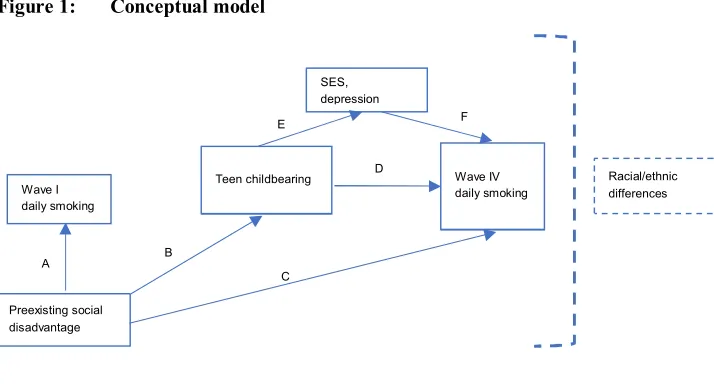
Figure 1: Conceptual model
1. Does teen childbearing predict daily smoking in young adulthood in a nationally representative longitudinal study of women (Figure 1, path D)?
2. If teen childbearing is associated with subsequent smoking, is this relationship explained by the selection of socially disadvantaged teens into smoking and teen childbearing (paths A–C)?
3. After accounting for selection processes, do socioeconomic status and depression in young adulthood mediate any remaining relationship between teen childbearing and subsequent daily smoking (paths D–F)?
4. Are there racial/ethnic differences in the association between teen childbearing and subsequent smoking or in its selection and mediation processes?
2. Background
2.1 Teen motherhood and cigarette smoking
US teen childbearing rates peaked in the 1950s, but teen motherhood emerged as a perceived social problem in later decades as most teen births became nonmarital (Furstenberg 2003). A large, longstanding literature has examined the consequences of teen childbearing for a variety of short- and long-term life outcomes (e.g., Taylor 2009). Some influential studies have found that the documented negative consequences of teen childbearing are mostly or entirely due to the selection of disadvantaged girls into early motherhood (Geronimus and Korenman 1993; Hoffman 1998; Turley 2003). But most
Wave I daily smoking
Preexisting social disadvantage
Teen childbearing Wave IV daily smoking
Racial/ethnic differences SES,
depression
A B
C
D E
B
researchers now attribute modest negative effects to teen motherhood (Fletcher and Wolfe 2009; Kane et al. 2013), with heterogeneity in these effects for different groups (Diaz and Fiel 2016; Williams et al. 2015).
Here, we consider the medium-term outcome of daily smoking in young adulthood (Figure 1, path D). Research on the relationship between teen childbearing and later smoking is sparse. Teen mothers-to-be have higher rates of prenatal smoking than most older age groups (Lu, Tong, and Oldenburg 2001; Mathews 2001; Ventura et al. 2003), even though they are disproportionately likely to quit smoking while pregnant (Colman and Joyce 2003; Curtin and Mathews 2016). White US teen mothers had a particularly high prenatal smoking prevalence of 34% in 2000–2001, compared to 9% for African American and 11% for Hispanic teen mothers (Dennis and Mollborn 2013). White teen mothers’ high levels of smoking partially explained their children’s elevated risk for low birthweight compared to children of older White mothers (Dennis and Mollborn 2013). After childbearing, evidence from the United Kingdom and Australia suggests that teen mothers have an increased likelihood of smoking (Graham et al. 2006; Webbink, Martin, and Visscher 2008). Young mothers in a high-risk New York sample were more likely to be current smokers than those who were childless (Stueve and O’Donnell 2007). Teen mothers are more likely than older women to resume smoking after childbirth (Colman and Joyce 2003), making the otherwise protective effect of childbearing weaker for this group.
2.2 Selection into smoking and teen childbearing
problem behavior” predicted by social disadvantage, being more likely than other adolescents to engage in unhealthy behaviors such as problematic alcohol use, marijuana use, and delinquency (Donovan, Jessor, and Costa 1988). Thus, because of social disadvantage underlying both behaviors, girls who have teen births may have already been more likely to smoke. In a high-risk local urban sample, women who had become mothers by about age 20 were more likely to have smoked in the past (Stueve and O’Donnell 2007). Evidence from the United Kingdom suggests that teen childbearing can compound smoking risk stemming from earlier childhood disadvantages (Graham, Hawkins, and Law 2010), which implies a blend of selection and causality.
2.3 Explanations for a relationship between teen childbearing and smoking
If selection processes do not fully account for the relationship between teen childbearing and subsequent smoking, what potential mediators could explain this association (Figure 1, paths D–F)? Teen motherhood is a stigmatized and stress-inducing experience for many reasons, including the violation of age norms, potential disruption to human capital formation, its association with depression, and the stress of motherhood more generally (Falci, Mortimer, and Noel 2010; Kane et al. 2013; Larson 2004). Cigarette smoking is a known strategy for coping with stress that tends to be classed and raced (Chassin et al. 1996; Lawrence et al. 2014). In a small qualitative study of teen mothers, Lawson (1994) found that a majority had already begun smoking between 10 and 11 years old. They reported reasons why they continued smoking during and after pregnancy, perceiving that the short-term benefits of smoking, such as relief from anxiety and weight control after childbearing, outweighed longer-term health risks.
2012; Zimmer and Zimmer 1998). In adulthood, less educated people are less likely to quit smoking (Chassin et al. 1996; Pickett et al. 2003).
2.4 Racial/ethnic heterogeneity in relationships between teen childbearing and smoking
Women’s cigarette smoking is patterned by race/ethnicity. White women begin smoking at younger ages than Black women (Geronimus, Neidert, and Bound 1993; Moon-Howard 2003) but are more likely to quit and do so at younger ages (Geronimus, Neidert, and Bound 1993). Using Add Health data, Chen and Jacobson (2012) and Lawrence and colleagues (2014) found that among African Americans, smoking rates started low but increased with age, resulting in the highest smoking rates of any racial group by their early thirties. There was an inverse U-shaped relationship between smoking and age for White, Asian American, and Hispanic respondents, with smoking rates increasing throughout adolescence and peaking in their mid-twenties. The age-related increase and decrease around this peak were particularly sharp for Whites (Chen and Jacobson 2012), and analyses of other data have found that this cessation among Whites is the main explanation for racial convergence in smoking prevalence over the life course (Pampel 2008).
Fertility complicates racialized smoking uptake and cessation patterns. A greater proportion of White women smoke during pregnancy compared to Black women (Arnold et al. 2001; Mathews 2001; Ventura et al. 2003). Adjusting for selection using within-family comparisons, Geronimus and Korenman (1993) found suggestive evidence that White teen mothers were more likely than their sisters to smoke during pregnancy, but the same was not true for African American teen mothers. Although childbearing generally lowers the likelihood of subsequent smoking (Pampel, Mollborn, and Lawrence 2014; Staff et al. 2010), this is likely not true for African American teen mothers, as their smoking rates continue to increase throughout their twenties and thirties after they have given birth. Unlike other groups, African American women who start smoking in adulthood are not more likely to stop smoking than those who started in their teens (Thompson, Moon-Howard, and Messeri 2011).
did not predict high school completion among US teen mothers and fathers. In contrast, Williams and associates (2015) identified negative implications of teen birth for self-rated health at midlife compared to giving birth after age 25 for Black but not for White or Hispanic women. Because it structures both teen childbearing and smoking, race/ethnicity may be a source of heterogeneity in their relationship.
2.5 Analytic plan
We capitalize on the longitudinal, nationally representative Add Health data to observe daily smoking before pregnancy and into young adulthood, several years after a teen birth. The core relationship we estimate is between teen childbearing and the odds of daily smoking in young adulthood. To answer the research questions, we estimate the influence of selection processes on this relationship, test for mediation of the adjusted relationship by socioeconomic attainment and depression symptoms, and examine whether all these relationships differ by the teen mother’s race/ethnicity. Addressing these goals requires longitudinal survey data following a large sample of young women over time, from before to well after the experience of teen childbearing, and comparing them to peers who did not experience a teen birth.
3. Methods
3.1 DataWe investigate the relationship between cigarette smoking in young adulthood and experiences of teenage motherhood using data from Add Health (Harris et al. 2009), a nationally representative survey of US adolescents. Add Health collected data on a variety of health-related subjects throughout four waves (wave 1 from September 1994 through December 1995; wave 2 from April 1996 through August 1996; wave 3 from August 2001 through April 2002; wave 4 from January 2008 through February 2009).
populations were oversampled, yet sampling weights, region, and school identifier allow researchers to represent the national population of adolescents.
For this study, we mainly used data from waves 1 and 4. Wave 4 data is the most recent information on the study participants, who were settling into young adulthood (ages 24 to 32) at the time of the interview. We used it to measure our outcome variable (daily smoking in young adulthood), as well as respondents’ characteristics in young adulthood that may mediate the relationship between teen motherhood and the likelihood of smoking in young adulthood. Wave 1 data provide information on the respondents’ teenage years (grades 7 through 12), including their family backgrounds. We used this data for our selection variables, which may generate a spurious relationship between teenage motherhood and smoking in young adulthood. We used wave 2 and 3 data only to measure daily smoking, which was needed for descriptive analyses of smoking across the four waves but was not used in multivariate models.
Our sample was limited to women, identified using respondents’ reports of biological sex in waves 1 and 4. Among them, 7,874 respondents who participated in Waves 1 and 4 and who were not missing sampling weights, region, or school identifier were eligible for analysis. We omitted those who gave birth before or were pregnant at wave 1 to establish time order between smoking at wave 1 and teen childbearing, leaving a final sample of 7,529.4 Following the recommendation of Allison (2002), we
used all analysis variables to impute missing values on independent and dependent variables, which retains all cases, reduces bias resulting from listwise deletion of missing cases, and produces unbiased estimates (Schafer 1999; Sterne et al. 2009). Missing values were imputed by the ‘mi impute chained’ command, and all analyses were conducted using Stata statistical software (StataCorp 2011).5
4 Among the 345 respondents who were excluded from analysis because of pregnancy or childbirth prior to
wave 1, 21.1% and 37.6% were daily smokers at waves 1 and 4, respectively.
5 Of the variables used for the 20 imputed datasets, wave 1 household income (24.9%), nativity (19.8%), and
3.2 Variables
3.2.1 Daily smoking at wave 4
Given the high prevalence of social smokers among adolescents and young adults, who smoke occasionally in certain social settings (Schane, Glantz, and Ling 2009; Song and Ling 2011), we focused our analyses on daily smokers, who may be at greater health risks than social smokers. Studies categorize current smokers into daily and intermittent smokers and define intermittent smokers as those who smoke “some days” (Lindström 2003; Trinidad et al. 2009). Although intermittent smoking can be a chronic pattern of cigarette use, it is also perceived as a transitional phase (from nonsmoking to daily smoking and vice versa; Berg et al. 2013). Adolescent and young adult intermittent smokers tend to be experimental or social smokers and may not transition to daily smokers (Wetter et al. 2004). Daily smokers, on the other hand, may have established their smoking habits and are less likely to quit, thus drawing greater attention for health interventions.
We defined daily smokers using respondents’ self-reports of smoking during the past 30 days. At wave 4, an initial question asked respondents whether they had ever smoked an entire cigarette. Those answering ‘yes’ were then asked how many days during the past 30 days they had smoked. Our study classified those answering 30 days as daily smokers (coded 1), while non-daily smokers were those who either had never smoked an entire cigarette or smoked during fewer than 30 days in the past month. For similar coding, see Johnson and Hoffman (2000) and Kandel et al. (2004).
3.2.2 Teen childbearing
3.2.3 Sociodemographic variables
We chose all independent variables (demographic characteristics, selection factors, wave 1 smoking, and mediators) because of their possible relationships to smoking or teenage motherhood. Multicollinearity among the variables was not a concern in the models. As a control, respondents’ age at wave 1 was calculated by subtracting their birth month and year from the wave 1 interview date. We measured respondents’ race/ethnicity, a potential source of heterogeneity, by four categories: Hispanic, non-Hispanic White, Black, and other race. We combined American Indian/Alaska Native and Asian/Pacific Islander as “other race” and excluded them from the analysis of racial/ethnic comparisons due to their small sample size of teen mothers. Respondents’ nativity was coded from a question asking if they had been born in the United States (US-born = 1; foreign-born = 0).
We included several selection variables, all measured at wave 1. First, student-reported grade point average (GPA) for four subjects was averaged into a four-point scale (D or lower = 1, C = 2, B = 3, A = 4) and recoded into a series of indicator variables (less than 3, 3 to 3.49, and 3.5 or more). Family socioeconomic status was measured by parents’ education and parent-reported household income. We recoded parent reports of earned degrees into approximate years of education.6 The highest
education levels of the mother and her spouse/partner were averaged. If the spouse’s education was missing from the parent report, we substituted the adolescent respondent’s report of his education level. Lacking that, the mother’s education was used for both. If no parent completed the survey, the adolescent respondent’s report of both parents’ education levels was substituted. Cubbin and associates (2005) found 75% agreement between parents’ and adolescents’ reports of parental education levels when data for both were available. Following Cubbin et al. (2005), we adjusted for the number of people in the household to create an indicator variable that represents parent-reported household income as a percentage of 1994 federal poverty thresholds (0 to 100, 101 to 200, 201 to 300, 301 to 400, and greater than 400%). Respondents’ family structure was coded into a series of indicator variables after Harris (1999): living with both biological parents, other types of two-parent families, a single mother, a single father, and other family structures. Religious service attendance was measured by frequency and coded into a series of indicator variables (never/no religion, less than
6 This variable was coded as: 8th grade or less = 8 years, some high school = 10, high school graduate = 12,
once a month, once a month or more but less than once a week, and at least once a week).
We also measured respondents’ wave 1 levels of depression symptoms and delinquency. The measure of depression symptoms used a subset of questions from the Center for Epidemiologic Studies Depression Scale (CES-D; Radloff 1977). Respondents were asked 19 questions about how often they had particular feelings in the past week (0 = never or rarely, 1 = sometimes, 2 = a lot of the time, 3 = most or all of the time), and the average of the 19 questions was used as a depression symptoms scale at wave 1 (alpha scale reliability coefficient = 0.91). In addition, respondents were asked 15 questions about how often they engaged in delinquent acts (0 = never, 1 = one or two times, 2 = three or four times, 3 = five or more times). The delinquency scale represents the respondents’ averaged answers to the 19 questions after reverse coding positive items (alpha scale reliability coefficient = 0.84). Because the depression and delinquency scales were highly skewed, we logged both scales after adding 1. Lastly, we included a dichotomous indicator of respondents’ reports of having ever had vaginal intercourse by wave 1. Because women who were pregnant were excluded from the sample, this was preexisting sexual activity that could not have led to the teen birth.
Respondents’ daily smoking status at wave 1 was another selection measure. Since we excluded respondents who gave birth before or were pregnant at wave 1, daily smokers at wave 1 would have started smoking before they became pregnant. In wave 1, the initial question asked respondents if they had ever tried cigarette smoking, even just one or two puffs. Those who had tried smoking and smoked 30 days in the past month were categorized as daily smokers (1), whereas those who had never tried smoking, never smoked an entire cigarette, or smoked less than 30 days in the past month were coded as 0.
For descriptive analysis of smoking of each racial/ethnic group over time, daily smoking in waves 2 and 3 was also measured. Wave 2 smoking measures were different from the other three waves, as respondents were asked about their smoking activity since the month of the wave 1 interview. We defined daily smokers as those who reported having tried smoking since the last interview (wave 1) and smoking 30 days in the last month. At wave 3, we defined daily smokers as those who reported having smoked an entire cigarette and smoking 30 days during the past month.
3.2.4 Potential mediators
motherhood. Teen childbearing has been shown to compromise mental health and educational and other socioeconomic attainment (see above), which may in turn increase smoking. Each respondent’s highest level of education achieved was recoded into approximate years from a categorical measure (earned degrees, recoded as in wave 1). Wave 4 household income is coded as a percent of the 1997 federal poverty thresholds, adjusting for household size (recoded as in wave 1). We measured home ownership by a dichotomous indicator of whether the respondent’s house, apartment, or residence is owned by themselves or their partner versus not. For the modified CES-D depression symptoms scale at wave 4, respondents were asked 10 questions about how often they had particular feelings in the past week (0 = never or rarely, 1 = sometimes, 2 = a lot of the times, 3 = most of the time or all of the time), and we averaged their responses after reverse coding positive items (alpha scale reliability coefficient = 0.84).
3.3 Analysis
and Hispanic), to better understand the interaction effects. All analyses used Stata’s complex survey design commands (StataCorp 2011). We present odds ratios, or exponentiated coefficients, for the logistic regression models.
4. Results
4.1 Associations between teen childbearing and smoking
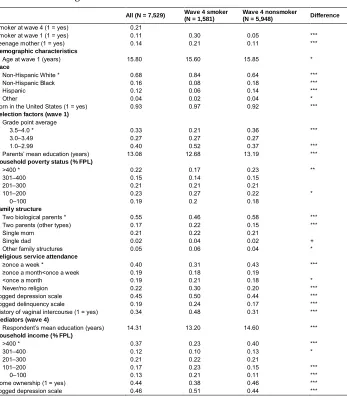
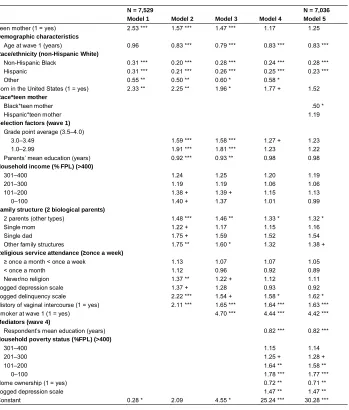
Table 1 reveals that teen childbearing and subsequent wave 4 daily smoking are strongly related (path D in Figure 1). Teen mothers made up 21% of daily smokers at wave 4, compared to 11% of nonsmokers and 14% of the overall sample. Table 2, model 1 estimated this relationship after controlling for age, race/ethnicity, and nativity. Becoming a teen mother before wave 4 was associated with 1.5 times higher odds of smoking at wave 4 compared to other women (odds ratio = 2.53).
4.2 Selection processes
Table 1: Weighted means for variables used in analyzing daily smoking and teenage motherhood
All (N = 7,529) Wave 4 smoker (N = 1,581)
Wave 4 nonsmoker
(N = 5,948) Difference
Smoker at wave 4 (1 = yes) 0.21
Smoker at wave 1 (1 = yes) 0.11 0.30 0.05 *** Teenage mother (1 = yes) 0.14 0.21 0.11 ***
Demographic characteristics
Age at wave 1 (years) 15.80 15.60 15.85 *
Race
Non-Hispanic White * 0.68 0.84 0.64 *** Non-Hispanic Black 0.16 0.08 0.18 *** Hispanic 0.12 0.06 0.14 ***
Other 0.04 0.02 0.04 *
Born in the United States (1 = yes) 0.93 0.97 0.92 ***
Selection factors (wave 1)
Grade point average
3.5–4.0 * 0.33 0.21 0.36 *** 3.0–3.49 0.27 0.27 0.27
1.0–2.99 0.40 0.52 0.37 *** Parents’ mean education (years) 13.08 12.68 13.19 ***
Household poverty status (% FPL)
>400 * 0.22 0.17 0.23 ** 301–400 0.15 0.14 0.15
201–300 0.21 0.21 0.21
101–200 0.23 0.27 0.22 *
0–100 0.19 0.2 0.18
Family structure
Two biological parents * 0.55 0.46 0.58 *** Two parents (other types) 0.17 0.22 0.15 *** Single mom 0.21 0.22 0.21
Single dad 0.02 0.04 0.02 + Other family structures 0.05 0.06 0.04 *
Religious service attendance
≥once a week * 0.40 0.31 0.43 *** ≥once a month<once a week 0.19 0.18 0.19
<once a month 0.19 0.21 0.18 * Never/no religion 0.22 0.30 0.20 *** Logged depression scale 0.45 0.50 0.44 *** Logged delinquency scale 0.19 0.24 0.17 *** History of vaginal intercourse (1 = yes) 0.34 0.48 0.31 ***
Mediators (wave 4)
Respondent’s mean education (years) 14.31 13.20 14.60 ***
Household income (% FPL)
>400 * 0.37 0.23 0.40 ***
301–400 0.12 0.10 0.13 *
201–300 0.21 0.22 0.21
101–200 0.17 0.23 0.15 ***
0–100 0.13 0.21 0.11 ***
Home ownership (1 = yes) 0.44 0.38 0.46 *** Logged depression scale 0.46 0.51 0.44 ***
Source: National Longitudinal Study of Adolescent Health (1995).
Note: Reference categories are indicated with * next to variable names. Analyses account for sample design effects (weighting, stratification, and clustering). Depression and delinquency scales are logged after adding 1 to the original scales (0–3).
Table 2: Odds ratios from binary logistic regression models predicting wave 4 daily smoking by teenage motherhood, selection factors, mediators, and controls
N = 7,529 N = 7,036
Model 1 Model 2 Model 3 Model 4 Model 5
Teen mother (1 = yes) 2.53 *** 1.57 *** 1.47 *** 1.17 1.25
Demographic characteristics
Age at wave 1 (years) 0.96 0.83 *** 0.79 *** 0.83 *** 0.83 ***
Race/ethnicity (non-Hispanic White)
Non-Hispanic Black 0.31 *** 0.20 *** 0.28 *** 0.24 *** 0.28 *** Hispanic 0.31 *** 0.21 *** 0.26 *** 0.25 *** 0.23 *** Other 0.55 ** 0.50 ** 0.60 * 0.58 *
Born in the United States (1 = yes) 2.33 ** 2.25 ** 1.96 * 1.77 + 1.52
Race*teen mother
Black*teen mother .50 *
Hispanic*teen mother 1.19
Selection factors (wave 1)
Grade point average (3.5–4.0)
3.0–3.49 1.59 *** 1.58 *** 1.27 + 1.23 1.0–2.99 1.91 *** 1.81 *** 1.23 1.22 Parents’ mean education (years) 0.92 *** 0.93 ** 0.98 0.98
Household income (% FPL) (>400)
301–400 1.24 1.25 1.20 1.19 201–300 1.19 1.19 1.06 1.06 101–200 1.38 + 1.39 + 1.15 1.13 0–100 1.40 + 1.37 1.01 0.99
Family structure (2 biological parents)
2 parents (other types) 1.48 *** 1.46 ** 1.33 * 1.32 * Single mom 1.22 + 1.17 1.15 1.16 Single dad 1.75 + 1.59 1.52 1.54 Other family structures 1.75 ** 1.60 * 1.32 1.38 +
Religious service attendance (≥once a week)
≥ once a month < once a week 1.13 1.07 1.07 1.05 < once a month 1.12 0.96 0.92 0.89 Never/no religion 1.37 ** 1.22 + 1.12 1.11 Logged depression scale 1.37 + 1.28 0.93 0.92 Logged delinquency scale 2.22 *** 1.54 + 1.58 * 1.62 * History of vaginal intercourse (1 = yes) 2.11 *** 1.65 *** 1.64 *** 1.63 *** Smoker at wave 1 (1 = yes) 4.70 *** 4.44 *** 4.42 ***
Mediators (wave 4)
Respondent’s mean education (years) 0.82 *** 0.82 ***
Household poverty status (%FPL) (>400)
301–400 1.15 1.14
201–300 1.25 + 1.28 +
101–200 1.64 ** 1.58 **
0–100 1.78 *** 1.77 ***
Home ownership (1 = yes) 0.72 ** 0.71 ** Logged depression scale 1.47 ** 1.47 ** Constant 0.28 * 2.09 4.55 * 25.24 *** 30.28 ***
Source: National Longitudinal Study of Adolescent Health (1995).
Note: Models 1–4 include all racial/ethnic groups (N = 7529); model 5 includes White, Black, and Hispanic (N = 7036). Analyses account for sample design effects (weighting, stratification, and clustering).
4.3 Mediation of the teen childbearing-smoking relationship
Table 2, model 4 shows that introducing socioeconomic attainment and depression into the model (Figure 1, path F) resulted in the coefficient for teen motherhood (path D) losing statistical significance. In testing for mediation using the criteria outlined by Baron and Kenny (1986), we found that educational attainment and income-to-needs ratio together mediated the teen childbearing-daily smoking relationship in path D. Supplemental models showed that teen childbearing did not significantly predict home ownership or depression symptoms (path E), so they did not qualify as mediators. In a supplemental model in which only education and income were included as mediators, the teen childbearing odds ratio was 1.14 and was not statistically significant. Thus, education and income were the mediators that explained why teen childbearing was positively related to subsequent smoking: Teen childbearing predicted reduced subsequent household income and educational attainment, which were associated with an increased likelihood of daily smoking.
4.4 Racial/ethnic heterogeneity in processes
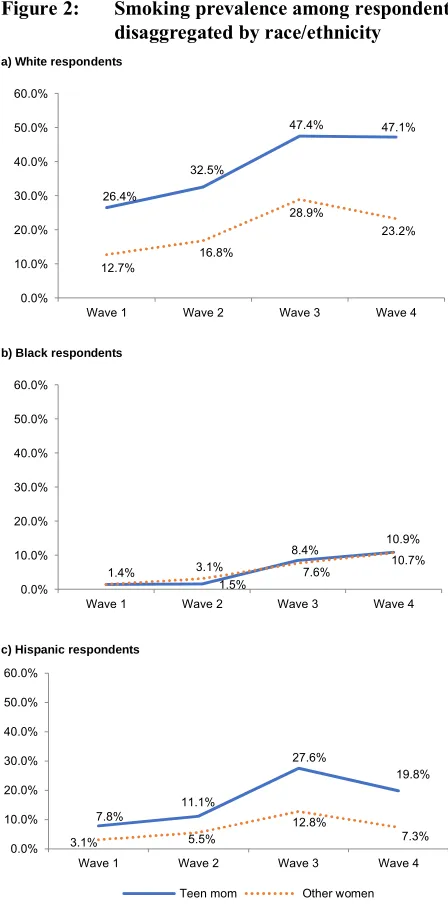
Figure 2: Smoking prevalence among respondents by teen mother status, disaggregated by race/ethnicity
a) White respondents
b) Black respondents
c) Hispanic respondents
Source: National Longitudinal Study of Adolescent Health (1995).
Note: Analyses account for sample design effects (weighting, stratification, and clustering). 26.4%
32.5%
47.4% 47.1%
12.7%
16.8%
28.9%
23.2%
0.0% 10.0% 20.0% 30.0% 40.0% 50.0% 60.0%
Wave 1 Wave 2 Wave 3 Wave 4
1.4%
1.5%
8.4% 10.9% 3.1% 7.6% 10.7% 0.0%
10.0% 20.0% 30.0% 40.0% 50.0% 60.0%
Wave 1 Wave 2 Wave 3 Wave 4
7.8%
11.1%
27.6%
19.8%
3.1% 5.5%
12.8%
7.3% 0.0%
10.0% 20.0% 30.0% 40.0% 50.0% 60.0%
Wave 1 Wave 2 Wave 3 Wave 4
At all waves, there were large racial/ethnic differences in smoking prevalence, with the highest among Whites, the lowest among African Americans, and Hispanics in between. By wave 4, 47.1% of White teen mothers were daily smokers, compared to 19.8% for Hispanic teen mothers and 10.9% for Black teen mothers. Thus, even White women who never became teen mothers still had a smoking prevalence (23.2%) that was higher than any group of Black or Hispanic women.
Given the racial/ethnic differences in the gaps in smoking prevalence between teen mothers and others portrayed in Figure 1, it is perhaps unsurprising that Table 2, model 5 identified significant differences by race/ethnicity in the relationship between teen motherhood status and the likelihood of later smoking (Figure 1, path D). To explore racial/ethnic differences in selection and mediation processes, Table 3 presents the same first four models as Table 2 but disaggregated by race/ethnicity for White, Black, and Hispanic women. There was no significant relationship between teen childbearing and smoking among Black women in any model. Only for White women was there a significant relationship between teen motherhood and wave 4 smoking at the p<.05 level after controlling for social background in model 2. For Hispanics, this relationship was larger in magnitude than for White women (an odds ratio of 1.94 compared to 1.68) but was only significant at the p<.10 level. This marginally significant relationship was explained by the socioeconomic mediators, as it was for White women. Supplementary models showed that for both Hispanic and White women as in Table 2 for all women, education and income mediated the relationship.
Table 3: Odds ratios from binary logistic regression models predicting daily smoking at wave 4 by teenage motherhood, disaggregated by race/ethnicity
Model 1 Model 2 Model 3 Model 4
Teen mother among Whites (n = 4,163) 2.87 *** 1.68 *** 1.56 *** 1.23 Teen mother among Blacks (n = 1,681) 0.94 0.70 0.70 0.62 Teen mother among Hispanics (n = 1,191) 2.65 *** 1.94 + 1.82 + 1.23
Source: National Longitudinal Study of Adolescent Health (1995).
Note: DV: daily smoking at wave 4, IV: teenage motherhood, models restricted to each racial/ethnic group. Model 1: controls for demographic characteristics; model 2: controls for demographic characteristics and selection factors; model 3: controls for demographic characteristics, selection factors, and smoking at wave 1; model 4: controls for demographic characteristics, selection factors, smoking at wave 1, and mediators. Analyses account for sample design effects (weighting, stratification, and clustering). + p<.10; * p<.05; ** p<.01; *** p<.001.
5. Discussion
4, controlling for demographic factors and previous smoking. This greater likelihood of daily smoking was due in large part to selection factors. Controlling for academic achievement, family structure and socioeconomic status, religiosity, delinquency, previous sexual activity, and preexisting smoking substantially reduced the association between teen motherhood and subsequent smoking. Achieved socioeconomic status mediated the remaining relationship: Teen childbearing reduced women’s educational attainment and household income, which in turn increased their likelihood of smoking.
Teen mothers are disadvantaged in part because of lower socioeconomic status and riskier behaviors, including smoking. And their smoking during or after pregnancy may result in further disadvantage. Smoking during pregnancy may lead to lower birthweight babies who require more personal and medical care, which may further exacerbate the disadvantaged positions of their mothers. Furthermore, parental smoking can expose infants and children to secondhand smoke, which can increase their risk of disease and death (US Department of Health and Human Services 2006). Thus, we have identified one pathway through which socioeconomic and health disadvantage may accumulate among young mothers and contribute to the intergenerational transmission of poor health: Social disadvantage is associated with becoming a teen mother, which predicts lower socioeconomic attainment, which is related to increased risk of smoking, which can increase the risk of preterm and low weight births and of infant and child disease and mortality. These risky infants and children may require expensive and time consuming medical care and may experience developmental delays that further stress the mother and reduce her educational progress, perpetuating the vicious cycle of intergenerational inequality.
to fit in with their peers. Thus, antismoking programs could target teens’ social networks, including family members and friends (Christakis and Fowler 2008).
Effective social and health policies can break the vicious cycle of intergenerational inequality. Policy makers can find ways to reduce risky behaviors such as smoking and unprotected sex during youth and adolescence; provide school-, community-, and clinic-based smoking cessation programs; reduce teenage childbearing; increase prenatal care and healthy behaviors during gestation; increase health care access; encourage educational attainment among pregnant women and teen mothers; and provide health care and childcare for infants of young mothers. Educational experts should watch for young mothers who are at risk of dropping out of high school or, less visibly, of forgoing college and other advanced levels of educational attainment. Our findings suggest that reducing social disadvantage is a promising policy route. Such a reduction may simultaneously decrease rates of teen childbearing and of teen mothers' smoking behaviors, as well as ameliorating the negative socioeconomic consequences of teen childbearing.
At the larger societal level, social and health policies can address unacceptably high rates of unintended pregnancies, poverty, and smoking among teenagers. Compared to older age groups, US children are more likely to live in poverty, with poverty rates of 18.0% for individuals under the age of 18, 11.6% for individuals aged 65 and over, and 9.3% for individuals aged 18 to 64 in 2016 (Semega, Fontenot, and Kollar 2017). More Americans are now insured due in part to the Affordable Care Act, which can provide birth control information to teenagers, prenatal care to pregnant teens, and care to newborns and their mothers. In fact, the percentage of uninsured Americans declined from 16.0% to 9.0% between 2010 and 2016, based on the time of interview with the National Health Interview Survey (Cohen, Zammitti, and Martinez 2017). Thus, changing structural conditions – including increasing health care access, reducing poverty, and improving the quality of schools and neighborhoods – could reduce risky behaviors, including smoking and engaging in risky sex, and thereby improve the quality of life and boost the health of young women and their children.
advertising – including the ‘Camel No. 9’ campaign that RJ Reynolds launched in 2007 – is extremely appealing to young girls (Pierce et al. 2010). Because most pregnant women understand the detrimental effects of smoking on their own and their unborn children’s health, they have added motivation to quit and therefore become prime candidates for smoking cessation programs (Delpisheh, Brabin, and Brabin 2006). Compared to other industrialized countries, the United States has relatively low life expectancies and very high rates of teen fertility and such adverse birth outcomes as low birthweight babies, prematurity, and infant mortality (Woolf and Aron 2013). Interventions to reduce teen smoking and fertility could contribute to increased life expectancies and close part of the unacceptably high gap between the United States and its peer countries.
Our results highlight the strengths of the Add Health dataset. One innovative aspect of our analyses is the ability to use multiple waves to obtain smoking information on teen women before they became pregnant and follow them after they bore children. Additional research that builds on our results is merited. For example, future research could expand upon our analyses by examining data from wave 5, which would follow women longer into adulthood and track smoking patterns.
Beyond drawbacks arising from being able to definitively establish time order but not causality, this study has three key limitations. First, although we provided detail on non-Hispanic Whites and Blacks and Hispanics for which we had sufficient sample sizes, future research could focus on other small but important subpopulations, including Asians and Native Americans, as well as on teen fathers. Future research could also examine more detail within the racial/ethnic groups we examined, including country of origin (e.g., comparing Hispanic Mexican Americans, Puerto Ricans, and Cubans) and nativity. Indeed, we found that compared to the foreign-born population, the native-born population was about twice as likely to smoke by wave 4. Second, we could incorporate other factors that may affect the association between pregnancy and smoking, including relief from anxiety and weight control. Finally, while the Add Health data is current, the results may be affected by historical period. Future research could examine other datasets to see if the results respond to temporal and spatial variations.
6. Acknowledgements
References
Allison, P.D. (2002). Missing data. Thousand Oaks: Sage. doi:10.4135/978141298 5079.
Arnold, C.L., Davis, T.C., Berkel, H.J., Jackson, R.H., Nandy, I., and London, S. (2001). Smoking status, reading level, and knowledge of tobacco effects among low-income pregnant women. Preventive Medicine 32(4): 313–320.
doi:10.1006/pmed.2000.0815.
Baron, R.M. and Kenny, D.A. (1986). The moderator–mediator variable distinction in social psychological research: Conceptual, strategic, and statistical considerations.Journal of Personality and Social Psychology51(6): 1173–1182.
doi:10.1037/0022-3514.51.6.1173.
Berg, C.J., Wen, H., Cummings, J.R., Ahluwalia, J.S., and Druss, B.G. (2013). Depression and substance abuse and dependency in relation to current smoking status and frequency of smoking among nondaily and daily smokers. American Journal on Addictions22(6): 581–589.doi:10.1111/j.1521-0391.2013.12041.x. Center for Behavioral Health Statistics and Quality (2016). 2015 National Survey on
Drug Use and Health: Detailed tables [electronic resource]. Rockville: Substance Abuse and Mental Health Services Administration. https://www.samhsa.gov/ data/sites/default/files/NSDUH-DetTabs-2015/NSDUH-DetTabs-2015/NSDUH-DetTabs-2015.pdf.
Centers for Disease Control and Prevention (2008). Smoking-attributable mortality, years of potential life lost, and productivity losses: United States, 2000–2004.
Morbidity and Mortality Weekly Report57(45): 1226–1228.
Chassin, L., Presson, C.C., Rose, J.S., and Sherman, S.J. (1996). The natural history of cigarette smoking from adolescence to adulthood: Demographic predictors of continuity and change. Health Psychology 15(6): 478–484. doi:10.1037/0278-6133.15.6.478.
Chen, P. and Jacobson, K.C. (2012). Developmental trajectories of substance use from early adolescence to young adulthood: Gender and racial/ethnic differences.
Journal of Adolescent Health 50(2): 154–163. doi:10.1016/j.jadohealth.2011. 05.013.
Christakis, N.A. and Fowler, J.H. (2008). The collective dynamics of smoking in a large social network. New England Journal of Medicine 358(21): 2249–2258.
Cohen, R.A., Zammitti, E.P., and Martinez, M.E. (2017). Health insurance coverage: Early release of estimates from the National Health Interview Survey, 2016 [electronic resource]. Hyattsville: National Center for Health Statistics.
https://www.cdc.gov/nchs/data/nhis/earlyrelease/insur201705.pdf.
Colman, G.J. and Joyce, T. (2003). Trends in smoking before, during, and after pregnancy in ten states.American Journal of Preventive Medicine24(1): 29–35.
doi:10.1016/S0749-3797(02)00574-3.
Cubbin, C., Santelli, J., Brindis, C.D., and Braveman, P. (2005). Neighborhood context and sexual behaviors among adolescents: Findings from the National Longitudinal Study of Adolescent Health. Perspectives on Sexual and Reproductive Health37(3): 125–134.doi:10.1363/3712505.
Curtin, S.C. and Mathews, T.J. (2016). Smoking prevalence and cessation before and during pregnancy: Data from the birth certificate, 2014.National Vital Statistics Reports 65(1): 1–14.
Delpisheh, A., Brabin, L., and Brabin, B.J. (2006). Pregnancy, smoking and birth outcomes.Women’s Health 2(3): 389–403.doi:10.2217/17455057.2.3.389. Dennis, J.A. and Mollborn, S. (2013). Young maternal age and low birth weight risk:
An exploration of racial/ethnic disparities in the birth outcomes of mothers in the United States.Social Science Journal50(4): 625–634.doi:10.1016/j.soscij.2013. 09.008.
Diaz, C.J. and Fiel, J.E. (2016). The effect(s) of teen pregnancy: Reconciling theory, methods, and findings. Demography 53(1): 85–116. doi:10.1007/s13524-015-0446-6.
Donovan, J.E., Jessor, R., and Costa, F.M. (1988). Syndrome of problem behavior in adolescence: A replication. Journal of Consulting and Clinical Psychology
56(5): 762–765.doi:10.1037/0022-006X.56.5.762.
Erdmans, M.P. and Black, T. (2015).On becoming a teen mom: Life before pregnancy. Berkeley: University of California Press.
Erlingsdottir, A., Sigurdsson, E.L., Jonsson, J.S., Kristjansdottir, H., and Sigurdsson, J.A. (2014). Smoking during pregnancy: Childbirth and health study in primary care in Iceland. Scandinavian Journal of Primary Health Care 32(1): 11–16.
Falci, C.D., Mortimer, J.T., and Noel, H. (2010). Parental timing and depressive symptoms in early adulthood. Advances in Life Course Research 15(1): 1–10.
doi:10.1016/j.alcr.2010.05.001.
Fletcher, J.M. (2011). The effects of teenage childbearing on the short- and long-term health behaviors of mothers. Journal of Population Economics25(1): 201–218.
doi:10.1007/s00148-011-0381-9.
Fletcher, J.M. and Wolfe, B.L. (2009). Education and labor market consequences of teenage childbearing evidence using the timing of pregnancy outcomes and community fixed effects. Journal Of Human Resources 44(2): 303–325.
doi:10.3368/jhr.44.2.303.
Frieden, T.R. and Blakeman, D.E. (2005). The dirty dozen: 12 myths that undermine tobacco control. American Journal of Public Health 95(9): 1500–1505.
doi:10.2105/AJPH.2005.063073.
Furstenberg, F.F., Jr. (2003). Teenage childbearing as a public issue and private concern. Annual Review of Sociology 29: 23–39. doi:10.1146/annurev.soc.29. 010202.100205.
Geronimus, A.T. and Korenman, S. (1993). Maternal youth or family background? On the health disadvantages of infants with teenage mothers. American Journal of Epidemiology137(2): 213–225.doi:10.1093/oxfordjournals.aje.a116662. Geronimus, A.T., Neidert, L.J., and Bound, J. (1993). Age patterns of smoking in US
black and white women of childbearing age.American Journal of Public Health
83(9): 1258–1264.doi:10.2105/AJPH.83.9.1258.
Gilman, S.E., Breslau, J., Subramanian, S.V., Hitsman, B., and Koenen, K.C. (2008). Social factors, psychopathology, and maternal smoking during pregnancy.
American Journal of Public Health 98(3): 448–453. doi:10.2105/AJPH.2006. 102772.
Gittelsohn, J., Roche, K.M., Alexander, C.S., and Tassler, P. (2001). The social context of smoking among African-American and white adolescents in Baltimore City.
Ethnicity and Health 6(3–4): 211–225.doi:10.1080/13557850120078134. Graham, H., Francis, B., Inskip, H.M., Harman, J., and Southampton Women Study
Group Team (2006). Socioeconomic lifecourse influences on women’s smoking status in early adulthood. Journal of Epidemiology and Community Health
Graham, H., Hawkins, S.S., and Law, C. (2010). Lifecourse influences on women’s smoking before, during and after pregnancy.Social Science and Medicine70(4): 582–587.doi:10.1016/j.socscimed.2009.10.041.
Hanna, E.Z., Faden, V.B., and Dufour, M.C. (1994). The motivational correlates of drinking, smoking, and illicit drug use during pregnancy. Journal of Substance Abuse6(2): 155–167.doi:10.1016/S0899-3289(94)90181-3.
Harris, K.M. (1999). The health status and risk behaviors of adolescents in immigrant families. In: Hernandez, D.J. (ed.).Children of immigrants: Health, adjustment, and public assistance. Washington, D.C.: National Academy Press: 286–347. Harris, K.M., Florey, F., Tabor, J., Bearman, P.S., Jones, J., and Udry, J.R. (2009). The
National Longitudinal Study of Adolescent Health: Research design.
http://www.cpc.unc.edu/projects/addhealth/design.
Hoffman, S.D. (1998). Teenage childbearing is not so bad after all. Or is it? A review of the new literature. Family Planning Perspectives30(5): 236–243. doi:10.2307/ 2991610.
Johnson, R.A. and Hoffmann, J.P. (2000). Adolescent cigarette smoking in US racial/ethnic subgroups: Findings from the National Education Longitudinal Study. Journal of Health and Social Behavior 41(4): 392–407. doi:10.2307/ 2676293.
Kandel, D.B., Kiros, G.-E., Schaffran, C., and Hu, M.-C. (2004). Racial/ethnic differences in cigarette smoking initiation and progression to daily smoking: A multilevel analysis. American Journal of Public Health 94(1): 128–135.
doi:10.2105/AJPH.94.1.128.
Kane, J.B., Morgan, S.P., Harris, K.M., and Guilkey, D.K. (2013). The educational consequences of teen childbearing. Demography 50(6): 2129–2150.
doi:10.1007/s13524-013-0238-9.
Kearney, M.S. and Levine, P.B. (2015). Investigating recent trends in the U.S. teen birth rate.Journal of Health Economics41: 15–29.doi:10.1016/j.jhealeco.2015. 01.003.
Larson, N.C. (2004). Parenting stress among adolescent mothers in the transition to adulthood. Child and Adolescent Social Work Journal 21(5): 457–476.
Lawrence, E.M., Pampel, F.C., and Mollborn, S. (2014). Life course transitions and racial and ethnic differences in smoking prevalence. Advances in Life Course Research22: 27–40.doi:10.1016/j.alcr.2014.03.002.
Lawson, E.J. (1994). The role of smoking in the lives of low-income pregnant adolescents: A field study.Adolescence29(113): 61–79.
Lindström, M. (2003). Social capital and the miniaturization of community among daily and intermittent smokers: A population-based study. Preventive Medicine36(2): 177–184.doi:10.1016/S0091-7435(02)00049-X.
Lu, Y., Tong, S., and Oldenburg, B. (2001). Determinants of smoking and cessation during and after pregnancy. Health Promotion International 16(4): 355–365.
doi:10.1093/heapro/16.4.355.
Martin, J.A., Hamilton, B.E., Osterman, M.J.K., Driscoll, A.K., and Matthews, T.J. (2017). Births: Final data for 2015 [electronic resource].National Vital Statistics Reports66(1): 1–70.https://www.cdc.gov/nchs/data/nvsr/nvsr66/nvsr66_01.pdf. Mathews, T.J. (2001). Smoking during pregnancy in the 1990s.National Vital Statistics
Reports49(7): 1–14.
Maxson, P.J., Edwards, S.E., Ingram, A., and Miranda, M.L. (2012). Psychosocial differences between smokers and non-smokers during pregnancy. Addictive Behaviors37(2): 153–159.doi:10.1016/j.addbeh.2011.08.011.
McDermott, E. and Graham, H. (2006). Young mothers and smoking: Evidence of an evidence gap. Social Science and Medicine 63(6): 1546–1549. doi:10.1016/ j.socscimed.2006.03.025.
Mokdad, A.H., Marks, J.S., Stroup, D.F., and Gerberding, J.L. (2004). Actual causes of death in the United States, 2000.JAMA291(10): 1238–1245.doi:10.1001/jama. 291.10.1238.
Mollborn, S. (2010). Exploring variation in teenage mothers’ and fathers’ educational attainment. Perspectives on Sexual and Reproductive Health 42(3): 152–159.
doi:10.1363/4215210.
Mollborn, S. and Lovegrove, P.J. (2011). How teenage fathers matter for children: Evidence from the ECLS-B.Journal of Family Issues32(1): 3–30.doi:10.1177/ 0192513X10370110.
Moon-Howard, J. (2003). African American women and smoking: Starting later.
American Journal of Public Health 93(3): 418–420. doi:10.2105/AJPH.93.3. 418.
Pampel, F.C. (2008). Racial convergence in cigarette use from adolescence to the mid-thirties.Journal of Health and Social Behavior49(4): 484–498.
Pampel, F.C., Mollborn, S., and Lawrence, E.M. (2014). Life course transitions in early adulthood and SES disparities in tobacco use. Social Science Research43: 45– 59.doi:10.1016/j.ssresearch.2013.08.005.
Pickett, K.E., Wakschlag, L.S., Dai, L., and Leventhal, B.L. (2003). Fluctuations of maternal smoking during pregnancy. Obstetrics and Gynecology 101(1): 140– 147.
Pierce, J.P., Messer, K., James, L.E., White, M.M., Kealey, S., Vallone, D.M., and Healton, C.G. (2010). Camel No. 9 cigarette-marketing campaign targeted young teenage girls.Pediatrics 125(4): 619–626.doi:10.1542/peds.2009-0607.
Quinlivan, J.A., Tan, L.H., Steele, A., and Black, K. (2004). Impact of demographic factors, early family relationships and depressive symptomatology in teenage pregnancy.Australian and New Zealand Journal of Psychiatry38(4): 197–203.
doi:10.1080/j.1440-1614.2004.01336.x.
Radloff, L.S. (1977). The CES-D scale: A self-report depression scale for research in the general population. Applied Psychological Measurement 1(3): 385–401.
doi:10.1177/014662167700100306.
Rogers, R.G., Hummer, R.A., Krueger, P.M., and Pampel, F.C. (2005). Mortality attributable to cigarette smoking in the United States. Population and Development Review 31(2): 259–292.doi:10.1111/j.1728-4457.2005.00065.x. Schafer, J.L. (1999). Multiple imputation: A primer. Statistical Methods in Medical
Research 8(1): 3–15.doi:10.1177/096228029900800102.
Schane, R.E., Glantz, S.A., and Ling, P.M. (2009). Social smoking: Implications for public health, clinical practice, and intervention research. American Journal of Preventive Medicine37(2): 124–131.doi:10.1016/j.amepre.2009.03.020. Sedgh, G., Finer, L.B., Bankole, A., Eilers, M.A., and Singh, S. (2015). Adolescent
pregnancy, birth, and abortion rates across countries: Levels and recent trends.
Semega, J.L., Fontenot, K.R., and Kollar, M.A. (2017). Income and poverty in the United States: 2016. Washington, D.C.: US Census Bureau (Current Population Reports P60-259).
Song, A.V. and Ling, P.M. (2011). Social smoking among young adults: Investigation of intentions and attempts to quit. American Journal of Public Health 101(7): 1291–1296.doi:10.2105/AJPH.2010.300012.
Spencer, N. (2006). Explaining the social gradient in smoking in pregnancy: Early life course accumulation and cross-sectional clustering of social risk exposures in the 1958 British national cohort.Social Science and Medicine62(5): 1250–1259.
doi:10.1016/j.socscimed.2005.07.026.
Staff, J., Schulenberg, J.E., Maslowsky, J., Bachman, J.G., O’Malley, P.M., Maggs, J.L., and Johnston, L.D. (2010). Substance use changes and social role transitions: Proximal developmental effects on ongoing trajectories from late adolescence through early adulthood.Development and Psychopathology22(4): 917–932.doi:10.1017/S0954579410000544.
StataCorp (2011). Stata statistical software: Release 12. College Station: StataCorp. Sterne, J.A., White, I.R., Carlin, J.B., Spratt, M., Royston, P., Kenward, M.G., Wood,
A.M., and Carpenter, J.R. (2009). Multiple imputation for missing data in epidemiological and clinical research: Potential and pitfalls. BMJ 338: b2393.
doi:10.1136/bmj.b2393.
Stueve, A. and O’Donnell, L. (2007). Continued smoking and smoking cessation among urban young adult women: Findings from the reach for health longitudinal study. American Journal of Public Health 97(8): 1408–1411.
doi:10.2105/AJPH.2006.109397.
Taylor, J.L. (2009). Midlife impacts of adolescent parenthood.Journal of Family Issues
30(4): 484–510.doi:10.1177/0192513X08329601.
Thompson, A.B., Moon-Howard, J., and Messeri, P.A. (2011). Smoking cessation advantage among adult initiators: Does it apply to black women?Nicotine and Tobacco Research13(1): 15–21.doi:10.1093/ntr/ntq200.
Turley, R.N.L. (2003). Are children of young mothers disadvantaged because of their mother’s age or family background? Child Development 74(2): 465–474.
doi:10.1111/1467-8624.7402010.
US Department of Health and Human Services (2006). The health consequences of involuntary exposure to tobacco smoke: A report of the Surgeon General. Atlanta: Centers for Disease Control and Prevention.
Ventura, S.J., Hamilton, B.E., Mathews, T.J., and Chandra, A. (2003). Trends and variations in smoking during pregnancy and low birth weight: Evidence from the birth certificate, 1990–2000.Pediatrics111(5): 1176–1180.
Webbink, D., Martin, N.G., and Visscher, P.M. (2008). Does teenage childbearing increase smoking, drinking and body size?Journal of Health Economics 27(4): 888–903.doi:10.1016/j.jhealeco.2008.02.005.
Wetter, D.W., Kenford, S.L., Welsch, S.K., Smith, S.S., Fouladi, R.T., Fiore, M.C., and Baker, T.B. (2004). Prevalence and predictors of transitions in smoking behavior among college students. Health Psychology 23: 168–177. doi:10.1037/0278-6133.23.2.168.
Williams, K., Sassler, S., Addo, F., and Frech, A. (2015). First-birth timing, marital history, and women’s health at midlife. Journal of Health and Social Behavior
56(4): 514–533.doi:10.1177/0022146515609903.
Wodtke, G.T. (2013). Duration and timing of exposure to neighborhood poverty and the risk of adolescent parenthood. Demography50(5): 1765–1788.doi:10.1007/s13 524-013-0219-z.
Woolf, S.H. and Aron, L.Y. (2013). U.S. health in international perspective: Shorter lives, poorer health. Washington, D.C.: National Academies Press.