Electronic Security: a case study of IIT Bombay Central Library
By
Mr. Mahendra N. Jadhav and Ms. Shobha Kulkarni *
Abstract:
IIT Bombay Central library has varied collection in physical as well
electronic/digital form. The access and maintenance of physical collection has
become a great challenge as far as economic and ethical problems are
concerned. The digital collection can easily be preserve on system and
accessible to users on web without being tampered but the rare and classic
collection in physical form need to be preserved for future generation by
overcoming the unethical means of losses. The MODROB / MHRD sponsored
project helped to initiate the issue of security by installing the electronic security
system to secure the esteemed collection and augment circulation activity. The
present paper discussed the methodology for phase –1 followed in securing the
reference collection of the library.
Key words: Electronic Security System; Reference Books - Security, Academic library
* Assistant Librarian, Central Library, IIT Bombay, Mumbai- 400 076 Email – Mr. Mahendra, N. Jadhav [email protected]
Introduction:
IIT Bombay ranks amongst the top three Technological Institutions in India as well as the Asia Pacific region. Today, the Institute is recognized as one of the centre of academic excellence in the country and growing with time and change with national aspirations, national perspectives, and trends world - wide. The Central Library (CL) plays a vital role in fulfilling the vision of the institute. It has completed nearly 45 years and has built a large collection of books, journals and non-book materials. It also has a rich collection of resources in electronic media available locally on the Institute Intranet and accessible on the Web. It caters to the needs of large groups of users including more than 400 faculty, 5000 students (U.G., P.G. and Research Scholars) and equally large number of supporting staff. It has computerized all it’s housekeeping activities using software developed in-house that is being maintained and updated regularly. The Bar-code technology is used to enhance the circulation transactions. It uses state-of-the-art technology in its functioning and services. The demand for Library service as information provider has increased substantially. There has been a significant rise in demand for literature resources for research in terms of journals, databases, research monographs and patents - both in electronic and print versions, as well as the book resources. Total Collection of the CL as:
Books 2,07,010
Periodicals
1. Current 1,190
2. Back volumes 95,650
3.Standards/Reports/Pamp-hlets
65,514
Need of Security System
Central Library is serving more than 10000 users (IITB students, faculty, staff, research scholars, corporate and educational institutional members and daily visitors etc.) The library is open at 9:00 am. to 11:00 pm. on all working days and 10:00 am. to 5:00 pm on all Saturdays, Sundays and holidays throughout the year except three national holidays i.e. Independence day, Gandhi Jayanti and Republic day. The daily circulation issues/returns transaction is more that 1000.
The multifold increase in library collection as well as users need, library needs to be equipped with modern IT gadgets to safeguard the collection. The vigilance and maintenance of library collection is basically a responsibility of library personals. The library staff strength is reduced due to retirement (presently total staff in CL is 50 whereas till 1990 it was 75). The difficulty in recruiting the new manpower due to financial constraints and government policies, the security of library material has become a great concern to library authority with existing staff.
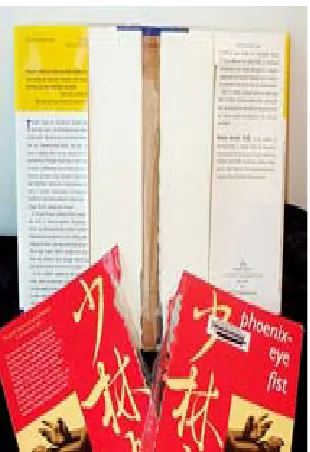
Books are often found on the library shelves with all their pages torn from the spine. Library thieves mistakenly believe they can avoid being caught by ripping or the pages cut out of an entire book and leaving the cover behind. Sometimes book has been damaged beyond repair and has to be replaced. Unfortunately, some books cannot be replaced because they are out of print.
Fig. 1 : Mutilated books found in the library
undertaken to find out the proper security measures for minimizing such a heavy loss of library materials. The survey has pointed out the following security measures used globally for library security.
Types of Security System:
• CC T.V ;
• Video Cameras; and
• Electronic security systems (ESS).
Out of these three, CC.TV and Video cameras as a security system is found unsuitable for CL as far as the architectural design of library building is concerned. The library material stacked in many floors and monitoring the readers’ movements from one of the central location is a difficult task to library. The authority, therefore took the decision to procure 3M Electronic Security System to safeguard the physical materials of the library under the MODROB/MHRD sponsored project. It has an electro-magnetic-based surveillance system to check pilferage of books and its components are as follows.
• Electromagnetic gate: It is installed at the entrance of the Library. The gate has sensors for magnetic strip inserted in each book of the Library. Any unauthorized exit of library material will produce alarm to alert the library staff.
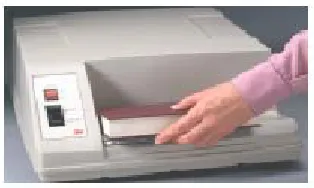
• Sensitizer / de-sensitizer unit: 3M - 995 workstation de-sensitizes each book that is issued out and re-sensitizes each book that is returned to the Library.
Fig. 3 : Sensitizer/ Desensitizer Unit.
• Desensitizes or sensitizes non magnetic materials at the flip of switch
• Movable
• Optical trigger eliminates buttons
• Verifier light identification protected materials • Audio signal
• Tattle tapes (Magnetic strips) that required to be inserted in each book.
Fig. 4: 3M™ Tattle-Tape™ B1 Security Strips (adhesive one side) • Strip is easily applied in spine of book
• Strip is completely concealed
• Extra-long liner for application between pages of books and periodicals.
• Strips fit deeply into gutter, making them virtually undetectable.
Methodology:
The installation of ESS in the library is not only enhanced the security of library material but it encourages the library staff for high vigilance. The ESS system is procured under the Modernization of Library Automation Project sponsored by MHRD. The infrastructure includes TT, manpower to insert the tape and the most important is the necessary fund to procure TT as well as for labor charges. While considering the amount of work and money involved in securing the huge collection of CL, the decision for phase wise completion of work was taken. This study is therefore restricted to phase-1. In phase-1 the complete Reference collection was selected for insertion of TT. Before inserting the TT, the books were physically checked and if any book found damaged/minor repairing then those books were sent out for binding/repair to outside binders/in-house bindery. Similarly the decision was taken to separate the following types of reference collection and kept it in the inactive collection area so that it will be easy to apply weeding out criteria in future.
a) Old editions of encyclopedias and other reference sources e.g. yearbook, handbook etc.
b) Books in foreign languages i.e. French, German and Russian if not used in past ten years
After sticking tattle tapes with books, two Assistant librarians have physically checked the book and put the date stamp and initials on the backside of title page for identifications.
The Tattle Tapes are two types B1 (shown in fig.4) and B2 (shown in fig.5). The B1 TT is single sided sticking that was used for hardbound cover in spine and The B2 is both sided sticking which were used for paperback edition. The total work was finished within 85 man-days for 11,208 Reference Books. The casual laborers were paid @ 123 Rs. per day. The actual statistics of work done is as follows.
Expenditure Heads
Cost per Unit No. of Units No. of Days Charges Paid
Labor Charges (Casual Laborers)
Rs. 123 2 85 Rs. 20,910
Material Charges (Tattle Tapes)
Rs. 12 11,208 -- Rs. 1,34,496
Total Charges Rs. 1,55,406 Total Books Processed 11,208 Expenditure per Book Rs. 13.86
2500
5404
8050
0 2000 4000 6000 8000 10000
12000 11208
1st Month 2nd Month 3rd month 4th Month
Progress of work Conclusions and Recommendations:
There is a sense around the open access libraries of that have a problem with security and material theft. Library security is a complex but important issue. The safety of library staff, patrons, and the library collection are all at stake. ESS is widespread and effective in deterring and catching thieves. Unfortunately, security problems will probably not disappear in the future and libraries will need to continue to be aware of what is occurring in the library and new ideas in dealing with different security problems.
In second phase, the Library plans an installation of self-charge security equipment. The final phase calls for the self-operated equipment that will integrate the circulation function and the security function together which will make the efficient lending out operation.
Acknowledgement:
The authors are thankful to Librarian/ Dy. Librarian for encouragement in
undertaking the case study and also would like to acknowledge the efforts of professional colleagues of IIT Bombay Central Library.
References: