13 -15 March, 2002 DRTC, Bangalore Paper: CH
Metadata for Managing Internet Resources
Khaiser Nikam
Department of Library and Information Science
University of Mysore
Mysore
Email: [email protected]
Abstract
This article deals with the concept of metadata and its
importance in a web based environment .It describes the
meaning and functions of metadata .Briefly discusses the
guiding principles such as intrinsicality , extensibility , syntax
independence , optionality , repeatability and modifyability
behind the identification of the metadata element sets. The
fifteen Dublin Core element sets and their definition is shown
in the form of a table. The relevance of metadata to librarians
in the context of rapidly changing web based environment is
emphasized along with the necessary skills that the library
community has to possess .It also includes a couple of worked
1
Introduction
The emergence of Internet and its rapid growth in the recent past has influenced the
libraries and information centers a great deal. This has resulted in the digital extension of
the academic and research libraries. A variety of scholarly information resources such as
texts, images and sound now exist in electronic form. They may be accessed from any
place and at any point. Among the researchers and scholarly community this information
is passed on by word of mouth. But for the others much of this information is very
difficult to locate and access.
So, the question arises as to why it is so difficult to find a needed piece of information on
the Internet and the World Wide Web? This is because there is lack of standard
description about the web resources. Just like how in a physical conventional library, the
documents are catalogued, indexed and abstracted in the same manner the varied Internet
resources need to be properly indexed and described, so as to facilitate speedy access and
precise retrieval. Of course there are a number of well designed search engines like
Lycos, which automatically index many of the resources available on the web and
maintain uptodate databases of locations . Indexes are useful in small collection within
a given domain. But as and when the space and coverage of the collection increases,
indexes pose problems of large retrieval sets and problems of cross-disciplinary semantic
drift. Therefore richer records created by content experts need to improve search and
retrieval.
Formal standards such as Text Encoding Initiatives (TEI header), MARC cataloguing and
government Information Locator Services (GILS) will provide necessary richness, but
such records are time consuming to create and maintain and hence may be produced for
most important resources.
Hence an alternative solution that promises to mediate these extremes involves the
a formal cataloguing record with the help of a small amount of human effort such records
could be described especially if the author of the resource could be encouraged to create
the description. If the description followed an established standard only the creation of
the record could require human intervention; automated tools could discover to achieve
consensus on a list of metadata elements that would yield simple description in a wide
range of subject areas, and to lay the ground work for achieving further progress in the
definition of metadata elements that describe electronic information.
However, it is a fact that the Internet has more information than the traditional libraries;
professional indexers and cataloguers can manage using existing methods and systems.
Hence, it was agreed that a reasonable alternate way to obtain usable metadata for
electronic resources is to give authors and information providers a means to describe the
resources themselves.
2
What is Metadata?
Metadata is data about data .Tim Berners – Lee of the W3Cdescribes matadata as
machine understandable information about web resources or other things (Berners, Lee
1998). Metadata is any structured descriptive information about other data that is used to
aid the identification, description, location and management of web resources. The use of
the term metadata predates the web.
The functions of metadata are to provide a means to discover that the data set exists and
how it might be obtained or accessed .to indicate how the resource may be used, by
documenting the content quality, and features of data set. Metadata is intended to use one
of the common search engines to find a simple term, and evaluate the effort actually
needed to find useful information.
Metadata aims to satisfy resource discovery irrespective of subject matter. The
identification of elements for information resource discovery is restricted to DLO’s
sought in the Internet and whatever solutions can be proposed to DLO’s could be
extended to other kinds of resources. The DLO’s for instance are electronic versions of
newspaper articles or a Dictionary.
In a networked environment DLL’s can be very complex because they consist of text
with callouts to images, audio and video clips or other hypertext documents .It is a
general belief that the DLO’s are primarily intellectual text and that the metadata required
for DLO’s will be similar to the metadata that is need for describing printed text.
Therefore the Dublin Core workshop’s goal was to define a core set of metadata elements
that would allow authors and information providers to describe their work and facilitate
interoperability among resource discovery tools.
3
Guiding principles of Metadata
The Dublin core metadata workshop decided to keep the element sets as small as
possible. Their purpose was to see that the meaning of the elements will be understood by
most users, and that the elements will be flexible enough for the description of the
resources in a wide range of subject areas .The guiding principles are:
q Intrinsicality: It refers to properties of the objects such as intellectual contents and
physical form. ‘Subject element is intrinsic data. Cost and access considerations are
extrinsic data.
q Extensibility: This refers to extension mechanisms, which allow the inclusion of
intrinsic data for objects that can not be adequately described by a small set of
elements. This will allow revisions while maintaining some backward compatibility
with the original definition element set.
q Syntax Independence: Syntactic bindings are avoided because it is too early to
propose formal definitions and because the Dublin core is intended to be eventually
used in a range of disciplines and application program.
q Optionality: All elements are optional. Dublin core may eventually be applied to
objects for which some elements have no meaning (who is the author of a satellite
q Repeatability: all elements in Dublin core are repeatable. Ex: Multiple author
elements would be used when a resource has multiple authors.
q Modifiability: an optional qualifier can modify each element in the Dublin core. If no
qualifier is present, the element has its common sense meaning; otherwise, the
definition of the element is modified by the value of the qualifier. Ex: Subject
(scheme = LCHS) indicates that the subject terms are ta ken from the Library of
congress Subject Headings.
4
The Dublin Core workshop
The Dublin Core workshop, which was conducted at Dublin, Ohio in 1995, decided to
identify simple set of elements for describing networked resources. The Dublin core
metadata set is a simple semantic metadata. It is the consensus of an international group
of cross-disciplinary experts, including librarians. The aim of this informal international
meet was to design simple metadata sets to facilitate information discovery in a
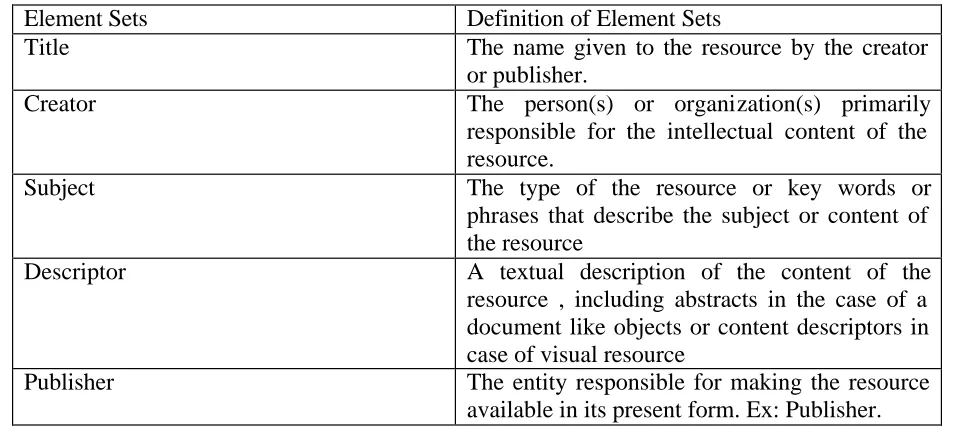
networked environment. The element sets and their definition is shown in Table I.
Table I
DUBLIN CORE DATA ELEMENTS
Element Sets Definition of Element Sets
Title The name given to the resource by the creator
or publisher.
Creator The person(s) or organization(s) primarily
responsible for the intellectual content of the resource.
Subject The type of the resource or key words or
phrases that describe the subject or content of the resource
Descriptor A textual description of the content of the
resource , including abstracts in the case of a document like objects or content descriptors in case of visual resource
Publisher The entity responsible for making the resource
Contributors Person(s) or organization(s) in addition to those specified in the creator element who have made significant contributions to the resource but whose contribution is secondary to the individuals
Date The date the resource was made available in its
present form
Resource type The category of the resource.
Format The data representation of the resource
Resource identifier String or number used to uniquely identify the resource
Source The work either in print or electronic form
which this resource is derived , if applicable
Language Language(s)of the intellectual content of the
resource
Relation Relationship to other resources
Coverage The spatial location and temporal duration ,
characteristic of the resource
Rights A link to a copy right notice or rights
management
5
Metadata in libraries
Librarians have a lot to look forward if metadata gets smart. The electronic library
program in the UK and the European Union ‘s DESIRE project for research information
location and retrieval and developing automated web based cataloguing and indexing
systems: subject information gateways are based on quality controlled resource
catalogues – containing full description of resources .As archives community are
seriously considering metadata to ensure the integrity and longevity of records, a similar
approach might be useful for digital preservation in libraries , particularly for networked
documents .
As digital resources became more established as information resources, metadata
specialists in libraries will have an increasing role in maintaining intellectual access:
enhancing collections through digitized preservation of materials, and being a consultant
electronic resources, libraries will need personnel with strong computing skills, library
knowledge, ad innovative ness and flexible to challenge constantly changing needs and
environments.
6
DC in HTML
EXAMPLES I
<html><head>
<title>UKOLN Home page</title>
<metaname “DC.Title”content=”UKOLN:office for Library and Information Networking”>
<metaname “DC. Subject”content=”national centre, network information support, library community, awareness , research , information services, public library networking , bibliographic management ,distributed library systems, metadata, resource discovery, conferences, lectures, workshops”>
<mataname =”DC.Description”content =”UKOLN is a national center for support in network information management in the library and information communities . It provides awareness , research and information services”>
<metaname =DC. Creator” content = “UKOLN services group”> </head>
EXAMPLE 2
<html><head>
<title >Mysore University Library</title>
<metaname =”DC.Creator”content =” Stephen P. Robinson”>
<metaname=”DC.Subject”contect =” Organization Behaviour”> <metaname=”DC. Publisher”content =”Prntice Hall”>
<metaname=”DC.Date”content=”1998”>
<metaname=”DC.Description”content =”This book deals with various aspects of organization behaviour relating specifically to individuals and organization systems”>
<metaname =”DC.Language”content=”English” </head>
7
Conclusion
Effective management of networked information will definitely depend on the proper
management of metadata. There is a great demand for metadata, as it is not only the key
8
References
1. DESIRE Project.
http://www.ukoln.ac.UK/metadata /desire/overview/rev_pre.htm
2. Berner-Lee (Tim). Metadata Architecture: Documents, Metadata, and Links
Axiom of web architecture 3. 1997.http://www.w3c.org/Designissues/Meta.html
3. Hodgon (Katrina). Metadata: Foundations, Potentials and Application.
http://www.gpu.srv.ualberta.ca/-khl1/Metadata.html
4. Iannella (Renata) and Andrew (Wagh). Metadata: Enabling the Internet, 1997.
http://www.dstc.edu.au/RDU/reports/CAUSE97/index.html
5. Logoze (Carl). The WarWick Framework, A container Architecture for Diverse
set of Metradata. D-Lib Magazine, July / August 1996.
http://www.dlib.org/dlib/july96/lagoze/o7lagoze.html
6. Edward (Gaynor). From MARC to Markup: SGML and Online Library Systems.