A FRAMEWORK FOR MANAGEMENT OF DISTRIBUTED DATA PROCESSING AND EVENT SELECTION FOR THE ICECUBE NEUTRINO OBSERVATORY
by
Juan Carlos Díaz Vélez
A thesis
submitted in partial fulfillment of the requirements for the degree of Master of Science in Computer Science
Boise State University
DEFENSE COMMITTEE AND FINAL READING APPROVALS
of the thesis submitted by
Juan Carlos D´ıaz V´elez
Thesis Title: A Framework for management of distributed data processing and event selection for the IceCube Neutrino Observatory
Date of Final Oral Examination: 22 May 2013
The following individuals read and discussed the thesis submitted by student Juan Carlos D´ıaz V´elez, and they evaluated his presentation and response to questions during the final oral examination. They found that the student passed the final oral examination.
Amit Jain, Ph.D. Chair, Supervisory Committee
Jyh-haw Yeh, Ph.D. Member, Supervisory Committee
Alark Joshi, Ph.D. Member, Supervisory Committee
Daryl Macomb, Ph.D. Member, Supervisory Committee
The author wishes to express gratitude to Dr. Amit Jain and the members
of the committee as well the members of the IceCube Collaboration. The author
also acknowledges the support from the following agencies: U.S. National Science
Foundation-Office of Polar Programs, U.S. National Science Foundation-Physics
Di-vision, University of Wisconsin Alumni Research Foundation, the Grid Laboratory
of Wisconsin (GLOW) grid infrastructure at the University of Wisconsin - Madison,
the Open Science Grid (OSG) grid infrastructure; U.S. Department of Energy, and
National Energy Research Scientific Computing Center, the Louisiana Optical
Net-work Initiative (LONI) grid computing resources; National Science and Engineering
Research Council of Canada; Swedish Research Council, Swedish Polar Research
Secretariat, Swedish National Infrastructure for Computing (SNIC), and Knut and
Alice Wallenberg Foundation, Sweden; German Ministry for Education and Research
(BMBF), Deutsche Forschungsgemeinschaft (DFG), Research Department of
Plas-mas with Complex Interactions (Bochum), Germany; Fund for Scientific Research
(FNRS-FWO), FWO Odysseus programme, Flanders Institute to encourage scientific
and technological research in industry (IWT), Belgian Federal Science Policy Office
(Belspo); University of Oxford, United Kingdom; Marsden Fund, New Zealand; Japan
Society for Promotion of Science (JSPS); the Swiss National Science Foundation
(SNSF), Switzerland; This research has been enabled by the use of computing
re-sources provided by WestGrid and Compute/Calcul Canada.
Juan Carlos was born and raised in Guadalajara, Jal. Mexico. He initially came
to the U. S. as a professional classical ballet dancer and performed with several ballet
companies including Eugene Ballet and Ballet Idaho. In 1996, Juan Carlos returned to
school and graduated from Boise State University with a B. S. in Physics specializing
in Condensed Matter Theory under Dr. Charles Hanna where he was introduced to
computation. Juan Carlos currently works for the IceCube Neutrino Observatory at
the University of Wisconsin-Madison. In 2010, he traveled to the South Pole to work
on the completion of the IceCube Detector.
IceCube is a one-gigaton neutrino detector designed to detect high-energy cosmic
neutrinos. It is located at the geographic South Pole and was completed at the end
of 2010. Simulation and data processing for IceCube requires a significant amount
of computational power. We describe the design and functionality of IceProd, a
management system based on Python, XMLRPC, and GridFTP. It is driven by a
central database in order to coordinate and administer production of simulations and
processing of data produced by the IceCube detector upon arrival in the northern
hemisphere. IceProd runs as a separate layer on top of existing middleware and can
take advantage of a variety of computing resources including grids and batch systems
such as GLite, Condor, NorduGrid, PBS, and SGE. This is accomplished by a set of
dedicated daemons that process job submission in a coordinated fashion through the
use of middleware plug-ins that serve to abstract the details of job submission and
job management. IceProd fills a gap between the user and existing middleware by
making job scripting easier and collaboratively sharing productions more efficiently.
We describe the implementation and performance of an extension to the IceProd
framework that provides support for mapping workflow diagrams or DAGs consisting
of interdependent tasks to an IceProd job that can span across multiple grid or cluster
sites. We look at some use-cases where this new extension allows for optimal allocation
of computing resources and addresses general aspects of this design, including security,
data integrity, scalability, and throughput.
ABSTRACT . . . vi
LIST OF TABLES . . . xi
LIST OF FIGURES . . . xii
LIST OF ABBREVIATIONS . . . xiv
1 Introduction . . . 1
1.1 IceCube . . . 2
1.1.1 IceCube Computing Resources . . . 2
2 IceProd . . . 5
2.1 IceProd . . . 5
2.2 Design Elements of IceProd . . . 7
2.2.1 IceProd Core Package . . . 8
2.2.2 IceProd Server . . . 11
2.2.3 IceProd Modules . . . 14
2.2.4 Client . . . 15
2.3 Database . . . 15
2.3.1 Database Structure . . . 16
2.4 Monitoring . . . 17
2.4.1 Web Interface . . . 19
2.5.1 Authentication . . . 20
2.5.2 Encryption . . . 21
2.5.3 Data Integrity . . . 21
2.6 Off-line Processing . . . 22
3 Directed Acyclic Graph Jobs . . . 24
3.1 Condor DAGMan . . . 24
3.2 Applications of DAGs: GPU Tasks . . . 24
3.3 DAGs in IceProd . . . 25
4 The IceProd DAG . . . 29
4.1 Design . . . 29
4.1.1 The IceProdDAG Class . . . 30
4.1.2 The TaskQ Class . . . 32
4.1.3 Local Database . . . 33
4.2 Attribute Matching . . . 33
4.3 Storing Intermediate Output . . . 37
4.3.1 Zones . . . 37
5 Performance . . . 43
5.1 Experimental Setup . . . 43
5.2 Performance . . . 46
5.2.1 Task Queueing . . . 46
5.2.2 Task Dependency Checks . . . 46
6 Artifacts . . . 56
6.1 Code . . . 56
6.2 Documentation . . . 56
7 Limitations of IceProd . . . 58
7.1 Fault Tolerance . . . 58
7.2 Database Scalability . . . 58
7.3 Scope of IceProd . . . 59
8 Conclusions . . . 60
8.1 Future Work . . . 61
REFERENCES . . . 63
A Python Package Dependencies . . . 65
B Job Dependencies . . . 66
C Writing an I3Queue Plugin a for New Batch System . . . 67
D IceProd Modules . . . 69
D.1 Predefined Modules . . . 69
D.1.1 Data Transfer . . . 69
E Experimental Sites Used for Testing IceProdDAG . . . 71
E.0.2 WestGrid . . . 71
E.0.5 University of Maryland’s FearTheTurtle Cluster . . . 73
F Additional Figures . . . 74
1.1 Data processing CPU . . . 4
1.2 Runtime of various MC simulations. . . 4
4.1 Example zone definition for an IceProd instance . . . 38
5.1 Sites participating in experimental IceProdDAG tests . . . 45
5.2 Run times for task-queueing functions. . . 50
5.3 Task run times . . . 54
E.1 CHTC Resources . . . 72
E.2 UMD Compute Cluster . . . 73
1.1 The IceCube detector . . . 3
2.1 JEP state diagram . . . 9
2.2 Network diagram of IceProd system . . . 12
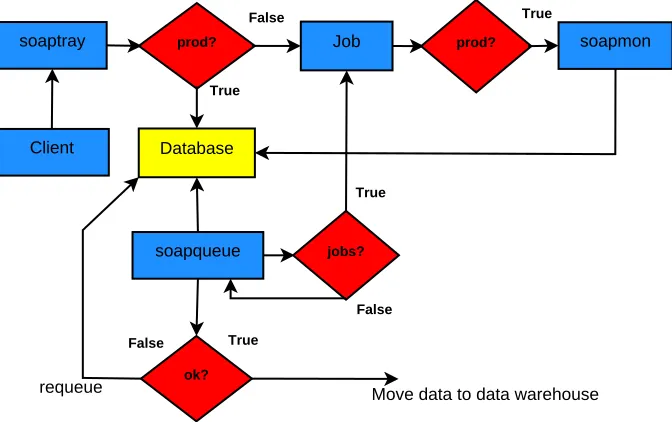
2.3 State diagram of queueing algorithm . . . 13
2.4 Diagram of database . . . 18
3.1 A simple DAG . . . 26
3.2 XML representation of a Dag . . . 27
3.3 A more complicated DAG . . . 28
4.1 IceProd DAG implementation . . . 31
4.2 TaskQ factory . . . 34
4.3 JEP state diagram for a task . . . 35
4.4 Task requirement expressions . . . 36
4.5 Distribution of file transfer speeds . . . 39
4.6 Distribution of file transfer speed over a long interval . . . 40
4.7 Evolution of average transfer speed . . . 41
4.8 SQL query with zone prioritization . . . 42
5.1 DAG used for benchmarkin . . . 44
5.2 Worst case scenario for dependency check algorithm in a DAG . . . 47
5.5 Task completion by site . . . 51
5.6 Task completion by site (CPU tasks) . . . 52
5.7 Task completion by site (GPU tasks) . . . 53
5.8 Ratio of CPU/GPU tasks for Dataset 9544 . . . 55
C.1 I3Queue implementation . . . 68
D.1 IPModule implementation . . . 70
F.1 The xiceprod client . . . 74
F.2 IceProd Web Interface . . . 75
DAG– Directed Acyclic Graph
DOM – Digital Optical Module
EGI– European Grid Initiative
GPU – Graphics Processing Unit
JEP– Job Execution Pilot
LDAP – Lightweight Directory Access Protocol
PBS – Portable Batch System
RPC– Remote Procedure Call
SGE – Sun Grid Engine
XML– Extensive Markup Language
XMLRPC – HTTP based RPC protocol with XML serialization
CHAPTER 1
INTRODUCTION
Large experimental collaborations often need to produce large volumes of
computa-tionally intensive Monte Carlo simulations and process vast amounts of data. These
tasks are often easily farmed out to large computing clusters, or grids but for such
large datasets it is important to be able to document software versions and parameters
including pseudo-random number generator seeds used for each dataset produced.
Individual members of such collaborations might have access to modest computational
resources that need to be coordinated for production. Such computational resources
could also potentially be pooled in order to provide a single, more powerful, and
more productive system that can be used by the entire collaboration. IceProd is a
scripting framework package meant to address all of these concerns. It consists of
queuing daemons that communicate via a central database in order to coordinate
production of large datasets by integrating small clusters and grids [3]. The core
objective of this Master’s thesis is to extend the functionality of IceProd to include a
workflow management DAG tool that can span multiple computing clusters and/or
1.1
IceCube
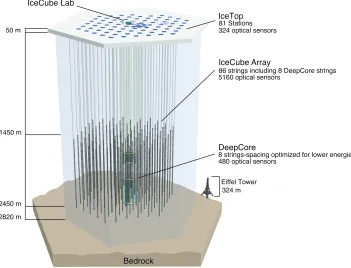
The IceCube detector shown in Figure 1.1 consists of 5160 optical sensors buried
between 1450 and 2450 meters below the surface of the South Polar ice sheet and
is designed to detect neutrinos from astrophysical sources [1, 2]. However, it is also
sensitive to downward-going muons produced in cosmic ray air showers with energies
in excess of several TeV1. IceCube records ∼1010 cosmic-ray events per year. These
cosmic-ray-induced muons represent a background for most IceCube analyses as they
outnumber neutrino-induced events by about 500 000:1 and must be filtered prior
to transfer to the northern hemisphere due to satellite bandwidth limitations [4]. In
order to develop reconstructions and analyses, and in order to understand systematic
uncertainties, physicists require a comparable amount of statistics from Monte Carlo
simulations. This requires hundreds of years of CPU processing time.
1.1.1 IceCube Computing Resources
The IceCube collaboration is comprised of 38 research institutions from Europe, North
America, Japan, and New Zealand. The collaboration has access to 25 different
clusters and grids in Europe, Japan, Canada, and the U.S. These range from small
computer farms of 30 nodes to large grids such as the European Grid Infrastructure
(EGI), European Enabling Grids for E-sciencE (EGEE), Louisiana Optical Network
Initiative (LONI), Grid Laboratory of Wisconsin (GLOW), SweGrid, Canada’s
West-Grid, and the Open Science Grid (OSG) that may each have thousands of compute
nodes. The total number of nodes available to IceCube member institutions is
uncertain since much of our use is opportunistic and depends on the usage by other
50 m
1450 m
2450 m
2820 m
IceCube Array
86 strings including 8 DeepCore strings 5160 optical sensors
DeepCore
8 strings-spacing optimized for lower energies 480 optical sensors
Eiffel Tower 324 m IceCube Lab
IceTop 81 Stations 324 optical sensors
Bedrock
Figure 1.1: The IceCube detector: The thick lines at the bottom represent the instrumented portion of the ice. The circles on the top surface represent the surface air-shower detector IceTop.
projects and experiments. In total, IceCube simulation has run on more than 11,000
distinct nodes and a number of CPU cores between 11,000 and 44,000. On average,
IceCube simulation production has run concurrently on ∼4,000 cores at a given
time and it is anticipated to run on ∼5,000 cores simultaneously during upcoming
Table 1.1: Data processing demands. Data is filtered on 400 cores at the South Pole using loose cuts to reduce volume by a factor of 10 before satellite transfer to the northern hemisphere (Level1). Once in the North, more computationally intensive event reconstructions are performed in order to further reduce background contamination (Level2). Further event selections are made for each analysis channel (Level3).
Filter livetime proc. time (2.8 GHz) Level1 8 hrs/run 2400.0 h/run
Level2 9456.0 h/run
Level3 (µ) 14.88 h/run
Level3 (cscd) 10.1 h/run
Table 1.2: Runtime of various MC simulations of background cosmic-ray shower events and neutrino (ν) signal with different energy spectra for different flavors of neutrinos.
simulation livetime runtime (2.6 GHz) single shower 10 sec 3.5 h/core
CHAPTER 2
ICEPROD
2.1
IceProd
The IceProd framework is a software package developed for the IceCube collaboration
in order to address the needs for managing productions across distributed systems
and in order to pool resources scattered throughout the collaboration [3]. It fills a gap
between the powerful middleware and batch system tools currently available and the
user or production manager. It makes job scripting easier and collaboratively sharing
productions more efficient. It includes a collection of interfaces to an expanding
number of middleware and batch systems that makes it unnecessary to re-write
scripting code when migrating from one system to another.
This Python-based distributed system consists of a central database and a set
of daemons that are responsible for various roles on submission and management of
grid jobs as well as data handling. IceProd makes use of existing grid technology and
network protocols in order to coordinate and administer production of simulations and
processing of data. The details of job submission and management in different grid
environments is abstracted through the use of plug-ins. Security and data integrity
are concerns in any software architecture that depends heavily on communication
through the Internet. IceProd includes features aimed at minimizing security and
IceProd provides a graphical user interface (GUI) for configuring simulations and
submitting jobs through a production server. It provides a method for recording
all the software versions, physics parameters, system settings, and other steering
parameters in a central production database. IceProd also includes an object-oriented
web page written in PHP for visualization and live monitoring of datasets. The
package includes a set of libraries, executables, and daemons that communicate with
the central database and coordinate to share responsibility for the completion of tasks.
Because of this, IceProd can thus be used to integrate an arbitrary number of sites,
including clusters and grids at the user level. It is not, however, a replacement for
Globus, GLite, or any other middleware. Instead, it runs on top of these as a separate
layer with additional functionality.
Many of the existing middleware tools including Condor-C, Globus, and CREAM
make it possible to pool any number of computing clusters into a larger pool. Such
arrangements typically require some amount of work by system administrators and
may not be necessary for general purpose applications. Unlike most of these
appli-cations, IceProd runs at the user level and requires no administrator privileges. This
makes it easy for individual users to build large production systems by pooling small
computational resources together.
The primary design goal of IceProd was to manage production of IceCube detector
simulation data and related filtering and reconstruction analyses but its scope is not
limited to IceCube. Its is design general enough to be used for other applications. As
of this writing, the Hight Altitude Water Cherenkov (HAWC) observatory has begun
using IceProd for off-line data processing [5].
Development of IceProd is an ongoing effort. One important current area of
DAGMan in order to optimize the use of specialized hardware and network topologies
by running different job sub-tasks on different nodes. The are two approaches to
DAGs in the IceProd frame work. The first is a plug-in-based approach that relies on
the existing workflow functionality of the batch system and the second, which is the
product of this Master’s thesis is native IceProd implementation that allows a single
job’s tasks to span multiple grids or clusters.
2.2
Design Elements of IceProd
The IceProd software package can be logically divided into the following components
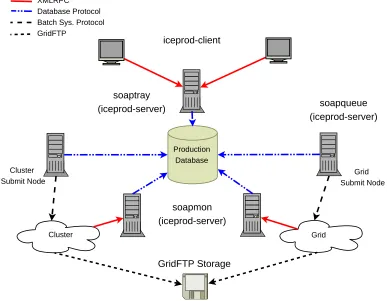
or software libraries illustrated in Figure 2.2:
• iceprod-core - a set of modules and libraries of common use throughout IceProd.
• iceprod-server - a collection of deamons and libraries to manage and schedule job submission and monitoring.
• iceprod-modules - a collection of predefined IceProdModule classes that provide an interface between IceProd and an arbitrary task to be performed on a
compute node as will be defined in Section 2.2.3.
• iceprod-client - a client (both graphical and text) that can download, edit, and submit dataset steering files to be processed.
• A database that stores configured parameters, libraries (including version
infor-mation), job information, and performance statistics.
• A web application for monitoring and controlling dataset processing.
2.2.1 IceProd Core Package
Theiceprod-core package contains modules and libraries common to all other IceProd packages. These include classes and methods for writing and parsing XML,
trans-porting data, and this is also where the basic classes that define a job execution on
a host are themselves defined. Also included in this package is an interpreter for a
simple scripting language that provides some flexibility to XML steering files.
The JEP
One of the complications of operating on heterogeneous systems is the diversity of
architectures, operating systems, and compilers. For this reason, Condor’s
NMI-Metronome build and test system [6] is used for building the IceCube software for a
variety of platforms. IceProd sends a Job Execution Pilot (JEP), a Python script that
determines what platform it is running on, and after contacting the monitoring server
determines which software package to download and execute. During runtime, this
executable will perform status updates through the monitoring server via XMLRPC,
a remote procedure call protocol that works over the Internet [7]. This information
is updated on the database and is displayed on the monitoring web page. Upon
completion, the JEP will clean up its workspace, but if configured to do so will cache
a copy of the software used and make it available for future runs. When caching is
enabled, an MD5Sum check is performed on the cached software and compared to
what is stored on the server in order to avoid using corrupted or outdated software.
Jobs can fail under many circumstances. These can include submission failures
due to transient system problems and execution failures due to problems with the
problems with the monitoring daemon or the data repository. In order to account for
possible transient errors, the design of IceProd includes a set of states through which
a job will transition in order to guarantee a successful completion of a well-configured
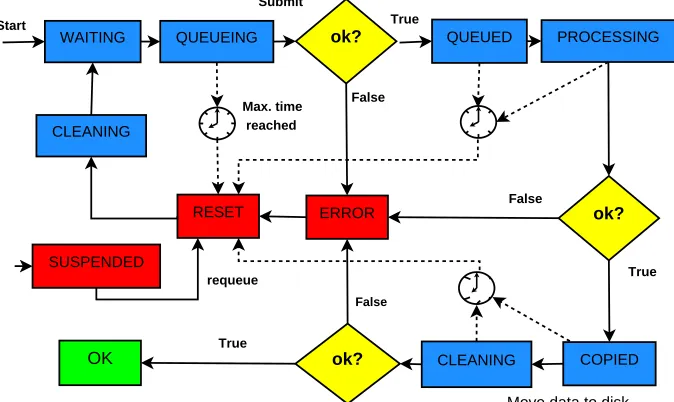
job. The state diagram for an IceProd job is depicted in Figure 2.1.
WAITING QUEUEING RESET QUEUED False PROCESSING True False ok? ok? True
Move data to disk
False requeue ok? True COPIED ERROR CLEANING OK Submit Max. time reached SUSPENDED CLEANING Start
Figure 2.1: State diagram for the JEP. Each of the non-error states through which a job passes includes a configurable timeout. The purpose of this timeout is to account for any communication errors that may have prevented a job from setting its status correctly
XML Job Description
In the context of this document, a dataset is defined to be a collection of jobs that
share a basic set of scripts and software but whose input parameters depend on the
enumerated index of the job. A configuration or steering file describes the tasks to
be executed for an entire dataset. IceProd steering files are XML documents with
a defined schema. This document includes information about the specific software
the C++ software framework used by the IceCube collaboration [8]), parameters
passed to each of the configurable modules, and input files needed for the job. In
addition, there is a section for user-defined parameters and expressions to facilitate
programming within the XML structure. This is discussed further in Section 2.2.1.
IceProd Expressions
A limited programming language was developed in order to allow more scripting
flexibility that depends on runtime parameters such as job index, dataset ID, etc. This
allows for a single XML job description to be applied to an entire dataset following a
SPMD (Single Process, Multiple Data) operation mode. Examples of valid expressions
include the following:
1. $args(<var>) a command line argument passed to the job (such as job ID, or dataset ID).
2. $steering(<var>) a user-defined variable.
3. $system(<var>) a system-specific parameter defined by the server. 4. $eval(<expr>) a mathematical expression (Python).
5. $sprintf(<format>,<list>) string formatting. 6. $choice(<list>) random choice of element from list.
7. $attr(<var>)system-dependent attributes to be matched against IceProdDAG jobs (discussed in Chapter 4).
The evaluation of such expressions is recursive and allows for a fair amount of
feature. An example of this is that $eval() statements prohibit such things as loops and import statements that would allow the user to write an entire Python program
within an expression. There is also a limit on the number of recursions in order to
prevent closed loops in recursive statements.
2.2.2 IceProd Server
The IceProd server is comprised of the four daemons mentioned in the list below
(items 1-4) and their respective libraries. There are two basic modes of operation:
the first is a non-production mode in which jobs are simply sent to the queue of a
particular system, and the second stores all of the parameters in the database and
also tracks the progress of each job. The soapqueue daemon running at each of the
participating sites periodically queries the database to check if any tasks have been
assigned to it. It then downloads the steering configuration and submits a given
number of jobs. The size of the queue at each site is configured individually based on
the size of the cluster and local queuing policies.
1. soaptray - a server that receives client requests for scheduling jobs and steering information.
2. soapqueue - a daemon that queries the database for tasks to be submitted to a particular cluster or grid.
3. soapmon- a monitoring server that receives updates from jobs during execution and performs status updates to the database.
Figure 2.2 is a graphical representation that describes the interrelation of these daemons. Grid Grid Submit Node Production Database soaptray (iceprod-server) iceprod-client soapqueue (iceprod-server) Cluster soapmon (iceprod-server) XMLRPC Database Protocol Batch Sys. Protocol GridFTP
Cluster Submit Node
GridFTP Storage
Figure 2.2: Network diagram of IceProd system: IceProd clients and JEPs com-municate withiceprod-server modules via XMLRPC. Database calls are restricted to iceprod-server modules. Queueing daemons calledsoapqueue are installed at each site and periodically query the database for pending job requests. The soapman server receives monitoring update from the jobs.
Plug-ins
In order to abstract the process of job submission for the various types of systems,
IceProd defines a base class I3Grid that provides an interface for queuing jobs. Plug-in
Client soaptray
Database
prod? Job
soapqueue jobs? True
False
soapmon
True False
prod? True
ok? True
Move data to data warehouse
False
requeue
functions for queuing jobs, removing jobs, and status checks. Plug-ins also support
the inclusion of job attributes such as priority, maximum allowed wall time, and
requirements such as disk, memory, etc. IceProd has a growing library of plug-ins
that are included with the software including Condor, PBS, SGE, Globus, GLite, Edg,
CREAM, SweGrid, and other batch systems. In addition, one can easily implement
user-defined plug-ins for any new type of system that is not included in this list.
2.2.3 IceProd Modules
IceProd modules, like plug-ins, implement an interface defined by a base class
IP-Module. These modules represent the atomic tasks to be performed as part of the
job. They have a standard interface that allows for an arbitrary set of parameters
to be configured in the XML document and passed from the IceProd framework. In
turn, the module returns a set of statistics in the form of a string-float dictionary
back to the framework so that it can be automatically recorded in the database and
displayed on the monitoring web page. By default, the base class will report the
module’s CPU usage but the user can define any set of values to be reported such
as number of events that pass a given processing filter, etc. IceProd also includes
a library of predefined modules for performing common tasks such as file transfers
through GridFTP, tarball manipulation, etc.
External IceProd Modules
Included in the library of predefined modules is a special module i3, which has two parameters, class and URL. The first is a string that defines the name of an external
IceProd module and the second specifies a Universal Resource Locator (URL) for
found. Any other parameters passed to this module are assumed to belong to the
referred external module and will be ignored by the i3 module. This allows for the
use of user-defined modules without the need to install them at each IceProd site.
External modules share the same interface as any other IceProd module.
2.2.4 Client
The IceProd-Client contains two applications for interacting with the server and
submitting datasets. One is a pyGtk-based GUI (see Figure F.1) and the other is a
text-based application that can run as a command-line executable or as an interactive
shell. Both of these applications allow the user to download, edit, submit, and control
datasets running on the IceProd-controlled grid. The graphical interface includes drag
and drop features for moving modules around and provides the user with a list of valid
parameter for know modules. Information about parameters for external modules is
not included since these are not known a priori. The interactive shell also allows the
user to perform grid management tasks such as starting and stopping a remote server,
adding and removing participation of specific sites in the processing of a dataset, as
well as job-specific actions such as suspend and reset.
2.3
Database
At the time of this writing, the current implementation of IceProd works exclusively
with a MySQL database but all database calls are handled by a database module
which abstracts queries and could be easily replaced by a different relational database.
2.3.1 Database Structure
A dataset in IceProd represents a job description and a collection of jobs associated
with. Each dataset describes a common set of modules and parameters but operate
on separate data (single instruction, multiple data). At the top level of the database
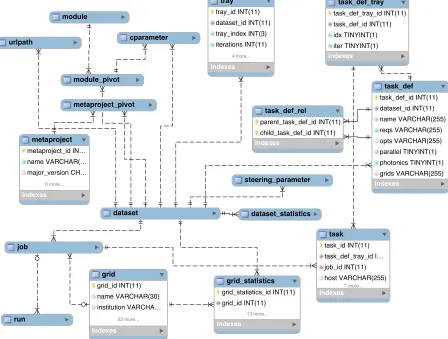
structure is the dataset table. The primary key database id is the unique identifier for each dataset though it is possible to assign nemonic string alias. Figure 2.4 is a
simplified graphical representation of the relational structure of the database. The
IceProd database is logically divided into two classes that could in principle be entirely
different databases. The first describes a steering file or dataset configuration (items
1 - 8 in the list below) and the second is a job-monitoring database (items 9 - 12).
The most important tables are described below.
1. dataset: unique identifier as well as attributes to describe and categorize the dataset including a textual description.
2. meta project: describes a software environment including libraries and exe-cutables.
3. module: describes an IPModule class.
4. module pivot: relates a module to a given dataset and specifies the order in which this module is called.
5. tray: describes a grouping of modules that will execute given the same software environment ormeta project
7. carray element: describes an array element value in the case the parameter is of type vector or a name-value pair if the parameter is of type dict.
8. steering parameter: describes general global variables that can be referenced from any module.
9. job: describes each job in the queue related to a dataset. Columns include state, error msg, previous status, and last update.
10. task def: describes a taks definition an related trays.
11. task rel: describes the relationship of task definitions ortask defs
12. task: keeps track of the state of a task in a similar way that job does.
2.4
Monitoring
The status updates and statistics reported by the JEP via XMLRPC and stored in the
database provide useful information for monitoring not only the progress of datasets
but also for detecting errors. The monitoring daemon soapmon is an HTTP daemon
that listens to XMLRPC requests from the running processes (instances of JEP). The
updates include status changes and information about the execution host as well as
job statistics. This is a multi-threaded server that can run as a stand-alone daemon
or as a cgi-bin script within a more robust Web server. The data collected from each
job can be analyzed and patterns can be detected with the aid of visualization tools
2.4.1 Web Interface
The current web interface for IceProd was designed by a collaborator, Ian Rae. It
works independently from the IceProd framework but utilizes the same database. It
is written in PHP and makes use of the CodeIgniter object-oriented framework [9].
The IceCube simulation and data processing web monitoring tools provide different
views that include, from top level downwards,
• general view: displays all datasets filtered by status, type, grid, etc.
• grid view: displays everything that is running a particular site,
• dataset view: displays all jobs and statistics for a given dataset including every
site that it is running on, and
• job view: displays each individual job including status, job statistics, execution
host, and possible errors.
There are some additional views that are applicable only to the processing of real
detector data:
• calendar view: displays a calendar with a color-coding indicating the status of
job associated with a particular data-taking day.
• day view: displays the status of detector runs for a given calendar day.
• run view: displays the status of jobs associated with a particular detector run.
The web interface also uses XMLRPC in order to send commands to the soaptray
daemon and provides authenticated users the ability to control jobs and datasets.
Other features include graphs displaying completion rates, errors, and number of jobs
2.4.2 Statistical Data
One aspect of IceProd that is not found in most grid middleware is the built-in
collec-tion of user-defined statistical data. Each IceProd module is passed a<string,float>
map object to which it can add entries or increment a given value. IceProd collects
this data on the central database and reports it on the monitoring page individually
for each job and collectively for the whole dataset as a sum, average, and standard
deviation. The typical type of information collected on IceCube jobs includes CPU
usage, number of events passing a particular filter, number of calls to a particular
module, etc.
2.5
Security and Data Integrity
Whenever dealing with network applications one must always be concerned with
security and data integrity in order to avoid compromising privacy and the validity of
scientific results. Some effort has been made to minimize security risks in the design
and implementation of IceProd. This section will summarize the most significant of
these. Figure 2.2 indicates the various types of network communication between the
client, server, and worker node.
2.5.1 Authentication
IceProd integrates with an existing LDAP server for authentication. If one is not
available, authentication can be done with database accounts though the former is
preferred. Whenever LDAP is available, direct database authentication should be
disabled. LDAP authentication allows the IceProd administrator to restrict usage
improper use. This also keeps users from being able to directly query the database
via a MySQL client.
2.5.2 Encryption
Both soaptray and soapmon can be configured to use SSL certificates in order to
encrypt all data communication between client and server. The encryption is done by
the HTTPS server with either a self-signed certificate or preferably with a certificate
signed by a trusted CA. This is recommended for client-soaptray communication but
is generally not considered necessary for monitoring information sent to soapmon by
the JEP as this just creates a higher CPU load on the system.
2.5.3 Data Integrity
In order to guarantee data integrity, an MD5sum or digest is generated for each file
that is transmitted. This information is stored in the database and is checked against
the file after transfer. Data transfers support several protocols but preference is to
primarily rely on GridFTP, which makes use of GSI authentication [10, 11]. When
dealing with databases one also needs to be concerned about allowing direct access
to the database and passing login credentials to jobs running on remote sites. For
this reason, all monitoring calls are done via XMLRPC and the only direct queries
are performed by the server, which typically operates behind a firewall on a trusted
system. The current web design does make direct queries to the database but a
dedicated read-only account is used for this purpose. An additional security measure
is the use of a temporary random-generated string that is assigned to each job at the
time of submission. This passkey is used for authenticating communication between
If the job is reset, this passkey will be changed before a new job is submitted. This
prevents stale jobs that might be left running from making monitoring updates after
the job has been reassigned.
2.6
Off-line Processing
This section describes the functionality of IceProd that is specific to detector data
processing. For Monte Carlo productions, the user typically defines the output to be
generated including the number of files. This makes it easy to determine the size of
a dataset a priori such that the job table is generated at submission time. Unlike
Monte Carlo production, real detector data is typically associated with particular
times and dates and the total size of the dataset is typically not know from the start.
In IceCube, a dataset is divided in to experiment runs that span over∼8 hours (see
Table 1.1 on Page 3). Each run contains an variable number of sub-runs with files of
roughly equal size.
A processing steering configuration generates an empty dataset with zero jobs. A
separate script is then run over the data in order to map a file (or files) to a particular
job as an input. Additional information is also recorded such as date, run number,
and sub-run number mostly for display purposes on the monitoring web page but
this information is not required for functionality of IceProd. Once this mapping has
been generated, there is a processing-specific base class derived from IceProdModule that automatically gets a list of input files from thesoapmon server. This list of files includes information such as URL, file size, MD5Sum, and type of file. The module
then downloads the appropriate files and performs a checksum to make sure there was
on the database with similar information. The additional information about the run
CHAPTER 3
DIRECTED ACYCLIC GRAPH JOBS
Directed acyclic graphs or DAGs allow you to define a job composed of multiple tasks
that are to be run on separate compute nodes and may have interdependencies. DAGs
make it possible to map a large workflow problem into a set of jobs that may have
different hardware requirements and to parallelize portions of the workflow. Examples
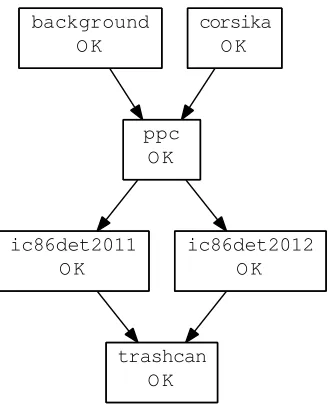
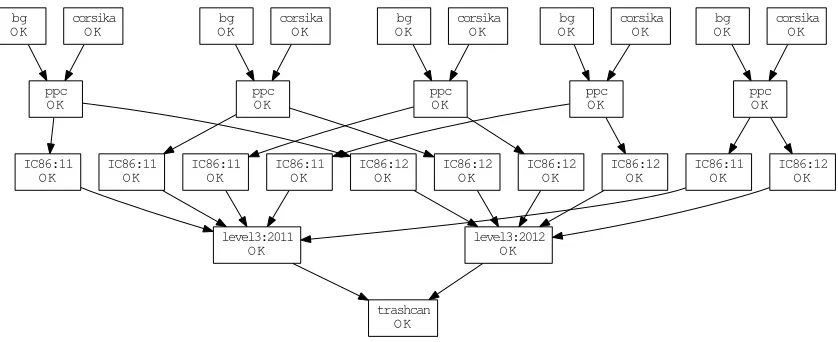
of DAGs are graphically represented in Figures 3.1 and 3.3.
3.1
Condor DAGMan
DAGMan is a workflow manager developed by the HTCondor group at University of
Wisconsin-Madison and included in with the HTCondorTM batch system [12]. Condor
DAGMan describes job dependencies as directed acyclic graphs. Each vertex in the
graph represents a single instance of a batch job to be executed while edges correspond
the execution order of the jobs or vertices. A DAGMan submit script describes the
relationships of vertices and associates a Condor submit script for each vertex or task.
3.2
Applications of DAGs: GPU Tasks
The instrumented volume of ice at the South Pole is an ancient glacier that has formed
over several thousands of years. As a result, it has a layered structure of scattering
IceCube’s simulation include a much faster approach for direct propagation of photons
in the optically complex Antarctic ice [13] by use of GPUs. This new simulation
module runs much faster than a CPU-based implementation and more accurately than
using parametrization tables [14], but the rest of the simulation requires standard
CPUs. As of this writing, IceCube has access to ∼ 20k CPU cores distributed throughout the world but has only a small number of nodes equipped with GPU
cards. The entire simulation cannot be run on the GPU nodes since it is CPU bound
and would be too slow in addition to wasting valuable GPU resources. In order to
solve this problem, the DAG feature in IceProd is used along with the modular design
of the IceCube simulation chain in order to assign CPU tasks to general purpose grid
nodes while running the photon propagation on GPU-enabled machines as depicted
in Figure 3.1.
3.3
DAGs in IceProd
The original support for DAGs in IceProd was through Condor’s DAGMan and was
implemented by Ian Rae, a colleague from University of Wisconsin. The Condor
plug-in for IceProd provides an plug-interface for breakplug-ing up a job plug-into multiple plug-interdependent
tasks. In addition to changes required in the plug-in, it was necessary to add a way to
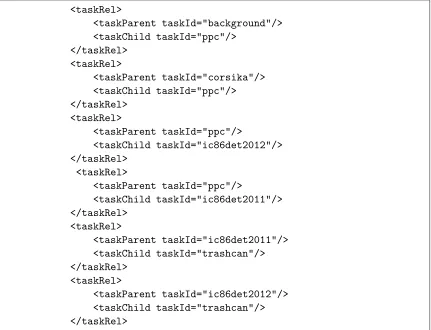
describe such a graph in the IceProd dataset XML steering file. This is accomplished
by associating a given module sequence ortray to a task and declaring a parent/child association for each interdependent set of tasks as shown in Figures 3.1 and 3.2.
Similar plug-ins have also been developed for PBS and Sun Grid Engine plug-ins.
One limitation of this type of DAG is that it is restricted to run on a specific cluster
background O K
ppc O K
ic86det2011 O K
ic86det2012 O K corsika
O K
trashcan O K
<taskRel>
<taskParent taskId="background"/> <taskChild taskId="ppc"/>
</taskRel> <taskRel>
<taskParent taskId="corsika"/> <taskChild taskId="ppc"/> </taskRel>
<taskRel>
<taskParent taskId="ppc"/>
<taskChild taskId="ic86det2012"/> </taskRel>
<taskRel>
<taskParent taskId="ppc"/>
<taskChild taskId="ic86det2011"/> </taskRel>
<taskRel>
<taskParent taskId="ic86det2011"/> <taskChild taskId="trashcan"/> </taskRel>
<taskRel>
<taskParent taskId="ic86det2012"/> <taskChild taskId="trashcan"/> </taskRel>
bg OK ppc OK IC86:11 OK IC86:12 OK bg OK ppc OK IC86:11 OK IC86:12 OK bg OK ppc OK IC86:11 OK IC86:12 OK bg OK ppc OK IC86:11 OK IC86:12 OK bg OK ppc OK IC86:11 OK IC86:12 OK level3:2011 OK level3:2012 OK corsika OK corsika OK corsika OK corsika OK corsika OK trashcan OK
CHAPTER 4
THE ICEPROD DAG
The primary objective for this thesis has been to implement a DAG that is driven
by IceProd and is independent from any batch system. This chapter describes the
design and implementation of a workflow management system similar to Condor’s
DAGMan that is primarily based on the plug-in feature of IceProd. There has been
some work recently to incorporate work flow management DAGs into grid system. For
example, Cao et al. have developed a sophisticated workflow manager that relies on performance modeling and predictions in order to schedule tasks [15]. By contrast,
IceProd relies on a consumer-based approach to scheduling where local resources
consume tasks on demand. This approach naturally lends itself to efficient utilization
of computing resources.
4.1
Design
The IceProdDAG consists of a pair of plug-ins that take the roles of a master queue
and a slave queue, respectively. The master queue interacts solely with the database
rather than acting as an interface to a batch system while the slave task queue
manages task submission via existing plug-in interfaces. Both of these classes are
to move several database calls such that they are called from within the plugin. These
calls are now normally handled by the plug-in iGrid base class but are overloaded by
the dag plug-in.
The current database design already includes a hierarchical structure for
represent-ing DAGs and this can be used for checkrepresent-ing task dependencies. A major advantage
of this approach is that it allows a single DAG to span multiple sites and thereby
make optimal use of resources. An example application would allow to combine one
site with vast amounts of CPU power but no GPUs available and another site better
equipped with GPUs.
4.1.1 The IceProdDAG Class
The primary role of the IceProdDAG class is to schedule tasks and handle their respective inter-job dependencies. This class interacts with the database in order to
direct the execution order of jobs on other grids. The IceProdDAG class assumes the
existence of a list of sub-grids in its configuration. These are manually configured by
the administrator, though in principle it is possible to dynamically extend a dataset
to include other sub-grids via the database. The algorithm that determines inclusion
or exclusion of a sub-grid in the execution of a task for a given dataset is described
in Section 4.2.
The IceProdDAG plug-in queues jobs from the database just as any other batch
system plug-in would but rather than writing submit scripts and submitting jobs to
a cluster or grid, it updates the status of the child tasks associated with each job
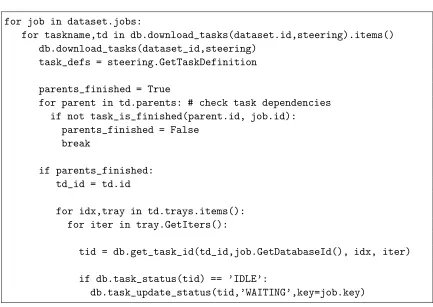
and leaves the actual job submission to the respective sub-grids. The pseudo-code in
for job in dataset.jobs:
for taskname,td in db.download_tasks(dataset.id,steering).items() db.download_tasks(dataset_id,steering)
task_defs = steering.GetTaskDefinition
parents_finished = True
for parent in td.parents: # check task dependencies if not task_is_finished(parent.id, job.id):
parents_finished = False break
if parents_finished: td_id = td.id
for idx,tray in td.trays.items(): for iter in tray.GetIters():
tid = db.get_task_id(td_id,job.GetDatabaseId(), idx, iter)
if db.task_status(tid) == ’IDLE’:
db.task_update_status(tid,’WAITING’,key=job.key)
The initial state of all tasks is set to IDLE, which is equivalent to a hold state. When scheduling a new job, the IceProdDAG then traverses the dependency tree,
starting with all tasks a level 0 until it finds a task that is ready to be released by
meeting one of the following conditions:
1. The task has no parents (a level 0 task).
2. All the task parents have completed and are now in a state of OK.
If a task meets these requirements, its status is set to WAITING and any sub-grids that meet the task requirements is free to grab this task and submit it to its own
scheduler. As with other plugins, the IceProdDAG will only keep track of a maximum
sized set of “queued” jobs determined by the iceprod.cfg configuration.
4.1.2 The TaskQ Class
The TaskQ class is an abstract base class from which other plug-in classes can extend
their own functionality by means of inheritance. This class treats the task as a
single job rather than a component of one. TaskQ overloads many of the database
method calls and handles treatment of a node in a DAG or task in the same way that
the iGrid class and the derived plug-ins handle jobs. The implementation of batch
system-specific plugins takes advantage of Python’s support for multiple inheritance
[16]. In order to implement an IceProd-based dag on a system X, one can define a
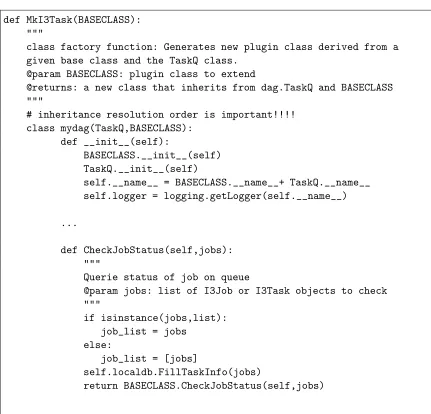
class Xdag that derives from both dag.TaskQ and X. The dag.TaskQ class provides the interaction to the database while class X provides the interface to the batch
system. Inheritance order is important in order to properly resolve class methods.
The dag module includes a TaskQ factory function (Figure 3.2) that can automatically
simply needs to specify a plug-in of type BASECLASS::TaskQ. The plug-in factory understands that it needs to generate an instance that is derived fromBASECLASS and TaskQ with the proper methods overloaded when inheritance order needs to be overridden.
The TaskQ class handles task errors, resets, and time outs in a similar way that
other plug-ins do for jobs but also takes additional task states into account. The
state diagram for a task is shown in Figure 4.3. Each instance of a TaskQ needs to
handle its own garbage collection and set the appropriate states independent of the
job being handled by the IceProdDAG instance.
4.1.3 Local Database
A goal of this thesis was to implement most of the new functionality at the plug-in
level. The existing database structure assumes a single batch system job ID for each
job in a dataset. The same is true for submit directories and log files. Rather than
changing the current database structure to accommodate task-level information, a
low-impact SQLite database is maintained locally by the TaskQ plug-in in order to
keep track of this information. The use of SQLite at the plug-in level had already
been established by both PBS and SGE DAGs in order to keep track of the local
queue ID information for each task.
4.2
Attribute Matching
A new database table has been added to assign attributes to a particular grid or IceProd instance. These attributes are used in the mapping of DAG tasks to special
def MkI3Task(BASECLASS): """
class factory function: Generates new plugin class derived from a given base class and the TaskQ class.
@param BASECLASS: plugin class to extend
@returns: a new class that inherits from dag.TaskQ and BASECLASS """
# inheritance resolution order is important!!!! class mydag(TaskQ,BASECLASS):
def __init__(self):
BASECLASS.__init__(self) TaskQ.__init__(self)
self.__name__ = BASECLASS.__name__+ TaskQ.__name__ self.logger = logging.getLogger(self.__name__)
...
def CheckJobStatus(self,jobs): """
Querie status of job on queue
@param jobs: list of I3Job or I3Task objects to check """
if isinstance(jobs,list): job_list = jobs
else:
job_list = [jobs]
self.localdb.FillTaskInfo(jobs)
return BASECLASS.CheckJobStatus(self,jobs)
...
WAITING QUEUEING RESET QUEUED PROCESSING True False ok? True
Move intermediate data to temporary storage
False reset job ok? ERROR COPYINGOUTPUT OK Submit Max. time reached SUSPENDED CLEANING Start COPYINGINPUT ok? ok? False True True False IDLE
Figure 4.3: JEP state diagram for task. Each of the non-error states through which a task passes includes a configurable timeout. Tasks need to account for additional states such as ”COPYINGINPUT and ”COPYINGOUTPUT.
name value pairs, which can be numerical or boolean. Examples of such attributes
are:
• HasGPU = True
• CPU = True
• Memory = 2000
• HasPhotonicsTables = True
• GPUSPerNode = 4
The IceProdDAG does an evaluation of each task requirements and matches them
against the attributes advertised by each of the subgrids during each job scheduling
interval. The XML schema already included a tag for task requirements that is
used to specify Condor requirements or ClassAds directly in the DAGMan plug-in.
Condor and allow for complex boolean expressions involving attribute variables and
IceProd expressions as described in Section 2.2.1. A new expression keyword $attr()
has been added to the IceProd scripting language for this purpose. The database
pivot table (grid statistics) that pairs grids and datasets now includes a new column, task def id, that references a task definition. By default, this column value is set to −1, indicating that this mapping applies to the entire dataset at the job level.
A non-negative value indicates a matching at a specific task level. If an expression
evaluates to true when applied to a particular task-grid pair, an entry is created or updated in the grid statistics table. By default, all grids are assumed to have CPUs (unless otherwise specified) and any task without requirements is assumed to require
a CPU. Examples of task requirements are shown in Figure 4.4.
<task id="background">
<taskTray iters="0" tray="0"/> <taskReqs>$attr(CPU)</taskReqs> </task>
<task id="ppc_bg">
<taskTray iters="0" tray="1"/> <taskReqs>$attr(hasGPU)</taskReqs> </task>
<task id="corsika">
<taskTray iters="0" tray="2"/>
<taskReqs>$attr(CPU) and ($attr(Mem) > 2000) </taskReqs> </task>
<task id="ppc">
<taskTray iters="0" tray="3"/> <taskReqs>$attr(hasGPU)</taskReqs> </task>
4.3
Storing Intermediate Output
Most workflow applications require the passing of data between parent and child
nodes in the DAG. One can envision using a direct file transfer protocol between
tasks but this is impractical for three main reasons:
1. Firewall rules may prevent such communication between compute nodes.
2. This requires a high level of synchronization to ensure that a child task starts
in time to receive the output of it’s parents.
3. With such synchronous scheduling requirements, it is very difficult to recover
from failures without having to reschedule the entire DAG.
It is therefore more convenient to define a temporary storage location for holding
intermediate out from tasks. A pleasant side effect of this approach is the ability
to have a coarse checkpointing from which to resume jobs that fail due to transient
errors or that get evicted before they complete. For a local cluster, especially those
with a shared file system, this is trivial but on wide-spread grids one should consider
bandwidth limitations. In order to optimize performance, an IceProd instance should
be configured to use a storage server with a fast network connection. Under most
circumstances, this corresponds to a server that has a minimal distance in terms of
network hops.
4.3.1 Zones
The concept of a zone ID is introduced in order to optimize performance. Each site is configured with a particular zone ID that loosely relates to the geographical zone
relative numbers do not reflect distances between zones. For example, University of
Wisconsin sites have been assigned a zone ID of 1 and DESY-Zeuthen in Germany
has been assigned zone ID 2. A mapping of zone ID to URL is also defined in the
configuration file of each instance of IceProd. The distance metric is a measure of
Table 4.1: Example zone definition for an IceProd instance. The IceProd instance in this example is assumed to be located in zone 1.
zone ID URL distance
1 gsiftp://us-server.domain.edu/path 0 2 gsiftp://german-server.domain.de/path 10 3 gsiftp://canadian-server.domain.ca/path 2 4 gsiftp://japan-server.domain.jp/path 20
latency with arbitrary units. The distances can be initially assigned arbitrarily at each
site in order to minimize network latency. One could in principle just calculate an
average network speed for each server. However, in reality, this is a time-dependent
value that needs to be optimized periodically. This is accomplished by weighted
running average that favors new values over old ones. Figures 4.5 and 4.6 illustrate
how the average network speed can vary with time. During a sufficiently
short-term period, speeds are randomly distributed around mean approximating a Gaussian
distribution. Over a longer term, time-dependent factors such as network load can
shift mean of distribution so that it no longer resembles a Gaussian. The calculation
of the mean value
¯ xi = 1
n n
X
i
xi (4.1)
can be replaced
¯
xi = xi¯−1+wxi
where xi is the distance metric measured a interval i, w < 1 is the weight, and ¯xi is the weighted running average. The value w = 0.01 was chosen arbitrarily to be sensitive to temporal variation but not too sensitive to high-frequency fluctuations
based on Figure 4.7 in an effort to improve performance.
0 5 10 15 20
distance parameter x (MB/s) 0.00
0.02 0.04 0.06 0.08 0.10 0.12 0.14
co
un
ts
Distribution of relative speeds for Dataset 9036
Gaussian fit
data (10000 entries)
Figure 4.5: Distribution of file transfer speeds for intermediate DAG data. Dur-ing a sufficiently short-term period, speeds are randomly distributed around mean approximating a Gaussian distribution.
The database has been updated to include a new column “zone” in the job table that is used for determining priorities in scheduling of tasks. Figure 4.8 shows the
algorithm for setting priorities in the scheduling of tasks. The distance is periodically
calculated based on Equation (4.2) and is used to order the selection of tasks within
a dataset from the database. By default, all jobs are initialized to zone 0, which is
0 5 10 15 20 distance parameter x (MB/s)
0.00 0.02 0.04 0.06 0.08 0.10 0.12 0.14
co
un
ts
Distribution of relative speeds for Dataset 9036
Gaussian fit
data (100000 entries)
0 200 400 600 800 1000 Interval
6 7 8 9 10 11 12 13
dist
an
ce
pa
ram
ete
r x
(M
B/s)
Evolution of Average Speed (Dataset 9036)
average
w=0.01
w=0.1
SELECT ...
CASE j.zone
WHEN 0 THEN 0 // default local
WHEN 1 THEN %f // values filled in by WHEN 2 THEN %f // Python loop over zones WHEN 3 THEN %f
...
ELSE NULL // Inf. ignore END AS distance
FROM task
JOIN job j ON
t.job_id = j.job_id JOIN grid_statistics gs
ON
j.dataset_id = gs.dataset_id AND
t.task_def_id = gs.task_def_id WHERE
gs.grid_id = %u AND
task.status = ’WAITING’ AND
distance IS NOT NULL ...
ORDER BY
j.dataset_id, distance, j.job_id ...
LIMIT %u
CHAPTER 5
PERFORMANCE
5.1
Experimental Setup
For the purposes of testing the implementation of the IceProdDAG, Dataset 9544 was
submitted to IceCube’s production system. This dataset is representative of typical
Monte Carlo productions and is represented by the DAG in Figure 5.1. Dataset
9544 consists of 10k jobs that run on CPUs and GPUs and was generated using the 7
separate sites shown on Table 5.1 and distributed throughout in the U.S. and Canada.
The test dataset performed at least as well as a batch system driven DAG but allowed
for better optimization of resources. The DAG used in Dataset 9544 consists of the
following tasks:
1. corsika generates an energy-weighted primary cosmic-ray shower.
2. background generates a uniform background cosmic-ray showers with a real-istic spectrum in order to simulate random coincidences in the detector.
3. ppc propagates photons emitted by corsika. This task requires GPUs.
background OK
ppc_bg OK
ic86det0 OK
level2 OK
trashcan OK
corsika OK
ppc OK
5. ic86det0combines the output from the two sources and simulates the detector electronics and triggers.
6. level2 applies the same reconstructions and filters uses for real detector data. This task requires the existence of large pre-installed tables of binned
multi-dimensional probability density functions.
7. trashcan cleans up temporary files generated by previous tasks.
Sites in Table 5.1 were chosen to test the implementation of the IceProdDAG while
minimizing interfere with current Monte Carlo productions. At the same time, it was
important that the resources utilized are representative of the those that will be used
in a real production environment. The GPU cluster in WestGrid consists of 60 nodes
with 3 GPU slots each and is fully dedicated to GPU processing. For this reason,
WestGrid is not well suited for standard DAG configurations that rely on the batch
system for scheduling tasks and was a driving reason for this thesis. CHTC and NPX3
also include GPUs but are primarily genera-purpose CPU clusters. Each of these sites
Table 5.1: Participating Sites.
Site Name Location OS queue GPUs PDF tab.
Parallel (WG) Alberta, CA CentOS 5 PBS(Torque) Y N
Jasper (WG) Alberta, CA CentOS 5 PBS(Torque) N N
Breezy (WG) Alberta, CA CentOS 5 PBS(Torque) N Y
UMD Maryland, USA Ubuntu11 SGE N Y
Dirac California, USA SLC5 PBS Y N
CHTC Wisconsin, USA SLC6/5 Condor Y N
NPX3 Wisconsin, USA SLC6 Condor Y Y
the column labelled “PDF tab.” Appendix E provides more information about each
of the sites listed in Table 5.1.
5.2
Performance
5.2.1 Task Queueing
The mechanism for queueing tasks is identical to that of queueing simple serial
jobs. As was described in Section 4.2, each grid checks the grid statistics table for dataset,task id pairs mapped to it and queues tasks associated to it.
5.2.2 Task Dependency Checks
The execution time for the dependency checking algorithm described in Section 4.1.1
can be expressed on a per job basis by
T(n, p) = Θ(n·p¯) (5.1)
where ¯p is the average number of parents for each task andn is the number of tasks in the DAG. In general, the performance of this algorithm is given by
T(n) =O(n(n−1)/2) (5.2)
task0
task1
task2
task3
task4
task5
task6
task7
task8
task9
which has an execution time given by T(n) = Θ(n) since there are n vertices and n−1 edges as the vertex must have at least one incoming or outgoing edge. The fact that T(n)6= Θ(n2/n−1) is due to the fact that every vertex has to be counted once
even if it has no parents. The average time for dependency checks is reduced if we use
task0
task1 task2 task3 task4 task5 task6 task7 task8 task9
(a) One-to-many
task0
task1
task2
task3
task4
(b) Line
task0
task1 task2
task3 task4 task5 task7
(c) k-ary tree withk= 2
Figure 5.3: Examples of best case scenario DAG configurations for dependency check algorithm. The DAG in each case has n−1 edges that need to be checked since each vertex must have at least one incoming or outgoing edge.
a topologically sorted DAG and exit the loop as soon as we find a task that has not
DAG such as the one in Figure 5.3(b), the average number of dependency checks is
(n−1)/2 and for for a k-ary tree (Figure 5.3(c)), the average number of checks is
1 logkn
logXkn
i
ki = 1 logkn
k(n−1)
(k−1) (5.3)
1 2 3 4 5 6 7 8 9 10
n 0
10 20 30 40 50
T(
n)
Dataset 9544 with |V|,|E| = 7,6
Figure 5.4: Range of complexity for task dependency checks corresponds to shaded area. The top curve corresponds to the worst case scenario withT(n) = Θ(n(n−1)/2) and the bottom curve is the best case scenario with T(n) = Θ(n−1) where n=|V| corresponds to the number of vertices for a DAG G= (E, V).
The actual values from the distribution of run times of dependency checks for
5.2.3 Attribute Matching
The algorithm described in Section 4.2 involves periodical checks to see if attributes
for sub-grids have changed and subsequent updates to the grid-statistics table. The
run time for this algorithm is proportional to the number of tasks in a DAG and the
number of sub-grids. The time complexity for matching a dataset to a set of sub-grids
is therefore given by
T(nt, ng) = Θ(nt·ng) (5.4)
wherengis the number of sub-grids andntis the number of tasks or vertices in a DAG. This has a similar functional for to that of Equation (5.1). One important difference is
that the task dependency check is applied to every queued job where as the attribute
matching algorithm described by Equation (5.4) is applied on a per-dataset basis.
The actual execution time for each of the algorithms described in Sections 5.2.3,
5.2.1 and 5.2.2 is summarized in Table 5.2.
Table 5.2: Run times for task-queueing functions for Dataset 9544.
Function Unit µ σ x˜
Attribute Matching ms/task site 0.20 0.06 0.18 Dependency Check ms/task job 3.83 3.01 3.58 Task Queueing1 ms/task job 52.49 58.66 37.74
5.2.4 Load Balancing
One of the intended benefits of spreading the DAG over multiple sites was to optimize
the usage of resources. Given that TaskQ instances are task consumers that pull tasks
from the queue (as opposed to being assigned tasks by a master scheduler), each site
1Task queuing only considers database queries and does not include actual batch system calls
will take what it can consume based on factors such as how many compute slots
available or how slow the compute nodes are. This avoids situations in which some
clusters is being starved while others are overwhelmed. The pie graph in Figures
5.5,5.6, and 5.7 show the relative number of jobs processed at each of the sites listed
in Table 5.1. The larger slices correspond to resources that had the highest throughput
during the processing of Dataset 9544.
CHTC:background 9.0% CHTC:corsika 7.7% CHTC:ic86det0 13.4% CHTC:level2 8.2% CHTC:ppc 4.1% CHTC:ppc_bg 4.3% npx3:level2 5.1% npx3:ppc 3.0% npx3:ppc_bg 3.2% parallel:level2 2.1% parallel:ppc 9.8% parallel:ppc_bg 9.4% breezy:background 1.2% breezy:corsika 1.1% breezy:ic86det0 1.0% breezy:level2 0.8% jasper:background 6.6% jasper:corsika 8.0% jasper:ic86det0 1.0% UMD:ic86det0 1.1%
Task assignment
Figure 5.5: Task completion by site for Dataset 9544. The larger slices correspond to resources that had the highest throughput during the processing of Dataset 9544.
CHTC
56.6%
npx3
13.4%
breezy
4.1%
jasper
23.0%
UMD
2.9%
CPU Task Assignment
CHTC:ppc_bg
23.4%
npx3
21.1%
parallel
55.5%
GPU Task Assigment
the workflow. The major impetus for this thesis was the concern that simulation
production was limited by the small number of GPUs relative to the available CPUs
on some clusters and the opposite case for the WestGrid Parallel cluster. This problem
can be optimized by pooling resources together as was done with this test run. Table
5.3 shows the run-time numbers for each of the tasks that make up the DAG in Figure
5.1. The ratio of CPU to GPU tasks should roughly be determined by the ratio of
Table 5.3: Run times for tasks in Dataset 9544 Task µ(sec) σ (sec) x˜ (sec)
corsika 1689.02 475.50 1540.0
background 3294.89 789.24 3048.5
ppc 489.79 793.71 452.0
ppc bg 1059.95 1708.74 999.0
ic86det0 1218.07 401.14 1171.0
level2 816.8 326.97 781.0
trashcan 1.8 4.67 0.0
combined corsika 2492.73 1034.12 2458.0 combined ppc 774.98 1362.58 663.0
average run times for input CPU tasks to that of GPU tasks plus the ratio of the sum
of run times for output CPU tasks to the average runtime of GPU tasks
¯
Rgpu = (¯tcorsika+background) (¯tppc+ppc bg)
+ (¯tic86det0+ ¯tlevel2) (¯tppc+ppc bg)
, (5.5)
which from Table 5.1, we get
¯
Rgpu ≈5.84 (5.6)
or using the median instead of the mean,
˜
Figure 5.8 show the ratio of CPU tasks to GPU tasks during the run of Dataset
9544. Both the median and mean values are higher than the values given by Equations
(5.6) and (5.7), though the values are skewed by the beginning of the run but seem
to approach ¯Rgpu at a later point. In reality, the performance of Dataset is affected
0
20
40
60
80
100
120
Time interval (hr)
0
10
20
30
40
Ra
tio
of
CPU/
GPU
ta
sk
s
Relative number of processing tasks
ratio
median=7.90
µ
=11.77
µ +1σ ¯R ˜ RFigure 5.8: Ratio of CPU processing tasks to GPU processing tasks.