R E V I E W
Open Access
Biological function in the twilight zone of
sequence conservation
Chris P. Ponting
Abstract
Strong DNA conservation among divergent species is
an indicator of enduring functionality. With weaker
sequence conservation we enter a vast
‘
twilight zone
’
in which sequence subject to transient or lower
constraint cannot be distinguished easily from
neutrally evolving, non-functional sequence. Twilight
zone functional sequence is illuminated instead by
principles of selective constraint and positive selection
using genomic data acquired from within a species
’
population. Application of these principles reveals that
despite being biochemically active, most twilight zone
sequence is not functional.
Function versus conservation versus constraint
Functionality of most human protein coding, and some
non-coding, sequence is clearly implied when it is
con-served across diverse mammalian species. This has been
a rule-of-thumb by which to infer whether a sequence is
functional without the benefit of experimental data.
Con-servation, however, is not a faithful indicator of
functional-ity. High sequence conservation could reflect a relatively
brief period of neutral evolution over which few mutations
accumulated. Just because approximately 98% of human
DNA is conserved in chimpanzee, for example, this does
not imply that this amount of sequence conveys function.
Conversely, poor conservation of a sequence does not
imply that it is devoid of function. After all, low
conserva-tion could also be explained by frequent episodes when
rare mutations are brought to high frequency and
fix-ation within a populfix-ation by positive selection.
Thresh-olding on percentage nucleotide sequence identity thus
fails to neatly separate functional from non-functional
sequence. This means that as sequence conservation
di-minishes we drop into a
‘twilight zone’
[1, 2] in which
Correspondence:[email protected]
MRC Human Genetics Unit, The Institute of Genetics and Molecular Medicine, University of Edinburgh, Western General Hospital, Crewe Road, Edinburgh EH4 2XU, UK
DNA cannot immediately be ascribed as either
func-tional or non-funcfunc-tional. Population genetics principles
illuminate the functionality of sequence in the twilight
zone. These can be used to assess whether sequence
evolution has been constrained, meaning that it exhibits
a slower rate of change than predicted by a model of
neutral evolution; selective constraint is inferred by
considering the degree by which allele frequencies are
depressed across extant populations [3–5]. Conversely,
functional sequence subject to positive selection exhibits a
rate of change greater than seen for neutrally evolving
sequence.
Sequence conservation and constraint are not the only
benchmark by which to evaluate functionality. High
throughput experimental assays are providing
genome-wide assessments of functional sequence. Armed with this
experimental information, can we now reveal the extent of
functional sequence and associated molecular and cellular
biology present in the twilight zone of low sequence
con-servation? Here I review instances where sequence is
func-tional despite its low conservation, focusing principally on
our own and other mammalian species. I conclude that
population genomics-based approaches to predict function
are paramount because, counterintuitively, experiments are
not perfect predictors of function.
A twilight zone protein-coding gene
The 2310003L06Rik gene exemplifies the rapidity with
which a locus can evolve (Fig. 1). Little is known about
its function, except that in mouse gene expression is
specific to the tongue. With regards to evolution, it is a
member of the secretory calcium-binding
phosphopro-tein (SCPP) gene family [6, 7] located in a tandem array
on mouse chromosome 5, including those encoding
en-amel matrix proteins, milk caseins and salivary proteins,
which mostly arose by local gene duplication and
subse-quent divergence during early mammalian evolution. In
four respects, this gene is not well conserved: (i) it is
present only in theria (marsupials and placental mammals)
but not in monotremes; (ii) its amino acid sequence varies
greatly, with a 3.7-fold difference in length between mouse
and dog; (iii) it contains lineage-specific repeats and
inser-tions or deleinser-tions; and (iv) in some lineages, such as the
Catarrhini (including human), it has acquired open-reading
frame disruptions and thus has become a pseudogene.
Nu-cleotide sequence similarities between closely related
spe-cies, such as mouse and rat, differ little between exons and
introns and its protein sequence has evolved at a rate near
to that of synonymous sites, often used as a neutral rate
proxy. Of all its many features, conservation is evident only
in these orthologues’
initiating codon, their common
number of exons and their splice sites.
Functional sites that are neither well conserved nor
constrained fall into two classes that differ in the rate by
which they accumulate mutations relative to the neutral
rate (Fig. 2). Sites in the first class evolve rapidly due to
positive selection and adaptation. This is when rare
mu-tations confer reproductive advantage leading to their
rise in frequency and their fixation in that population
fas-ter than neutral mutations. In mammals, most positively
Fig. 1.Rapid evolution among 2310003L06Rik orthologues.aNucleotide conservation is low across placental mammals, and the locus is not aligned with non-mammalian species. The mouse gene is incompletely predicted in Ensembl, and absent from other databases such as RefSeq and CCDS.bRapid evolution of mammalian 2310003L06Rik orthologues. Open reading frames (shown ingrey) are of highly variable length (amino acid numbers shown on theright) across mammalian species (phylogeny shown onleft, not to scale). Human, chimpanzee and macaque genomes contain nucleotide substitutions that truncate the open-reading frame (“!”; pseudogene indicated inblack). Deletions in the squirrel (Spermophilus tridecemlineatus) orthologue, relative to the dog, are indicated by“Δ”, and repeats in the dog sequence are shown by“R”. Aligned protein sequences are indicated bydotted blueandbrown lines. There is no significant sequence similarity evident between mouse and opossum (Monodelphis domestica) orthologues (blastpE> 0.2).dN/dSis explained in the legend to Fig. 2
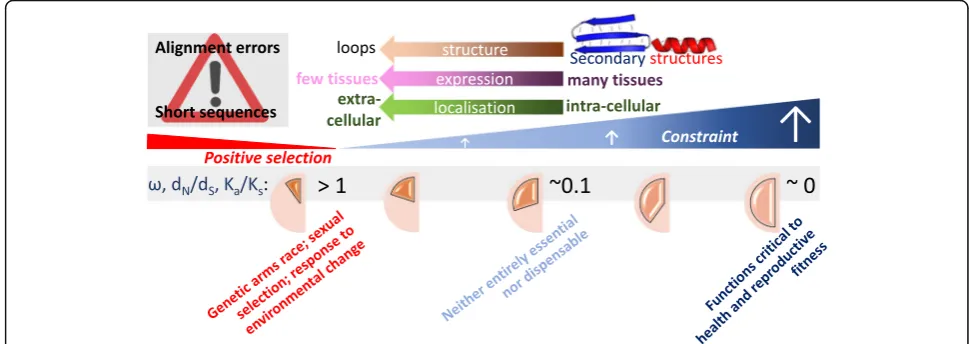
Fig. 2.Trends regarding sequence constraint. Protein-coding sites that are highly constrained (dN/dS→0) tend to fall within secondary structures
within intracellular proteins expressed in many tissues, whereas the less-numerous sites that are evolving either near neutrally (dN/dS≈1) or in
response to positive selection (dN/dS> 1) tend to lie in disordered regions or in loops in secreted proteins that are expressed in a tissue-restricted
manner [73–75]. The median value ofdN/dSfor human and mouse orthologues is 0.095 [76]. Inferences of positive selection (for example using PAML
[77]) can be in error due to sequence misalignment [78, 79], or when alignments are short [80], or whendNexceedsdSbecause of chance fluctuations.
dN/dS(also written asKa/Ksorω) [81] is the ratio of the number of nonsynonymous substitutions per nonsynonymous site (dN) to the number of
selected substitution events occur outside of DNA that
encodes protein [8]. Nevertheless, they are particularly
concentrated in the ~1% of genomic sequence that is
protein-coding and their density is low overall in the
non-protein-coding portion [8]. The second class of functional
yet poorly conserved sequence evolves by weak negative
selection [9]. Such sites accumulate substitutions, on
aver-age, slower than the neutral rate and show a low degree of
constraint. Variants at these sites that have only a slight
deleterious effect on fitness can become fixed in
popula-tions, which is a consequence of natural selection being
unable to discriminate effectively between slightly
deleteri-ous and neutral mutations [3, 10] (discussed below).
Has a poorly conserved homologous sequence diverged
by weak negative selection or else by positive selection?
Answering this question computationally remains a
sub-stantial challenge because some approaches are associated
with high rates of false positive predictions [11]. The most
compelling examples are when candidate positively
se-lected sites are spatially clustered within ligand-binding
pockets, such as observed in mouse major urinary
pro-teins [12] or in major histocompatibility complex class
I subunits [13]. As with these two studies, clear-cut
in-stances are often found for proteins involved in
repro-duction—because of the genetic arms race inherent in
sexual selection [14]
—
or in immunity and host defence
[15]. The genetic arms race with viruses, in particular,
is predicted to account for nearly a third of all
posi-tively selected change occurring in human protein
se-quence that is conserved across mammals [16]. The
evolution of primate and bat poly-ADP-ribose
polymer-ases, for example, appears to have been subject to
consid-erable genetic arms races with unidentified pathogens,
resulting in positively selected sites that cluster in three
dimensions and in a disordered region of unknown
function [17].
Genes whose variants have been positively selected,
in-cluding those involved in reproduction and host defence,
are often in large families whose numbers are not well
conserved between, or even within, species owing to high
rates of duplication and/or pseudogenisation [18
–
20].
Nevertheless, basal mutational rates of duplication and
loss are highly variable; hence, in most cases it is difficult
to evaluate the contribution made by selection in retaining
or purging gene duplicate and gene disruptive alleles in
the population [21]. Some examples in human evolution
are more compelling because of their ability to link copy
number variation with fitness. A higher gene copy number
of
CCL3L1
, which encodes a known ligand for the human
immunodeficiency virus (HIV) co-receptor CCR5, for
ex-ample, is associated with lower susceptibility to HIV and
to acquired immunodeficiency syndrome, and even higher
copy numbers are observed in chimpanzees [22]. In
general, however, despite their high prevalence, with
four-times more human nucleotides present in copy
num-ber increased regions than in single nucleotide variant
sites, copy number gain of human genes appears to be
under little or no selection [23].
To summarise the hallmarks of a rapidly evolving gene,
I return to the 2310003L06Rik protein-coding locus
(Fig. 1). It is a member of a large multi-gene family
(namely SCPP genes) whose genes duplicated and
be-came pseudogenes rapidly over mammalian evolution;
it encodes a secreted protein, which means perhaps that
it is more likely to be engaged in inter-specific conflict
between host and pathogens; this protein
’
s structure is
apparently flexible and disordered, which is less likely
to evolve by purifying selection; and, its expression
pro-file is narrowly restricted to few tissues, indeed to only
one, the tongue. Nevertheless, in the absence of
statis-tical evidence that this gene has experienced episodes
of positive selection, it need only be stated that its
evo-lution has been more rapid than that of most
mamma-lian genes.
Twilight zone non-protein coding genes
If we conceive of a spectrum of conservation with most
protein-coding genes placed at one extreme because of
their strong degree of constraint, then long non-coding
RNAs (lncRNAs) are located at the other: most
multi-exonic lncRNA loci exhibit little or no cross-vertebrate
sequence conservation (Fig. 3) [24]. Where conservation
exists it need not reflect an RNA-mediated function, but
could be explained instead by functional elements
con-tained within the underlying DNA that are crucial to the
normal function of an adjacent protein-coding gene.
Nevertheless, a degree of constraint on lncRNA
transcrip-tion and splicing is evident within lncRNA promoters,
splice sites and exons [25–28]. In contrast to most
mam-malian protein-coding genes, which possess homologues
that are identifiable across diverse animal phyla and
be-yond, 80% of human lncRNA families originated recently
during primate evolution, and only 3% are conserved in
more distantly related species such as chicken or frog
[29, 30]. Not only conservation, but also constraint and
positive selection, are low or absent on intergenic lncRNAs
among modern human or mouse populations [29, 31, 32].
of RNA-dependent function, such enhancer-like lncRNAs
will not justify consideration as genes. For promoter-like
lncRNAs, RNA sequence-dependent function could be
mediated by secondary structure. Nevertheless, there is no
support for proposed conserved secondary structures of
well-studied lncRNAs, such as
HOTAIR
,
SRA
, and
Xist
,
from pairwise covariation in sequence changes [35].
Shorter (~22 nucleotide) microRNAs are also often
lineage-specific [36]. Placental and marsupial mammals
have experienced a net gain of nearly one new microRNA
family per million years, over twice the rate observed in
birds [37]. Once a new family arises, it can expand rapidly
by tandem duplication and lose members by
pseudogen-isation, as observed for a primate-specific family of 46
microRNAs present on human chromosome 19 [38].
Con-comitantly, mRNA targets of these microRNAs can evolve
by the gain or loss of binding sites within mRNAs
’
3
′
UTRs [39, 40].
Figure 4 summarises the preceding two sections on
lineage-specific genes using examples drawn from gene
birth, death, transformation and conversion, focusing
specifically on the human genome.
Non-conservation of the non-functional genome
Evolution of the mammalian genome is dominated not
by conservation and stasis but by tumult and large-scale
change [41]. The human genome, for example, is
esti-mated to have lost 22% (700 Mb) of its DNA and gained
an equivalent amount over the last 75 million years [42].
Chromosomal gene content—even between closely related
species—is rarely conserved. An extreme example of this
is the genomes of Indian and Chinese muntjak deer that
have dramatically differing numbers of chromosomes (6
and 46, respectively) despite sharing a common ancestor
within the last 2 million years [43].
Most conserved sequence lies within the
non-functional ~92% of the mammalian genome [4, 44]. Rapid
resculpting of mammalian genomes is dominated by
lineage-specific insertion and deletion of transposable
element (TE) sequence whose debris, together with
other repetitive sequence, contribute up to two-thirds
of the human genome [45]. Although occasionally it is
proposed that a large fraction of TEs are functional [46],
there is no evolutionary or experimental evidence to
support this. Conversely, because the locations of
inser-tion or deleinser-tion mutainser-tions in TEs occur almost exactly
as would be expected from random events, the vast
ma-jority of TEs appear to be inert [47], with less than 2%
of TE sequence (approximately 20 Mb) bearing the
signature of constraint [44, 48]. The exceptions are,
nevertheless, of interest: for example, 18 human
Alu
elements have evidence for being translated [49]; a
handful of syncytin protein-coding genes have their
origins in TEs (Fig. 4); and several families of
micro-RNAs have derived from TEs, albeit slowly over
evolu-tionary time [50, 51].
a
c
b
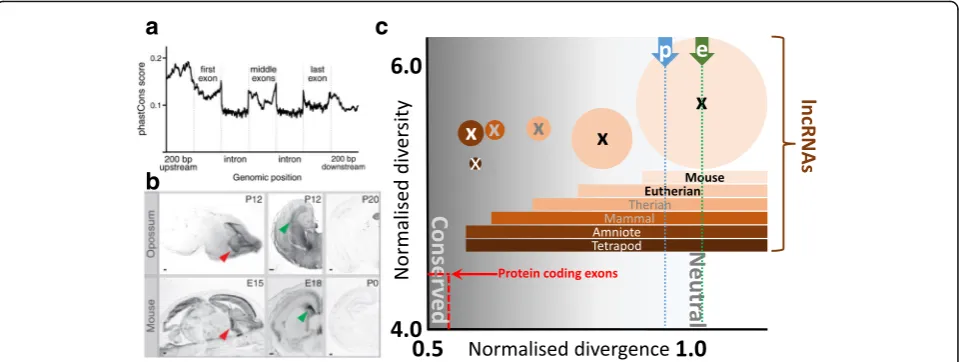
Fig. 3.Most mouse lncRNAs are not conserved in sequence or in transcription.aPan-vertebrate conservation is low in promoters and exon sequence, as indicated, for a generic lncRNA locus. Y-axis: conservation (phastCons) scores sampled across 877 mouse multi-exon lncRNAs (reproduced from [82]).bAn exception that establishes a more general rule: expression conservation of a lncRNA (AK082072) across mouse and marsupial (Monodelphis domestica) brain development (reproduced from [82]).cNormalised divergence (X-axis;d/dAR) and diversity (Y-axis;π/d) of lncRNAs whose expression is
restricted to mouse, eutheria, theria, mammalia, amniota and tetrapoda where thearea of a circleindicates relative lncRNA numbers (7306 in the mouse-only set).Divergenceis the mouse-rat median substitution rate normalised by the local neutral mutation rate;diversityis the mouse median nucleotide diversity divided by local mouse-rat divergence. Increasing conservation is indicated by darker background hues. For comparison, significantly reduced divergence and diversity values are evident for protein-coding exons (shown inred); in general, tissue-specific transcription of protein-coding orthologues is highly conserved [83]. The diversity (π/d) of only eutherian-specific lncRNAs differs significantly from proposed neutral sequence. For a description of the data, definitions ofd, dARandπ, and further details see [32]. Mediand/dARdivergence estimates of promoter-like (p)
Twilight zone of the functional genome
The ~8% functional genome, however, has also been
al-tered greatly over tens of millions of years of mammalian
evolution, with slow and fast rates of change for the
func-tional protein-coding and funcfunc-tional non-coding portions
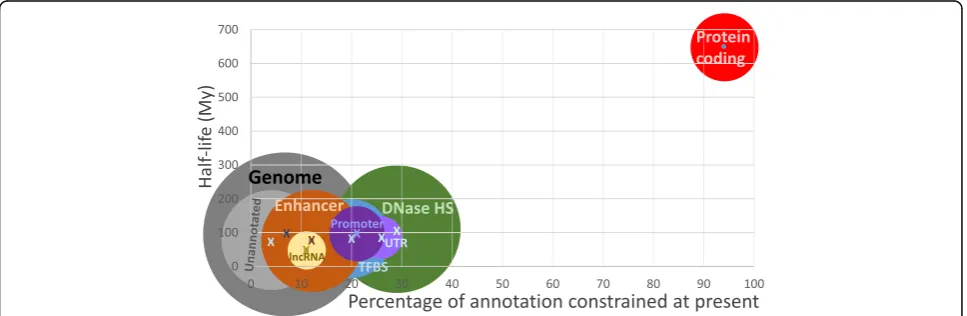
of the genome, respectively (Fig. 5). Two extant species
that last shared a common ancestor near the emergence
of bilateral animals, 650 million years ago, are estimated
now to share only half of their constrained protein-coding
sequence. The equivalent half-life for functional
non-coding sequence is considerably shorter, at approximately
75–100 million years [44] (Fig. 5).
Open chromatin, which contains many protein-binding
sites, contributes both the largest amount of functional
(area of circles in Fig. 5) and the greatest density (Fig. 5,
X-axis) of functional sequence. Nevertheless, such sites,
and promoters and enhancers more generally, are poorly
conserved across mammals [52–55]. It is estimated that
Fig. 4.Lineage-specific genes arise through gene birth, death and duplication and exaption of transposable elements. Examples of lineage-specific protein-coding genes (shown inred) or non-coding genes (shown inpurple) present in one or more of the human, mouse and opossum (Monodelphis domestica) genomes. Orthologous genes are indicated across vertical columns. Where orthologous sequence is absent, due to a lineage-specific insertion or deletion, no boxes are shown. The eutherianXistnoncoding RNA gene arose, in part, from disruption of an ancestralLnx3protein-coding gene [84]. The 2310003L06Rik gene (‘RIK’) is disrupted in human (Fig. 1). ThePoldincRNA gene arose de novo, within the last ~3.5 million years, in the mouse lineage within untranscribed sequence [85].Grey boxesindicate non-genic sequence in human and in opossum that is orthologous to the mousePoldilocus but that has no conservation of transcription. RodentBC1and primateBC200noncoding genes arose independently from separate retrotransposition events yet bind the same protein, FMRP [86]. Similarly, syncytins 1 and 2 arose from endogenous retroviral element insertions in the primate lineage, and separately syncytins A and B arose from such insertions in the rodent lineage [87].Dark blue double-headed arrows
indicate lineage-specific episodes of gene conversion between the two 5′UTRs ofGASP1andGASP2, genes that are placental mammal-specific [88]. TheKAL1(anosmin-1) gene is entirely absent, and inferred to have been deleted, from the mouse genome [76]. Three duplications of human-specific
SRGAP2A/B/Cgenes occurred within the last approximately 3.4 million years [89]. Four members of the microRNA 130/301 family are present in both the opossum and mouse genome, but 21 members are found in the human genome [36, 90].MYAmillion years ago
promoters for over 40% of genes have arisen or been lost
in either the human or mouse lineage since their last
com-mon ancestor [55]. In a comparison of human, mouse,
dog, opossum and chicken, most binding events were
unique to one of these species [53]. In large part, the
rap-idity by which proteins’
DNA binding sites are gained and
lost is explained by their short length. In a 1-kb segment
of human DNA it is predicted that a new 7–8 bp
protein-binding motif arises, by neutral evolution, on average
every 60,000 years [56].
Non-adaptive explanations of rapid evolution
Turnover of functional sequence, and allelic changes in
gene repertoire, do not need to improve reproductive
fitness. Instead, many changes have been deleterious, yet
have not been removed by negative selection (reviewed in
[10, 57]). In particular, alleles that have only a modest
nega-tive effect on fitness (small neganega-tive selection coefficient,
s
)
will only have a strong likelihood of being purged from a
species when its effective population size (
N
e) is large
(Fig. 6). Conversely, when
N
eis small, as it is for modern
humans, then weakly deleterious variants show a greater
chance of becoming retained. This implies that many
vari-ants that disrupt or delete genes, especially those with only
subtle changes to organismal phenotype, will have been
fixed despite being deleterious.
Rapid evolution could also reflect higher than average
mutation rates. Sequence with a high CpG dinucleotide
content, including protein-coding sequence, evolves
particularly rapidly owing to a high rate of mutation
from the methylated form of CpG to TpG and CpA in
germline genomes [58–60]. Sequence lying within the
highly recombining regions of the genome also evolves
especially rapidly, with one mouse gene experiencing a
100-fold increase due to this phenomenon of biased
gene conversion [61, 62]. Functional regions of the
non-coding genome can also mutate rapidly due to
DNA-bound factors blocking the displacement of
error-prone polymerase-α
sequence during replication [63].
Identifying sequences under positive selection due to
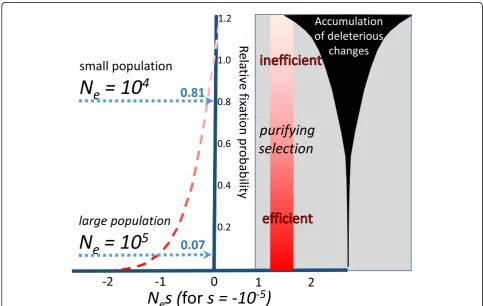
Fig. 6.Variation in selection efficiency. Purifying selection is increasingly inefficient for alleles of small selection coefficientswithin species of relatively small effective population sizesNe, leading to an increasing rate of accumulation of deleterious changes. The graph shows the
probability of fixation of a new variant relative to the neutral expectation (Y-axis) as a function ofNesfors=−10−5(modified from [10]). For larger
values, such asNe= 105, the probability of fixation relative to the neutral expectation is small at approximately 7%. Nevertheless, in a population
adaptation is thus made more complex because not just
the classical neutral model, but also models accounting
for these mutational biases, need to be rejected.
Concluding remarks: what do we mean by
function?
On one hand, 80% of the human genome has been
an-notated by experiment either as being bound by proteins
or as being the substrate of enzymatic activity, the
ma-jority of which overlaps with the ~67% of the genome
that is TE-derived. On the other hand, this is far more
than the ~8% of the human genome that shows
evolu-tionary evidence of constraint, and there is evidence that
only very few TEs aligned between species’
genomes are
constrained (see above). Resolution of this apparent
paradox stems from the realisation that many (even the
majority of ) molecular phenomena in cells are
inconse-quential in the sense that they are not surveyed
effect-ively by natural selection [64, 65]. These phenomena
include non-functional RNA–protein or protein–protein
or protein–DNA interactions [66–68]. In the latter case,
most interactions between proteins and chromatin have
been shown as failing to alter transcription of putative
target genes [68]. Current experiments are thus unable
to distinguish cleanly between molecular activities that
are incidental and those that are consequential, even vital.
By contrast, evolutionary approaches can infer function,
annotating sequence by the importance attributed to it by
natural selection. Whilst problems remain to be overcome
[69, 70], such approaches can discern lineage-specific
function in sequence that is not conserved among species,
and the absence of function in aligned, notionally
con-served sequence [3]. Human genome sequencing at the
population level is now accelerating [5, 71, 72]. The
resulting extensive diversity data will permit the inference
of constraint at high resolution and will thus shed light on
function and molecular mechanisms. It will also help to
overthrow misguided notions that function requires
between-species sequence conservation or that function
is widespread outside constrained sequence.
Acknowledgements
The author thanks the MRC, ERC and the Wellcome Trust for funding, and also two anonymous referees, Oscar Bedoya-Reina, Luis Sanchez-Pulido and other group members for very helpful comments.
Authors’contributions
CPP wrote this article.
Competing interests
The authors declare that they have no competing interests.
Publisher
’
s Note
Springer Nature remains neutral with regard to jurisdictional claims in published maps and institutional affiliations.
References
1. Doolittle RF. Of URFs and ORFs: a primer on how to analyze derived amino acid sequences. Mill Valley: University Science Books; 1986.
2. Rost B. Twilight zone of protein sequence alignments. Protein Eng. 1999;12:85–94.
3. Lawrie DS, Petrov DA. Comparative population genomics: power and principles for the inference of functionality. Trends Genet. 2014;30:133–9. 4. Gulko B, Hubisz MJ, Gronau I, Siepel A. A method for calculating probabilities
of fitness consequences for point mutations across the human genome. Nat Genet. 2015;47:276–83.
5. Lek M, Karczewski KJ, Minikel EV, Samocha KE, Banks E, Fennell T, et al. Analysis of protein-coding genetic variation in 60,706 humans. Nature. 2016;536:285–91.
6. Kawasaki K, Weiss KM. Mineralized tissue and vertebrate evolution: the secretory calcium-binding phosphoprotein gene cluster. Proc Natl Acad Sci U S A. 2003;100:4060–5.
7. Kawasaki K, Lafont AG, Sire JY. The evolution of milk casein genes from tooth genes before the origin of mammals. Mol Biol Evol. 2011;28:2053–61. 8. Halligan DL, Kousathanas A, Ness RW, Harr B, Eory L, Keane TM, et al.
Contributions of protein-coding and regulatory change to adaptive molecular evolution in murid rodents. PLoS Genet. 2013;9:e1003995. 9. Ohta T. Near-neutrality in evolution of genes and gene regulation. Proc Natl
Acad Sci U S A. 2002;99:16134–7.
10. Harris EE. Nonadaptive processes in primate and human evolution. Am J Phys Anthropol. 2010;143 Suppl 51:13–45.
11. Hughes AL. Near neutrality: leading edge of the neutral theory of molecular evolution. Ann N Y Acad Sci. 2008;1133:162–79.
12. Emes RD, Beatson SA, Ponting CP, Goodstadt L. Evolution and comparative genomics of odorant- and pheromone-associated genes in rodents. Genome Res. 2004;14:591–602.
13. Hughes AL, Nei M. Pattern of nucleotide substitution at major histocompatibility complex class I loci reveals overdominant selection. Nature. 1988;335:167–70.
14. Wyckoff GJ, Wang W, Wu CI. Rapid evolution of male reproductive genes in the descent of man. Nature. 2000;403:304–9.
15. Dawkins R, Krebs JR. Arms races between and within species. Proc R Soc Lond B Biol Sci. 1979;205:489–511.
16. Enard D, Cai L, Gwennap C, Petrov DA. Viruses are a dominant driver of protein adaptation in mammals. Elife. 2016;5.
17. Daugherty MD, Young JM, Kerns JA, Malik HS. Rapid evolution of PARP genes suggests a broad role for ADP-ribosylation in host-virus conflicts. PLoS Genet. 2014;10:e1004403.
18. Emes RD, Goodstadt L, Winter EE, Ponting CP. Comparison of the genomes of human and mouse lays the foundation of genome zoology. Hum Mol Genet. 2003;12:701–9.
19. Nei M, Rooney AP. Concerted and birth-and-death evolution of multigene families. Annu Rev Genet. 2005;39:121–52.
20. Hughes AL. Natural selection and the diversification of vertebrate immune effectors. Immunol Rev. 2002;190:161–8.
21. Kondrashov FA. Gene duplication as a mechanism of genomic adaptation to a changing environment. Proc Biol Sci. 2012;279:5048–57.
22. Gonzalez E, Kulkarni H, Bolivar H, Mangano A, Sanchez R, Catano G, et al. The influence of CCL3L1 gene-containing segmental duplications on HIV-1/ AIDS susceptibility. Science. 2005;307:1434–40.
23. Sudmant PH, Mallick S, Nelson BJ, Hormozdiari F, Krumm N, Huddleston J, et al. Global diversity, population stratification, and selection of human copy-number variation. Science. 2015;349:aab3761.
24. Kapusta A, Feschotte C. Volatile evolution of long noncoding RNA repertoires: mechanisms and biological implications. Trends Genet. 2014;30:439–52. 25. Ponjavic J, Ponting CP, Lunter G. Functionality or transcriptional noise?
Evidence for selection within long noncoding RNAs. Genome Res. 2007;17:556–65.
26. Carninci P, Kasukawa T, Katayama S, Gough J, Frith MC, Maeda N, et al. The transcriptional landscape of the mammalian genome. Science. 2005;309:1559–63.
28. Schuler A, Ghanbarian AT, Hurst LD. Purifying selection on splice-related motifs, not expression level nor RNA folding, explains nearly all constraint on human lincRNAs. Mol Biol Evol. 2014;31:3164–83.
29. Necsulea A, Soumillon M, Warnefors M, Liechti A, Daish T, Zeller U, et al. The evolution of lncRNA repertoires and expression patterns in tetrapods. Nature. 2014;505:635–40.
30. Necsulea A, Kaessmann H. Evolutionary dynamics of coding and non-coding transcriptomes. Nat Rev Genet. 2014;15:734–48.
31. Haerty W, Ponting CP. Mutations within lncRNAs are effectively selected against in fruitfly but not in human. Genome Biol. 2013;14:R49. 32. Wiberg RA, Halligan DL, Ness RW, Necsulea A, Kaessmann H, Keightley PD.
Assessing recent selection and functionality at long noncoding RNA loci in the mouse genome. Genome Biol Evol. 2015;7:2432–44.
33. Marques AC, Hughes J, Graham B, Kowalczyk MS, Higgs DR, Ponting CP. Chromatin signatures at transcriptional start sites separate two equally populated yet distinct classes of intergenic long noncoding RNAs. Genome Biol. 2013;14:R131. 34. Kutter C, Watt S, Stefflova K, Wilson MD, Goncalves A, Ponting CP, et al.
Rapid turnover of long noncoding RNAs and the evolution of gene expression. PLoS Genet. 2012;8:e1002841.
35. Rivas E, Clements J, Eddy SR. A statistical test for conserved RNA structure shows lack of evidence for structure in lncRNAs. Nat Methods. 2017;14:45–8. 36. Guerra-Assuncao JA, Enright AJ. Large-scale analysis of microRNA evolution.
BMC Genomics. 2012;13:218.
37. Meunier J, Lemoine F, Soumillon M, Liechti A, Weier M, Guschanski K, et al. Birth and expression evolution of mammalian microRNA genes. Genome Res. 2013;23:34–45.
38. Zhang R, Wang YQ, Su B. Molecular evolution of a primate-specific microRNA family. Mol Biol Evol. 2008;25:1493–502.
39. Arcila ML, Betizeau M, Cambronne XA, Guzman E, Doerflinger N, Bouhallier F, et al. Novel primate miRNAs coevolved with ancient target genes in germinal zone-specific expression patterns. Neuron. 2014;81:1255–62.
40. Heimberg AM, Sempere LF, Moy VN, Donoghue PC, Peterson KJ. MicroRNAs and the advent of vertebrate morphological complexity. Proc Natl Acad Sci U S A. 2008;105:2946–50.
41. Young RS. Lineage-specific genomics: Frequent birth and death in the human genome: The human genome contains many lineage-specific elements created by both sequence and functional turnover. Bioessays. 2016;38:654–63. 42. Mouse Genome Sequencing C, Waterston RH, Lindblad-Toh K, Birney E,
Rogers J, Abril JF, et al. Initial sequencing and comparative analysis of the mouse genome. Nature. 2002;420:520–62.
43. Wurster DH, Benirschke K. Indian muntjac, Muntiacus muntjak: a deer with a low diploid chromosome number. Science. 1970;168:1364–6.
44. Rands CM, Meader S, Ponting CP, Lunter G. 8.2% of the Human genome is constrained: variation in rates of turnover across functional element classes in the human lineage. PLoS Genet. 2014;10:e1004525.
45. de Koning AP, Gu W, Castoe TA, Batzer MA, Pollock DD. Repetitive elements may comprise over two-thirds of the human genome. PLoS Genet. 2011;7:e1002384.
46. Mattick J. Video Q&A: Non-coding RNAs and eukaryotic evolution - a personal view. BMC Biol. 2010;8:67.
47. Palazzo AF, Gregory TR. The case for junk DNA. PLoS Genet. 2014;10:e1004351. 48. Lindblad-Toh K, Garber M, Zuk O, Lin MF, Parker BJ, Washietl S, et al. A
high-resolution map of human evolutionary constraint using 29 mammals. Nature. 2011;478:476–82.
49. Lin L, Jiang P, Park JW, Wang J, Lu ZX, Lam MP, et al. The contribution of Alu exons to the human proteome. Genome Biol. 2016;17:15.
50. Smalheiser NR, Torvik VI. Mammalian microRNAs derived from genomic repeats. Trends Genet. 2005;21:322–6.
51. Piriyapongsa J, Marino-Ramirez L, Jordan IK. Origin and evolution of human microRNAs from transposable elements. Genetics. 2007;176:1323–37. 52. Dermitzakis ET, Clark AG. Evolution of transcription factor binding sites in
Mammalian gene regulatory regions: conservation and turnover. Mol Biol Evol. 2002;19:1114–21.
53. Schmidt D, Wilson MD, Ballester B, Schwalie PC, Brown GD, Marshall A, et al. Five-vertebrate ChIP-seq reveals the evolutionary dynamics of transcription factor binding. Science. 2010;328:1036–40.
54. Villar D, Berthelot C, Aldridge S, Rayner TF, Lukk M, Pignatelli M, et al. Enhancer evolution across 20 mammalian species. Cell. 2015;160:554–66. 55. Young RS, Hayashizaki Y, Andersson R, Sandelin A, Kawaji H, Itoh M, et al.
The frequent evolutionary birth and death of functional promoters in mouse and human. Genome Res. 2015;25:1546–57.
56. Durrett R, Schmidt D. Waiting for regulatory sequences to appear. Ann Appl Probab. 2007;17:1–32.
57. Koonin EV. Splendor and misery of adaptation, or the importance of neutral null for understanding evolution. BMC Biol. 2016;14:114.
58. Sved J, Bird A. The expected equilibrium of the CpG dinucleotide in vertebrate genomes under a mutation model. Proc Natl Acad Sci U S A. 1990;87:4692–6.
59. Cooper DN, Youssoufian H. The CpG dinucleotide and human genetic disease. Hum Genet. 1988;78:151–5.
60. Subramanian S, Kumar S. Neutral substitutions occur at a faster rate in exons than in noncoding DNA in primate genomes. Genome Res. 2003;13:838–44. 61. Glemin S, Arndt PF, Messer PW, Petrov D, Galtier N, Duret L. Quantification
of GC-biased gene conversion in the human genome. Genome Res. 2015;25:1215–28.
62. Berglund J, Pollard KS, Webster MT. Hotspots of biased nucleotide substitutions in human genes. PLoS Biol. 2009;7:e26.
63. Reijns MA, Kemp H, Ding J, de Proce SM, Jackson AP, Taylor MS. Lagging-strand replication shapes the mutational landscape of the genome. Nature. 2015;518:502–6.
64. Doolittle WF, Brunet TD, Linquist S, Gregory TR. Distinguishing between "function" and "effect" in genome biology. Genome Biol Evol. 2014;6:1234–7. 65. Doolittle WF. Is junk DNA bunk? A critique of ENCODE. Proc Natl Acad Sci
U S A. 2013;110:5294–300.
66. Davidovich C, Wang X, Cifuentes-Rojas C, Goodrich KJ, Gooding AR, Lee JT, et al. Toward a consensus on the binding specificity and promiscuity of PRC2 for RNA. Mol Cell. 2015;57:552–8.
67. Zhang J, Maslov S, Shakhnovich EI. Constraints imposed by non-functional protein-protein interactions on gene expression and proteome size. Mol Syst Biol. 2008;4:210.
68. Cusanovich DA, Pavlovic B, Pritchard JK, Gilad Y. The functional consequences of variation in transcription factor binding. PLoS Genet. 2014;10:e1004226. 69. Brandvain Y, Wright SI. The limits of natural selection in a nonequilibrium
world. Trends Genet. 2016;32:201–10.
70. Messer PW, Ellner SP, Hairston Jr NG. Can population genetics adapt to rapid evolution? Trends Genet. 2016;32:408–18.
71. Gudbjartsson DF, Helgason H, Gudjonsson SA, Zink F, Oddson A, Gylfason A, et al. Large-scale whole-genome sequencing of the Icelandic population. Nat Genet. 2015;47:435–44.
72. Telenti A, Pierce LC, Biggs WH, di Iulio J, Wong EH, Fabani MM, et al. Deep sequencing of 10,000 human genomes. Proc Natl Acad Sci U S A. 2016;113:11901–6.
73. Brown CJ, Takayama S, Campen AM, Vise P, Marshall TW, Oldfield CJ, et al. Evolutionary rate heterogeneity in proteins with long disordered regions. J Mol Evol. 2002;55:104–10.
74. Winter EE, Goodstadt L, Ponting CP. Elevated rates of protein secretion, evolution, and disease among tissue-specific genes. Genome Res. 2004;14:54–61.
75. Bellay J, Han S, Michaut M, Kim T, Costanzo M, Andrews BJ, et al. Bringing order to protein disorder through comparative genomics and genetic interactions. Genome Biol. 2011;12:R14.
76. Church DM, Goodstadt L, Hillier LW, Zody MC, Goldstein S, She X, et al. Lineage-specific biology revealed by a finished genome assembly of the mouse. PLoS Biol. 2009;7:e1000112.
77. Yang Z. PAML: a program package for phylogenetic analysis by maximum likelihood. Comput Appl Biosci. 1997;13:555–6.
78. Mallick S, Gnerre S, Muller P, Reich D. The difficulty of avoiding false positives in genome scans for natural selection. Genome Res. 2009;19:922–33.
79. Markova-Raina P, Petrov D. High sensitivity to aligner and high rate of false positives in the estimates of positive selection in the 12 Drosophila genomes. Genome Res. 2011;21:863–74.
80. Heger A, Ponting CP, Holmes I. Accurate estimation of gene evolutionary rates using XRATE, with an application to transmembrane proteins. Mol Biol Evol. 2009;26:1715–21.
81. Hurst LD. The Ka/Ks ratio: diagnosing the form of sequence evolution. Trends Genet. 2002;18:486.
82. Chodroff RA, Goodstadt L, Sirey TM, Oliver PL, Davies KE, Green ED, et al. Long noncoding RNA genes: conservation of sequence and brain expression among diverse amniotes. Genome Biol. 2010;11:R72. 83. Kryuchkova-Mostacci N, Robinson-Rechavi M. Tissue-specificity of gene
84. Duret L, Chureau C, Samain S, Weissenbach J, Avner P. The Xist RNA gene evolved in eutherians by pseudogenization of a protein-coding gene. Science. 2006;312:1653–5.
85. Heinen TJ, Staubach F, Haming D, Tautz D. Emergence of a new gene from an intergenic region. Curr Biol. 2009;19:1527–31.
86. Cao X, Yeo G, Muotri AR, Kuwabara T, Gage FH. Noncoding RNAs in the mammalian central nervous system. Annu Rev Neurosci. 2006;29:77–103. 87. Dupressoir A, Lavialle C, Heidmann T. From ancestral infectious retroviruses
to bona fide cellular genes: role of the captured syncytins in placentation. Placenta. 2012;33:663–71.
88. Winter EE, Ponting CP. Mammalian BEX, WEX and GASP genes: coding and non-coding chimaerism sustained by gene conversion events. BMC Evol Biol. 2005;5:54.
89. Dennis MY, Nuttle X, Sudmant PH, Antonacci F, Graves TA, Nefedov M, et al. Evolution of human-specific neural SRGAP2 genes by incomplete segmental duplication. Cell. 2012;149:912–22.
90. Hertel J, Lindemeyer M, Missal K, Fried C, Tanzer A, Flamm C, et al. The expansion of the metazoan microRNA repertoire. BMC Genomics. 2006;7:25. 91. Wray GA. Molecular clocks and the early evolution of metazoan nervous
systems. Philos Trans R Soc Lond B Biol Sci. 2015;370:20150046.
92. O'Leary MA, Bloch JI, Flynn JJ, Gaudin TJ, Giallombardo A, Giannini NP, et al. The placental mammal ancestor and the post-K-Pg radiation of placentals. Science. 2013;339:662–7.