*Corresponding author
E-mail address: [email protected] Received February 25, 2018
394 Available online at http://scik.org
J. Math. Comput. Sci. 8 (2018), No. 3, 394-420 https://doi.org/10.28919/jmcs/3686
ISSN: 1927-5307
FAIRNESS BASED ON BACKOFF ALGORITHMS FOR ENHANCING MANETS PERFORMANCE: A COMPREHENSIVE REVIEW
SAHERMANASEER1,* AND AFNAN ALAWNEH2
1Department of Computer Science Department, The University of Jordan, Amman, Jordan 2The University of Jordan, Amman, Jordan
Copyright © 2018 Manaseer and Alawneh. This is an open access article distributed under the Creative Commons Attribution License, which permits unrestricted use, distribution, and reproduction in any medium, provided the original work is properly cited.
Abstract: Recently the paradigm of achieving fairness in MANETs has become a significant issue in networks field.
Researchers have been studying methods and proposing algorithms to maintain the best performance of the network as well as
achieving fairness in utilizing resources. In MANETs nodes require fairness of accessibility to channel, bandwidth limit, quality
of service, etc. many models were proposed in fairness management process to guarantee the allocation and utility fairly between
nodes at the same time achieve the best output and performance as well as optimizing the power consumption and network
resources. This paper aims at exploring these models and algorithms and focus on the way that fairness is defined, since there is
no specific definition for fairness that all researchers agree on. Also this paper compares between the experiments and studies
done in this field and evaluate the level they could improve and enhance in MANETs performance in terms of fairness.
Keywords: MANETs; network resources; fairness; performance measurement; simulation.
1. Introduction
sector and networks to grow rapidly in order to meet the emerging demands of users.
Fairness is usually related to resource allocation, in every aspect of our lives. In Networks it is
related to nodes that expected to have same amount of Bandwidth and service quality.
Quality of service (QoS) is the main concern of the networks users, to achieve the best quality
and user satisfaction, the network consumes much of the available resources, some nodes may
not get the same bandwidth or power or even may not get the permission of accessibility to the
channels as other nodes.
Here comes the importance of fairness, in which the network can maintain the best performance
and best utilizing for the resources as well as distributing the resources fairly among the
propagated nodes in the network, backoff algorithms were used to maintain the fairness of the
network [1], through the delay time and CW, unfortunately this couldn’t be achieved in the
traditional backoff algorithms, so many researchers conducted experiments to adjust existing
algorithms and focusing on some parameters of backoff to reach fairness [21].
It so hard to predict the requirements (capacity, duration, and bandwidth, etc.) since the
distribution and propagation of a node is rapidly changed and not fixed in MANETs [20].
MANETs suffers the denial of service attacks, since it is an infrastructure less nature, also it
suffers the flooding attacks too, these attacks can be achieved using the per flow management,
which affects the security of the Network. In this case the aggregation must be performed to keep
the network secure, which leads to less fairness, again which affect the quality and success
delivery of data, the Traditional BEB couldn’t solve the problem of fairness since the BEB
choses the winner node of the contention and give it the priority over other nodes [21][27].
This all leads to the importance of implementing and achieving fairness process in MANETs.
This paper has surveyed (27) main articles, theses and reports including their references,
covering the years from 1999 up to 2017. In which the researchers focused on topics of fairness
in networks and MANETs and how to modify backoff algorithms to experiment the effect of
396
SAHER MANASEER AND AFNAN ALAWNEH
2. Materials and Methods
Achieving a sustainable environment of MANETs requires mechanisms and procedures for
incentives, and applying many algorithms over the processes of the router used in the network.
The awareness of the fairness importance in networks is clear since the beginning of wireless
networks appearance.
In early trials in 1999, [2] tried to achieve fairness through introducing new algorithms that
adapt any change in the wireless networks, and applicable to all CSMA protocols. The new
algorithms namely: connection based and time based, have shown according to the result better
fairness index.
[3] Had argued the problem of hidden terminal, when a transmitter send as another
transmitter sends simultaneously to the same receiver and the collision happens there. So the
researchers proposed a new scheme for the backoff of the distributed foundation MAC, in order
to enhance fairness problem and reduce collisions that the hidden terminals cause.
Figure 1: Fair share estimation
The new scheme allows the node to adjust the contention window, according to the estimated
calculated fair share algorithm above. The results showed better fairness but it return the
throughput has suffered a slight decrease.
In 2001, a new algorithm was introduced by [4], to solve the problem that the traditional BEB
suffers when the packet length is not stable. The variability of the packet length can severely
affect the fairness of the network. Based on the work of [3] a modification was done to the fair
share estimation algorithm to be applicable on the wireless network, and applied to the
DFWMAC protocol (the Wireless DFMAC), same results were found in wireless case, the
fairness has enhanced but through scarifying some throughput [3][4][20].
In 2005 [5], experimented the ability to achieve fairness in sharing the network bandwidth by
proposing a new packet switching and scheduling algorithm. The proposed work depends on
cooperation coefficient, in which this coefficient calculated how much a specific node
contributes to the network as well consumes from its recourses. The larger the coefficient the
larger the bandwidth the node can get accordingly. The cooperation coefficient is calculated
according to information of dynamic source routing.
The results showed that the cooperation coefficient has ensured fairness in sharing the
network bandwidth, exactly in the cooperative queuing process.
In [6] a new scheme of MAC was proposed which automatically optimizes the backoff of the
active nodes. This is done by modifying the contention window to reach the optimal size for the
CW in a way that leads to maximize and enhance throughput. At the same time if the channel
came into a saturation case or a heavy traffic all active nodes are forced to get same CWs, this
insures fairness of the channel capacity [6], [7].
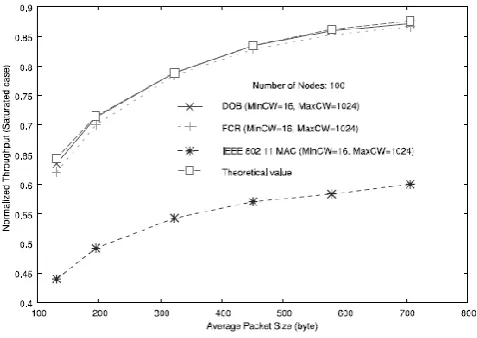
The experiment performed used a new index called “Average Channel Idle Interval”, which is
398
SAHER MANASEER AND AFNAN ALAWNEH
Figure 2: Simulation results of throughput with 50 nodes.
Figure 4: Changes of CW in simulation with 100 nodes.
400
SAHER MANASEER AND AFNAN ALAWNEH
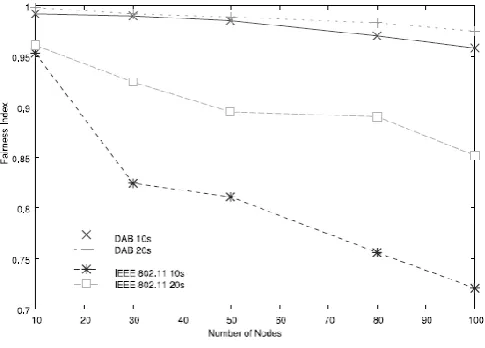
Figure 6: Fairness index.
The average idle interval shows the density of the network and the optimal CW. It doesn’t
need the estimation of the nodes number which make it a simple scheme and increase its
reliability in the dynamic environment of networks where the traffic changes frequently. As the
results showed that the throughput has increased and fairness is maintained since each node can
adjusts the backoff according to the idle channel interval to reach the optimal CW.
To resolve the problem of flooding attacks and enhancing the QoS, in 2006 [8] had proposed
a quantitative metric to measure the experienced fairness in the network during a flooding attacks,
and studied the effect of flow aggregation in such case. The experiment conducted introduced a
scheme of 3 levels of flow aggregation, the results showed the impact that flooding attacks have
on fairness, and proved that the proposed flow aggregation, is effective in such cases of flooding
attacks in maintaining the fairness approached by the network nodes, and higher resistance to
exhaustion attacks.
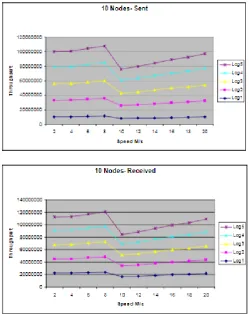
A modified logarithmic backoff algorithm was presented by [9], where the results showed
Figure 7: Sent and received data for a network of 10 nodes
Nodes near the gateway that links the Ad—hoc network to the internet to exchange packets
through, consumes more bandwidth than other nodes inside the network, to solve this problem
and the problem of the internal overhead caused by having the source and destination inside the
network, [10] proposed a new tree structure that shall be existed at the gateway to maintain faire
use of bandwidth. Also an algorithm for rerouting to enhance the process of internal traffic and
402
SAHER MANASEER AND AFNAN ALAWNEH
Figure 8: Tree construction algorithm.
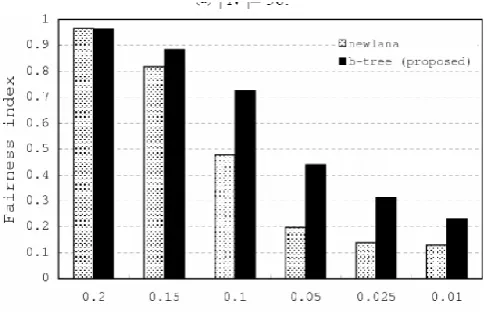
The following figures shows the performance evaluation for the proposed algorithm and
scheme when number of nodes =100.
Figure 10: Fairness of power consumption.
The results in the figures showed that the proposed tree, and rerouting algorithm, had
enhanced the fairness of the network remarkably, as well as the algorithm achieved balance in
high traffic or moderate one cases.
In [11], researchers had argued that the backoff algorithm (Exponential) become significantly
unfair towards the nodes that located in the middle area of a network. Since those nodes suffers
more collisions and failure due to the density in the middle of the network compared to the nodes
that have few neighbors, which makes the delay of the backoff larger and less throughput
comparing to those on the network borders. A modification was made to backoff algorithm and
the Impatient backoff (IBA) was proposed.
The proposed Backoff algorithm, decreases the delay when a collision happen, and the failure.
The algorithm reset the average backoff delays if they become too small, so the nodes maintain
404
SAHER MANASEER AND AFNAN ALAWNEH
Figure 11: Node throughput in a random topology, Exponential Backoff.
Figure 12: Node throughput in a random topology, Impatient Backoff
The traditional protocols of MANETs uses backoff algorithms to reduce congestions and
collisions. The main purpose is to make the node less aggressive in the collision, so the new
backoff algorithm as showed in the results allow the nodes to decrease the delay when a collision
Later in 2009, [12] came up with a new scheme which they named PEP (proportional fairness
backoff algorithm), which introduce a new scheme that allows the close nodes to the sink area to
get more opportunities to reach the proportional fairness.
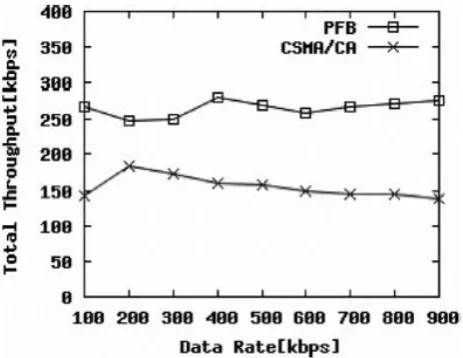
Figure 13: Throughput Comparison with Varying Data Rate
The figure shows that the rates of Data 100kbps, 200kbps, and 800kbps represent light,
medium, and overload traffic scenarios respectively.
Results of this study showed that the new method outperformed the throughput of IEEE
802.11, CSMAlCA.
Contention window based fairness backoff algorithm was proposed by [13], as a modification
on the binary backoff to enhance the unfairness of the opportunities a node can have after
406
SAHER MANASEER AND AFNAN ALAWNEH
Figure 14: Algorithm for authority nodes
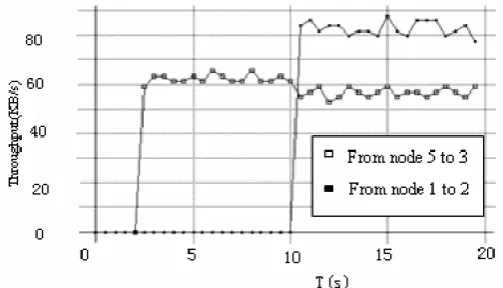
Figure 16: Transmission performance of ordinary nodes using
Figure 17: Transmission performance of leader nodes using
The results showed that this proposed algorithm could improve the fairness of accessing the
channel of the network. This algorithm outperformed the enhancing algorithm suggested in
[2][3][4], in enhancing the low system and decrease the overhead of communication.
In 2009, [14] introduced a new algorithm based on modifying the traditional backkoff
algorithm, and was named the adaptive efficiency fairness tradeoff (AEFT). The new scheme
increase the CW during the high traffic density, as well as using an adaptive window algorithm
to decrease the backoff delay when the channel is inactive due to fair scheduling process. The
408
SAHER MANASEER AND AFNAN ALAWNEH
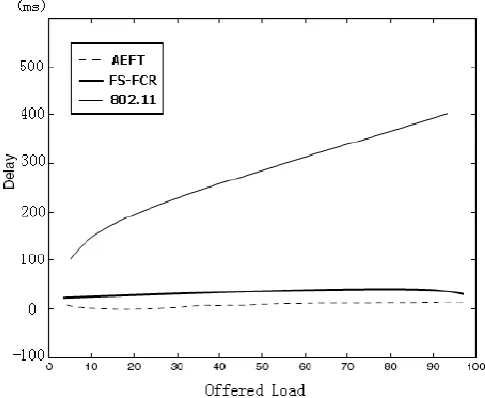
Figure 18: Time Delay with different loads
Figure 19: Fairness Performance
The results showed high throughput, and high fairness index too, also a tradeoff between
fairness and network efficiency.
The effect of funneling on fairness was studies by [15], a scheme based on proportional
fairness backoff was proposed for mitigating the funneling effect. The new algorithm named
smac-based proportional fairness backoff (SPFB), has proven to achieve better fairness in energy
[16] Made a comparison, between the TAOVD and TEA-AOVD protocol, in establishing a
fair node process. The problem arise since the MANETs don’t have tangible infrastructure, so
the lack of centralization makes them targeted by networks attacks and sometimes for
misbehavior by the nodes of the network [17][18]. The results showed that such protocols
(Trust routing protocols) especially the two studied namely TAODV, TEA-AODV, deal with
nodes unfairly, also they can cause a misbehaved node to take many opportunities than others.
Another algorithm was proposed by [19] to enhance the short term fairness in 802.11 protocol,
regardless the CW size, named the Inverse binary exponential backoff scheme (iBEB), the
algorithm proved enhancement in the throughput and a reduction in collision[28].
Figure 20: Saturation throughput
410
SAHER MANASEER AND AFNAN ALAWNEH
Figure 22: Collision probability p
The best of this algorithm is that it doesn’t require any estimation of the network status, it
simply allows nodes to get their backoff time randomly, then if a collision happens the node
minimize its CW to enhance its opportunity to channel accessibility, thus increasing the fairness.
To solve the problem of DSDV and AODV protocol mentioned earlier, some modifications
were made to these protocols by [22], the Ant colony optimization is used, and results were
Figure 23: Fairness Index all routing protocols
TABLE 1: SUMMARY OF COMPARISON RESULT
The results showed an enhancement in throughput for AODV 6.36%-13.2%, and for
DSDV .68%-5.47%.
Recently in 2016, [23] proposed a new backoff algorithm for 802.11 MANETs; to help in
achieving higer throughput and approach fairness through adjusting the CW size. The proposed
algorithm is named Maximum Throughput and fairness aware backoff (MTFB).
412
SAHER MANASEER AND AFNAN ALAWNEH
Figure 24: MTFB CW size for single and co-existence scenarios
Regarding performance evaluation, the results shown in the following figures:
Figure 25: Normalized throughput comparison
The algorithm helps to select the optimal CW adaptively. It proved high throughput and
higher short-term fairness with lower complexity, since it doesn’t need the multiple stages and
levels of backoff [23][24].
The Fair MAC Protocol (FMAC), was proposed based on IEEE 802.11, to enhance fairness in
[25]. Since the nodes that are slower than others overrun channel utilities for a long time, this
affects the throughput of the networks.
The proposed protocol uses the periods of backoff delay to choose the optimal CW time and
enhance the utilizing of power consumption in the network be decreasing the number of
collisions.
Figure 27: Flow chart of the main stages of FMAC.
The results of comparison between the traditional 802.11 and the proposed FMAC are showed
414
SAHER MANASEER AND AFNAN ALAWNEH
Figure 28: Comparison of Jain’s fairness index of FMAC and standard MAC
Figure 29: Comparison of Jain’s fairness index of FMAC and standard MAC
The experiment showed that transmission is faster through applying FMAC, and the power
consumption has decreased. And the fairness has increased. Thus, the throughput has been
enhanced and increased.
In 2017, [26] has used the history of network collisions number, to propose a new adaptive
MAC for CW size, to solve the backoff delay that the network suffers in heavy load and dense
situations, the CW is automatically modified, to lower the power consumption and increase the
Figure 30: Proposed back-off algorithm.
The experiment was applied on both topologies of Mesh and linear networks. The results in
both cases showed higher throughput and lower energy usage, as well as achieving better
fairness. The following figures are chosen for Mesh and linear networks though the traffic load is
lighter in linear topology.
416
SAHER MANASEER AND AFNAN ALAWNEH
Figure 32: Energy comparison in mesh topology
Figure 33: End-to-end delay comparison in linear topology
Many research papers has focused on proposing back algorithms, to enhance fairness and performance of the
network, backoff is considered as one of the mail algorithms that can be modified and used to mitigate the
delays and collisions during transmissions, main studies that targeted the fairness directly are detailed above,
and many other algorithms like [28][29][30][31], can be modified to enhance the performance through fairness
3. Conclusion
Most of the studies surveyed in this paper, have searched the fairness issue in network and
how to enhance it, mainly concentrating on these parameters: Contention window (Min and Max
values), backoff delay time, packet size, Area of network, speed, density (Traffic load), transmit
energy.
Most of the experiments showed an enhancement in fairness achieved, through adjusting
backoff algorithms and contention windows, in terms of reducing collisions and resulting in high
throughput. Considering the network conditions and settings of the studies parameters. This
implies that fairness affects the quality of service which makes it is a significant factor that
should be studied well to enhance the performance of the wireless network, increasing the
efficiency and decreasing the collisions and delays.
4. Recommendations
More research should be conducted in the field of fairness algorithms and more parameters
should be taken into considerations.
Conflict of Interests
The authors declare that there is no conflict of interests.
REFERENCES
[1] Manaseer, S. On Backoff Mechanisms for Wireless Mobile Ad Hoc Networks. Ph.D. University of Glasgow. (2010).
[2] Ozugura T., Naghshinehb M., Kermanib P. Fair Media Access for Wireless LANs. Global Telecommunications Conference, 1999.
[3] Bensaou, B., Wang, Y., Ko CC., Fair medium access in 802.11 based wireless ad-hoc networks, Proceedings of the 1st ACM international symposium on Mobile ad hoc networking & computing , August 2000, p. 99-106. [4] Y. Wang, and Bensaou. B., Achieving Fairness in IEEE 802.11 DFWMAC with Variable Packet Size, Proc. of
IEEE Global Telecommun. Conf., 2001. DOI: 10.1109/GLOCOM.2001.966350.
418
SAHER MANASEER AND AFNAN ALAWNEH
and Networking Conference, 6th IEEE Wireless Computing and Networking Conference (WCNC), March 2005.
[6] Tian X., Chen X., Ideguchi T., and Fang Y., Improving Throughput and Fairness in WLANs through Dynamically Optimizing Backoff, November 2005, IEICE Transactions on Communications 88-B(11):4328-4338. DOI: 10.1093/ietcom/e88-b.11.4328.
[7] Tassiulas L., and Sarkar S. Maxmin fair scheduling in wireless ad hoc networks, IEEE J. Selected Areas Commun., 23 (2005), NO. 1, 163-173.
[8] Hejmo M. , Mark, B. L. , Zouridaki C. and Thomas R. K. On the Fairness of Flow Aggregation for Denial-of-Service Resistant QoS in MANETs. The Third International Conference on Quality of Service in Heterogeneous Wired/Wireless Networks August 7-9 2006, Waterloo, ON, Canada.
[9] S. Manaseer, M. Ould-Khaoua and L. Mackenzie, Analytical Study of Backoff Algorithms for MAC Protocol in Mobile Ad Hoc Networks, 2nd UK Performance Engineering Workshop, UK. 2006.
[10] Ohata N., Zhang Y., Ji Y., Shen X. Fairness Improvement and Efficient Rerouting in Mobile Ad Hoc Networks. IEEE International Conference on communications, Glasgow, UK, June- 2007. DOI: 10.1109/ICC.2007.552.
[11] Gupta R., Walrand J. Impatient Backoff Algorithm: Fairness in a Distributed Ad-Hoc MAC. IEEE International Conference on communications, Glasgow, UK, June- 2007. DOI: 10.1109/ICC.2007.588. [12] Chen Y., Li M., Wang L., Yuan Z., Sun W., Zhu C., Zhu M., Shu L. A Proportional Fair Backoff scheme for
wireless sensor networks, IEEE 6th International Conference on Mobile Adhoc and Sensor Systems, MASS ’09, 2009.
[13] Zhang, D., Zhang, B., Lu, D. Contention window based fairness backoff algorithm in ad hoc networks. IEEE Int. Conference Neural Networks and Signal Processing, Zhenjiang, China (2008).
[14] Cui, H.X., Wei, G. A novel backoff algorithm based on the tradeoff of efficiency and fairness for ad hoc networks, Proc. Int. Conf. Commun. Mobile Comput., 2009, p. 81–86.
[15] Chunsheng, Z., Yuanfang, C., Lei, W., Lei, S., & Yan, Z. SMAC-based proportional fairness backoff scheme in wireless sensor networks. In Proceedings of the 6th international wireless communications and mobile computing conference, Caen, France (pp. 138–142). (2010).
Information Security South Africa (ISSA), 2011, vol., no., pp.1-8, 15-17 Aug. 2011 doi: 10.1109/ISSA.2011. [17] C. Dellarocas and C. A. Wood. The sound of silence in online feedback: Estimating trading risk in the presence
of report bias. Robert H. Smith School for Business, Leaders for the digital Economy, 2006.
[18] D. Umuhoza, J. I. Agbinya, C.W. Omlin. Estimation of Trust Metrics for MANET Using QoS Parameter and Source Routing Algorithms In Proceedings AUSWIRELESS '07: Proceedings of the The 2nd International Conference on Wireless Broadband and Ultra Wideband Communications, Washington, DC, 2007, pp 80-85. [19] Almotairi K. Inverse Binary Exponential Backoff: Enhancing Short-term Fairness for IEEE 802.11 Networks.
ISWCS 2013; The Tenth International Symposium on Wireless Communication Systems. August 2013, Ilmenau, Germany.
[20] Mehoaued K., Sekhri L., Bourenane M. Fairness Improvement of MAC in Wireless Ad Hoc Networks. Proceedings of the 8th International Workshop on Verification and Evaluation of Computer and Communication Systems (VECOS 2014), Bejaia, Algeria.
[21] H. Shi, R. V. Prasad, E. Onur, and I. G. M. M. Niemegeers, Fairness in wireless networks: Issues, measures and challenges, IEEE Commun. Surveys Tuts., vol. 16, no. 1, pp. 5–24, 1st Quart., 2014.
[22] Hartaman A., Rahmat B., and Istikmal. Performance and fairness analysis (using Jain's index) of AODV and DSDV based on ACO in MANE 4th International Conference on Interactive Digital Media (ICIDM) December, 2015 Bandung – Indonesia. DOI: 10.1109/IDM.2015.7516337.
[23] Kim I., Park S. Maximum throughput and fairness aware backoff considering co-existence with legacy WLAN. 2016 International Conference on Information and Communication Technology Convergence (ICTC). 2016, Jeju, South Korea. DOI: 10.1109/ICTC.2016.7763327.
[24] Khademi N., Welzl M., Armitage G., Gjessing S. Improving the Fairness of Alternative Backoff with ECN (ABE). IEEE 41st Conference on Local Computer Networks Dubai, United Arab Emirates. DOI: 10.1109/LCN.2016.19.
[25] Al-Ratta, N.M., Al-Rodhaan, M. and Al-Dhelaan, A. FMAC: Fair Mac Protocol for Achieving Proportional Fairness in Multi-Rate WSNs. Communications and Network, 7, 89-105.
[26] Sun, P.; Li, G.; Wang, F. (2017). An Adaptive Back-Off Mechanism for Wireless Sensor Networks. Future Internet 2017, Vol 9, No (2), Pp: 19. DOI:10.3390/fi9020019.
420
SAHER MANASEER AND AFNAN ALAWNEH Glasgow, 2006.
[28] Bani Yassein , M., Manaseer, S., Al-Turani, A. A Performance Comparison of Different Backoff Algorithms under Different Rebroadcast Probabilities for MANET’s. Paper presented at the 25th UK performance Engineering workshop (2009).
[29] Yang, Y., Song, G.n., Wei, K., Zhang, W.X. and You, X.H. ACK-Based Adaptive Backoff for Random Access Protocols. Sci. China Inf. Sci. 58 (2015), 1-14.
[30] Manaseer, Saher & Badwan, Fatima . History-Based Backoff Algorithms for Mobile Ad Hoc Networks. J. Comput. Commun. 4 (2016), 37-46.
[31] Yassein, M.B., Manaseer, S., Al-hassan, A.A., Taye, Z.A. and Al-Dubai, A.Y. A New Probabilistic Linear Exponential Backoff Scheme for MANETs. Proceedings of the 2010 IEEE International Symposium on Parallel and Distributed Processing, Workshops and PhD Forum, IPDPSW, Atlanta, 19-23 April 2010, 1-6. [32] S. Manaseer, A. Alawneh, Backoff as Performance improvements Algorithms A Comprehensive Review. Int. J.