Volume 4, Issue 7, 2017, pp. 141-153 Available online at www.jallr.com ISSN: 2376-760X
* Correspondence: Mohammad Reza Oroji, Email: [email protected] © 2017 Journal of Applied Linguistics and Language Research
Exploring the Relationship between EQ and Intermediate
EFL Learners’ Speaking Performance: A Gender Study
Kafieh Salar
Department of English, Damavand Branch, Islamic Azad University, Damavand, Iran
Mohammad Reza Oroji *
Department of English, Zanjan Branch, Islamic Azad University, Zanjan, Iran
Abstract
This study was an attempt to investigate the relationship between speaking proficiency of Iranian EFL learners and their Emotional Intelligence (EI) and gender. To this end, 40 students aged 16 to 19 from Avaye Zaban Institute in Tehran during the academic year of 2015-2016 took part in this study. The data was analyzed through SPSS (21), using descriptive statistics and analysis of the results of the Nelson English Language Test, Bar-On Emotional Quotient Inventory, and Farhady et al. speaking proficiency scales. The results of this study showed that there was a significant relationship between EI and the intermediate Iranian learners’ speaking performance. Besides, a significant relationship was found between their EQ scores and the amount of their English language proficiency on fluency. Finding of the study also showed that there was a significant difference in problem solving, independence, self-actualization, optimism, and self- regard components of emotional intelligence. This indicates that the emotional capacity of male and female students has developed differently, and they have their own strengths and weaknesses when it comes to emotional intelligence.
Keywords: Emotional Intelligence (EI), Gender Differences, Speaking Performances
INTRODUCTION
Students who receive higher intelligence quotient (IQ) scores are usually considered more intelligent. Intelligence as a general concept encompasses social and emotional factors besides the cognitive factors. Goleman (1995) stresses that, IQ contributes about 20 percent to the factors that determine life success; the rest is related to other factors including EI. Emotional intelligence refers to the capacities to recognize and regulate emotions in ourselves and in others. EI can be as much powerful, and at times, more powerful than IQ in predicting success in various life challenges (Goleman, 1995). By development of the concept of EQ, different issues and variables are attributed to it. Sternberg (1997) believes that academic achievement and intelligence are not measured only by academic scores, and we should consider people skills and attitudes. Sternberg researches on intelligence resulted into a new theory called “successful intelligence” and he (1997) believes that successful intelligent is required to achieve success in life and this theory is substantially broader than conventional theories of intelligence. It defines intelligence in terms of the ability to achieve one’s goals in life Conventional views of intelligence favor individuals who are strong in memory and analytical abilities, while to achieve success in life, practical and creativity abilities are important. Speaking is "the process of building and sharing meaning through the use of verbal and non-verbal symbols, in a variety of contexts" (Chaney, 1998, p. 13). Speaking is an interactive process of constructing meaning that involves producing and receiving and processing information (Burns & Joyce, 1997). Speaking is a crucial part of second language learning and teaching.
Previous studies have been carried out to investigate the relations of affective factors including Emotional Intelligence of learners with distinctive areas of learning a foreign language. Most of the research which has been done till now in Iran about emotional intelligence and its relation with various skills of learning strategies, are about listening, reading and writing strategies. In comparing with other skills, quite a few studies have been conducted to explore the effects of emotional intelligence in speaking skill. This research was determined to compensate the failure and pay more attention to this field. Globalization has encouraged everybody to get the knowledge of English as a second language. English language then has become the international language for communication.
RESEARCH QUESTIONS AND NULL HYPOTHESES
RQ1: Is there any significant relationship between emotional intelligence as a whole and speaking performance among intermediate EFL learners?
RQ2: Is there any significant relationship between components of EI and speaking performance among intermediate EFL learners?
RQ3: Is there any significant difference between EI and its components among intermediate EFL learners based on gender?
RQ4: Is there any significant difference between females and males’ performance on speaking among intermediate EFL learners?
And the following hypotheses were formulated:
HO1: There is no significant relationship between emotional intelligence as a whole and speaking performance among intermediate EFL learners.
HO2: There is no significant relationship between components of EI based on bar-On model and speaking performance among intermediate EFL learners.
HO3: There is no significant difference between EI and its components among intermediate EFL learners based on gender.
HO4: There is no significant difference between females and males’ performance on speaking among intermediate EFL learners.
METHOD
Participants
Participants of this study were 40 (20 males and 20 females) EFL learners from Avayeh Zaban Institute, Tehran, Iran, who had been selected from early total of 60 (30 males and 30 females) students of two classes after taking the Nelson English Language Test as an English language proficiency test. The ages range for participants were between 16 and 19.
Instruments
Three different instruments were used to conduct this study. The Nelson English Language Test was the first instrument which was used as a tool for homogenizing participants of the study. This test was consisting of 40 separate tests for ten levels of language proficiency which range from beginner to the advanced. The levels were numbered from 0, 50, 100,…, to 500. Each test consisted of 50 items measuring the general level of English which forms the basis for all specific uses of language. In the present study a test in the intermediate level – level 250 – was used.
1. Accent 2. Structure 3. Vocabulary 4. Fluency
5. Comprehension
The third instrument was Bar-On Emotional Quotient Inventory which originally developed by Bar-On in 1980. The Emotional Quotient Inventory was used to measure the Emotional Intelligence of the participants. Bar-On inventory was a self-report questionnaire that includes 133 Likert-scale items. To conduct the present study a translated version of this questionnaire to Persian was used. Samouei (2005) and her colleagues translated this questionnaire to Persian and also omitted some of its items for the reasons such as lack of conformity with Iranian context, causing low Cronbach alpha, etc. and reduced the total number of the items to ninety. They also tested the reliability and validity of the adjusted version of the questionnaire. The reason for the use of this type of questionnaire was Dornyei’s (2007) idea that “some personality test items … follow a true-false rating to ensure reliability in domains where the respondent may not be able to properly evaluate the degree to which a particular feature was present/true or not” (p. 106).
Design
The overall design of this study was correlational. Since the aim of this study was to determine if there is any significant relationship between emotional intelligence and foreign language speaking performance of intermediate EFL learners, a self- report instrument was administered to male and female learners in a regular class session.
RESULTS
The Distribution of the Initial Participants Language Proficiency as Table 1 showed, the mean of 60 initial participants Nelson English Language Test was 35.53 with standard deviation of 9.477.
Table1. Descriptive Statistics for the Distribution of the Initial Participants’ Language Proficiency
N Min Max Mean Std. Deviation
Nelson 60 17 50 35.53 9.477
Those students whose scores in Nelson English Language Test were between one standard deviation minus and plus the mean have been selected as the participants of the main study and others have been excluded. It means that 40 students whose scores were between 27 and 45 have been selected.
significant at levels below .05. However, this level of significance is reduced to .08 regarding ratings on participants’ achievements on vocabulary, which, obviously, means that in all cases, except one, the raters were in agreement over the achievements of the participants.
Table 2. Pearson Correlation Test for Inter- Rater Reliability
Comprehensibility Fluency Vocabulary Structure Pronunciation
Pearson Correlation 0.495 0.499 0.399 0.726 0.563
Sig. (2 -tailed) 0.027 0.025 0.081 0.000 0.010
The Distribution of the Participants’ Emotional Intelligence and Speaking Fluency, Accuracy, and Complexity Scores
Tables 3 and 4 present the results of the participant emotional intelligence and the fluency, accuracy, and complexity of student oral performance, respectively. These tables indicate descriptive statistics such as number of participants, minimum, maximum, mean and standard deviation of their scores.
Table 3. The Results of the Participants’ Emotional Intelligence
N Min Max Mean Std. Deviation
EQ 39 311 423 375.45 25.511
Intrapersonal 39 119 143 133.50 6.039
Interpersonal 39 71 86 80.11 3.645
Adaptability 39 71 77 74.42 1.687
Stress management 39 43 51 46.89 2.178
General mood 39 50 59 55.39 2.422
Table 4. The Results of the Participants’ Oral Task Fluency, Accuracy, and Complexity
N Min Max Mean S.D
Fluency 39 .5512 .5999 .579 .0132
Accuracy 39 .6172 .7199 .666 .0308
Complexity 39 2.6440 2.7348 2.696 .0256
The Results Regarding the First Research Hypothesis
Pearson’s correlation analysis was conducted to find answer for the first research question of the study. The correlation between participants’ emotional intelligence as a whole factor and their fluency, accuracy, and complexity in performing oral tasks was calculated. Table 5 presents the results of this analysis:
Table 5. The Relationship between EI and Oral Task Fluency, Accuracy, and Complexity
Fluency Accuracy Complexity
EQ Pearson Correlation -.156 -.058 .421**
It is observed from the Table 5 that emotional intelligence as a whole factor does not have a significant relationship with Fluency (p=0.351>0.05) and Accuracy (p=0.727>0.05) of the oral performance. But, there is a moderate positive correlation between emotional intelligence as a whole factor and oral performance complexity (p=0.008<0.01). This finding is in agreement with the findings of Khooei (2011) concerning the effect of emotional intelligence and its relation to oral task and fluency, accuracy, and complexity among Iranian EFL learners speaking skills.
The Results Regarding the Second Research Hypothesis
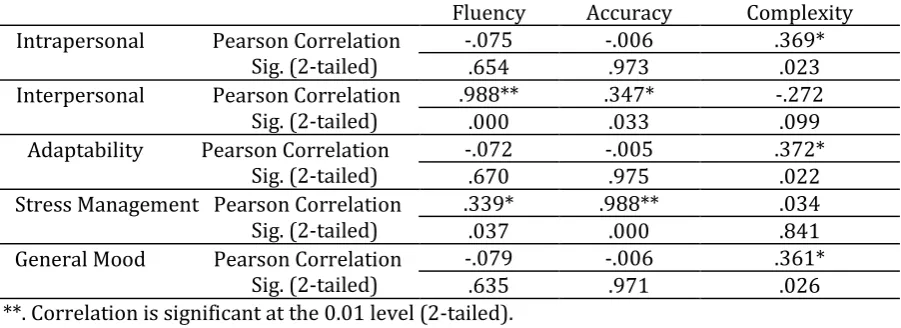
To determine whether there is any significant relationship between each component of emotional intelligence and fluency, accuracy, and complexity of oral performance among Iranian EFL learners, Pearson correlation analysis has been conducted whose results are presented in the Table 6:
Table 6. The Relationship between EI Components and Oral Task Fluency, Accuracy, and Complexity
Fluency Accuracy Complexity
Intrapersonal Pearson Correlation Sig. (2-tailed)
-.075 -.006 .369*
.654 .973 .023
Interpersonal Pearson Correlation Sig. (2-tailed)
.988** .347* -.272
.000 .033 .099
Adaptability Pearson Correlation Sig. (2-tailed)
-.072 -.005 .372*
.670 .975 .022
Stress Management Pearson Correlation Sig. (2-tailed)
.339* .988** .034
.037 .000 .841
General Mood Pearson Correlation Sig. (2-tailed)
-.079 -.006 .361*
.635 .971 .026
**. Correlation is significant at the 0.01 level (2-tailed). *. Correlation is significant at the 0.05 level (2-tailed).
From the statistical analysis of the second research question it became clear that among five dimensions of emotional intelligence interpersonal and stress management components were correlated with fluency and accuracy of oral performance and intrapersonal, adaptability, and general mood components had a significant relationship with complexity of speaking. This finding is in agreement with the findings of Kassaian, Koosha and Ketabi (2011). In their study concerning the effect of oral summery of short stories on male/female learners' speaking proficiency, significant relationship was found between EQ components and the speaking skills.
The Results Regarding the Third Research Hypothesis
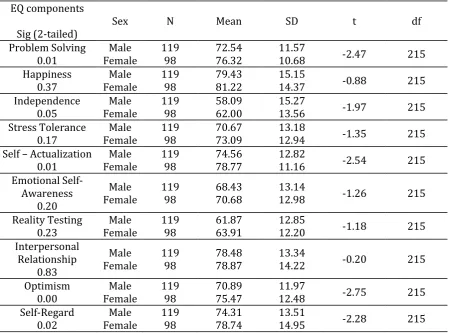
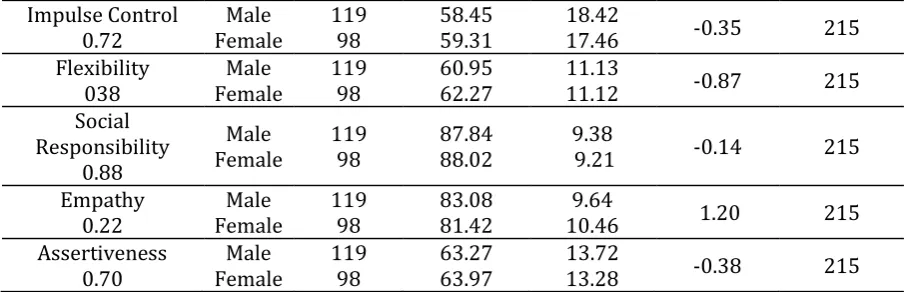
self-actualization, optimism, and self- regard components of emotional intelligence. This indicates that the emotional capacity of male and female students has been developed differently, and they have their own strengths and weaknesses when it comes to emotional intelligence.
Men and women have different kinds of Emotional Intelligence, high EQ for both sexes is key factor to learning success. Both men and women have emotional intelligence, according to EQ test developers MHS, but each gender has a significantly different Emotional Intelligence profile. Women have much stronger interpersonal skills than their male counterparts but men have significantly higher sense of self and independence. This means that women are much more aware of their own feelings as well as those of others and relate much better interpersonally than do men. Men however score more highly on self - regard and independence than women and also do better on dealing with events that are immediately stressful.
These findings have important implications in their performances. In the past men have dominated the top positions, partly because of their stress tolerance and independence, but people skills are now becoming more important as a culture of team working and partnerships takes effect. Women’s higher scores in the interpersonal areas will now help them reach higher levels in the corporate world. This is especially true if they also develop high stress tolerance. Men need to develop their empathy to balance their strong independence scores.
Table 7. Comparing the EI Components of Male and Female intermediate learners
EQ components
Sig (2-tailed) Sex N Mean SD t df
Problem Solving
0.01 Female Male 119 98 72.54 76.32 11.57 10.68 -2.47 215
Happiness 0.37
Male Female
119 98
79.43 81.22
15.15
14.37 -0.88 215
Independence 0.05
Male Female
119 98
58.09 62.00
15.27
13.56 -1.97 215
Stress Tolerance
0.17 Female Male 119 98 70.67 73.09 13.18 12.94 -1.35 215
Self – Actualization
0.01 Female Male 119 98 74.56 78.77 12.82 11.16 -2.54 215
Emotional Self-Awareness
0.20
Male Female
119 98
68.43 70.68
13.14
12.98 -1.26 215
Reality Testing
0.23 Female Male 119 98 61.87 63.91 12.85 12.20 -1.18 215
Interpersonal Relationship
0.83
Male Female
119 98
78.48 78.87
13.34
14.22 -0.20 215
Optimism
0.00 Female Male 119 98 70.89 75.47 11.97 12.48 -2.75 215
Self-Regard
Impulse Control
0.72 Female Male 119 98 58.45 59.31 18.42 17.46 -0.35 215
Flexibility
038 Female Male 119 98 60.95 62.27 11.13 11.12 -0.87 215
Social Responsibility
0.88
Male
Female 119 98 87.84 88.02 9.21 -0.14 9.38 215
Empathy
0.22 Female Male 119 98 83.08 81.42 10.46 9.64 1.20 215
Assertiveness 0.70 Male Female 119 98 63.27 63.97 13.72
13.28 -0.38 215
The Results Regarding the Forth Research Hypothesis
The forth hypothesis sought to determine whether or not there was a differences between gender and speaking skills. More specifically the hypothesis was: There is no significant difference between gender and speaking skills among EFL learners. Regarding this hypothesis as statistics in the multivariate tests (Table 8) clearly show there is no meaningful associations between these two factors. As results show there is also no significant difference at the 0.05 level of significant. This finding is in agreement with the findings of Gorjian, Moosavian and Shahramiri (2011). In their study concerning the effect of oral summery of short stories on male/female learners' speaking proficiency, no significant relationship was found between gender and the speaking skills.
The findings also show that it is safe to conclude that that there is a significant relationship between EQ and fluency; however, the other components of oral production do not meet the requirements of being statistically significant. In accordance with previous studies, this study shows females’ spoken language to be more advanced than the spoken language of males. The present study is particularly notable; however, because it identifies differences in syntactic development among adolescents, a population rarely studied by language development researchers. It now follows to discuss particular factors that may play a contributing role to such differences in language between males and females.
Table 8. Tests of Between-Subjects Effects
Source dependent variable Type3 sum of squares df Mean square f Sig
Corrected model pronunciation Structure Vocabulary Fluency comprehensibility 1.000a .957b .640c 8.715d 2.749e 5 5 5 5 5 .200 .191 .128 1.743 .550 .404 .168 .220 3.630 .554 .838 .970 .948 .026 .733 Intercept pronunciation
Structure Vocabulary Fluency comprehensibility 101.869 141.411 122.508 118.120 156.133 1 1 1 1 1 101.869 141.411 122.508 118.120 156.133 205.573 123.788 210.193 246.001 157.382 .000 .000 .000 .000 .000
Structure Vocabulary Fluency comprehensibility .094 .204 .131 .314 1 1 1 1 .094 .204 .131 .314 .083 .350 .272 .317 .778 .563 .610 .583 EQ pronunciation
Structure Vocabulary Fluency comprehensibility .697 .341 .329 .157 .507 3 3 3 3 3 .232. .114 .110 1.725 .169 .469 .100 .188 3.593 .170 .709 .959 .903 .041 .915 Gender EQ pronunciation
Structure Vocabulary Fluency comprehensibility .389 .094 .040 2.531 .314 1 1 1 1 1 .389 .094 .040 2.531 .314 .785 .083 .068 5.271 .317 .391 .778 .798 .038 .553 Error pronunciation
Structure Vocabulary Fluency comprehensibility 6.938 15.995 8.160 6.722 13.889 14 14 14 14 14 .196 1.192 .583 .980 .992 Total pronunciation
Structure Vocabulary Fluency comprehensibility 270.750 343.000 313.000 273.250 390.750 20 20 20 20 20 Corrected Total pronunciation
Structure Vocabulary Fluency comprehensibility 7.937 16.950 8.800 15.437 16.638 19 19 19 19 19
a. R Squared = .126 (Adjusted R Squared = -.186) b. R Squared = .056 (Adjusted R Squared = -.281) c. R Squared = .073 (Adjusted R Squared = -.258) d. R Squared = .565 (Adjusted R Squared = .409) e. R Squared = .165 (Adjusted R Squared = -.133)
DISCUSSION
Although several studies are conducted to investigate the relationship between emotional intelligence and different aspects of foreign language learning, as far as the researcher knows, there is little or no research on addressing the relationship between components of emotional intelligence and different aspects of speaking skill. Therefore, one to one comparison of the findings of this study with others would not be possible and the researcher is to be content with available studies. Results of the study are, to some extent, in line with the findings of Pishghadam (2009). He indicated that emotional intelligence as a whole factor and intrapersonal, interpersonal, and general mood components are significantly related to speaking ability of the students and rejected the existence of statistically significant relationship between stress management and adaptability components and speaking skill. Mohammadi (2012) investigated the role of emotional intelligence on English learning as a foreign language and found that emotional intelligence as a whole factor and intrapersonal, interpersonal, adaptability, and stress management components were correlated with English language learning and general mood component failed to have this relationship. Therefore, the findings of the present study somehow confirm her results.
Politzer’s (1983) findings, which revealed that these strategies were used by the girls more than the boys.
CONCLUSION
In this research the effect of emotional intelligence and gender on speaking proficiency was investigated. One of the first conclusions that can be reached from the results is that there is no significant relationship between emotional intelligence and participants speaking scores. Even if emotional intelligence and speaking skills are not tightly associated, it does not mean that emotional intelligence has no role in speaking. It may be playing an important role in indirect ways. According to Goleman (1995) emotional intelligence is an important factor in success. Furthermore, the second result of this study demonstrated that there was no significant difference between male and female of students. So, there is no relationship between gender and participants' scores. As the results of the statistical analysis revealed, that emotional intelligence as a whole factor does not have a significant relationship with Fluency and Accuracy of the oral performance. But, there is a moderate positive correlation between emotional intelligence as a whole factor and oral performance complexity. In this study 40 language learners who possessed a higher level of emotional intelligence were more aware of the appropriate conventions of the target language features than language learners who possessed a lower level of emotional intelligence. The significant role of emotional intelligence in determining the level of oral language performance features, as proved in the current study, suggests that language learner emotional intelligence should be invoked through incorporation of emotion-driven authentic native English stories and videos (Shakib & Barani, 2011; Bora, 2012; Abdolrezapour, 2012; Zarezadeh, 2013). This not only can be served as a language practice but also can provide exposure to authentic emotional aspect of the target language.
From the statistical analysis of the second research question it became clear that among five dimensions of emotional intelligence, interpersonal and stress management components were correlated with fluency and accuracy of oral performance and intrapersonal, adaptability, and general mood components had a significant relationship with complexity of speaking. Considering the nature of English language classes in EFL contexts, the existence of a relationship between second language speaking and emotional intelligence is expected. Krashen (1981) believes that speaking a second language appears to be difficult, challenging, and stressful for the learners, especially for adults who have to speak a language other than their mother tongue and it may lead to making lots of mistakes and facing problems.
relationship was found between their EQ scores and the amount of their English language proficiency on fluency.
Finding of the study showed that there is a significant difference in problem solving, independence, self-actualization, optimism, and self- regard components of emotional intelligence. This indicates that the emotional capacity of male and female students has been developed differently, and they have their own strengths and weaknesses when it comes to emotional intelligence.
REFERENCES
Abdolrezapour, P. (2013). The Relationship between Emotional Intelligence and EFL Learners’ Writing Performance. Procedia - Social and Behavioral Sciences, 70, 331-339.
Bora, F. D. (2012). The Impact of Emotional Intelligence on Developing Speaking Skills: From Brain-Based Perspective. Procedia - Social and Behavioral Sciences, 46, 2049-2098.
Burns, A. & Joyce, H. (1997). Focus on speaking. Sydney: National Centre for English Language Teaching and Research.
Cavallo, K. & Brienza, D. (2002). Emotional competence and leadership excellence at Johnson and Johnson: the emotional intelligence leadership study.
Chaney, S. (2011). Writer's workshop: Implementing units of study, findings from a teacher study group, and student success in writing. Retrieved from http://www.eric.ed.gov/PDFS/ED520323.pdf
Dornyei, Z. (2007). Research methods in applied linguistics. Oxford: Oxford University Press.
Embi, M.A. (2000). Language learning strategies: A Malaysian context. Bangi: Penerbit Universiti Kebangsaan Malaysia.
Farhadi, H., Jafarpour, A., & Birjandi, P. (1994). Language skills testing: From theory to practice. Tehran, Iran: SAMT Publishers.
Gardner, H. (1983). Frames of mind. New York: Basic Book, Inc.
Gardner, H. (1991). The unschooled mind: how children think and how schools should teach. New York: Basic Books Inc.
Gardner, H. (1999). Intelligence reframed: Multiple intelligences for the 21century. New York: Basic Books.
Gardner, H. (1983). Frames of mind: The theory of multiple intelligences. New York: Basic Books.
Goleman, D. (1995). Emotional intelligence. New York: Bantam Books.
Goleman, D. (1997). Emotional intelligence: Why it can matter more than IQ. New York: Bantam Books.
Goleman, D. (1998). Working with emotional intelligence. New York: Bantum Books. Gorjian, B. & Moosavinia, R. Shahramiri, P. (2011). Effects of Oral Summary of Short
Green, J.M. & Oxford, R.L. (1995). A closer look at learning strategies, L2 proficiency, and gender. TESOL Quarterly, 29 (2), 261-297.
Koohei, S. (2014). Emotional intelligence and its relation to oral task fluency, accuracy, and complexity among Iranian EFL learners. International Journal of Language
Learning and Applied Linguistics World, 6 (2), 76-93. Koosha, B. & Ketabi, S. & Kassaian, Z. (2011).The effects of self-esteem, age and gender on
the speaking skills of intermediate university EFL learners. Theory and Practice in Language Studies, 1(10), 1328-1337.
Krashen, S, (1981). Second language acquisition and second language learning. Oxford: Pregarnon Press.
Larsen-Freeman, D., & Long, M. (1991). An introduction to second language acquisition research. London: Longman.
Maccoby, E.E & Jacklin, C.N. (1974). The psychology of sex differences. Stanford: Stanford University Press.
Mohammadi, M. (2012). The role of emotional intelligence on English learning as a second language. International Research Journal of Applied and Basic Sciences, 3(9), 1953-1956.
Mohd Nazali Hj Abu Bakar. (1999). Strategi pembelajaran bahasa Melayu di kalangan pelajar tingkatan empat: satu tinjauan. Latihan Ilmiah Sarjana Muda. Universiti Kebangsaan Malaysia.
Oxford, R.L. (1989). The use of language learning strategies: A synthesis of studies with implications for strategy training. System, 17 (2), 235-247.
Oxford, R.L. (1990). Language learning strategies: What every teacher should know. New York: Newbury House.
Pishghadam, R. (2009). A quantitative analysis of the relationship between emotional intelligence and foreign language learning. Electronic Journal of Foreign Language Teaching, 6(1), 31-41.
Politzer, R.L. (1983). An exploratory study of self-reported language learning behaviors and their relation to achievement. Studies in Second Language Acquisition 6, 54-68. Punithavalli K. M. (2003). Strategi pembelajaran bahasa oleh pelajar-pelajar menengah rendah dalam mempelajari bahasa Inggeris sebagai bahasa kedua. Unpublished MA thesis. Universiti Kebangsaan Malaysia.
Samouei, R. (2005). Emotional intelligence test. Tehran: Sina Institute.
Shakib, S., & Barani, G. (2011). The Relationship between Emotional Intelligence and Language Proficiency of Iranian High School Students. Procedia - Social and Behavioral Sciences, 30, 1603-1607.
Slavin, R.E. (1997). Educational psychology: theory and practice (5th ed.) MA: Allyn and Bacon.
Sheorey, R., (1998). The state of English and English language teaching in India. TESOL Matters, 8 (4), 1, 19.
Sternberg, R. J. (1977). Intelligence, information processing, and analogical reasoning: The componential analysis of human abilities. Hillsdale, USA: Lawrence Erlbaum.