Issues
ISSN: 2146-4138
available at http: www.econjournals.com
International Journal of Economics and Financial Issues, 2018, 8(2), 137-147.
Regulation and Banking Performance in Liberalization Context
Amina Zgarni
1*
, Hassouna Fedhila
21Faculty of Economic Sciences and Management of Tunis, University of Tunis El Manar, Tunisia. 2The Higher Institute of
Accounting and Business Administration, University of Manouba, Tunisia. *Email: [email protected]
ABSTRACT
The financial liberalization initiated by several countries and always considered beneficial in terms of economic growth has recently shown its negative effects on bank performance. Empirical validation from a sample of ten quoted Tunisian commercial banks, observed over a period stretching from 1990 to 2011, shows that from the date of the total liberalization of the Tunisian financial sector, prudential regulation no longer affects the Return on assets. Similarly, we noticed that from this same date, the absence of a significant effect of the regulation on the Return on equity. Finally, the empirical results suggest that, starting from the date of full liberalization, regulatory ratios no longer continue to ensure their role of channeling banking activity and improving bank performance. Keywords: Prudential Regulation, Governance, Banking Crisis, Banking Performance, Financial Liberalization
JEL Classifications: G21, G28, F36, E44
1. INTRODUCTION
The proliferation of banking and financial crises that have ravaged the emerging economies has called into question the effectiveness of certain governance mechanisms in all types of companies, particularly in banks. Given the vital role of banks in all economies of the world, regulation is considered one of the most important external governance mechanisms in banks. Indeed, according to Llewellyn, (1999), the regulation aims to ensure the stability of the financial system, maintain the health of financial institutions and protect consumers. In this vein, contrary to what is expected from the process of liberalization, the main researches have shown that failures in the banking system can be explained to a large extent by the weakness of institutional regulation and the tendency towards liberalization. In fact, the financial liberalization initiated by several countries and long regarded as beneficial in terms of economic growth and improved banking performance has shown its negative effects on bank performance. As such, several recent studies show that it is behind the increase in the probability of occurrence of a banking crisis. However, Hermes and Meesters (2015) have shown that the impact of financial liberalization policies on bank efficiency depends on the extent to which bank regulation and supervision has been adopted and developed. It was with the neo-dcxstructuralism school that the approach of financial liberalization was criticized by showing its strong
responsibility in the economic decline, the instability, the fragility and the occurrence of banking crises. In the same vein, Gonzalez and Hermosillo (1999) Miotti and Plihon (2001), who seek to explain bank failures, conclude that financial liberalization allows banks to operate in a freer framework for risk-taking. In such a context, bank failures are mainly due to banks’ defective risk management policies, which in turn lead to deterioration in the quality of their commitments and a shortfall in their own funds. In this context, Angkinand et al. (2010) showed that the relationship between liberalization and banking crises strongly depends on the strength of regulation and supervision.
the effects of regulation and liberalization on performance are controversial.
The objective of this work is to know if a policy of financial liberalization, in order to promote financial development and growth, is pleasant for any economic and institutional environment and if financial liberalization does not affect the role of banking governance (prudential regulation) in determining bank performance.
Our research would therefore have the following problematic: What is the effect of prudential regulation on bank performance in a framework of financial liberalization?
To answer this problematic, we have articulated this article as follows: A second section is a review of the literature of empirical work on financial liberalization and its repercussions on the effect of banking governance (prudential regulation) on bank performance. A third section is reserved for the research methodology. A fourth section is dedicated to presenting the results of our estimates to Tunisian commercial banks. The last section is devoted to the conclusion.
2. FINANCIAL LIBERALIZATION
AND ITS REPERCUSSIONS ON THE
CONTRIBUTION OF REGULATION TO
PERFORMANCE: LITERATURE REVIEW
AND DEVELOPMENT OF HYPOTHESES
Non-recent phenomenon, the banking and financial crises, as noted by several authors (Celik and Karatepe, 2007), have more and more multiplied and aggravated in recent years. In this respect, Peter (2010) and Cornett et al. (2009), among others, consider that bad governance of banks is increasingly recognized as an important cause of the recent financial crisis (subprime crisis) caused the bankruptcy of several banks (Lehman Brothers) as well as the huge difficulties in several banks (Merrill Lynch).
Hence, being an important external governance mechanism in banks, regulation acts as a mechanism for resolving agency and discipline problems the behavior of the manager to act in the interests of shareholders, protects depositors and avoids risks. In this sense, Barth et al. (2004) assert that three major malfunctions provide an opportunity for the state to intervene to increase the efficiency of the banking market. First, there is the case of asymmetric information and the existence of externalities at the macro and microeconomic levels. Thus, to monitor market activities that could harm the public interest, banking regulations have been in use for years. According to Heremans (1999), banking regulation aims to protect consumers from market failures. In this respect, in their study of about one hundred firms in several regulated sectors including the banking sector, Booth et al. (2002) show that regulation as an external governance mechanism makes it possible to constrain allows them to limit the discretionary discretion of managers. In fact, regulation reduces the impact of managerial decisions on shareholder wealth, leading to a
substitution of regulations for internal control mechanisms that become less effective in limiting agency conflicts.
However, according to Boot and Thakor (1993), the interests of the shareholders of a bank, namely the maximization of the shareholder value, may not coincide with those of the regulations of the state insofar as the shareholders are risk takers whereas Regulators are risk averse and their main concern is the stability of the financial system (Capiro and Levine, 2002). Similarly, Barth et al. (2001) found that the nationalization of banks was negatively correlated with the development of the banking sector and positively associated with measures of bank inefficiency.
In total, according to the literature review, the results of studies on the effect of regulation on the performance of banks are divergent. In this work, in order to test this relationship, we propose the following hypothesis:
Hypothesis 1: Prudential regulation has a positive effect on banking performance:
Hypothesis 1-1: Prudential regulation has a positive effect on banking performance measured by return on equity (ROE) H1-1.
Hypothesis 1-2: Prudential regulation has a positive effect on banking performance measured by Return on assets (ROA) H1-2.
Hypothesis 1-3: Prudential regulation has a positive effect on banking performance measured by NBI H1-3.
Moreover, contrary to what is expected from the process of liberalization, the main research has shown that failures in the banking system can be explained to a large extent by the weakness of institutional regulation and the trend towards liberalization. In fact, it was with the neo-structuralism school that the approach of financial liberalization was criticized by showing its strong responsibility in the economic downturn, the instability, the fragility and the occurrence of banking crises. In the same line of thinking, several recent studies that seek to explain bank failures conclude that financial liberalization allows banks to operate in a freer environment with respect to risk-taking. In such a context, bank failures are mainly due to banks’ defective risk management policies, which in particular lead to deterioration in the quality of their commitments and a shortage of their own funds (Gonzalez and Hermosillo, 1999; Miotti and Plihon, 2001). Indeed, financial liberalization gives the banks a great deal of freedom of action and thus increases risk taking because, being in a competitive market, banks are afraid of seeing their profits fall or losses. In this case, the banks are moving towards the financing of bad customers. Thus, an excess of risk-taking may be behind bank fragility, bankruptcies and crises. In analyzing the banking crises in South Korea and Argentina, Miotti and Plihon (2001) argue that bank failures can be explained by the speculative behavior of banks that financial liberalization allows. The results of their work assert that bank failures are due to excessive speculative risk-taking.
still lower than the credits distributed and uncertain because it is always dependent on the decisions of depositors who can withdraw their capital at any time. Similarly, financial liberalization has the effect of reducing restrictions on the mobility of capital within the framework of financial liberalization programs, thereby making financial and non-financial institutions more interest rate risk. Indeed, a lender with a variable rate is at risk of seeing his income fall if rates fall. In addition, if the interest rate is fixed, in the event of a rate increase, the lender incurs an opportunity cost of having his income reduced. On the contrary, a variable rate borrower may see its financial costs increase if rates go up. On the other hand, when the rate is fixed, this borrower is at risk if rates fall.
In this context, by conducting a study of 20 countries in Asia, Latin America, Europe and the Middle East, during the 1970s-mid 1990s, Kaminsky and Reinhart (1996) confirm that during the 1970s (tight control of the financial markets), banking crises were rare and not linked to the crises of the payment balances, whereas the number of banking crises has just multiplied with the movement of financial liberalization in the world. Diaz (1985), comparing the situation of financial repression to that of financial liberalization, confirms that the latter has the effect of increasing instability and financial crises. For their part, Demirgüç-Kunt and Detragiache (1998), conducting a study of 53 countries during the period 1980–1995, say that banking crises increase with liberalization. Fisher and Chenard (1997), in turn, confirm that bank fragility increases with financial liberalization. This relationship is explained by the fact that: In order to increase their liquidity, banks allow themselves excessive risk taking by financing risky projects requiring high returns. This has the effect of seriously affecting the quality of their investment as well as their solvency.
To this excessive risk-taking is added the speculative and opportunistic behavior of the banks, which only accentuates the problem of the information asymmetry making the tasks of the supervisors more and more difficult. In this context, the Fisher and Chenard (1997) study confirms that financial liberalization has a negative effect on bank profitability measured by the ratio of the intermediation margin to the total assets. Indeed, the liberalization of credit rates has the effect of increasing the financial costs of the banking sectors (interest paid to customers) thus reducing bank profitability. On the other hand, the liberalization of lending rates and the liberalization of credits allowing excessive risk-taking increase the risk of default. In their study of the Colombian case, Barajas et al. (1999), showed the significant effect of financial liberalization on banks’ intermediation margin. Indeed, following the liberalization of lending rates, the profitability of banks has increased. However, poor credit quality negatively affects this margin.
In this context, based on a sample of banks from 80 countries during the period 1998–1995, Demerguc-Kunt and Huizinga (1999) highlight a set of variables that affect the interest margin and the profitability of banks. These are the characteristics of the bank, macroeconomic conditions, taxation, regulation, financial structure and legal indicators. According to these two authors, when the ratio of bank assets to GDP increases and the market concentration ratio decreases, margins and profits tend to decrease.
In addition, they pointed out that in developing countries, foreign banks have higher margins and profits than domestic banks, while the opposite is true in developed countries.
The study by Demerguc-Kunt and Huizinga (2001) on banks in developed and developing countries during the period 1990–1997, affirmed the significant impact of financial development on bank profitability. Moreover, their study confirms that when the development of banking services is high, competition tends to increase and the performance of banks tends to decrease. Finally, these authors conclude that the development of the financial market and that of the banking structure are complementary.
Based on a sample of nine universal banks in the Philippines from 2003 to 2011, Lim (2012) showed that financial liberalization has brought greater competition, improved efficiency and less market concentration. Similarly, based on a sample of 9 Tunisian banks during the period 1980–2009, Djlassi et al. (2011) showed the existence of a negative and significant relationship between financial liberalization and the bank’s profitability measured by the net interest margin.
Finally, it is also important to note that financial liberalization had the effect of allowing massive inflows of capital and debt in poor countries relative to rich countries. Foreign exchange risk thus appears when the national currency in the borrowing country is depreciated against the foreign currency (lending country) or when the foreign currency is appreciated in relation to the national currency. In addition to the increase in banking and financial risks, several authors, including: Kaminsky-Schmukler (2001), Giannetti (2007), Demirguc-Kunt et al. (2008), Federici and Caprioli (2009), Demirgüç-Kunt and Detragiache (1998), Fisher and Chenard (1997), Klaus and Martin, (1997), Gonzalez-Hermosillo et al. (1997), Gonz´alez-Hermosillo, 1999, tend to incriminate financial liberalization as the main cause of increased financial instability, vulnerabilities, bankruptcies and banking crises, as well as the decline in economic growth.
Nevertheless, other authors emphasize the benefits of liberalization. Kapur (1976) has shown the role of financial liberalization in increasing the demand for real cash balances, improving the level of bank deposits and lowering inflation. Indeed, according to this author, it is better to increase the level of the nominal rate on deposits than to reduce the rate of growth of the money supply. As for Mathieson (1979; 1980), he ensures that the liberalization of interest rates is the only guarantee of growth. In fact, early work recognizing the role and need for financial liberalization to address the problems caused by the policy of financial repression (government financial sector administration) were those of McKinnon (1973) and Shaw (1973).).
excessive currency generating inflationary pressures, households are reluctant to save.
Thus, these two authors confirm the importance of financial liberalization, however, they agree that the success of the process of financial liberalization requires the devaluation of the domestic currency because in this context, the amount of money in circulation is likely to cause inflation which leads to a reduction in nominal interest rates. For its part, by developing a model of two sectors, Galbis (1977) confirms that the improvement of the real deposit rates thanks to the financial liberalization, makes it possible to increase the average productivity of the investment by allowing the displacement of the savings from the traditional sector (constant and low capital outflow, and able to finance all its investments) to the modern sector (constant but higher capital outflow and investments are financed by savings and bank loans). In this sense, referring to Aizenman (2002), one can say that liberalization has the effect of increasing competition in the banking sector. This is likely to affect the short-term situation of banks in facing financial difficulties, but in the long run this new competitive environment encourages banks to operate in the most efficient way to ensure their survival. In the same vein, Bekaert et al. (2005) indicate that financial liberalization contributes to the development of the financial sector.
In addition, previous studies have shown that financial liberalization contributes to the achievement of development in the financial sector - where banks have said to be effective (Bekaert et al., 2005), economies were supported by the revival of real interest and wider availability of credit to domestic investors (Reinhart and Tokatlidis, 2005). In this sense, Lensink and Hermes (2003), Herme and Nhung (2007) and Bouzidi (2010), among others, say that financial liberalization positively affects the efficiency of banks. In fact, the entry of foreign banks is pushing domestic banks to minimize their costs, improve efficiency and develop diversified financial services in order to retain their customers and stabilize their position in the market. Kim (2005) shows that in the face of new competition resulting from financial liberalization, overhead costs tend to rise in the short term for domestic banks and their net interest margin (net interest income/total assets) tends to decrease. However, over the long term, the profitability of these banks is potentially greater.
All in all, the literature review allowed us to say that when financial liberalization is implemented in a weak institutional environment, bank performance tends towards regression, and banking crises tend to occur. This justifies the role of banking governance, particularly through its external prudential regulation mechanisms, in preventing crises and supervising bank performance (Menkhoff and Suwanaporn, 2007; Currie, 2006).
In this paper, to test the possible relationship between liberalization and performance as well as its effect on the benefits of banking regulation. We will propose the following hypotheses:
Hypothesis 2: Liberalization has a positive effect on banking performance.
Hypothesis 2-1: Liberalization has a positive effect on banking
performance measured by ROE H2-1.
Hypothesis 2-2: Liberalization has a positive effect on banking performance measured by ROA H2-2.
Hypothesis 2-3: Liberalization has a positive effect on banking performance measured NBI H2-3.
Hypothesis 3: In a framework of total liberalization, the prudential regulation has a positive effect on the banking performance. Hypothesis 3-1: In a framework of total liberalization,
prudential regulation has a positive effect on the banking performance measured by ROE H3-1.
Hypothesis 3-2: In a framework of total liberalization, prudential regulation has a positive effect on the banking performance measured by ROA H3-2.
Hypothesis 3-3: In a framework of total liberalization, prudential regulation has a positive effect on banking performance measured by NBI H3-3.
3. EMPIRICAL VALIDATION: CASE OF
TUNISIAN COMMERCIAL BANKS
3.1. The Tunisian Banking System
The Tunisian banking system seems to be very regulated compared to their counterparts in other countries. This justifies the weak allocation of Tunisian banks by some global crises, particularly the last subprime crisis (2007–2009). This does not prevent public authorities, including the Central Bank of Tunisia (BCT) to carry out reforms at the level of the banking sector. These reforms are aimed at improving prudential regulation, opening the financial sector to foreign investors, developing the stock market, implementing new indirect monetary policies, and releasing interest rates and the distribution of credits. These reforms begin with the Structural Adjustment Program in 1987.
Regarding the liberalization of interest rates, it is the first measure of financial reform. It is enacted as one of the first laws aimed at liberalizing the financial system. It was implemented relatively early in Tunisia (January 1987) and completed in November 2006. Concerning the reduction of reserve requirements, it is often the measure adopted after the liberalization of interest rates. Indeed, these reserves constitute an implicit tax on banking activities (Tunisia maintains a minimum level [1 and 2%]). the abolition of the credit framework has been progressive in Tunisia. Specialized banks still persist, notably the Banque de l'Habitat in Tunisia.
3.2. Measures of Variables
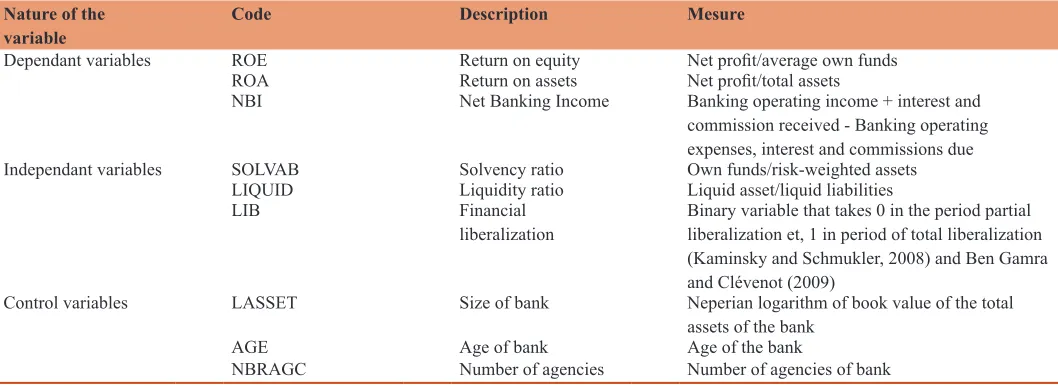
The explanatory variables that we will analyze are derived from the theoretical and empirical literature which focused on the assessment of the contribution of liberalization to the improvement of banking performance and the role of prudential regulation (external mechanism of banking governance) in the management discipline and the monitoring of bank performance (Table 1). 3.2.1. Dependant variables: Banking performance
In this study, we will introduce there banking performance variables: Accounting performance (ROA and ROE) and net banking income (NBI) (Adams and Mehran, 2002; Pinteris, 2002; Kwan, 2003; Capiro et al., 2004).
1. An accounting measure of performance (ROA) represented by the ROA calculated by the following formula: (Net profit/ total assets).
2. A second accounting measure of performance (ROE) represented by the ROE calculated by the following formula: (Equity/total assets).
3. We therefore retain a third indicator of bank profitability, it is the NBI which is none other than the gross margin generated by all the banking activities (banking operations and related operations to the bank’s operations).
We also try to study two regulatory variables that may have an impact on the performance of Tunisian banks listed on the Tunis stock exchange.
3.2.2. Governance variables
The governance variables selected in this study are thus related to external mechanisms: solvency ratio and liquidity ratio (Table 1). 3.2.2.1. Solvency ratio
The solvency ratio allows us to describe the ability of the company to meet its long-term financial obligations and to withstand economic adversity. This ratio, which is defined by the ratio between the own fund and the total risk-weighted assets, requires the bank to have a minimum amount of capital proportional to their credit risk. In accordance with Tunisian law, this solvency ratio should be greater than or equal to 8%, which means that the
equity should cover more than or equal to 8% of the weighted assets. The legislation imposes compliance with this ratio because of the benefits it brings to the bank and the economic cycle of the country and in particular the security of the depositors.
In our analysis, we define the solvency ratio (SOLVAB) by the ratio between the equity and the total commitments due to lack of data concerning the risks incurred by Tunisian banks and to the extent or the risks incurred for banks can be summed up mainly in the receivables of customers.
3.2.2.2. Liquidity ratio
This ratio determines the ability of firms to meet short-term commitments, that is, the ability of the company to settle its liabilities in the short term. It is defined by the ratio between liquid asset and liquid liability. According to Tunisian regulations, this ratio must be >100%. All banks must respect this rule because it allows them more security in the financing of these debts in the short term. In our study, the liquidity ratio will be represented by the variable (LIQUID).
3.2.3. Liberalization variable
With regard to liberalization, we limit our study to the liberalization of the domestic financial sector. It is a binary variable that takes the value 1 when liberalization is total and 0 when liberalization is partial (LIB). Thus, liberalization is considered total when there is no control over interest rates on debtors and creditors and when there is no control over loans, reserves and the entry of banks. It is considered partial when there is no control over interest rates on accounts receivable and payables or when there is no control over loans, reserves and the entry of banks (Table 1).
3.2.4. Control variables
We also include in the models built three control variables namely: • The size of the bank represented by the LASSET variable is
measured by the natural logarithm of the book value of its total assets at the end of the financial year. The logarithmic transformation avoids the scale problem that may result from the huge difference with the measurements of the other model variables. This measure is used in several studies such
Table 1: Variables description
Nature of the
variable Code Description Mesure
Dependant variables ROE Return on equity Net profit/average own funds
ROA Return on assets Net profit/total assets
NBI Net Banking Income Banking operating income + interest and commission received - Banking operating expenses, interest and commissions due
Independant variables SOLVAB Solvency ratio Own funds/risk-weighted assets
LIQUID Liquidity ratio Liquid asset/liquid liabilities
LIB Financial
liberalization Binary variable that takes 0 in the period partial liberalization et, 1 in period of total liberalization (Kaminsky and Schmukler, 2008) and Ben Gamra and Clévenot (2009)
Control variables LASSET Size of bank Neperian logarithm of book value of the total assets of the bank
AGE Age of bank Age of the bank
as Mak and Ong (1999), Godard (2001) and Fernandez and Arrondo (2002), Belkhir (2006). It is also used by Kwan (2003), who finds that the size of the bank has a positive and significant effect on its profitability suggesting the existence of economies of scale. It confirms this result by distinguishing between listed and unlisted banks. Other authors (Boyd and Runkle, 1993; Pinteris, 2002; Adams and Mehran, 2003) also find that performance is positively associated with the size of the bank. These authors state that as the size of the bank increases, the likelihood of bankruptcy decreases and performance improves.
• Age of the bank represented by the variable AGE, this variable measures the degree of maturity of the bank.
• Number of agencies represented by the variable NBRAGC, indeed the number of agencies reflects the extent of the bank’s activities and its degree of success. The larger the bank’s network, the more it will be lucky to market its products and subsequently increase its turnover.
4. MODELS ESTIMATION
The objective of this paper is to examine the effect of prudential regulation in the new framework of total financial liberalization on the performance of Tunisian commercial banks.
To achieve this goal, we have adopted three specifications of banking performance (ROA, ROE and NBI). For each specification, we first modeled the effect of the three variables selected (regulatory liquidity ratio, solvency ratio, liberalization) on performance. Then, in a second step, we combined the regulatory variables with the liberalization variable in order to identify the effect of liberalization on the impact of regulation on bank performance.
Our models are in the following form:
Performance = f (prudential ratios, liberalization, control variable)
a. Return on equity: ROE
ROE = α+β1 SOLVAB+β2LIQUID+β3LIB+β4LASSET+β5AGE +β6NBRAGC+ɛi
ROE = α+β1SOLVAB+β2LIQUID+β3LIB+β4LIB*SOLVAB+β5LI B*LIQUID+β6LASSET+β7AGE+β8NBRAGC+ɛi
b. Return on assets: ROA
ROA = α+β1SOLVAB+β2LIQUID+β3LIB+β4LASSET+β5AGE+ β6NBRAGC+ɛi
ROA = α+β1SOLVAB+β2LIQUID+β3LIB+β4LIB*SOLVAB+β5LI B*LIQUID+β6LASSET+β7AGE+β8NBRAGC+ɛi
c. Net banking income: NBI
NBI = α+β1SOLVAB+β2LIQUID+β3LIB+β4LASSET+β5AGE+ β6NBRAGC+ɛi
NBI = α+β1SOLVAB+β2LIQUID+β3LIB+β4LIB*SOLVAB+β5LI B*LIQUID+β6LASSET+β7AGE+β8NBRAGC+ɛi
4.1. Presentation of Sample
To validate the link between liberalization, regulation and bank performance, we relied on a sample of ten Tunisian commercial banks that are listed on the Tunisian stock exchange. The data are collected from the financial statements and stock market data published by the Financial Market Council and the Professional Association of Tunisian Banks, activity reports published by the banks of the sample at website: “www. bvmt.com.tn” and, failing this, via direct contact and consultation of the services concerned. The study period is spread over 22 years from 1990 to 2011 (220 observations). Our goal is to identify the effect of liberalization and banking governance (regulation) on the performance of these banks.
4.2. Descriptive Statistics
Based on Table 2, we can see the following:
The Tunisian commercial banks studied recorded an average ROE of 18.57%. In addition, this variable has a high variability of 112%, which shows a large fluctuation around the average. As for the ROA, its average is equal to 1.23%. This indicates that the accounting performance of the banks studied is relatively high. Similarly, we note a low dispersion of the variables 4.42%, so the observations are homogeneous. Regarding NBI, the average value recorded is 4.25%. The standard deviation is low (1.06%), so the observations are always homogeneous.
Regarding the application of prudential rules in the Tunisian banking sector, we note that most banks comply with the new regulatory ratios introduced by the public authorities. Indeed, the solvency ratio, which must be greater than or equal to 8%, according to the standards, is on average equal to 13.82% with a minimum value equal to 2.6% and a maximum value of 29.64%. Hence we can say that most Tunisian banks respect the solvency ratio. Volatility is low, so the sample is homogeneous. In addition, the liquidity ratio of these banks averages 122.58%. This ratio varies between 280.04% and 14.24%. It can be seen that most banks do not meet the 100% minimum liquidity ratio required by regulators. This means that Tunisian banks are in difficult conditions affecting their liquidity. These banks are not immune to the liquidity crisis. Regarding the size of the banks, it is on average equal to 14,409830 thousand dinars, which means that Tunisian commercial banks are small compared to foreign commercial banks (IMF, 1998). For example, in France, the average total assets of the 15 largest commercial banks calculated from 1997 to 2002 amounted to 199,213780 Miller Euros. Regarding age, we note that the average age of the banks in our sample is 32 years with a maximum age of 54 years and a minimum age of 3 years, this means that Tunisian commercial banks have a certain degree maturity and have acquired a level of approvable experience. Finally, we find that the average number of agencies is 85 with a maximum of 179 and a minimum of 17 thus, the network of banks in our sample is quite small compared to foreign banks and in particular European banks.
5. REGRESSION RESULTS
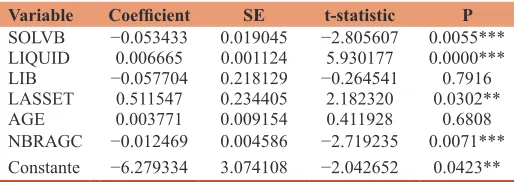
The results presented in Table 3 allow us to confirm the significant effect of regulatory ratios on bank performance (ROE). Thus, the solvency ratio has a negative and significant effect on bank performance. Our results thus converge with those of Icard (2002) and Cartapanis (2003) who argued that prudential regulation does not improve the security of the financial system. Similarly, these results are in the same vein of Minsky (1996) who shows that a institutional environment is a favorable ground for the emergence of a crisis.
While the liquidity ratio has a positive effect on banking performance (ROE). For this purpose, our hypothesis H1-1 is validated. Indeed, the regulatory ratios introduced by the public authorities have as their main objective the limit of the risk taking (following the granting of credits) and the supervision of the banks to ensure the solidity and the performance of the banking sector. Thus, the regulatory requirements are considered positive and resulting in an increase in the market capitalization of banks. Our results converge with those of Menkhoff and Suwanaporn (2007), Currie (2006); Booth et al. (2002) and Mehram (2004) who have shown that good banking governance (apprehended through prudential regulation) can be considered as a factor of sustainable growth of the economy. Our results also converge with those of Caprio et al. (2004) who have shown that good governance (seen from the perspective of prudential regulation) is the guarantor of efficient allocation of savings.
Regarding liberalization, it seems to have a negative, but not significant, effect on the banking performance measured by the ROE. This allows us to reverse our hypothesis H2-1. These results diverge from those obtained by Barajas et al. (1999), Fisher and Chenard (1997) and Herme and Nhung (2007) who have shown the significant effect of financial liberalization on banks’ performance. This divergence can be explained by the specificity of the Tunisian banks under study.
Lastly, we note that the variable LASSET has a significant and positive effect on bank accounting performance (ROE). While the NBRAGC variable has a significant but negative effect on ROE.
• The effect of regulation combined with total liberalization on banking performance (ROE).
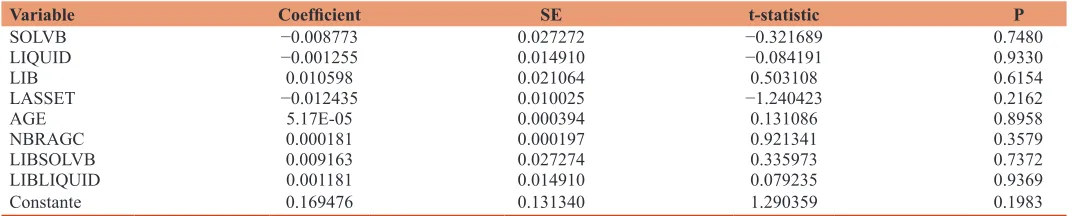
In what follows we try to estimate the effect of prudential regulation on the banking performance measured by the ROE in a framework of total liberalization for the Tunisian commercial banks. Regarding the effect of the liquidity regulatory ratio on performance from the date of full liberalization, it is not significant. As for the solvency regulatory ratio, it also proves that the effect
of this solvency ratio on ROE from the date of full liberalization is no longer significant. Our hypothesis H3-1 is therefore invalidated. Thus, in a framework of total liberalization, the governance mechanisms no longer pursue their role of channeling the banking activity (discipline the behavior of the leader so that it acts in the interests of the shareholders, protects the depositors, avoids the risks and controls the performance of banks). Our results are in line with those of Noy (2004) who, conducting an empirical investigation on a panel of 61 countries over the period 1975–1997, asserts that financial liberalization conducted with lax prudential regulation has favored excessive risk taking by banks (Table 4). b. The effect of liberalization and regulation on banking
performance (ROA)
The regression of governance and liberalization variables on the accounting performance of Tunisian commercial banks (ROA) allowed us to confirm the insignificant effect of regulatory ratios on bank performance. Our results diverge from those of Icard (2002), and Cartapanis (2003) and Caprio et al. (2004) who have argued that prudential regulation has a significant effect on bank performance. For this purpose, our hypothesis H1-2 is invalidated (Table 5). Regarding liberalization, it seems to have no significant effect on bank performance. This allows us to reverse our hypothesis H2-2. These results differ from those reported by Lensink and Hermes (2003) and Bouzidi (2010) who showed the significant effect of financial liberalization on bank performance. This divergence can be explained by the specificity of the Tunisian banks under study. Finally, we also note that the variables LASSET, AGE and NBRAGC do not have a significant effect on the bank accounting performance measured by the ROA.
• The effect of the regulation combined with the total liberalization on banking performance (ROA).
In what follows we try to estimate the effect of the prudential regulation on the accounting performance (ROA) in a framework
Table 3: The effect of prudential regulation and liberalization on ROE
Variable Coefficient SE t-statistic P
SOLVB −0.053433 0.019045 −2.805607 0.0055*** LIQUID 0.006665 0.001124 5.930177 0.0000*** LIB −0.057704 0.218129 −0.264541 0.7916 LASSET 0.511547 0.234405 2.182320 0.0302**
AGE 0.003771 0.009154 0.411928 0.6808
NBRAGC −0.012469 0.004586 −2.719235 0.0071*** Constante −6.279334 3.074108 −2.042652 0.0423**
***Significance at 1%, ** significance at 5%, * significance at 10%
Table 2: Descriptive statistics
Sample of 10
commercial banks ROE ROA NBI SOLVB LIQUID LIB LASSET AGE NBRAGC
Mean 0.185753 0.012374 0.042537 0.138209 1.225897 0.715828 14.409830 32.52273 85.19091
Median 0.064945 0.079662 0.042702 0.119257 1.104774 1.000000 14.385860 34.00000 82.00000
Maximum 00.68000 0.6098 0.097821 0.29730 2.8004 1.000000 15.792130 54.00000 179.0000
Minimum −0.741490 −0,103505 0.010034 0.002600 0.142434 0.000000 12.628870 3.000000 17.00000
SD 1.126328 0.044265 0.010687 0.119257 0.398981 0.466833 0.6849510 11.28196 34.63126
Observations 220 220 220 220 220 220 220 220 220
of total liberalization for the Tunisian commercial banks. From the Table 6, we find that the regulatory solvency ratio and the regulatory liquidity ratio do not have a significant effect on accounting performance from the date of full liberalization of the financial sector in Tunisia. These results suggest that the liberalization process initiated in Tunisia for the financial sector affects the role played by external governance mechanisms in monitoring and maintaining bank performance. These results are similar to those of Menkhoff and Suwanaporn (2007) who point out that financial liberalization in an underdeveloped institutional environment accentuates the proliferation of banking crises. Our hypothesis H3-2 is therefore invalidated. Thus, in a framework of total liberalization, the governance mechanisms have weaknesses in the determination of the performance.
c. Effect of prudential regulation and liberalization on banking performance (NBI).
Referring to the results shown in the Table 7, we can confirm the significant and positive effect of the regulatory solvency ratio on the NBI. Our hypothesis H1-3 is validated. these results converge with those of Menkhoff and Suwanaporn (2007), Currie (2006); Booth et al. (2002) and Mehram (2004) who have shown that good banking governance (apprehended through prudential regulation)
can be considered as a factor of sustainable growth of the economy. Our results also converge with those of Caprio et al. (2004) who have shown that good governance (seen from the perspective of prudential regulation) is the guarantor of efficient allocation of savings. However, the liquidity ratio has a negative effect on NBI. Our results converge with those of Icard (2002) and Cartapanis (2003) who argued that prudential regulation does not improve the security of the financial system.
Regarding liberalization, it has a significant and positive effect on the NBI. This allows us to confirm our hypothesis H2-3. These results corroborate those found by Hermes and Nhung (2007), Demerguc-Kunt and Huizinga (2001), Barajas et al. (1999) and Fisher and Chenard (1997) who showed the significant and positive effect of liberalization on bank performance. Similarly, our results converge with those of Lim (2012) who, based on a sample of nine universal banks in the Philippines from 2003 to 2011, showed that financial liberalization brought greater competition, improvement of efficiency and less concentration of the market. Our results are however divergent from those found by Djlassi et al. (2011) who, based on a sample of 9 Tunisian banks during the period 1980–2009, showed the existence of a negative and significant relationship between financial liberalization and the profitability of the bank measured by net interest margin.
Table 4: The effect of regulation combined with total liberalization on ROE
Variable Coefficient SE t-statistic P
SOLVB 0.135769 0.642435 0.211334 0.8328
LIQUID 0.133972 0.351235 0.381430 0.7033
LIB 0.132188 0.496206 0.266398 0.7902
LASSET 0.506006 0.236147 2.142757 0.0333**
AGE 0.003687 0.009284 0.397129 0.6917
NBRAGC −0.012663 0.004632 −2.733468 0.0068***
LIBSOLVB −0.188844 0.642486 −0.293927 0.7691
LIBLIQUID −0.127293 0.351233 −0.362419 0.7174
Constante −6.368439 3.093947 −2.058354 0.0408**
***Significance at 1%, ** significance at 5%, * significance at 10%
Table 5: The effect of liberalization and regulation on ROA
Variable Coefficient SE t-statistic P
SOLVB 0.000388 0.000808 0.480389 0.6314
LIQUID −7.32E-05 4.77E-05 −1.534411 0.1264
LIB 0.013973 0.009258 1.509318 0.1327
LASSET −0.012438 0.009949 −1.250248 0.2126
AGE 3.75E-05 0.000389 0.096619 0.9231
NBRAGC 0.000179 0.000195 0.919047 0.3591
Constante 0.166851 0.130472 1.278829 0.2023
***Significance at 1%, ** significance at 5%, * significance at 10%
Table 6: The effect of the regulation combined with the total liberalization ROA
Variable Coefficient SE t-statistic P
SOLVB −0.008773 0.027272 −0.321689 0.7480
LIQUID −0.001255 0.014910 −0.084191 0.9330
LIB 0.010598 0.021064 0.503108 0.6154
LASSET −0.012435 0.010025 −1.240423 0.2162
AGE 5.17E-05 0.000394 0.131086 0.8958
NBRAGC 0.000181 0.000197 0.921341 0.3579
LIBSOLVB 0.009163 0.027274 0.335973 0.7372
LIBLIQUID 0.001181 0.014910 0.079235 0.9369
Constante 0.169476 0.131340 1.290359 0.1983
Finally, we note that the variable LASSET has a significant and negative effect on NBI. Whereas the AGE has a significant positive effect on the NBI. Thus, the degree of maturity of the bank and the seniority favor its performance.
• The effect of the regulation combined with total liberalization on banking performance (NBI).
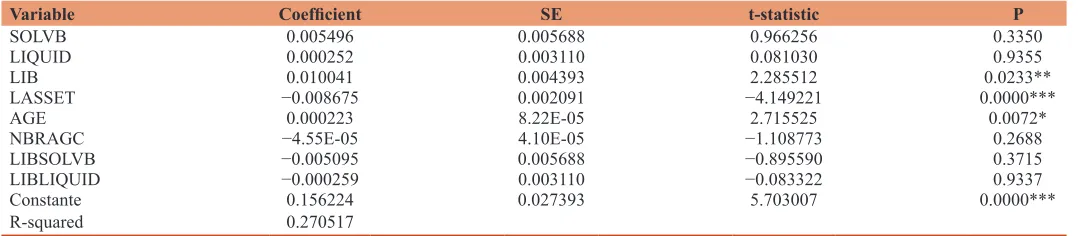
In what follows we try to estimate the effect of the prudential regulation on the net banking product in a framework of total liberalization for the case of the commercial Tunisian banks. Referring to the results shown in the Table 8, it can be confirmed that the effect of the liquidity regulatory ratio on performance (NBI) from the date of liberalization is no longer significant. In addition, the effect of the solvency regulatory ratio from the date of full liberalization is no longer significant. Thus, from the date of liberalization, the solvency ratio no longer contributes to the determination of NBI. Our hypothesis H3-3 is invalidated. Thus, in a framework of total liberalization, the governance mechanisms stop playing their disciplinary role in the determination of the performance. As for the liberalization variable, it has a significant and positive effect on NBI. The variables LASSET and NBRAGC respectively have a significant negative effect and a no significant positive effect on the NBI.
6. CONCLUSION
The purpose of this paper was to know if a policy of financial liberalization, in order to promote financial development and growth, is pleasant for any economic and institutional environment and if financial liberalization does not affect the role of banking governance (prudential regulation) in determining bank performance. Empirical validation from a sample of ten quoted Tunisian commercial banks, observed over a period stretching from 1990 to 2011, suggest that, starting from the date of full
liberalization, regulatory ratios no longer continue to ensure their role of channeling banking activity and improving bank performance. These results suggest that the process of financial liberalization is not adapted to the specificities of Tunisian banks as it weakens the role of this governance mechanism in determining bank performance. These results are of considerable interest to the public authorities, which must ensure the necessary adaptation and progress of the liberalization measures implemented with the specificities of commercial banks in Tunisia. In fact, regulation, which is a governance factor that has often shown its effectiveness and its decisive role of prevention against crises, is proving to be ineffective and without any effect on performance.
Our study differs from previous studies in studying the impact of regulation on the performance of Tunisian commercial banks in a context of liberalization. It is relevant for both policy makers and shareholders and bank managers in terms of the liberalization process that has begun and reached its final stage and the regulatory constraints that appear in this new liberalization framework, which is both cumbersome and non-performing. We used different ratios for measuring regulation as well as the performance of banks. However, despite the considerable contribution of this research, it is far from limitless. One of these limits concerns the sample chosen, which is closely linked to the specificities of the research since we aim to study the commercial banking sector in Tunisia, which is limited to ten. However, while the analysis in this area seems relevant, it does not allow us to generalize the results to other developing countries. Comparative analysis with other developing countries or with other types of banks (Islamic) to extend or narrow the scope of our results. Only new research can decide the question. Another limitation is the proposed measures of performance, which are far from exhaustive. Other measures could possibly enrich the explanatory power of our models.
Table 7: The effect of prudential regulation and liberalization on NBI
Variable Coefficient SE t-statistic P
SOLVB 0.000404 0.000169 2.393468 0.0176**
LIQUID −7.53E-06 9.96E-06 −0.755592 0.4507
LIB 0.008629 0.001934 4.461772 0.0000***
LASSET −0.008694 0.002078 −4.183342 0.0000***
AGE 0.000232 8.12E-05 2.857076 0.0047***
NBRAGC −4.48E-05 4.07E-05 −1.100683 0.2723
Constante 0.157548 0.027256 5.780236 0.0000***
***Significance at 1%, ** significance at 5%, * significance at 10%
Table 8: The effect of the regulation on NBI combined with total liberalization
Variable Coefficient SE t-statistic P
SOLVB 0.005496 0.005688 0.966256 0.3350
LIQUID 0.000252 0.003110 0.081030 0.9355
LIB 0.010041 0.004393 2.285512 0.0233**
LASSET −0.008675 0.002091 −4.149221 0.0000***
AGE 0.000223 8.22E-05 2.715525 0.0072*
NBRAGC −4.55E-05 4.10E-05 −1.108773 0.2688
LIBSOLVB −0.005095 0.005688 −0.895590 0.3715
LIBLIQUID −0.000259 0.003110 −0.083322 0.9337
Constante 0.156224 0.027393 5.703007 0.0000***
R-squared 0.270517
REFERENCES
Adams, R., Mehran, H. (2002), Is corporate governance different for bank holding companies? Economic Policy Review, Federal Reserve Bank of New York, 9(1), 123-142.
Aizenman, J. (2002), Financial Opening: Evidence and Policy Option. National Bureau of Economic Research University of Chicago Press. Available from: http://www.nbr.org/chapters/c9547.
Angkinand, A.P., Sawangngoenyuang, W., Wihlborg, C. (2010), Financial liberalization and banking crises: A cross-country analysis. International Review of Finance, 10(2), 263-292.
Barajas, A., Steiner, R., Salazar, N. (1999), The impact of liberalization and foreign investment in Colombia’s financial sector. Journal of Development Economics, 63(1), 157-196.
Barth, J., Capiro, G.J., Levine, R. (2004), Bank regulation and supervision: what works best? Journal of Financial Intermediation, 13, 205-248. Barth, J.R., Capiro, G.J., Levine, R. (2001), Banking system around the
globe do regulation and ownership affect performance and stability? National Bureau of Economic Research, Available from: http://www. nber.org/chapters/c10757.
Bekaert, G., Harvey, C.R., Lundblad, C. (2005), Does financial liberalization spur growth? Journal of Financial Economics, 7, 3-55. Belkhir, M. (2006), Board Structure, Ownership Structure, and Firm
Performance: Evidence from Banking. Working Paper of University of Orléans. France. Available from: http://www.halshs.archives-ouvertes.fr/halshs-00009115.
Ben Gamra, S., Clévenot, M. (2008), Les Effets Ambigus De La Libéralisation Financière Dans Les Pays En Développement, Croissance, Croissance Economique Ou Instabilité Financière. Working Paper. Available from: https://www.hal.archives-ouvertes. fr/hal-00323334.
Boot, A.W.A., Thakor, A.V. (1993), Self-interested bank regulation. The American Economic Review, 83(2), 206-212.
Booth, J.R., Cornett, M.M., Tehranaian, H. (2002), Boards of directors, ownership, and regulation. Journal of Banking and Finance, 26, 1973-1996.
Bouzidi, F. (2010), Consequence of the foreign bank implantation in developing countries and its impact on the local bank efficiency: Theoretical analysis and empirical tests on international data. International Journal of Economics and Finance, 2(5), 1-14. Boyd, J.H., Runkle, D.E. (1993), Size and performance of banking firms:
Testing the predictions of theory. Journal of Monetary Economics, 31(1), 47-67.
Capiro, G. Jr., Levine, R. (2002), Corporate governance in finance: Concepts and international observations. In: Litan, R.E., Pomerleano, M., Sundararajin, V., editors. Financial Sector Governance: The Roles of Public and Private Sectos. Washington, DC: The Brookings Institution. p17-50.
Caprio, G. Jr., Laeven, L., Levine, R. (2007), Governance and Bank Valuation, World Bank Policy Research, Janvier. Working Paper, No. 3202.
Caprio, G., Laeven, L., Levine, R. (2004), Governance and bank valuation. World Bank, Policy Research, Working Paper No. 3202, Fevrier, 1-47.
Cartapanis, A. (2003), Vers une prévension macro-prudentielle des crises financières internationales. Revue D’économie Financière, 70, 89-100.
Celik, A.E., Karatepe, Y. (2007), Evaluating and forecasting banking crises through neural network models: An application for Turkish banking sector. Expert Systems with Applications, 33(4), 809-815. Cornett, M.M., McNutt, J.J., Tehranian, H. (2009), Corporate governance
and earnings management at large US bank holding companies. Journal of Corporate Finance, 15(4), 412-430.
Currie, C. (2006), A new theory of financial regulation: Predicting, measuring and preventing financial crises. The Journal of Socio Economics, 35(1), 48-71.
Demerguc-Kunt, A., Huizinga, H. (1999), Determinants of commercial bank interest margins and profitability: Some international evidence. World Bank Economic Review, 13, 379-400.
Demerguc-Kunt, A., Huizinga, H. (2001), In: Asli, D., Rose, L., editors. Financial Structure and Bank Profitability in Financial Structure and Economic Growth: A Cross-country Comparison of Banks, Markets and Development. Cambridge, MA: MIT Press.
Demirgüç-Kunt, A., Detragiache, E. (1999), Financial Liberalization and Financial Fragility. In: Pleskovic, B., Stiglitz, J., editors. Proceedings of the Annual World Bank Conference on Development Economics. Washington, D.C: The World Bank. p332-334.
Demirgüç-Kunt, A., Detragiache, E., Tressel, T. (2008), Banking on the princiaples: Compliance with Basel core principles and bank soundness. Journal of Financial Intermediation, 17, 511-542. Diaz, A.C. (1985), Good-Bye Financial Repression, Hello Financial
Crash. Working Paper No. 441.
Djlassi, M., Hakimi, A., Hadi, H. (2011), Financial liberalization and banking profitability: A panel data analysis for Tunisian Banks. International Journal of Economics and Financial Issues, 1(2), 19-32. Federici, D., Caprioli, F. (2009), Financial development and growth an
empirical analysis. Econoic Modelling, 26(2), 285-294.
Fernandez, C., Arrondo, R. (2002), Alternative Internal Controls as Substitute of the Board of Directors. Available from: http://www. acede2003.org/archivos/217.pdf.
Fisher, K.P., Chenard, M. (1997), Financial Liberalization Causes Banking System Fragility. Centre Multifacultaire de Recherche en Economie e Finance Appliqué (CREFA). Faculté des Sciences De l’administration Université Laval. Available from: https://www.fsa. ulaval.ca/rd.
Galbis, V. (1977), Financial intermediation and economic growth in less-developed countries: A theoretical approach. Journal of Development Studies, 13, 58-72.
Giannetti, M. (2007), Financial liberalization and banking crises: The role of capital inflows and lack of transparency. Journal of Financial Intermediation, 16(1), 32-63.
Godard, L. (2001), La taille du conseil d’administration: Determinants et impact sur la performance. Revue Sciences de Gestion, 33, 125-148. Gonz´alez-Hermosillo, B. (1999), Determinants of Ex-ante Banking
System Distress: A Macro-micro Empirical Exploration of some Recent Episodes. Working Paper No. 99/33, IMF.
Gonzalez-Hermosillo, B., Pazarbasioglu, C., Billings, R. (1997), Determinants of banking system fragility: A case study of Mexico. Staff Papers International Monetary Fund, 44(3), 295-314. Herme, N., Nhung, V.T.H. (2007), The impact of financial liberalization
on bank efficiency: Evidence from Latin America and Asia. Applied Economics, 42(26), 3351-3365.
Heremans, D. (1999), Regulation of Banking and Financial Markets. Center of Economic Studies, and of Law and Economics, the law School of the Catholic University of Leuven. p950-986.
Hermes, N., Meesters, A. (2015), Financial liberalization, financial regulation and bank efficiency: A multi-country analysis. Applied Economics, 47(21), 2154-2172.
Icard, A. (2002), Stabilité Financière et Control Prudentiel; Colloque BEAC, Rôle et Fonction D’une Banque Centrale à l’ère de la Globalisation. Libreville, Novembre, 1-11.
International Monetary Fund. (1998), Tunisia: Banking System Issues and Statical Appendix. Washington, DC: IMF Staff Country Report No. 98/129.
Economic, 3(4), 305-360.
Jensen, M.C., Murphy, K.J. (1990), Performance pay and top-management incentives. Journal of Political Economy, 98(2), 225-264.
Kaminsky, G., Schmukler, C. (2001), On Booms and Crashes: Financial Liberalization and Stock Market Cycles. Washington DC: The World Bank. Policy Working Paper No. 2565.
Kaminsky, G.L., Reinhart, C.M. (1996), The Twin crises: Causes of banking and balance-of-payments problems. The American Economic Review, 89(3), 473-500.
Kaminsky, G.L., Schmukler, S.L. (2008), Short-run pain, long-run gain: The effects of financial liberalization. Review of finance, Oxford Universitypress for European Finance Association, 12(2), 253-292. Kapur, B. (1976), Alternative stabilization policies for less-developed
economies. Journal of Political Economy, 84(4), 777-795.
Kim, H.E. (2005), Domestic Financial Liberalization, Stabilizing Effects of Foreign Bank Entry, and Challenges to Bank Supervision: The Korean Experience. Working Paper.
Klaus, P.F., Martin, C. (1997), Financial Liberalization Causes Banking System Fragility. p32. Available from: http://www.ssrn.com/ abstract=25537.
Kwan, S.H. (2003), Operating performance of banks among Asian economies: An international and time series comparaison. Journal of Banking and Finance, 27(3), 471-489.
Lensink, R., Hermes, N. (2003), The short-term effects of foreign bank entry on domestic bank behavior: Does economic development matter? Journal of Banking and Finance, 27, 98-110.
Lim, E. (2012), A study on credit interest margin and effeciency ratios of selected universal banks in the Philippines for the year 2010. International Journal of Information Technology and Business Management, 2(1), 16-25.
Llewellyn, D. (1999) The economic rationale for financial regulation. Financial Services Authority Occasional Paper Series, 1, 57. Macey, J.R., O’Hara, M. (2003), The corporate governance of banks.
Economic Policy Review: Federal Reserve Bank of New York, 9(1), 91-108.
Mak, Y., Ong, P. (1999), Changes in Ownership Structure and Board
Structure after an Initial Public Offering. Available from: http:// www.papers.ssrn.com.
Mathieson, D. (1980), Financial reform and stabilization policy in a developing economy. Journal of Development Economics, 7(3), 359-395.
McKinnon, R.I. (1973), The Order of Economic Liberalization Financial Control in the Transition to a Market Economy. 2nd ed. Baltimore
and London: The Johnes Hopkins University Press.
Mehram, H. (2004), Corporate governance in the banking and financial services industries. Journal of Financial Intermediation, 13(1), 1-5. Menkhoff, L., Suwanaporn, C. (2007), 10 years after the crisis: Thailand’s
financial system reform. Journal of Asian Economics, 18(1), 4-20. Minsky, H.P., (1996), Uncertainty and the institutional structure of
capitalist economices. Journal of Economic Issues, 30(2), 357-368. Miotti, L., Plihon, D. (2001), Libéralisation financière, spéculation et
crises bancaires. Economie Internationale, 85, 156.
Noy, I. (2004), Financial liberalization, prudential supervision, and the onset of banking crises. Emerging Market Review, 5, 341-359. Peter, O.M. (2010), Corporate Governance of Banks after the Financial
Crisis Theory, Evidence, Reforms Law Working Paper No. 130/2009 University of Mainz and ECGI. Available from: http://www.ssrn. com/abstract=1448118.
Pinteris G, (2002), Ownership Structure, Board Characteristics and Performance of Argentine Banks. Mmeo: Department of Economics, University of Llinois.
Prowse, S.D. (1995), Alternative methods of corporate control in commercial banks. Economic Review Federal Reserve Bank of Dallas, 24, 24-36.
Reinhart, C., Tokatlidis, I. (2005), Before and after Financial Liberalization. Personal RePEc Archive Paper No. 6986. Germany: University of Munich. Available from: http://www.ideas.repec.org/p/ pra/mprapa/6986.html.
Roe, M.J. (1994), Strong Managers Weak Owners. The Political Roots of American Corporate, Finance. Princeton, N.J: University Press. Shaw, E.S. (1973), Financial Deepening in Economic Development.