Issues
ISSN: 2146-4138
available at http: www.econjournals.com
International Journal of Economics and Financial Issues, 2015, 5(Special Issue) 92-97.
2nd AFAP INTERNATIONAL CONFERENCE ON ENTREPRENEURSHIP AND BUSINESS MANAGEMENT (AICEBM 2015), 10-11 January 2015, Universiti Teknologi Malaysia, Kuala Lumpur, Malaysia.
Impact of Consumption Values on Consumer Environmental
Concern Regarding Green Products: Comparing Light, Average,
and Heavy Users’
Norazah Mohammed Suki
1*, Norbayah Mohammed Suki
21Labuan Faculty of International Finance, Universiti Malaysia Sabah, Labuan International Campus, Federal Territory of Labuan,
Sabah, Malaysia, 2Faculty of Computing & Informatics Science, Universiti Malaysia Sabah, Labuan International Campus, Federal
Territory of Labuan, Sabah, Malaysia. *Email: [email protected]
ABSTRACT
This study seeks to investigate the association of consumer consumption values (i.e., functional value, social value, and epistemic value) with consumer environmental concern regarding green products among light users, average users, and heavy users. This study applies a quantitative method based on the development of a structured self-administered questionnaire. Data was analyzed via correlation analysis and one-way analysis of variance utilizing Statistical Package for Social Sciences computer programme version 21. Results revealed that statistically significant differences were observed among the light users, average users and heavy users in terms of functional value, social value, and epistemic value that affect consumer environmental concern regarding green products. The results of this study furnish new momentum for the preceding discoveries on consumer environmental concern regarding green products, which are inadequately covered in the Malaysian context. The results provide important information and encourage companies to put more emphasis on functional value, social value, and epistemic value in order to boost consumer environmental concern regarding green products, which could assist the manufacturers in producing green products that will be readily liked by consumers.
Keywords: Green Product, Consumption Value, Environmental Concern, Structural Equation Modelling
JEL Classifications: M000
1. INTRODUCTION
Consumer environmental concern regarding green products appear when they using products that do not detrimentally affect human health or natural environmental wellbeing, include recycled components. Earlier research on green product purchase was examined in various geographical domains. In Korea, Oliver and Lee (2010) found that the purchase decision of Korean drivers’ in buying hybrid cars is influenced by factors such as perceived information quality, perceived social value, and self-image congruence. Another green product purchase research study investigated among Taiwanese noted that older buyers recognize green products to have high quality, and green consumption
could contribute to the development of environmental quality (Tsay, 2010; Qureshi et al., 2014).
benefits of using the green products, and encouraging them to choose green products in preference to non-green products in their daily lifestyle (Rasli et al., 2014).
This paper is prepared as follows: The ensuing section reviews related literature with proposed hypotheses. Methodology and data analysis are elaborated in sections three and four, respectively. This is followed by discussion of findings. The conclusion and directions for future research are presented in the final section.
2. LITERATURE REVIEW
2.1. Theory of Consumption ValuesThe theory of consumption values clarifies that consumer choice is a function of various consumption values i.e., functional value, social value, and epistemic value, which offer diverse influences in their decision making. Prior research by Sweeney and Soutar (2001) used functional value, and social value to develop a perceived value scale to measure consumer perceived value of a durable product brand.
2.2. Functional Value
Functional value is allied to the “perceived utility acquired from an alternative’s capacity for functional, utilitarian or physical performance and was thought to be generated by a product’s salient attributes” (Sheth et al., 1991. p. 162). Functional value of the green product is influenced by physical performance and functional benefits of the product gained by the consumers. Environmentally conscious consumers prefer to purchase ecological products that use no animal testing, and natural ingredient (Norazah, 2013c). From this, consumers consider quality to influence their decision in purchasing green products as opposed to non-green products. Based on this discussion, the hypotheses are developed as follows:
H1: Functional value positively correlated with consumer environmental concern regarding green products.
2.3. Social Value
Social value: “Perceived utility acquired from an alternative’s association with one or more specific social groups was defined as social value and it was measured through the product association with various reference groups of customers” (Sheth et al., 1991. p. 162). Customer ability to participate in making decisions towards purchasing green products influences their choice behaviour. Consumers who choose to purchase green products are helping to preserve the environment and motivate others to do the same. However, inconvenience and no time are the obstruction to recycling among consumer as noted by Perrin and Barton (2001). Peer opinion plays a role in influencing ones decision to get involved in activities concern on environmentally friendly nature (Straughan and Roberts, 1999) and environmental protection (Kahle, 1996). Thus, this study proposes the following hypothesis:
H2: Social value positively correlated with consumer environmental concern regarding green products.
2.4. Epistemic Value
Epistemic value refers to the “perceived utility acquired from an alternative’s capacity to arouse curiosity, provide novelty, or satisfy a desire for knowledge” (Sheth et al., 1991. p. 162). Consumers purchase a product due to familiarity of the current brand, high curiosity about a new product or willingness to learn about the new product. Knowledge is the main trait that affects the consumers’ decision making process in identifying new product adoption. For instance, consumer actual recycling behaviour is influenced by their knowledge of recycling process (Hanyu et al., 2000). They tend to match the perceived situational characteristics and product features when they choose to purchase products. This improves their problem-solving skills. Therefore, it is posited that:
H3: Epistemic value positively correlated with consumer environmental concern regarding green products.
H4: There were significant differences among the light users, average users and heavy users on the association between consumer consumption values (i.e., functional value, social value, and epistemic value) and consumer environmental concern regarding green products.
Based on the above mentioned literature, Figure 1 models the relationships between functional value, social value, and epistemic value and consumer environmental concern regarding green products.
3. MATERIALS AND METHODS
Respondents were pre-screened and recruited from members of the public in the Federal Territory of Labuan, Malaysia who applied green lifestyle. They were approached at the Labuan Airport Terminal, Labuan Bus Terminal, and Labuan Ferry Terminal during the time of data collection utilizing a purposive sampling method in November 2013 over a period of 2 weeks. After data screening of the responses from the 250 selected respondents, 200 were found to be usable and used in the data analysis, yielding a valid return rate of 83%.
A structured self-administered questionnaire which encompassed two parts is developed to test the proposed hypotheses. Section A contained socio-demographic questions such as gender, age, level of education, frequency of purchasing green product in a month, and source of obtaining green product information. Section B covered questions on the consumers’ perception of green products of which there were 22 items for measuring the instruments: Four-items for functional value, and four-items for social value which were all adapted from Sweeney and Soutar (2001). Next, four items were designed for epistemic value adapted from
H
H H
Hirschman (1980), and ten items for consumer environmental concern adapted from Tarrant and Cordell (1997). All items were measured on a five-point Likert scale ranging from strongly disagree to strongly agree. Data was analyzed using correlation analysis, and one-way analysis of variance (ANOVA) utilizing Statistical Package for Social Sciences computer programme version 21.
4. RESULTS
The socio-demographic characteristics of respondents is presented in Table 1 of which 39.5% of the sample is male and 60.5% is female. More than half of the respondents are in the younger age group from 18 to 24, inferring younger age groups are influenced by choice behaviour and environmental concern regarding purchasing and using green products.
Close to half of the respondents are degree holders. In terms of frequency of purchasing green products in a month, 49.5% of the respondents have purchased green products 1 or 2 times which shows the highest percentage. Meanwhile, 25% of respondents have purchased green products 3 or 4 times. It is clearly shown that 12.5% of respondents have purchased green products 5 to 6 times while 13% of respondents have purchased green products more than 7 times. Regarding source of obtaining green product information, about 34% of the respondents obtaining information regarding green product from friend and family members followed by internet (24%). When compared between television and radio, respondents prefer to rely to television (24%) in obtaining information regarding green product through effective advertisements with convincing message content.
4.1. Reliability Analysis
The reliability of the items was verified using Cronbach’s alpha to evaluate the internal consistency of the constructs. Table 2 presents the results of Cronbach’s alpha whereby all values exceed the starting point of 0.70 in relation to the expected factors (Hair et al., 2010; Nunnally and Bernstein, 1994), denoting strong reliability among the measures.
4.2. Correlations with Consumer Environmental Concern Regarding Green Products
Empirical results as shown in Table 3 specified that functional value, as posited in H1, has significant and positive association with consumer environmental concern regarding green products (r = 0.161, P < 0.01) thus supporting H1, as expected. Next, social value (r = 0.330, P < 0.01) as conjectured in H2 is maintained and had significant and positive correlation with consumer environmental concern regarding green products. Finally, epistemic value revealed a significantly positive link with consumer environmental concern regarding green products (r = 0.401, P < 0.01), inferring H3 is supported. In order of importance, epistemic value is the strongest significant determinant of the consumer environmental concern regarding green products, followed by social value, and functional value.
The skewness of all the items ranged from 0.184 to 1.145, below ±2, while the kurtosis values ranged from 0.105 to 1.548, well below the threshold of ±10. Hence the results signify that the scores approximate a “normal distribution” or “bell-shaped curve.” Means for all constructs ranged from 3.793 to 3.873 on a five-point Likert scale, establishing that the majority of the respondents had a positive perception of environmental concern.
4.3. Impact of Usage Groups on Consumer
Environmental Concern Regarding Green Products
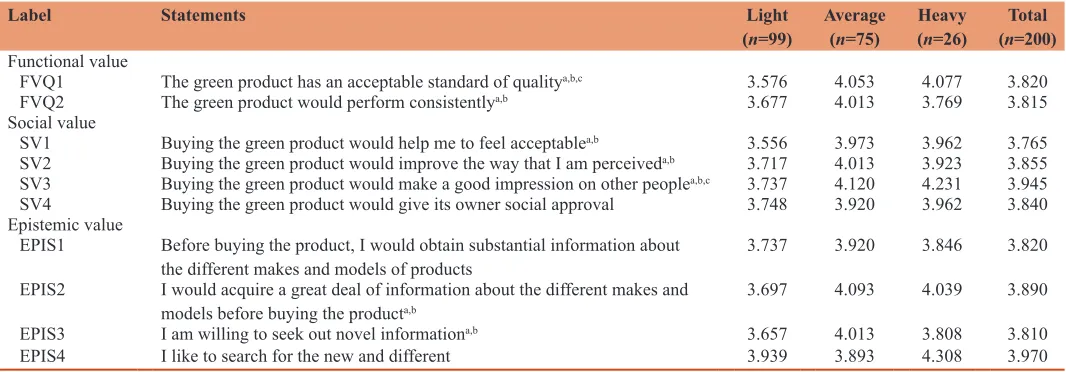
ANOVA was performed to investigate the differences among the light users, average users and heavy users on the association between consumer consumption values (i.e., functional value, social value, and epistemic value) and consumer environmental concern regarding green products. Consumer frequency of purchasing green products is categorized into three usage groups i.e., light users (purchases green products ≤2 times), average users (purchases green products 3-6 times), and heavy users (purchases green products ≥7 times). Turkey’s honestly significant difference (HSD) post-hoc multiple comparisons test statistic was embark on to provide further insights into the differences of the ANOVA. The findings are shown in Table 4 where there were significant mean differences among the light users, average users and heavy users in terms of association between consumption values (i.e. functional value, social value, and epistemic value) and environmental concern regarding green products (P < 0.05), implying H4 is strengthened. Table 1: Socio‑demographic profile of respondents
Characteristics Frequency Percentage
Gender
Male 79 39.5
Female 121 60.5
Age
18-24 122 61.0
25-34 27 13.5
35-44 20 10.0
>45 31 15.5
Education level
SPM 39 19.5
STPM/Matriculation 43 21.5
Degree 88 44.0
Masters 30 15.0
Frequency of purchasing green product in a month
1-2 times 99 49.5
3-4 times 50 25.0
5-6 times 25 12.5
>7 times 26 13.0
Source of obtaining green product information
Friend and family 68 34.0
Television 55 27.5
Radio 14 7.0
Magazine 15 7.5
Internet 48 24.0
Table 2: Reliability analysis
Variables Number
of items items deletedNumber of Cronbach’s alpha
Functional value 4 2 0.746
Social value 4 - 0.824
Epistemic value 4 - 0.805
5. DISCUSSION
This study investigated the association of consumer consumption values (i.e., functional value, social value, and epistemic value) with consumer environmental concern regarding green products among light users, average users, and heavy users. Empirical results revealed that functional value was significantly correlated with consumer environmental concern regarding green products, thus maintaining H1 (Figure 2). This finding coincides with prior studies such as in Norazah (2013c); Sheth et al. (1991). Significant differences occurred across the three usage groups for this construct. The Tukey HSD post-hoc multiple comparisons test showed that differences existed between light users and average users for the item, “FVQ1: The green product has an acceptable standard of quality,” and “FVQ2: The green product would perform consistently.” The mean of average users was greater than light users for these items (Table 4).
Next, Hypothesis 2 tested the association between social value and consumer environmental concern regarding green products. Findings indicate that social value was a significant determinant of consumer environmental concern regarding green products,
confirming H2 (Figure 2). These findings corroborates Straughan and Roberts (1999)’s study. Out of four items in social value factor, heavy users rated highly on item “SV3: Buying the green product would make a good impression on other people” (mean = 4.231), while light users prefer “SV4: Buying the green product would give its owner social approval” (mean = 3.748). Statistically significant differences emerged when comparing the light users with average users, and with heavy users (P < 0.05) for item “SV3: Buying the green product would make a good impression on other people,” as derived from the Tukey HSD post-hoc multiple comparisons test.
Hypothesis 3 tested the link between epistemic value and consumer environmental concern regarding green products. The strength of the association between the two constructs provided evidence for this relationship (Figure 2). Hence H3 is sustained. Table 4 presented that this construct comprised four items. The results of the ANOVA specified that there were significant dissimilarities between the three usage groups (i.e., light users, average users, and heavy users) perception on epistemic value. Further analysis of the items specified that two of the four items had significant differences between the three usage groups, including: “EPIS2: I would acquire a great deal of information about the different makes and models before buying the product,” and “EPIS3: I am willing to seek out novel information,” where the mean of average users was higher than light users. Consumer show concern on the environmental issues when they change their consumption behavior toward going greener and be more environmentally sensitive (Kilbourne and Pickett, 2008). Their knowledge of the eco-labeling of green products influences their decision process in all phases (Laroche et al., 2001; Norazah, 2013a; 2013b; Rex r=0.161*
r=0.330*
r=0.401* *P<0.05
Figure 2: Summaries of correlations
Table 4: Mean comparisons between groups based on frequency of purchasing green products
Label Statements Light
(n=99) Average (n=75) Heavy (n=26) (nTotal =200)
Functional value
FVQ1 The green product has an acceptable standard of qualitya,b,c 3.576 4.053 4.077 3.820
FVQ2 The green product would perform consistentlya,b 3.677 4.013 3.769 3.815
Social value
SV1 Buying the green product would help me to feel acceptablea,b 3.556 3.973 3.962 3.765
SV2 Buying the green product would improve the way that I am perceiveda,b 3.717 4.013 3.923 3.855
SV3 Buying the green product would make a good impression on other peoplea,b,c 3.737 4.120 4.231 3.945
SV4 Buying the green product would give its owner social approval 3.748 3.920 3.962 3.840 Epistemic value
EPIS1 Before buying the product, I would obtain substantial information about
the different makes and models of products 3.737 3.920 3.846 3.820
EPIS2 I would acquire a great deal of information about the different makes and models before buying the producta,b
3.697 4.093 4.039 3.890
EPIS3 I am willing to seek out novel informationa,b 3.657 4.013 3.808 3.810
EPIS4 I like to search for the new and different 3.939 3.893 4.308 3.970
aANOVA significant <0.05. bTurkey’s post-hoc analysis light-average significant <0.05. cTurkey’s post-hoc analysis light-heavy significant <0.05
Table 3: Inter-construct correlations
Variables Mean SD Skewness Kurtosis 1 2 3 4
Functional value 3.818 0.707 3.818 0.36 1.000
Social value 3.851 0.691 3.851 0.265 0.582** 1.000
Epistemic value 3.873 0.675 3.873 1.234 0.460** 0.522** 1.000
Environmental concern 3.793 0.911 3.793 1.548 0.161* 0.330** 0.401** 1.000
and Baumann, 2007). Recycling education upsurges the rate of recycling among consumers (Sidique et al., 2010a; 2010b).
6. CONCLUSION AND RECOMMENDATIONS
Empirical results in this study confirmed that functional value, social value, and epistemic value, jointly and significantly impacted consumer environmental concern regarding the green products. Significant mean differences appeared among three usage groups i.e. light users (purchases green products ≤2 times), average users (purchases green products 3-6 times), and heavy users (purchases green products ≥7 times). Functional value focuses on consumer insight about green products, their prices and product quality. Social value concerns the influence of peer opinion that includes acceptance and impression in purchasing green products, while epistemic value touches consumer preferences to crave knowledge and hunt for detail information regarding the green products before making purchases.
In regards to the practical standpoint, it is essential for businesses and organizations to incorporate social values, epistemic values, and functional values in their business activities such as creating attractive and informative advertising campaigns towards boosting consumer environmental concern regarding the importance of using green products. This would facilitate their dynamism efficient purchases (Geyer-Allely and Zacarias-Farah, 2003). Indeed, they should not disregard the significance of forming positive awareness about consuming green products among consumers through offering discounts or promotions for purchasing green products. Accountable businesses and organizations should highly value nature by presenting the product in an environmentally friendly manner in terms of producing, promoting, and packaging the products.
From the theoretical viewpoint, results do contribute to the extant literature in the sense that the proposed model helps to identify the specific consumption values that have significant effects on consumer environmental concern regarding green products. Next, this study employed quantitative research design whereby results support previous research in the field of environmental behaviour. Encouragingly, the results of this study furnish a new momentum to the preceding discoveries on consumer environmental concern regarding green products, which is inadequately concealed in the literature in the Malaysia setting by investigating the influences of consumption values (i.e., functional value, social value, and epistemic value) on consumer environmental concern regarding green products, beside differences across the three usage groups i.e., light users, average users and heavy users, within the Malaysian context. Additional study is very much encouraged to extend this study by selecting consumers who purchase and use specific types of green products. Future research into purchasing green products should consider extending the current research by inputting mediating variables such as knowledge and enjoyment, and moderating variable like demographics in the research model in order to investigate consumer acceptance of green products and the green environment.
REFERENCES
Geyer-Allely, E., Zacarias-Farah, A. (2003), Policies and Instruments for promoting sustainable household consumption. Journal of Cleaner Production, 11(8), 923-926.
Hair, J.F., Black, W.C., Babin, B.J., Anderson, R.E. (2010), Multivariate Data Analysis: A Global Perspective. 7th ed. New Jersey: Pearson
Education Inc.
Hanyu, K., Kishino, H., Yamashita, H., Hayashi, C. (2000), Linkage between recycling and consumption: A case of toilet Paper in Japan. Resources, Conservation and Recycling, 30(3), 177-199. Hirschman, E. (1980), Innovativeness, novelty seeking, and consumer
creativity. Journal of Consumer Research: An Interdisciplinary Quarterly, 7(3), 283-295.
Kahle, L.R. (1996). Social values and consumer behavior: Research from the list of values. In The psychology of values: The Ontario symposium. Mahwah, NJ: Lawrence Erlbaum Associates, 8, 135-151. Kilbourne, W., Pickett, G. (2008), How materialism affects environmental
beliefs concern, and environmentally responsible behaviour. Journal of Business Research, 61(9), 885-893.
Laroche, M., Bergeron, J., Barbaro-Forleo, G. (2001), Targeting consumers who are willing to pay more for environmentally friendly products. Journal of Consumer Marketing, 18(6), 503-520. Lee, K. (2008), Opportunities for green marketing: Young consumers.
Marketing Intelligence and Planning, 26(6), 573-586.
Nazir, S., Khan, S., Jamil, R.A., Mehmood, Q.S. (2014), Impact of customer relationship management on customer satisfaction in hoteling industry. Journal of Management Info, 3(1), 84-98. Norazah, M.S. (2013a), Green products purchases: Structural
relationships of consumers’ perception of Eco-Label, Eco-Brand and environmental advertisement. Journal Sustainable Science and Management, 8(1), 1-10.
Norazah, M.S. (2013b), Young consumer ecological behaviour: Effects of environmental knowledge, healthy food, and healthy way of life with the moderation of gender and age. Management of Environmental Quality: An International Journal, 24(6), 726-737.
Norazah, M.S. (2013c), Consumer ecological behaviour: Structural relationships of environmental knowledge, healthy food, and healthy way of life. Journal Sustainable Science and Management, 8(2), 100-107.
Nunnally, J.C., Bernstein, I.H. (1994), Psychometric Theory. 3rd ed.
New York, NY: McGraw-Hill.
Oliver, J.D., Lee, S.H. (2010), Hybrid car purchase intentions: A cross-cultural analysis. Journal of Consumer Marketing, 27(2), 96-103. Perrin, D., Barton, J. (2001), Issues associated with transforming
household attitudes and opinions into materials recovery: A review of two kerbside recycling schemes. Resources, Conservation and Recycling, 33(1), 61-74.
Qureshi, M.I., Rasli, A.M., Zaman, K. (2014), A new trilogy to understand the relationship among organizational climate, workplace bullying and employee health. Arab Economic and Business Journal, 9(2), 133-146.
Rasli, A.M., Norhalim, N., Kowang, T.O., Qureshi, M.I. (2014), Applying managerial competencies to overcome business constraints and create values evidence from small technology-based firms in Malaysia. Journal of Management Info, 3(1), 99-121.
Rex, E., Baumann, H. (2007), Beyond ecolabels: What green marketing can learn from conventional marketing? Journal of Cleaner Production, 15(6), 567-576.
Sheth, J., Newman, B., Gross, B. (1991), Why we buy what we buy: A theory of consumption values. Journal of Business Research, 22(2), 159-170.
rate of recycling: An analysis of minnesota counties. Resources, Conservation and Recycling, 54(4), 242-249.
Sidique, S.F., Lupi, F., Joshi, S.V. (2010b), The effects of behaviour and attitudes on drop-off recycling activities. Resources, Conservation and Recycling, 54(3), 163-170.
Straughan, R., Roberts, J. (1999), Environmental segmentation alternatives: A look at green consumer behaviour in the new millennium. Journal of Consumer Marketing, 16(6), 558-575.
Sweeney, J., Soutar, G. (2001), Consumer perceived value: The development of a multiple item scale. Journal of Retailing, 77(2), 203-220.
Tarrant, M., Cordell, H. (1997), The effect of respondent characteristics on general environmental attitude-behaviour correspondence. Environment and Behaviour, 29(5), 618-637.