Issues
ISSN: 2146-4138
available at http: www.econjournals.com
International Journal of Economics and Financial Issues, 2016, 6(1), 139-146.
The Model of the Formation and Implementation of the Creative
and Innovative Potential of the Russian System of Higher
Education
Aleksandr Pavlovich Gorbunov
1, Natalya Nikolaevna Gorbunova
2, Ekaterina Vladimirovna Efimova
3,
Sofiya Georgievna Kilinkarova
4*
1Pyatigorsk State Linguistic University, Pyatigorsk, Russian Federation, 2Pyatigorsk State Linguistic University, Pyatigorsk,
Russian Federation, 3Pyatigorsk State Linguistic University, Pyatigorsk, Russian Federation, 4Pyatigorsk State Linguistic University,
Pyatigorsk, Russian Federation. *Email: [email protected]
ABSTRACT
Theoretical interpretation and applied projection of the dynamics of the innovative role of higher education as a scientific basis for developing a model of the formation and implementation of the creative and innovative potential of the Russian higher education system are one of the most controversial problems of the modern Russian and world economy. The research is based on the principles of the system, system-situational and integrative approaches, macroeconomic and microeconomic analysis, methods of the structural and functional characteristics of the processes under study, research and projection of economic relations in their real dynamics with respect to their historical and logical origin. The integrating potential of the model of the transformative (creative and innovative) university is an adequate response to the challenges of the new era. This model allows to integrate and overcome a whole range of social and economic gaps in the public system precisely because it embodied the fundamental bases that meet the essence of the new era.
Keywords:Russian Higher Education, Knowledge Economy, Competency-based Economy
JEL Classifications: A20, A29, O53
1. INTRODUCTION
The modern economy is characterized by the increase in the system pressure of three main objective trends - innovation, competitiveness and globalization. At the same time, all of them have a single substance as an integrated foundation - the generation of new knowledge, its industrial development and large-scale distribution. However, it is not quite understood that the emerging knowledge economy, in its deepest essence, acts as economy of the knowledge novelty (innovation) and, accordingly, of the general transformative competences. It expresses the transition to a new, intellectual and innovative way of reproduction, requiring a single universal productive-economic process and the corresponding flexible product that fundamentally changes the status and functions of the system dynamics of higher education in the overall process and the mechanism of social reproduction.
The essence and significance of substantial changes in the
reproductive mechanism are still insufficiently revealed. The
reason is that it has not been brought to the forefront that under the new conditions the main strategic instrument for the implementation of innovative, competitive and globalized vectors of the dynamics of the national economy is the advanced
development of such sector of social production, which definitely
includes all three stages of the innovative algorithm. This sector is particularly represented by institutions of higher education - the only sphere wherein the functioning mechanism objectively includes generating, disseminating and applying new knowledge as intellectual and innovative capital in its basic varieties.
methodological ground - focused no longer on maintaining the traditional economic dynamics, but on continuous reproduction of the dynamics of innovation.
Today it is generally accepted that there has been established a stable functional interaction between the level of education of the collective worker, the quality of social labor productivity and the growth of the national income - as a direct correlation between these three parameters, based, in particular, on the level of education, including higher education. However, there has not been yet developed a crucially important idea that a new, innovative era generates different qualitative determination of higher education and, therefore, highly skilled workers, “produced” only in higher education institutions (in modern economic theory indicating the category of medium high human capital). New requirements for human capital as a necessarily enriched by intellectual and innovative component, creates tensions between traditionally understood functions of university education and modern more applied utilitarian interpretation of its functions, in connection with which both the economic practice and modern theory ensure the compromise between them. But in fact, there is a need for a synergistic solution of the contradiction between these approaches that provide a transition to the methodology and practice of the systematic innovation dynamics of higher education. This can develop a model of the University of the New Generation, which gives the most adequate response to the challenges of the new era, since it is based on the continuous renewal of creativity and innovation in all the processes and relationships of labor and management.
At the same time the increasingly widespread position is that the modern university is a kind of “business enterprise” for the production, dissemination and application of knowledge, similar to any other type of business (in terms of the basic principles of its organization and management) leading to the emergence of new economic industries and sectors. But in fact, systemic innovation dynamics as a qualitatively new economic relation is intended to profoundly transform the type of university, not only in terms of processes and relations of the production and transfer of new knowledge, but also in terms of processes and relations of organization and management, which determines the regularity of innovation management formation as a universal system of special economic relations, distributed, in their turn, on innovative business processes in all sectors of the economy. Furthermore, the changes include not only the organizational and economic level of economic relations, but also the deep social and economic level - the level of property relations that transforms the system of economic interests and implies qualitative changes of the collective worker of the system of higher education and the economic system as a whole.
Theoretical interpretation and applied projection of the dynamics
of the innovative role of higher education as a scientific basis for
developing a model of the formation and implementation of the creative and innovative potential of the Russian higher education system are one of the most controversial problems of the modern Russian and world economy, as far as the issue, in fact, is about the strategic resources of the country in the era of national economy globalization.
Both foreign and domestic scientists made a significant contribution
to the development of the discussed problems. Slaughter and Leslie (1997) elaborated on the idea of academic capitalism, which consists in the fact that in current market conditions universities should be more market-oriented, i.e., conduct a variety of applied, commercial, strategic and other case studies. This idea was developed in relation to the institutional aspects in the work by
Engells and Dangerfield (1998), who suggested a market-model
university. The concept of the entrepreneurial university was
intensively developed by Clark (2011), Röpke (1998), Etzkowitz et al. (2000), whose works reflected the key characteristics of the innovative university, as well as justified “triple helix” of relations
“academic environment – industry – government.”
Russian scientists Borovskaya (2009), Kuzminov and Yudkevich (2007), Klyachko (2011) examined the issues addressed from
the perspective of reforms in the system of higher education of the Russian Federation and the transformation of its economic
and financial fundamentals. Particular attention is paid to the
elaboration of the Russian university models of the XXI century.
2. METHODOLOGY
This study is based on the fundamental principles of the classical economic school about the role of knowledge, science and education in economic development and modern approaches to the study of the nature and characteristics of higher education as an innovative factor of socio-economic transformation, presented in the latest works of domestic and foreign authors. The research used the conceptual approaches dedicated to:
• The specificity of the interrelation of higher education and
the main sectors of the real economy;
• The interconnection of information and knowledge;
• The role of knowledge as a specialized and versatile tool,
which has a productive force;
• The role of economic interests in the implementation of
effective management of the socio-economic systems and the functioning of the system of stimulation and motivation;
• The economic content of innovation and innovativeness; • The essential foundations of socio-economic governance
(management);
• The structure and functions of the collective worker of the
society;
• Distinguishing two leveled subsystems in the system of
economic relations of the society;
• Organizational and economic relations and socio-economic
relations.
This research is based on the principles of the system, system-situational and integrative approaches, macroeconomic and microeconomic analysis, methods of the structural and functional characteristics of the processes under study, research and projection of economic relations in their real dynamics with respect to their historical and logical origin.
The instruments and methodical framework of the study include
general scientific principles and approaches of the economic
• Dialectical principles of the ascent from the concrete to the
abstract, from the single - to the general, and on this basis - to the projection of the ways to improve the existing practice;
• The principles of the unity of the historical and logic, analysis
and synthesis, induction and deduction, differentiation and integration;
• The subject-object and subject-subject characteristics of
economic processes and relations;
• The graphic, statistical and ranked methods of the processing of empirical material.
3. RESULTS AND DISCUSSION
The 21st century has become the time of the formation and
reassessment of priorities and principles of the further development of the Russian higher education system, which brought some
results by the years 2012-2014. Analyzing the statistics of the
beginning of the 21st century, in particular, its first decade,
Klyachko (2011) concludes that the Russian Federation is a country with a high level of education. The 2002 census showed that 462 people per 1000 people, aged 15 years and older,
have higher education (complete and undergraduate), as well as vocational secondary education, while according to the last Soviet census in 1989, this figure was 322 people (i.e., their
share increased by 1.4 times from 1989 to 2002). In the year 2009, the proportion of persons with higher education (including
postgraduate) among the employed population amounted to 28.2% (by this indicator Russia ranks fourth in the world, trailing only Norway, the USA and the Netherlands), and with vocational
secondary education – 27.1%. The total number is 55.3%, which
is over a half. By the number of the university students, which
is 523 per 10,000 population, Russia holds the second place in
the world after the USA. Furthermore, if we add the number of students of secondary vocational education (i.e., tertiary education,
according to the international classification) to this amount, we will get a total number of 673 students per 10,000 population, and by this indicator Russia ranks first (Klyachko, 2011).
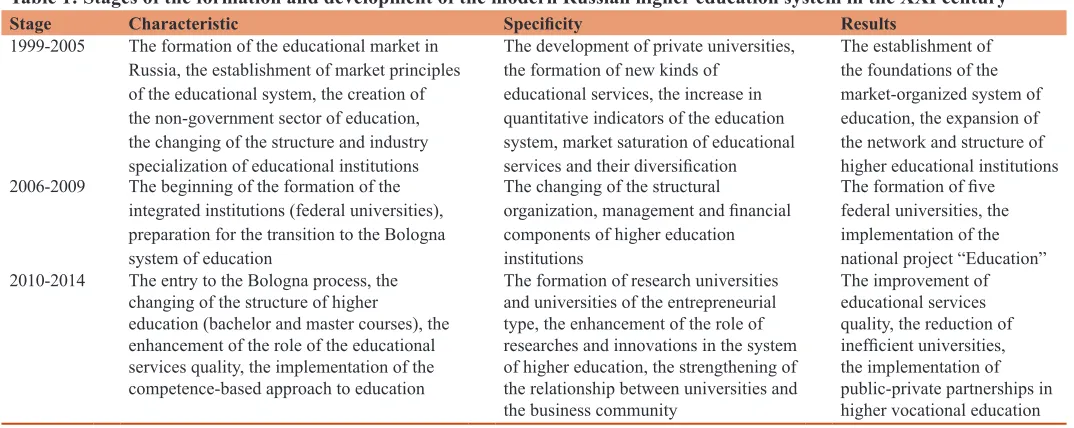
In general, in the 21st century there can be distinguished three
formative stages of the modern Russian higher education system
until 2014 (Table 1).
In the 21st century, there was a transition in Russia to more
constructive reforms, stability, consolidation and signs of growth
in the economy. For example, in the year 2000 economic growth was 7-7.5%, gross domestic product (GDP) growth – 7.6%,
growth in industrial production – 9.2% (Abramenko and Ilyina,
2001). In 1999-2004 and subsequent years there was an increase
in gross domestic product (Figure 1). This had a positive impact on higher education.
The legislative and regulatory framework in the field of higher education, elaborated in the 1990s, was further developed and expanded. In 2001, the President of the Russian Federation V.V.
Putin in his annual Address to the Federal Assembly noted, “…We must clearly set out the limits for free education, ensure fair and guaranteed access to this education and also create an adequate legal foundation for fee-paying education” (Annual Address of
the President of the Russian Federation to the Federal Assembly
of the Russian Federation, 2001).
In the 2000/01 academic year, Russia had 312 public universities, 165 academies and 130 institutes, and in 2011/12, there were
634 public universities, 169 academies and 123 institutes (Figure 2).
In addition, as mentioned above, the field of private higher
education was well formed by the beginning of the 21st century (the
number of private universities increased to 413 in the 2005/2006 academic year and to 446-in 2011/12) (Figure 3).
The dynamics of change in 2000-2014 covered different aspects
of higher education: Funding modalities; teaching and learning process indicators; the integration of education and research; training and retraining of the teaching staff; the improvement of the
Figure 1: Dynamics of gross domestic product in the period
1999-2013 based on Statistical Yearbook of Russia (2014)
Figure 2: Public Higher Education Institutions by type in the
2000/01-2011/12 academic years based on data from education in figures (2013)
Figure 3: Dynamics of the sector of public and private education
institutions at the turn of the 21st century based on data from education
quality assessment of educational institutions; the definition of the
principles of admission quotas; the adaptation of Russian higher education to the new pan-European settings; the restructuring of the federal ministry responsible for higher education; the transition
to new classifications; the formation of new types of universities
(federal, national, research) etc.
There were also some positive changes in the financial and
economic situation. Thus, the share of consolidated budget expenditures on education as a percentage of GDP increased to
3.9% in 2006 compared to 2.9% in 2000, and by 2010, this figure was already 4.3% (Table 2).
It should be emphasized that the demand for higher education in Russia steadily increased and household expenditures on education grew in absolute volumes, although they did not change as a percentage of GDP (Table 3).
The extra budgetary income compensated for the lack of public funding to some extent, which was less than half of the required
amount, reflecting the assessment of this sector still as “costly”,
which did not contribute to advancing the goals of the forward-looking development of Russian higher education up to today.
A wide range of measures were implemented in the field of the
renewal and strengthening of university science in the 21st century –
from concept of the development of the university science sector in the context of the transition to a market economy (1992) to
the implementation of such documents as concept for scientific, scientific-technical, and innovation policy in the education system for 2001-2005 (2000), Doctrine of Russian Science Development,
concept of reforming of Russian science, concept of the innovation policy of the Russian Federation, Main conceptual provisions of
the regional scientific and technical policy of higher education and others. Accordingly, the first decade of the 21st century was a
time of the particular strengthening of university science and the growth of many of its indicators. Tables 4 and 5 show that in this
period there was an increase in the internal current and capital expenditures for research and development.
However, at the beginning of the 21st century there was a significant
reduction in the number of personnel engaged in research and
Table 1: Stages of the formation and development of the modern Russian higher education system in the XXI century
Stage Characteristic Specificity Results
1999-2005 The formation of the educational market in Russia, the establishment of market principles of the educational system, the creation of the non-government sector of education, the changing of the structure and industry specialization of educational institutions
The development of private universities, the formation of new kinds of
educational services, the increase in quantitative indicators of the education system, market saturation of educational services and their diversification
The establishment of the foundations of the market-organized system of education, the expansion of the network and structure of higher educational institutions 2006-2009 The beginning of the formation of the
integrated institutions (federal universities), preparation for the transition to the Bologna system of education
The changing of the structural
organization, management and financial components of higher education institutions
The formation of five federal universities, the implementation of the national project “Education” 2010-2014 The entry to the Bologna process, the
changing of the structure of higher
education (bachelor and master courses), the enhancement of the role of the educational services quality, the implementation of the competence-based approach to education
The formation of research universities and universities of the entrepreneurial type, the enhancement of the role of researches and innovations in the system of higher education, the strengthening of the relationship between universities and the business community
The improvement of educational services quality, the reduction of inefficient universities, the implementation of public-private partnerships in higher vocational education
Table 2: Dynamics of public funding of higher education based on data from indicators of education (2013)
Indicator 2004 2005 2006 2007 2008 2009 2010 2011
Expenditure on education
Consolidated budget, RUB bn 593,2 801,8 1036,4 1343,0 1664,2 1783,5 1893,9 2231,8 Federal budget 121,6 162,1 212,4 294,6 355,0 418,0 442,8 553,4 Consolidated budget of subjects of the Russian Federation 471,6 628,6 810,1 1032,5 1292,2 1345,9 1450,9 1726,4 The share of consolidated budget expenditures (% of GDP) 3,5 3,7 3,9 4,0 4,0 4,6 4,1 4,0 The share of education expenditures in the consolidated
budget of the Russian Federation (%) 12,7 11,8 12,4 11,8 11,8 11,1 10,8 11,2
GDP: Gross domestic product
Table 3: Household expenditure on education services in 2000‑2011 based on data from indicators of education (2013)
Indicator 2000 2002 2004 2007 2008 2009 2010 2011
Amount of commercial educational services, RUB mln 41,5 72,9 118,7 241,6 287,5 310,2 326,1 347,3
% of GDP 0,6 0,7 0,7 0,7 0,7 0,7 0,7 0,6
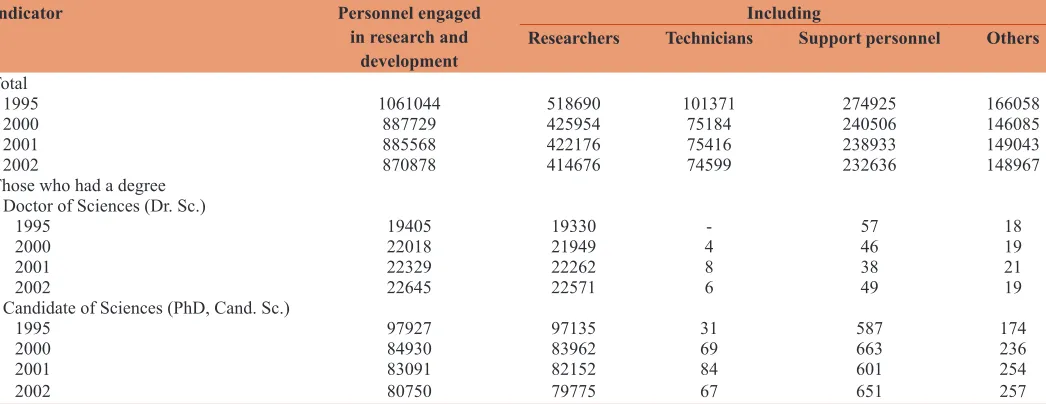
development (Table 6) which should be taken into account, although it included the growing number of Doctors of Science.
The trend of the reduction of personnel engaged in research and development continued in subsequent years, as shown in Table 7. Despite the positive dynamics of the development of higher education in Russia, there are still some systemic problems, which
are difficult to resolve. For example, the problem of the qualitative
organization of the competitive distribution of the state order for preparation of graduates, which in turn is closely connected with
the need to have full and accessible information that reflects the real extent, quality and perspectives of training of the qualified
personnel and their compliance with the demand in the labor market. This decision is being attempted to get regionalized, but
it challenges the unity of both the educational and economic field
of Russia.
However, this issue, like other problems, is addressed by conventional methods that are not correlated with the emerging new type of economy and society in which the really productive resource is only the knowledge which contains the novelty of the transformative value (otherwise, the economic system would have mainly obsolete knowledge). In addition, a new type of economy is impossible without the reproduction of a particular kind of competence, namely the competence to manage the production and realization of the transformative novelty value of knowledge, i.e., general universal transformative (creative and innovative)
competences. On this basis, the economy of the novelty of
knowledge and universal transformative (creative and innovative) competencies is understood as the deep essence of the emerging “knowledge economy.” It is a new type of economy and society based on a new transformative (intellectually innovative
Table 4: Internal research and development expenditure
in 1995-2002 (RUB mln, 1995 – RUB bln) based on data from education in Russia (2003)
Indicator 1995 2000 2001 2002
In then-current prices The total amount of the internal expenditures for research and development
12149,5 76697,1 105260,7 135004,5
Including
Internal current expenditures 11672,1 73873,3 100507,4 128243,3 Capital expenditures 477,4 2823,8 4753,3 6761,2 In constant prices of 1989
The total amount of the internal expenditures for research and development
2,49 3,32 3,87 4,31
Including
Internal current expenditures 2,39 3,20 3,69 4,09 Capital expenditures 0,10 0,12 0,18 0,22
Table 5: Internal research and development expenditure
in 2005-2012 (RUB mln in current prices) based on data from indicators of science (2013)
Indicator 2005 2008 2011 2012
In current prices
The total amount of the internal expenditures for research and development
230785,1 431073,2 610426,7 699869,8
Including Internal current
expenditures 221119,5 410864,9 568386,7 655061,7 Capital expenditures 9665,6 20206,2 42039,9 44808,0
Table 6: Number of personnel engaged in research and development in 1995‑2002 (persons) based on data from education
in Russia (2003)
Indicator Personnel engaged
in research and development
Including
Researchers Technicians Support personnel Others
Total
1995 1061044 518690 101371 274925 166058
2000 887729 425954 75184 240506 146085
2001 885568 422176 75416 238933 149043
2002 870878 414676 74599 232636 148967
Those who had a degree Doctor of Sciences (Dr. Sc.)
1995 19405 19330 - 57 18
2000 22018 21949 4 46 19
2001 22329 22262 8 38 21
2002 22645 22571 6 49 19
Candidate of Sciences (PhD, Cand. Sc.)
1995 97927 97135 31 587 174
2000 84930 83962 69 663 236
2001 83091 82152 84 601 254
2002 80750 79775 67 651 257
Table 7: Number of personnel engaged in research and
development in 2005-2012 (persons) based on data from indicators of science (2014)
Indicator Personnel engaged in research and development
Including ResearchersTechnicians Support
personnelOthers
and creatively innovative) method of the public (universal) reproduction and on the results of the intellectual activity, which have an innovative content that are guaranteed by technological and economic application and bringing added value.
In the new era, the era of the reproduction of innovations and the integrating creative and innovative kind of labor, to achieve the imperatives, laid down in its formation type and social code, there is a need for a new type of the university that can not only recover
its lost categorical flexibility, but also transform it to a higher
qualitative level which is appropriate to the novelty, versatility and interdependence of the imperatives of the new era.
The economic model of the new type of the university must embody a really integrating and universally unique tool to become a truly fundamental and universal response to the challenges of the new era. The current dominating views on the necessary model of the university, as well as the practically implemented models of the university, are clearly insufficient for such a fundamental answer. The reasons for this are that the practical needs of society (particularly its business structures) are presently focused on workers with a narrowly instrumental and single-discipline orientation, who meet situational and short-term needs
for the replacement of the existing specific posts, which become
multiple and segmented. This turned modern universities into multidisciplinary professional educational institutions with many narrow professional training areas. In such a way, the modern
university lost its categorical flexibility.
This tendency of the substitution of the university flexibility for
the pragmatism of the narrowly instrumental goals that meet short-term interests of corporate capitalism and the utilitarian state is
now a defining issue, analyzed in many studies (Senashenko, 2012; Readings, 2009; Kolesnikova, 2013). The Japanese experience (which is a definite alternative) when a graduate is prepared
on a wide basis as a “generalist” (a “generalist” in contrast to a “specialist”), who is then trained for special tasks within the enterprise itself in the framework of internal training, remains on the periphery of global processes. This is also due to the fact that the economic pragmatism of business in general global terms (and Japan is no exception) increasingly requires the reduction in the cost of the internal training, and, therefore, is set to receive more instrumentally trained workers from the university. The economic pragmatism of the utilitarian state, in its turn, requires a more economical use of public funds for these purposes.
The economic pragmatism itself, direction of which coincides with the business of its serving state, requires a short-cut (and, accordingly, the reduction in expenditure) from fundamental research and its results to applied research results and their implementation in the design and experimental development of
specific products. In fact, at the same time there is an increase
in both the need to reduce the life cycle of the reproduction of innovations, and the need to reduce their cost.
It is a mistake to believe that the current economic pragmatism is marked only as instantaneous - it actually embodies the universality of the tendency, successively connecting all formational genotypes,
to the enhanced demand for the increased level of the economic
efficiency of the functioning and development of each unit of social
reproduction. In addition, this tendency is fundamental: Each unit of social reproduction (as the system, structure, process, stage, and
result) should become more social-efficient and cost-effective in
the socio-historical evolution. In the new era, these two types of
efficiency should be directly integrated - and if not to consider
this regular tendency, it is impossible to correctly interpret the
specific historical role of the modern economic pragmatism of
the corporate-capitalist system (both in the image of business, and in its another image – the utilitarian state). It is also impossible to distinguish the real role of innovation and the real purpose of the new era as the era of innovation among these images of the
specifically situational contemporary reality.
Therefore, the university models, which are presently dominant in the public debate, should be analyzed in this context. They are, in our view, can be divided into two main groups: Realistic and pragmatic models and non-pragmatic models. Both groups, despite having rational kernels, can no longer provide a fundamental integrating response to the challenges of the new era.
Models of the first group, characterized as realistic and pragmatic,
can be reduced to the two basic models, which now entered into the world, including Russian, socio-economic practice and are offered as the most advanced and preferred models: The model of the research university and the model of the entrepreneurial university.
The model of the research university, despite seeming fundamental (because it relies on the fundamental role of science in general and in its special applied demand in modern economy), stands still as one-sided, as it focuses on the one side, on a research single unit. Although this unit, in fact, is a generating unit in innovation, the model itself is still of the integrating nature. Even if to transform this model into more comprehensive, based on a fairly common idea that all forms of practice, as well as all types of training, must be of the exploratory nature nowadays, it does not get the desired perfection, because the very concept of “research” has no indication of the result or the product coming into practice, and, therefore, there is the isolation of science as the research from practice as a real transformative activity. At the same time, this realizable model is still both realistic and pragmatic, and for the present outgoing era is quite optimal. Therefore, the literature indicates that “the research university is the most perfect model of higher education that meets the needs of society, human needs and
the needs of the state for the scientific, technological, technical and
innovative activity in all forms and levels of education” (Mayer
and Babanskii, 2006).
The entrepreneurial university model, more pragmatic than the model of the research university, is focused on another separate unit – the unit of the direct or indirect commercialization of created innovations and even more, on the direct commercialization of all activities of the university, but without the reconstruction and development of its universal origin. And thus it is (despite its instantaneous and long-term relevance and progressiveness as the
one-sided than the first model, as in the context of the implementation
of the business functions the university could, in principle, be
satisfied with the borrowing of foreign scientific innovations and
desist from its fundamental research functions. Entrepreneurship is one of the most important real-practical embodiments of the transformative (creative and innovative) activities, but it has no
universality. Konstantinov and Filonovich (2007) deeply analyzed both theoretical approaches to the definition of the entrepreneurial
university and the issues related to the practical embodiment of the status of the entrepreneurial university in the Russian education system. They conclude that “taking into account which areas of activity are key to higher education, we can say that the university which wants to be called entrepreneurial should overcome the limitations in three areas:
• The generation of knowledge, constantly working on the
development of new research methods and the examination of new areas of knowledge or new challenges in already known areas;
• Teaching, developing the innovative teaching methods
and modifying the learning content by revealing the latest achievements of science and practice;
• The implementation of knowledge into practice by means of
various kinds of interaction with the environment.
That is, these scientists believe that the entrepreneurial university cannot but be of the research nature – and then the one-sidedness of the “business” model is overcome.
Nevertheless, it is important that both these concepts (models) of the university, despite their one-sidedness, are at least viable and demanded by the social and economic practice. After all, they are currently opposed to the views that are still defending the model of the university as the center of some “classic” universality, wherein the abstract spirit of science and education, freely rising to its own heights in the form of the “public good”, revels in its nature and hangs over the actual activity practice, not directly connecting to it, but restricting to thinking processes, which are not integrated with
the economic turnover. In these models, the required flexibility of
the university affairs can be interpreted only as an abstract (in fact, unrealistic and impossible as it stands) “comprehensiveness.” Therefore, the vagueness of graduates training, in its turn, resulting from the understanding of the university function as a center of “freethinking,” “the search for truth for the sake of the truth” and “methodological knowledge,” i.e. as a center of the formation of
not so much the specific professional culture but as the general
professional and even common culture, a center that is not limited in its activities by economic, narrow pragmatic tasks and not targeted by them.
Despite the apparent attractiveness of the second group, which
we characterize as “non-pragmatic,” these models clearly reflect
the views denying the growing pragmatism of the economy and social life in general. Thus they negate the principle of a steady
increase in the integrated social and economic efficiency of the
units of social reproduction that makes these views and models demanded by neither the present nor the future social and economic practice, and as a result, futile and short-term. They are not only impractical in all senses, but also economically more costly as they lengthen and complicate the way of the direct realization of the
general (common cultural and general professional) competencies
of graduates in specific professional, specialized areas and fields requiring the mediating units to get the personnel “fit” for those
areas and the demanded instrumental functions and, accordingly, extra costs for maintenance of these units.
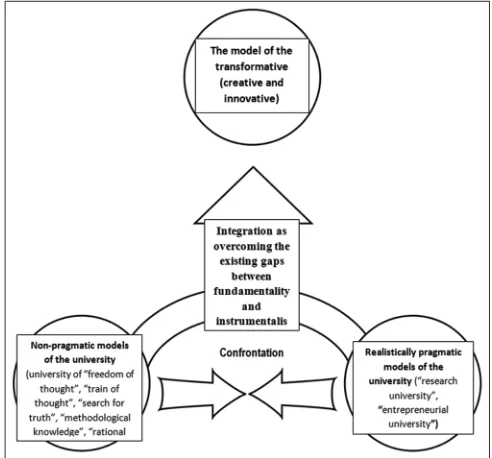
The confrontation of the above concepts (models) of the university reveals the real socio-economic gap between fundamentality and instrumentalism and, more than that, the gap between ideas (science, analytics, etc.) and socio-economic practice, which requires a radical transformation of both the modern university and the relations of modern society in general. As far as neither one nor the other of the considered groups of models of the university cannot give an adequate fundamental integrating response to the challenges of the new era, this function should be implemented by a really productive university model of the new generation, which we characterize as the university of the transformative (creative and innovative) type. Its integrating potential and the ability to overcome the profound discontinuity between fundamentality and instrumentalism, expressed in the confrontation of the non-pragmatic and realistically non-pragmatic concepts of the university,
are identified and revealed in Figure 4.
As it stands, the model of the transformative (creative and innovative) university acts as an integrating self-renewing socio-humanitarian and socio-economic technological tool of the reproduction of processes and relations of the transformative (creative and innovative) activities ensuring the generation of the transformative value of knowledge novelty and its transmission (transfer) into the real economy and social sphere in the form of innovation technologies and competences. Thus, this economically substantiated model of the advanced environment of a multicultural professional community and civil society cultivates the universal unique organizers of innovations and communications, who act as developers, carriers and transmitters of the key transformative
Figure 4: The integrating potential of the model of the transformative
(creative and innovative) activity-based and communicative competences, able and willing to implement them in the diverse spheres of activity and communication, transforming these areas by themselves.
Thus, this model allows to integrate and overcome a wide range of social and economic gaps in the public system, precisely because its fundamental bases meet the essence of the new era. Relying on them, one can almost manage to bridge the gap in the organization of the modern university.
REFERENCES
Abramenko, V., Ilyina, N. (2001), Shaky well-being: Russia is entering a new year with a good performance but an unclear perspective. Segodnya [Today]. No 1. 4, January.
Annual Address of the President of the Russian Federation to the Federal Assembly of the Russian Federation of April 3. (2001). Мoscow. p13. Borovskaya, М.А. (2009), In: Borovskaya, M.A., Zakharevich, V.G.,
editors. Organizational and Informational Models of Financial and Economic Management of the University Based on the Design-Process Approach: Monograph. Taganrog: TTI SFU Publishing House. p176.
Clark, B.R. (2011), Creating Entrepreneurial Universities. Moscow: The HSE Publishing House.
Concept for Scientific, Scientific-Technical, and Innovation Policy in the Education System of the Russian Federation for 2001-2005, Approved by Order of the Russian Ministry of June 6 (2000), No. 1705. Science in Education. Part 1. The Organizational Base. Moscow: Russian Ministry of Education. p83-96.
Education in Figures. (2013). Мoscow: The National Research University Higher School of Economics.
Engells, J., Dangerfield, A. (1998), The market-model university: Humanities in the age of money. Harvard Review, 100(5): 48-55. Etzkowitz, H. is the following: Etzkowitz, H. (2000), The dynamics of
innovation: from National Systems and ‘Mode 2’ to a Triple Helix of university-industry-government relations (with Leydesdorff), _Research Policy_ 29(2), 109-123.
Etzkowitz, H., Webster, A., Gebhardt, C., Cantisano Terra, B.R. (2000), The future of the university and the university of the future: Evolution of ivory tower to entrepreneurial paradigm. Research Policy, 29(2), 313-330.
Indicators of Education. (2013), Statistics Digest. Мoscow: The National Research University Higher School of Economics. p72-80. Indicators of Science. (2014), Мoscow: The National Research University
Higher School of Economics. p98.
Klyachko, T.L. (2011), Education in the Russian federation: Problems and trends of the development in the early twenty-first century. Mir Rossii [World of Russia], 20(1), 88.
Klyachko, T.L. (2011), Education in the Russian federation: Problems and development trends in the early XXI century. World of Russia, 20(1), 88.
Kolesnikova, Е.Y. (2013), Modern university: In search of meaning and reason. Akademia [Academy], 3, 6.
Konstantinov, G.N., Filonovich, S.R. (2007), What is the entrepreneurial university? Voprosy Obrazovaniya [Questions of Education], 1, 52. Kuzminov, Y.I., Yudkevich, M.M. (2007), Universities in Russia and
America: Differences in academic conventions. Questions of Education, 4, 141-148.
Mayer, G.V., and Babanskii, M.D. (2006), Innovation and the mission of the university. Universitetskoye Upravlenie [University Management], 6(46), 11.
Readings, B. (2009), The University in Ruins. Minsk: Nauka.
Röpke, J. (1998), The Entrepreneurial University, Innovation, Academic Knowledge Creation and Regional Development in a Globalized Economy. Working Paper 15 Department of Economics, Philipps-Universität Marburg, Germany.
Ropke, J. (1998), The Entrepreneurial University: Innovation, Academic Knowledge Creation and Regional Development in a Globalized Economy. Working Paper, Department of Economics, Philipps-Universitat, Marburg, Germany.
Senashenko, V. (2012), On the problems of the formation of the modern university. Rektor Vuza [Rector of the University], 12, 38-43. Slaughter, S., Leslie, L.L. (1997), Academic Capitalism. Politics, Policies,
and the Entrepreneurial University. Baltimore: The John Hopkins University Press.