Issues
ISSN: 2146-4138
available at http: www.econjournals.com
International Journal of Economics and Financial Issues, 2017, 7(3), 437-443.
The Long Memory Behavior of the EUR/USD Forward Premium
Nessrine Hamzaoui
1*, Boutheina Regaieg
21Faculty of Economic Sciences and Management, Tunis, Tunisia, 2Faculty of Law, Economics and Management, Jendouba, Tunisia. *Email: [email protected]
ABSTRACT
This paper empirically investigates the contribution of the term structure of the forward premium to explain the long memory behavior that can characterize the forward premium. We apply our empirical study on 1-month, 3-month, 6-month, 9-month and 1-year forward premiums of the EUR/
USD over 17 years with a daily frequency from 08 January 1999 to 08 January 2016. Therefore, we estimate the auto regressive fractionally integrated
moving average model by a semi-parametric method that is Geweke and Porter-Hudak (1983) and a parametric model namely the maximum likelihood
method. The estimation results of long memory parameter confirm the persistence and the fractional dynamics of the forward premium. Moreover, both approaches are consistent when it is the case of 6, 9 and 12 months horizons. These findings bring into question the relevance of the term structure of
the foreign exchange forward premium in the determination of the long memory attitude.
Keywords: Auto Regressive Fractionally Integrated Moving Average, Box-Jenkins, Geweke and Porter-Hudak Method, Whittle, Long Memory JEL Classifications: F3, F31
1. INTRODUCTION
The forward premium puzzle is considered as one of the puzzles that persisted and characterized the foreign exchange markets. It is closely related to the failure of uncovered interest rate parity given that it leads to a prominent empirical result which is often
enigmatic. Although Baillie (2011) fully recognizes the existence of solving difficulties of all kinds of puzzles of International
Finance, it believes that it is premature to claim victory at the paradox of the forward premium. The forward premium anomaly
provides some important empirical evidence confirming not understanding the functioning of some international financial
markets. These extreme events may be the most important in terms of production of new theories and new insights.
The purpose of this study is to estimate the long memory parameters of the forward premium series using the auto regressive fractionally integrated moving average (ARFIMA) model and to examine the relevance of the term structure of the foreign exchange forward premium in the determination of the long memory attitude. To do
this, we implement various methods of estimating the coefficient
of fractional integration. We note that ARFIMA processes are relevant in the modeling of time series characterized by a structure
of long run dependence. Thus, they distance from auto-regressive moving average (ARMA) processes by their joint perception of the dynamics of the short and long run of the studied series. Indeed, the fractional integration parameter allows to relate the dynamics of long run which is not detected by the autoregressive parameters and of moving average. The objective being to look for the presence of a possible long memory in the forward premiums at various horizons.
The remainder of the paper is organized as follows: Section 2 discusses related literature and hypothesis development. Section 3 presents our methodology while Section 4 provides details on our empirical results. Section 5 concludes.
2. LITERATURE REVIEW
The review of the literature associated with the question is based on a rigorous chronological path, from the founding works of Fama (1984), Bilson (1981), Cumby (1988), Gregory and McCurdy (1984), Hodrick and Srivastava (1984), Frankel and Engel (1984), Hodrick (1987), Bekaert and Hodrick (1993), Bekaert (1996) and
(2012). In fact, some studies have been based in the explanation of
the forward premium anomaly on arguments of the risk premium, on the context of treatment of incomplete information, on the differences
in developed markets versus emerging markets, and on profitability
and economic value of the currency speculation. Furthermore, other studies have raised the problem of the puzzle otherwise by referring to the term structure of the exchange rates and suggest that the forecast horizon is an important element in understanding the forward premium puzzle. In this context, Chaboud and Wright
(2005) deduced that the coefficient of the regression slope is close
to unity just for a very short horizons (at a frequency of 5 min). On
the other hand, Yang and Shintani (2006) analyze the regression of
the forward rate unbiased hypothesis by varying time horizons from 1 day to 1 year. Through panel data, they offer the possibility to obtain
a slope coefficient that is positive for short horizons and negative at longer horizons and improving forecast performance coefficient. Alexius (2001) and Chinn and Meredith (2004) used quarterly data
for the yields of long-term government bonds and suggest that in extreme cases of the distribution, the role of the risk premium or other factors causing the forward premium anomaly could be less important than in the case of a median horizon. Thus, these approaches are less prone to the problem of potential bias caused by a mixture of different sources, periods of time or frequencies. In addition, Bhar
and Chiarella (2003) studied the risk premium as a mean reversion
diffusion and analyzed the term structure of the risk premium for three different maturities of forward exchange rates.
Several conflicting findings on the forward premium nature allow
suggesting that either a short memory or unit root models are not appropriate to model the data. In particular, Maynard and Phillips
(2001) and Baillie and Bollerslev (1994) find that a fractionally
integrated model can adjust properly with the forward premium while providing an explanation for the dichotomy that exists in the literature model. It is obvious that the attitude of long memory or unit root in the forward premium implies persistence in the forecast error, then allowing it to be predictable from past values. This can only lead a rejection of the hypothesis of no bias in the
forward rate. Therefore, Maynard and Phillips (2001) suggest
that the literature should be interested in the study of the reasons why the forward premium can demonstrate such characteristics of time series. Furthermore, the time series properties of the forward premium can be explained by either the long memory behavior of the forward premium or the existence of structural breaks in the forward premium. In this regard, the topic of long memory and persistence have been the subject of several studies such us that of Baillie (1996). In the same way, Baillie et al. (1996) report that there is a direct relation between the long term dependence in the conditional variances of daily spot exchange rates and the long memory in the forward premium. This relation could explain the systematic rejection of the unbiasedness hypothesis as an artefact due to the unbalanced regression of the return on the premium. In this context, a review of the related literature clearly reports the sources of the volatility of exchange rates, the dynamics of
long memory, and fractional dynamics in the financial time series.
However, it should be checked whether these exchange rates tend to decline rapidly, as with non-integrated processes, or rather to decline more slowly, as with fractionally integrated process. In the latter case, the exchange rates show a long memory character.
3. METHODOLOGY
The forward premium puzzle is the violation of the uncovered interest parity (UIP).
The UIP parity states that:
∆st,t+k = a + b(ft,k−st) + εt,t+k
st: Represents the natural logarithm of the spot exchange rate at time t,
ftt+1: Represents the natural logarithm of the forward exchange
rate at time t,
∆st,t+k is expected changes in exchange rates,
(ft,k−st) is the forward premium,
εt: A white noise error term.
To analyze the forward exchange premium, we estimate the ARFIMA model for each series of our sample. Before estimating
the coefficients of the model presented above, we should first
proceed to a preliminary analysis of series studied via the stationary test, the test of the normality hypothesis of return series and the test of the autoregressive conditional heteroscedastic effect that priory requires the determination of the ARMA process followed by the daily forward premium series. Initially, we apply the Box–Jenkins technique and thereafter we estimate the long memory parameter via a semi-parametric method, that of Geweke and Porter-Hudack (1983) and a parametric method, that of approximated maximum likelihood of Whittle (1951).
3.1. The Box and Jenkins Method
It consists of using an ARMA type procedure that requires
three main steps namely the identification phase of the process in the first place. Based on the study of simple and partial
correlograms, it is a question of detecting the autocorrelation through the analysis of the autocorrelation functions (ACF) and partial autocorrelation functions (FAP) of stationary series
of forward premiums expressed in first differences. This will
make it possible to determine the appropriate model in the family of autoregressive integrated moving average (ARIMA) models. After completing this step which is certainly the most important, then it is recommended to estimate the parameter and to select the appropriate model, to end with the validity check.
3.2. Fractional Integration Processes
The ARFIMA models were developed by Granger and Joyeux
(1980) and Hosking (1981) and they are a generalization of
ARIMA processes of Box and Jenkins in which the exponent of differentiation d was an integer. They are long memory processes with the aim of identifying the phenomenon of persistence.
Mignon and Lardic (2002) define the long memory process in
“In the time domain, the long memory processes are characterized by an ACF which decreases hyperbolically as and as the delay increases, while that of short-term memory decreases exponentially. In the frequency domain, the long memory processes are characterized by a spectral density increasing without limit when the frequency tends to zero.” (Mignon and
Lardic, 2002. p. 324).
In the case of ARFIMA process, d may take the actual values, and not only integer values. A fractionally integrated series has the characteristic of a dependence between remote observations as we can see in the autocovariance function or in the spectral density function. We note that the introduction of fractional integration process helps to reduce the constraints on the
autoregressive and moving average coefficients of parametric
models.
An ARFIMA (p,d,q) process where d ∈ − 1 2 1 2
, is defined by:
Φ(L)Xt = Θ(L)εt
Where,
εt d
t t
u u BB
= ∇− , :
( )
0, 2
Φ(L) et Θ(L) are delay polynomials of degree p and q respectively.
∇ = −d
(
)
d = − −(
−)
−(
−)
(
−)
−…L dL
d d L
d d d
L 1 1 1 2 1 2 3 2 3 ! ! ∇ = = ∞
∑
d j j j L π 0(
)
( )( )
j0 k j
j d k 1 d
j 1 d k
< ≤
Γ − − −
= =
Γ + −
∏
and j= 0,1,….
Γ corresponds to the gamma function.
The processes ARFIMA (p,d,q) are long memory processes when
d∈ −
1 2 1 2
, and d ≠ 0. They are invertible if d> −1 2 and
stationary if d< 1 2.
More specifically, three cases can be distinguished according to
the values of the parameter d:
• If 0 < d < ½, the ARFIMA process is a long memory
stationary process. Autocorrelations are positive and decreases hyperbolically to zero as the delay increases. The spectral density is concentrated around low frequencies and tends to
infinity when the frequency tends to zero.
• If d = 0, the ARFIMA process reduces to the standard ARMA
process.
• If −½ < d < 0, the process is anti-persistent: The autocorrelations
decreases hyperbolically to zero and the spectral density is dominated by high-frequency components (it tends to zero as the frequency tends to zero).
3.2.1. Semi-parametric methods
Geweke and Porter-Hudak (GPH) were the pioneers of the development of methods for semi-parametric estimation in the
early 1980s. Therefore, the Geweke and Porter-Hudak (1983)
method is based on the expression of the spectral density function of the process ARFIMA (p,d,q) when the frequencies tend to zero and can only estimate the long memory parameter (d). It is necessary to present the expression of the spectral density function of the stationary process knowing that this method relies on the behavior of the spectral density around zero. It is simply to estimate
the coefficients b and d by the least-squares on the following simple
equation of linear regression:
Yj = a + bZj + δj
Where is the periodogram of the time series and b = d8.
The estimation ˆd follows a normal distribution when T→∞.
3.2.2. Parametric methods
The maximum likelihood methods are considered among the most effective methods in estimating the long memory parameter (d). These methods are used to estimate all parameters simultaneously, including the method of exact maximum likelihood and the method of approximated maximum likelihood of Whittle (1951).
The approximated maximum likelihood estimator of Whittle proves to be a good estimator since it is asymptotically and normally distributed (Fox and Taqqu, 1986; Dahlhaus, 1989). Indeed, given the complexity of the implementation of the exact maximum likelihood parameter of fractional integration (developed by Sowell [1992] later in the time domain), Fox and Taqqu (1986) proposed an approximation of the log-likelihood function given by Whittle (1951). In fact, the Whittle procedure is part of the parametric estimation methods using maximum likelihood which occupy an important place among the methods for estimating the parameters of a process ARFIMA(p,d,q).
We notice that the application of this method requires the prior choice of initial values for the parameters representing the ARFIMA model (p,d,q).
3.3. Sample and Data
Our sample consists of 4436 daily observations of the EUR/USD 1-month, 3-month, 6-month, 9-month and 1-year forward exchange rates forward exchange rates over a period of 9 years
from 08 January 1999 to 08 January 2016. The data collected are
obtained from Datastream and are expressed in logarithmic form to avoid the Siegel’s paradox (Baillie and McMahon, 1989).
4. RESULTS
4.1. Descriptive Statistics
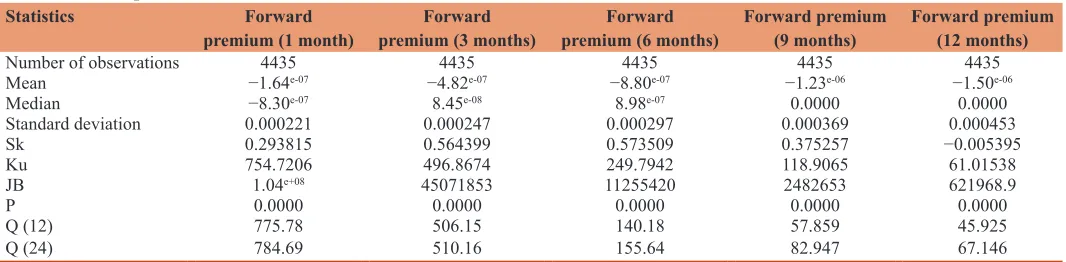
Table 1 displays descriptive statistics of daily 1, 3, 6, 9 and 12-month forward premium series for the EUR/USD during the study period.
Table 1 shows that 1-year forward premium has the highest standard deviation of all forward premium series. On the other side, the highest mean and median values are attributed to 1-month
forward premium. However, the skewness coefficients are positive
for all the distributions of EUR/USD forward premiums (whatever the 1, 3, 6 and 9-month horizon) showing asymmetric and thicker
right series, but these coefficients and their respective averages
have opposite signs which induces that there are extreme values for 1, 3, 6 and 9-month forward premiums. This is an evidence of phases of sudden depreciation and appreciation experienced by the EUR/USD parity throughout the period studied. Henceforth, this is not the case of the 1 year horizon. Furthermore, all forward premium series are leptokurtic, having a thicker tail that the normal
distribution as shown by the kurtosis coefficients. In addition,
the variables studied are volatile since the null hypothesis of normality is strongly rejected for all horizons according the
Jarque–Bera statistic at the 5% level significance. By examining
the Q Ljung–Box statistics distributed asymptotically as a Chideux at 12 and 24 degrees of freedom and their critical zero probabilities, we deduce that series of forward premiums are characterized by a non-linearity, an heteroscedasticity and are not representative of white noise. This can be explained in particular by the existence of a long memory.
4.2. Box and Jenkins Method
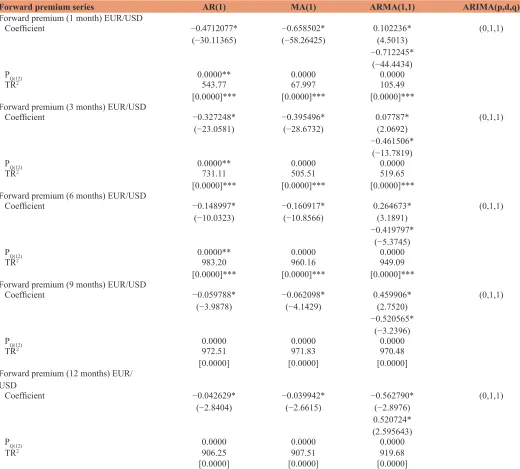
Table 2 presents the estimation results of the Box–Jenkins method. For the four horizons, the study of simple and partial correlograms through the analysis of the ACF and FAP of the EUR/USD forward premiums, leads us to retain the models AR(1), MA(1) and ARMA(1,1) retracing at best the autocorrelation characterizing the variables studied.
On the one side, the estimation of the model with a constant term
shows a non-significance of the variables. On the other side, the coefficients of the explanatory variables AR(1) and MA(1) are significantly different from 0.
Using the Box–Pierce test, we note that there is no term outside
the confidence intervals. Similarly, the residuals are representative
of white noise process and the probability of the Q statistic is greater in probability than the critical value. Given the absence
of autocorrelation of the residuals, we confirm that the model studied is well specified which is also confirmed by the statistics
DW and empirical F that suggest a good adjustment. Accordingly,
ARIMA(0,1,1) model is validated to represent the EUR/USD
forward premium series.
4.3. The Estimation of ARFIMA Models
In what follows, we try to detect the possible presence of long memory by estimating the long memory parameter of daily forward
premium series firstly via the GPH method and secondly via the
technique of the approximated maximum likelihood of Whittle; considering that the condition of stationarity of the variables
expressed in first differences is verified.
For the Geweke and Porter-Hudak (1983) method, it is imperative
to fix, at first sight, the power to specify the width of the band
(m) of the periodogram. Thus, the estimation of long memory parameter for 1, 3, 6, 9 and 12-month forward premiums is done
with powers equal to 0.45, 0.5, 0.55 and 0.8 in order to follow
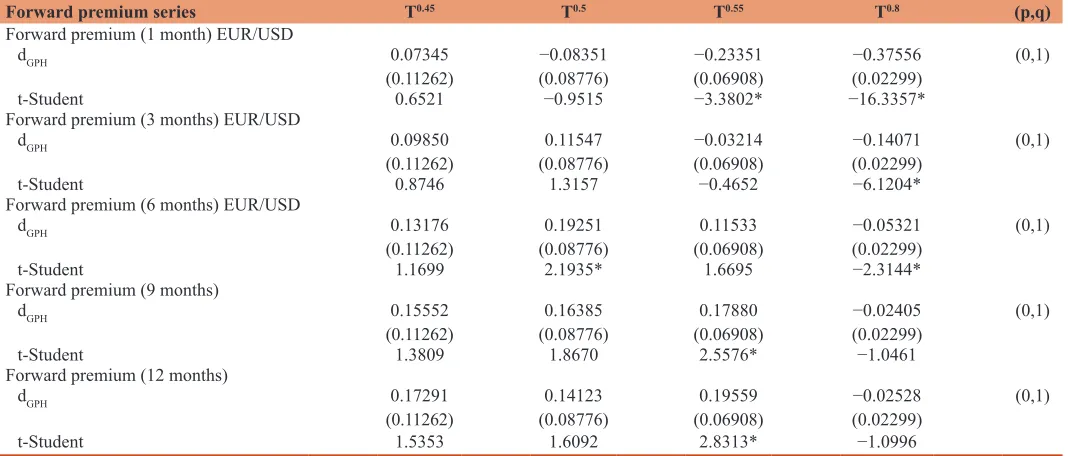
the evolution of the estimates obtained from the variation in the number of periodogram ordinates. The ARFIMA estimation results by the GPH method of the EUR/USD 1, 3, 6, 9 month and 1 year forward premiums are reported in Table 3.
Table 3 shows that the estimated parameter d is positive and
significantly different from zero, with an ordered number (m) of
the periodogram limited to (T0.5) for the 6-month forward premium
and limited to (T0.55) for the 9-month and 1-year forward premiums.
Concerning the 1 month and 3 month horizons, the estimates do not
satisfy the criteria of significance and positivity of the parameter
d jointly, whatever the ordered number (m) of the periodogram extend to (T0.45, T0.5,T0.55 and T0.8). Thus, the estimated results of
fractional integration parameter d via GPH procedure plead in favor of an ARFIMA process which is a stationary long memory process, given the long memory characterizing the EUR/USD forward premium at different horizons.
Thereafter, for the estimation of long memory parameter by the technique of approximated maximum likelihood of Whittle
(1951), we first start with setting initial values for the parameters of the model. So, we must retain the model which satisfies
Table 1: Descriptive statistics
Statistics Forward
premium (1 month) premium (3 months)Forward premium (6 months)Forward Forward premium (9 months) Forward premium (12 months)
Number of observations 4435 4435 4435 4435 4435
Mean −1.64e-07 −4.82e-07 −8.80e-07 −1.23e-06 −1.50e-06
Median −8.30e-07 8.45e-08 8.98e-07 0.0000 0.0000
Standard deviation 0.000221 0.000247 0.000297 0.000369 0.000453
Sk 0.293815 0.564399 0.573509 0.375257 −0.005395
Ku 754.7206 496.8674 249.7942 118.9065 61.01538
JB 1.04e+08 45071853 11255420 2482653 621968.9
P 0.0000 0.0000 0.0000 0.0000 0.0000
Q (12) 775.78 506.15 140.18 57.859 45.925
Q (24) 784.69 510.16 155.64 82.947 67.146
the convergence of the minimization algorithm since the log-likelihood function is not globally concave. Our choice is then made on the different combinations in order to retain ultimately the model whose parameters are significant in addition to minimizing the Akaike, Schwarz and Hannan-Quinn information criteria.
The estimation results of ARFIMA by the method of approximated maximum likelihood of Whittle (1951) are reported in Table 4.
In light of the estimation results of ARFIMA via Whittle procedure,
the presence of long memory is confirmed for all series examined
whatever the horizon (1 month, 3 month, 6 month, 9 month and
1 year) as the estimated fractional integration parameters are
positive and statistically significant.
5. CONCLUSION
The purpose of this study is to investigate the contribution of the term structure of the forward premium to explain the long memory behavior that can characterize it. The 1-month, 3-month, 6-month, 9-month and 1-year forward premiums of the Euro/USD parity have been examined over 17 years with a daily frequency. According to the estimation of the long memory parameter, our results reveal that ARFIMA model is relevant to recall the dynamics of the long run of the series studied via the Table 2: Estimation results of the Box-Jenkins method
Forward premium series AR(1) MA(1) ARMA(1,1) ARIMA(p,d,q)
Forward premium (1 month) EUR/USD
Coefficient −0.4712077*
(−30.11365) −0.658502*(−58.26425) 0.102236*(4.5013) −0.712245*
(−44.4434)
(0,1,1)
PQ(12) 0.0000** 0.0000 0.0000
TR2 543.77
[0.0000]*** [0.0000]***67.997 [0.0000]***105.49
Forward premium (3 months) EUR/USD
Coefficient −0.327248*
(−23.0581) −0.395496*(−28.6732) 0.07787*(2.0692) −0.461506*
(−13.7819)
(0,1,1)
PQ(12) 0.0000** 0.0000 0.0000
TR2 731.11
[0.0000]*** [0.0000]***505.51 [0.0000]***519.65
Forward premium (6 months) EUR/USD
Coefficient −0.148997*
(−10.0323) −0.160917*(−10.8566) 0.264673*(3.1891)
−0.419797* (−5.3745)
(0,1,1)
PQ(12) 0.0000** 0.0000 0.0000
TR2 983.20
[0.0000]*** [0.0000]***960.16 [0.0000]***949.09
Forward premium (9 months) EUR/USD
Coefficient −0.059788*
(−3.9878) −0.062098*(−4.1429) 0.459906*(2.7520) −0.520565*
(−3.2396)
(0,1,1)
PQ(12) 0.0000 0.0000 0.0000
TR2 972.51
[0.0000] [0.0000]971.83 [0.0000]970.48
Forward premium (12 months) EUR/ USD
Coefficient −0.042629*
(−2.8404) −0.039942*(−2.6615) −0.562790*(−2.8976) 0.520724*
(2.595643)
(0,1,1)
PQ(12) 0.0000 0.0000 0.0000
TR2 906.25
[0.0000] [0.0000]907.51 [0.0000]919.68
Estimates made on EVIEWS software (version 5.0). The values in parentheses are the t-Student statistics. The superscript (*) indicates that the model is significant and is to be used for the test on the residues. P is the probability assigned to the autocorrelations obtained from the Box-Pierce test compared with 0.01 (significance level of 1%). Exhibitors (**) indicate that there is error autocorrelation of order <1. TR2 is the test statistic obtained from the ARCH LM test on high squared residuals with a lag order specified by the appearance of the autocorrelations and partial autocorrelations. Values in brackets denote the probabilities associated with the statistic test TR2. Exhibitors (***) indicate the presence of heteroscedasticity of
fractional integration parameter. The results of the estimation of ARFIMA model by the two estimation procedures GPH method and approximated maximum lilkelihood of Whittle are consistent in favor of a EUR/USD 6-month, 9-month and 1-year forward premiums characterized by a long memory behavior. Moreover, they reveal the presence of persistent shocks induced by the existence of persistence in the forward premium series.
The presence of structural breaks also proves to play an important role in explaining the long memory of the forward premium series. Allowing for structural breaks reduces the persistence of the forward
premium across all horizons and model specifications. Nevertheless,
the forward premium still follows the fractionally integrated process (corroborating Baillie and Bollerslev, 1994; Maynard and Phillips,
2001 and Choi and Zivot, 2005). These findings bring into question
the relevance of the term structure of the foreign exchange forward premium in the determination of the long memory attitude.
REFERENCES
Alexius, A. (2001), Uncovered interest rate parity revisited. Review of International Economics, 9, 505-517.
Baillie, R.T. (1996), Long memory processes and fractional integration in econometrics. Journal of Econometrics, 73, 5-59.
Baillie, R.T. (2011), Possible solutions to the forward bias paradox.
Journal of International Financial Markets, Institutions and Money, 21, 617-622.
Baillie, R.T., Bollerslev, T. (1994), The long memory of the forward premium. Journal of International Money and Finance,13, 565-571. Baillie, R.T., Bollerslev, T., Mikkelsen, H.O. (1996), Fractionally
integrated generalized autoregressive conditional heteroskedasticity.
Journal of Econometrics, 74, 3-30.
Bansal, R.T. (1997), An exploration of the forward premium puzzle in
currency markets. The Review of Financial Studies, 10(2), 369-403.
Bekaert, G. (1996), The time-variation of risk and return in foreign exchange markets: A general equilibrium perspective. Review of
Financial Studies, 9, 427-440.
Bekaert, G., Hodrick, R.J. (1993), On biases in the measurement of foreign exchange risk premiums. Journal of International Money and Finance, 12, 115-138.
Bekaert, G., Hodrick, R.J., Marshall, D.A. (1997), The implications of
first-order risk aversion for asset market risk premiums. Journal of Monetary Economics, 40, 3-39.
Bhar, R., Chiarella, C. (2003), Analysis of Time Varying Exchange Rate
Risk Premia. Sydney: School of Finance and Economics, University of Technology.
Table 4: ARFIMA estimation by the method of approximated maximum likelihood of Whittle (1951) The series
studied Forward premium 1 month Forward premium 3 months Forward premium 6 months Forward premium 9 months Forward premium 12 months
dWHIT 0.0375 0.0102 0.0402 0.0634 0.01122
t-Student 36.7076* 2.43509* 4.09223* 16.18010* 4.37279*
σ2 1.228e-10 2.4202e-10 8.7690e-09 3.6113e-08 2.0479e-07
AIC −101204.8122 −98195.8617 −82274.3114 −75996.9288 −68300.6590
SC −101192.0176 −98183.0671 −82261.5168 −75984.1343 −68287.8644
HQIC −101200.2997 −98191.3492 −82269.7989 −75992.4163 −68296.1465
Estimates made on the RATS software (version 7.0). The superscript (*) indicates that the fractional integration coefficient is statistically significant. σ2 is the estimated variance. AIC, SC, HQIC respectively represent the Akaike information criterion (1973), Schwarz information criterion and Hannan-Quinn information criterion. ARFIMA: Auto regressive fractionally integrated moving average
Table 3: ARFIMA estimation by the GPH method
Forward premium series T0.45 T0.5 T0.55 T0.8 (p,q)
Forward premium (1 month) EUR/USD
dGPH 0.07345
(0.11262) (0.08776)−0.08351 −0.23351(0.06908) (0.02299)−0.37556 (0,1)
t-Student 0.6521 −0.9515 −3.3802* −16.3357*
Forward premium (3 months) EUR/USD
dGPH 0.09850
(0.11262) (0.08776)0.11547 −0.03214(0.06908) (0.02299)−0.14071 (0,1)
t-Student 0.8746 1.3157 −0.4652 −6.1204*
Forward premium (6 months) EUR/USD
dGPH 0.13176
(0.11262) (0.08776)0.19251 (0.06908)0.11533 (0.02299)−0.05321 (0,1)
t-Student 1.1699 2.1935* 1.6695 −2.3144*
Forward premium (9 months)
dGPH 0.15552
(0.11262) (0.08776)0.16385 (0.06908)0.17880 (0.02299)−0.02405 (0,1)
t-Student 1.3809 1.8670 2.5576* −1.0461
Forward premium (12 months)
dGPH 0.17291
(0.11262) (0.08776)0.14123 (0.06908)0.19559 (0.02299)−0.02528 (0,1)
t-Student 1.5353 1.6092 2.8313* −1.0996
Estimates made on the RATS software (version 7.0). T is the number of observations. m represents the width of the strip of the periodogram (with m=Tpower). The values in parentheses are
asymptotic standard deviations. The superscript (*) indicates that the fractional integration coefficient is statistically significant. The last column indicates the order (p,q) of the estimated
Bilson, J. (1981), The speculative efficiency hypothesis. Journal of
Business, 54, 435-51.
Burnside, C., Eichenbaum, M., Kleshchelski, I., Rebelo, S. (2011), Do
peso problems explain the returns to the carry trade? Review of Financial Studies, 24(3), 853-891.
Chaboud, A.P., Wright, J.H. (2005), Uncovered interest parity: It
works, but not for long. Journal of International Economics, 66, 349-362.
Chernov, M., Graveline, J.J., Zviadadze, I. (2012), Sources of Risk in
Currency Returns, CEPR Discussion Paper No. DP8745.
Chinn, M.D., Meredith, G. (2004), Monetary policy and long horizon uncovered interest parity. IMF Staff Papers, 51(3), 409-430. Choi, H., Zivot, E. (2005), Long memory and structural changes in the
forward discount: An empirical investigation. Journal of International Money and Finance, 26, 342-363.
Cumby, R.E. (1988), Is it risk? Explaining deviations from uncovered
interest parity. Journal of Monetary Economics, 22, 279-300. Dahlhaus, R. (1989), Efficient parameter estimation for self-similar
processes. The Annals of Statistics, 17(4), 1749-1766.
Fama, E. (1984), Forward and spot exchange rates. Journal of Monetary Economics, 14, 319-338.
Farhi, E., Gabaix, X. (2011), Rare Disasters and Exchange Rates, Working
Paper, Harvard University and New York University.
Fox, R., Taqqu, M.S. (1986), Large-sample properties of parameter estimates for strongly dependent stationary Gaussian time series. The Annals of Statistics, 14(2), 517-532.
Frankel, J.A., Engel, C.M. (1984), Do asset demands optimize over the mean and variance of returns? A six currency test. Journal of
International Economics, 17, 309-323.
Geweke, J., Porter-Hudak, S. (1983), The estimation and application of long memory time series models. Journal of Time Series Analysis, 4, 221-238.
Granger, C.W.J., Joyeux, R. (1980), An introduction to long-memory time
series models and fractional differencing. Journal of Time Series Analysis, 1, 15-29.
Gregory, A.W., McCurdy, T.H. (1984), Testing the unbiasedness hypothesis
in the forward foreign exchange market: A specification analysis.
Journal of International Money and Finance, 3, 357-368.
Hodrick, R.J. (1987), The Empirical Evidence on the Efficiency of
Forward and Futures Foreign Exchange Markets. Char: Harwood. Hodrick, R.J., Srivastava, S. (1984), An investigation of risk and return
in forward foreign exchange. Journal of International Money and Finance, 3, 5-29.
Hosking, J. (1981), Fractional differencing. Biometrika, 68, 165-176.
Maynard, A., Phillips, P.C.B. (2001), Rethinking an old empirical puzzle:
Econometric evidence on the forward discount anomaly. Journal of
Applied Econometrics, 16, 671-708.
Menkhoff, L., Sarno, L., Schmeling, M., Schrimpf, A. (2012), Carry
trades and global foreign exchange volatility. The Journal Of Finance, 67(2), 681-718.
Mignon, V., Lardic, S. (2002), Économétrie des Séries Temporelles Macroéconomiques et Financières. Paris: Economica.
Mueller, P., Stathopoulos, A., Vedolin, A. (2012), International Correlation
Risk. Working Paper, London School of Economics.
Pippenger, J. (2011), Pippenger’s CIP-based solution to the forward
bias puzzle: A rejoinder. Journal of International Financial Markets Institutions and Money, 21(5), 867-873.
Sowell, F. (1992), Modeling long-run behavior with the fractional ARIMA
model. Journal of Monetary Economics, 29, 277-302.
Verdelhan, A. (2010), A habit-based explanation of the exchange rate risk
premium. Journal of Finance, 65(1), 123-146.
Yang, K., Shintani, M. (2006), Does the prediction horizon matter for the
forward premium anomaly? Evidence from panel data. Economics