Interprofessional Learning: Classroom
Versus Practice Settings
Judy E. Anderson, PhD; Christine Ateah, PhD; Pamela Wener, MEd; Wanda Snow, MA; Colleen Metge, PhD; Laura MacDonald, MEd;
Moni Fricke, MSc; Sora Ludwig, MD; Penny Davis, MEd
Abstract
Background: Health Canada and Cochrane reviews indicate a need for rigorous outcome testing following interprofessional learning, particularly in practice set-tings. This led to research questioning whether knowledge, attitudes, perceptions, values, and skills regarding collaborative patient care improve after interprofes-sional learning in classroom and practice settings based on the degree of exposure to interprofessional learning compared to a control group.
Methods and Findings: Pre-licensure students from seven health-profession pro-grams were assigned to three groups: Control (no intervention), Education (class-room-based interprofessional learning), and Full-Participant (class(class-room-based and practice-based interprofessional learning). They were later surveyed to assess outcomes. Immersion at an interprofessional practice setting had a greater impact on scores than classroom-based interprofessional education. Both interventions significantly improved attitudes, perceptions, knowledge, and skills related to interprofessional collaboration. Only immersion improved the perceived impor-tance of sharing leadership. Changes after the education intervention persisted at five-month follow-up.
Conclusions: Interprofessional learning in classroom and practice settings posi-tively impacted participants’ knowledge, attitudes, perceptions and values, and skills regarding interprofessional teamwork. Use of a longitudinal study with a control group provided evidence that pre-licensure interprofessional learning would increase awareness of the need to collaborate. Findings encourage longer-term study of how interprofessional learning in various settings could improve how future practitioners approach patient care.
Keywords: Attitudes, Practice-site immersion; Collaboration; Longitudinal study; Pre-licensure
Introduction
The quest to improve patient care, safety, health human-resource retention, and cost efficiency is the impetus behind long-standing healthcare renewal [1]. Initiatives in Interprofessional Education for Collaborative Patient-centred Practice (IECPCP) in Canada added to the international momentum driving reforms [2–6]. However, research on interprofessional education (IPE) is complex and is complicated by many challenges, such as finding common ground, time, and collaborative approaches among faculty from different programs for development of IPE learn-ing opportunities. These significant educational challenges are followed by other research challenges related to the collection of data and respectful interpretation of findings from both qualitative and quantitative methods of inquiry, valued
differ-Journal of Research in
Interprofessional Practice and Education
Vol. 2.1 July, 2011
Journal of Research in Interprofessional Practice and Education (JRIPE)
Vol. 2.1 © 2011
ently across the professions. The interprofessional aspect of education research, where methodologies include respecting principles of collaboration and other ele-ments of IPE [7,8], also challenges educational structures at universities (gover-nance, learning schedules, time-tabling, classroom size and number, distance, etc.) and in healthcare settings (demand for fieldwork and clinical placements, room size, care schedules, etc.). Interprofessional aspects of education research also leads to challenges regarding perceptions about the prospect of change or benefits of risk-ing change [9,10]. Evaluation tools in university-based IPE have tended to focus on learner enjoyment of or satisfaction with a particular learning format or experience, rather than the underlying perceptions, attitudes, knowledge, and skills that learn-ers acquired or found modified from that experience [11].
Interprofessional learning in a clinical setting is reported to have positive out-comes for practice in that setting, as reported from interviews with healthcare pro-fessionals (physicians, nurse practitioners, social workers, and pharmacists) [12]. Improvements included a non-hierarchical culture, mutual respect, and egalitarian-ism, where practitioners were viewed as unique and making valuable contributions to patient care. A two-week immersion in a clinical education ward increased stu-dent knowledge of other professions and fostered more positive attitudes toward IPE among healthcare education students from multiple professions [13]. In addi-tion, qualitative evaluation of pre-licensure immersion-based collaborative learning has noted increased satisfaction and enhanced opportunities for interprofessional collaboration and teamwork among students in an interprofessional training unit as compared to their previous clinical training experiences [14]. Furthermore, patients in that interprofessional ward reported a high level of satisfaction with their care. A recent Cochrane review on the effects of practice-based interprofessional-collab-oration interventions found that practice-based interventions may improve out-comes. However, the authors emphasized the need for more rigorous studies [15]. Moreover, very few studies have examined the impact of various exposure levels (i.e., classroom-based IPE on its own vs. classroom-based IPE in conjunction with delivery in a clinical setting) on attitudes, values, skills, and knowledge related to IPE among pre-licensure healthcare students [11,16–18].
The initiative discussed here used validated tools to test the effectiveness of two interventions to improve health-profession educational curricula. Evidence that IPE, collaboration, and patient-centred practice improve the quality of patient care and patient safety [19–24] has only recently influenced educational standards. This sug-gests that future educational programming will rely, in part, on rigorous studies on IPE effects. A search using the Cochrane registry resulted in few rigorous studies looking at IPE [16–18]. This research was part of a national IECPCP response [25] and in direct response to the identified need in Manitoba for practitioners who can work in interdisciplinary teams [26–28].
At the University of Manitoba, four faculties (Dentistry, Medicine, Nursing, Pharmacy) and two schools (Medical Rehabilitation and Dental Hygiene) partnered with two service-provider organizations to undertake a study that aimed to contribute new knowledge of best practices for teaching interprofessional collaboration and
Journal of Research in
Interprofessional Practice and Education
Vol. 2.1 July, 2011
4
Differences in Pre-licensure Interprofessional Learning
improving the quality of patient care. The service-provider partners were the Winnipeg Regional Health Authority and the J. A. Hildes Northern Medical Unit, which provides contractual healthcare in First Nations, Inuit, and remote communi-ties in northern Manitoba and central Nunavut. These partners enabled immersion of small interprofessional groups of pre-licensure students in collaborative-practice set-tings in urban, rural, and remote locations in Manitoba and Nunavut with Inuit and Aboriginal populations or underserved populations in urban settings. Direct out-comes needed to improve practice—that is, acquisition of new knowledge, attitudes, skills, and values (including respect for and the valuing of input from other profes-sionals)—were evaluated using established or new tools. Through education research, this project extended the scope of IECPCP into an area of critical need in Canada.
The research question was as follows: Do knowledge, attitudes, perceptions and values, and team skills about collaboration and patient care improve based on the degree of exposure to interprofessional learning? Since there are few reports regard-ing such longitudinal changes measured against a matched control group, we tested the effectiveness of two interventions, education and practice-setting experiences, using a control vs. intervention design. Exposure, immersion, and mastery are described in the University of British Columbia (UBC) model, and relate to the intensity of experiences associated with interprofessional education [29]. This model was originally developed by the College of Health Disciplines to conceptual-ize the range of interprofessional experiences students could have at that institution and convey that range to the broader community. At its heart, the model presumes that students in health- and health-service education programs will be positioned to learn most effectively at various times, as they develop into professionals. That “optimal learning time” is also recognized to depend on students’ ability to learn during their evolution as professionals and interactions with other professionals. The model is relevant to the present study in that participants were provided a range of interventions that enabled them to experience interprofessional interac-tions to variable extents, simultaneously with opportunities for critical reflecinterac-tions and self-assessment about those experiences. Both types of opportunity (interven-tions and reflec(interven-tions) were interactive in a professional context and fall within the scope of two of the three-part set of processes in the UBC model, namely exposure (to an interprofessional education intervention) and immersion (in an interprofes-sional practice setting) [29].
Methods
The manner of evaluating outcomes of the study was developed by linking outcomes with objectives to improve individual and team roles in IPE [30,31] and used an interprofessional collaborative approach [32,33] informed by contact theory [34,35] and shared learning IPE experiences [36]. Conditions for producing change in a group were provided: a common goal; institutional support, cooperation, positive expectations, and interactions of equal status for teamwork in cooperative learning by students [37]. Elements of collaboration, including the development of a common purpose or outcome, the acceptance and recognition of complementary skills and
Journal of Research in
Interprofessional Practice and Education
Vol. 2.1 July, 2011
5
Differences in Pre-licensure Interprofessional Learning
expertise, and effective coordination and ongoing communication [38] were inte-grated into all interactions.
Interprofessional faculty designed the project collaboratively and also served as preceptors during immersion experiences. Community interests were represented by a nurse recruited from a reserve-based health unit. Action-research methodolo-gies and appreciative inquiry leveraged faculty expertise to bridge IPE research with practice [39,40]. These methods were clarified by the essential elements of IPE for a “learner community,” including experiential learning in classroom and practice settings that involve interaction with members of other professions. Faculty mod-elled interprofessional collaboration in their teaching and drew on the expertise of professionals who work effectively in interprofessional teams [41]. Action strategies developed a framework of individual and team roles in IPE, and IPE strategies were tested [30] by iteratively linking evaluations with objectives [31]. The development of action strategies using appreciative inquiry, assessed using qualitative methods during the study, will be reported elsewhere.
Evaluation, using mixed methods, was based on Kirkpatrick’s model for evaluat-ing learnevaluat-ing through four levels [42,43] and modified to include attitudes as learnevaluat-ing outcomes and changes in organizational practice [44]. Participation was based on the assumptions of adult-learning theory that distinguish adults as being able to change self-concept, learn in ongoing reference to experience, be ready and deliber-ately prepare to learn [45,46]. Application of reflective-practitioner theory [47] rec-ognized the iterative integration of knowledge and experience by adult learners [48]. Following approval by the Human Ethics Review Board at the University of Manitoba (H2006:189), pre-licensure students from seven health-profession pro-grams (dental hygiene, dentistry, medicine, nursing, occupational therapy, phar-macy, and physical therapy) were enrolled through separate recruitment sessions. They received honoraria (according to time commitment to the study) and living/travel expenses related to practice-site immersion.
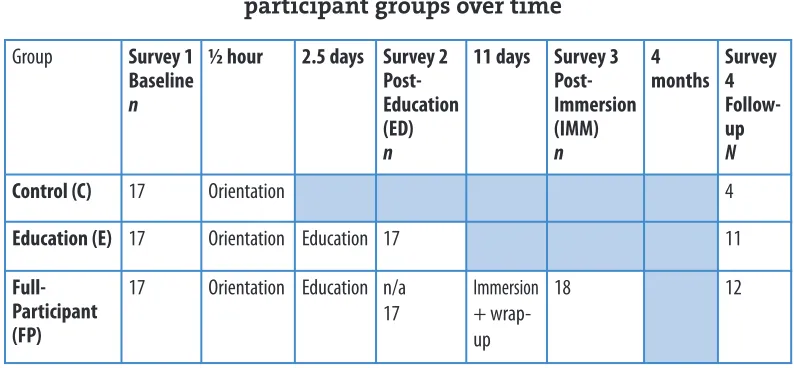
There were three groups in the study: Control, Education, and Full-Participant. Group assignment was random for those students (85%) who agreed to participate in any group. The final 15% of assignments used student availability and program information to balance the groups. The study design is shown in Table 1. On day 1, after seating in interprofessional groups of 4 to 5 for a 30-minute orientation to the project, all participants completed Survey 1. After dismissing the Control group, Education and Full-Participant groups immediately received 2.5 consecutive days of education and completed Survey 2. After dismissing the Education group, the Full-Participant group received 2 to 3 hours of orientation to one of four practice sites and travelled to those sites two days later. Following 10 to 11 days at a practice site (including travel), the Full-Participant group reconvened for one day and com-pleted Survey 3. The Follow-up Survey 4 was 4 to 5 months after Survey 3. Initially there were 17 participants in each group; however, one participant in the Education group joined the Full-Participant group during the education intervention.
Journal of Research in
Interprofessional Practice and Education
Vol. 2.1 July, 2011
6
Differences in Pre-licensure Interprofessional Learning
Table 1
Schedule of interventions and surveys for three participant groups over time
Note: Groups completed the survey referred to in the column where the group name appears. (n= group size for Surveys 1, 2, and 3; N= num-ber of respondents who completed the follow-up Survey 4 in each group). One participant joined the FP group after the education intervention.
Education intervention
Participants in interprofessional groups undertook interactive group and individual learning activities during the education intervention, including short presentations by faculty experts, team-building exercises, brainstorming sessions, and periods of reflec-tion. Interprofessional education was defined as “learning with, from, and about” each other, as developed by the Centre for the Advancement of Inter-Professional Education (CAIPE) [7]. The education intervention was developed to address the various aspects of this definition. Participants learned in both small and large groups that included stu-dents from a minimum of 5 of the 7 professional programs included in the project. “Learning withone another” was represented by activities in small groups, beginning with participants getting to know about the definition of IP learning and primary healthcare delivery, and the determinants of health. The process of “learning fromone another” was developed using teamwork activities in problem solving and task plan-ning. Lectures were given by faculty educators from all the participant professions and included topics such as group roles, sources of conflict, and conflict resolution. The process of “learning aboutone another” was represented in the intervention by discus-sions among participants about one another’s choice of profession, reasons for that choice, and the range of contributions to healthcare delivery that participants had learned about their own program.
During the education intervention, participants determined the meaning of health at the individual, family, and community level. They also worked at under-standing the components of patient-centred high-quality care, engaged in collabo-rative learning about practice, and determined the effectiveness of interprofessional community-based primary healthcare delivery. In small groups, participants identi-fied the basis of their choice of profession and participated in both a teamwork-learning activity and a group-roles teamwork-learning activity. Two patients presented their stories about teamwork and patient-centred practice, with particular illustration of
Journal of Research in
Interprofessional Practice and Education
Vol. 2.1 July, 2011
7
Differences in Pre-licensure Interprofessional Learning
Anderson, Ateah, Wener, Snow, Metge, MacDonald, Fricke, Ludwig, & Davis
Group Survey 1 Baseline n
½ hour 2.5 days Survey 2 Post-Education (ED) n
11 days Survey 3 Post-Immersion (IMM) n
4 months
Survey 4 Follow-up N
Control (C) 17 Orientation 4
Education (E) 17 Orientation Education 17 n 11
Full-Participant (FP)
17 Orientation Education n/a 17
Immersion + wrap-up
the impact of little collaboration or poor communication among professions on patient care and the need for advocacy by self or family to receive diagnosis, acute care, education, rehabilitation, and long-term care. The patient stories and determi-nants of health were discussed by participants and faculty preceptors in small inter-professional groups and by the larger group of participants. Lectures included group theory and group development, elements of collaboration, conflict and its res-olution, team dynamics, and group effectiveness. Participants anonymously answered daily reflection questions about the impact of each day’s experiences, and a faculty member facilitated discussion of the reflections the next day.
Immersion intervention
Participants in interprofessional groups of 4 to 5 travelled to one of four practice sites. Each participant was from a different health profession program. Sites were selected based on a positive recommendation from partner organizations about their ability to provide for collaborative practice and interprofessional patient-cen-tred care. Two sites were remote (rural or northern) and two were in urban centres. Sites are not identified by location for reasons of confidentiality. Variations among communities and practice settings were apparent from the outset. Matching each participant’s personality, group skills and skills at conflict resolution across the four Full-Participant groups was beyond the scope of the study. Activity schedules for shadowing staff were planned for each site depending on the communities, clinic schedules, available physical space, staffing, client and patient needs, and the nature and scope of practice. Participants had daily interaction with trained faculty precep-tors (1 to 2 hours) and completed a daily reflection questionnaire.
As with the education intervention, design of the immersion intervention addressed the CAIPE definition of interprofessional education. The process of “learning withone another” was represented by orienting participants to the practice setting, planning the logistics of travel and travelling to the setting location, interact-ing with the respective community and scope of care at the settinteract-ing, and at some sites, living with one another. The process of “learning fromone another” was represented by discussions among participants about interactions with staff, patients, and mem-bers of the community; the coordination of meeting times; discussion at meetings facilitated by preceptors; and working together to write a paper-based patient-case scenario. The assignment was to develop a case scenario that was related to prevalent chronic-health conditions that participants learned about at that practice setting and to investigate together, the requirements for and potential to receive complex inter-disciplinary care in that care setting. The process of “learning aboutone another” was represented by observations while shadowing professionals during case, direct dis-cussions about care with staff, and direct participation in the community.
Evaluation tools
Surveys 1 (baseline), 2 (post-education), 3 (post-immersion), and 4 (follow-up) were identical and included multiple evaluation tools to assess the constructs of interest. The survey instruments were used previously on pre-licensure students in
Journal of Research in
Interprofessional Practice and Education
Vol. 2.1 July, 2011
8
Differences in Pre-licensure Interprofessional Learning
health-profession programs, cited as detecting change and grounded in sound con-struct theory and/or prior rigorous psychometric testing, where possible. Although the interventions were based on the definition of IPE as “learning with, from, and about one another,” evaluation tools were “about” particular attitudes, perceptions, concepts, knowledge, or skills, based on prior interprofessional experiences “with, from, and about” one another.
To assess attitudinal changes as a result of the various levels of IPE experience, the Attitudes Toward Health Care Teams Scale (ATHCTS) was administered [49]. This tool measures attitudes toward team processes and collaboration among healthcare professionals, and is reliable and valid for assessing attitudinal changes about working on an interdisciplinary team. The survey consists of 21 Likert-type items with responses ranging from strongly agree (“1”) to strongly disagree (“6”). As an example, the first item from Factor 1 reads, “The team approach improves the quality of care for patients.”
The Interprofessional Education Perception Scale(IEPS) [50,51] was used to eval-uate the degree of change regarding participant perceptions of IPE. The tool is an 18-item, self-administered questionnaire using a five-point Likert scale (“1” = strongly disagree to “5” = strongly agree). The instrument is considered valid and reliable as a means of evaluating IPE initiatives using a pre/post-test design. The statement “Individuals in my profession are well-trained” is an example of items relating to Factor 1, competence and autonomy.
Knowledge regarding interprofessional concepts was measured pre- and post-intervention using the Interdisciplinary Team Concepts (ITC) and the
Interdisciplinary Team Intelligence Quotient (ITIQ) instruments, which are used to evaluate healthcare professional students doing team training in geriatric set-tings [52]. These tools were modified slightly to reflect healthcare delivery within Canada. The ITC and ITIQ consist of 18 and 10 true/false items, respectively. For example, item 1 on the ITC reads, “An interdisciplinary team approach to healthcare is viewed as unimportant by the changing healthcare industry.”
Skills related to teamwork were evaluated using two measures developed for use in the Geriatric Interdisciplinary Team Training (GITT) Program [53]. The Team Skills Scale(TSS) is a self-assessment tool designed to find changes in interdisciplinary skill level after educational interventions, and is internally consistent and reliable. The TSS consists of 17 Likert-scaled items in which respondents rate their perceived skill level for various tasks, from poor (“1”) to excellent (“5”). For example, item 1 asks respon-dents to rate their ability to function effectively in an interdisciplinary team. Sturespon-dents in the Full-Participant group completed an additional measure three times during the immersion experience (on days 1, 5, and 9). The Team Fitness Test (TFT) [53] tool was designed to evaluate self-perceptions of an individual’s skills in teamwork within a group. Respondents rate how well a statement applies to their team for 25 Likert-scaled statements, from definitely applies to our team (“4”) to does not describe our team at all (“1”). Statements include “Team members know they can depend on one another” and “Team members respect each other.” For the TFT, a mean-item score was calculated (the sum of response scores divided by the number of items completed).
Journal of Research in
Interprofessional Practice and Education
Vol. 2.1 July, 2011
9
Differences in Pre-licensure Interprofessional Learning
Together these instruments addressed different domains of learning outcomes [43] as follows: acquisition of knowledge (ATHCTS, ITC, ITIQ); modifications of attitudes (ATHCTS); modifications of perceptions (ATHCTS, IEPS); and acquisi-tion of teamwork skills (TSS, TFT).
Instruments that met criteria for reliability and validity—including study of a similar population for sample validation, reported as detecting change, and use of sound-construct theory to develop the measure—were chosen wherever possi-ble. Cronbach’s alpha values, used as a measure of internal consistency [54], were similar in this study for each group and factor as those reported previously for ATHCTS, IEPS, and TSS except where sample size was small (e.g., Full-Participant group, Follow-up survey) or for factors that compiled participant scoring for a small number of items (e.g., IEPS factors 2 [2 items] and 4 [3 items]). Other instruments (ITIC, ITIQ in the GITT Kit) were used to examine the acquisition of IPE knowledge although not previously validated on a pre-licensure sample popu-lation. Each tool was administered first to faculty to test for usefulness (variable interpretation based on experience or profession) and the time for completion. This testing also helped in developing the procedures for data entry and calcula-tion of scores for survey measures where an attribute was derived arithmetically by adding numerically coded responses for a pre-set group of questions or statements into a single score. Scores entered into spreadsheets (Microsoft Excel) were used in statistical analyses.
Other measures were also embedded in surveys, including measures of overall satisfaction and reaction to the project (Pre- and Post-Experiential Blockof surveys, modified with permission and originally adapted with permission from GITT [52]) and participant stereotypes of other healthcare professionals (Student Stereotypes Rating Questionnaire [55]), including nine characteristics on which each profes-sion, including participants’ own, was rated from “1” to “5.” Some findings are reported [56]. Information on behavioural change (behavioural intention to change), which typically identifies individuals’ transfer of interprofessional learning to their practice, was also measured based on Ajzen’s Theory of Planned Behaviour [57,58]. In addition, qualitative data were collected through open-ended reflections in response to guided questions; these reflections were completed daily by the participants in the Education and Full-Participant groups.
Statistics
Responses for each participant (coded) and survey tool were compiled according to published scoring algorithms and entered into Microsoft Excel worksheets. Data (mean ± standard error [SEM]) were analyzed using the General Linear Models Procedure (SAS v9.1) to match the design of survey completion (Table 1) as follows. One-way analysis of variance (ANOVA, 3 groups at 1 time) was used to study base-line differences by age, sex, program, and program year. Two-way repeated-meas-ures ANOVAs were used to study between- and within-group differences in scores after IPE-education and IPE-immersion interventions (1–3 groups x 2–3 times) and at follow-up (Full-Participant group at 4 time points, or all 3 groups at 2 times:
Journal of Research in
Interprofessional Practice and Education
Vol. 2.1 July, 2011
10
Differences in Pre-licensure Interprofessional Learning
follow-up vs. baseline). Post hoc least squares tests determined differences between groups if the overall probability of the ANOVA was less than 0.05.
Results
Demographics
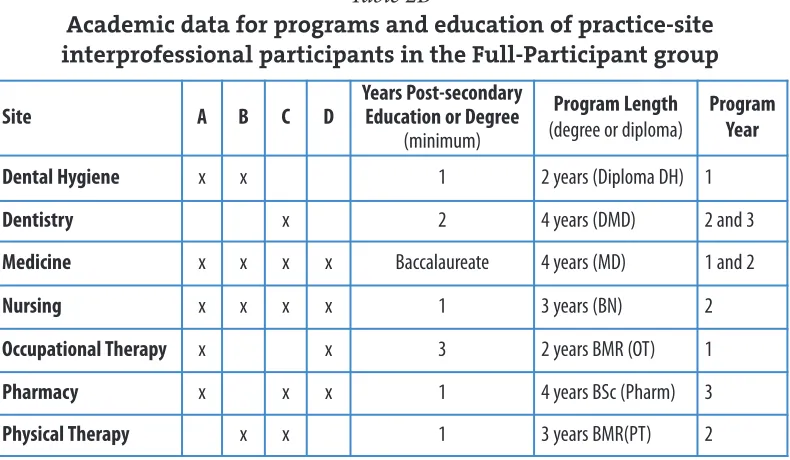
Groups were similar in age, sex, and program and year of program (Table 2A). Table 2B shows the distribution of participants by program for the Full-Participant group separated for the four practice sites and information about the programs (entry requirements, length). Participants recruited to the Control, Education, and Full-Participant groups were distributed across all program years: 56–76% of all participants were in years 1–2 of their program (Table 2B).
Table 2A
Demographic data for Control (C), Education (E,) and Full-Participant (FP) groups
Note: One participant initially volunteered for the E group and during the education intervention entered the FP group; data for that individual are analyzed in the FP group.
Table 2B
Academic data for programs and education of practice-site interprofessional participants in the Full-Participant group
Journal of Research in
Interprofessional Practice and Education
Vol. 2.1 July, 2011
11
Differences in Pre-licensure Interprofessional Learning
Anderson, Ateah, Wener, Snow, Metge, MacDonald, Fricke, Ludwig, & Davis
Age (yrs)
mean ± SD
Percent Females
Year in Program:
“n” in year 1, 2, 3, and 4 (% of group by program year)
Control (C)
(n= 17) 24.7 ± 3.1 76.5%
7, 6, 2, 2 (41, 35, 12, 12%)
Education (E)
(n= 16) 23.6 ± 1.8 75.0%
6, 3, 5, 2 (37, 19, 31, 13%)
Full-Participant (FP)
(n = 18) 24.1 ± 2.9 83.3%
5, 6, 5, 2 (28, 33, 28, 11%)
Site A B C D
Years Post-secondary Education or Degree
(minimum)
Program Length
(degree or diploma)
Program Year
Dental Hygiene x x 1 2 years (Diploma DH) 1
Dentistry x 2 4 years (DMD) 2 and 3
Medicine x x x x Baccalaureate 4 years (MD) 1 and 2
Nursing x x x x 1 3 years (BN) 2
Occupational Therapy x x 3 2 years BMR (OT) 1
Pharmacy x x x 1 4 years BSc (Pharm) 3
Physical Therapy x x 1 3 years BMR(PT) 2
Baseline: Survey 1
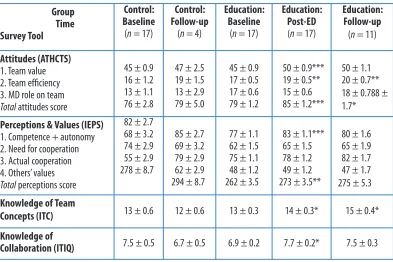
At the baseline, knowledge (ITC, ITIQ), attitudes (ATHTCS), team skills (TSS), and perceptions and values (IEPS) were evenly distributed across groups (data not shown), such that there were no significant differences in quantitative data among participant professions or by age, sex, or year in program. There were also no signifi-cant changes in mean score for any survey tool between baseline and follow-up sur-veys for the Control group (Table 3).
Education: Survey 2
After the education intervention, scores on several of the evaluation tools for atti-tudes, perceptions, knowledge, and team skills tools were increased over baseline for the Education (Table 3) and Full-Participant groups (Table 4). IPE education increased scores of both groups for overall attitudes score (total ATHCTS) and atti-tudes toward team value (ATHCTS factor 1). The Education group also had an increased score for attitudes toward team efficiency (ATHCTS factor 2). Attitudes toward physicians’ shared role on the team did not change after education. Knowledge about interdisciplinary teams (ITIQ) increased in the Education group. Knowledge of team concepts (ITC) increased, and perceptions of competence and autonomy (IEPS factor 1) increased in both Education and Full-Participant groups. Although the factor related to a perceived need for cooperation showed significant overall improvement (by the ANOVA analysis), there was no significant change for
Journal of Research in
Interprofessional Practice and Education Vol. 2.1 July, 2011 12 Differences in Pre-licensure Interprofessional Learning Anderson, Ateah, Wener, Snow, Metge, MacDonald, Fricke,
Ludwig, & Davis Group
Time Survey Tool
Control: Baseline
(n= 17)
Control: Follow-up
(n= 4)
Education: Baseline
(n= 17)
Education: Post-ED
(n= 17)
Education: Follow-up
(n= 11)
Attitudes (ATHCTS)
1. Team value 2. Team efficiency 3. MD role on team Totalattitudes score
45 ± 0.9 16 ± 1.2 13 ± 1.1 76 ± 2.8
47 ± 2.5 19 ± 1.5 13 ± 2.9 79 ± 5.0
45 ± 0.9 17 ± 0.5 17 ± 0.6 79 ± 1.2
50 ± 0.9*** 19 ± 0.5** 15 ± 0.6 85 ± 1.2***
50 ± 1.1 20 ± 0.7** 18 ± 0.788 ± 1.7*
Perceptions & Values (IEPS)
1. Competence + autonomy 2. Need for cooperation 3. Actual cooperation 4. Others’ values Totalperceptions score
82 ± 2.7 68 ± 3.2 74 ± 2.9 55 ± 2.9 278 ± 8.7
85 ± 2.7 69 ± 3.2 79 ± 2.9 62 ± 2.9 294 ± 8.7
77 ± 1.1 62 ± 1.5 75 ± 1.1 48 ± 1.2 262 ± 3.5
83 ± 1.1*** 65 ± 1.5 78 ± 1.2 49 ± 1.2 273 ± 3.5**
80 ± 1.6 65 ± 1.9 82 ± 1.7 47 ± 1.7 275 ± 5.3
Knowledge of Team
Concepts (ITC) 13 ± 0.6 12 ± 0.6 13 ± 0.3 14 ± 0.3* 15 ± 0.4*
Knowledge of
Collaboration (ITIQ) 7.5 ± 0.5 6.7 ± 0.5 6.9 ± 0.2 7.7 ± 0.2* 7.5 ± 0.3
Table 3
Control (C) and Education (E) group scores over time for attitudes, perceptions and values, and knowledge
(mean ± SEM; n= group size)
either the Education or Full-Participant group in this factor (IEPS factor 2), likely due to small group size. Interestingly, the perception of actual cooperation and the understanding of others’ values did not improve. The teamwork skills score (Table 5, TSS) increased in both the Education and Full-Participant groups after the educa-tion interveneduca-tion. The lack of statistical interaceduca-tions between group and time fac-tors for these variables suggested that the education intervention had a generally positive effect on improving many factors related to attitudes, as well as some per-ceptions, knowledge, and skills for both groups (ATHCTS, IEPS, TSS, ITC) and ITIQ for the Education group (not shown).
Immersion: Survey 3
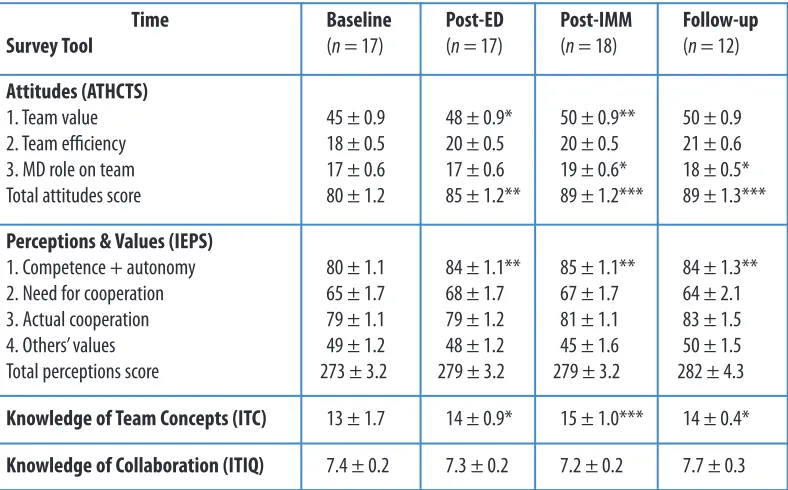
After the IPE-immersion experiences at a practice setting, the Full-Participant group had scores that were significantly increased over baseline values (Tables 4 to 5) and had retained the significant improvements over baseline values that were present after the IPE-education intervention. In addition, attitudes toward physi-cians’ role on a team (ATHCTS factor 3) increased significantly after immersion. Knowledge about team concepts (ITC), perceptions about competence and auton-omy in teamwork (IEPS factor 1) and the Team Skills Scale score (TSS) that had increased after education increased further after immersion. Perceptions and values toward actual cooperation (IEPS factor 3) and understanding others’ values (IEPS factor 4), and scores for knowledge of collaboration (ITIQ) did not change after the IPE-immersion intervention.
Journal of Research in
Interprofessional Practice and Education Vol. 2.1 July, 2011 13 Differences in Pre-licensure Interprofessional Learning Anderson, Ateah, Wener, Snow, Metge, MacDonald, Fricke, Ludwig, & Davis
Table 4
Full-Participant (FP) group scores over time for attitudes, perceptions and values, and knowledge (mean ± SEM; n = group size)
Time Survey Tool
Baseline
(n= 17)
Post-ED
(n= 17)
Post-IMM
(n= 18)
Follow-up
(n = 12)
Attitudes (ATHCTS)
1. Team value 2. Team efficiency 3. MD role on team Total attitudes score
45 ± 0.9 18 ± 0.5 17 ± 0.6 80 ± 1.2
48 ± 0.9* 20 ± 0.5 17 ± 0.6 85 ± 1.2**
50 ± 0.9** 20 ± 0.5 19 ± 0.6* 89 ± 1.2***
50 ± 0.9 21 ± 0.6 18 ± 0.5* 89 ± 1.3***
Perceptions & Values (IEPS)
1. Competence + autonomy 2. Need for cooperation 3. Actual cooperation 4. Others’ values Total perceptions score
80 ± 1.1 65 ± 1.7 79 ± 1.1 49 ± 1.2 273 ± 3.2
84 ± 1.1** 68 ± 1.7 79 ± 1.2 48 ± 1.2 279 ± 3.2
85 ± 1.1** 67 ± 1.7 81 ± 1.1 45 ± 1.6 279 ± 3.2
84 ± 1.3** 64 ± 2.1 83 ± 1.5 50 ± 1.5 282 ± 4.3
Knowledge of Team Concepts (ITC) 13 ± 1.7 14 ± 0.9* 15 ± 1.0*** 14 ± 0.4*
Knowledge of Collaboration (ITIQ) 7.4 ± 0.2 7.3 ± 0.2 7.2 ± 0.2 7.7 ± 0.3
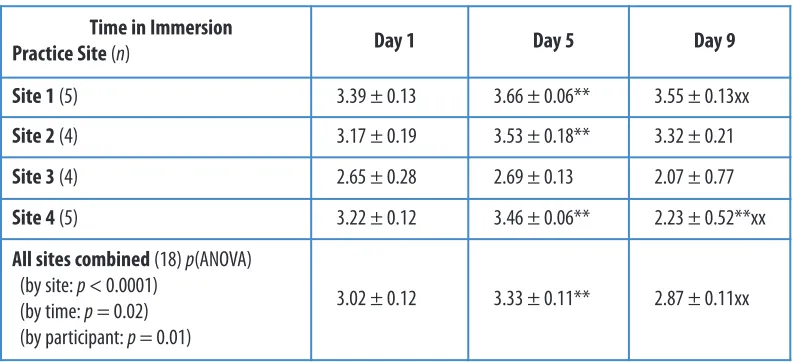
Team Fitness Test (TFT) scores were calculated as mean-item scores from responses collected during immersion (IMM) on days 1, 5, and 9 at the four prac-tice sites. Some participants noted, particularly at day 1 of IMM, that they could not respond to particular items in the survey, as some questions were not applicable at the time (i.e., they did not feel the team had a chance to function yet); other partic-ipants left a number of the items blank. Team fitness mean-item scores (Table 6 TFT,
Journal of Research in
Interprofessional Practice and Education
Vol. 2.1 July, 2011
14
Differences in Pre-licensure Interprofessional Learning
Anderson, Ateah, Wener, Snow, Metge, MacDonald, Fricke, Ludwig, & Davis
Time p(ANOVA) columns
Groupp(ANOVA) rows
Baseline
(nsd)
Post-ED Post-IMM Follow-up (N)
(0.0001)
Control (C) n (17) N (4) (nsd)
59 ± 3.4
60 ± 4.0 59 ± 4.0
Education (E) n (16) (0.01) N(11) (nsd)
60 ± 3.4 60 ± 2.4
66 ± 1.8*
64 ± 2.4CCC
Full-Participant (FP) n(18) (0.001) N(12) (0.0001)
59 ± 3.2 61 ± 1.8
64 ± 1.9* 66 ± 1.8
74 ± 3.2***†††
72 ± 1.8***† 71 ± 1.8xxx†CCCEE
Note: This table shows group scores over time (mean ± SEM) for all participants (n= group size) and Survey 4 respondents at follow-up (N).
p(ANOVA) = the significance level for the overall effect of time (baseline to post-IMM) for each comparison by column (between-group compar-ison) and by row (within-group comparcompar-ison). Symbols indicate significant changes from baseline (* = p< 0.05; *** = p < 0.0001) or Post-ED survey results († = p < 0.05; ††† = p < 0.001). Letters indicate significant between-group changes (same column) from the Control group (CCC = p < 0.001) or the Education group (EE = p < 0.01). nsd = no significant difference.
Table 5
Team Skills Scale (TSS) scores for groups by time
Table 6
Team Fitness Test (TFT) mean-item scores for Full-Participant group by time and practice site (mean ± SEM; n= group size)
Note: p(ANOVA) = the significance level for overall comparisons by site and time (day 1 to day 9). Symbols indicate significant changes from day 1 (** = p < 0.01) or day 5 (xx = p < 0.01).
Time in Immersion
Practice Site(n) Day 1 Day 5 Day 9
Site 1(5) 3.39 ± 0.13 3.66 ± 0.06** 3.55 ± 0.13xx
Site 2(4) 3.17 ± 0.19 3.53 ± 0.18** 3.32 ± 0.21
Site 3(4) 2.65 ± 0.28 2.69 ± 0.13 2.07 ± 0.77
Site 4 (5) 3.22 ± 0.12 3.46 ± 0.06** 2.23 ± 0.52**xx
All sites combined(18) p(ANOVA) (by site: p < 0.0001)
(by time: p= 0.02) (by participant: p = 0.01)
Figure 1) showed an overall increase over the time in IPE immersion at all four prac-tice sites. These scores increased from days 1 to 5 and 5 to 9, and differed among practice sites. TFT mean-item scores also increased for all individual participants from day 1 to day 9 (p= 0.01, data not shown). There were differences in the TFT mean-item scores among practice sites (p< 0.001). TFT mean-item scores changed with time (p= 0.02 overall ANOVA), increasing from day 1 to day 5 (p<0.01) and decreasing from day 5 to day 9 of the immersion intervention (p< 0.01). There were also significant differences among sites (0.03 < p< 0.002).
Follow-up vs. baseline
Twenty-three participants in the intervention group and only 4 (out of 17) partici-pants in the Control group completed Survey 4. However, there were factors that changed between baseline and follow-up for the respondents of both the Education and Full-Participant groups, including scores for attitudes toward team efficiency (ATHCTS factor 2); perceptions related to competence and autonomy (IEPS fac-tor 1); Team Skills Scale score (TSS); and knowledge about teamwork and collabo-ration (ITIQ).
Full-Participant respondents typically had the same or slightly higher scores at follow-up than respondents from the Education or Control groups (compare right-hand columns in Tables 3 and 4), for knowledge of interdisciplinary team concepts (ITIQ), attitudes toward team value (ATHCTS factor 1), and overall attitudes score
Journal of Research in
Interprofessional Practice and Education
Vol. 2.1 July, 2011
15
Differences in Pre-licensure Interprofessional Learning
Anderson, Ateah, Wener, Snow, Metge, MacDonald, Fricke, Ludwig, & Davis
Figure 1
Figure 1: Changes in Team Fitness Test (TFT) mean-item scores for the Full-Participant group
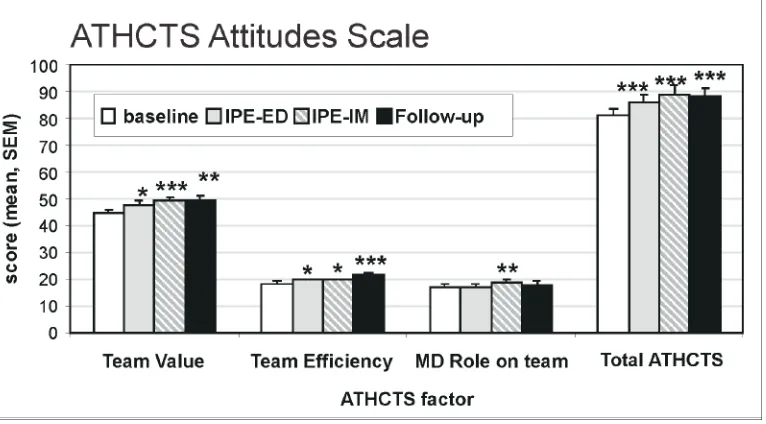
(total ATHCTS). Knowledge of team concepts increased for Education respondents at follow-up. Full-Participant respondents had higher scores for attitudes toward physicians’ shared role on a team (ATHCTS factor 3, p< 0.01, Figure 2) after follow-up compared to baseline. The same grofollow-up had previously shown increased scores for this factor after the immersion intervention. The Full-Participant respondents also had higher scores for knowledge of interdisciplinary team concepts (ITC, Table 4, right-hand column) than Control respondents at follow-up (Table 3, second column), and higher Team Skills Scale scores than all other respondents (TSS, Table 4, right-hand column). It is important to note that all participants were engaged in the continuation of their respective professional-education programs during the time between baseline and follow-up, so the improvements or changes cannot be attributed solely to participation in this study. This may explain why the score for knowledge of teams and collaboration improved for all three groups between baseline and follow-up (p< 0.01).
Figure 2:
Changes in Attitudes Toward Health Care Teams Scale (ATHCTS) scores over time
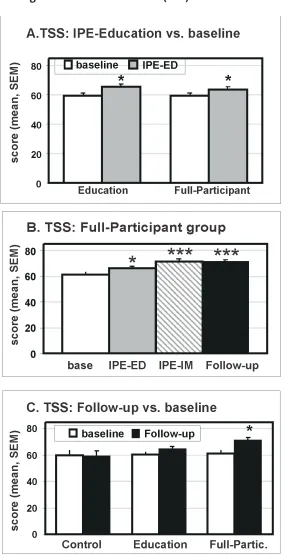
At follow-up, respondents from the Full-Participant group had the highest Team Skills Scale score (TSS, Table 5, right-hand column). As illustrated in Figure 3, the TSS score increased after classroom IPE (Figure 3A), increased progressively from baseline to post-immersion, and was maintained at follow-up for the Full-Participant group (Figure 3B). TSS score was also significantly higher than at base-line for respondents from the Full-Participant group but not for respondents to Survey 4 from the Control or Education group (Figure 3C; Table 5, first column).
Journal of Research in
Interprofessional Practice and Education
Vol. 2.1 July, 2011
16
Differences in Pre-licensure Interprofessional Learning
Anderson, Ateah, Wener, Snow, Metge, MacDonald, Fricke, Ludwig, & Davis
Figure 3
Changes in Team Skills Scale (TSS) scores over time
Journal of Research in
Interprofessional Practice and Education
Vol. 2.1 July, 2011
17
Differences in Pre-licensure Interprofessional Learning
Anderson, Ateah, Wener, Snow, Metge, MacDonald, Fricke, Ludwig, & Davis
Note: There were no significant differences among participant professions or by age, sex or year in program.
A. TSS mean-item scores after classroom IPE-education intervention (IPE-ED) compared to scores at baseline for Education and Full-Participant groups. Symbols indicate differences from baseline (* = p < 0.05; ** = p < 0.01).
B. TSS scores for the Full-Participant group at baseline, after education intervention (IPE-ED), after practice-setting IPE immersion (IPE-IM), and at follow-up. Symbols indicate differences from baseline and post-education intervention (* = p < 0.05; *** = p < 0.001).
Discussion
IPE moves education into the realm of trans-professional learning where students learn with, from, and about each other in settings that blur scopes of practice and heighten collaboration [59]. Results showed that IPE opportunities in the classroom and through immersion in practice settings advanced knowledge, skills, attitudes, and values about teamwork. This is consistent with the idea that bringing people together in meaningful ways leads to deep, responsive learning [35,60,61]. The robust findings were provided by a relatively small longitudinal study and likely enabled with the inclusion of a Control group designed for comparison against two test interventions. The comparison with a control group is uncommon in educa-tional research. The ability to detect changes in this interprofessional cohort of par-ticipants through the statistical design of repeated measures analyses of variance suggests similar control groups would be valuable for other studies.
The findings after the educational intervention showed that active learning in interprofessional groups in a classroom setting was effective in improving a subset of the scores measuring the following: knowledge about interdisciplinary team con-cepts; attitudes toward teams; perceptions and values about competence, autonomy, cooperation, and others’ values; and teamwork skills.
Results on attitude scores for changes related to the education intervention showed the potential for an IPE intervention in an educational setting to promote longer-term improvement in patient outcomes through consensus on patient needs and priorities (ATHCTS factor 1, related to team value) and to reduce inefficiencies of communication that could negatively impact patient outcome (ATHCTS factor 2, related to team efficiency). Attitudes toward leadership on a team (ATHCTS fac-tor 3, related to physicians’ shared role on the team) scored higher when respon-dents were more skeptical or questioning of physicians as stereotypical authority figures, and this score did not change after IPE experiences in a classroom setting. Interestingly, the comparison of Full-Participant group participant scores post-IMM does not show the same improvement in attitudes toward team efficiency, pos-sibly due to the additional experiences of the Full-Participant group and the range of those experiences among the four practice sites. However, the observation that classroom exposure to teamwork activities and learning about the determinants of health, sources of conflict, and conflict resolution in interprofessional groups improved most scores on perceptions about interprofessional teamwork is further convincing of the value of IPE in an educational setting. These factors relate to per-ceptions of “my profession” performing well, independently and cooperatively, and being respected by individuals in all professions. Therefore, through the classroom setting for IPE exposure and the two high-impact patient stories, participants in general learned the importance of teamwork. Those stories had highlighted serious problems that arose when teamwork and shared responsibility for poor patient out-comes are deficient. Those learnings persisted for the Full-Participant group through their IPE-immersion experiences and into follow-up (for respondents from both the Education and Full-Participant groups).
Interprofessional immersion at a practice site increased positive attitudes to
Journal of Research in
Interprofessional Practice and Education
Vol. 2.1 July, 2011
18
Differences in Pre-licensure Interprofessional Learning
teamwork and its value, and the earlier benefits of the education intervention sisted. Improved attitudes toward the physicians’ role suggest that participants per-ceived responsibility across the healthcare team as balanced more equitably than previously thought. The lack of change in other attitude scores shows different atti-tudes are separable and change separately. Preceptors observed a wide range of behaviours between and among staff at practice sites, from high-level collaboration that welcomed participants to directive management and conflict or perceived con-flict (sometimes involving participants), which likely resulted in site-specific changes and considerable variability in Team Fitness Test scores. Overall, scores for many factors of knowledge, perceptions, skills, and attitudes that can facilitate inter-professional collaborative practice improved after immersion at a practice setting.
There were many scores measured after active interprofessional education in a classroom setting, despite the small number of participants. Participants learned things together, “with, from and about one another,” that were revealed by compar-isons between groups, with a Control group and over time. That new information was only available because participants were in direct interaction and contact with one another while learning about patient issues, their own and others’ professional roles (including knowledge, attitudes, skills, and values of other professions), team-work for problem-solving, and the broader determinants of health. These findings have implications for developing pre-licensure curricula.
Findings from the follow-up survey showed that many of the previous improve-ments in perceptions, attitudes, and team skills were fairly long-lasting among the Education and Full-Participant groups. Importantly, this included improved atti-tudes toward physicians’ role on a team (ATHCTS factor 3; Figure 2); perceptions related to competence and autonomy on a team (Table 4); and team skills (Table 5; Figure 3). Unfortunately, the small number of Control group respondents limited the interpretation of findings at follow-up relative to Control. The loss to follow-up among students in the Control group was 76% (13 out of 17). It cannot be ascer-tained whether or not the withdrawal from the study was related to students’ atti-tudes or knowledge of IPE or interprofessional collaboration, and the absence or the direction of bias due to loss-to-follow-up cannot be determined. For most Survey 4 respondents, however, the score they recorded at baseline for attitudes was in the upper half of the scale range measured for all participants in this study. This suggests that application of the ATHCTS tool may be able to identify which stu-dents have more collaborative attitudes. If this were confirmed by a future study, this discriminative feature would be informative to the admission interview processes for student selection into health-profession programs.
Limitations of this study were the relatively small number of participants and logistics of participant recruitment to develop interprofessional groups with 85% random assignment of participants. We developed a mean-item team fitness score (average rather than total). This was because some questions were not applicable before participants had an opportunity for team function. Regular educational pro-grams continued during the study so changes for respondents may not be due solely to IPE education and/or immersion interventions, although Control group
respon-Journal of Research in
Interprofessional Practice and Education
Vol. 2.1 July, 2011
19
Differences in Pre-licensure Interprofessional Learning
dents showed no score changes between baseline and follow-up. Rather than devel-oping an evaluation tool explicitly to assess “with, from, and about one another” experiences, the study assessed knowledge, attitudes, skills, and perceptions about particular aspects of collaboration and other professions. For that reason, interpre-tation of findings is limited to the potential for changes in the assessed parameters that may improve the outcome of care.
It is useful to note that there are also limitations in utilizing statistical analyses alone to draw conclusions regarding efficacy and impact of a relatively small, short-term study for longer-short-term, real-world application. Unfortunately, the study design did not include a survey of previous participant experiences with other professions, the healthcare system, previous education or personal interests, prior beliefs, cul-tural or social diversity, learning styles, and competing needs that would have enabled correlation of findings with multiple experiential parameters. This study did not test whether participants in interprofessional learning as observed partici-pating in interprofessional collaboration in classroom and practice settings would practise more collaboratively. A longer-term, large, and well-controlled longitudinal study would be required to determine whether exposure to and immersion in inter-professional learning during pre-licensure programs improves healthcare outcomes for patients, their families, and communities. Challenges to the design and conduct of the study also resulted from the difficulty of applying theoretical concepts in research design to actual practices.
Conclusion
Improvements in a subset of scores related to attitudes, values, and perceptions, plus knowledge about and skills relating to teamwork and collaboration in this study were time-dependent, and were specific to IPE-education experiences in a class-room setting, IPE-immersion intervention in a practice setting, or resulted from IPE-learning experiences in both settings.
The noted improvements were found to be independent of profession or demo-graphics, as participants from all professions showed such changes. Importantly, improved scores by the Full-Participant group in attitudes toward physicians’ role on a team (ATHCTS factor 3), overall attitudes (total ATHCTS), perceptions of competence and autonomy (IEPS factor 1), and knowledge of team concepts (ITC) persisted into the immersion experience or further into the follow-up survey.
The education intervention, itself, had considerable positive impact, even with the programmatic variations in practical training and clinical experiences that might be anticipated to affect the outcome of the intervention in a classroom set-ting. However, since attitudes toward physicians’ role on a team improved only after IPE-immersion experiences, it may be useful to augment current programmatic clinical experiences to provide IPE-learning opportunities where students from dif-ferent professions share leadership and decision-making regarding patient care.
Although the limitations noted above qualify our interpretation, the findings from this longitudinal research study indicate that IPE experiences are important in learning about collaboration for patient-centred care. Evolution of collaborative
Journal of Research in
Interprofessional Practice and Education
Vol. 2.1 July, 2011
20
Differences in Pre-licensure Interprofessional Learning
attitudes toward shared leadership among professionals (including the role of physi-cians on the healthcare team) requires active experiences in a collaborative practice setting. This study was able to provide that insight, for the design utilized different levels of exposure to IPE and included time-dependent comparisons to survey results for a control group that was not exposed to these IPE-learning opportunities in the classroom or practice settings. As such, these findings suggest IPE-learning opportunities should be included, with appropriate resource allocations, in health-profession education programs, starting in the classroom or problem-based tutorial learning, and continuing into practice settings in rotations that involve direct involvement with patients and other professionals. IPE opportunities, for example in Clinical-Learning Units using simulation, standardized patients, and collabora-tive-practice clinical facilities, should help to advance student learning in domains of knowledge, skills, attitudes, perceptions and values, and team skills related to col-laboration. Such units may also be able to evaluate students in those same domains, prior to licensure or even at the time of application to health-profession programs.
Acknowledgements
The authors are grateful for the partnerships of the Northern Medical Unit staff, in particular the director, Dr. Bruce Martin; and the Winnipeg Regional Health Authority. Collaborative input to the original proposal from Manitoba Health and the deans and directors of participating University of Manitoba faculties (Dentistry, Medicine, Nursing, Pharmacy) and schools (Dental Hygiene and Medical Rehabilitation, including Occupational Therapy and Physical Therapy depart-ments) is also appreciated. The authors especially acknowledge contributions from project staff, including Ms. L. Tryhuk, community and practice-site leaders, staff, patients, clients, and people in communities where this study was conducted in 2007. We would also like to acknowledge funding from Health Canada (agreement #6804-15-2005/6880031).
Abbreviations
IPE (Interprofessional Education)
ATHCTS (Attitudes Toward Health Care Teams Scale)
CAIPE (Centre for the Advancement of Inter-Professional Education) GITT (Geriatric Interdisciplinary Team Training) Program
IEPS (Interprofessional Education Perceptions Scale) ITIQ (Interdisciplinary Team Intelligence Quotient) ITC (Interdisciplinary Team Concepts)
TSS (Team Skills Scale), TFT (Team Fitness Test)
IECPCP (Interprofessional Education for Collaborative Patient-Centred Practice)
References
1. World Health Organization. (1988). Learning together to work together for health: Report of a WHO study group on multiprofessional education of health personnel: The team approach (Technical Report Series 769). Geneva: WHO.
2. Curran, V. (2004). Interprofessional education for collaborative patient-centred practice: Research synthesis paper. Ottawa, ON: Health Canada. URL: http://www.med.mun.ca/getattachment /3a9bf92b-c99e-4b5b-9648-4a755604a124/Curran—Resarch-Synthesis-Paper.pdf.aspx [March, 2011].
Journal of Research in
Interprofessional Practice and Education
Vol. 2.1 July, 2011
21
Differences in Pre-licensure Interprofessional Learning
3. D’Amour, D., & Oandasan, I. (2004). Interdisciplinary education for collaborative patient centred practice: An evolving framework (Report). Ottawa, ON: Health Canada.
4. Canadian Interprofessional Health Collaborative (CIHC). (2008). [Website]. URL: http://www.cihc.ca/.
5. International Association for Interprofessional Education and Collaborative Practice (InterEd.). (2008). Our objectives. URL: http://www.interedhealth.org/site/about/our-objectives [March, 2011].
6. Johnson, A. W., Potthoff, S. J., Carranza, L., Swenson, H. M., Platt, C. R., & Rathbun, J. R. (2008). CLARION: A novel interprofessional approach to health care education. Academic Medicine, 81(3), 252-256.
7. Centre for the Advancement of Interprofessional Education (CAIPE). (2002). Defining IPE. URL: http://www.caipe.org.uk/about-us/defining-ipe [March, 2011].
8. D’Amour, D., & Oandasan, I. (2005). Interprofessionality as the field of interprofessional practice and interprofessional education: An emerging concept. Journal of Interprofessional Care, 19(Suppl. 1), 8-20.
9. Gilbert, J. H. (2005). Interprofessional learning and higher education structural barriers. Journal of Interprofessional Care, 19(Suppl. 1), 87-106.
10. Barker, K., Bosco, C., & Oandasan, I. (2005). Factors in implementing interprofessional education and collaborative practice initiatives: Findings from key informant interviews. Journal of Interprofessional Care, 19(Suppl. 1), 166-176.
11. Freeth, D., Hammick, M., Koppel, I., Reeves, S., & Barr, H. (2002). A critical review of evaluations of interprofessional education (Report). London: Learning and Teaching Support Network for Health Sciences and Practice.
12. Price, D., Howard, M., Hilts, L., et al. (2009). Interprofessional education in academic family med-icine teaching units. Canadian Family Physician, 55, e1-e5.
13. Pozner, S., Hylin, U., Kusoffsky, A., Lauffs, M., Mattiasson, A. C., & Nordstrom, G. (2004). Interprofessional training in the context of clinical practice: Goals and students’ perceptions on clinical education wards. Medical Education, 38, 727-736.
14. Reeves, S., & Freeth, D. (2002). The London training ward: An innovative interprofessional learn-ing initiative. Journal of Interprofessional Care, 16, 41-52.
15. Zwarenstein, M., Goldman, J., & Reeves, S. (2009). Interprofessional collaboration: Effects of prac-tice-based interventions on professional practice and healthcare outcomes (Review). Cochrane Collaboration, 4, 1-28.
16. Zwarenstein, M., Reeves, S., Barr, H., Hammick, M., Koppel, I., & Atkins, J. (2001). Interprofessional education: Effects on professional practice and health care outcomes. Cochrane Database of Systematic Reviews, 1(1), CD002213.
17. Barr, H., Freeth, D., Hammick, M., Koppel, I., & Reeves, S. (2005). The evidence base and recom-mendations for interprofessional education in health and social care: A summary of findings from systematic review. In H. Barr, I. Koppel, S. Reeves, M. Hammick, & D. Freeth (Eds.), Effective interprofessional education: Argument, assumption and evidence, pp.1-4. Oxford: Blackwell. URL: http://www.swap.ac.uk/docs/barr_05.pdf [March, 2011].
18. Meads, G., Ashcroft, J., Barr, H., Scott, R., & Wild, A. (2005). The case for interprofessional collabo-ration in health and social care. Oxford: Blackwell.
19. Romanow, R. J. (2002). Building on values: The future of health care in Canada. Report of the Commission on the Future of Health Care in Canada. Ottawa, ON: National Library of Canada. 20. Kaufman, D. M., McClaran, J., Toombs, M., Beardall, S., Levy, I., & Chockalingam, A. (2001). Achieving cardiovascular health through continuing interprofessional development. Canadian Journal of Public Health, 92(4), I10-I16.
21. Canadian Interprofessional Health Collaborative (CIHC). (2008). Knowledge transfer and exchange in interprofessional education: Synthesizing the evidence to foster evidence-based
deci-sion making. URL: http://www.cihc.ca/files/publications/The_Evidence_For_IPE_July2008
.pdf [March, 2011].
22. Morey, J. C., Simon, R., Jay, G. D., et al. (2002). Error reduction and performance improvement in the emergency department through formal teamwork training: Evaluation results of the MedTeams project. Health Services Research, 37(6), 1553-1581.
23. Hammick, M., Freeth, D., Koppel, I., Reeves, S., & Barr, H. (2007). A best evidence systematic review of interprofessional education: BEME Guide no. 9.Medical Teacher, 29,735-751. 24. Horbar, J. D., Rogowski, J., Plsek, P. E., et al. (2001). Collaborative quality improvement for
neona-tal intensive care. NIC/Q Project Investigators of the Vermont Oxford Network. Pediatrics, 107(1), 14-22.
Journal of Research in
Interprofessional Practice and Education
Vol. 2.1 July, 2011
22
Differences in Pre-licensure Interprofessional Learning
25. Oandasan, I., D’Amour, D., Zwarenstein, M., et al. (2004). Interprofessional education for collabo-rative patient centred practice (Report). Ottawa, ON: Health Canada.
26. Sinclair, M. (2002). The report of the Manitoba Pediatric Cardiac Surgery Inquest: An inquiry into twelve deaths at the Winnipeg Health Sciences Centre in 1994. URL: http://www.pediatric cardiacinquest.mb.ca [March, 2011].
27. Manitoba Family Services and Housing, Winnipeg Regional Health Authority, & Manitoba Health. (2008). Winnipeg Integrated Services Initiative: A conceptual framework (Report). URL: http://www.wrha.mb.ca/community/wis/files/ConceptFramework_E.pdf [March, 2011]. 28. Manitoba Health. (2002). Primary health care policy framework. URL: http://www.gov.mb.ca
/health/phc/framework.html [March, 2011].
29. Charles, G., Bainbridge, L., & Gilbert, J. H. V. (2010). The University of British Columbia (UBC) model of interprofessional education. Journal of Interprofessional Care, 24(1), 9-18.
30. Altrichter, H., Posch, P., & Somekh, B. (1993). Teachers investigate their work: An introduction to the methods of action research. New York, NY: Routledge.
31. Lingard, L., Albert, M., & Levinson, W. (2008). Qualitative research: Grounded theory, mixed methods, and action research. British Medical Journal, 337,a567.
32. Oandasan, I., & Reeves, S. (2005). Key elements of interprofessional education. Part 2: Factors, processes and outcomes. Journal of Interprofessional Care, 19(Suppl. 1), 39-48.
33.Oandasan, I., & Reeves, S. (2005). Key elements for interprofessional education. Part 1: The learner, the educator and the learning context. Journal of Interprofessional Care, 19(Suppl. 1), 21-38. 34. Hewstone, M., & Brown, R. (1986). Contact is not enough: An intergroup perspective on the
“con-tact hypothesis.” In M. Hewstone & R. Brown (Eds.), Contact and conflict in intergroup encoun-ters (pp. 1-44). Oxford: Blackwell.
35. Hewstone, M., Carpenter, J., Franklyn-Stokes, A., & Routh, D. (1994). Intergroup contact between professional groups: Two evaluation studies. Journal of Community and Applied Social Psychology, 4,347-363.
36. Steinert, Y. (2005). Learning together to teach together: Interprofessional education and faculty development. Journal of Interprofessional Care, 19(Suppl. 1), 60-75.
37. Jacobs, G. M., Lee, C., & Ng, M. (1997). Cooperative learning in the thinking classroom: Research and theoretical perspectives (pp. 1-22). Singapore.
38. Way, D., Jones, L., & Busing, N. (2000). Implementation strategies: Collaboration in primary care— Family doctors and nurse practitioners delivering shared care (Report). Toronto, ON: Ontario College of Family Physicians.
39. Somekh, B. (1995). The contribution of action research to development in social endeavours: A position paper on action research. British Education Research Journal, 21, 331-355.
40. Cooperrider, D. L., Whitney, D., & Stavros, J. M. (2008). Appreciative inquiry handbook for leaders of change (2nd ed.). Brunswick, OH: Crown.
41. O’Neill, B. J., & Wyness, M. A. (2005). Student voices on an interprofessional course. Medical Teacher, 27(5), 433-438.
42. Kirkpatrick, D. L. (1967). Evaluation of training. In R. L. Craig & L.R. Bittel (Eds.), Training and development handbook (pp. 87-112). New York, NY: McGraw-Hill.
43. Kirkpatrick, D. (1996). Revisiting Kirkpatrick’s four-level model. Training and Development, 50, 54-59.
44. Barr, H., Freeth, D., Hammick, M., Koppel, I., & Reeves, S. (2000). Evaluations of interprofessional education: A United Kingdom review for health and social care.United Kingdom Centre for the Advancement of Interprofessional Education with the British Educational Research Association. URL: http://www.caipe.org.uk/silo/files/evaluations-of-interprofessional-education .pdf [March, 2011].
45. Knowles, M. S. (1990). The adult learner: A neglected species (4th ed.). Houston, TX: Gulf Publishing. 46. Craddock, D., Borthwick, A., & McPherson, K. (2006). Interprofessional education in health and
social care: Fashion or informed practice? Learning in Health and Social Care, 4, 220-242. 47. Schön, D. A. (1987). Educating the reflective practitioners: Towards a new design for teaching and
learning in the profession. San Francisco, CA: Jossey-Bass.
48. Reeves, S., Suter, E., Goldman, J., Martimianakis, T., Chatalalsingh, C., & Dematteo, D. (2007). A scoping review to identify organizational and education theories relevant for interprofessional practice and education (Report). Calgary Health Region & QUIPPED—Queen’s University Inter-Professional Patient-Centred Education Direction. URL: http://meds.queensu.ca.proxy1 .lib.umanitoba.ca/quipped/assets/ScopingReview_IP_Theories_Dec07.pdf [March, 2011]. 49. Heinemann, G. D., Schmitt, M. H., Farrell, M. P., & Brallier, S. A. (1999). Development of an
Attitudes Toward Health Care Teams Scale. Evaluation & the Health Professions, 22, 123-142.
Journal of Research in
Interprofessional Practice and Education
Vol. 2.1 July, 2011
23
Differences in Pre-licensure Interprofessional Learning
50. Luecht, R. M., Madsen, M. K., Taugher, M. P., & Petterson, B. J. (1990). Assessing professional per-ceptions: Design and validation of an Interdisciplinary Education Perception Scale. Journal of Allied Health, 19(2), 181-191.
51. Hawk, C., Buckwalter, K., Byrd, L., Cigelman, S., Dorfman, L., & Ferguson, K. (2002). Health pro-fessions students’ perceptions of interprofessional relationships. Academic Medicine, 77(4), 354-357.
52. GITT Kit. (2003). Geriatric Interdisciplinary Team Training Kit: The GITT Kit. New York, NY: John A. Hartford Foundation.
53. Hyer, K., Heinemann, G. D., Fulmer, T. (2002). Team skills scale. In G. D. Heinemann & A. M. Zeiss (Eds.), Team performance in health care: Assessment and development (pp. 159-163). New York, NY: Plenum.
54. Nunnally, J. C., & Bernstein, I. H. (1994). Psychometric theory (3rd ed.). New York: McGraw-Hill. 55. Hean, S., Clark, J. M., Adams, K., & Humphris, D. (2006). Will opposites attract? Similarities and differences in students’ perceptions of the stereotype profiles of other health and social care professional groups. Journal of Interprofessional Care, 20(2), 162-181.
56. Ateah, C., Snow, W., Wener, P., et al. (2011, February). Stereotyping as a barrier to collaboration: Does interprofessional education make a difference? Nurse Education Today, 31(2), 208-213. 57 Ajzen, I. (1988). Attitudes, personality, and behavior. Chicago, IL: Dorsey Press.
58. Ajzen, I. (1991). The theory of planned behavior. Organizational Behavior and Human Decision Processes, 50,179-211.
59. Harden, R. M. (1998). AMEE guide No. 2: Multiprofessional education. Part 1—Effective multi-professional education: A three-dimensional perspective. Medical Teacher, 20,402-408. 60. Allport, G. W. (1954). The nature of prejudice. Cambridge, MA: Addison-Wesley.
61. Hean, S., & Dickinson, C. (2005). The contact hypothesis: An exploration of its further potential in interprofessional education. Journal of Interprofessional Care, 19(5), 480-491.
Journal of Research in
Interprofessional Practice and Education
Vol. 2.1 July, 2011
24
Differences in Pre-licensure Interprofessional Learning