JIEM, 2014 – 7(4): 857-890 – Online ISSN: 2014-0953 – Print ISSN: 2014-8423 http://dx.doi.org/10.3926/jiem.1005
Relation of project managers’ personality and project performance: An
approach based on value stream mapping
Maurizio Bevilacqua, Filippo Emanuele Ciarapica, Michele Germani, Giovanni Mazzuto,
Claudia Paciarotti
Department of Industrial Engineering Università Politecnica delle Marche (Italy)
[email protected], [email protected], [email protected], [email protected], [email protected]
Received: November 2013 Accepted: July 2014
Abstract:
Purpose:
This work investigates the influence of project managers’ personality on the success
of a project in a Multinational Corporation. The methodology proposed for analyzing the
project managers’ personality is based on the Myers-Briggs Type Indicator.
Design/methodology:
Forty projects carried out in 2012 by multinational corporation,
concerning new product development (NPD), have been analyzed, comparing the profile of
project managers with results obtained in terms of traditional performance indexes (time delay
and over-budget of projects) and performance indexes usually used in “Lean Production”
sector (waste time and type of “wastes”). A detailed analysis of the most important “wastes”
during the project development is carried out using the Value Stream Mapping (VSM)
technique.
Findings:
Relying on the Myers–Briggs personality instrument, results show that extroverted
managers (as opposed to introverted managers) carry out projects that show lower delay and
lower waste time. Introverted managers often make “Over-processing” and “Defect” types of
waste. Moreover, lower delay and over-budget have been shown by perceiving managers.
that several aspects of our data collection effort helped enhance the accuracy of the results,
future research could conduct real-time case study research to get more detailed insights into
the proposed relationships and avoid retrospective bias. Moreover we focused on a single
respondent, the project manager. This helped us ensure that their interpretations played an
important role in product development. But, we cannot examine the opinion of team members
that could be different from project manager’s opinion regarding some questions.
Originality/value:
This research provides insight useful to develop proactive approaches to
prevent project failures, including the creation of more effective messages and methods to help
companies to make the best choices during managers´ hiring. Moreover this research would
allow organizations to better match the short-term organizational needs with appropriate
personality types.
Keywords:
Project managers’ personality, Myers-Briggs type indicator, value stream mapping, project
performance, New Product Development (NPD)
1. Introduction
Several researchers highlighted a relation between project managers’ personality and project performance. According to Purcell and Hutchinson (2007) the personality of project managers plays a significant role in the projects’ outcome, especially when the project concerns the new product development (NPD). The leadership and the interpersonal skills of project managers are the most important key factors that lead a project to be successful (Othman, Gouw & Bhuiyan, 2012). It is therefore more productive to preselect innovative, creative people for the early stages of a project, and then teach this group the business discipline required in stage-gate NPD processes. Crawford (1987) suggested that market research supporting early stage NPD project analysis is often not done very well because the individuals usually selected are risk averse, patient, and persistent individuals, whereas market research for NPD requires personnel with high risk acceptance, creativity, and openness to the “irrational” process of NPD. Researchers have long debated the skills and competencies (Gehring, 2007) that are beneficial in the project manager role that may reduce project failures (Gillard & Price, 2005). Jablokow and Booth (2006) introduced the concepts of cognitive gaps to explain the source of problems in new projects. First, differences between the nature and difficulty of the problem at hand and the cognitive resources of the problem solvers tasked with its solution; and second, differences between the cognitive abilities and approaches of the problem solvers themselves.
analyzed using the Myers-Briggs Type Indicator (MBTI) method while project performance is assessed using two traditional indexes (project delay and over-budget) and two indexes used in lean production management: waste time and waste type. The last two indexes, never used in project management field, have been defined in this work using an approach based on Value Stream Mapping (VSM) techniques. This research would allow Multinational Corporation to prevent project failures making the best choices during managers´ hiring.
The paper is organized as follows: section 2 is divided into two parts. Section 2.1 presents a brief overview of MBTI and a review of the relevant literature on the use of MBTI in the determination of managers’ personalities (section 2.1.1). Moreover, section 2.1.2 briefly describes the Value Stream Mapping tools used in this work. The second part of section 2 analyses the literature about the influence of project managers’ personality on project performance and develops the research hypothesis. Section 3 describes the procedure carried out to collect and to analyze data. In Section 4, results of data analysis are presented. Finally, discussion and conclusions are presented in sections 5 and 6.
2. Hypothesis development
2.1 Background
2.1.1 Personality type and Myers Briggs Type Indicator
Various testing methods for classifying individuals have been developed in the past. The most important tests of personality type include the Rorschach ink blot test, the Thematic Apperception Test (TAT), the Myers–Briggs Type Indicator (MBTI), and the Big Five personality trait taxonomy, among many others. The TAT and Rorschach are projective tests, i.e. the assessment of the subject is based on what the individual projects on a given image (Dolfi & Andrews, 2007). The Big Five personality traits overlap with some MBTI classifications and are comprised of openness, conscientiousness, extroversion, agreeableness and neuroticism.
According to Dolfi and Andrews (2007), project managers have certain functional characteristics associated with their work environment that lend themselves well to MBTI classification. The MBTI Form M is a forced-choice, self-disclosure instrument that has been administered more than 2 million times yearly, making it the most administered personality profile (Myers & Myers, 1980). Based on Jung’s theory of psychological types, the MBTI contains four dichotomous scales and each category presents two polar opposites. They are:
• where a person focuses his or her attention: extroversion (E) and introversion (I),
• the way a person gathers information: sensing (S) and intuition (N),
• how a person deals with the outer world: judging (J) and perceiving (P). For example, a person could be MBTI profiled with INFJ. This means the person has a tendency towards introversion, intuition, feeling, and judging.
Extraverted individuals obtain information through an orientation toward the outer world of people, events, or things. They enjoy meeting new people, thinking aloud, and being active. Introversion types seek the introspection of ideas, thoughts, and concepts. They prefer to process their thoughts internally before speaking, have few close friends, and often seek conversations that tend to be deeper in nature.
Sensing (S) and Intuition (N) refers to how information from the external world is understood and interpreted by individuals. Sensing types are more aware of their senses in relation to their environment; they are often factually based, focus on practical, concrete problems, and they generally believe that if something works, it is best to leave it alone. Individuals who have a tendency to understand the world through an Intuitive process prefer to live in a world of possibilities and options and to look towards the future. They also tend to focus on complicated abstract problems, seeing the big picture, sometimes at the expense of details (Hirsh & Kummerow, 1997).
Thinking (T) and Feeling (F) are considered the ‘‘rational processes’’ by which we come to certain conclusions and judgments regarding the gathered information. Thinking types (T) prefer to make decisions based on an impersonal objective position. Feeling types (F) have a tendency to respond well and easily to people’s values and they are adept at assessing the human impact of decisions.
Judging (J) and Perceiving (P) refer to how we ‘‘live our outward life’’. Judging types prefer to live a structured, organized life. They tend to be self-disciplined, they enjoy making decisions, and they thrive on order. Perceiving types prefer to live a more flexible and adaptable lifestyle. They tend to thrive on spontaneity, they prefer to leave things open, require more information in order to make decisions, and often get things done at the last minute (Sprague, 1997). The four dichotomies resulting from completion of Form M are reported as four-letter personality types such as ESTP or ISFJ. Each letter corresponds to an individual’s preference in each of the four pairs of personality indicators such as E or I, S or N, T or F, and J or P. There are 16 possible combinations called types.
2.1.2 Value Stream Mapping and Project performance
client satisfaction. The primary challenge of project management is to achieve all of the project goals and objectives while adhering to project constraints (Harrison & Lock, 2004). Although in general terms project performance is recognized as a multidimensional parameter (Bannerman, 2008) the most cited project output variables are comprised of cost, schedule, technical performance outputs, and customer satisfaction (Meza & Jeong, 2013). Moreover, most of the project performance evaluation methods used by many organizations do not explicitly consider key input variables that add value for the client (Farris, Groesbeck, Van Aken & Letens, 2006).
Nr. Type of waste Description 1) Waiting
A) Waiting for capacity available B) Information is waiting for people
C) Waiting for data, answer, specifications, results, approvals, decisions, releases, signs
2) Transport/Handoffs
A) Excessive data traffic B) Handoffs
C) Stop and go tasks/ Task switching D) Ineffective communication
3) Movement A) Information huntingB) Remote locations C) Lack of direct access
4) Over Processing
A) Unnecessary detail and accuracy B) Unnecessary features and processes C) Inappropriate use of competency D) Use of inappropriate tools/methods E) Excessive approvals
F) Excessive transactions
5) Inventory
A) Exceeding capacity utilizations (Queues on critical path) B) High system variability (Queues on critical path) C) Large batch sizes (Queues on critical path) D) Unnecessary testing equipment and prototypes E) Excessive storage
6) Overproduction/Un-synchronized processes
A) Poor synchronization as regards time and capacity B) Poor synchronization as regards contents
C) Over-dissemination of information D) Redundant tasks
7) Defects A) Deficient information qualityB) Erroneous data and information C) Poor testing and verification
8) Reinvention A) Poor design re-useB) Poor knowledge re-use
9) Lack of discipline
A) Unclear goals and objective
B) Unclear roles, responsibilities and rights C) Unclear rules
D) Insufficient readiness to cooperate E) Poor schedule discipline
F) Incompetence/Poor training
10) Limited IT Resources A) Poor compatibilityB) Poor capability C) Low capacity
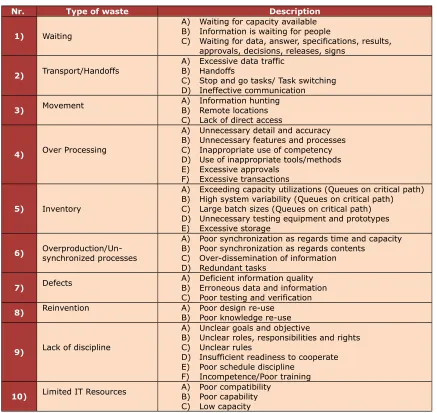
Table 1. Waste categories (Bauch, 2004)
2.2 The influence of project managers’ personality on project performance
Numerous researchers, in the past, have investigated the relationship between personality types and professions. Two meta-analyses published in 1991 investigated the relations between Big Five personality dimensions and various aspects of job performance (Barrick & Mount, 1991; Tett, Jackson & Rothstein, 1991). Both papers reviewed the existing literature and classified the specific personality measures used in the different studies into one or more of the Big Five factors. The results of the two meta-analyses were similar. Across different occupational groups and measures of job performance, the Big Five markers, particularly conscientiousness, were related to performance.
Their analysis shows that indeed many MBTI types might be suited for project managers while others are not. However, they confirm that the ESTJ type is a preferred type of project manager. Smith in his research (2001) confirmed Shenhar and Wideman’s work (2000) and found the four outer quadrants of the 16 types in the MBTI table as suitable for project management. Mills, Robey and Smith (1985) using the MBTI also found that traditional managers were ESTJ or ISTJ, the S being the dominant characteristic for project managers. Black and Slaker (2004) found that NT (intuitive thinking) types had greater leadership tendencies. Mullaly and Thomas (2004) compared the general population to career project managers finding them to be INT or IST types. Turner & Muller (2006) examined the MBTI type as it relates to project management by looking at the interaction of personality type with project type. What can be said of many personality classifications is that one size does not fit all. Dolfi and Andrews (2007) looked at the optimism of project managers and whether optimism, innate or learned, would allow project managers to overcome the impediments associated with the work environment. More recently, Davis (2011) investigated the impact of project managers’ emotional intelligence (EI) on their interpersonal competence. Results indicate meaningful relationships with the two models used:
• Assessments based on the ability model (Mayer, Salovey, & Caruso, 2000) and
• mixed model (Bar-On, 2000) and the domains of conflict management and problem solving.
This study expands research on project managers’ characteristics in the area of project management by applying the MBTI to the success of the project. Particular attention has been given to performance indexes that add value for the client.
2.2.1 Extroverts versus introverts
• H1: Extroverted project managers carry out projects that show:
• (a) lower delay than introverted project managers.
• (b) lower over-budget than introverted project managers.
• (c) lower waste time than introverted project managers.
• H2: There is a relation between the type of waste and the extroverted/introverted personality of project managers.
2.2.2 Judging versus perception
In addition to the extrovert–introvert dichotomy, Jungian theory further asserts that an individual has a tendency toward either perceiving or judging as the predominant way in which they deal with their outer world. Perceiving individuals are curious individuals, whose general approach to tasks allows them to be flexible and keep their options open. These attributes allow them to be spontaneous, adaptable, and ready for change. By contrast, people who prefer judging as their way of dealing with the outer world typically approach problem solving in a highly organized and structured manner. The task of managing a project requires managers that follow a structured approach based on project plan, including the project scope, the Work Breakdown Structure (WBS), responsibility assignments, schedules, key staffing requirements, budgets and so on. Moreover, as previously mentioned, all previous studies (Shenhar & Wideman, 2000; Smith in his research, 2001) showed that judging type is a preferred type of project manager. This leads to propose the following hypotheses:
• H3: Judging project managers carry out projects that show
• (a) lower delay than perceiving project managers.
• (b) lower over-budget than perceiving project managers.
• (c) lower waste time than perceiving project managers.
• H4: There is a relation between the type of waste and the judging/perceiving personality of project managers.
2.2.3 Sensing versus intuition
observing events through one or more of the five senses. Sensing individuals primarily acquire information by relying on their senses, past experiences, and through evaluating objective facts. An individual who relies more on intuition tends to acquire information through imagination or by perceiving objects as possibilities. The studies proposed in literature have different opinions about this aspect. Shenhar and Wideman (2000), Smith (2001) and Mills, Robey and Smith (1985) agree that sensing must be the dominant characteristic for project managers while Black and Slaker (2004) found that intuitive types have greater leadership tendencies. Mullaly and Thomas (2004) say that project managers could have a sensing or intuition dimension. In our opinion, sometimes the project managers need to forecast budget or duration of activities only using their intuitional skills, especially when they have to manage new projects. This leads to propose the following hypotheses:
• H5: Intuitive project managers carry out projects that show:
• (a) lower delay than sensing project managers
• (b) lower over-budget than sensing project managers
• (c) lower waste time than sensing project managers
• H6: There is a relation between the type of waste and the sensing/intuitive personality of project managers.
2.2.4 Thinking versus feeling
This leads to the following hypotheses:
• H7: Thinking project managers carry out projects that show
• (a) lower delay than feeling project managers
• (b) lower over-budget than feeling project managers
• (c) lower waste time than feeling project managers.
• H8: There is a relation between the type of waste and the thinking/feeling personality of project managers.
3. Research Approach
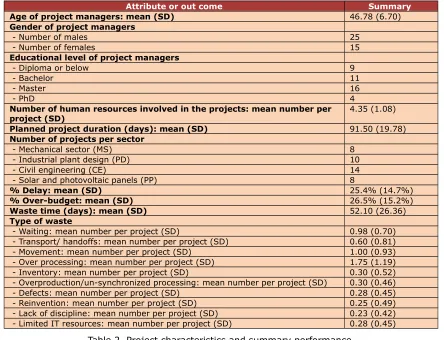
Data regarding managers’ personality have been obtained by interviews of project managers from different companies that belong to the multinational corporation analyzed in this work. This corporation is made up of 17 companies sited in the main European countries that cover four industrial sectors: mechanical sector (MS), industrial plant design (PD), civil engineering (CE) and design/development of solar and photovoltaic panels (PP). 118 projects of NPD have been carried out by 47 project managers that work in this corporation in 2012. Most of these projects covered a short period (see table 2: mean planned project duration is equal to 91.50 days) and they involved little resources (see table 2: mean number of human resources involved in the projects are equal to 4.35). In order to carry out this research we conducted a census; after we contacted 8 project managers employed in 4 companies of the multinational corporation for the pilot study, 13 companies remained eligible for participation in the main study. The 4 companies used for the pilot study have been chosen in order to cover the four industrial sectors of the multinational corporation. As reported in the previous section this work began by doing literature study, it gave an overview about technical and management practices that can influence the success of a new product development project. In the second step, findings from the literature study helped us to form a questionnaire draft to conduct semi structured interviews with 8 project managers used as a pilot study. Literature review and semi structured interviews allowed us to select:
• the specific technical and management practices of the new products that can influence the success of a new product in the multinational corporation analyzed in this work.
• the best questions that can be used to address these practices.
Than we called the 13 companies involved in the main study and spoke with the CEO, or the project manager to ask for their participation in the study. 11 project managers chose not to take part in the research. 39 projects carried out in 2012 have been discarded because of lack of data or not reliability data. Moreover because of the retrospective nature of this study, several procedures were used to increase the validity of the collected data. The study excluded the following types of projects: those whose development histories were more than 5 years old and those where the key personnel associated with their development had left the organization. Finally 40 projects carried out by 28 different project managers have been considered in the main study. Personal interviews with project managers have been organized in order to:
• explain the objective of this research
• explain the meaning of each question proposed in the questionnaire
• collect information regarding product development project
• fill the questionnaire. Each project manager filled out the questionnaire showed in appendix 2. It takes approximately 20 minutes to complete.
Few project managers chose not to take part in the research. Finally 40 projects have been considered. Each project manager filled out a copy of the 93-item MBTI form M before beginning the project. It takes approximately 20 to 30 minutes to complete. A panel of experts made up of 6 people has been selected for developing value stream mapping of every project and for analyzing project results. The experts were 2 academics who conduct their research activities in the project management sector and four project managers. An example of the method used for analyzing the forty projects is mentioned in appendix A. In particular, this case study concerns the design of a hydraulic system. For each of the 40 managers, two aspects have been collected:
• their attitudes as measured by the MBTI (see section 3.2), and
• their effectiveness, measured through four parameters (see section 3.1).
Moreover, project manager age, gender and educational level have been registered and used as covariates.
To ensure that the effects of project complexity had been taken into account, three more variables were used as covariates:
• number of human resource involved: that is the team size of the project;
most important project fields. These sectors are: mechanical sector (MS), industrial plant design (PD), civil engineering (CE) and design and development of solar and photovoltaic panels (PP).
• planned project duration: this is the initial duration of the project assessed by the project manager
3.1 Dependent variables
The traditional dependent variables were:
• project delay = planned project duration – real project duration/planned project duration (expressed in percentage terms);
• project over-budget = planned project budget – real project budget/planned project budget (expressed in percentage terms).
The dependent variables based on Value Stream Mapping analysis were:
• waste time = real project duration - value added time of the project (VA/T). VA/T is the project time that provides value to the customer;
• waste types (already mentioned in table 1).
3.2 Independent variables
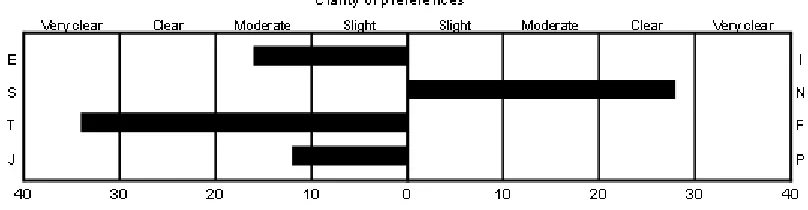
Figure 1. The strengths of MBTI type preferences (Choi, Deek & Im, 2008)
The score for each dimension was obtained using the combination of the participants reported type and preference scores. In the example the participant’s reported type was ENTJ and its resulting preference scores were 16, 28, 34, and 12 on each of the dimensions. Then the score for the purposes of this research were:
• 16 on the EI dimension (E being negative and their preference score being -16),
• 28 on the SN dimension (N being positive and their preference score being 28),
• 34 on the TF dimension (T being negative and their preference score being -34), and
• 12 on the JP dimension (J being negative and their preference score being -12).
Preference scores are always positive. The type determines the sign of the score.
4. Results
Attribute or out come Summary
Age of project managers: mean (SD) 46.78 (6.70)
Gender of project managers
- Number of males 25
- Number of females 15
Educational level of project managers
- Diploma or below 9
- Bachelor 11
- Master 16
- PhD 4
Number of human resources involved in the projects: mean number per
project (SD) 4.35 (1.08)
Planned project duration (days): mean (SD) 91.50 (19.78)
Number of projects per sector
- Mechanical sector (MS) 8
- Industrial plant design (PD) 10
- Civil engineering (CE) 14
- Solar and photovoltaic panels (PP) 8
% Delay: mean (SD) 25.4% (14.7%)
% Over-budget: mean (SD) 26.5% (15.2%)
Waste time (days): mean (SD) 52.10 (26.36)
Type of waste
- Waiting: mean number per project (SD) 0.98 (0.70) - Transport/ handoffs: mean number per project (SD) 0.60 (0.81) - Movement: mean number per project (SD) 1.00 (0.93) - Over processing: mean number per project (SD) 1.75 (1.19) - Inventory: mean number per project (SD) 0.30 (0.52) - Overproduction/un-synchronized processing: mean number per project (SD) 0.30 (0.46) - Defects: mean number per project (SD) 0.28 (0.45) - Reinvention: mean number per project (SD) 0.25 (0.49) - Lack of discipline: mean number per project (SD) 0.23 (0.42) - Limited IT resources: mean number per project (SD) 0.28 (0.45)
Table 2. Project characteristics and summary performance
Personality type N Personality type n MTBI dimensions N
ENFJ 0 INFJ 0 Extroverted (E) 26
ENFP 0 INTJ 2 Introverted (I) 14
ENTJ 3 INTP 2 Sensing (S) 30
ENTP 3 INFP 0 Intuitive (N) 10
ESFJ 6 ISFJ 4 Thinking (T) 23
ESFP 7 ISFP 0 Feeling (F) 17
ESTJ 4 ISTJ 0 Judging (J) 19
ESTP 3 ISTP 6 Perceiving (P) 21
Table 3. Personality types of project managers
4.1 The effect of personality measures on project performance
Delay BudgetOver- 1 2 3 4 5 6 7 8 9
Gender .171 .162
Age -.075 .000 -.044
Educational_levela .121 .030 -.034 -.111
Company_sectorb .213 .226 -.013 -.203 .097
Human_resources .260 -.166 -.158 .274 -.056 .145
Planned_duration .327* .158 -.073 .250 .092 .396* .523**
EIc .349* .046 .025 .113 .002 .090 -.019 -.016
SNc .103 .339* .155 .347* -.100 .110 -.120 .025 .141
TFc .017 -.047 -.025 -.295 .021 -.160 -.076 -.084 -.209 -.422**
JPc -.361* -.508** .002 -.098 -.028 -.035 .163 -.186 -.058 -.318* -.091
a Educational level was coded as Diploma or below =1; Bachelor = 2; Master = 3; PhD = 4. b Company sector was coded as 1=PP; 2=MS; 3=PD; and 4=CE.
c Positive scores are indicated by the dimensions I, N, F, and P and negative scores by the dimensions E, S, T and J.
* p < 0.05. ** p < 0.01.
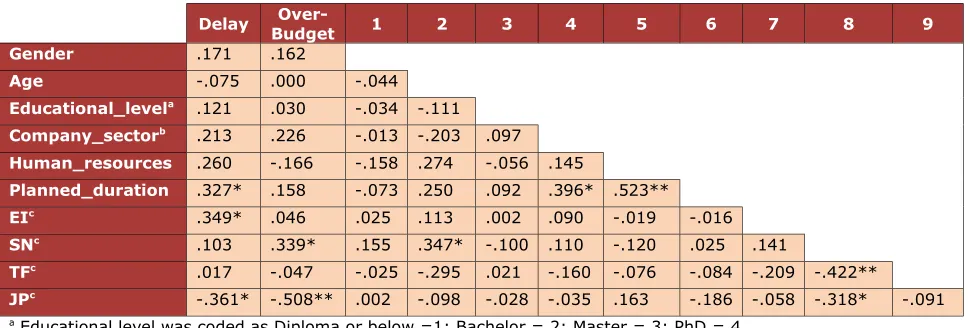
Table 4. Correlations between variables and traditional performance indexes
Waste
time Waiting Transporthandoffs Movement processingOver Inventory
gender -.001 .028 .258 -.112 .077 .253
age .024 -.166 .106 -.209 -.107 -.128
Educational levela .218 .092 .000 .173 .197 .078
Company sectorb .427** .020 -.006 .477** .259 .019
Human resources .426** -.022 .165 .179 -.010 .083
Planned duration .621** -.164 .070 .194 .261 .156
EIc .333* .293 .123 .318* .349* .114
SNc .136 .000 .059 .195 .265 .051
TFc -.132 .134 -.001 -.379* -.224 .048
JPc -.219 -.124 -.004 -.124 -.359* -.214
a Educational level was coded as Diploma or below =1; Bachelor = 2; Master = 3; PhD = 4. b Company sector was coded as 1=PP; 2=MS; 3=PD; and 4=CE.
c Positive scores are indicated by the dimensions I, N, F, and P and negative scores by the dimensions
E, S, T and J. * p < 0.05. ** p < 0.01.
Over
production Defects Reinvention disciplineLack Limited ITresources
gender .056 .101 -.079 -.046 -.014
age -.151 .038 -.107 -.108 -.081
Educational levela .087 -.067 .177 -.088 .112
Company sectorb -.192 .325* .276 -.056 .052
Human resources .144 -.098 -.024 .104 .219
Planned duration .089 .024 .276 .035 .196
EIc -.063 .417** .122 -.213 .073
SNc -.255 .251 .062 -.071 -.122
TFc .260 -.129 .064 -.086 -.119
JPc -.074 -.107 -.022 -.021 .135
a Educational level was coded as Diploma or below =1; Bachelor = 2; Master = 3; PhD = 4. b Company sector was coded as 1=PP; 2=MS; 3=PD; and 4=CE.
c Positive scores are indicated by the dimensions I, N, F, and P and negative scores by the dimensions
E, S, T and J. * p < 0.05. ** p < 0.01.
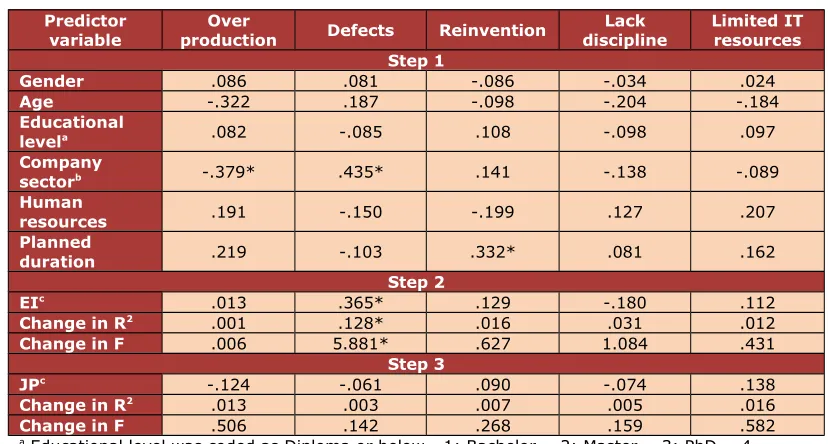
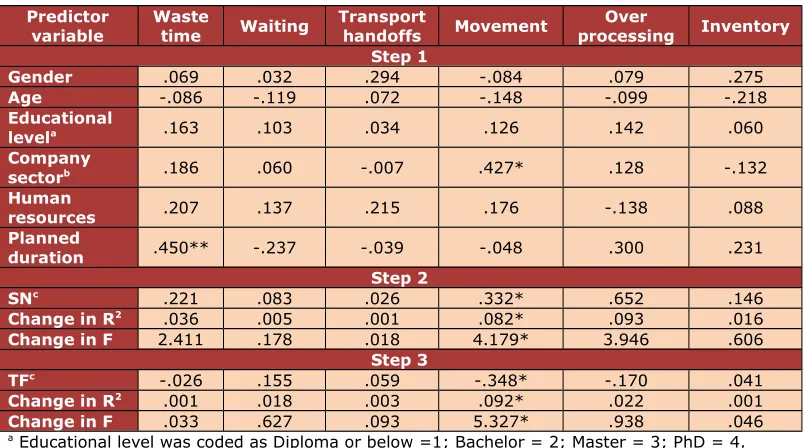
Remembering that each individual exhibited two different traits that were related to attitudes, each individual has a social orientation attitude (extroverted or introverted) and a second attitude known as judging or perceiving. The judging–perceiving attitude is a person’s attitude toward the interaction of their sensing–intuition trait and their thinking–feeling trait. These two attitude traits are tested in one model to determine whether particular attitude traits may affect performance. Tables 6 and 7 contain the results of the effects of the manager’s social orientation (extrovert–introvert) and the manner in which they deal with the outer world (perceiving or judging) on traditional and VSM performance indexes. A Hierarchical Multiple Regression has been developed for verifying cause and effect relations. We entered the covariates in step 1, and independent variables in step 2 and 3. In the table, entries represent standardized coefficient.
Predictor variable % Delay Over-Budget Step 1
Gender .218 .134
Age -.166 .071
Educationallevela .094 -.017
Companysectorb .044 .195
Human_resources .209 -.320 Planned_duration .249 .241
Step 2
EIc .382* .015
Change in R2 .140* .001
Change in F 6.851* .009
Step 3
JPc -.400** -.464*
Change in R2 .137** 0.184*
Change in F 8.188*** 8.658*
a Educational level was coded as Diploma or below =1; Bachelor = 2;
Master = 3; PhD = 4.
b Company sector was coded as 1=PP; 2=MS; 3=PD; and 4=CE. c Positive scores are indicated by the dimensions I and P and negative
scores by the dimensions E and J. * p < 0.05.
** p < 0.01. *** p < 0.005
Table 6. Effect of EI and JP on traditional performance indexes
Predictor variable Wastetime Waiting Transporthandoffs Movement processingOver Inventory Step 1
Gender .069 .032 .294 -.084 .079 .275
Age -.086 -.119 .072 -.148 -.099 -.218
Educational levela .163 .103 .034 .126 .142 .060
Company sectorb .186 .060 -.007 .427* .128 -.132
Human resources .207 .137 .215 .176 -.138 .088
Planned duration .450* -.237 -.039 -.048 .300 .231
Step 2
EIc .350* .311 .116 .313* .363* .155
Change in R2 .117* .093 .013 .094* .127* .023
Change in F 9.334* 3.546 .475 4.886* 5.652* .884
Step 3
JPc -.174 -.212 -.038 -.166 -.309 -.237
Change in R2 .026 .038 .001 .024 .081 .048
Change in F 2.142 1.482 .045 1.227 3.978 1.889
a Educational level was coded as Diploma or below =1; Bachelor = 2; Master = 3; PhD = 4. b Company sector was coded as 1=PP; 2=MS; 3=PD; and 4=CE.
c Positive scores are indicated by the dimensions I and P and negative scores by the dimensions E and J.
Predictor
variable productionOver Defects Reinvention disciplineLack Limited ITresources Step 1
Gender .086 .081 -.086 -.034 .024
Age -.322 .187 -.098 -.204 -.184
Educational
levela .082 -.085 .108 -.098 .097
Company
sectorb -.379* .435* .141 -.138 -.089
Human
resources .191 -.150 -.199 .127 .207
Planned
duration .219 -.103 .332* .081 .162
Step 2
EIc .013 .365* .129 -.180 .112
Change in R2 .001 .128* .016 .031 .012
Change in F .006 5.881* .627 1.084 .431
Step 3
JPc -.124 -.061 .090 -.074 .138
Change in R2 .013 .003 .007 .005 .016
Change in F .506 .142 .268 .159 .582
a Educational level was coded as Diploma or below =1; Bachelor = 2; Master = 3; PhD = 4. b Company sector was coded as 1=PP; 2=MS; 3=PD; and 4=CE.
c Positive scores are indicated by the dimensions I and P and negative scores by the dimensions E
and J. * p < 0.05.
Table 7. Effect of EI and JP on VSM performance indexes
Each person also exhibited two mental functions (Wheeler, 2001). The two ways in which individuals use these two mental functions offer an explanation as to why people perceive the world differently and why people form judgments differently. Individuals prefer one way of perceiving (sensing or intuition) and have one primary way of judging (thinking or feeling). These two mental function traits are tested to determine whether the mental function traits affect performance. Tables 8 and 9 contain the results for traditional and VSM performance indexes by the individual’s preferred method of perceiving (sensing–intuition) and by their preferred manner for judging (thinking–feeling).
Predictor variable % Delay Over-Budget Step 1
Gender .218 .134
Age -.166 .071
Educational_levela .094 -.017
Company_sectorb .044 .195
Human_resources .209 -.320
Planned_duration .249 .241
Step 2
SNc .202 .303
Change in R2 .030 .069
Change in F 1.274 2.832
Step 3
TFc .087 .107
Change in R2 .006 .009
Change in F .238 .354
a Educational level was coded as Diploma or below =1; Bachelor = 2;
Master = 3; PhD = 4.
b Company sector was coded as 1=PP; 2=MS; 3=PD; and 4=CE. c Positive scores are indicated by the dimensions N and F and
negative scores by the dimensions S and T. * p < 0.05.
** p < 0.01. *** p < 0.005.
Predictor
variable Wastetime Waiting Transporthandoffs Movement processingOver Inventory Step 1
Gender .069 .032 .294 -.084 .079 .275
Age -.086 -.119 .072 -.148 -.099 -.218
Educational
levela .163 .103 .034 .126 .142 .060
Company
sectorb .186 .060 -.007 .427* .128 -.132
Human
resources .207 .137 .215 .176 -.138 .088
Planned
duration .450** -.237 -.039 -.048 .300 .231
Step 2
SNc .221 .083 .026 .332* .652 .146
Change in R2 .036 .005 .001 .082* .093 .016
Change in F 2.411 .178 .018 4.179* 3.946 .606
Step 3
TFc -.026 .155 .059 -.348* -.170 .041
Change in R2 .001 .018 .003 .092* .022 .001
Change in F .033 .627 .093 5.327* .938 .046
a Educational level was coded as Diploma or below =1; Bachelor = 2; Master = 3; PhD = 4. b Company sector was coded as 1=PP; 2=MS; 3=PD; and 4=CE.
c Positive scores are indicated by the dimensions N and F, and negative scores by the dimensions
S and T. * p < 0.05. ** p < 0.01.
Predictor
variable productionOver Defects Reinvention disciplineLack Limited ITresources Step 1
Gender .086 .081 -.086 -.034 .024
Age -.322* .187 -.098 -.204 -.184
Educational
levela .082 -.085 .108 -.098 .097
Company
sectorb -.379* .435* .141 -.138 -.089
Human
resources .191 -.150 -.199 .127 .207
Planned
duration .219 -.103 .332 .081 .162
Step 2
SNc -.121 .137 .097 .032 -.030
Change in
R2 .011 .014 .007 .001 .001
Change in F .429 .553 .271 .026 .023
Step 3
TFc .141 .019 .119 -.187 -.220
Change in
R2 .015 .001 .011 .027 .037
Change in F .591 .010 .414 .899 1.319
a Educational level was coded as Diploma or below =1; Bachelor = 2; Master = 3; PhD = 4. b Company sector was coded as 1=PP; 2=MS; 3=PD; and 4=CE.
c Positive scores are indicated by the dimensions N and F, and negative scores by the
dimensions S and T. * p < 0.05.
** p < 0.01.
Table 9. Effect of SN and TF on VSM performance indexes
the individual’s social orientation (extrovert–introvert), the manner in which they deal with the outer world (perceiving or judging), the individual’s preferred method of perceiving (sensing– intuition), and their preferred manner for judging (thinking–feeling) on traditional and VSM performance indexes. In each of the two regressions, gender, age, educational level, company sector, human resources involved and planned duration were included as covariates.
Predictor variable % Delay Over-Budget Step 1
Gender .214 .125
Age -.290 -.051
Educational levela .100 .003
Company sectorb -.014 .165
Human resources .383* -.116
Planned duration .150 .092
Step 2
EIc .365* -.016
SNc .075 .172
TFc .048 -.003
JPc -.372* -.418*
Overall F for the equation 2.748* 1.639
Overall R2 .487* .361
a Educational level was coded as Diploma or below =1; Bachelor =
2; Master = 3; PhD = 4.
b Company sector was coded as 1=PP; 2=MS; 3=PD; and 4=CE. c Positive scores are indicated by the dimensions I, N, F, and P and
negative scores by the dimensions E, S, T and J. * p < 0.05.
Table 10. Effect of EI, SN, TF and JP on traditional performance indexes
Predictor
variable Waste time Waiting Transport_handoffs Movement Over_processing Step 1
Gender .045 .028 .289 -.115 .051
Age -.240 -.164 .057 -.416* -.345*
Educational
levela .171 .106 .036 .133 .153
Company
sectorb .087 .039 -.017 .250 -.021
Human
resources .306* .228 .234 .287 .026
Planned
duration .449* -.281 -.038 -.034 .261
Step 2
EIc .333* .322 .123 .246 .311*
SNc .152 .061 .036 .136 .171
TFc -.009 .161 .073 -.356* -.196
JPc -.134 -.172 -.018 -.180 -.290
Overall F for the
equation 5.158*** .802 .449 3.526*** 2.236*
Overall R2 .640*** .217 .134 .549** .435*
a Educational level was coded as Diploma or below =1; Bachelor = 2; Master = 3; PhD = 4. b Company sector was coded as 1=PP; 2=MS; 3=PD; and 4=CE.
c Positive scores are indicated by the dimensions I, N, F, and P and negative scores by the
dimensions E, S, T and J. * p < 0.05.
Predictor
variable Inventory productionOver Defects Reinvention disciplineLack Step 1
Gender .269 .112 .058 -.115 -.024
Age -.297 -.236 .081 -.136 -.235
Educational
levela .066 .074 -.080 .120 -.101
Company
sectorb -.166 -.311 .355* .105 -.146
Human
resources .194 .216 -.101 -.211 .152
Planned
duration .169 .146 -.066 .404* .033
Step 2
EIc .141 .028 .368* .153 -.218
SNc .070 -.131 .130 .204 -.081
TFc .007 .108 .072 .187 -.254
JPc -.217 -.144 -.015 .172 -.132
Overall F for the
equation .804 .831 1.343 .866 .461
Overall R2 .217 .223 .317 .230 .137
a Educational level was coded as Diploma or below =1; Bachelor = 2; Master = 3; PhD = 4. b Company sector was coded as 1=PP; 2=MS; 3=PD; and 4=CE.
c Positive scores are indicated by the dimensions I, N, F, and P and negative scores by the
dimensions E, S, T and J. * p < 0.05.
** p < 0.01. *** p < 0.005
Table 11. Effect of EI, SN, TF and JP on VSM performance indexes
4.1.1 The effect of the extroverted–introverted dimension on project performance
H1 stated that extroverted project managers exhibit higher project performance, in terms of (a) % delay, (b) over-budget and (c) waste time, than introverted project managers.
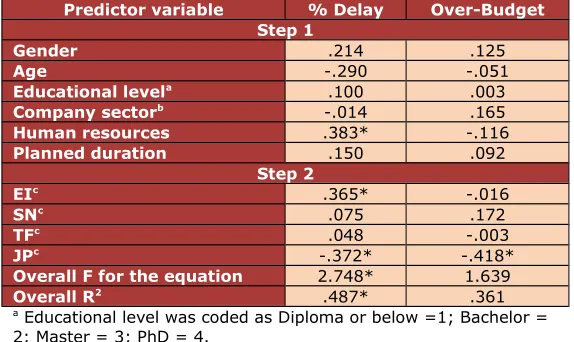
Correlations in Table 4 indicating that managers’ EI is correlated positively (Pearson’s correlation coefficient = .349, p < 0.05, two tailed test) with project delay provide initial support for Hypothesis 1(a). Similarly, EI is significant in the regression (∆R2 = .140 and ∆F = 6.851, p < 0.05, two-tailed test: table 6). When the attitudes are combined with the remaining personality traits, the conclusions are similar (B = .365, p < 0.05, two-tailed test: table 10). Regarding relationships between performance (in terms of % delay) and personalities, the results obtained show that extroverted managers have a significantly lower delay in comparison with introverted ones. Thus, H1(a) is supported.
The correlation between over-budget and EI was not significant (table 4). Similarly, EI is not significant in either of the two regressions (tables 6 and 10). Thus, H1(b) is not supported.
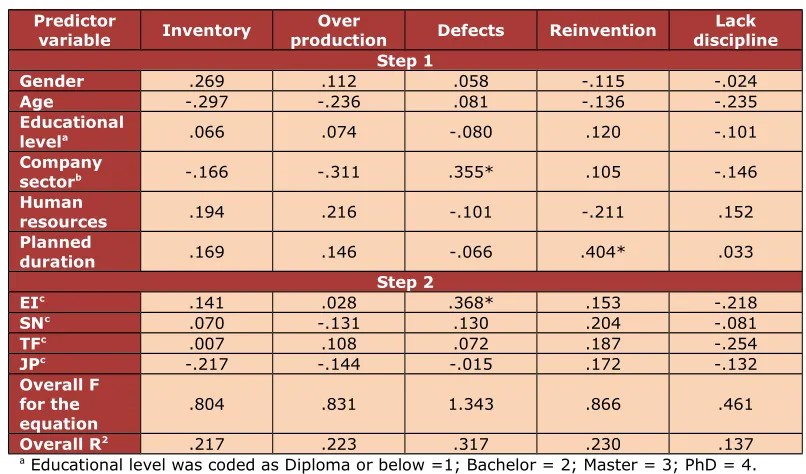
H2 stated that there is a relation between type of waste and extroverted/introverted personality of project managers. The “Over-Processing” type of wastes are done significantly more by Introverted than Extroverted managers as shown in tables 5 (Pearson’s correlation coefficient = .349, p < 0.05), table 7 (∆R2 = .127 and ∆F = 5.652, p < 0.05) and table 11 (B = .311, p < 0.05). Higher percentage of “Defect” wastes have also been found to be done by Introverted than Extroverted managers (Pearson’s correlation coefficient = .417, p < 0.01: table 5; ∆R2 = .128 and ∆F = 5.881, p < 0.05: table 7; B = .368, p < 0.05: table 11). Regarding the type of waste “Movement”, correlations in table 5 indicating that the introverted manager is correlated positively with the number of wastes (Pearson’s correlation coefficient = .318, p < 0.05). Similarly, EI is significant in Hierarchical regression analysis (∆R2 = .094 and ∆F = 4.886, p < 0.05: table 7). Unfortunately, when the attitudes are combined with the remaining personality traits (Table 11), the extroverted/introverted attitude is overshadowed by the thinking/feeling attitude. Thus, there is some support for H2.
4.1.2 The effect of the judging–perceiving dimension on project performance
H3 stated that Judging project managers exhibit higher project performance, in terms of (a) % delay, (b) over-budget and (c) waste time, than Perceiving project managers.
The correlation between project delay and JP was significant and negative (Pearson’s correlation coefficient = -.361, p < 0.05, two tailed test: table 4). This result indicates that judging managers made significantly more delay than perceiving managers. Similarly, JP is significant and negative in either of the two regressions (∆R2 = .137 p < 0.01 and ∆F = 8.188, p < 0.005: table 6) (B = -.372, p < 0.05, two-tailed test: table 10). The direction of the parameter estimates (table 10) supported the opposite of hypothesis H3(a). Thus, the results obtained show that Perceiving managers have a significantly lower delay in comparison with Judging ones.
The correlation between over-budget and JP was also significant and negative (Pearson’s correlation coefficient = -.508, p < 0.01, two tailed test: table 4). Similarly, JP is significant and negative in either of the two regressions (∆R2 = .184 p < 0.05 and ∆F = 8.658, p < 0.05: table 6) (B = -.418, p < 0.05, two-tailed test: table 10). These results supported the opposite of hypothesis H3(b). Thus, the results obtained show that Perceiving managers have a significantly lower over-budget in comparison with Judging ones.
The correlation between Waste time and JP was not significant (table 5). Similarly, JP is not significant in either regression (tables 7 and 11). Thus, H3(c) is not supported.
= .359, p < 0.05). This result provides initial support of the statement: “over-processing” wastes are more frequently done by Judging than Perceiving managers. Unfortunately JP is not significant in either of the two regressions (tables 7 and 11). These results indicate that there is not a significant cause-effect relation between the “over-processing” number and the attitude JP. Thus, H4 is not supported.
4.1.3 The effect of the sensing–intuition dimension on project performance
H5 stated that Intuitive project managers exhibit higher project performance, in terms of (a) % delay, (b) over-budget and (c) waste time, than Sensing project managers.
The correlation between project delay and SN was not significant (table 4). Similarly, SN is not significant in either of the two regressions (tables 8 and 10). Thus, H5(a) is not supported.
The correlation between over-budget and SN was significant and positive (Pearson’s correlation coefficient = .339, p < 0.05: table 4), but SN is not significant in either of the two regressions (tables 8 and 10). These results indicate that there is not a significant cause-effect relation between the dependent variable “over-budget” and the attitude SN. Thus, H5(b) is not supported.
Moreover SN is not significant for the dependent variables “waste time” and “type of wastes” (tables 5, 9 and 11). Thus, H5(c) and H6 are not supported.
4.1.4 The effects of the thinking–feeling dimension on project performance
H7 stated that thinking project managers exhibit higher project performance, in terms of (a) % delay, (b) over-budget and (c) waste time, than feeling project managers.
Correlation in Table 4 indicates that managers’ TF is not correlated with project delay. Similarly, TF is not significant in the two regressions (tables 8 and 10). Thus, H7(a) is not supported.
Moreover, the correlation between the dependent variables over-budget and waste time with TF was not significant (tables 4 and 5). Similarly, TF is not significant in either of the two regressions (tables 8, 9 and 10). Thus, H7(b) and H7(c) are not supported.
Table 12 summarizes the hypothesis testing results.
Hypothesis Outcome
H1: Extroverted project managers carry out projects that show:
(a) lower delay than
introverted project managers Supported (b) lower over-budget than
introverted project managers Not supported (c) lower waste time than
introverted project managers. Supported H2: There is a relation between the type of waste and the
extroverted/introverted personality of project managers
Relation between introverted managers with type of wastes: “Over-processing” and “Defect”
H3: Judging project managers carry out projects that show
(a) lower delay than perceiving
project managers Supported the opposite of hypothesis H3a (b) lower over-budget than
perceiving project managers Supported the opposite of hypothesis H3b (c) lower waste time than
perceiving project managers. Not supported. H4: There is a relation between the type of waste and the
judging/perceiving personality of project managers Not supported.
H5: Intuitive project managers carry out projects that show
(a) lower delay than sensing
project managers Not supported. (b) lower over-budget than
sensing project managers Not supported. (c) lower waste time than
sensing project managers. Not supported. H6: There is a relation between the type of waste and the intuitive/sensing
personality of project managers Not supported.
H7: Thinking project managers carry out projects that show
(a) lower delay than feeling
project managers Not supported. (b) lower over-budget than
feeling project managers Not supported. (c) lower waste time than
feeling project managers. Not supported. H8: There is a relation between the type of waste and the thinking/feeling
personality of project managers
Relation between thinking managers with type of waste:
“Movement”
Table 12. Summary results of hypothesis testing
5. Discussion
scheduling. Some symptoms that the panel highlighted were: under-utilization of resources, increase in investment, idle equipment and unnecessary testing.
Regarding managers’ personality, the results show that potentially two of the four Jungian personality dimensions (extroversion–introversion and judging–perceiving but not sensing– intuition nor thinking–feeling) significantly affect managerial end-users’ abilities to manage projects. This work highlights that Extrovert managers provided better performance in comparison with Introvert ones, in terms of both traditional and VSM indexes. The correlation between personality type and type of waste provides the same information: introverted managers more often make “over-processing” and “defect” errors. In our opinion, these results obtained from Extrovert and Introvert managers, are connected to the fact that project managers must be able to communicate in many ways with many people. We noticed that Extrovert managers often work with five to nine people every day and they are typically early in the office or late out of the office, doing their solitary work out of hours or at weekends. The extroversion-introversion (E-S) dichotomy assesses whether a person prefers to be either extroverted or introverted, thus focusing their attention and obtaining their energy for daily activities. According to the literature, we notice that Extrovert managers are more connected to the outer world of people, places, and things and they are considered sociable, gregarious, and interactive. Introverts preferred solitude to recover energy, oriented towards the inner world of concepts and ideas.
Once corporation has a better understanding of the characteristics that lead to more successful information retrieval, training programs can be tailored toward managerial end-users with different cognitive styles. The Jungian system of personality classification asserts that no individual is a “pure” type (Jung, 1971). Each individual possesses the ability to function in all of the traits that makeup the types, but tends to prefer one trait in each of the four-dimensional pairs. By analyzing the personality traits that lead to best performance, training programs can be developed to help people with other personality traits to learn how to use some of their non-preferred traits and thereby provide higher performance. By taking this duality into consideration, trainers will be better able to design programs that enable managerial end-users with the non-preferred traits to learn how to adopt the most appropriate approach when managing projects.
6. Conclusions
This research could provide insight useful to develop proactive approaches to prevent project failures, including the creation of more effective messages and methods to help companies to make the best choices. For instance, many managers who come from accounting backgrounds are typically STJ personality types. This personality type prefers to obtain data through direct or objective perceptions. According to the MBTI theory, however, those individuals who have a preference for the sensing trait possess the intuition trait too. A person may simply need some training to become proficient at using a less preferred dimension of their personality. This training would allow them to better use another facet of their personality and thus to manage projects more accurately.
Secondly, this research has implications for staffing. During the last decade, one of the fastest growing aspects in human resource management has been in the area of personality testing as employees are selected based on whom best fits the required profile (Rolfe & McPherson, 1995). One issue closely related to staffing is the growing trend in the outsourcing of selected aspects of management via short-term contracts (Feltham & Hughes, 1999). This research would allow corporation to better match the short-term organizational needs with appropriate personality types.
project manager had a number of positions before becoming a project manager, gaining experience in an industry before being a manager.
We conclude highlighting that not each personality is suited to a project leader job. Using Myers-Briggs Type Indicator notation, we can show that only a few combinations are compatible with various management styles. Future research could be conducted in order to better understand the impact of the extroverted–introverted personality dimension. Such future research could examine the impact of the EI dimension on the capacity to manage large teams as well as on the formulation of the project cost baseline. Although the results reported to date have been implemented in a European corporation, replications of this study in other cultures and other industries would be very useful to verify these findings.
Regarding the limitations of this work it is necessary to highlight that we collected data from project managers in a retrospective way. While we believe that several aspects of our data collection effort helped enhance the accuracy of the results, future research could conduct real-time case study research to get more detailed insights into the proposed relationships and avoid retrospective bias. Moreover we focused on a single respondent, the project manager. This helped us ensure that their interpretations played an important role in product development. But, we cannot examine the opinion of team members that could be different from project manager’s opinion regarding some questions.
References
Bannerman, P.L. (2008). Defining project success: a multilevel framework. Proceedings PMI Research Conference, Warsaw, Poland, July 13-16.
Bar-On, R. (2000). Emotional and social intelligence: Insights from the emotional quotient inventory. In R. Bar-On & J. Parker (Eds.), The handbook of emotional intelligence: Theory, development, assessment, and application at home, school, and in the workplace (1st ed., pp. 363–388). San Francisco, CA: Jossey-Bass.
Barrick, M.R., & Mount, M.K. (1991). The Big Five personality dimensions and job performance: A meta-analysis. Personnel Psychology, 4 4 , 1 – 2 6 . http://dx.doi.org/10.1111/j.1744-6570.1991.tb00688.x
Bauch, C. (2004). Lean Product Development: Making waste transparent. Massachusetts Institute of Technology. PhD thesis August 2004.
Bowen, P.L., Ferguson, C.B., Lehmann, T.H., & Rohde, F.H. (2003). Cognitive style factors affecting database query performance. International Journal of Accounting Information Systems, 4, 251–273. http://dx.doi.org/10.1016/j.accinf.2003.05.002
Choi, K.S., Deek, F.P., & Im, I. (2008). Exploring the underlying aspects of pair programming: The impact of personality. Information and Software Technology, 50, 1114–1126.
http://dx.doi.org/10.1016/j.infsof.2007.11.002
Crawford, C.M. (1987). New product failure rates: a reprise. Research management. New York, NY: Inst, ISSN 0034-5334, ZDB-ID 3901105. 30.1987, (4), 20-24.
http://dx.doi.org/10.1126/science.237.4810.20
Davis, S.A. (2011). Investigating the Impact of Project Managers’ Emotional Intelligence on
Their Interpersonal Competence. Project Management Journal, 42(4 ), 37– 57.
http://dx.doi.org/10.1002/pmj.20247
De Jong, R.D., Bouhuys, S.A., & Barnhoorn, J.C. (1999). Personality, self-efficacy and functioning in management teams: a contribution to validation. International Journal of Selection and Assessing, 7(1), 46–49. http://dx.doi.org/10.1111/1468-2389.00103
Dolfi, J., & Andrews, E. (2007). The Subliminal Characteristics Of Project Managers: An Exploratory Study Of Optimism Overcoming Challenge In The Project Manager Work E nv i r o n m e n t . International Journal of Project Management, 2 5 , 6 7 4 - 6 8 2 .
http://dx.doi.org/10.1016/j.ijproman.2007.02.002
Farris, J., Groesbeck, R.L., Van Aken, E.M., & Letens, G. (2006). Evaluating the relative performance of engineering design projects: a case study using data envelopment analysis. IEEE Transaction Engineering Management, 53(3), 471–482.
http://dx.doi.org/10.1109/TEM.2006.878100
Feltham, R., & Hughes, D. (1999). Interim Managers: Distinguishing Personality Characteristics of Managers on Short-term Contracts. International Journal of Selection and Assessment, 7(4), 209-214. http://dx.doi.org/10.1111/1468-2389.00121
Gehring, D. (2007). Applying traits theory of leadership to project management. Project Management Journal, 38(1), 44–54.
Gillard, S., & Price, J. (2005). The competencies of effective project managers: A conceptual analysis. International Journal of Management, 22(1), 48–53.
Harrison, F., & Lock, D. (2004). Advanced Project Management a Structured Approach. Gower Publishing, Ltd. pp. 34.
Jablokow, K.W., & Booth, D.E. (2006). The Impact and Management of Cognitive Gap in High Performance Product Development Organizations. Journal of Engineering and Technology Management, 23, 313-336. http://dx.doi.org/10.1016/j.jengtecman.2006.08.003
Jeong, K.J., & Phillips, D.T. (2011). Application of a concept development process to evaluate process layout designs using value stream mapping and simulation. Journal of Industrial Engineering and Management, 4(2), 206-230. http://dx.doi.org/10.3926/jiem.2011.v4n2.p206-230
Johnson, W.L., Mauzey, E., Johnson, A.M., Murphy, S.D., & Zimmerman, K.J. (2001). A higher order analysis of the factor structure of the Myers–Briggs Type Indicator. Measurement and Evaluation in Counseling and Development, 34, 96–108.
Jung, C.G. (1971). Psychological types. In R. F. C. Hull (Eds.), The collected works of Carl Gustav Jung, Vol. 6. Princeton, NJ: Princeton University Press (Original work published in 1921).
Mayer, J., Salovey, P., & Caruso, D. (2000). Models of emotional intelligence. In R. J. Sternberg (Ed.), Handbook of intelligence (pp. 396–420). New York: Cambridge University Press.
http://dx.doi.org/10.1017/CBO9780511807947.019
Meza, D., & Jeong, K.Y. (2013) Measuring efficiency of lean six sigma project implementation using data envelopment analysis at NASA. Journal of Industrial Engineering and Management, 6(2), 401-422. http://dx.doi.org/10.3926/jiem.582
Mills, J., Robey, D., & Smith, L. (1985). Conflict handling and personality dimension of project management personnel. Psychological Reports, 57, 1135–1143.
http://dx.doi.org/10.2466/pr0.1985.57.3f.1135
Mohanty, A., Mishra, J., & Satpathy, B. (2011). Activity modes selection for project crashing through deterministic simulation. Journal of Industrial Engineering and Management, 4(4), 610-623. http://dx.doi.org/10.3926/jiem.224
Mullaly, M.E., & Thomas, J. (2004). Linking Personality and Project Success: Exploring the Inter-relationship of Psychological Type and Project Manager Competency, presented at IRNOP VI, Turku, Finland.
Myers, I.B., & Myers, P.B. (1980). Gifts differing: understanding personality type. Palo Alto, CA: Davies-Black Publishing.
Prabhakar, G.P. (2008). What is project success: a literature review. International Journal of Business Management, 3(9), 3–10.
Purcell, J., & Hutchinson, S. (2007). Front-line managers as agents in the HRM-performance causal chain: theory, analysis and evidence. Human Resource Management Journal, 17(1), 3–20. http://dx.doi.org/10.1111/j.1748-8583.2007.00022.x
Rother, M., & Shook, J. (1999). Learning to See. Version 1.2. Brookline, MA: Lean Enterprise Institute.
Rolfe, I., & McPherson, J. (1995). Formative assessment: how am I doing?. Lancet, 345, 837-839. http://dx.doi.org/10.1016/S0140-6736(95)92968-1
Shenhar, A.J., & Wideman, R.M. (2000). Matching project management style with project type for optimum success. PMForum internet site at www.pmforum.com, also found at
http://www.maxwideman.com/papers/profiles/observations.htm.
Smith, L.W. (2001). The effects of project manager personality profiles on projects. Proceedings of the Project Management Institute Annual Seminars and Symposium, Nashville, TN.
Sprague, M.M. (1997). Personality type matching and student teacher evaluation. Contemporary Education, 69, 54–57.
Tett, R.P., Jackson, D.N., & Rothstein, M. (1991). Personality measures as predictors of job performance: A meta-analytic review. Personnel Psychology, 67, 737–743.
Thomas, G., & Fernandez, W. (2008). Success in IT projects: a matter of definition?. International Journal of Project Management, 26(7), 733–742.
http://dx.doi.org/10.1016/j.ijproman.2008.06.003
Turner, J.R., & Muller, R. (2006). Choosing Appropriate Project Managers. Matching Their Leadership Style to the Type of Project. Newtown Square, PA: The Project Management Institute.
Wheeler, P. (2001). The Myers–Briggs Type Indicator and applications to accounting education and research. Issues in Accounting Education, 16(1), 123–150.
Appendix A. Application of VSM techniques in a project of Hydraulic System Development
This project has been developed by a firm involved in the production of thin film silicon solar modules. The firm needed to substitute the hydraulic system, which opens the chamber’s lid. The opening system consists of a double hydraulic cylinder, which works with a short lever on the lid’s lateral edge to turn it.
The project manager, before beginning the project, filled out a copy of the 93-item MBTI form M and the result was the personality Extraverted, Intuition, Thinking and Judging (ENTJ).
PROJECT DESCRIPTION
The opening system (called TOC) was not initially developed by Oerlikon Solar. When the company bought the project, it received the whole digital and paper documentation but no one knew if the hydraulic system was oversized, if the cylinder’s stroke was completely used, or if the leverage geometry was appropriate. During the Retrieving Information step, many aspects have been verified: for instance, the match between documents and installed parts have been checked, the parts’ specifications requested to the supplier, etc. This activity has been performed in order to generate missing “know-how”. After this step, Reverse Engineering is necessary to make up for the lack of “know-why”. While many parts have a clear function in the system, there are still some open issues. Design criterions were not available, so reverse engineering on existing parts was mandatory. This activity took a long time due to the point-based procedure: at first hypothesis is generated then verification is shown, in which the results are compared with expected values, and in case of failure the process is looped. It has been possible to apply a Fine Tuning to the mechanism only at the end of reverse engineering, when a complete view over the assembly was available. Once the opening mechanism has an optimal setup, then actuators are properly sized. Lever’s geometry provides the needed stroke, and needed force. This force can be delivered with several combinations of the piston’s size and pressure. Embodiment is a critical phase: it must be verified that actuators could be mounted in the relative hollow. This has been a long procedure: the whole TCO’s assembly must be considered including cables, wires, pipes, valves, accessories. A complete and detailed tridimensional-model is then put in motion in order to verify that actuators do not hit anything during movement. At the end of this long work, a Design Review takes place. At this point, the process splits in to two branches: 1) Pneumatic System development (multi-lever mechanism) and 2) Hydraulic System’s cost reduction. The second solution has two ways:
• Actuator size reduction: it consists in downscaling every component (valves, cylinders, pipes, …) while maintaining the current scheme.
The project manager decided to create two teams; each one took care of a concept. At the end, the pneumatic project was frozen due to a problem in the pressure boost while the second concept (actuator size reduction) showed better performance.
VALUE STREAM MAPPING OF THE PROJECT
Once the project was finished, a panel of experts drew the Value Stream Mapping (VSM) of that project identifying the added value time of the activities (VA/T) and the type of wastes. VA/T value is the activity time that provides value to the customer (see figure 2).
The observed lead-time of the project is 74 days (this is the real project duration) while the observed value-added time is 33 days. As shown in figure 2, the panel of experts identified several “over-processing”, “movement”, “waiting” wastes. As mentioned before, the process started with “Information retrieving” and “Reverse engineering”. Both activities generated a double waste:
• Waste of resources: people are committed to looking for information which was supposed to be available.
• Waste of time: the real phase of development had to wait, so lead-time grew.
According to our classification of wastes these issues correspond to “Information hunting” (3A of table 1).