Volume 26, Issue 3 • Summer 2016
AbstrAct
In 2012, the provincial cancer agency in Alberta initiated a provin-cial quality improvement project to develop, implement, and evalu-ate a provincial cancer navigation program spanning 15 sites across more than 600,000 square kilometres. This project was selected for two years of funding (April 2012–March 2014) by the Alberta Cancer Foundation (ACF) through an Enhanced Care Grant pro-cess (ACF, 2015). A series of articles has been created to capture the essence of this quality improvement (QI) project, the processes that were undertaken, the standards developed, the education frame-work that guided the orientation of new navigator staff, and the outcomes that were measured. The first article in this series focused on establishing the knowledge base that guided the development of this provincial navigation program and described the methodology undertaken to implement the program across 15 rural and isolated urban cancer care delivery sites (Anderson et al., 2016). This arti-cle, the second in the series, delves into the education framework
that was developed to guide the competency development and ori-entation process for the registered nurses who were hired into cancer patient navigator roles and how this framework has evolved to sup-port navigators, as they move from novice to expert practice. The third and final article will explore the outcomes that were achieved through this quality improvement project culminating with a dis-cussion section highlighting key learnings, adaptations made, and next steps underway to broaden the scope and impact of the provin-cial navigation program.
iNtrODuctiON
D
eveloping, implementing, and evaluating a provincial navigation program spanning 15 sites across more than 600,000 square kilometres is no small feat, but that is what was undertaken within Alberta’s provincial cancer agency. Work on this provincial quality improvement (QI) proj-ect began in April 2012 and is ongoing. However, the grant-funded portion of the work occurred from 2012–2014 and is the focus of this series of articles. Capturing the essence of this program work, the processes that were undertaken, the stan-dards developed, the education framework that guided the ori-entation of new navigator staff, and the outcomes that were measured in the initial two-year, grant-funded project required the development of a series of articles.The intention of this series of articles is to share the learn-ings gleaned from the multiple stages of this project with oth-ers who may be considering the implementation of a similar program. As well, these articles will contribute to the knowl-edge base regarding the impact that a cancer patient navigator program such as this can have on the patient experience, team functioning, care coordination, and health system utilization. In the first article, the focus was on establishing the knowledge base that guided the development of the navigation program and describing the methodology undertaken to implement the program across 15 rural and isolated urban cancer care deliv-ery sites (Anderson et al., 2016). This article, the second in the series, delves into the education framework that was developed to guide the competency development and orientation for reg-istered nurses who were hired into cancer patient navigator roles and how this framework has evolved to support naviga-tors from novices to experts. The third and final article will explore the overarching navigation model that emerged and
HeleNe HuDsON lecturesHiP
This manuscript was written on the basis of the presentation offered as the Helene Hudson Lectureship at the Annual Conference of the Canadian Association of Nursing in Oncology held in Toronto in 2015.
Developing a provincial cancer patient navigation
program utilizing a quality improvement approach
Part two: Developing a Navigation Education
Framework
by Linda C. Watson, Jennifer Anderson, Sarah Champ, Kristina Vimy, and Andrea Delure
AbOut tHe AutHOrs
Linda C. Watson, RN, PhD, CON(C), CancerControl Alberta, Alberta Health Services, Alberta, Canada
Jennifer Anderson, RN, MN, CON(C), CancerControl Alberta, Alberta Health Services, Alberta, Canada
Sarah Champ, RN, BScN, CON(C), CancerControl Alberta, Alberta Health Services, Alberta, Canada
Kristina Vimy, RN, BN, Faculty of Nursing, University of Calgary, Alberta, Canada
Andrea Delure, BA, CancerControl Alberta, Alberta Health Services, Alberta, Canada
Corresponding author and requests for reprints: Linda C. Watson, 2210-2nd St. SW, Calgary, AB, Canada T2S 3C3
Email: [email protected];
Phone: 403-698-8190
ABSTRACT
In 2012, the provincial cancer agency in Alberta initiated a provin-cial quality improvement project to develop, implement, and evalu-ate a provincial cancer navigation program spanning 15 sites across more than 600,000 square kilometres. This project was selected for two years of funding (April 2012–March 2014) by the Alberta Cancer Foundation (ACF) through an Enhanced Care Grant pro-cess (ACF, 2015). A series of articles has been created to capture the essence of this quality improvement (QI) project, the processes that were undertaken, the standards developed, the education frame-work that guided the orientation of new navigator staff, and the outcomes that were measured. The first article in this series focused on establishing the knowledge base that guided the development of this provincial navigation program and described the methodology undertaken to implement the program across 15 rural and isolated urban cancer care delivery sites (Anderson et al., 2016). This arti-cle, the second in the series, delves into the education framework
that was developed to guide the competency development and ori-entation process for the registered nurses who were hired into cancer patient navigator roles and how this framework has evolved to sup-port navigators, as they move from novice to expert practice. The third and final article will explore the outcomes that were achieved through this quality improvement project culminating with a dis-cussion section highlighting key learnings, adaptations made, and next steps underway to broaden the scope and impact of the provin-cial navigation program.
INTRODUCTION
D
eveloping, implementing, and evaluating a provincial navigation program spanning 15 sites across more than 600,000 square kilometres is no small feat, but that is what was undertaken within Alberta’s provincial cancer agency. Work on this provincial quality improvement (QI) proj-ect began in April 2012 and is ongoing. However, the grant-funded portion of the work occurred from 2012–2014 and is the focus of this series of articles. Capturing the essence of this program work, the processes that were undertaken, the stan-dards developed, the education framework that guided the ori-entation of new navigator staff, and the outcomes that were measured in the initial two-year, grant-funded project required the development of a series of articles.The intention of this series of articles is to share the learn-ings gleaned from the multiple stages of this project with oth-ers who may be considering the implementation of a similar program. As well, these articles will contribute to the knowl-edge base regarding the impact that a cancer patient navigator program such as this can have on the patient experience, team functioning, care coordination, and health system utilization. In the first article, the focus was on establishing the knowledge base that guided the development of the navigation program and describing the methodology undertaken to implement the program across 15 rural and isolated urban cancer care deliv-ery sites (Anderson et al., 2016). This article, the second in the series, delves into the education framework that was developed to guide the competency development and orientation for reg-istered nurses who were hired into cancer patient navigator roles and how this framework has evolved to support naviga-tors from novices to experts. The third and final article will explore the overarching navigation model that emerged and
HELENE HUDSON LECTURESHIP
This manuscript was written on the basis of the presentation offered as the Helene Hudson Lectureship at the Annual Conference of the Canadian Association of Nursing in Oncology held in Toronto in 2015.
Developing a provincial cancer patient navigation
program utilizing a quality improvement approach
Part two: Developing a Navigation Education
Framework
by Linda C. Watson, Jennifer Anderson, Sarah Champ, Kristina Vimy, and Andrea Delure
ABOUT THE AUTHORS
Linda C. Watson, RN, PhD, CON(C), CancerControl Alberta, Alberta Health Services, Alberta, Canada
Jennifer Anderson, RN, MN, CON(C), CancerControl Alberta, Alberta Health Services, Alberta, Canada
Sarah Champ, RN, BScN, CON(C), CancerControl Alberta, Alberta Health Services, Alberta, Canada
Kristina Vimy, RN, BN, Faculty of Nursing, University of Calgary, Alberta, Canada
Andrea Delure, BA, CancerControl Alberta, Alberta Health Services, Alberta, Canada
Corresponding author and requests for reprints: Linda C. Watson, 2210-2nd St. SW, Calgary, AB, Canada T2S 3C3
Email: [email protected]; Phone: 403-698-8190
the outcomes that were achieved through this quality improve-ment project. The final article will also include key learning, adaptations made, and work underway to broaden the scope and impact of the provincial navigation program.
bAcKGrOuND
Cancer patient navigation can be defined as a “proactive, intentional process of collaborating with a person and his or her family to provide guidance, as they negotiate the maze of treatments, services and potential barriers throughout the can-cer journey” (Canadian Partnership Against Cancan-cer [CPAC], 2012, p. 5). The central concept within this definition includes an individual (navigator) being available to support a cancer patient at any point throughout his or her cancer journey. The scope of support that a navigator can provide to the patient and their family is directly influenced by whether the naviga-tion program utilizes a lay navigation model or a professional navigation model (CPAC, 2012). Lay navigation programs uti-lize volunteers or cancer survivors to provide information and awareness of resources such as psychosocial supports, home care, and other health services in a community setting (Meade et al., 2014). Professional navigation models utilize registered health care professionals, most commonly registered nurses or social workers, to provide a variety of clinical supports and services including psychosocial interventions, coordination of care, health education, case management, and facilitation of communication between health systems and the patient (Pedersen & Hack, 2010; Wells et al., 2008).
In 2012, through the generous support of the Alberta Cancer Foundation (ACF), funding was secured to implement a cancer patient navigation program in Alberta. In alignment with the provincial goal of creating a comprehensive and coordinated cancer care system (Alberta Health, 2013), the goals that guided the development of this program included enhancing inte-gration with primary care; improved access for rural patients to psychological, physical, and supportive care services; and developing a strong cancer workforce to meet the needs of can-cer patients and their families in Alberta. During the program design phase, several key decisions were made that fundamen-tally directed the program and the development of the education framework. The first impactful decision was to utilize a profes-sional navigation model. A previous provincial needs assess-ment had identified the need for improved linkages between the cancer patient/family, community care agencies and health-care providers in the primary, ambulatory and acute health-care set-tings (Miller, 2006). Further, this needs assessment highlighted that improved linkages were required across the cancer trajec-tory from prevention, through diagnosis, treatment and into survivorship and/or palliation (Miller, 2006). Due to the scope of need, a professional model of navigation was selected as the most appropriate approach in Alberta.
The second influential decision made was that the can-cer patient navigator role would be designed as a specialized oncology registered nurse (RN) role. Oncology nurses are ideally suited for the patient navigator role due to their com-prehensive knowledge of the cancer disease and the vari-ous treatment modalities used to treat cancer. Additionally,
they possess competencies in complex symptom manage-ment, supportive care, patient education, and have a strong experience base in facilitating continuity and coordination of care between health care providers and care delivery settings and systems (Doll et al., 2007; Fillion et al., 2006; Pedersen & Hack, 2010; CPAC, 2012). The vision for the navigator role was that they would work to provide a single point of contact for patients and families living with cancer, and for health care professionals caring for those patients in the community set-ting who require information about care management. In this way, the navigator role would connect the patient, the com-munity-based provider, and the cancer care system, serving to facilitate integration of care across systems (Cook et al., 2013).
The third key decision made was to introduce the navi-gator role into the rural and isolated urban cancer centres across the province, as the provincial needs assessment had revealed patients who live in rural and isolated urban centres face additional challenges in accessing care and experienc-ing coordinated care (Miller, 2006). Moreover, smaller com-munity settings often have a limited number of health care providers with oncology expertise and supportive care knowl-edge (Cantril & Haylock, 2013). Thus, the RN who becomes a navigator needed to have a broad oncology knowledge base in order to serve all cancer patients within a specific geographical area and be prepared to deliver navigation support at any point on their cancer journey (Thomas & Peters, 2014).
PrOJect MetHODOlOGY
This implementation project was designed as a continual QI project, as the core goal of the project was to implement the cancer patient navigator role into the existing clinical envi-ronment at each setting and evaluate its impact. The imple-mentation guide for cancer patient navigation developed by the Canadian Partnership Against Cancer (CPAC, 2012) was utilized as a guiding document, as it is well established that successful QI requires a comprehensive and effective change management strategy (Langley, Moen, Nolan, Norman, & Provost, 2009).
tHe cANcer PAtieNt NAViGAtiON
curriculuM
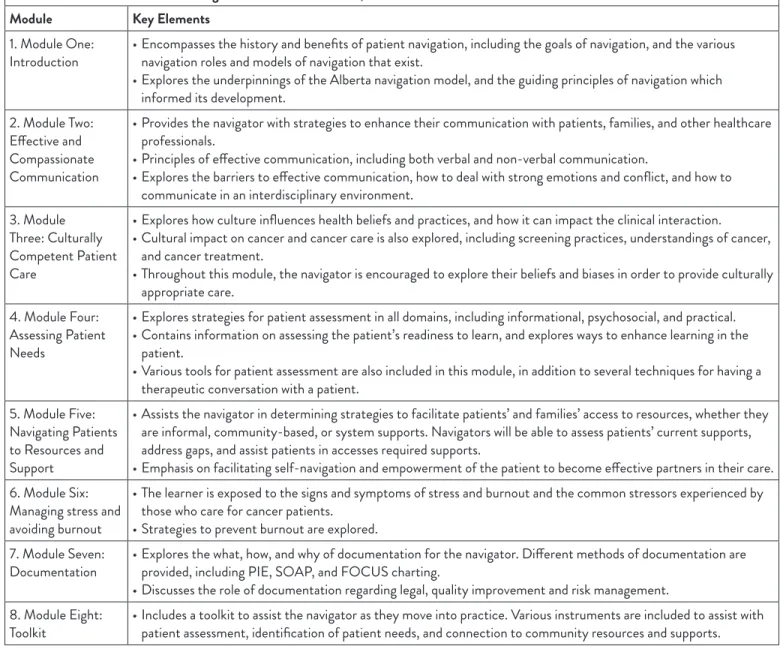
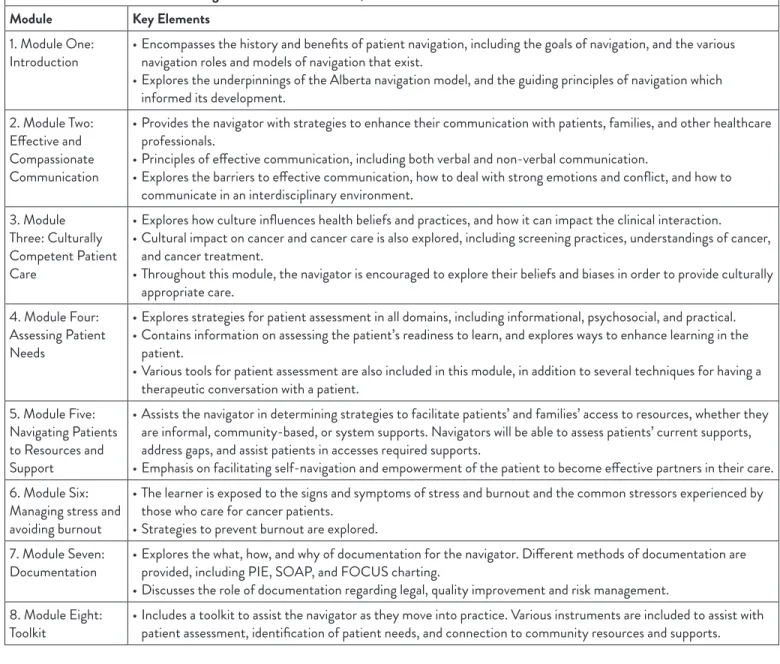
As part of the earlier work undertaken in Alberta, which began in 2006 with the initial provincial needs assess-ment (Miller, 2006), a cancer patient navigation curriculum was developed (Dozois, 2010). The curriculum consisted of eight modules. Modules and key elements are outlined in Table 1.
This existing curriculum was the starting point for devel-oping both the navigator role description and orientation plan. Initial work focused on the question of how best to prepare an RN to take on the navigator role. A comprehensive mapping of this curriculum was conducted to determine whether any new content needed to be developed (Dozois, 2010). Additionally, the literature regarding navigation was reviewed, and naviga-tion programs (including tumour-specific ones) within our province, as well as others across Canada, were consulted in order to gain an understanding of the scope and function of navigation roles, both provincially and nationally. Based on
the previous needs assessment, the existing navigation curric-ulum content, the literature, and input from key operational stakeholders, the overall vision for the navigator program and role in Alberta was established. A standard job description was developed, which outlined the scope and function of the role (Anderson et al., 2016), as well as the corresponding apti-tude and skill set necessary to be successful in the role. Once the standardized role description was vetted with operational management and provincial human resources (HR), the scope and description allowed for the development of a provincial orientation program.
tHe PrOFessiONAl NAViGAtiON
cOMPeteNcY FrAMeWOrK AND cOre
AreAs OF PrActice
Knowledge about cancer patient navigation continued to grow after the development of the Alberta navigation curric-ulum. In fact, in 2010, CPAC supported the implementation of cancer navigation programs in several jurisdictions as a
Table 1: Alberta Cancer Patient Navigation Curriculum (Dozois, 2010)
Module Key Elements
1. Module One:
Introduction • Encompasses the history and benefits of patient navigation, including the goals of navigation, and the various navigation roles and models of navigation that exist. • Explores the underpinnings of the Alberta navigation model, and the guiding principles of navigation which
informed its development. 2. Module Two:
Effective and Compassionate Communication
• Provides the navigator with strategies to enhance their communication with patients, families, and other healthcare professionals.
• Principles of effective communication, including both verbal and non-verbal communication.
• Explores the barriers to effective communication, how to deal with strong emotions and conflict, and how to communicate in an interdisciplinary environment.
3. Module Three: Culturally Competent Patient Care
• Explores how culture influences health beliefs and practices, and how it can impact the clinical interaction.
• Cultural impact on cancer and cancer care is also explored, including screening practices, understandings of cancer, and cancer treatment.
• Throughout this module, the navigator is encouraged to explore their beliefs and biases in order to provide culturally appropriate care.
4. Module Four: Assessing Patient Needs
• Explores strategies for patient assessment in all domains, including informational, psychosocial, and practical. • Contains information on assessing the patient’s readiness to learn, and explores ways to enhance learning in the
patient.
• Various tools for patient assessment are also included in this module, in addition to several techniques for having a therapeutic conversation with a patient.
5. Module Five: Navigating Patients to Resources and Support
• Assists the navigator in determining strategies to facilitate patients’ and families’ access to resources, whether they are informal, community-based, or system supports. Navigators will be able to assess patients’ current supports, address gaps, and assist patients in accesses required supports.
• Emphasis on facilitating self-navigation and empowerment of the patient to become effective partners in their care. 6. Module Six:
Managing stress and avoiding burnout
• The learner is exposed to the signs and symptoms of stress and burnout and the common stressors experienced by those who care for cancer patients.
• Strategies to prevent burnout are explored. 7. Module Seven:
Documentation • Explores the what, how, and why of documentation for the navigator. Different methods of documentation are provided, including PIE, SOAP, and FOCUS charting. • Discusses the role of documentation regarding legal, quality improvement and risk management.
8. Module Eight:
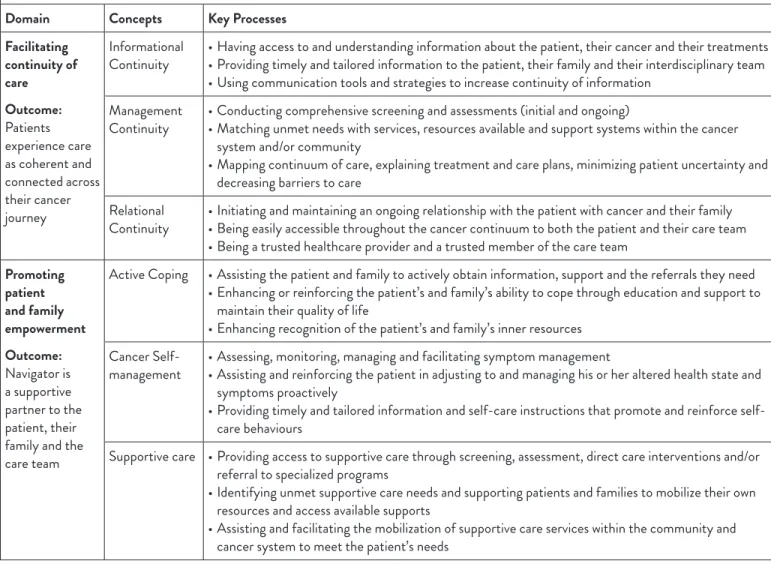
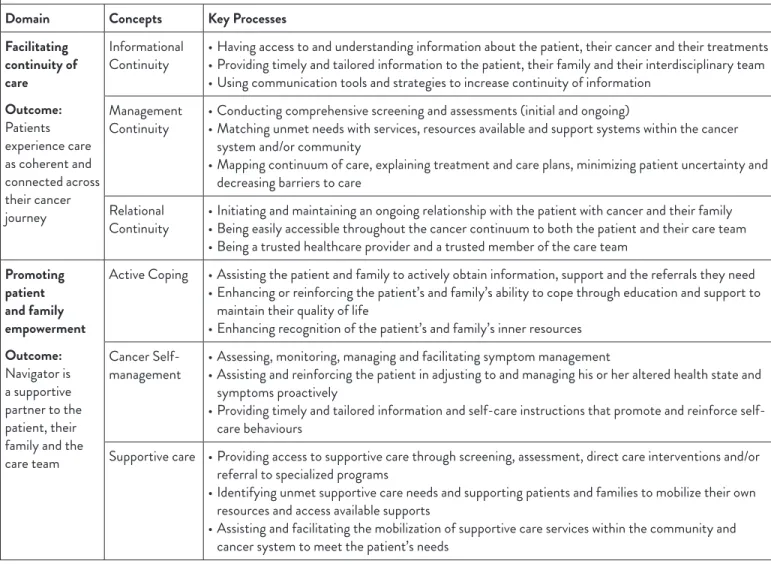
driver towards a more patient-centred, integrated care sys-tem. Based on the evaluation of these programs, a guide to implementing navigation (CPAC, 2012) was released. This guide explained three models of cancer navigation; peer or lay led, professional led, and virtual (on-line). As part of this resource, a bi-dimensional conceptual framework for professional cancer patient navigation developed by Fillion et al. (2012) was included. This framework describes the duality of the navigator role, as both patient/family and health system centric and includes two theoretic and co-de-pendent domains of professional navigation: facilitating con-tinuity of care (health system centric), and promoting patient and family empowerment (person centric). Table 2 highlights the two domains, along with the three related concepts and key processes under each domain.
The development of this professional navigation concep-tual framework (Fillion et al., 2012) provided further clarity regarding the ways that navigators contribute to improved outcomes for the patient and family, as well as the health system. However, it did not clearly outline the core areas of practice and competencies of the navigator, nor did it iden-tify the resources and educational supports required to enact the cancer patient navigator role. To address this issue, the researchers published a subsequent paper (Cook et al., 2013),
which synthesized the domains and processes established by Fillion et al. (2012), with the practice standards and compe-tencies for specialized oncology nurses, developed in 2006 by the Canadian Association of Nurses in Oncology (CANO), and similar roles in Australia. Three core areas of prac-tice for professional navigators were identified: providing information and education, providing emotional and sup-portive care, and facilitating coordination of services and con-tinuity of care within the context of an interdisciplinary team approach (Cook et al., 2013).
Although the Cook et al. paper was not published until 2013, these core areas for practice were included in the CPAC navigation implementation guide in 2012. The publication of this guide coincided with the development of the Alberta cancer patient navigation program and associ-ated navigation education framework development. Hence, a comparison was done of the content and topic areas between the Alberta navigation curriculum, the professional naviga-tion framework, the core areas of practice, and the Alberta cancer patient navigator job description. The purpose of this comparison was to identify alignment, synergies, and areas where further content was required. The result from this comparison, in turn, guided development of the Navigation orientation framework.
Table 2: Professional Navigation Framework (adapted from Fillion et al., 2012)
Domain Concepts Key Processes
Facilitating continuity of care
Outcome: Patients experience care as coherent and connected across their cancer journey
Informational
Continuity • Having access to and understanding information about the patient, their cancer and their treatments• Providing timely and tailored information to the patient, their family and their interdisciplinary team • Using communication tools and strategies to increase continuity of information
Management
Continuity • Conducting comprehensive screening and assessments (initial and ongoing)• Matching unmet needs with services, resources available and support systems within the cancer system and/or community
• Mapping continuum of care, explaining treatment and care plans, minimizing patient uncertainty and decreasing barriers to care
Relational
Continuity • Initiating and maintaining an ongoing relationship with the patient with cancer and their family• Being easily accessible throughout the cancer continuum to both the patient and their care team • Being a trusted healthcare provider and a trusted member of the care team
Promoting patient and family empowerment Outcome: Navigator is a supportive partner to the patient, their family and the care team
Active Coping • Assisting the patient and family to actively obtain information, support and the referrals they need • Enhancing or reinforcing the patient’s and family’s ability to cope through education and support to
maintain their quality of life
• Enhancing recognition of the patient’s and family’s inner resources Cancer
Self-management • Assessing, monitoring, managing and facilitating symptom management• Assisting and reinforcing the patient in adjusting to and managing his or her altered health state and symptoms proactively
• Providing timely and tailored information and care instructions that promote and reinforce self-care behaviours
Supportive care • Providing access to supportive care through screening, assessment, direct care interventions and/or referral to specialized programs
• Identifying unmet supportive care needs and supporting patients and families to mobilize their own resources and access available supports
DeVelOPMeNt OF tHe iNitiAl
NAViGAtiON OrieNtAtiON FrAMeWOrK
The Alberta navigation curriculum provided an excellent starting point for the development of the job description for the cancer patient navigator role, and for the navigation edu-cation framework. The Alberta navigation curriculum was the only navigation-specific curriculum at that time in Canada and the decision was made to utilize this navigation curriculum as core content and structure in the orientation process. However, after comparing the content of the curriculum to the national framework, the core areas of practice, and the job description, gaps in the content were identified. These gaps informed rede-sign and reorganization of the existing content, resulting in new content being developed and integrated. Modules that were redesigned included documentation, as all Alberta navi-gators were required to document in a standardized approach within the provincial electronic medical record (EMR), and cultural competency, to include the more recent context of cul-tural safety. The order in which the modules were utilized in the orientation was also adapted; we wanted to utilize a step-wise, sequential approach to learning. Finally, new content was added to supplement the existing modules and included con-tent on case management, the concept of personhood in prac-tice, health literacy and principles of adult learning, screening for distress, mapping of community resources, and informa-tion about complementary and alternative therapies.In addition to content revision, a variety of modes of learn-ing were incorporated throughout the curriculum. Some learning occurred primarily through self-study and read-ing relevant articles to each module. Other learnread-ing (such as teaching and coaching skills, communication, and com-plementary therapies) was facilitated through video confer-ence sessions in either one-on-one or small group situations. Other components (such as telephone triage and palliative care) were learned through face-to-face experiences in the tertiary cancer centres or community facilities.
This approach to orientation was utilized for the initial ori-entation phase to support the integration of cancer patient navigator roles in all 15 sites involved in this program: four regional cancer centres (RCCs) and 11 community cancer clin-ics (CCCs) (Anderson et al., 2016). Ongoing feedback was gathered from the navigators who participated in the initial orientation, as well as the operational managers to whom the navigators reported at each site.
eVOlutiON tO A NAViGAtiON
eDucAtiON FrAMeWOrK
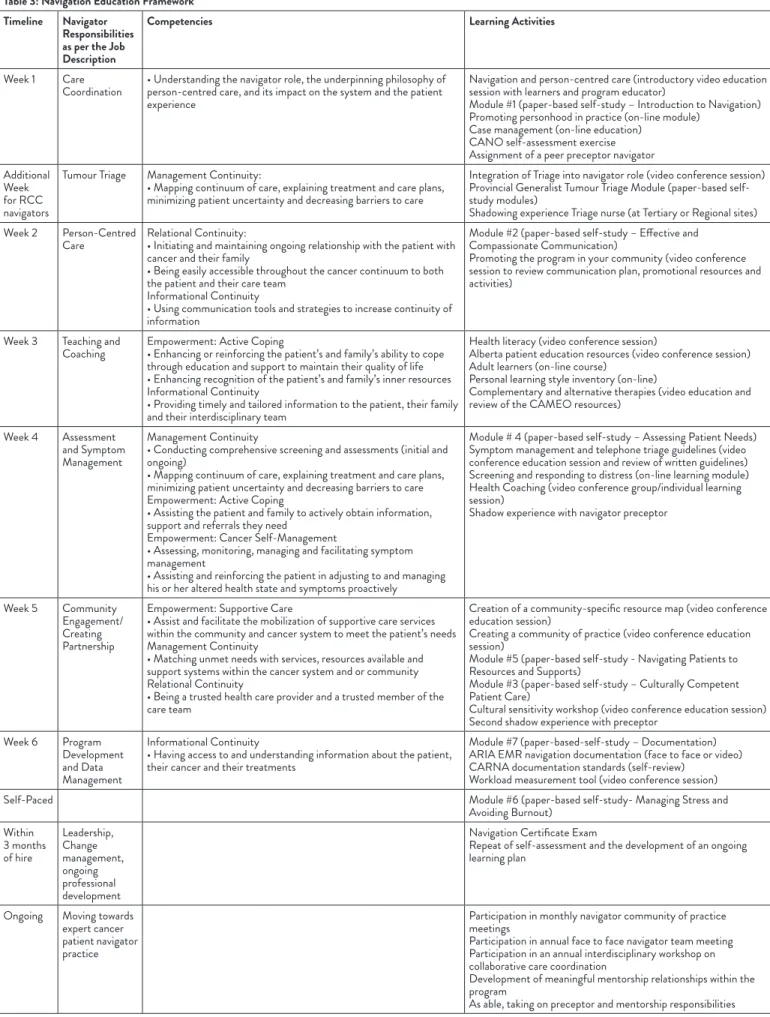
As the navigation program developed from a pilot program to an operational program, and as the experiential knowl-edge base of navigation practice grew across sites, the ori-entation framework was modified and expanded to include ongoing professional development. There have been signifi-cant opportunities to learn from navigators about how to best prepare them to move into a new navigator role and support their ongoing professional development. Several key learnings have emerged, and have resulted in the evolution of a broad
education framework, which is more extensive and compre-hensive than simply an orientation approach and can guide navigators, as they move from novice to expert practice. Maximize impact, minimize volume
Navigators have reported that supplemental learning mate-rials, such as articles and videos, for each course module were valuable in enhancing their understanding. However, they stressed that the volume of reading was, at some points, overwhelming. Based upon this feedback, the program team worked to streamline the additional readings by focusing on the key competencies required by new navigators. A review of the required reading articles was conducted and the number of articles was decreased.
Navigators reported that the use of multiple learning modalities (videos, online content, face-to-face meetings, video conferences, small group sessions, and self-study) was helpful to their learning. Therefore, this varied approach was strengthened.
More support for community engagement
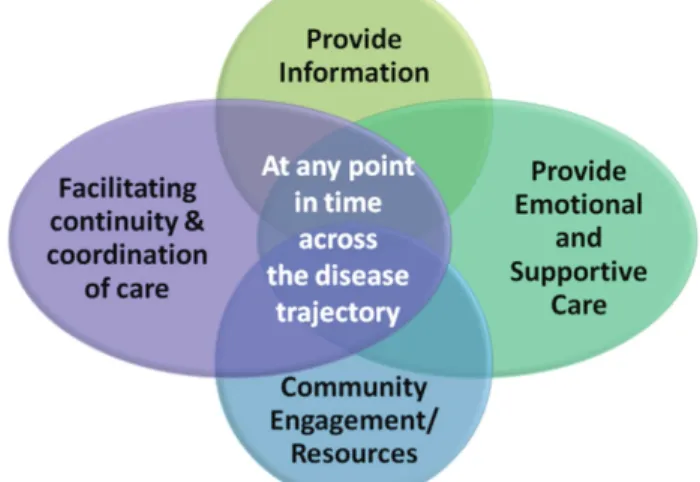
One area where new navigators have consistently felt under-prepared for actualizing the navigator role was commu-nity engagement. As experienced oncology nurses, the naviga-tors have been most familiar with working in an environment where the work came to them. For example, as a clinic nurse in an ambulatory oncology setting, the daily work is driven by the care needs of patients who are scheduled for appoint-ments that day. In the community, because the navigator role was new to these communities, there was no work coming to them at the beginning. The navigators needed to engage their community in understanding the navigator role and how it could benefit both the system and patients. This type of com-munity engagement was unfamiliar to most navigators and, although the navigation course included community resource mapping tools in the tool box, the work of community engage-ment challenged most new navigators. As a result, community engagement has been identified as a fourth core area of prac-tice (see Figure 1), and an increased emphasis on the topic was integrated into the one-on-one and small group sessions in the education framework.
Self-reflection as the starting point
Self-reflection not only enhances nurses’ learning expe-riences, but it also allows them to hone their critical thinking skills. Furthermore, it assists nurses in ensuring their learning experiences reflect their needs (Asselin & Fain, 2013). Because the nurses entered the navigation role with different back-ground experiences and knowledge bases, the decision to inte-grate a self-reflection exercise into the orientation program was made. This exercise is based on the CANO/ACIO (2006) stan-dards of practice, and is completed at the end of the first week of orientation, and then at three- and six-month intervals, to iden-tify areas on which to focus ongoing professional development efforts. The navigator and the program educator then discuss specific learning needs identified in the self-reflection and tailor additional learning experiences to the needs of the individual. At the three-month point in the role, the self-reflection is repeated by the new navigator and a learning plan is co-created between the navigator and educator. This process ensures continual pro-fessional development and movement towards expert practice. Novice versus experienced pathway
As more navigators joined the program, it was appar-ent that all nurses had a steep learning curve, as they moved into the navigation role. However, it became apparent that the nurses who did not have oncology experience had significantly more challenges. From the beginning of the program, all nav-igators who were new to oncology participated in the basic nursing orientation for the clinic setting prior to taking on the navigator orientation. However, there were still significant gaps in oncology-specific knowledge that made it difficult for these novice oncology nurses to move into the navigator role. This highlighted a key assumption in the original orientation framework—that the incumbent already had oncology knowl-edge. Given this assumption, the orientation had not contained any disease-specific content beyond symptom management. Based on this learning, a decision was made that new navi-gators who had no previous oncology experience would com-plete additional orientation components to develop baseline oncology knowledge and skills prior to starting the navigation components of their orientation. These navigators are encour-aged and supported to complete the De Souza Foundations in Oncology Nursing Practice course using a distance education format (De Souza Institute, n.d.) within the first six months in the navigator role.
Peer preceptorship and mentorship
Mentorship and preceptorship have been widely identified as key facilitators of professional practice development in nurs-ing (Canadian Nurses Association [CNA], 2004; CPAC, 2012). Although these two terms are often used interchangeably, they are, in fact, different (Watson, Raffin-Bouchal, Melnik, & Whyte, 2012). Preceptorship is linked more closely with supporting the integration of new staff into a particular work-place (Yonge, Billay, Myrick, & Luhanga, 2007), and is usually an assigned, time-limited relationship, which focuses on the development of the new staff’s clinical knowledge and skills relevant to the new work environment (Watson et al., 2012). Conversely, mentorship is a relationship that is more focused
on supporting continual professional development beyond the initial phase in the role (Yonge et al., 2007). Typically, a men-tor is chosen by the mentee, but it can evolve from an initial preceptor relationship (Watson et al., 2012).
One of the largest initial challenges for the navigation pro-gram implementation was that the provincial experience base in generalist navigation was limited. Therefore, the ability to utilize either preceptorship or mentorship as a professional develop-ment strategy for new navigators was restricted. Initially, the pro-gram educator served as both preceptor and mentor. However, as the program grew and more nurses were settled in their nav-igator roles, new opportunities to distribute this responsibility emerged. Now, new navigators are assigned during their orien-tation phase to an experienced navigator preceptor who works in a nearby cancer clinic setting. A less formal approach to men-torship has been established where new staff are encouraged to seek guidance from other experienced navigators. This approach is nurtured through monthly navigation teleconferences, an annual face-to-face navigation team meeting, and relationships developed during the navigator’s preceptorship.
Addition of triage in regional centres
As the navigation program and role became more estab-lished in all communities with a regional or community can-cer centre, a greater understanding of the differences in the navigation competencies between navigator roles within the RCCs and CCCs has emerged. Navigators who work at the larger RCC sites that receive direct referrals for new consul-tations required further competency development in tumour triage. Given the navigators at the RCC sites began connect-ing with patients as soon as possible after diagnosis, it became apparent that the navigators could also support timely access to first consult by ensuring:
• The consult was booked within the appropriate timeframe for the individual’s clinical situation;
• The appropriate tests/scans were booked prior and com-pleted in a timely manner prior to the initial consult; • That the patient was aware of the next steps in care;
• That the patient had access to the relevant information to participate in decision-making at that initial consult.
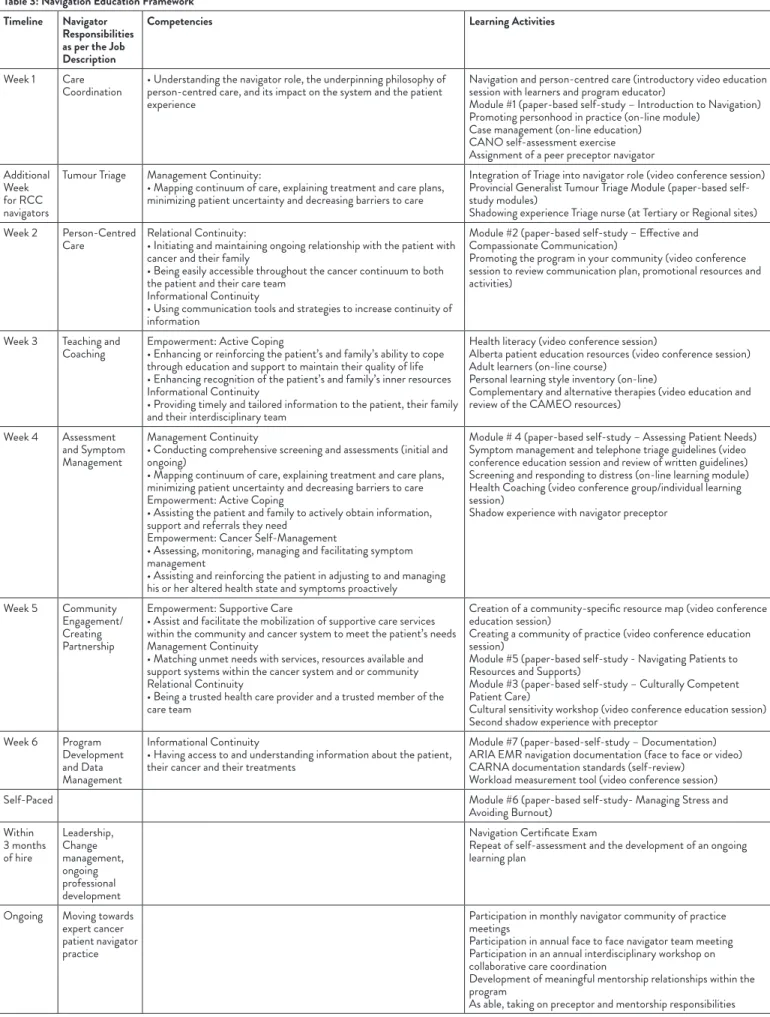
As a result of learning a cancer patient navigator could play a larger role in the initial access phase, a new job description was created highlighting the integration of triage competen-cies in sites where new consults are received. This was fol-lowed by the integration of a module for tumour triage into the education framework for navigators at regional sites. Cross training with existing triage staff then occurred, expanding their competencies and including those in the cancer patient navigator role. This increased navigation and triage capacity at the regional sites through the creation of a navigation team.
Table 3: Navigation Education Framework Timeline Navigator
Responsibilities as per the Job Description
Competencies Learning Activities
Week 1 Care
Coordination • Understanding the navigator role, the underpinning philosophy of person-centred care, and its impact on the system and the patient experience
Navigation and person-centred care (introductory video education session with learners and program educator)
Module #1 (paper-based self-study – Introduction to Navigation) Promoting personhood in practice (on-line module)
Case management (on-line education) CANO self-assessment exercise Assignment of a peer preceptor navigator Additional
Week for RCC navigators
Tumour Triage Management Continuity:
• Mapping continuum of care, explaining treatment and care plans, minimizing patient uncertainty and decreasing barriers to care
Integration of Triage into navigator role (video conference session) Provincial Generalist Tumour Triage Module (paper-based self-study modules)
Shadowing experience Triage nurse (at Tertiary or Regional sites) Week 2 Person-Centred
Care Relational Continuity:• Initiating and maintaining ongoing relationship with the patient with cancer and their family
• Being easily accessible throughout the cancer continuum to both the patient and their care team
Informational Continuity
• Using communication tools and strategies to increase continuity of information
Module #2 (paper-based self-study – Effective and Compassionate Communication)
Promoting the program in your community (video conference session to review communication plan, promotional resources and activities)
Week 3 Teaching and
Coaching Empowerment: Active Coping• Enhancing or reinforcing the patient’s and family’s ability to cope through education and support to maintain their quality of life • Enhancing recognition of the patient’s and family’s inner resources Informational Continuity
• Providing timely and tailored information to the patient, their family and their interdisciplinary team
Health literacy (video conference session)
Alberta patient education resources (video conference session) Adult learners (on-line course)
Personal learning style inventory (on-line)
Complementary and alternative therapies (video education and review of the CAMEO resources)
Week 4 Assessment and Symptom Management
Management Continuity
• Conducting comprehensive screening and assessments (initial and ongoing)
• Mapping continuum of care, explaining treatment and care plans, minimizing patient uncertainty and decreasing barriers to care Empowerment: Active Coping
• Assisting the patient and family to actively obtain information, support and referrals they need
Empowerment: Cancer Self-Management
• Assessing, monitoring, managing and facilitating symptom management
• Assisting and reinforcing the patient in adjusting to and managing his or her altered health state and symptoms proactively
Module # 4 (paper-based self-study – Assessing Patient Needs) Symptom management and telephone triage guidelines (video conference education session and review of written guidelines) Screening and responding to distress (on-line learning module) Health Coaching (video conference group/individual learning session)
Shadow experience with navigator preceptor
Week 5 Community Engagement/ Creating Partnership
Empowerment: Supportive Care
• Assist and facilitate the mobilization of supportive care services within the community and cancer system to meet the patient’s needs Management Continuity
• Matching unmet needs with services, resources available and support systems within the cancer system and or community Relational Continuity
• Being a trusted health care provider and a trusted member of the care team
Creation of a community-specific resource map (video conference education session)
Creating a community of practice (video conference education session)
Module #5 (paper-based self-study - Navigating Patients to Resources and Supports)
Module #3 (paper-based self-study – Culturally Competent Patient Care)
Cultural sensitivity workshop (video conference education session) Second shadow experience with preceptor
Week 6 Program Development and Data Management
Informational Continuity
• Having access to and understanding information about the patient, their cancer and their treatments
Module #7 (paper-based-self-study – Documentation) ARIA EMR navigation documentation (face to face or video) CARNA documentation standards (self-review)
Workload measurement tool (video conference session) Self-Paced Module #6 (paper-based self-study- Managing Stress and
Avoiding Burnout) Within
3 months of hire
Leadership, Change management, ongoing professional development
Navigation Certificate Exam
Repeat of self-assessment and the development of an ongoing learning plan
Ongoing Moving towards expert cancer patient navigator practice
Participation in monthly navigator community of practice meetings
Participation in annual face to face navigator team meeting Participation in an annual interdisciplinary workshop on collaborative care coordination
Development of meaningful mentorship relationships within the program
cONclusiON
In 2012, the provincial cancer care agency in Alberta under-took a daunting task, to develop, implement, and evaluate the impact of a provincial cancer patient navigation program span-ning 15 isolated urban cancer care delivery centres. In order to achieve this goal, a provincial plan was required, followed by a robust implementation phase. The focus of this article was to share the development of the orientation for new navigators and to describe the evolution, from an orientation framework to an education framework, based on our experience. Much collective learning has occurred as a result of the implementation of this provincial cancer patient navigation program. It is hoped that
through sharing these learnings, similar programs will have an informed starting place to begin program planning and devel-opment, thus leveraging health system transformation forward.
The third and final article in this series will highlight the overarching navigation model that has emerged from this QI work and report on the findings from the program evaluation. The knowledge shared through this series of articles will add to the knowledge base regarding how to implement and sup-port a large scale cancer patient navigation program and will highlight the impact that such a program can have on the patient experience, team functioning, care coordination, and health system utilization.
reFereNces
Alberta Cancer Foundation (ACF) (2015). Annual progress report. Retrieved from http://albertacancer.ca/progress-report/ spring-2015/patient-navigators
Alberta Health (AH). (2013). Changing our future: Alberta’s cancer plan to 2030. Retrieved from http://www.health.alberta.ca/documents/ Cancer-Plan-Alberta-2013.pdf
Alberta Research Ethics Community Consensus Initiative (ARECCI) (2012). ARECCI guidelines for quality improvement and evaluation projects. Retrieved from http:// w w w. a i h e a l t h s o l u t i o n s . c a / i n i t i a t i v e s - p a r t n e r s h i p s / arecci-a-project-ethics-community-consensus-initiative/
Anderson, J., Champ, S., Vimy, K., DeIure, J., & Watson, L. (2016). Developing a provincial cancer patient navigation program utilizing a quality improvement approach: Part one-designing and implementing. Canadian Oncology Nursing Journal, 26(2), 122–128. doi:10.5737/23688076262122128
Asselin, M.E., & Fain, J.A. (2013). Effect of reflective practice education on self-reflection, insight, and reflective thinking among experienced nurses: A pilot study. Journal for Nurses in Professional Development, 29(3), 111–119. doi:0.1097/NND.0b013e318291c0cc Canadian Association of Nurses in Oncology/Association
canadienne des infirmières en oncologie (CANO/ACIO). (2006). Practice standards and competencies for the specialized oncology nurse. Retrieved from http://www.cano-acio.ca/~ASSETS/ DOCUMENT/Practice/CONEP_Standards2006September28_ REVISEDFor_20Website.pdf
Canadian Nurses Association (2004). Achieving excellence in professional practice: A guide to preceptorship and mentoring. Retrieved from https://www.cna-aiic.ca/en/download-buy/ preceptorship-and-mentorship
Canadian Partnership Against Cancer (CPAC) (2012). Navigation:
A guide to implementing best practices in Person-Centred Care.
Retrieved from http://www.cancerview.ca/idc/groups/public/ documents/webcontent/guide_implement_nav.pdf
Cantril, C., & Haylock, P.J. (2013). Patient navigation in the oncology care setting. Seminars in Oncology Nursing, 29(2), 76–90. doi:10.1016/j.soncn.2013.02.003
Cook, S., Fillion, L., Fitch, M.I., Veillette, A.M., Matheson, T., Aubin, M., ... Rainville, F. (2013). Core areas of practice and associated competencies for nurses working as professional cancer navigators. Canadian Oncology Nursing Journal/Revue Canadienne de soins infirmiers en oncologie, 23(1), 44–52.
De Souza Institute (n.d). Foundations in oncology nursing practice. Retrieved from https://portfolio.desouzainstitute.com/courses/ viewCourse/567
Doll, R., Barroetavena, M., Ellwood, A., Fillion, L., Habra, M., Linden, W., & Stephen, J. (2007). The cancer care navigator:
Towards a conceptual framework for a new role in oncology. Oncology Exchange, 6(4), 28–35. Retrieved from http://www. oncologyex.com/gif/archive/2007/vol6_no4/6_continuing_ care_4.pdf
Dozois, E. (2010). Alberta Health Services (AHS). Cancer patient navigation course. Internal AHS document.
Fillion, L., Cook, S., Veillette, A., Aubin, M., de Serres, M., Rainville, F., ... Doll, R. (2012). Professional navigation framework: Elaboration and validation in a Canadian context. Oncology Nursing Forum, 39(1), 58–69. doi:10.1188/12.ONF.E58-E69 A
Fillion, L., de Serres, M., Lapointe-Goupil, R., Bairati, I., Gagnon, P., Deschamps, M., ... Demers, G. (2006). Implementing the role of patient-navigator nurse at a university hospital centre. Canadian Oncology Nursing Journal/Revue canadienne de soins infirmiers en oncologie, 16(1), 11–17.
Langley, G., Moen, R., Nolan, K., Nolan, T., Norman, C., & Provost, L. (2009) The Improvement Guide: A Practical Approach to Enhancing Organisational Performance. San Francisco, CA: Jossey Bass. Meade, C.D., Wells, K.J., Arevalo, M., Calcano, E.R., Rivera, M.,
Sarmiento, Y., Freeman, H.P., & Roetzheim, R.G. (2014). Lay navigator model for impacting cancer health disparities. Journal of Cancer Education, 29(3), 449–457. doi:10.1007/s13187-014-0640-z Miller, J. (2006). Cancer patient navigation needs assessment: Project
report. Alberta Cancer Board: Medical Affairs and Community Oncology Division, Internal Document.
Pedersen, A., & Hack, T. (2010). Pilots of oncology healthcare: A concept analysis of the patient navigator role. Oncology Nursing Forum, 37(1), 55–60. doi:10.1188/10.ONF.5560
Thomas, M., & Peters, E. (2014). Setting-specific navigation. In K. Blaseg, P. Daughtery, & K. Gamblin (Eds.), Oncology nurse navigation: Delivering patient-centered care across the continuum. Pittsburg, Pennsylvania: Oncology Nursing Society.
Watson, L., Raffin-Bouchal, S., Melnick, A., & Whyte, D. (2012). Designing and implementing an ambulatory oncology nursing peer preceptorship program: Using grounded theory research to guide program development. Nursing Research and Practice. Article ID 451354. doi:10.1155/2012/451354.
Wells, K.J., Battaglia, T.A., Dudley, D.J., Garcia, R., Greene, A., Calhoun, E., … Raich, P.C. (2008). Patient navigation: State of the art or is it science? Cancer, 113(8), 1999–2010. doi:10.1002/cncr.23815 World Medical Association (WMA) (2008). Declaration of
Helsinki: Ethical principles for medical research involving human subjects. Retrieved from http://www.wma.net/ en/30publications/10policies/b3/17c.pdf
the outcomes that were achieved through this quality improve-ment project. The final article will also include key learning, adaptations made, and work underway to broaden the scope and impact of the provincial navigation program.
BACKGROUND
Cancer patient navigation can be defined as a “proactive, intentional process of collaborating with a person and his or her family to provide guidance, as they negotiate the maze of treatments, services and potential barriers throughout the can-cer journey” (Canadian Partnership Against Cancan-cer [CPAC], 2012, p. 5). The central concept within this definition includes an individual (navigator) being available to support a cancer patient at any point throughout his or her cancer journey. The scope of support that a navigator can provide to the patient and their family is directly influenced by whether the naviga-tion program utilizes a lay navigation model or a professional navigation model (CPAC, 2012). Lay navigation programs uti-lize volunteers or cancer survivors to provide information and awareness of resources such as psychosocial supports, home care, and other health services in a community setting (Meade et al., 2014). Professional navigation models utilize registered health care professionals, most commonly registered nurses or social workers, to provide a variety of clinical supports and services including psychosocial interventions, coordination of care, health education, case management, and facilitation of communication between health systems and the patient (Pedersen & Hack, 2010; Wells et al., 2008).
In 2012, through the generous support of the Alberta Cancer Foundation (ACF), funding was secured to implement a cancer patient navigation program in Alberta. In alignment with the provincial goal of creating a comprehensive and coordinated cancer care system (Alberta Health, 2013), the goals that guided the development of this program included enhancing inte-gration with primary care; improved access for rural patients to psychological, physical, and supportive care services; and developing a strong cancer workforce to meet the needs of can-cer patients and their families in Alberta. During the program design phase, several key decisions were made that fundamen-tally directed the program and the development of the education framework. The first impactful decision was to utilize a profes-sional navigation model. A previous provincial needs assess-ment had identified the need for improved linkages between the cancer patient/family, community care agencies and health-care providers in the primary, ambulatory and acute health-care set-tings (Miller, 2006). Further, this needs assessment highlighted that improved linkages were required across the cancer trajec-tory from prevention, through diagnosis, treatment and into survivorship and/or palliation (Miller, 2006). Due to the scope of need, a professional model of navigation was selected as the most appropriate approach in Alberta.
The second influential decision made was that the can-cer patient navigator role would be designed as a specialized oncology registered nurse (RN) role. Oncology nurses are ideally suited for the patient navigator role due to their com-prehensive knowledge of the cancer disease and the vari-ous treatment modalities used to treat cancer. Additionally,
they possess competencies in complex symptom manage-ment, supportive care, patient education, and have a strong experience base in facilitating continuity and coordination of care between health care providers and care delivery settings and systems (Doll et al., 2007; Fillion et al., 2006; Pedersen & Hack, 2010; CPAC, 2012). The vision for the navigator role was that they would work to provide a single point of contact for patients and families living with cancer, and for health care professionals caring for those patients in the community set-ting who require information about care management. In this way, the navigator role would connect the patient, the com-munity-based provider, and the cancer care system, serving to facilitate integration of care across systems (Cook et al., 2013).
The third key decision made was to introduce the navi-gator role into the rural and isolated urban cancer centres across the province, as the provincial needs assessment had revealed patients who live in rural and isolated urban centres face additional challenges in accessing care and experienc-ing coordinated care (Miller, 2006). Moreover, smaller com-munity settings often have a limited number of health care providers with oncology expertise and supportive care knowl-edge (Cantril & Haylock, 2013). Thus, the RN who becomes a navigator needed to have a broad oncology knowledge base in order to serve all cancer patients within a specific geographical area and be prepared to deliver navigation support at any point on their cancer journey (Thomas & Peters, 2014).
PROJECT METHODOLOGY
This implementation project was designed as a continual QI project, as the core goal of the project was to implement the cancer patient navigator role into the existing clinical envi-ronment at each setting and evaluate its impact. The imple-mentation guide for cancer patient navigation developed by the Canadian Partnership Against Cancer (CPAC, 2012) was utilized as a guiding document, as it is well established that successful QI requires a comprehensive and effective change management strategy (Langley, Moen, Nolan, Norman, & Provost, 2009).
THE CANCER PATIENT NAVIGATION
CURRICULUM
As part of the earlier work undertaken in Alberta, which began in 2006 with the initial provincial needs assess-ment (Miller, 2006), a cancer patient navigation curriculum was developed (Dozois, 2010). The curriculum consisted of eight modules. Modules and key elements are outlined in Table 1.
This existing curriculum was the starting point for devel-oping both the navigator role description and orientation plan. Initial work focused on the question of how best to prepare an RN to take on the navigator role. A comprehensive mapping of this curriculum was conducted to determine whether any new content needed to be developed (Dozois, 2010). Additionally, the literature regarding navigation was reviewed, and naviga-tion programs (including tumour-specific ones) within our province, as well as others across Canada, were consulted in order to gain an understanding of the scope and function of navigation roles, both provincially and nationally. Based on
the previous needs assessment, the existing navigation curric-ulum content, the literature, and input from key operational stakeholders, the overall vision for the navigator program and role in Alberta was established. A standard job description was developed, which outlined the scope and function of the role (Anderson et al., 2016), as well as the corresponding apti-tude and skill set necessary to be successful in the role. Once the standardized role description was vetted with operational management and provincial human resources (HR), the scope and description allowed for the development of a provincial orientation program.
THE PROFESSIONAL NAVIGATION
COMPETENCY FRAMEWORK AND CORE
AREAS OF PRACTICE
Knowledge about cancer patient navigation continued to grow after the development of the Alberta navigation curric-ulum. In fact, in 2010, CPAC supported the implementation of cancer navigation programs in several jurisdictions as a
Table 1: Alberta Cancer Patient Navigation Curriculum (Dozois, 2010) Module Key Elements
1. Module One:
Introduction • Encompasses the history and benefits of patient navigation, including the goals of navigation, and the various navigation roles and models of navigation that exist. • Explores the underpinnings of the Alberta navigation model, and the guiding principles of navigation which
informed its development. 2. Module Two:
Effective and Compassionate Communication
• Provides the navigator with strategies to enhance their communication with patients, families, and other healthcare professionals.
• Principles of effective communication, including both verbal and non-verbal communication.
• Explores the barriers to effective communication, how to deal with strong emotions and conflict, and how to communicate in an interdisciplinary environment.
3. Module Three: Culturally Competent Patient Care
• Explores how culture influences health beliefs and practices, and how it can impact the clinical interaction.
• Cultural impact on cancer and cancer care is also explored, including screening practices, understandings of cancer, and cancer treatment.
• Throughout this module, the navigator is encouraged to explore their beliefs and biases in order to provide culturally appropriate care.
4. Module Four: Assessing Patient Needs
• Explores strategies for patient assessment in all domains, including informational, psychosocial, and practical. • Contains information on assessing the patient’s readiness to learn, and explores ways to enhance learning in the
patient.
• Various tools for patient assessment are also included in this module, in addition to several techniques for having a therapeutic conversation with a patient.
5. Module Five: Navigating Patients to Resources and Support
• Assists the navigator in determining strategies to facilitate patients’ and families’ access to resources, whether they are informal, community-based, or system supports. Navigators will be able to assess patients’ current supports, address gaps, and assist patients in accesses required supports.
• Emphasis on facilitating self-navigation and empowerment of the patient to become effective partners in their care. 6. Module Six:
Managing stress and avoiding burnout
• The learner is exposed to the signs and symptoms of stress and burnout and the common stressors experienced by those who care for cancer patients.
• Strategies to prevent burnout are explored. 7. Module Seven:
Documentation • Explores the what, how, and why of documentation for the navigator. Different methods of documentation are provided, including PIE, SOAP, and FOCUS charting. • Discusses the role of documentation regarding legal, quality improvement and risk management.
8. Module Eight:
driver towards a more patient-centred, integrated care sys-tem. Based on the evaluation of these programs, a guide to implementing navigation (CPAC, 2012) was released. This guide explained three models of cancer navigation; peer or lay led, professional led, and virtual (on-line). As part of this resource, a bi-dimensional conceptual framework for professional cancer patient navigation developed by Fillion et al. (2012) was included. This framework describes the duality of the navigator role, as both patient/family and health system centric and includes two theoretic and co-de-pendent domains of professional navigation: facilitating con-tinuity of care (health system centric), and promoting patient and family empowerment (person centric). Table 2 highlights the two domains, along with the three related concepts and key processes under each domain.
The development of this professional navigation concep-tual framework (Fillion et al., 2012) provided further clarity regarding the ways that navigators contribute to improved outcomes for the patient and family, as well as the health system. However, it did not clearly outline the core areas of practice and competencies of the navigator, nor did it iden-tify the resources and educational supports required to enact the cancer patient navigator role. To address this issue, the researchers published a subsequent paper (Cook et al., 2013),
which synthesized the domains and processes established by Fillion et al. (2012), with the practice standards and compe-tencies for specialized oncology nurses, developed in 2006 by the Canadian Association of Nurses in Oncology (CANO), and similar roles in Australia. Three core areas of prac-tice for professional navigators were identified: providing information and education, providing emotional and sup-portive care, and facilitating coordination of services and con-tinuity of care within the context of an interdisciplinary team approach (Cook et al., 2013).
Although the Cook et al. paper was not published until 2013, these core areas for practice were included in the CPAC navigation implementation guide in 2012. The publication of this guide coincided with the development of the Alberta cancer patient navigation program and associ-ated navigation education framework development. Hence, a comparison was done of the content and topic areas between the Alberta navigation curriculum, the professional naviga-tion framework, the core areas of practice, and the Alberta cancer patient navigator job description. The purpose of this comparison was to identify alignment, synergies, and areas where further content was required. The result from this comparison, in turn, guided development of the Navigation orientation framework.
Table 2: Professional Navigation Framework (adapted from Fillion et al., 2012) Domain Concepts Key Processes
Facilitating continuity of care
Outcome:
Patients experience care as coherent and connected across their cancer journey
Informational
Continuity • Having access to and understanding information about the patient, their cancer and their treatments• Providing timely and tailored information to the patient, their family and their interdisciplinary team • Using communication tools and strategies to increase continuity of information
Management
Continuity • Conducting comprehensive screening and assessments (initial and ongoing)• Matching unmet needs with services, resources available and support systems within the cancer system and/or community
• Mapping continuum of care, explaining treatment and care plans, minimizing patient uncertainty and decreasing barriers to care
Relational
Continuity • Initiating and maintaining an ongoing relationship with the patient with cancer and their family• Being easily accessible throughout the cancer continuum to both the patient and their care team • Being a trusted healthcare provider and a trusted member of the care team
Promoting patient and family empowerment Outcome:
Navigator is a supportive partner to the patient, their family and the care team
Active Coping • Assisting the patient and family to actively obtain information, support and the referrals they need • Enhancing or reinforcing the patient’s and family’s ability to cope through education and support to
maintain their quality of life
• Enhancing recognition of the patient’s and family’s inner resources Cancer
Self-management • Assessing, monitoring, managing and facilitating symptom management• Assisting and reinforcing the patient in adjusting to and managing his or her altered health state and symptoms proactively
• Providing timely and tailored information and care instructions that promote and reinforce self-care behaviours
Supportive care • Providing access to supportive care through screening, assessment, direct care interventions and/or referral to specialized programs
• Identifying unmet supportive care needs and supporting patients and families to mobilize their own resources and access available supports
DEVELOPMENT OF THE INITIAL
NAVIGATION ORIENTATION FRAMEWORK
The Alberta navigation curriculum provided an excellent starting point for the development of the job description for the cancer patient navigator role, and for the navigation edu-cation framework. The Alberta navigation curriculum was the only navigation-specific curriculum at that time in Canada and the decision was made to utilize this navigation curriculum as core content and structure in the orientation process. However, after comparing the content of the curriculum to the national framework, the core areas of practice, and the job description, gaps in the content were identified. These gaps informed rede-sign and reorganization of the existing content, resulting in new content being developed and integrated. Modules that were redesigned included documentation, as all Alberta navi-gators were required to document in a standardized approach within the provincial electronic medical record (EMR), and cultural competency, to include the more recent context of cul-tural safety. The order in which the modules were utilized in the orientation was also adapted; we wanted to utilize a step-wise, sequential approach to learning. Finally, new content was added to supplement the existing modules and included con-tent on case management, the concept of personhood in prac-tice, health literacy and principles of adult learning, screening for distress, mapping of community resources, and informa-tion about complementary and alternative therapies.
In addition to content revision, a variety of modes of learn-ing were incorporated throughout the curriculum. Some learning occurred primarily through self-study and read-ing relevant articles to each module. Other learnread-ing (such as teaching and coaching skills, communication, and com-plementary therapies) was facilitated through video confer-ence sessions in either one-on-one or small group situations. Other components (such as telephone triage and palliative care) were learned through face-to-face experiences in the tertiary cancer centres or community facilities.
This approach to orientation was utilized for the initial ori-entation phase to support the integration of cancer patient navigator roles in all 15 sites involved in this program: four regional cancer centres (RCCs) and 11 community cancer clin-ics (CCCs) (Anderson et al., 2016). Ongoing feedback was gathered from the navigators who participated in the initial orientation, as well as the operational managers to whom the navigators reported at each site.
EVOLUTION TO A NAVIGATION
EDUCATION FRAMEWORK
As the navigation program developed from a pilot program to an operational program, and as the experiential knowl-edge base of navigation practice grew across sites, the ori-entation framework was modified and expanded to include ongoing professional development. There have been signifi-cant opportunities to learn from navigators about how to best prepare them to move into a new navigator role and support their ongoing professional development. Several key learnings have emerged, and have resulted in the evolution of a broad
education framework, which is more extensive and compre-hensive than simply an orientation approach and can guide navigators, as they move from novice to expert practice.
Maximize impact, minimize volume
Navigators have reported that supplemental learning mate-rials, such as articles and videos, for each course module were valuable in enhancing their understanding. However, they stressed that the volume of reading was, at some points, overwhelming. Based upon this feedback, the program team worked to streamline the additional readings by focusing on the key competencies required by new navigators. A review of the required reading articles was conducted and the number of articles was decreased.
Navigators reported that the use of multiple learning modalities (videos, online content, face-to-face meetings, video conferences, small group sessions, and self-study) was helpful to their learning. Therefore, this varied approach was strengthened.
More support for community engagement
One area where new navigators have consistently felt under-prepared for actualizing the navigator role was commu-nity engagement. As experienced oncology nurses, the naviga-tors have been most familiar with working in an environment where the work came to them. For example, as a clinic nurse in an ambulatory oncology setting, the daily work is driven by the care needs of patients who are scheduled for appoint-ments that day. In the community, because the navigator role was new to these communities, there was no work coming to them at the beginning. The navigators needed to engage their community in understanding the navigator role and how it could benefit both the system and patients. This type of com-munity engagement was unfamiliar to most navigators and, although the navigation course included community resource mapping tools in the tool box, the work of community engage-ment challenged most new navigators. As a result, community engagement has been identified as a fourth core area of prac-tice (see Figure 1), and an increased emphasis on the topic was integrated into the one-on-one and small group sessions in the education framework.