Issues
ISSN: 2146-4138
available at http: www.econjournals.com
International Journal of Economics and Financial Issues, 2015, 5(2), 434-440.
Does the Financial Development Spur Export Performance?
Evidence from Turkish Firm-Level Data
Serap Coban*
Department of Economics, Nevsehir Haci Bektas Veli University, Nevsehir, Turkey. *Email: [email protected]
ABSTRACT
This paper investigates the causal relationship between financial development and export performance of firms in manufacturing sector in Turkey over the 1991-2012 period. After constructing banking sector and stock market financial development indexes and grouping the firms according to financial constraint indicators, for each groups and all of the firms in the sample panel causality test conducted developed by Dumitrescu and Hurlin (2012). The empirical evidence shows while development of the stock market plays a supportive role in increasing export performance for all groups, the direction of causality between development of banking sector and export performance can differ according to groups. The empirical evidence demonstrates the importance of policy reforms in the financial sector for the international trade. The financial development can be used as a predictor of export performance.
Keywords: Export Performance of Firms, Financial Development, Panel Causality, Turkey JEL Classifications: E44, L20, O10
1. INTRODUCTION
In a competitive world, sustaining economic growth and increasing
the competitiveness of a country is directly related to the export performance of that country’s firms. In the international trade
literature, this relationship is lead to an investigation on the main
factors that encourage firms to export and promote to improve their export activities. In general, the oppurtunity for access to financial instruments easily to overcome firms’ liquidity problems can be seen as one of the main factors that determine the export performance of firms. From this point of view, a well-functioning financial system
has an important role to play supporting economic growth and providing accumulation of funds to serve commercial activities.
The existence of the relationship between financial development
and economic growth has been discussed in both on theoretical
and empirical grounds. In particular, after the 2008 financial crisis, functioning of the financial system in terms of economic
growth and international trade has further increased its importance. Empirical studies addressing different aspects of the relationship
between financial development and economic growth can be
evaluated in three main categories. In thefirst category, there are papers describing the relationship between financial development
and economic growth at the macro level. The papers in this
category can be divided into four subgroups. The first group includes papers which find causality from financial development
to economic growth supports the supply leading hypothesis. The papers in the second group point out a causality relationship from
growth of the real sector to financial development and support
demand following hypothesis. In the third group of these papers, it is argued that there is a bidirectional relationship between
economic growth and financial development. In the fourth group, papers can not find a causality relationship between financial
development and economic growth. Thesecond category includes studies that investigate the relationship between financially
dependent industries/firms and countries’ financial development.
In the third category, papers incorporate a new dimension to the issue taking into account the international trade in the preceding category. In this direction, recent empirical studies using micro
data have begun to be addressed the relationship between financial development and economic growth both at industry and firm level. On the other hand, while the majority of studies present results on the relationship between financial development and economic growth using cross country/industry/firm data, Guiso et al. (2004) suggest that financial development also may affect the economic
Apart from firms’ financial situation, the country’s financial development is also thought to affect the performance of firms which have been continuing its export activities already. Therefore, the
main theme of this paper is the relationship between the country’s
financial development and the export performance of firms. In this context, the main purpose of the study is to investigate the causal relationship between the financial development of the country and export performance of firms to give a different insight in terms of establishing a link between macro and micro literature. Although there are some studies on this issue as is explained in the literature review; there is no other published study explaining causality relationship between a country’s financial development and export performance of firms, to my knowledge. This paper therefore aims to fulfill this gap and contributes to empirical literature. The first stage of the study, covering the period 1991- 2012, construct indexes in order to evaluate the development of the banking sector
and stock market development separately to see more clearly the
effect of financial development. In this context, the banking sector financial development is measured by an index created using five variables related banking sector. To measure stock market financial development, an index is created that contains the four financial
development variables related to stock market. Following Huang
(2010), Saci and Holden (2008) and The World Economic Forum (2011), these indexes are obtained using the principal component analysis (PCA). In the second stage, inspired from the idea that the firms are affected in a different way from financial development within a country, 101 manufacturing firms are grouped according to their some financial characteristics. In the first group, firms are
separated into foreign shareholding and no foreign shareholding
firms. In the second group, there are lower leverage firms and higher leverage firms. Finally, lower liquidity firms and higher liquidity firms are in the third subgroup. In the third stage, using panel causality test developed by Dumitrescu and Hurlin (2012), it is investigated the causality between export performance and financial development for each group and all of the firms in the sample.
Following the introduction, the structure of the study is designed as follows. The second part of the study carries out a literature review. Third part presents the dataset, variables, and the model
used in this study. The fourth part reveals the empirical findings
and conclusion follows it.
2. REVIEW OF THE LITERATURE
The first studies on the connection between financial institutions
and the international trade emphasis generally on theoretical basis
of this issue. Kletzer and Bardhan (1987) state that when technology and other equipments are constant, different practices related to loan agreements in a country can create inequality between countries. Rajan and Zingales (1998) and Demirgüç- Kunt and Maksimovic (1998) suggest that a developed financial system facilitates firms access to external financing for investment. From the view of that a developed financial system which reduces the credit constraints (Love, 2003), it can be said that financial development increases the willingness of firms operate in foreign markets.
When we scrutinize the relationship between trade and financial
development at the micro level, there is no clear conclusion
about how a financial system within a country influences firms with different characteristics. The heterogeneity of firms that perform export activities is an obstacle to the formation of a
joint judgment on this issue. However, several studies reach a
conclusion that highly efficient, large-scale, capital-intensive and more high-paying firms participate in foreign trade activities (Bernard and Jensen, 1999; Alvarez and López, 2005; Kasahara and Rodrigue, 2008; Lopez and Yadav, 2010). Beck (2003) shows that financial development increases exports in industries that are highly dependent on external finance, while Becker and Greenberg (2005) point out a positive relationship between higher financial development and higher exports, this relationship is stronger in industries with higher entry costs. Since export includes fixed entry costs such as product promotion, marketing expenses,
capture standards for the regulation of the destination country and
forming the distribution network and financing of these costs are more difficult than other investment costs, firms are able to tend to export more in a more developed financial system. Otherwise, just firms with sufficient liquidity have a potential to meet high entry cost, the entry of firms into foreign markets is prevented by less develop financial system due to access to finance is limited. While several studies find empirical results that potential exporting firm exposed to fixed entry cost, the effect of financial development on financing of these fixed cost is ignored in international trade literature. Roberts and Tybout (1997), for 60% of firms located in Columbia in their dataset, suggest that a firm’s current export volume is largely determined by the previous export experience. Accordingly, the profitability of exports increases when previous export experience is increased. In addition, they point out that fixed costs are important in entry decision to export for firms. Similar results are demonstrated by Bernard and Wagner (2001) for Germany and Bernard and Jensen (2004) for USA. It can be expected to be a tight relationship between the financial development in a country and export performance of firms and concluded that more advanced financial development reduce the financial constraints, thus firms are more courageous in exporting.
Many studies standing on the impact of firm-specific financial situation/constraint on export profitability conducted at the firm level before, however, the effect of financial development that can eliminate the financing constraints on the export behavior has been neglected. Only a few studies explore the impact of financial constraints on the export activity. Greenaway et al. (2007), using panel data of manufacturing firms operating in the UK, investigate the impact of the financial condition of the firms on their export decisions. They find that financial health of exporting firms is better than non-exporting firms. Moreover, their results suggest that the export activity may be a factor to improve the firm’s financial situation. On the other hand, studies by Forlani (2010) for Itaian firms and Muûls (2008) for Belgian firms are concluded that financial constraints affect the possibility to export significantly
negatively.
With a different viewpoint, using a large dataset which is a
combination of macro and micro indicators, Berman and Héricourt
constraint indicators and the ratio of total private credit to gross
domestic product (GDP) as an indicator of financial development. Their empirical findings indicate that financial development plays a significant mediating role between financial constraints and the export activities. In addition, Amiti and Weinstein (2011) point out the functioning of financial institutions is an important determinant of firm-level exports during Japanese financial crises. Fauceglia (2014), point out a more developed financial system increases the export probability through the reduction of credit constraints.
As a result, studies in the literature usually investigate the
causal relationship between the firm’s financial health and
their export performance. Export activities improve the firm’s financial situation, in other words, there is causality from export performance to financial health (Greenaway et al., 2007). On the other hand, some papers shows that the propensity to export is higher when the firms are financially healthy and there exists a causal relationship from financial situations to the propensity to export activities (Wagner, 2014; Minetti and Zhu, 2011; Berman and Hericourt, 2010; Forlani, 2010; Muûls, 2008). In this study, the causal relationship between the country’s financial development and export performance of the firms is investigated to provide a contribution to literature with firm-level evidence on the financial development-trade nexus.
3. DATA AND MODEL
This study investigates the causal relationship between financial development and export performance of the firm for the period 1991-2012. Choosing financial development indicators accurately is necessary to demonstrate the effect of financial development clearly (Levine, 2005). Finance-growth literature offers many financial development indicators. However, by selecting only one or a few indicators, the focus of the financial development becomes narrow and an oversimplified understanding of interactions is
promoted. Besides, construction of a model including a wide
range of financial development indicators will lead to econometric
modeling problems such as autocorrelation.
In line with the literature in order to overcome these problems and
discuss the effect of many variables together (Huang, 2010; Saci
and Holden, 2008; the World Economic Forum, 2011) two indexes are constructed with the help of PCA representing the development of the banking sector and the stock market separately. These indexes are calculated for the period 1991-2011 in particular it is important to reflect the period of development of Turkey’s banking sector and stock market. For banking sector five variables and for stock market four variables are used in construction of indexes. Deposit money bank assets to GDP (dbagdp), private credit by deposit money banks to GDP (pcrdbgdp), private credit by deposit money banks and other financial institutions to GDP (pcrdbofgdp), bank deposits to GDP (bdgdp) and bank credit to bank deposits (bcbd) are used in calculation of financial development in banking sector (fdbank). Stock market capitalization to GDP, stock market total value traded to GDP, stock market turnover ratio and international debt issues to GDP are use to calculate financial development in stock market (fdstock). The data of financial development indicators are obtained from World Bank Financial Structure Database (updated November
2013) firstly developed by Beck et al. (2000). Intensity of export sales, expressing the share of foreign sales in total sales, is taken into account as an indicator of export performance (expint) which is the most commonly used in the literature (Katsikeas et al., 2000). Data on intensity of export sales is compiled from balance sheets of the manufacturing firms quoted at Borsa İstanbul (BIST). Logarithmic
values of all variables are used in the analysis.
Firms with a maximum of 4 years missing foreign sales data during the period between 1991 and 2012 are identified and a total of 101 firms operating in the manufacturing industry are included. Although all firms operate in the manufacturing industry, firms exhibit quite heterogeneous structural patterns. To reduce this heterogeneity and to reveal systematic differences, firms are
grouped in three different ways. In addition, this grouping is also
important in terms of determining whether financial development
affects each group differently.
Firms with foreign ownership share as an indicator of foreign
direct invesment which reduces the financial constraints and makes it more flexible to achieve external financing (Wang and Wang, 2014; Huang et al., 2008; Héricourt and Poncet, 2009) are determined for the first group. Accordingly, there are 37 firms with foreign ownership share (with foreign direct investment [FDI]) and 64 firms without foreign ownership share (without FDI). For
the second and third groups, taking into account leverage ratio
(higher and lower leverage) and liquidity ratio (higher and lower liquidity) as an indicator of financial constraints (Berman and Héricourt, 2010), groupings are based on the median values due to the extreme values of both variables.
Based on the literature, the causality relationship between financial development and export performance is investigated according to
groups and models in the following pattern:
In addition, the analysis is repeated for all of the firms as a whole. Each country can be affected in a different way from financial development because of its unique differences. Moreover, firms
with different characteristics within a country will also be able to
react in different ways to finance development. In this paper, it is expected that there will be a differentiation in causality relationship between financial development and the export performance of firms belonging to different groups (Table 1).
4. EMPİRİCAL METHODOLOGY
4.1. Panel Unit Root and Cross Sectional DependenceIn order to investigate causality, first step of preliminary testing is to examine whether series have unit root. Conventional unit
Table 1: Subgroups of firms and models
Subgroups Model 1 Model 2
1. With FDI expint=f (fdbank) expint=f (fdstock)
2. Without FDI expint=f (fdbank) expint=f (fdstock)
3. Higher leverage expint=f (fdbank) expint=f (fdstock) 4. Lower leverage expint=f (fdbank) expint=f (fdstock)
5. Higher liquidity expint=f (fdbank) expint=f (fdstock)
6. Lower liquidity expint=f (fdbank) expint=f (fdstock)
root tests developed by Levin et al. (2002, hereinafter LLC) and Im et al., (2003, hereinafter, IPS), Breitung (2000), Maddala and Wu (1999 hereinafter, MW), and Hadri (2000) are widely used methods in panel data literature. Existing paper employs LLC (2002) and IPS (2003) tests which are based on following equation:
∆y y t Ki k∆y
it= +i i it− + i + i it k− + it
=
∑
α η 1 δ θ ε
1 ( )
k
(1)
and
εit⊕ σε
iid
N( ,0 2); i = 1,…,N; t = 1,…, T (2)
Where y denotes the variable which is being tested for unit root, Δ denotes difference operator, and Ki denotes lag order. The LLC involves the null hypothesis that ηi=0 for all i against the alternative hypothesis that ηi=η<0 for all i. One of the weak points of LLC test is the assumption that η is considered as homogeneous for all i. This weakness is eliminated by IPS and it assumes ηi to be
heterogeneous across all i. Although IPS test involves the same null, alternative hypothesis of IPS allows for non-stationary for
some individuals.
One of the major issues that inherently arise in every panel
data study with potential implications on parameter estimation and inference are the possibility that the individual units are
interdependent (Sarafidis and Wansbeek, 2012). Estimations under
cross-sectional dependence may provide inconsistent results and
it may cause bias. In addition, Bai and Kao (2006) explain that cross-sectional dependence could exist even in micro level data due to herd behavior either at firm level or household level. Since the dataset in this paper includes firm level observations, testing existence of possible cross-sectional dependence becomes crucial
before investigating causality.
In applied econometrics, several tests for cross section dependence
have been proposed (Breusch and Pagan, 1980; Pesaran, 2004; 2006; Ng, 2006). In this paper, CD test is used developed by Pesaran (2004) due to T<N. Pesaran (2004) CD test, under the
null of no cross-sectional dependence, is calculated as follows:
CD T
N N
N N =
−
∧
= + =
−
∑
∑
21 1 1
1
( ) i j i ij
(3)
Unlike the LM test developed by Breusch and Pagan (1980), the above statistic of CD test has exactly mean zero for fixed values
of T and N.
4.2. Panel Causality
As indicated by Dumitrescu and Hurlin (2012) if a causal
relationship is valid for the country in terms of any economic phenomenon, it is highly possible to valid for other countries. Therefore, the causal relationship on the panel data frame with
larger observations can be tested more efficiently. One of the main issues in panel data models is related to the existence of the
heterogeneity and cross-sectional dependence. To overcome these
problems, Dumitrescu and Hurlin (2012, hereinafter, DH) proposes
a simple Granger (1969) non-causality test in heterogeneous panel data models with fixed coefficients.
DH panel Granger causality test, under the null hypothesis states the absence of homogeneous Granger causality is tested against an alternative hypothesis that such a relationship exists at least
in one unit. It is therefore employed DH approach which can be formulized as follows:
y K k y K k x
it= +i i t k+ i t k+ i, t
=
− =
−
∑
∑
α γi β ε
k
i k ( )
, ( ) ,
1 1
(4)
with K N∈ * and i=( ( ),..., (K) ')
i i
1 in which y and x represent
export performance of firm and financial development, respectively. The approach is based on an average Wald statistics which have
standard normal asymptotic distribution and it tests the null
indicating the existence of homogeneous non-causality from x to y against the alternative indicating causality from x to y for at least
one cross-section unit of the panel. The testing procedure has a number of advantages as well as it tackles with cross-sectional dependence. First, the tests have very good properties even in samples with very small values of T and N. Second, the test statistics
based on cross section average of individual Wald statistics can be
used without estimating any particular panel regression. Third, the method can be employed in unbalanced panels and/or panels with different lag order K for each individual.
5. EMPİRİCAL RESULTS
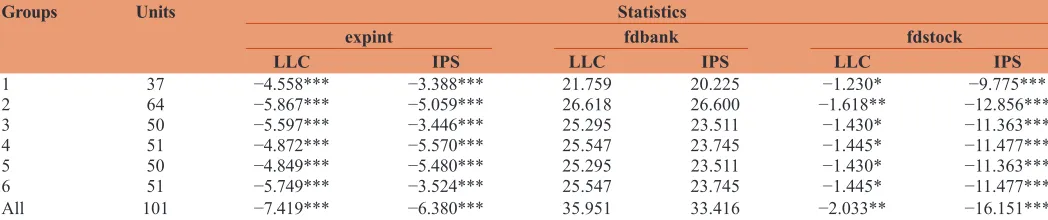
Unit root test results for export performance (expint) and financial development indexes (fdbank and fdstock) are as shown in Table 2.
Test results indicate for the levels of expint and fdstock that the null hypothesis of a unit root is rejected. According to the both test
results fdbank is not stationary in its level and becomes stationary
at the first difference.
Before employing DH panel Granger causality test, cross sectional
dependence between units must also be investigated. Null hypothesis that there is no cross sectional dependence strongly
rejected for all groups and test results clearly indicate the existence
of cross-sectional dependence in the all groups as seen in Table 3.
Due to aggregation of positive and negative correlations Pesaran CD test sometimes does not reject the null hypothesis although
the cross-sectional dependence in the error term. To overcome this
problem, the average absolute correlation values are examined to
be sure whether there is cross sectional dependence (Hoyos and
Sarafidis, 2006). abs values in Table 3 are very high and prove
the existence of cross sectional dependence under the fixed effect specification.
Used to investigate the causal relationship between financial development and export performance of firms DH panel Granger
causality test results are reported in Table 4. This analysis is applied
separately for each group and all of the firms in the sample.
Looking at the whole picture as a bird’s eye view, a strong
performance of firms is appeared in each group. This finding implies that a more efficient stock market may have a positive effect on export performance of firms enhancing their accessing the broader set of potential funding sources. On the other hand, it is generally concluded that an increase in export performance
supports the development of banking sector when the causality
relationship between banking sector development and the export
performance is considered. This supports the demand following hypothesis asserts that developments in the real sector spur the
financial development in banking sector. An increase in the export performance of firms leads to an increase in demand for
intermediary services in the banking sector.
According to the share of foreign ownership the results show that export performance of firms with FDI contribute to the
development of the banking sector, but the development of the
banking sector does not promote the export performance of these firms. This result may imply that if the FDI is export-oriented (Du and Girma, 2008), this may be an alternative financing tool for firms with FDI, and therefore they do not need the services
of the banking sector which generally presents short-term credit
options. On the other hand it is concluded that there is a causality relationship from development of the stock market to export performance. Considering the firms without FDI, the results indicate that export performance support banking sector in the first 2 years, then bidirectional causality between banking sector development and export performance is seen in the 3rd year. For
firms in this group, there is bidirectional causality between export performance and the development of the stock market, except for the first lag. In particular compared with the other group, the
support of development of stock market and lagged support of banking sector is seen more clearly.
When the analysis is repeated for the firms with higher leverage, the findings refer to bidirectional causality between development
of the banking sector and export performance. However, there
is a unidirectional causality from stock market development to
export performance of this group. In addition, the findings can not
present a clear conclusion about the causal relationship between
export performance and the development of the banking sector for firms with lower levarage. For this group, bidirectional causality between export performance and the development of stock market arises. The findings indicate more prominent relationships between firms with high leverage and banking sector development, while firms with lower leverage and stock market development.
In the group of firms with higher liquidity, the results point out a
weak causal relationship between the development of the banking
sector and the export performance. There is a bidirectional
relationship in the 3rd year and the first 2 years supports demand following hypothesis. For this group, bidirectional causality
between export performance and the development of stock market can be seen. The group of firms with lower liquidity bidirectional causality between exports and the development of the banking
sector, but there is no clear conclusion about the causal relationship
between development of stock market and export performance. Firms with higher liquidity are supported by stock market development and firms with lower liquidity are supported by the
development of banking sector.
When the causality relationship is investigated for all firms in the sample, export performance supports the banking sector development in the first 2 years and then this relationship becomes
bidirectional in the 3rd year. On the other hand, there is bidirectional
causality between the development of stock market and export performance of firms in other years except for the 1st year. The
finding about causality relationship between export performance and financial development in banking sector and the evidence obtained by Özün and Çifter (2007) may be consistent. Using a multiscale Granger causality test for Turkish manufacturing sector, they find that growth in the industrial production index has a significant positive impact in the first 24 months on the credit
volume of banking sector and the increase in credit volume has a
positive impact on industrial production index in the subsequent
periods.
6.CONCLUSİON
Export by creating economies of scale and reducing technical inefficiency can be considered as one of the important variables
that lead to increase productivity growth. In terms of Turkish
Table 2: Panel unit root test results
Groups Units Statistics
expint fdbank fdstock
LLC IPS LLC IPS LLC IPS
1 37 −4.558*** −3.388*** 21.759 20.225 −1.230* −9.775***
2 64 −5.867*** −5.059*** 26.618 26.600 −1.618** −12.856***
3 50 −5.597*** −3.446*** 25.295 23.511 −1.430* −11.363***
4 51 −4.872*** −5.570*** 25.547 23.745 −1.445* −11.477***
5 50 −4.849*** −5.480*** 25.295 23.511 −1.430* −11.363***
6 51 −5.749*** −3.524*** 25.547 23.745 −1.445* −11.477***
All 101 −7.419*** −6.380*** 35.951 33.416 −2.033** −16.151***
*,**, *** Significance level of 10%, 5% and 1% respectively.
Table 3: Pesaran’s CD test results
Groups Expint=f (bank) abs expint=f (stock) abs
1 11.578*** 0.403 8.727*** 0.398
2 37.598*** 0.376 23.042*** 0.359
3 17.814*** 0.403 12.180*** 0.382
4 35.165*** 0.370 23.092*** 0.369
5 46.405*** 0.407 30.304*** 0.382
6 22,162*** 0.374 20.081*** 0.378
All 48.546*** 0.382 31.861*** 0.372
*,**, *** Significance level of 10%, 5% and 1% respectively. abs: The average absolute
economy, exports seem to have a critical role in providing
economic growth. Due to facing foreign markets with high
entry barriers, firms need to being supported by external finance substantially. In this point, the development of the financial system will have a supporting role in enhancing the access to external finance for the export activities. Considering this linkage, this paper is to investigate the causal relationship between financial development and export performance. The relationships between development of the banking sector and the export performance, and stock market development and export performance are evaluated separately. Moreover, firms are grouped according to some financial constraints criteria based on the literature such as foreign ownership share, leverage and liquidity ratios and analysis
are repeated for each groups. The contributions of this study to literature are as follows. First, starting with the idea that micro units as a whole have a role to play in macroeconomic developments and at the same time macroeconomic developments also affect
the micro units in an economy, the first time in this study, to my knowledge, a causal relationship is established between the export performance of firms and financial development in two dimensions
as banking sector development and stock market development.
Second, two indexes for both banking sector and stock market are created using several financial development indicators, in this way, sensitivity of causality to selected financial development indicators
reduce and direction of the relationship is investigated according to banking sector and stock market, separately.
Using data for 101 manufacturing firms quoted at BIST over the period 1991-2012, in general, the findings show that development of the stock market plays a supportive role in increasing export performance of firms. For firms without FDI and have a relatively low leverage ratios arises bidirectional causality between export
performance and the development of stock market. Firms with
FDI can meet the financing needs through partners abroad, thus they can remain indifferent to domestic financial development. For
this reason, it can be concluded that there would not be a strong
causal relationship for this group of firms. While banking sector development supports export performans of firms with lower liquidity, stock market development spur export performance of firms with higher liquidity. Finally, when all of the firms
are analyzed, the results show bidirectional causality between
development of stock market and export performance, while the development of banking sector starts to support export performance in later time periods. When export performance of firms’ increases,
demand for banking transactions increases and this process
provides development of the banking sector. Gradually, a mutual
interaction between the development of banking sector and the
export performance is concerned. The obtained findings suggust that financial development, especially stock market development, in a country spur the export performance of firms. Therefore, policymakers should recognize that development of the financial
markets is one of the main supporters of economic growth and need to take necessary precautions to increase incentives.
Although the firm-level data contains more information than
macro-level data, there are a few points to keep in mind in interpreting
obtained results. First, considering only manufacturing firms this
paper can not reach a conclusion in terms of non- manufacturing
Table
4: Panel causality r
esults Di rec tion of causality 1.W ith FDI 2.W ithout FDI 3.Higher leverage 4. Lower leverage 5. Higher liquidity 6. Lower liquidity All firms Lag 1 Lag 2 Lag 3 Lag 1 Lag 2 Lag 3 Lag 1 Lag 2 Lag 3 Lag 1 Lag 2 Lag 3 Lag 1 Lag 2 Lag 3 Lag 1 Lag 2 Lag 3 Lag 1 Lag 2 Lag 3
expint ► fdbank
1.807** 5.120*** 6.681*** 1.790*** 4.239*** 7.535*** 2.066*** 5.092*** 7.409*** 1.484 4.026*** 7.064*** 1.821*** 4.986*** 7.277*** 1.724** 4.131*** 7.193*** 1.772*** 4.554*** 7.235***
fdbank ► expint
0.906 1.726 4.527 1.461 2.769 5.991*** 0.803 1.703* 5.359** 1.577* 2.989 5.443** 1.485 3.038 5.507*** 0.909 1.680* 5.298** 1.194 2.352 5.402***
expint ► fdstock
1.191 3.309** 4.465 1.636** 3.531*** 5.906*** 1.298 3.155** 4.053 1.573* 3.716*** 6.21 1*** 1.455 4.494*** 6.225*** 1.418 2.403 4.081 1.436 3.438*** 5.143***
fdstock ► expint
firms. Second, the results do not represent the entire economy because of firms under consideration only traded in the BIST. For further studies, different indicators related to export performance and financial
constraints can be used. Firms may be subject to different groupings.
Also, analyses can be replicated with different causality tests.
REFERENCES
Alvarez, R., López, R.A. (2005), Exporting and performance: evidence from chilean plants. Canadian Journal of Economics, 38, 1384-1400. Amiti, M., Weinstein, D.E. (2011), Exports and financial shocks. The
Quarterly Journal of Economics, 126(4), 1841-1877.
Bai, J., Kao, C. (2006), On the estimation and inference of a panel cointegration model with cross-sectional dependence. In: Baltagi, B., editor. Contributions to Economic Analysis. Amsterdam: Elsevier. p3-30.
Beck, T. (2003), Financial dependence and ınternational trade. Review of International Economics, 11, 296-316.
Beck, T., Levine, R., Loayza, N. (2000), Finance and the sources of growth. Journal of Financial Economics, 58, 261-300.
Becker, B., Greenberg, D. (2005), Financial Development and International Trade. Chicago: University of Illinois at Urbana-Champaign Mimeo.
Berman, N., Hericourt, J. (2010), Financial factors and the margins of trade: evidence from cross-country firm-level data. Journal of Development Economics, 93, 206-217.
Bernard, A.B., Jensen, B.J. (1999), Exceptional exporter performance: cause, effect or both?. Journal of International Economics, 47(1), 1-25. Bernard, A.B., Jensen, J.B. (2004), Why some firms export. The Review
of Economics and Statistics, 86(2), 561-569.
Bernard, A.B., Wagner, J. (2001), Export entry and exit by German firms. Weltwirtschafliches Archiv, 137(1), 105-123.
Breitung, J. (2000), The local power of some unit root tests for panel data. Advances in Econometrics, 15: nonstationary Panels, Panel Cointegration, and Dynamic Panels. Amsterdam: JAI Press. p161- 178. Breusch, T., Pagan, A. (1980), The lagrange multiplier test and its
applications to model spesification in econometrics. Review of Economic Studies, 47(1), 239-253.
Demirgüç-Kunt, A., Maksimovic, V. (1998), Law, finance and firm growth. The Journal of Finance, 53(6), 2107-2137.
Du, J., Girma, S. (2008), Multinationals, access to finance and the exports of private firms in China. Discussion Papers 08/03. University of Nottingham, GEP.
Dumitrescu, E.I., Hurlin, C. (2012), Testing for Granger noncausality in heterogeneous panels. Economic Modelling, 29(4), 1450-1460. Fauceglia, D. (2014), Credit constraints, firm exports and financial
development: evidence from developing countries. The Quarterly Review of Economics and Finance, Available from: http:// www. dx. doi.org/10.1016/j.qref.2014.08.003.
Forlani, E. (2010), Liquidity constraints and firm’s export activity. Mimeo, CORE Louvain.
Granger, C. (1969), Investigating causal relations by econometric models and cross spectral methods. Econometrica,37(3), 424-438. Greenaway, D., Guariglia, A., Kneller, R. (2007), Financial factors and
exporting decisions. Journal of International Economics, 73, 377- 395. Guiso, L., Sapienza, P., Zingales, L. (2004), Does local financial development
matter?. Quarterly Journal of Economics, 119(3), 929-969.
Hadri, K. (2000), Testing for stationarity in heterogeneous panel data. Econometric Journal, 3, 148-161.
Héricourt, J., Poncet, S. (2009), FDI and credit constraints: firm level evidence in China. Economic Systems, 33(1), 1-21.
Hoyos, R.E., Sarafidis, V. (2006), Testing for cross-sectional dependence
in panel data models. Stata Journal, 6(4), 482-496.
Huang, Y. (2010), Determinants of Financial Development. USA: Palgrave Macmillan.
Huang, Y., Ma, Y., Yang, Z., Zhang, Y. (2008), A fire sale without fire: an explanation of labor intensive FDI in China. MIT Sloan Research Paper 4713-08.
Im, K.S., Pesaran, M.H., Shin, Y. (2003), Testing for unit roots in heterogeneous panels. Journal of Econometrics, 115(1), 53-74. Kasahara, H., Rodrigue, J. (2008), Does the use of imported intermediates
increase productivity?. Journal of Development Economics, 87(1), 106-118.
Katsikeas, C.S., Leonidou, L.C., Morgan, N.A. (2000), Firm-level export performance assessment: review, evaluation, and development. Academy of Marketing Science, 28(4), 493-511.
Kletzer, K., Bardhan, P. (1987), Credit markets and patterns of international trade. Journal of Development Economics, 27, 57-70. Levin, A., Lin, C.F., Chu, J. (2002), Unit root tests in panel data:
asymptotic and finite sample properties. Journal of Econometrics, 108(1), 1-24.
Levine, R. (2005), Finance and growth: theory and evidence. In: Aghion, P., Durlauf, S., editors. Handbook of Economic Growth.
1st ed., Vol. 1. Chapter 12. Amsterdam: Elsevier. p865-934.
Lopez, R., Yadav, N. (2010), Imports of intermediate inputs and spillover effects: evidence from chilean plants. Journal of Development Studies, 46, 1385-1403.
Love, I. (2003), Financial development and financing constraints: international evidence from the structural investment model. The Review of Financial Studies, 16(3), 765-791.
Maddala, G.S., Wu, S. (1999), A comparative study of unit root tests with panel data and a new simple test. Oxford Bulletin of Economics and Statistics, 61, 631-652.
Minetti, R., Zhu, S. (2011), Credit constraints and firm export: microeconomic evidence from Italy. Journal of International Economics, 83, 109-125.
Muûls, M., (2008), Exporters and credit constraints. A firm-level approach. Research Series 200809-22, National Bank of Belgium. Ng, S. (2006), Testing cross-section correlation in panel data using
spacings. Journal of Business and Economic Statistics, 24, 12-23. Özün, A., Çifter, A. (2007), Industrial production as a credit driver in
banking sector: an empirical study with wavelets. Banks and Bank Systems, 2(2), 69-80.
Pesaran, M.H. (2004), General diagnostic tests for cross section dependence in panels. Unpublished manuscript, Faculty of Economics and Politics, University of Cambridge.
Pesaran, M.H. (2006), Estimation and inference in large heterogeneous panels with a multifactor error structure. Econometrica, 74, 967- 1012.
Rajan, R.G., Zingales, L. (1998), Financial dependence and growth. American Economic Review, 88(3), 559-586.
Roberts, M.J., Tybout, J.R. (1997), The decision to export in colombia: an empirical model of entry with sunk costs. American Economic Review, 87(4), 545-564.
Saci, K., Holden, K. (2008), Evidence on growth and financial development using principal components. Applied Financial Economics, 18(19), 1549-1560.
Sarafidis, V., Wansbeek, T. (2012), Cross-sectional dependence in panel data analysis. Econometric Reviews, 31, 483-531.
The World Economic Forum. (2011), The Financial Development Report 2011. New York, USA: World Economic Forum USA Inc.
Wagner, J. (2014), Credit constraints and exports: evidence for German manufacturing enterprises Applied Economics, 46(3), 294-302. Wang, J., Wang, X. (2014), Benefits of foreign ownership: evidence from