R E V I E W
Open Access
Anaphylaxis
Harold Kim
1,2*, David Fischer
3Abstract
Anaphylaxis is an acute, potentially fatal systemic reaction with varied mechanisms and clinical presentations. Although prompt recognition and treatment of anaphylaxis are imperative, both patients and healthcare professionals often fail to recognize and diagnose early signs and symptoms of the condition. Clinical
manifestations vary widely, however, the most common signs are cutaneous symptoms, including angioedema, urticaria, erythema and pruritus. Immediate intramuscular administration of epinephrine into the lateral thigh is first-line therapy, even if the diagnosis is uncertain. The mainstays of long-term management include specialist assessment, avoidance measures, and the provision of an epinephrine auto-injector and an individualized anaphylaxis action plan. This article provides an overview of the causes, clinical features, diagnosis and acute and long-term management of this serious allergic reaction.
Introduction
Anaphylaxis is defined as a serious allergic reaction that is rapid in onset and may cause death [1,2]. The preva-lence of anaphylaxis is estimated to be as high as 2%, and appears to be rising, particularly in the younger age group [3-5].
The more rapidly anaphylaxis develops, the more likely the reaction is to be severe and life-threatening [4]. Therefore, prompt recognition and management of the condition are imperative. However, anaphylaxis is often under-recognized and treated inadequately. Diag-nosis and management are challenging since reactions are often immediate and unexpected. Furthermore, there is no single test to diagnose anaphylaxis in routine clinical practice [3,6]. This article will provide an over-view of the causes and clinical features of anaphylaxis as well as strategies for the accurate diagnosis and manage-ment of the condition.
Causes
Most episodes of anaphylaxis are triggered through an immunologic mechanism involving immunoglobulin E (IgE) which leads to mast cell and basophil activation and the subsequent release of inflammatory mediators such as histamine, leukotrienes, tryptase and prostaglan-dins. Although any substance has the potential to cause anaphylaxis, the most common causes of IgE-mediated
anaphylaxis are: foods, particularly, peanuts, tree nuts, shellfish and fish, cow’s milk, eggs and wheat; medica-tions (most commonly penicillin), and natural rubber latex. Exercise, aspirin, non-steroidal anti-inflammatory drugs (NSAIDs), opiates, and radiocontrast agents can also cause anaphylaxis, but anaphylactic reactions to these agents often result from non-IgE-mediated mechanisms. In other cases, the cause of anaphylactic reactions is unknown (idiopathic anaphylaxis). In chil-dren, anaphylaxis is most often caused by foods, while venom- and drug-induced anaphylaxis is more common in adults [4,7-9]. Table 1 provides a more comprehen-sive list of the potential causes of anaphylaxis.
Co-morbidities and concurrent medications may also affect the severity of anaphylactic reactions and patient response to treatment. For example, patients with asthma and cardiovascular disease are more likely to experience a poor outcome from anaphylaxis. Concur-rent administration of beta-blockers can interfere with the patient’s ability to respond to epinephrine, the first-line of treatment for anaphylaxis (discussed later). Furthermore, the use of angiotensin-converting enzyme (ACE) inhibitors and angiotensin receptor blockers (ARBs) can impact a patient’s compensatory physiologic response to anaphylaxis, leading to more severe reac-tions [10].
Signs and symptoms
Since anaphylaxis is a generalized reaction, a wide vari-ety of clinical signs and symptoms involving the skin, * Correspondence: [email protected]
1University of Western Ontario, London, Ontario, Canada
Full list of author information is available at the end of the article
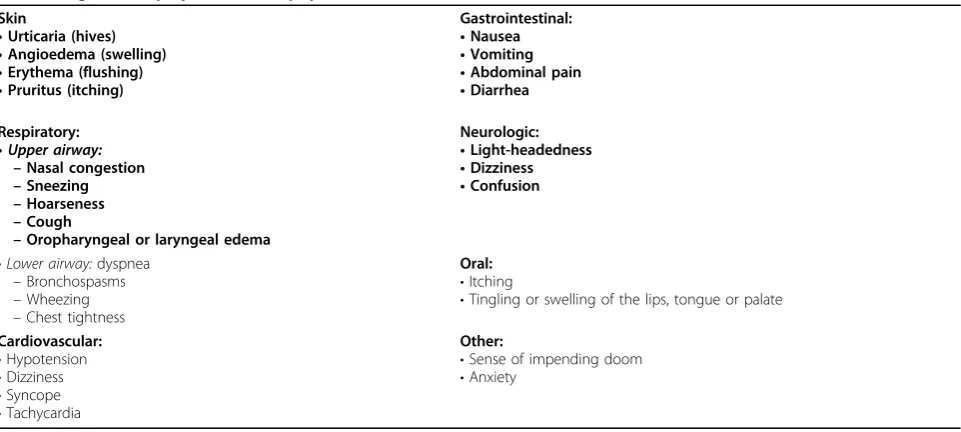
gastrointestinal and respiratory tracts, and cardiovascular system can be observed (see Table 2). The most common clinical manifestations are cutaneous symptoms, including urticaria and angioedema, erythema (flushing), and pruri-tus (itching) [11]. Patients also often describe an
impend-ing sense of death (angor animi). Death due to
anaphylaxis usually occurs as a result of respiratory obstruction or cardiovascular collapse, or both. Evidence suggests that there is a direct correlation between the immediacy of symptom onset and the severity of the epi-sode, with the more rapid the onset, the more severe the event [12]. It is important to note that the signs and symp-toms of anaphylaxis are unpredictable and may vary from patient to patient and from one reaction to another. Therefore, the absence of one or more of the common symptoms listed in Table 2 does not rule out anaphylaxis, and should not delay immediate treatment.
The signs and symptoms of anaphylaxis typically develop within minutes after exposure to the offending
antigen, but may occasionally occur as late as 1 hour post exposure. Symptoms usually follow a uniphasic course, with resolution of symptoms within hours of treatment. However, up to 20% of reactions follow a biphasic course characterized by an asymptomatic per-iod of 1-8 hours followed by recurrent symptoms [13].
Diagnosis
The diagnosis of anaphylaxis is based primarily on clinical signs and symptoms, as well as a detailed description of the acute episode, including antecedent activities and events. Diagnostic criteria for anaphylaxis were published by a multidisciplinary group of experts in 2005 and 2006, and are shown in Table 3[1,2]. A diagnosis of anaphylaxis is highly likely when any one of the criteria listed in Table 3 is fulfilled. Since the evaluation and diagnosis of anaphylaxis is often com-plex, referral to an allergist with training and expertise in the identification and management of anaphylaxis should be considered.
History
The history is the most important tool to establish the cause of anaphylaxis and should take precedence over diagnostic tests. It should elicit information about clini-cal manifestations (e.g., urticaria, angioedema, flushing, pruritus, airway obstruction, gastrointestinal symptoms, syncope, and hypotension); agents encountered before the reaction, such as foods, medications or insect bites/ stings, as well as the patient’s activities preceding the event (e.g., exercise, sexual activity). The absence of cutaneous symptoms puts the diagnosis in question since the majority of anaphylactic episodes include
Table 1 Causes of anaphylaxis Common:
•Foods: most commonly peanuts, tree nuts, egg, seafood and fish, cow’s milk, wheat
•Medications: most commonly antibiotics
•Insect stings (bees and wasps)
•Natural rubber latex
•Unidentified (no cause found; idiopathic anaphylaxis) Less common:
•Exercise
•Semen
•Food additives: monosodium glutamate, metabisulfite
•Hormonal changes: menstrual factors
•Topical medications
•Transfusions
Table 2 Signs and symptoms of anaphylaxis [6,11] Skin
•Urticaria (hives)
•Angioedema (swelling)
•Erythema (flushing)
•Pruritus (itching)
Gastrointestinal:
•Nausea
•Vomiting
•Abdominal pain
•Diarrhea
Respiratory:
•Upper airway: –Nasal congestion
–Sneezing
–Hoarseness
–Cough
–Oropharyngeal or laryngeal edema
Neurologic:
•Light-headedness
•Dizziness
•Confusion
•Lower airway:dyspnea
–Bronchospasms
–Wheezing
–Chest tightness
Oral:
•Itching
•Tingling or swelling of the lips, tongue or palate
Cardiovascular:
•Hypotension
•Dizziness
•Syncope
•Tachycardia
Other:
•Sense of impending doom
cutaneous symptoms; however, their absence does not rule out anaphylaxis [4].
Additional diagnostic tests
The diagnosis of a specific cause of anaphylaxis may be supported by the results of skin tests and/or in vitro IgE tests [4]. These tests can determine the presence of specific IgE antibodies to foods, medications (e.g., penicillin), and stinging insects. However, for the majority of medications, standardized skin tests and/or
in vitro tests are not available. In general, skin testing is more sensitive than in vitro testing and is the diag-nostic procedure of choice for the evaluation of most IgE-mediated causes of anaphylaxis (if available for the relevant trigger or allergen). If skin testing is per-formed, it should be done under the supervision of a physician who is experienced in the procedure in a set-ting with appropriate rescue equipment and medica-tion available [4].
The clinical diagnosis of anaphylaxis can sometimes be supported by the documentation of elevated concen-trations of mast cell and basophil mediators such as plasma histamine or serum or plasma total tryptase. However, it is critical to obtain blood samples for these measurements as soon as possible after the onset of symptoms since elevations are transient.
Differential diagnosis
Other diagnoses that might present with signs and/or symptoms characteristic of anaphylaxis should be excluded. The most common conditions that mimic anaphylaxis include: vasodepressor (vasovagal/neurocar-diogenic) reactions (which are characterized by hypoten-sion, pallor, bradycardia, weakness, nausea and vomiting); acute respiratory decompensation from severe asthma attacks, foreign body aspiration and pulmonary embolism; vocal cord dysfunction; acute anxiety (e.g., panic attack or hyperventilation syndrome); myocardial
dysfunction, acute poisoning; hypoglycemia; and seizure disorders [4,14].
Treatment Acute management
The acute treatment of anaphylaxis begins with rapid assessment of the airway, breathing and circulation. Epi-nephrine is the drug of choice for anaphylaxis and should be given immediately to any patient with a sus-pected anaphylactic episode. Treatment should be pro-vided even if the diagnosis is uncertain since there here are no contraindications to the use of epinephrine [6].
The recommended dosing of epinephrine for the acute treatment of anaphylaxis is 0.01 mg/kg up to a maxi-mum of 0.5 mg administered intramuscularly every 5– 20 min as necessary [6]. Intramuscular administration into the lateral thigh is recommended as it allows for more rapid absorption and higher plasma epinephrine levels compared to subcutaneous administration [10]. Glucagon should also be considered in patients using beta-blockers.
All patients receiving emergency epinephrine must be transported to hospital immediately (ideally by ambu-lance) for evaluation and observation. Patients should also be placed in a recumbent (supine) position with the lower extremities elevated, unless this is precluded by shortness of breath or vomiting [6,15,16].
As mentioned earlier, patients with asthma, particu-larly those with poorly controlled asthma, are at increased risk of a fatal reaction. In these patients, ana-phylaxis may be mistaken for an asthma exacerbation and inappropriately treated solely with asthma inhalers. Therefore, if there are ongoing asthma symptoms in an individual with known anaphylaxis, epinephrine should be given [6].
Oxygen therapy should also be considered in any patient with symptoms of anaphylaxis, particularly for those with prolonged reactions. Intravenous fluids
Table 3 Clinical criteria for diagnosing anaphylaxis [1,2]
Anaphylaxis is highly likely when any 1 of the following 3 criteria is fulfilled following exposure to an allergen:
1 Acute onset of an illness (minutes to several hours) with involvement of the skin, mucosal tissue, or both (e.g., generalized hives, pruritus or flushing, swollen lips-tongue-uvula) and at least 1 of the following:
a. Respiratory compromise (e.g. dyspnea, wheeze, bronchospasm, stridor, reduced PEF, hypoxemia)
b. Reduced BP or associated symptoms of end-organ dysfunction (e.g. hypotonia [collapse], syncope, incontinence) 2 2 or more of the following that occur rapidly after exposure to alikelyallergen for that patient (minutes to several hours):
a. Involvement of the skin-mucosal tissue (e.g., generalized hives, itch-flush, swollen lips-tongue-uvula) b. Respiratory compromise (e.g., dyspnea, wheeze, bronchospasm, stridor, reduced PEF, hypoxemia) c. Reduced BP or associated symptoms (e.g., hypotonia [collapse], syncope, incontinence)
d. Persistent GI symptoms (e.g., painful abdominal cramps, vomiting)
3 Reduced BP after exposure to aknownallergen for that patient (minutes to several hours): a. Infants and children: low systolic BP (age specific) or > 30% decrease in systolic BP*
b. Adults: systolic BP < 90 mmHg or > 30% decrease from that person’s baseline
PEF = Peak expiratory flow; BP: blood pressure; GI: gastrointestinal
(crystalloid solutions or colloid volume expanders) should also be provided since massive fluid shifts can occur rapidly in anaphylaxis due to increased vascular permeability. Volume replacement is particularly impor-tant for patients whose hypotension persists despite epi-nephrine injections. Supportive therapy such as inhaled beta2-agonists (for patients experiencing bronchospasm)
and antihistamines (for control of cutaneous symptoms) can also be helpful, but should never replace epinephr-ine as first-lepinephr-ine therapy. Vasopressors, such as dopa-mine, can also be considered if epinephrine injections and volume expansion with intravenous fluids fail to alleviate hypotension. Glucocorticosteroids have a slow onset of action and, therefore, these agents have not been shown to be effective for the acute treatment of anaphylaxis. Theoretically, however, they may prevent biphasic or protracted reactions and, hence, are often given on an empirical basis. To date, there is no conclu-sive evidence that the administration of glucocorticos-teroids prevents a biphasic response [4].
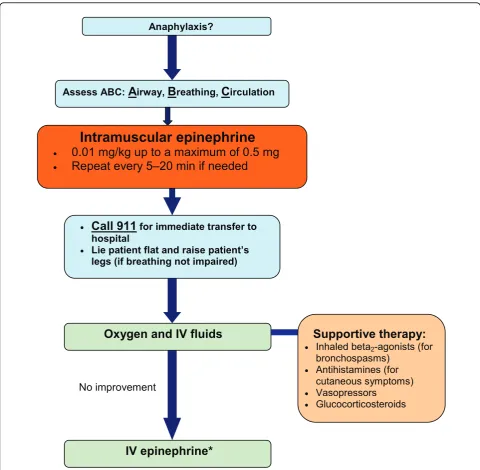
If intramuscular epinephrine and intravenous fluids fail to improve anaphylactic symptoms, intravenous infusions of epinephrine may be required; however, these infusions should be given by a physician who is trained and experienced in its use and has the capacity for continuous blood pressure and cardiac monitoring. Figure 1 provides a simplified algorithm for the acute management of anaphylaxis.
Following acute treatment, patients should be observed for a period of time due to the risk of a bipha-sic response or possible recurrence of the reaction as epinephrine wears off. The observation period should be individualized based on the severity of the initial reac-tion and access to care. Experts have recommended observing patients for 4 to 6 hours following an anaphy-lactic reaction, with prolonged observation times for patients with severe or refractory symptoms [6].
Long-term management
The mainstays of long-term management for patients who have experienced an anaphylactic episode include: specialist assessment, a prescription for an epinephrine auto-injector, patient and caregiver education on avoid-ance measures, and the provision of an individualized anaphylaxis action plan.
Specialist assessment
After acute anaphylaxis, patients should be assessed for their future risk of anaphylaxis, ideally by an allergist. These specialists are experienced in identifying and con-firming the cause of anaphylaxis, educating patients on appropriate avoidance strategies, drafting an anaphylaxis action plan, and advising whether immunotherapy is appropriate [4,6].
Prescription for an epinephrine auto-injector
A prescription for an epinephrine auto-injector should be provided to all patients who have experienced
ana-phylaxis previously, including those who have had any
rapid-onset systemic allergic reaction (gastrointestinal, respiratory, cardiac); diffuse hives to any food or insect stings; or anyrapid-onset (i.e., minutes to hours) reac-tion of any severity to the highest risk foods such as peanut, tree nuts, fish, and shellfish [6].
There are currently two epinephrine auto-injectors
available in North America: EpiPen® and Twinject®.
Both products come in two dosages (0.15 mg and 0.30 mg), which are prescribed according to weight. The 0.30 mg dosage should be used for those weighing 30 kg or more, and the 0.15 mg dosage for children
weighing between 15–30 kg. Certain sources
recom-mend switching to the 0.30 mg dose at 25 kg rather than 30 kg [16]. These devices should be stored prop-erly (avoiding temperature extremes) and replaced before the expiration date. More information on these auto-injectors is available at http://www.epipen.ca and http://www.twinject.ca.
Upon prescription of an epinephrine auto-injector, healthcare providers must instruct the patient on how and when to use the device. Instructions on proper use should be reviewed verbally and accompanied by a DVD and/or written material, and should be reinforced annually.
Education on avoidance measures
Patients with anaphylaxis to medications should be informed about all cross-reacting medications that should be avoided. Should there be a future essential indication for use of the medication causing anaphy-lactic reactions, it may be helpful to educate patients about possible management options, such as medica-tion pretreatment and use of low osmolarity agents in patients with a history of reactions to radiographic contrast media, or induction of drug tolerance proce-dures (also known as drug desensitization) [4].
Induction of drug tolerance procedures temporarily
modify a patient’s immunologic or non-immunologic
response to a drug through the administration of incremental doses of the drug. However, drug toler-ance is usually maintained only as long as the drug is administered; therefore, the procedure needs to be repeated in the future if the patient requires the drug again after finishing a prior therapeutic course (for more information, see article on Drug Allergy in this supplement).
No improvement
Assess ABC:
A
irway,B
reathing,C
irculationx
Call 911
for immediate transfer to hospitalx Lie patient flat and raise patient’s
legs (if breathing not impaired) Anaphylaxis?
Oxygen and IV fluids
Supportive therapy:
x Inhaled beta2-agonists (for
bronchospasms) x Antihistamines (for
cutaneous symptoms) x Vasopressors
x Glucocorticosteroids
IV epinephrine*
Intramuscular epinephrine
x
0.01 mg/kg up to a maximum of 0.5 mg
xRepeat every 5–20 min if needed
Patients who have had an anaphylactic reaction to an insect sting should be advised about avoidance measures to reduce the risk of future stings. Such measures include: being alert when eating outdoors (as wasps are attracted to food), wearing shoes and long pants when in fields, and having nests or hives near the patient’s home removed [14]. Patients who have previously experienced venom-induced anaphylaxis are often candi-dates for venom immunotherapy, which is successful in preventing anaphylaxis in up to 98% of patients (see article on Allergen Immunotherapy in this supplement).
Subjects at high risk of a reaction to latex include: healthcare workers, children with spina bifida and geni-tourinary abnormalities; and workers with occupational exposure to latex. Patients with spina bifida (regardless of a history of latex allergy) and patients with a positive history of latex allergy should have all medical-surgical-dental procedures performed in a latex-safe environ-ment. This is an environment in which no natural rub-ber latex gloves are used in the room or surgical suite and in which there are limited latex-based accessories (catheters, adhesives, tourniquets, anesthesia equipment or devices) which come in contact with the patient [4].
Patients should also obtain and wear medical identifica-tion (such as a MedicAlert bracelet/necklace) that indi-cates that they have experienced anaphylaxis as well as the responsible agent. Patients should also be instructed to avoid drugs that might increase their susceptibility and/or complicate the management of an anaphylactic event, such as beta-blockers, ACE inhibitors, or ARBs [4].
Anaphylaxis action plan
A comprehensive, individualized anaphylaxis action plan should be prepared which defines roles and responsibilities
and emergency protocols [6]. Important information that should be included in this plan is shown in Table 4[6,18]. Examples of such a plan, along with other relevant infor-mation and materials, can be downloaded at Anaphylaxis Canada (http://www.anaphylaxis.ca) or the Food Allergy and Anaphylaxis Network (http://www.foodallergy.org; a US-based association). Action plans should be reviewed annually and updated if necessary. A copy of the plan should be made available to all relevant persons, such as day-care providers, teachers, and employers. Recommen-dations for the management of anaphylaxis in schools and other community settings [15] are available through the Allergy Safe Communities website at http://www.allergysa-fecommunities.ca.
Conclusions
Anaphylaxis is an acute, potentially fatal systemic reac-tion with varied mechanisms and clinical presentareac-tions. Prompt recognition and treatment of anaphylaxis are imperative; however, both patients and healthcare pro-fessionals often fail to recognize and diagnose anaphy-laxis in its early stages. Diagnostic criteria which take into account the variable clinical manifestations of ana-phylaxis are now available and can assist healthcare pro-viders in the early recognition of the condition. Immediate intramuscular administration of epinephrine into the lateral thigh is first-line therapy for anaphylaxis. Acute management may also involve oxygen therapy, intravenous fluids, and adjunctive therapies such as anti-histamines or inhaled beta2-agonists. The mainstays of
long-term management include specialist assessment, a prescription for an epinephrine auto-injector, patient and caregiver education on avoidance measures, and the provision of an individualized anaphylaxis action plan.
Table 4 Components of an anaphylaxis action plan [6,18] Contact details
•Names and contact details for emergencies, including family members, allergist/immunologist and family doctor
•Contact details for local emergency or ambulance services Allergens/Triggers
•Clear identification of allergens/triggers to be avoided
–Include generic and proprietary names of drugs and possible cross-sensitivities, if relevant How to recognize the signs and symptoms of anaphylaxis
•Mouth:itching, swelling of lips/tongue
•Throat:itching, tightness, closure, hoarseness
•Skin:itching, hives, eczema, swelling, flushing
•Gut:vomiting, diarrhea, abdominal pain
•Lung:shortness of breath, cough, wheeze
•Heart:hypotension, dizziness, syncope, tachycardia
•Neuro(or head):light-headedness
•Other:feeling of impending doom, anxiety
Medications prescribed and when they should be used
•Epinephrine auto-injectors (first-line); should include detailed instructions (with photographs, if possible) on how to correctly administer the auto-injector device (for daycare, school and/or office staff)
•Antihistamines (for cutaneous symptoms)
•Inhaled beta2-agonists (for bronchospasm)
Key take-home messages
• Anaphylaxis is defined as a serious allergic reaction that is rapid in onset and may cause death.
• Prompt recognition and treatment are critical in
anaphylaxis.
• The diagnosis is based primarily on clinical signs and symptoms.
•The most common clinical manifestations are
cuta-neous symptoms, including urticaria and angioedema, erythema, and pruritus.
•Referral to an allergist or immunologist should be considered for all persons who have experienced a pre-vious anaphylactic episode.
• Epinephrine is the drug of choice for anaphylaxis
and should be given immediately, even if the diagnosis is uncertain; intramuscular administration into the lat-eral thigh is recommended.
• There are no contraindications to the use of
epinephrine.
•The mainstays of long-term treatment include: spe-cialist assessment, avoidance measures, and the
provi-sion of an epinephrine auto-injector and an
individualized anaphylaxis action plan.
Acknowledgements
This article has been published as part ofAllergy, Asthma & Clinical ImmunologyVolume 7 Supplement 1, 2011: Practical guide for allergy and immunology in Canada. The full contents of the supplement are available online at http://www.aacijournal.com/supplements/7/S1
Author details
1University of Western Ontario, London, Ontario, Canada.2McMaster
University, Hamilton, Ontario, Canada.3University of Western Ontario, London, Ontario, Canada.
Competing interests
Dr. Harold Kim is the past president of the Canadian Network for Respiratory Care and co-chief editor ofAllergy,Asthma &Clinical Immunology. He has received consulting fees and honoraria for continuing education from AstraZeneca, GlaxoSmithKline, Graceway Pharmaceuticals, King Pharma, Merck Frosst, Novartis, and Nycomed.
Dr. David Fischer is a member of the Board of Directors of the Canadian Society of Allergy & Clinical Immunology. He has received consulting fees and honoraria for continuing education from AstraZeneca, GlaxoSmithKline, Graceway Pharmaceuticals, King Pharma, Merck Frosst, Novartis, Paladin Labs and Nycomed.
Published: 10 November 2011
References
1. Sampson HA, Munoz-Furlong A, Bock SA, Schmitt C, Bass R, Chowdhury BA, Decker WW, Furlong TJ, Galli SJ, Golden DB, Gruchalla RS, Harlor AD Jr, Hepner DL, Howarth M, Kaplan AP, Levy JH, Lewis LM, Lieberman PL, Metcalfe DD, Murphy R, Pollart SM, Pumphrey RS, Rosenwasser LJ, Simons FE, Wood JP, Camargo CA Jr:Symposium on the definition and management of anaphylaxis: summary report.J Allergy Clin Immunol 2005,115:584-91.
2. Sampson HA, Munoz-Furlong A, Campbell RL, Adkinson NF Jr, Bock SA, Branum A, Brown SG, Camargo CA Jr, Cydulka R, Galli SJ, Gidudu J, Gruchalla RS, Harlor AD Jr, Hepner DL, Lewis LM, Lieberman PL, Metcalfe DD, O’Connor R, Muraro A, Rudman A, Schmitt C, Scherrer D, Simons FE, Thomas S, Wood JP, Decker WW:Second symposium on the
definition and management of anaphylaxis: summary report–Second National Institute of Allergy and Infectious Disease/Food Allergy and Anaphylaxis Network symposium.J Allergy Clin Immunol2006,117:391-7. 3. Lieberman PL, Camargo CA, Bohlke K, Jick H, Miller RL, Sheikh A, Simons FE:
Epidemiology of anaphylaxis: findings of the ACAAI Epidemiology of Anaphylaxis Working Group.Ann Allergy Asthma Immunol2006, 97:596-602.
4. Lieberman P, Nicklas RA, Oppenheimer J, Kemp SF, Lang DM, Bernstein DI, Bernstein JA, Burks AW, Feldweg AM, Fink JN, Greenberger PA, Golden DB, James JM, Kemp SF, Ledford DK, Lieberman P, Sheffer AL, Bernstein DI, Blessing-Moore J, Cox L, Khan DA, Lang D, Nicklas RA, Oppenheimer J, Portnoy JM, Randolph C, Schuller DE, Spector SL, Tilles S, Wallace D:The diagnosis and management of anaphylaxis practice parameter: 2010 update.J Allergy Clin Immunol2010,126:477-80.
5. Shen Y, Li L, Grant J, Zhao Z, Zhang X, Zhou L, Fowler D:Anaphylactic deaths in Maryland (US) and Shanghai: a review of forensic autopsy cases from 2004 to 2006.Forensic Sci Int2009,186:1-5.
6. Waserman S, Chad Z, Francoeur MJ, Small P, Stark D, Vander Leek TK, Kaplan A, Kastner M:Management of anaphylaxis in primary care: Canadian expert consensus recommendations.Allergy2010,65:1082-92. 7. Braganza SC, Acworth JP, McKinnon DR, Peake JE, Brown AF:Paediatric
emergency department anaphylaxis: different patterns from adults.Arch Dis Child2006,91:159-63.
8. Brown SGA:Clinical features and severity grading of anaphylaxis.J Allergy Clin Immunol2004,114:371-76.
9. Brown AF, McKinnon D, Chu K:Emergency department anaphylaxis: a review of 142 patients in a single year.J Allergy Clin Immunol2001, 108:861-66.
10. Simon FE:Anaphylaxis, killer allergy: long-term management in the community.J Allergy Clin Immunol2006,117:367-77.
11. Webb LM, Lieberman P:Anaphylaxis: a review of 601 cases.Ann Allergy Asthma Immunol2006,97:39-43.
12. Terr AI:Anaphylaxis.Clin Rev Allergy1985,3:3-23.
13. Stark BJ, Sullivan TJ:Biphasic and protracted anaphylaxis.J Allergy Clin Immunol1986,78:76-83.
14. Ellis AK, Day JH:Diagnosis and management of anaphylaxis.CMAJ2003, 169:307-11.
15. Canadian Society of Allergy and Clinical Immunology:Anaphylaxis in schools & other settings.CSACI;, 2 2009.
16. Sicherer SH, Simons FE, Section on Allergy and Immunology American Academy of Pediatrics:Self-injectable epinephrine for first-aid management of anaphylaxis.Pediatrics2007,119:638-46. 17. Burks A:Peanut allergy.Lancet2008,371:1538-46.
18. Muraro A, Roberts G, Clark A, Eigenmann PA, Halken S, Lack G, Moneret-Vautrin A, Niggemann B, Rancé F, EAACI Task Force on Anaphylaxis in Children:The management of anaphylaxis in childhood: position paper of the European academy of allergology and clinical immunology.Allergy 2007,62:857-71.
doi:10.1186/1710-1492-7-S1-S6
Cite this article as:Kim and Fischer:Anaphylaxis.Allergy, Asthma & Clinical Immunology20117(Suppl 1):S6.
Submit your next manuscript to BioMed Central and take full advantage of:
• Convenient online submission
• Thorough peer review
• No space constraints or color figure charges
• Immediate publication on acceptance
• Inclusion in PubMed, CAS, Scopus and Google Scholar
• Research which is freely available for redistribution