ISSN 2324-805X E-ISSN 2324-8068 Published by Redfame Publishing URL: http://jets.redfame.com
The Evaluation of Teacher Training Programs in the United States of
America in Terms of Student-Centered Practices Used in Class
Ayşe Elitok Kesici1
, Barış Çavuş2 1
School of Education, Aydın Adnan Menderes University, Aydın, Turkey 2School of Foreign Languages, Aydın Adnan Menderes University, Turkey
Correspondence: Ayşe Elitok Kesici, School of Education, Aydın Adnan Menderes University, Aydın, Turkey.
Received: August 1, 2019 Accepted: August 14, 2019 Online Published: August 19, 2019
doi:10.11114/jets.v7i10.4462 URL: https://doi.org/10.11114/jets.v7i10.4462
Abstract
The purpose of this research was to evaluate the teacher training programs in the United States of America in terms of student-centered practices used in class. Learning and teaching processes were evaluated based on classroom observations (the methods, techniques, materials and student-centered practices used in class). Qualitative research method was used in the research. The researcher collected the data through direct participatory and unstructured observation. In participatory observation approach, the observer makes observations without any external influence. The researcher made observations in three different classes during the spring semester of 2017-2018 academic year. The observations were made at the 4th grade level. The study group of the observations was composed of three teachers. The first of the classes in which the observations were made was social studies teaching, while the second was psychological counseling and guidance teaching, and the third was primary school teaching. The researcher kept the duration of the observations long. The reason for this was to try to ensure that teacher candidates and the teacher considered the researcher as if she were a member of the class. This precaution is necessary so as to be able to capture the natural atmosphere of the class and minimize artificial behaviors, which, in turn, positively affects the validity and reliability of the research. According to the findings obtained from the research, it was found that a total of 19 active learning methods, techniques and practices were used in the three classes. In class, question-answer was used most. It was observed that there were 17 different types of active methods, techniques and instructional practices. It was determined that a total of 19 different kinds of active learning materials were used in the three classes. Projector was the material which used the most in class. Based on the findings of the research, it was determined that there were also active learning practices that were not used in class. Depending on the fact that learning by doing is the most permanent traced learning, practices that can make the student active can be included more.
Keywords: teacher training, program evaluation, instructional methods, active learning, student-centered practices
1. Introduction
In an instructional program, learning and teaching process is the most important element that influences students to achieve the gains of the program. The effectiveness of the learning process means the achievement of the students’ goals, the success of the teacher, the success of the program and thus, the success of the education system. In this process, the importance of the teacher who is the implementer of the program is an undeniable fact. The teacher is important because (s) he is the one who will raise future generations. In the research, teacher candidates who are the teachers of the future were observed. In this regard, it is required qualified teachers are raised. A qualified teacher can be defined as a person who is an expert in his/her subject area, is equipped in terms of general knowledge and general ability, and has sufficient knowledge and skills regarding the knowledge for teaching profession.
research process. The researchers concluded that student-centered practices could help students to form researcher identities (Hosein & Rao, 2017).
In the educational process of today’s information society, it deemed appropriate to teach students how to reach information, not to store information. The student should reach the information with his/her own living. Therefore, students will be able to become individuals who search, interpret, think and question rather than being individuals who just memorize and do not think. There are hundreds of techniques in active learning to achieve this goal (Koçak, 2010). Even when we examine South African countries, which are namely the underdeveloped countries in the world, it can be seen that there is a transition from teacher-centered education to student-centered education in the education systems of the countries such as Botswana, Lesotho, South Africa and Namibia (Khoboli, 2007).
In particular, John Dewey’s idea of student-centered education provided the basis for the spread and development of active learning in the 1980s. Together with being student-centered, it advocated a democratic atmosphere and enabled active learning to come to the forefront in order to achieve this. Dewey, who advocated the direct and active participation of the individuals interacting with each other to the learning environment, can be said to have initiated the active learning model in this respect. Bloom also emphasized that the student should be active in the learning process and mentioned the relationship between permanent learning and active role-participation. Tyler advocated active learning in that the student would gain a high level of thinking ability by working through what was learned. (Sahinel, 2015: 150).
In order for student-centered practices to be implemented in the classroom, it is important that the school in which these practices are implemented has a student-centered structure. In this regard, we can define a student-centered school as a school where the relationships among the students are strong, arrangements are made in accordance with the levels of the learners, emotional and social development of the students are supported, learning is provided anytime and anywhere within the real world, technology is adapted to the learning and teaching process, open and on time assessment is deemed important, and lifelong learning and independent learning are promoted (Wolfe, Steinberg & Hoffman, 2013).
Active learning involves various techniques such as demonstration, peer collaboration, presentations and discussion activities (Lammers & Murphy, 2002). There are many different student-centered learning styles and approaches mentioned in the literature (Bishop & Verleger, 2013). By encouraging teachers to use active learning, students can participate in the learning process and thus, more permanent traced learning can be achieved. In this context, various strategies, methods, techniques, materials and instructional practices can be evaluated within the scope of active learning.
The concept of autonomous learning is also related to the concept of active learning because autonomous learning is defined as the ability to take responsibility for learning. Autonomous learning is associated with the students who play an active role in the learning process. Autonomous learner is seen as an independent, self-directing and lifelong learner (Vandiver & Walsh, 2010).
The topic of this research is to observe the learning and teaching process of teacher training programs in the United States of America in terms of teaching profession knowledge. This research is important because it was carried out in the faculty of education of one of the most developed universities in the world. The findings of the research can shed light on the teacher training programs of developing and underdeveloped countries. For example, in Saudi Arabian universities, generally rote teaching and teacher-centered teaching methods and ways of knowing are taught (Alghamdi, 2013a, 2013b). Students are considered successful when they can demonstrate what they have learned in real life, not by memorizing what they have learned again. It can be said that developing and underdeveloped countries fall even further behind in the rankings of international scientific studies and academic achievements since teacher-centered strategies, methods, techniques and materials are used in their classes.
When the developed countries are examined in terms of education, it can be seen that they manage their human resources very well (Arabacı, 2011). One of the most important factors affecting good management of human resources is the learning and teaching processes. Only if individuals can receive qualified education in this process can they be raised as productive, qualified, multi-dimensional thinking and self-confident individuals. In order for learning and teaching processes to be effective, student-centered practices should be utilized. When the results of the PISA 2015 test are examined, it can be seen that the United States of America ranks at a high position. It can be argued that in education, quantitative changes should be followed by qualitative changes in order to achieve significant improvement in PISA test results (Çelen, Çelik & Seferoğlu, 2011). It is required to develop the qualitative dimension of the learning and teaching processes within the learning environments.
willingly and passionately as their feelings and thoughts are actively involved in the learning environment. Furthermore, the learning achievements of students will be enhanced as they will have the opportunity to move more freely in the learning environment without a certain seating order and to include all their emotions in the learning process. Students will have the opportunity to communicate effectively with each other as they will be able to communicate face to face. In addition, arranging the environment with tools and materials will also have a positive effect on the learning achievement. These methods will also enable students to think freely and creatively, see the connections between events, and reach information at the analysis and synthesis level (Aykaç, 2018). Material diversity should be attained in the courses. Therefore, many principles such as individual-orientedness, from concrete to abstract, and life-orientedness, which are of the educational principles will be put into practice and permanent learning will be achieved.
In student-centered classroom practices, teaching materials and the physical characteristics of the classroom are very important for permanent traced learning just as it is important to use student-centered methods and techniques. For this reason, the methods, techniques and course materials were observed together in this study. In particular, the elements that provided active participation of the students were taken into consideration. If the student actively participates in class, (s) he can configure information according to himself/herself.
2. Purpose
The purpose of this research was to evaluate the teacher training programs in the United States of America in terms of student-centered practices used in class. Learning and teaching processes were evaluated based on classroom observations (the methods, techniques, materials and student-centered practices used in class).
3. Method
Qualitative research method was used in the research. According to Doğan (2007), qualitative research tries to understand a situation from a holistic point of view within its associated links. Qualitative methods exhibit a scientific research approach different from quantitative research methods. Despite the fact that the processes of both are similar to each other, qualitative methods are based on texts and semiotic data and have unique steps and different designs in data analysis (Creswell, 2016). Qualitative research is the comprehensive and long-term investigation of specific phenomena and events in their natural environments (Saban, 2007: 469).
3.1 Data Collection
The researcher collected the data through direct participatory and unstructured observation. Unstructured observation is a type of observation that gives the observer freedom to collect and record information without structuring before the observation. These can be in the form of taking notes and keeping a diary. It requires the observer to undertake the tasks of synthesizing, abstracting and organizing information. In participatory observation approach, the observer makes observations without any external influence (Büyüköztürk, Çakmak, Akgün, Karadeniz & Demirel, 2018). The researcher made observations in three different classes during the spring semester of 2017-2018 academic year.
At the time of the observations, each situation was recorded and then, the data was aimed to be determined by content analysis. For the data obtained from the observations, content analysis and descriptive statistics were used together. The researcher sat on an armrest chair on the back row in the classroom and tried to take notes of everything without influencing any of the things happening in the classroom. At the end of each observation, the observation records were reviewed by the researcher and they were completed if there was any lacking information. Moreover, the observations made on that day were transcribed into word program on the computer on the same day. The reason for this day-to-day computer transcription is the effort to minimize data loss. In transcribing the data day by day, the researcher can remember a situation (s)he observed during the observations and write it more detailed, which, in turn, prevents data loss.
In total, the researcher made 60 hours of observation in 3 different classes. 17 lectures were observed in social studies teaching class and primary school teaching class, while 14 lectures were observed in psychological counseling and guidance teaching class. The observations in social studies and primary school teaching classes lasted 8.5 weeks, whereas in in psychological counseling and guidance teaching class, the observations lasted 7 weeks. In this class, the observation period was shorter because the teacher held exams from time to time. A total of 115 pages of data were collected from the observations in 3 classes.
3.2 Study Group
The first of the classes in which the observations were made was social studies teaching, while the second was psychological counseling and guidance teaching, and the third was primary school teaching. The observations were made at the 4th grades of these three classes. The group observed was the 3 faculty members and the students in the classes of these faculty members. The faculty member of social studies teaching class was an assistant professor. The faculty members of the other two classes were teaching assistants, both of whom continued their doctoral education.
3.3 Validity and Reliability
Validity is namely the fact that the findings obtained from the research are actually related to what they appear to be or not. Reliability is the fact that the measurement made is consistent or stable (Robson, 2015). Karasar (2018) defined validity and reliability as “Validity is the degree to which the thing to be measured has been measured. Reliability is the stability between the independent measurements of the same thing”. Presenting the findings obtained from the observations made directly increased the reliability and validity of the research.
Furthermore, in order for the data obtained to be better understood, the data were presented in tables where necessary. In this respect, the study is a descriptive research due to the fact that it aims to reveal the present situation as it is.
The observations lasted eight weeks. The researcher kept the duration of the observations long. The reason for this was to try to ensure that students and the teacher considered the researcher as if she were a member of the class. This precaution is necessary so as to be able to capture the natural atmosphere of the class and minimize artificial behaviors, which, in turn, positively affects the validity and reliability of the research. Teachers agreed to make observations in their classrooms. Therefore, the research attached importance to the principle of volunteering.
3.4 Data Analysis
Descriptive survey, which is one of the qualitative research methods, was used in the research. Data texts were read several times and then coding was formed after making evaluations via line-by-line reading technique. The concepts used while creating the codes were formed by taking the data obtained from the observations, the purpose of the research and related literature into consideration. After the coding process, the codes created were combined together and their common points were determined. Therefore, the themes forming the outlines of the research findings were identified and content analysis was performed. After the content analysis, descriptive analyses were performed on these texts and the data was presented to the reader.
3.5 The Characteristics of the Classes Observed
There are a total of 12 teacher candidates in the Social Studies Teaching class. 11 of them are female and 1 of them is male. All the students in this class are white. The class is quite spacious. The floors are covered with carpets. The chairs and tables are ergonomic. These chairs and tables are foldable and they can be dragged. They have wheels under them. 3 walls of the class are covered with white boards. The other wall is thoroughly covered with maps. These maps are World Map and the Map of the USA. There is also a material room in this class. The classroom has a projector, a computer and an opaque projector.
From time to time, the teacher goes into the material room and brings the necessary materials for the lecture. The students sit around the tables in groups of 6, 4 and 2 people. The students have always sat in the same place for 8 weeks. The seating arrangement is as 3 groups around 3 tables.
There are 21 teacher candidates in the Primary School Teaching class. 20 of them are female and 1 of them is male. All students in this class are white. The class is a medium-size class. The floors are covered with ceramics. The class has armrest chairs. Each student sits individually. Only one wall of the class has a regular-size whiteboard. The classroom has a projector, a computer and an opaque projector. The paint of the class is not in a very good condition and it can be seen that some of the paint is worn-out. The class sits in a u-layout all the time.
4. Findings
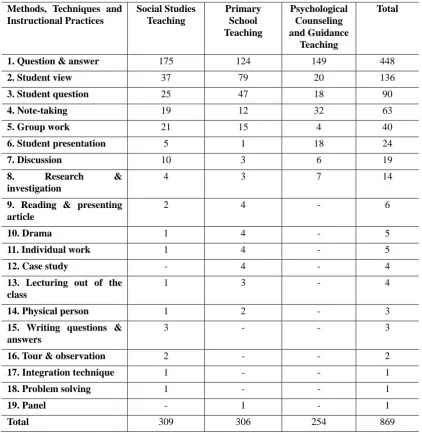
Table 1. Student-centered Methods, Techniques and Instructional Practices Used in Class
Methods, Techniques and Instructional Practices
Social Studies Teaching
Primary School Teaching
Psychological Counseling and Guidance
Teaching
Total
1. Question & answer 175 124 149 448
2. Student view 37 79 20 136
3. Student question 25 47 18 90
4. Note-taking 19 12 32 63
5. Group work 21 15 4 40
6. Student presentation 5 1 18 24
7. Discussion 10 3 6 19
8. Research & investigation
4 3 7 14
9. Reading & presenting article
2 4 - 6
10. Drama 1 4 - 5
11. Individual work 1 4 - 5
12. Case study - 4 - 4
13. Lecturing out of the class
1 3 - 4
14. Physical person 1 2 - 3
15. Writing questions & answers
3 - - 3
16. Tour & observation 2 - - 2
17. Integration technique 1 - - 1
18. Problem solving 1 - - 1
19. Panel - 1 - 1
Total 309 306 254 869
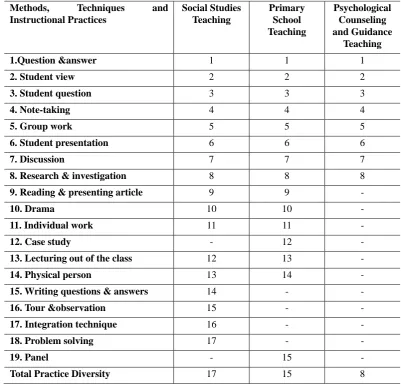
Table 2. The Diversity of Student-centered Methods, Techniques and Instructional Practices Used in Class
Methods, Techniques and Instructional Practices
Social Studies Teaching
Primary School Teaching
Psychological Counseling and Guidance
Teaching
1.Question &answer 1 1 1
2. Student view 2 2 2
3. Student question 3 3 3
4. Note-taking 4 4 4
5. Group work 5 5 5
6. Student presentation 6 6 6
7. Discussion 7 7 7
8. Research & investigation 8 8 8
9. Reading & presenting article 9 9 -
10. Drama 10 10 -
11. Individual work 11 11 -
12. Case study - 12 -
13. Lecturing out of the class 12 13 -
14. Physical person 13 14 -
15. Writing questions & answers 14 - -
16. Tour &observation 15 - -
17. Integration technique 16 - -
18. Problem solving 17 - -
19. Panel - 15 -
Total Practice Diversity 17 15 8
When Table 2 was examined, it was observed that there were up to 17 types of practices in terms of the diversity of student-centered methods, techniques and instructional practices. The minimum number of practices was 8. It was observed that the diversity of practices was the most in the social studies teaching class, which was followed by the primary school teaching class and psychological counseling and guidance teaching class, respectively.
Samples of Methods, Techniques and Instructional Practices Used in Class:
All of the teachers come to class 5 minutes before and always finish the lecture on time. In all the three classes, students are sometimes asked questions that make them think and that involve information during questions-answers. In one of the lectures, the students in the social studies teaching class set up stands in different parts of the class. One student introduced the industrial revolution, another student talked about Gandhi, another introduced the historical process of money, one other student introduced a book called Free Wings. This practice was a pre-study instructional activity on how teacher candidates would explain a topic when they became teachers. The other students in the class walked around the stands in pairs or in threes and listened to the demonstrations of those in the stands. All the students visited all the stands. There were many interesting materials and activities in the stands regarding the topic being told such as worksheets, puzzles, concept maps, colored pictures. After the demonstrations of these students were over, the other students set up their stands. All the students switched in time and presented their own demonstrations. It was an activity that involved many positive features such as learning by doing, socializing and self-confidence.
The teachers in all the three classes made their students prepare projects. In this way, they helped the teacher candidates to acquire scientific process skills. The students would generate articles from these projects. Besides, the students were taught how to write the reference section in the articles. In some classes, the teachers continued to provide students with information about the flow of projects from time to time. Information about the introduction, body and conclusion sections of the project was focused on. In the primary school teaching class, the research topic of the students was to write a biography and they would interview the people of whom they would write the biography. For this reason, the faculty member was giving information to the students about the interview technique. Furthermore, these students would make a poster presentation of their research at the end of the semester.
In all the three classes, the faculty members said they would give extra scores to the students attending conferences and participating in voluntary work. Therefore, they reinforced the teacher candidates’ behavior of participating in scientific activities and exhibiting a sharing attitude. Students were also required to read some articles.
In the social studies teaching class, current issues were also discussed. One of them was the teacher strikes in Virginia. Another issue was the closure of some schools in the United States of America. Many schools were being closed in Chicago and Detroit. In psychological counseling and guidance teaching class, pregnancy issues and percentages in high school were also discussed and possible solutions were dwelled upon. Another current issue was a type of cigarette that was widely used among young people. In another lecture, videos about drug use were shown. Discussing the current issues regarding education in the lectures can develop students’ behavior of gaining awareness towards educational problems. The teacher asked the students to write 10 reasons on the whiteboard about the closure of schools. All of the three walls of the class were covered with whiteboards. Therefore, all the students could easily be active. These practices were the activities that made the teacher candidates be life-oriented and that improved their problem solving skills.
In another lecture, the faculty member of the social studies teaching class brought up the incident in which 17 students were raked and killed in a high school in Florida. The same teacher mentioned the necessity of wh- questions (5w 1h questions) while teaching the subjects. The teachers often talked about the people who have been influential in American history in connection with the subjects. These influential people were; Jr. Martin Luther King, Christopher Columbus and Rosa Parks.
In the social studies teaching class, the teacher made all the students stand up and asked everyone to match up with one other students. She asked these pairs the question of “who are called heroes?” and following this, she asked them to talk about the Columbus Day. Then, she asked follow-up questions to the pairs and the pairs answered the questions. The student who spoke first gave the word to his/her friend afterwards. The teacher stopped the groups from time to time and asked questions.
The faculty member of the primary school teaching class told the students that libraries were good places to study in and talked about the facilities of some libraries. With an e-mail system of the university, students could access to all the resources related to their courses. Faculty members could upload the articles related to courses or other resources to this system and share them with their students. The system could also be used for in-class e-mails. Current announcements about the class could be typed in this system and shared with the students.
The faculty member of the primary school teaching class gave her lecture in the library twice. The students reviewed the primary school course books in the library. They asked questions to their teacher from time to time. In another lecture, the students searched for the issues regarding gender in the library.
The two teachers were talking about the importance of seeing the big picture on any subject during their lectures. The teachers were dwelling upon what the big problem about the subjects was. In all the three classes, it was often emphasized that no discrimination should be made against LGBTs and the people of different religions. In primary school teaching class, three LGBT people came to the class as a guest and told the students about their challenges. The students asked them questions. These people were; a lesbian, a gay and a homosexual. After the student presentations, each teacher candidate asked the class why that issue was important for teachers and helped the class to offer various solutions to that issue. The faculty member of the social studies teaching class told the students that history was full of mysteries and thus, she was keeping the students curious about the subject.
Sometimes the teachers called the students with their names. In the social studies teaching class, the faculty member enabled the students to act their management styles via the drama method. The class was divided into groups of 3. One group acted the democratic management style, the other group acted the autocratic management style, and the other group acted the monarchic management style.
she divided the students into two groups, and there were the students of the same opinion and those of the opposite opinion on a topic. First, each group spoke and defended their own views and then, the groups reached a negotiation. Both views were represented in this negotiation.
Group works were usually conducted as discussing the issue with the other friend in all the three classes. The group work appropriate to the steps of a particular technique was included less. The faculty member of the social studies teaching class gave one of her lectures in workshop. All kinds of course materials could be made there. This workshop included different materials such as colored fabrics, metals, plastics, etc. and their machines. The person in charge told the students how to use these machines. They could make a figure that symbolized a country, or they could print a sample money or create a robot, etc. The teacher asked the students to design a material as homework. In the primary school teaching class, the lecture was given in the garden and the students improvised a real news on the discrimination against an Afro-American school boy in kindergarten by using the drama method.
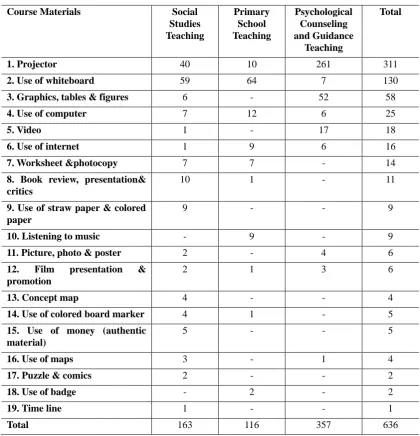
Table 3. Course Materials Used in Class
Course Materials Social Studies Teaching
Primary School Teaching
Psychological Counseling and Guidance
Teaching
Total
1. Projector 40 10 261 311
2. Use of whiteboard 59 64 7 130
3. Graphics, tables & figures 6 - 52 58
4. Use of computer 7 12 6 25
5. Video 1 - 17 18
6. Use of internet 1 9 6 16
7. Worksheet &photocopy 7 7 - 14
8. Book review, presentation& critics
10 1 - 11
9. Use of straw paper & colored paper
9 - - 9
10. Listening to music - 9 - 9
11. Picture, photo & poster 2 - 4 6
12. Film presentation & promotion
2 1 3 6
13. Concept map 4 - - 4
14. Use of colored board marker 4 1 - 5
15. Use of money (authentic material)
5 - - 5
16. Use of maps 3 - 1 4
17. Puzzle & comics 2 - - 2
18. Use of badge - 2 - 2
19. Time line 1 - - 1
Total 163 116 357 636
When Table 3 was examined, it was determined that a total of 19 different kinds of materials were used in the three classes. Projector was the material used most in class. It was followed by use of whiteboard and use of graphics, tables and figures. The class which used classroom materials most was the psychological counseling and guidance class, which was followed by the social studies teaching class and primary school teaching class, respectively.
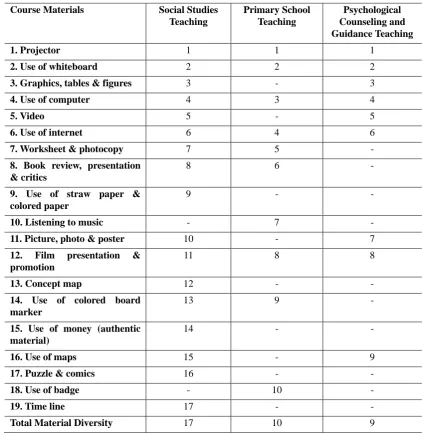
Table 4. The Diversity of Course Materials Used in Class
Course Materials Social Studies Teaching
Primary School Teaching
Psychological Counseling and Guidance Teaching
1. Projector 1 1 1
2. Use of whiteboard 2 2 2
3. Graphics, tables & figures 3 - 3
4. Use of computer 4 3 4
5. Video 5 - 5
6. Use of internet 6 4 6
7. Worksheet & photocopy 7 5 -
8. Book review, presentation & critics
8 6 -
9. Use of straw paper & colored paper
9 - -
10. Listening to music - 7 -
11. Picture, photo & poster 10 - 7
12. Film presentation & promotion
11 8 8
13. Concept map 12 - -
14. Use of colored board marker
13 9 -
15. Use of money (authentic material)
14 - -
16. Use of maps 15 - 9
17. Puzzle & comics 16 - -
18. Use of badge - 10 -
19. Time line 17 - -
Total Material Diversity 17 10 9
When Table 4 was examined, it was observed that there were up to 17 different kinds of materials in terms of material diversity. It was determined that the diversity of practices was the most in the social studies teaching class, which was followed by the primary school teaching class and psychological counseling and guidance teaching class, respectively.
Samples of Material Use in Class:
At the beginning of the semester, the teacher in the primary school teaching class used a badge until everybody memorized her name. Both the teacher’s and the students’ names were in front of them on their armrest chairs. The teacher of this class was writing the agenda for each week on the whiteboard. The teacher showed how to search for resources on the internet. The teacher of the psychological counseling and guidance teaching class reflected the exam achievement percentage of the class in the projector.
The teachers of the two classes used minute cards to remind students how much time was left before the end of the presentation. These were the cards written on the colored cardboards. On them, it was written 5 minutes, 2 minutes and Stop. In the psychological counseling and guidance teaching class, rigid, relaxed and normal family types were shown via various case study videos.
The faculty member of the psychological counseling and guidance teaching class usually supported her presentation with graphics and photographs while she was lecturing from the projector. Sometimes the writings in the presentations made with the power point were too small. The teachers also reflected the reference sections of the subjects they presented.
In the psychological counseling and guidance teaching class, videos were shown about the educational campaigns in various schools. For example, in order to draw attention to peer bullying in a school, the students wrote and painted “bullying” on their faces. In another school campaign, it was seen that some people wandered around the school and community areas wearing “I am lesbian” t-shirts. Besides, there was a video screening of another school regarding school dropouts. In addition to these, the issues of racism, slavery, gender problem, religion and discrimination between men and women were the issues frequently discussed in the classes. Such up-to-date news and practices can increase students’ sensitivity towards problems and these practices can also ensure that the life- orientedness principle of education is fulfilled.
The students of the social studies teaching class made the detailed presentation of the film black panther which had just came out. This movie was shot only with Afro-American people. The students also introduced another film in which the characters were only Afro-American women. In one of the lectures, they featured a video demonstration regarding the views of famous people on LGBT community. The teachers were attentive to use colored board markers while using the whiteboard. In student presentations, it was observed from time to time in the power points that the principles of preparing materials were not adequately followed. For example; the writing was too small and there was too much writing, etc.
5. Conclusion and Suggestions
According to the findings obtained from the research, it was found that a total of 19 active learning methods, techniques and practices were used in the three classes. In class, question-answer was used most. It was observed that there were 17 different types of active methods, techniques and instructional practices. It was determined that a total of 19 different kinds of active learning materials were used in the three classes. Projector was the material which used the most in class. Based on the findings of the research, it was determined that there were also active learning practices that were not used in class. Depending on the fact that learning by doing is the most permanent traced learning, practices that can make the student active can be included more.
In class, question-answer was used most, which was followed by student view and student question. Group work also had a significant place in the research findings. In the light of these findings, it can be said that acquiring positive characteristics function of Vygotsky’s (1978) social constructivism theory was used in these classes. In group work, students learn from each other by sharing and thus, they comprehend the subject (Kalpana, 2014: 28). Considering these findings, it can be said that teacher candidates have learned the course subjects permanently.
The group which used student-centered methods, technical and instructional practices most was the social studies teaching class, which was followed by the primary school teaching class and psychological counseling and guidance teaching class, respectively. The most commonly used practice in all the three classes was question-answer. Question-answer is one of the oldest techniques known. Question-answer can also be called as the Socrates method. It is ensured that the person reaches the correct answer with questions. Its area of application is quite wide. It is used with many methods. It can be used easily with active learning and enables learners to activate their intellectual activities.
The group which used methods, techniques, student-centered practices and who had the richest material diversity was the social studies teaching class. According to the findings obtained from classroom observations, there were 17 different types of the methods, techniques and practices used in class. Nonetheless, it was also determined that there were also practices that were not utilized in class. These were; demonstration, brainstorming, six thinking hats technique, station, micro teaching and etc. Such practices may be dwelled upon more in class.
In material use, the class settings in which projector and white board were intensely used were observed. There were no learning environments where insufficient authentic objects and models were used or students designed materials. The use of materials that appeal to the five senses in learning environments increases the probability of learning to be permanent. The diversity of the materials used in the courses will increase the efficiency of teaching.
In the classes where active learning methods are used, many activities such as role playing, small group presentations, individual student presentations, directed creativity exercises, small group discussions, brainstorming, in-class writing activities, feedback lectures, discussion classes, self-assessment activities can be implemented. Active methods increase the academic achievement of students and improve their writing and research skills. Besides, student-centered practices also improve students’ learning and critical thinking skills (Sibona & Pourrezajourshari, 2018; Alghamdi & Deraney, 2018; Gür & Seyhan, 2006; Gammons, & Inge, 2017). The learning environment created with effective learning model has a positive effect on students in terms of learning, teaching and communication dimensions (Kalem & Fer, 2003) and student-centered practices positively affect academic achievement.
References
Alghamdi, A. K. H. (2013a). Pre-service teachers’ preferred methods of assessment: A perspectivefrom Saudi Arabia.
Australian Journal of Teacher Education, 38(4), 66-90. https://doi.org/10.14221/ajte.2013v38n4.6
Alghamdi, A. K. H. (2013b). An exploration into “private” higher education in Saudi Arabia: Improving quality and accessibility? The ACPET Journal for Private Higher Education, 2(2), 33-44.
Alghamdi, A. K. H., & Deraney, P. (2018). Teaching research skills to undergraduate students using anactive learning approach: A proposed model for preparatory-year students in Saudi Arabia. International Journal of Teaching and Learning in Higher Education, 30(2), 184-194.
Arabacı, İ. B. (2011). Türkiye’de ve OECD ülkelerinde eğitim harcamaları. Elektronik Sosyal BilgilerDergisi, 10(35), 100-112.
Aykaç, N. (2018). Öğretim ilke ve yöntemleri. Ankara: PegemAkademi Yayıncılık.
Bishop, J. L., & Verleger, M. A. (2013, June). The flipped classroom: A survey of the research. In ASEE national conference proceedings, Atlanta, GA (Vol. 30, No. 9, pp. 1-18).
Büyüköztürk, Ş., Çakmak, E., Akgün, Ö. E., Karadeniz, Ş., & Demirel, F. (2018). Bilimsel araştırmayöntemleri. Ankara. Pegem Akademi. https://doi.org/10.14527/9789944919289
Çelen, F. K., Çelik, A., & Seferoğlu, S. S. (2011). Türk eğitim sistemi ve PISA sonuçları. XIII.Akademik Bilişim Konferansı Bildirileri, 2 - 4 Şubat 2011 İnönü Üniversitesi, Malatya.
Creswell, J. W. (2016). Nitel araştırma yöntemleri: Beş yaklaşıma göre nitel araştırma ve araştırma deseni (S.B. Demir & M. Bütün Trans.). Ankara: Siyasal Kitabevi.
Doğan, Y. (2007). Sosyal bilgiler öğretiminde tarihsel yazılı kanıtların kullanımı.Unpublished doctoral dissertation, Gazi Üniversitesi Eğitim Bilimleri Enstitüsü, Ankara.
Gammons, R. W., & Inge, L. T. (2017). Using the ACRL framework to develop a student-centered model for program-level assessment. Communications in Information Literacy, 11(1), 168-184.
https://doi.org/10.15760/comminfolit.2017.11.1.40
Gür, H., & Seyhan, G. (2006). İlköğretim 7. sınıf matematik öğretiminde aktif öğrenmenin öğrenci başarısı üzerine etkisi. Balıkesir Üniversitesi Fen Bilimleri Enstitüsü Dergisi, 8(1), 17-27.
Hamdan, A. (2005). Women and education in Saudi Arabia: Challenges and achievements. International Education Journal, 6(1), 42-64.
Hosein, A., & Rao, N. (2017). Students’ reflective essays as insights into student centred-pedagogies within the undergraduate research methods curriculum. Teaching in Higher Education, 22(1), 109-125.
https://doi.org/10.1080/13562517.2016.1221804
Kalem, S., & Fer, S. (2003). Aktif öğrenme modeliyle oluşturulan öğrenme ortamının öğrenme, öğretme veiletişim sürecine etkisi. Kuram ve Uygulamada Eğitim Bilimleri, 3(2), 433-461.
Kalpana, T. (2014). A constructivist perspective on teaching and learning: A conceptual framework. International Research Journal of Social Sciences, 3(1), 27-29.
Karasar, N. (2018). Bilimsel araştırma yöntemleri.Ankara: Nobel Yayın Dağıtım.
Khoboli, B. (2007, January). Doable model of learner-centered education: the science teachers’ product after a twentieth century action research. In Proceedings of the 15th Annual Conference of the Southern African Association for
Research in Mathematics, Science, and Technology Education (pp. 402-410).
Koçak, S. (2010). Aktif öğrenme yönteminin öğrencilerin bilişim teknolojileri dersindeki başarıları ve öğrenme strateji
düzeyleri üzerindeki etkileri.Unpublished master thesis, Dokuz Eylül Üniversitesi Eğitim Bilimleri Enstitüsü,
Lammers, W. J., & Murphy, J. J. (2002). A profile of teaching techniques used in the university classroom: A descriptive profile of a US public university. Active Learning in Higher Education, 3(1), 54-67.
https://doi.org/10.1177/1469787402003001005
Lumpkin, A., Achen, R. M., & Dodd, R. K. (2015). Student perceptions of active learning. College Student Journal, 49(1), 121-133.
Nave, B. (2015). Student-Centered Learning: Nine Classrooms in Action. Harvard Education Press. 8 Story Street First Floor, Cambridge, MA 02138.
Patton, M. Q. (2017). Qualitative evaluation and research methods. Thousand Oaks, CA: Sage.
Robson, C. (2015). Bilimsel araştırma yöntemleri: Gerçek dünya araştırması. Ankara: Anı Yayıncılık.
Saban, A. (2007). Lisansüstü öğrencilerin nitel araştırma metodolojisine ilişkin algıları. Selçuk Üniversitesi Sosyal Bilimler Enstitüsü Dergisi, 1(17), 469-485.
Şahinel, M. (2015). Eğitimde yeni yönelimler (In O. DemirelEds.).Ankara: Pegem Akademi Yayıncılık.
Sibona, C., & Pourrezajourshari, S. (2018). The impact of teaching approaches and ordering on IT project management: Active learning vs. lecturing. Information Systems Education Journal, 16(5), 66.
Vandiver, D. M., & Walsh, J. A. (2010). Assessing autonomous learning in research methods courses: Implementing the student-driven research project. Active Learning in Higher Education, 11(1), 31-42.
https://doi.org/10.1177/1469787409355877
Vygotsky, L. S. (1978). Mind in society: The development of higher mental process. Cambridge, MA: Harvard University Press.
Wolfe, R. E., Steinberg, A., & Hoffman, N. (2013). Anytime, anywhere: Student-centered learning for schools and
teachers. Cambridge, MA: Harvard Education Press.
Yıldırım, A., & Şimşek, H. (2018). Sosyal bilimlerde nitel araştırma yöntemleri. Ankara: Seçkin Yayıncılık.
Copyrights
Copyright for this article is retained by the author(s), with first publication rights granted to the journal.