ISSN 2324-805X E-ISSN 2324-8068 Published by Redfame Publishing URL: http://jets.redfame.com
Pathology Residency Programme of a Developing Country–Landscape of
Last 25 Years
Imran Siddiqui1, Natasha Ali2, Naila Kayani1
1
Department of Pathology & Laboratory Medicine
2
Department of Pathology & Laboratory Medicine/Oncology
Correspondence: Dr Natasha Ali, Department of Pathology and Laboratory Medicine/Oncology, The Aga Khan University, Karachi, Pakistan. Tel: 021-3486-1306
Received: October 13, 2015 Accepted: November 2, 2015 Online Published: December 2, 2015
doi:10.11114/jets.v4i3.1231 URL: http://dx.doi.org/10.11114/jets.v4i3.1231
Abstract:
We report the evolution of a residency programme in Pathology from a developing country. This article highlights the historical perspective of our application procedure, the number of inductions, the programme framework, acheivements and limitations.
Keywords: pathology residency, 25 years, developing country
1. Background
Pakistan is the most populated country in the WHO eastern Mediterranean region. It has a population of over 180 million, spread over four provinces in federally administered areas. The growth rate is approximately 2% and Punjab is the most populous province. In Pakistan, the number of doctors and nurses has risen from 48 to 71 per 100,000 and from 16 to 30 per 100,000 respectively between 1990 and 2003. The major challenge, still, is the imbalance of the population to health-care workers ratio. Due to health reform initiatives, over the years many medical colleges have been established(Khan, Biggs, & Mubbashar). In Pakistan, every year, about 30,000 students, pass F.Sc premedical examination securing over 60% marks and apply to get admission in medical colleges. Pakistan per year produces 14,000 medical graduates. After a year of internship, approximately 12,000 candidates appear for post graduate entrance exam i.e. Fellowship of the College of Physicians and Surgeons (FCPS) part I. Of these, 250 candidates are declared successful and apply for fellowship training in various College of Physicians and Surgeons (CPSP) recognized teaching hospitals.
In the last two decades, dramatic changes have occurred in the field of medicine. In particular, the number of female graduates entering in to the medical career has increased. Apart from this, the once “sought after” residency programmes of Medicine and Surgery allied are receiving a decreased number of applications. On a completely different aspect, the current generation of graduates appears to be choosing careers that provide large incomes relative to the length of their training and preparation. Perhaps the practitioners want to care for their patients and receive the personal rewards of practicing medicine. A similar shift has been observed with respect to medical specialties that provide controllable lifestyle. These specialties which include anesthesia, dermatology, radiology, emergency medicine, pathology, ophthalmology and neurology have shown increasing number of applications(Bland & Isaacs, 2002). Pathology and Laboratory Medicine, unlike such disciplines as surgery or psychiatry, is not considered “core clerkship” rotation at most Canadian and American medical schools. Most schools also do not have mandatory rotations in pathology for their graduates(Magid & Cambor). The discipline of pathology and laboratory medicine itself is practiced in diverse ways throughout the world. In the U.S., for M.D. trainees, the discipline, and training in the discipline, is generally carried out as a comprehensive whole including clinical chemistry, hematology, microbiology, immunology, laboratory management, molecular pathology, informatics and transfusion medicine (including apheresis)(B. R. Smith, 2008).
Medicine is one of the programmes under its umbrella. The training caters for four different residency programmes under one roof. The disciplines include Chemical Pathology, Haematology, Histopathology and Microbiology. The programme was established in 1988. With more than 25 years of rich experience in the fields of clinical service, research and education, this study is designed to assess with quantifiable outcomes the overall progress of the programme till date.
2. Material and Methods
2.1 Application Procedure
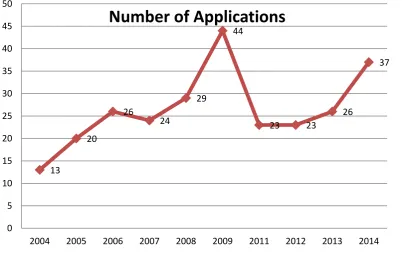
Entrance into the Pathology residency programme at the Aga Khan University Hospital commences by passing the mandatory part 1 exam of the Fellow of College of Physicians and Surgeons, Pakistan. The department of post graduate medical education invites applications once a year in Pathology and successful candidates take the entrance exam and interview. The entrance exam is divided into an English language assessment which is common to applicants of all residency programmes and a subject specific exam. In the last 25 years, the applications into the program have been on the rise as shown in (Figure 1)
Figure 1. Applications of Pathology residency in the last 25 years1 2.2 Residency Curriculum
The curriculum is designed in such a way that it trains individuals for potentially diverse career paths that emphasize full-time clinical practice. It is based on the didactic criteria articulated by ACGME specifically: “Education in clinical pathology must include microbiology, immunopathology, blood banking/transfusion medicine, chemical pathology, cytogenetic, haematology, coagulation, toxicology, medical microscopy, molecular biologic techniques, aspiration techniques and other advanced diagnostic techniques as they become available”(B. R. Smith et al., 2006). In addition to this, the programme also includes residency in histopathology which is based on anatomic pathology curriculum, similar to that proposed by association of directors of anatomic and surgical pathology.
2.3 Resident’s Framework
a: Departmental Residency Committee
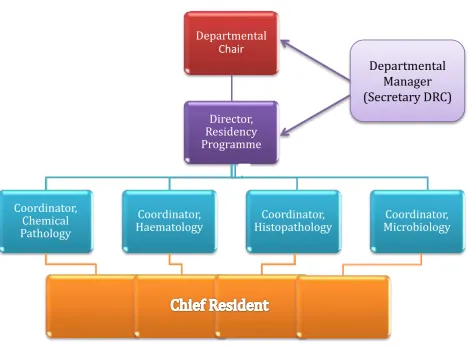
The departmental residency committee (DRC) is chaired by the residency director and consists of representatives from all four sections (Chemical Pathology, Haematology, Histopathology and Microbiology). Other members include the chief resident and departmental manager. The DRC is responsible to look after all resident related issues pertaining to service,
1
Year wise date available from 2004
13
20
26
24
29
44
23 23
26
37
0 5 10 15 20 25 30 35 40 45 50
2004 2005 2006 2007 2008 2009 2011 2012 2013 2014
academics and research (Figure 2).
Figure 2. Departmental Residency Committee
b: Resident’s research grant:
In order to culminate rich and practice changing research, the Department, through a strict evaluation of proposals awards research grants to residents for research projects. In a study done on orthopedic residents by Macknin JB et al(Macknin, Brown, & Marcus), the authors concluded that residents, who publish in a peer reviewed journal during the residency period, are more likely to continue publishing in their future careers.
c: Resident’s in-house exam
For the overall progression of attainment of medical knowledge during residency, the post graduate medical education conducts yearly in-house resident exam. Pathology residents are graded based on “one best” format questions. Apart from this, the residents also answer short essay questions. Department of PGME also conducts generic lectures, common to residents across the hospital. This knowledge is also assessed in the in-house exam.
Residents in the Department of Pathology and Laboratory Medicine are also assessed mid-year through short essay questions. This mid-year written exam is taken on a pre-decided date across all sections. Promotion of residents to the next level is based on the cumulative percentage of these two exams.
d: Fellow of College of Physicians and Surgeons exam
The College of Physicians and Surgeons Pakistan (CPSP) was incorporated through Ordinance XX of 1962 issued on 19th May 1962. CPSP has been conducting exams since then to certify graduating residents in 72 specialties. Competency based curricula have been developed for each discipline by the relevant faculties. More than 10,000 training slots have been awarded in 129 CPSP accredited medical institutions throughout the country. Pathology residents become eligible to take the exit exam after 4 years of training. The other pre-requisite includes a dissertation or two original articles published in indexed journals. The examination consists of a written and a practical part. The written exam is divided into two papers of 10 questions each. Candidates are required to pass both the written and practical components. Residents
Departmental
Chair
Director,
Residency
Programme
Coordinator,
Chemical
Pathology
Coordinator,
Haematology
Coordinator,
Histopathology
Coordinator,
Microbiology
who pass the examination are given only their pass status and not their actual scores.
e: Contribution to College of Physicians and Surgeon Pakistan by AKU Faculty
At the national level, the faculty of the Department of Pathology and Laboratory contributes to CPSP at various levels. Three of our faculty members constitute the committee of Microbiology, n=2 contribute to the committee of Histopathology and n=1 is a member of the committee of Chemical Pathology at CPSP. Apart from this, n=10 faculty members are recognized supervisors/examiners of CPSP.
f: Best resident award
The PGME introduced the best resident award in Pathology residency programme in 2009. The award is based on a standard critrerion and is chosen by faculty members who have worked with the resident throghout their training. The criterion includes residents’ character, judement, his/her aptitude as a team leader and passing of exit exams. The best resident based on this is chosen from all four sections. The DRC then meets and puts forward the name of one best resident from all sections with the highest score.
2.4 Progress after Residency
Progress after residency with respect to the individual careers of the candidates was classified into national, international and left pathology. We also gathered information on the academic output based mainly on peer reviewed publications and research grants. Information on publications was obtained by performing individual name searches in PubMed. List of research grant was obtained from the research section of the department.
2.5 Statistical Analysis
All frequencies were expressed as numbers and percentages using SPSS software version 19.
3. Results
From the start till 2014, we have received a total of 265 applications2 out of which n=79 candidates have graduated from the time of its inception, 25 years ago. The first resident graduated in 1991. There have been n=52 female graduates and n= 27 male graduates. The male: female ratio has been divided into three group years shown in figure 3.
Figure 3. Distribution of male:female ratio over the years
Of these successful n=79 candidates, n=6 belonged to the province of Punjab, n= 67 belonged to Sindh, n= 5 were from Khyber puhktunkhwa and n=1 was from Baluchistan. Thirty two residents have successfully completed training in Histopathology, n=23 in Haematology, n=14 in Microbiology and n=10 in chemical pathology till date.
In the initial years, the programme was of 3 years duration. Within five years of its inception, the programme was
2
Data available since 2004
0 5 10 15 20 25 30 35 40
1991-1999
2000-2008
2009-2014
4
13
11
7
19
26
Number
of
resid
ents
Year groups
Female
extended to 4 years. In the year 2006, the residency programme was extended till 5 years. Out of the 79 graduates, n=37 (47%) of the candidates graduated after 5 years. All our residents have cleared the in-house residency exam until now. A total of n=76 (96%) residents have graduated from CPSP by clearing the exit exam (FCPS). Few of our graduates have also been awarded gold medals by CPSP for securing the highest marks in their respective disciplines (Table 1)
Table 1. List of residents awarded gold medals in CPSP examination
In the last 25 years we have had n=4 residency directors and n=16 chief residents, who have managed resident related matters during their tenure (Table 2: List of programme directors and chief residents with their tenure).
Table 2. List of programme directors and Chief residents with their tenure
Programme Director Tenure Chief Resident Tenure
Dr Hizbullah Sheikh 1990-1992 Dr Rashida Ahmed Dr Naveen Faridi
1990-1991 1992
Dr Naila Kayani 1993-2000 Dr Salman Adil
Dr Imran Siddiqui Dr Erum Khan Dr Aysha H Khan Usman Shaikh
1993 1994-1997 1998 1999 2000 Dr Ghulam Nabi Kakepoto 2001-2003 Dr Khorram Essa
Dr Mohammad Nasim Sabir Dr Rehana Younis
2001 2002 2003 Dr Imran Siddiqui 2004 - 2014 Dr Jawaid Jabbar
Dr Naveen Naz Dr Adnan Qureshi Dr Beena Umer Dr Lena Jafri Dr Talha Naeem
2004 2005 2006 – 2008 2009 – 2010 2011-2012 2013 – 2014
The resident’s research grant programme was started in 2008. Across the university, this is unique to the Department of Pathology and Laboratory Medicine. Year I and II residents are encouraged for maximum participation. Till 2014, n=37 grants have been awarded for various research proposals (Figure 4: Number of awarded research proposals per year).
PubMed search of the graduated residents revealed n=25 research papers that have been published from the gant awarded projects. Currently, n= 51 graduates are serving as consultants nationally, n=23 are working outside Pakistan and n=5 have left Pathology. Of the n=51 serving nationally, n=25 (49%) are part of the current faculty of the Department of Pathology and Laboratory Medicine.
Resident’s name Discipline Year
Dr Najmus Sehar Dr Amna Khurshid
Histopathology Histopathology
2004 2006
Dr Mohammad Adnan Qureshi Haematology 2010
Dr Farheen Karim Haematology 2013
Figure 4. Residents research grant awards per year
Following is the list of candidates with the best resident award achievement (Table 3). Three of these acheivers are currently full time faculty in the Department.
Table 3. List of Best Resident Awards
Name of Resident Year
Dr Adnan Qureshi 2009
Dr Natasha Ali 2010
Dr Farhan Dar 2011
Dr Lena Jafri 2012
Dr Anila Rashid 2013
Dr Talha 2014
4. Discussion
The PGME, conducts external review of all the post graduate programmes periodically. The first review was conducted in 2008 wherein all the programmes were validated by an international team. The second similar review was conduted in 2012. In this review, our residency programmes of Histpathology and Microbiology were declared one of the top 5 best programmes across the university. The summary of all the programmes as stated by the international team was that (i) we have a highly qualified, academically oriented staff (ii) there is high volume of clinical material (iii) we have excellent clinical laboratory facilities (iv) we have an effective continuous performance assessment (v) effective experimental learning of management skills and (vi) there are excellent opportunities for research. The applications for pathology residency have been steadily increasing at our institution. The programme started with two residents in 1988. Sixteen years later, the strength had increased to 31. In 2006, n=37 residents had successfully graduated. A year later, the programme achieved a milestone by extending the training to five years instead of four. Eight new residency positions were allocated to all four disciplines and till 2014, n=79 candidates have successfully exited the programme. Similar trends have been seen in other CPSP recognized training centers in Pakistan. This is in contrast to US medical
4 3
5
9 7
5 3
0 1 2 3 4 5 6 7 8 9 10
2008 2009 2010 2011 2012 2013 2014
graduates, where Pathology has become less attractive. In 1981, 2.3% of US medical school graduates planned a career in Pathology. By 1986, this number had declined to 1.6%. This decline has mainly occurred due to less number of male graduate applications, whereas the female recruitment has been unchanged. Discouragement has also come from a perceived shortage of job openings, negative statements from other physicians, the addition of a fifth-year requirement and lack of patient contact(R. D. Smith & Prichard, 1987). Few of these factors are common to our residency programme as well, but in contrast, have resulted in a surge of applications, mainly female.
The specialty of Pathology and Laboratory Medicine in the last decade has undergone a paradigm shift by entering a phase in which the 4 year residency programme is followed by a one year sub-specialty fellowship training(Crawford, Hoffman, & Black-Schaffer) preferably ending with an exit exam. In Pakistan, the concept of sub-specialty fellowship training is still in its infancy. Extending the residency programme to five years was undertaken to consolidate the resident’s knowledge of the previous four years and also to keep them in-service since the probability of clearing the exam would increase as compared to a resident who is out of practice at the time of taking the exam. The other advantage was to groom these residents towards a faculty position and also identify potential faculty position candidates for the future. In comparison, during the 4 year residency era, 71.4% cleared the exam in first attempt (written and practical) whereas in the 5 year residency period, 78% of the candidates have cleared the exam in first attempt.
The Accreditation Council for Graduate Medical Education (ACGME) and the Residency Review Committee for Internal Medicine (RRC-IM) in the United States of America support research as an important component of residency training. In 1994, the RRC-IM established a new requirement that ‘‘prior to the completion of training, each resident must demonstrate acceptable scholarly activity,’’ defined as ‘‘original research, comprehensive case reports or review of clinical and research topics(Levine, Hebert, & Wright, 2005). Takahashi O et al in 2009 concluded that majority of residents thought that research activity was worthwhile and that participation in research activity was associated with higher levels of satisfaction with residency training(Takahashi et al., 2009). Till 2011, approximately 67% of the resident research grants funded work has been published in high impact factor journals. The remaining projects, are work in progress, contributing towards the residents professional development.
In a country like Pakistan, majority of the citizens have limited access to primary and basic healthcare facilities. One of the mission of the Aga Khan University's PGME department is to promote holistic patient and population centered health care of highest standards. During the interview process of the residency programme, every year, applications from provinces other than Sindh are always preferred. The rationale is, that when these residents successfully graduate as consultants from the programme, they will go back to their original area of residence and fill the void that exists due to shortage of specialists with post graduate qualifications. Improper healthcare facilities in Pakistan are the sequelae of political instability, population growth and economic stagnation. Approximately, 34% of the graduates of our residency programme are serving at consultant positions spreading all over the country. At the national level one of our major conribution also includes the first civilian FCPS training programme in Chemical Pathology. Though a major change is unachievable till implementation of national health plans unhampered by constraint economic resources occurs, these 34% are playing their role in bringing about the change needed in underdeveloped areas of the country.
Till the end of last century, medical migrants from Pakistan and other developing countries constituted a significant proportion of the medical workforce in the developed countries(Astor et al., 2005). Though this resulted in in direct loss of professionals to the native country, it also provided the migrants with opportunities of better medical practice, specialist training and professional development. Approximately 29% of our graduates working outside Pakistan at consultant posts. They continue to excel based on thier foundation training received at the Aga Khan University. Despite these achievements, like any other programme we also have challenges. From a trainee’s perspective, “work overload inhibiting learning” is a significant stressor in pathology residency programs. Although most pathology residents do not exceed the mandated limit of duty hours, the quality of time they spend at work serves as a source of stress.
Information management is crucial in pathology. Many reports have stressed the need for improved informatics training in pathology residency programme. With the introduction of stringent accreditation requirements, laboratories are paying more attention to compliance and their use of information systems (Henricks et al, 2009). Informatics training is critical in pathology given the recent surge in implementation of the electronic health record, wider adoption of digital pathology, and the expanding role of laboratory information systems in the day-to-day activities of laboratory pathology. The current barrier in our system to introduce this as part of training is limited access to pathology informatics expertise and resources.
5. Conclusion
in research and education along with training pathologists to be outstanding diagnosticians and prepare them for constructive and exemplary leadership roles to serve and respond to needs in the country and its region.
Acknowledgement
1. Ms. Shamsha Punjwani, Manager Pathology & Laboratory Medicine for prvoviding data on the number of applications and graduates
2. Mr. Barkat Virani, Manager, PGME for providing data on number of applications
3. Ms. Firdaus Shahid, Assistant Manager, Pathology & Laboratory Medicine – for providing data of resident’s research grant
Conflict of interest
None
References
Astor, A., Akhtar, T., & Matallana, M. A., et al. (2005). Physician migration: views from professionals in Colombia, Nigeria, India, Pakistan and the Philippines. Soc. Sci. Med., 61, 2492-2500.
http://dx.doi.org/10.1016/j.socscimed.2005.05.003
Bland, K. I., & Isaacs, G. (2002). Contemporary trends in student selection of medical specialties: the potential impact on general surgery. Arch. Surg., 137, 259-267. http://dx.doi.org/10.1001/archsurg.137.3.259
Crawford, J. M., Hoffman, R. D., & Black-Schaffer, W. S. Pathology subspecialty fellowship application reform, 2007-2010. Am. J. Clin. Pathol., 135, 338-356. http://dx.doi.org/10.1309/AJCP16DQXAMQKVNK
Henricks, W. H., Boyer, P. J., Harrison, J. H., Tuthill, J. M., & Healy, J. C. (2003). Informatics training in pathology residency programs: proposed learning objectives and skill sets for the new millennium. Arch. Pathol. Lab. Med., 127(8), 1009-1018.
Khan, J. S., Biggs, J. S., & Mubbashar, M. H. Evaluation techniques in Punjab, Pakistan: eight years of reforms in health professional education. J. Ayub. Med. Coll. Abbottabad., 23, 154-158.
Levine, R. B., Hebert, R. S., & Wright, S. M. (2005). Resident research and scholarly activity in internal medicine residency training programs. J. Gen. Intern. Med., 20, 155-159.
http://dx.doi.org/10.1111/j.1525-1497.2005.40270.x
Macknin, J. B., Brown, A., & Marcus, R. E. Does research participation make a difference in residency training? Clin. Orthop. Relat. Res., 472, 370-376. http://dx.doi.org/10.1007/s11999-013-3233-y
Magid, M. S., & Cambor, C. L. (2011). The integration of pathology into the clinical years of undergraduate medical education: a survey and review of the literature. Hum. Pathol., 43, 567-576. http://dx.doi.org/10.1016/j.humpath.2011.06.006
Smith, B. R., Wells, A., & Alexander, C. B., et al. (2006). Curriculum content and evaluation of resident competency in clinical pathology (laboratory medicine): a proposal. Am. J. Clin. Pathol., 125, Suppl:S3-37.
Smith, B. R. (2008). Meeting the curriculum needs for different career paths in Laboratory Medicine. Clin. Chim. Acta. 393, 5-8. http://dx.doi.org/10.1016/j.cca.2008.03.019
Smith, R. D., & Prichard, R. W. (1987). A survey of first-year pathology residents: factors in career choice. Hum. Pathol. 18, 1089-1096. http://dx.doi.org/10.1016/S0046-8177(87)80374-X
Takahashi, O., Ohde, S., & Jacobs, J. L., et al. (2009). Residents' experience of scholarly activities is associated with higher satisfaction with residency training. J. Gen. Intern. Med., 24, 716-720.
http://dx.doi.org/10.1007/s11606-009-0970-4