www.ijtrd.com
Solar Panel's Current-Voltage Characteristics
1
Khaleel I Abass,
2Ali A K Al-Waeli and
3Kadhem A N Al-Asadi,
1
Mechanical Eng. Dept., University of Technology-Iraq
2Ibn Rushed College, Baghdad University, Iraq
3
Education College for Human Science, University of Basra, Iraq
Abstract-
This article checks the relation between
current-voltage characteristics, to evaluate the impact of solar radiation
and temperature on the productivity of a solar photovoltaic
module. Photovoltaic systems have become an urgent
requirement to reduce dependence on fossil fuels and reduce
air pollutants from burning. In Iraq, this rich country in fossil
fuels such as natural gas and crude oil, is suffering from a
shortage of electricity supplies and long hours of disruption. It
seems that the solution using natural gas or diesel plants is no
longer feasible and switching to photovoltaic stations is the
best option to this day. The results of the study showed that the
current is affected slightly by the increase in the radiation
intensity whilethe module voltages is affectedhighly by the
intensity of radiation, especially when the load on the cell is
increasedcausing an increase in power produced.
Keywords
-
PV Module, Solar Radiation, Temperature,
Voltage, Current.
I. INTRODUCTION
Iraq (a country rich in natural resources such as oil and natural
gas) suffers from significant problems in the processing of
electricity to citizens. The power outages for long hours caused
the Iraqi citizens to rely on generators running by diesel and
gasoline [1]. The use of these generators has been aggravated
by air pollution (already contaminated and hard). The
extraction of crude oil has caused significant pollution in the
atmosphere of Iraq because of the spread of oil wells
throughout the country [2]. Rainfall lack for more than two
decades has caused the Fertile Crescent (Mesopotamia) to turn
into a source of dust to Iraq and neighboring countries [3]. It
also increased the salinity of water in the rivers and thus
reduced the large cultivated areas [4].Also, Iraq has suffered
from many wars that caused the destruction and deterioration
of services, especially for power generation facilities [5].
The shift towards the use of renewable energies in electricity
production has become very vital in Iraq to reduce the
environmental impact of excessive combustion of fossil fuels
[6]. Some may consider wind power to be limited in certain
parts of Iraq, making it useless [7]. Many consider the use of
solar energy to produce heat and electricity in Iraq necessary
and successful, as Iraq's environment is characterized by high
solar radiation is very high because of the country is located
next to the solar belt [8]. Solar heat can be used to heat
domestic water [9], solar distillation [10-13], heating air for
comfort purposes [14, 15], and heating Trombe wall for
ventilation and heating rooms [16-18].Electricity can be
produced using solar chimney [19], concentrated solar power
plants [20], and photovoltaic cells [21]. Among these
applications, photovoltaic cells are considered the most
acceptable, because of their high elasticity, which can be
operated in various areas of Iraq topography, desert,
mountains, and green plains [22]. It can also work in areas far
from the national grid [23].
In addition to the possibility of installation PV modules in
different areas, its applications are multiple, for example it can
be set for street lighting [24], health clinics [25], electricity
telecommunication towers [26], pumping systems [27], and
lighting cars parking [28]. Dependence on electricity produced
from photovoltaic cells is determined by the weather
conditions as they are affected by solar radiation [29, 30], air
temperature [31, 32], relative humidity [33, 34], wind [35],
shadow [36], dust [39, 40], and other factors such as air mass
[41], and tilt angle [42].
The current-voltage (I-V) characteristics of a particular
photovoltaic (PV) cell module or array are giving a detailed
description of its solar energy conversion ability and
efficiency. Knowing the electrical I-V characteristics (more
importantly (Pmax) of a solar cell, or panel is critical in
determining the device’s output performance and solar
efficiency[43].
The main electrical characteristics of a PV cell or module are
summarized in the relationship between the current and
voltage produced on a typical solar cell I-V characteristics
curve[44]. A large part of the solar radiation falling on the
solar cell turns into heat while the smaller part of the radiation
turns into electricity. Increasing the intensity of solar radiation
to the photovoltaic cell turns into (I), while increases in the
temperature of the solar cell reduce its voltage (V).
In this study, I-V and P-V properties were tested for an in-vitro
photoelectric unit to assess the possibility of using such
techniques in the solar radiation environment in Iraq. Iraq is
characterized by high solar radiation, which is an average of
460 W/m
2in winter and reaches 1000 W/m
2in summer.
II. EXPERIMENTAL SETUP
A. Effect of Light Intensity
Figure 1 shows the characteristics of the I-V curve of a
photovoltaic cell system with a light intensity of 1000, 800 and
500 W / m 2. The figure shows a significant difference in the
characteristics of V-I
Figure 1: V-I Characteristics of Solar Cell under Several Solar
Radiation Intensity
www.ijtrd.com
To evaluate the performance of an array of PV cells, attention
should be paid to the sequence and transition resistors, which
can be considered very important in this assessment because of
their direct effect on the solar cell filler (FF). The filler is
defined as the power ratio at the maximum power point (MPP)
divided by the short circuit current (Isc) and the voltage of the
open circuits (Voc). From this definition, the refill factor (FF)
can be considered as a measure of a distinctive I-V curve, and
by moving away from this curve, the efficiency of the PV
array becomes impaired.
The internal losses of the semiconductor layer resulting from
communication describe the RS resistance series. These losses
directly affect the forward shape of the I-V solar system
around the MPP and thus fill the filler. The effect of
degradation on short circuit current (Isc) by increasing the
chain resistance is obviuos. This is evident when the radiation
density is high, while the open circuit voltage remains
unaffected. This feature is undesirable as it causes a reduction
in peak power and results in degradation of the efficiency of
the PV system.
The RP (or parallel) resistivity represents the currents of the
leakage of electrons from the surface of the solar cell via PN
junctions. This transformation affects the slope of the
characteristic I-V curve near the short circuit current point and
results in the deterioration of the FF. This deterioration in
general has a practical effect on the efficiency of the solar cell
system less than the resistance of the chain. Low conversion
resistance results in higher open loop decay especially under
low voltages, and there is no effect on short circuit current in
this case. Resistivity is directly affected by solar radiation
absorbed in the short circuit current. When the absorbed
radiation is increased, the slope of the characteristic I-V curve
decreases near the short circuit current point and the effective
conversion resistance decreases proportionately.
A. Simulation and experimental results
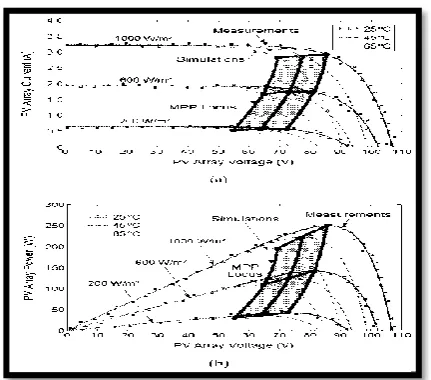
Figure 2 represents the characteristic curves of I-V and P-V for
a 250V-rated PV system when changing the intensity of solar
radiation and cell temperature. In this case, the temperature
was set at 25 ° C and the intensity of the solar radiation was
changed by 200, 600, 1000 W/m
2. Experimental data obtained
using current and voltage measurement devices enabled the
I-V curve to be plotted for the studied units.
Figure 2: V-I and P-VCharacteristics of Solar Cell Affected by
Different Temperature and Solar Radiation
Using the curves of Fig. 2, a specific point is found where the
MPP is maximized. This point depends entirely on the
maximum or optimal solar radiation intensity. The PV output
characteristic curve is divided into two parts: the left part: The
source at which the output current approaches the constant,
and the right part: the voltage source area where the output
voltage is barely changed. The MPP point changes by
changing the intensity of the solar radiation, the angle of the
cell's tilt, and the temperature of the cell itself. It is always
recommended to operate PV systems in MPP (shaded area)
mode to optimize the system output. This method requires
constant modification to face the solar cells and perpendicular
to the sun to reach maximum power output.
B. Equipment
The solar panel used in the tests incorporates a module of (85
W, 12 V). It contains a sensor for the Irradiation and
Temperature. These sensors are Red and Black; to provide the
solar panel power output. Also, the 5-pin terminal provides
irradiation and temperature data. To make it easy to be
handled, the light weight solar module is placed on wheels.
Side of the panel contains a meter for measuring the angle of
the solar panel inclination towards the horizontal surface.The
solar irradiation intensity and the PV temperature sensors used
in the tests were type DELLENZO. These sensors are used to
transfer the heat and the irradiation from the Solar Source
using the connections to the DL Solar device.
Figure3: Solar Panel Equipment Used.
D. Tests procedure
1.
Change the light from (100 ,75, 50, and 25)
2.
Change the resistances from 0 to 1000 Ω and take
reading of power, current, and voltage.
3.
Draw a relationship between current and voltage.
4.
Draw a relationship between power and voltage.
III. RESULTS AND DISCUSSION
www.ijtrd.com
equal to 3.2 Watts, we noted when the power is increased the
voltage will increase for four different lights intensities. In
general, the PV module output power is increased with
elevated solar radiation intensity. This outcome power increase
is related tovoltage increase.
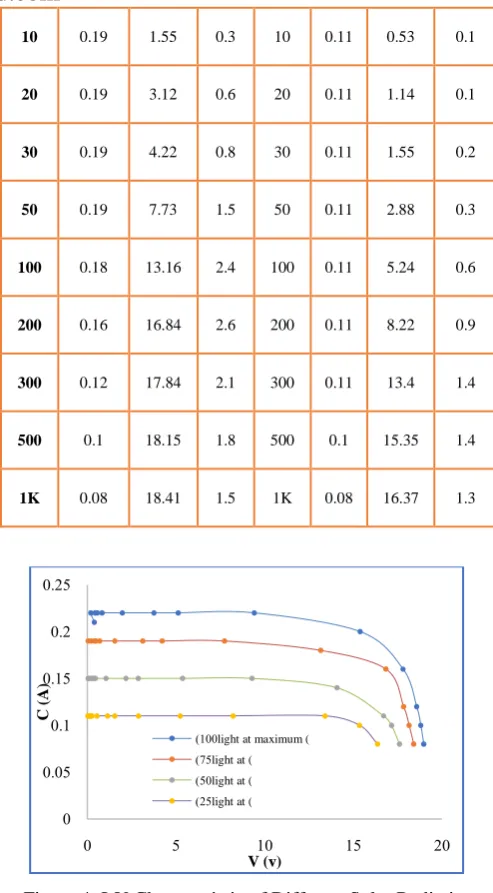
Table 1: data from experiment
Light at (100) Light at (50)
Ω I V P Ω I V P
0 0.21 0.4 0 0 0.15 0.04 0
1 0.22 0.2 0 1 0.15 0.13 0
2 0.22 0.44 0.1 2 0.15 0.25 0
3 0.22 0.57 0.1 3 0.15 0.31 0
5 0.22 0.84 0.2 5 0.15 0.45 0.1
10 0.22 1.98 0.4 10 0.15 1.05 0.2
20 0.22 3.76 0.8 20 0.15 2.17 0.3
30 0.22 5.13 1.1 30 0.15 2.87 0.4
50 0.22 9.42 2 50 0.15 5.37 0.8
100 0.2 15.39 3.1 100 0.15 9.28 1.4
200 0.16 17.81 2.8 200 0.14 14.08 2
300 0.12 18.58 2.2 300 0.11 16.71 1.9
500 0.1 18.81 1.9 500 0.1 17.16 1.7
1K 0.08 18.98 1.6 1K 0.08 17.61 1.5
Light at (75) Light at (25)
Ω I V P Ω I V P
0 0.19 0.04 0 0 0.11 0.03 0
1 0.19 0.21 0 1 0.11 0.08 0
2 0.19 0.4 0.1 2 0.11 0.12 0
3 0.19 0.47 0.1 3 0.11 0.19 0
5 0.19 0.69 0.1 5 0.11 0.25 0
10 0.19 1.55 0.3 10 0.11 0.53 0.1
20 0.19 3.12 0.6 20 0.11 1.14 0.1
30 0.19 4.22 0.8 30 0.11 1.55 0.2
50 0.19 7.73 1.5 50 0.11 2.88 0.3
100 0.18 13.16 2.4 100 0.11 5.24 0.6
200 0.16 16.84 2.6 200 0.11 8.22 0.9
300 0.12 17.84 2.1 300 0.11 13.4 1.4
500 0.1 18.15 1.8 500 0.1 15.35 1.4
1K 0.08 18.41 1.5 1K 0.08 16.37 1.3
Figure 4: I-V Characteristic of Different Solar Radiation
Figure 5: P-V Characteristic of Different Solar Radiation.
CONCLUSION
Iraq suffers from a severe shortage of electricity supplies, and
to this day, this problem has not been solved because of the
decision makers prefer to establish high-cost steam power
stations, which run with fossil fuels. Although Iraq has one of
the world's largest reserves of oil and natural gas, such stations
emit millions of tons of pollutants into the air every year.
Therefore, the shift towards the use of photovoltaic stations
has been introduced as an alternative to these stations. In this
study, the behavior of the photovoltaic cell was understood
0 0.05 0.1 0.15 0.2 0.25
0 5 10 15 20
C
(
A
)
V (v)
light at maximum ( 100
) light at ( 75 )
light at ( 50 )
light at ( 25 )
-0.5
0 0.5 1 1.5 2 2.5 3 3.5
0 5 10 15 20
P
(W
)
V (v)
light at maximum ( 100
) light at ( 75 )
light at ( 50 )
www.ijtrd.com
when solar radiation was increased. The solar cell was tested
by exposing it to four light intensities (25, 50, 75, 100 W) and
found that cell productivity was increased by light intensity, as
the intensity of the radiation increased the energy. There was a
noticeable effect on solar module due to temperature.
References
[1] A. A. Al-Waeely, S. D. Salman, W. K. Abdol-Reza, M. T. Chaichan, H.
A. Kazem and H. S. Al-Jibori, "Evaluation of the spatial distribution of shared electrical generators and their environmental effects at Al-Sader City-Baghdad-Iraq," International Journal of Engineering & Technology IJET-IJENS, vol. 14, No. 2, pp. 16-23, 2014.
[2] K. A. Al-Aasadi, A. A. Al-Waeelyand H. A. Kazem, "Assessment of air
pollution caused by oil investments in Basra Province-Iraq," J Nov. Appl Sci., vol. 4, No. 1, pp. 82-86, 2015.
[3] A. A. Kazem, M. T. Chaichan &H. A. Kazem, "Effect of dust on photovoltaic utilization in Iraq: review article," Renewable and Sustainable Energy Reviews, vol. 37, pp. 734-749, 2014.
[4] B. R. Yaseen, K. A. Al Asaady, A. A. Kazem, M. T. Chaichan,
"Environmental impacts of salt tide in Shatt al-Arab-Basra/Iraq," IOSR Journal of Environmental Science, Toxicology and Food Technology, vol. 10, No. 1-2, pp. 35-43, 2016. DOI :10.9790/2402-10123543
[5] A. A. Al-Waeely, H. N. Al-qaralocy, K. A. Al-Aasadi, M. T. Chaichan,
H. A. Kazem, "The environmental aftermath resulted from chemical bombardment of Halabja Territory for the period 1988-2014," International Journal of Scientific & Engineering Research, vol. 6, N0. 9, pp. 40-44, 2015.
[6] H. A. Kazem, M. T. Chaichan, "Experimental analysis of the
performance characteristics of PEM Fuel Cells," International Journal of Scientific & Engineering Research, vol. 7, No. 2, pp. 49-56, 2016. [7] A. M. J.Mahdy, A. A. Al-Waeely, K. A. Al-Aasadi, "Can Iraq use the
wind energy for power generation?" International Journal of Computation and Applied Sciences IJOCAAS, vol. 3, No. 2, 2017. [8] M. Walker, "Climate of Iraq,"translated by A. A. Al Waeli, K. A.
Al-Aasadi, F. S. Rahem, M. T. Chaichan, Zaki Printing Office Baghdad- Iraq, 2018.
[9] M. T. Chaichan, K. I. Abass&H. M. Salih, "Practical investigation for water solar thermal storage system enhancement using sensible and latent heats in Baghdad-Iraq weathers," Journal of Al-Rafidain University Collage for Science, Issue 33, pp. 158-182, 2014.
[10] M. T. Chaichan, H. A. Kazem &K. I. Abass, "Improving productivity of
solar water distillator linked with salt gradient pond in Iraqi weather," World Congress on Engineering 2012, London, UK, 4-6 July, 2012
[11] M. T. Chaichan, H. A. Kazem, K. I. Abass, A. A. Al- Waeli,
"Homemade solar desalination system for Omani families," International Journal of Scientific & Engineering Research, vol. 7, No. 5, pp.1499-1504, 2016.
[12] M. T. Chaichan, H. A. Kazem, "Single slope solar distillator
productivity improvement using phase change material and Al2O3 nanoparticle," Solar Energy, vol. 164, pp. 370-381, 2018. https://doi.org/10.1016/j.solener.2018.02.049
[13] M. T. Chaichan &H. A. Kazem, "Using aluminum powder with PCM (paraffin wax) to enhance single slope solar water distillator productivity in Baghdad-Iraq winter weathers," International Journal of Renewable Energy Research, vol. 1, No. 5, pp. 151-159, 2015.
[14] M. T. Chaichan, K. I. Abass, H. A. Kazem, "The impact of thermal storage materials on the heating and storage efficiencies of a solar air heater," World Wide Journal of Multidisciplinary Research and Development, vol. 4, No. 6, pp. 121-128, 2018.
[15] M. T. Chaichan, K. I. Abass, M. A. Rasheed and H. A. Kazem, "Using
paraffin wax as a thermal storage material in a solar air heater," International Conference for Renewable Energies, UOT, Baghdad, Iraq, 2013.
[16] M. T. Chaichan, K. I. Abass, R. S. Jawad, A. M. J. Mahdy, "Thermal performance enhancement of simple Trombe wall," International Journal of Computation and Applied Sciences IJOCAAS, vol.2, No. 1, pp. 33-40, 2017.
[17] M. T. Chaichan, K. I. Abass, D. S. M. Al-Zubidi, "A study of a hybrid
solar heat storage wall (Trombe wall) utilizing paraffin wax and water," Journal of Research in Mechanical Engineering, vol. 2, No. 11, pp. 1-7, 2016.
[18] M. T. Chaichan &K. I. Abass, "Experimental study to improve thermal
performance of simple solar energy collecting wall," Industrial Applications of Energy Systems (IAES09), Sohar University, Oman, 2009.
[19] M. T. Chaichan &H. A. Kazem, "Thermal storage comparison for
variable basement kinds of a solar chimney prototype in Baghdad - Iraq weathers," International journal of Applied Science (IJAS), vol.2, No. 2, pp. 12-20, 2011.
[20] M. T. Chaichan, K. I. Abass, H. A. Kazem, H. S. Al Jibori&U.
Abdul-Hussain, "Novel design of solar receiver in concentrated power system,"
International J. of Multidispl. Research &Advcs. in Eng. (IJMRAE), vol. 5, No. 1, pp. 211-226, 2013.
[21] M. T. Chaichan, H. A. Kazem, "Generating Electricity Using
Photovoltaic Solar Plants in Iraq," Springer, ISBN: 978-3-319-75030-9. https://doi.org/10.1007/978-3-319-75031-6
[22] A. H. A. Al-Waeli, H. A. Kazem, M. T. Chaichan, "Review and design
of a standalone PV system performance," International Journal of Computation and Applied Sciences IJOCAAS, vol. 1, No. 1, pp. 1-6, 2016.
[23] H. A. Kazem, F. Hasson and M. T. Chaichan, "Design and analysis of stand-alone solar photovoltaic for desert in Oman," The 3rd Scientific International Conference, Technical College, Najaf, Iraq, 2013
[24] A. A. Al-Waeely, K. A. Al-Aasadi, "Analysis of stand-alone solar
photovoltaic for desert in Iraq," International Research Journal of Advanced Engineering and Science, International Research Journal of Advanced Engineering and Science, vol. 3, No. 2, pp. 204-209, 2018.
[25] M. T. Chaichan, H. A. Kazem, A. M. J.Mahdy&A. A. Al-Waeely,
"Optimal sizing of a hybrid system of renewable energy for lighting street in Salalah-Oman using Homer software," International Journal of Scientific Engineering and Applied Science (IJSEAS), vol.2, No. 5, pp. 157-164, 2016.
[26] H. A. Kazem and M. T. Chaichan, "Design and analysis of standalone solar cells in the desert of Oman," Journal of Scientific and Engineering Research, vol. 3, No. 4, pp. 62-72, 2016.
[27] M. T. Chaichan, H. A. Kazem, A. M. J.Mahdy&A. A. Al-Waeely,
"Optimization of hybrid solar PV/ diesel system for powering telecommunication tower," IJESET, vol. 8, No. 6, pp. 1-10, 2016.
[28] H. A. Kazem, A. H. A. Al-Waeli, M. T. Chaichan, A. S. Al-Mamari, A.
H. Al-Kabi, "Design, measurement and evaluation of photovoltaic pumping system for rural areas in Oman," Environment Development and Sustainability, vol. 19, No. 3, pp. 1041-1053, 2017. DOI: 10.1007/s10668-016-9773-z, 2016.
[29] H. A. Kazem, A. H. A.Al-Waeli, A. S. A. Al-Mamari, A. H. K. Al-Kabi,
M. T. Chaichan, "A photovoltaic application in car parking lights with recycled batteries: A techno-economic study," Australian Journal of Basic and Applied Science, vol. 9, No. 36, pp.: 43-49, 2015.
[30] M. T. Chaichan, H. A. Kazem, "Experimental analysis of solar intensity
on photovoltaic in hot and humid weather conditions," International Journal of Scientific & Engineering Research, vol. 7, No. 3, pp. 91-96, 2016.
[31] M. J. B.Buni, A. A. Al-Waeely, K. A. Al-Aasadi, "Effect of solar radiation on photovoltaic cell," International Research Journal of Advanced Engineering and Science, Volume 3, Issue 3, pp. 47-51, 2018. [32] H. A. Kazem, M. T. Chaichan, "Effect of environmental variables on photovoltaic performance-based on experimental studies," International Journal of Civil, Mechanical and Energy Science (IJCMES), vol. 2, No. 4, pp. 1-8, 2016
[33] M. T. Chaichan, H. A. Kazem, A. A. Kazem, K. I. Abass, K. A. Al-Aasadi, "The effect of environmental conditions on concentrated solar system in desertec weathers," International Journal of Scientific and Engineering Research, vol. 6, No. 5, pp. 850-856, 2015.
[34] H. A. Kazem and M. T. Chaichan, "Effect of humidity on photovoltaic
performance based on experimental study," International Journal of Applied Engineering Research (IJAER), vol. 10, No. 23, pp. 43572-43577, 2015.
[35] R. T. A. Hamdi, S. A. Hafad, H. A. Kazem, M. T. Chaichan, "Humidity
impact on photovoltaic cells performance: A review," International Journal of Recent Engineering Research and Development (IJRERD), vol. 3, No. 11, pp. 27-37, 2018.
[36] C. Schwingshackla, M. Petitta, J.E. Wagner, G. Belluardo, D. Moser, M.
Castelli, M. Zebisch and A. Tetzlaf, "Wind effect on PV module temperature: Analysis of different techniques for an accurate estimation," Energy Procedia, vol. 40, pp. 77 – 86, 2013.
[37] H. A. Kazem, M. T. Chaichan, A. H. Al-Waeli, K. Mani, "Effect of shadows on the performance of solar photovoltaic," Mediterranean Green Buildings & Renewable Energy, pp.379-385, 2017, DOI: 10.1007/978-3-319-30746-6_27
[38] R. S.Jawad, K. I.Abass, A. A. Al-Wailie, D. S M Al-Zubaidi, "Dust effect on PV outcomes at five different sites around Baghdad," Journal of Scientific and Engineering Research, vol.4, No. 7, pp. 93-102, 2017. [39] R. T. A.Hamdi, S. H. Hafed, M. T. Chaichan, H. A. Kazem, "Dust
impact on the photovoltaic outcomes," International Journal of Computation and Applied Sciences, vol. 5, No. 2, pp. 385-390, 2018.
[40] K. S.Rida, A. A. Al-Waeely, K. A. H. Al-Asadi, "The impact of air mass
on photovoltaic panel performance", EngSci Rep; vol. 1, No. 1, pp. 1-9, 2016.http://dx.doi.org/10.18282/ser.v1.i1.41.
[41] A. A. Al-Waeely, K. A. Al-Aasadiand A. M. J.Mahdy, "Effect of tilt angle and temperature on PV performance," Elixir Elec. Eng., vol. 113,pp. 49334-49340, 2017.
[42] J. P. Rama, H.Manghania, D. S. Pillai, T. S.Babu, M.Miyatake, N.
www.ijtrd.com
[43] A. H. A. Al-Waeli, K. Sopian, H. A. Kazem, M. T. Chaichan,
"Nanofluid based grid connected PV/T systems in Malaysia: A techno-economical assessment," Sustainable Energy Technologies and Assessments, vol. 28, pp. 81-95, 2018.
https://doi.org/10.1016/j.seta.2018.06.017
[44] A. H. A. Al-Waeli, K. Sopian, H. A. Kazem and M. T. Chaichan,
"Photovoltaic thermal PV/T systems: A review," International Journal of Computation and Applied Sciences IJOCAAS, vol. 2, No. 2, pp. 62-67, 2017.
[45] A. H. A. Al-Waeli, K. Sopian, J. H. Yousif, H. A. Kazem, J. Boland, M.
T. Chaichan, "Artificial neural network modeling and analysis of
photovoltaic/thermal system based on the experimental study," Energy Conversion and Management, vol. 186, pp. 368–379, 2019.
[46] A. H. A. Al-Waeli, M. T. Chaichan, H. A. Kazem, K. Sopian,
"Evaluation and analysis of nanofluid and surfactant impact on photovoltaic-thermal systems," Case Study in Thermal Engineering, vol. 13, 100392, 2019.
[47]
A. H. A. Al-Waeli, M. T. Chaichan, K. Sopian, H. A. Kazem,"Influence of the base fluid on the thermo-physical properties of nanofluids with surfactant," Case Study of Thermal Engineering, vol. 13, 100340, 2019.