The Thirty-Third AAAI Conference on Artificial Intelligence (AAAI-19)
Scene Text Recognition from Two-Dimensional Perspective
Minghui Liao,
1∗Jian Zhang,
2∗Zhaoyi Wan,
2∗Fengming Xie,
2Jiajun Liang,
2Pengyuan Lyu,
1Cong Yao,
2Xiang Bai
1†1Huazhong University of Science and Technology,2Megvii (Face++)
[email protected], [email protected], [email protected], [email protected], [email protected], [email protected], [email protected], [email protected]
Abstract
Inspired by speech recognition, recent state-of-the-art al-gorithms mostly consider scene text recognition as a se-quence prediction problem. Though achieving excellent per-formance, these methods usually neglect an important fact that text in images are actually distributed in two-dimensional space. It is a nature quite different from that of speech, which is essentially a one-dimensional signal. In principle, directly compressing features of text into a one-dimensional form may lose useful information and introduce extra noise. In this paper, we approach scene text recognition from a two-dimensional perspective. A simple yet effective model, called Character Attention Fully Convolutional Network (CA-FCN), is devised for recognizing the text of arbitrary shapes. Scene text recognition is realized with a semantic seg-mentation network, where an attention mechanism for char-acters is adopted. Combined with a word formation module, CA-FCN can simultaneously recognize the script and pre-dict the position of each character. Experiments demonstrate that the proposed algorithm outperforms previous methods on both regular and irregular text datasets. Moreover, it is proven to be more robust to imprecise localizations in the text detec-tion phase, which are very common in practice.
Introduction
Scene text recognition has been an active research field in computer vision because it is a critical element of a lot of real-world applications, such as street sign reading in the driverless vehicle, human computer interaction, assis-tive technologies for the blind and guide board recogni-tion (Rong, Yi, and Tian 2016; Zhu et al. 2018). As com-pared to the maturity of document recognition, scene text recognition is still a challenging task due to large variations in text shapes, fonts, colors, backgrounds, etc.
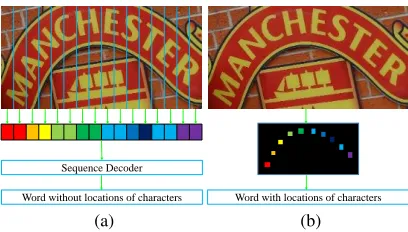
Most of the recent works (Shi, Bai, and Yao 2017; Shi et al. 2016; Zhu, Yao, and Bai 2016) convert scene text recognition into sequence recognition, which hugely simpli-fies the problem and leads to great performance on regular text. As shown in Fig. 1a, they firstly encode the input im-age into a feature sequence and then apply decoders such as
∗
Authors contribute equally.
†
Corresponding author.
Copyright c2019, Association for the Advancement of Artificial
Intelligence (www.aaai.org). All rights reserved.
RNN (Hochreiter and Schmidhuber 1997) and CTC (Graves et al. 2006) to decode the target sequence. These methods produce good results when the text in the image is horizontal or nearly horizontal. However, different from speech, text in scene images is essentially distributed in a two-dimensional space. For example, the distribution of the characters can be scattered, in arbitrary orientations, and even in curve shapes, as shown in Fig. 1. In these cases, roughly encoding the im-ages into one-dimensional sequences may lose key informa-tion or bring undesired noises. (Shi et al. 2016) tried to alle-viate this problem by adopting a Spatial Transform Network (STN) (Jaderberg et al. 2015b) to rectify the shape of the text. Nevertheless, (Shi et al. 2016) still used a sequence-based model, so the effect of the rectification is limited.
Sequence Decoder
Word without locations of characters
(a)
Word with locations of characters
(b)
Figure 1: Illustration of text recognition in one-dimensional and two-dimensional spaces. (a) shows the recognition cedures of sequence-based methods. (b) presents the pro-posed segmentation-based method. Different colors mean different character classes.
loca-+ + +
A
A
A
A
A
+
Convolution
Concat Upsampling
Character attention module Deformable Convolution
H×W×3 𝑯𝟐×𝑾 𝟐×64
𝑯 𝟒×
𝑾 𝟒×128
𝑯 𝟖×
𝑾 𝟖×256
𝑯 𝟖×
𝑾 𝟖×512
𝑯 𝟖×
𝑾 𝟖×512
𝑯 𝟖×
𝑾 𝟖×128
𝑯 𝟖×
𝑾 𝟖×128
𝑯 𝟒×
𝑾 𝟒×128
𝑯 𝟐×
𝑾 𝟐×128
𝑯 𝟐×
𝑾 𝟐×C Input
stage-1 stage-2 stage-3 stage-4 stage-5
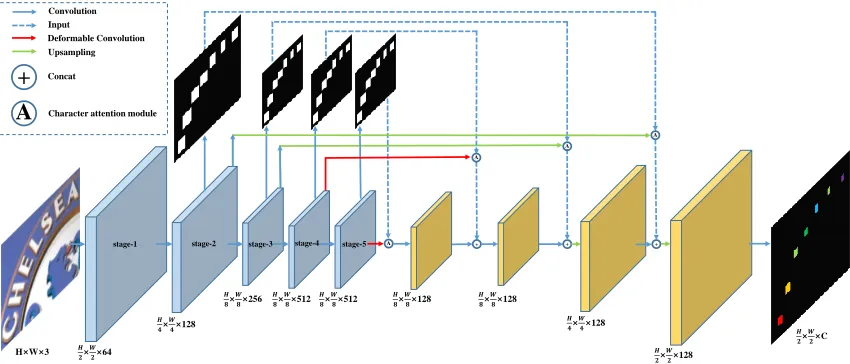
Figure 2: Illustration of the CA-FCN. The blue feature maps in the left are inherited from the VGG-16 backbone; The yellow feature maps in the right are extra layers. H, W mean the height and width of the input image; C is the number of classes.
tion of each character, can be obtained by a word formation module, as shown in Fig. 1b. In this way, the procedures of compressing and slicing the features, which are widely used in the sequence-based methods, are avoided. Profiting from the higher dimensional perspective, the proposed method is much more robust than the previous sequence-based meth-ods in terms of text shapes, background noises, and impre-cise localizations from the detection stage (Liao et al. 2017; Liao, Shi, and Bai 2018; Liao et al. 2018). Character-level annotations are needed in our proposed method. However, the character annotations are free of labor because only pub-lic synthetic data is used in the training period, where the annotations are easy to obtain.
The contributions of this paper can be summarized as follows: (1) A totally different perspective for recogniz-ing scene text is proposed. Different from the recent works which treat the text recognition problem as a sequence recognition problem in one-dimensional space, we propose to solve the problem in two-dimensional space. (2) We de-vise character attention FCN for scene text recognition. To the best of our knowledge, which can deal with images of arbitrary height and width, as well as naturally recog-nize text in various shapes, including but not limited to ori-ented and curve shapes. (3) The proposed method achieves state-of-the-art performance on regular datasets and outper-forms the existing methods with a large margin on irregular datasets. (4) We investigate the network’s robustness to im-precise localization in the text detection phase for the first time. This problem is important in real-world applications but was previously ignored. Experiments show that the pro-posed method is more robust to imprecise localization (see . Ablation study).
Related Work
Traditionally, scene text recognition systems firstly detect each character, using binarization or sliding-window opera-tion, then recognize these characters as a word.
Binarization-based methods, such as Extremal Regions (Novikova et al. 2012) and Niblack’s adaptive binarization (Bissacco et al. 2013), find character pixels after binarization. However, text in the natural scene image may have varying backgrounds, fonts, colors or uneven illumination and so on, which bina-rization based methods can hardly handle. Sliding window methods use multi-scale sliding window strategy to local-ize characters from the text image directly, such as Ran-dom Ferns (Wang, Babenko, and Belongie 2011), Integer Programming (Smith, Feild, and Learned-Miller 2011) and Convolutional Neural Network (CNN) (Jaderberg, Vedaldi, and Zisserman 2014). For the word recognition stage, com-mon methods are integrating contextual information with character classification scores, such as Pictorial Structure models, Bayesian inference, and Conditional Random Field (CRF), which are employed in (Wang, Babenko, and Be-longie 2011; Weinman, Learned-Miller, and Hanson 2009; Mishra, Alahari, and Jawahar 2012a; 2012b; Shi et al. 2013). Inspired by speech recognition, recent works designed an encoder-decoder framework, where text in images are en-coded into feature sequences and then deen-coded as characters. With the development of the deep neural network, convolu-tional features are extracted at encoder stage, and then RNN or CNN network is applied to decode these features, then CTC is used to form the final word. This framework was pro-posed by (Shi, Bai, and Yao 2017). Later they also developed an attention-based STN for rectifying text distortion, which is useful to recognize curved scene text (Shi et al. 2016). Based on this framework, subsequent works (He et al. 2016; Wu et al. 2016; Liu, Chen, and Wong 2018) also focus on irregular scene text.
compress-ing a text image into a feature sequence may lose key in-formation and add extra noise, especially when the text is curved or seriously distorted.
There are some works that tried to improve some dis-advantages of the encoder-decoder framework. (Bai et al. 2018) found that when considering the scene text recog-nition problem under the attention-based encoder-decoder framework, the misalignment between the ground truth strings and the attention’s output sequences of the probabil-ity distribution, which is caused by missing or superfluous characters, will confuse and mislead the training process. To handle this problem, they propose a method called edit probability which considered losses including not only the probability distribution but also the possible occurrences of missing/superfluous characters. (Cheng et al. 2018) aimed to handle oriented text and realized that it is hard for the current encoder-decoder framework to capture the deep features of the oriented text. To solve this problem, they encode the in-put image to four feature sequences of four directions to ex-tract scene text features in those directions. (Lyu et al. 2018) proposed an instance segmentation model for word spotting, which uses an FCN-based method in its recognition part. However, it focused on the end-to-end word spotting task and no discussion is applied to verify the recognition part.
In this paper, we consider text recognition from the two-dimensional perspective and design a character attention FCN to deal with text recognition problem, which can nat-urally avoid those disadvantages of the encoder-decoder frameworks. For example, compressing a text image into a feature sequence may lose key information and add extra noise, especially when the text is curved or seriously dis-torted. The proposed method obtains high accuracy on both regular and irregular text, Meanwhile, it is also robust to im-precise localization in the text detection phase.
Methodology
Overview
The whole architecture of our proposed method consists of two parts. The first part is a Character Attention FCN (CA-FCN) which predicts the characters at pixel level. Another part is a word formation module which groups and arranges the pixels to form the final word result.
Character attention FCN
The architecture of CA-FCN is basically a fully convolu-tional network, as shown in Fig. 2. We use VGG-16 as the backbone while dropping the fully connected layers and re-moving its pooling layers of stage-4 and stage-5. Besides, a pyramid-like structure (Lin et al. 2017) is adopted to han-dle varying scales of characters. The final output is of shape
H
2 ×
W
2 ×C, whereH,W are the height and width of the
input image andCis the number of classes including charac-ter categories and background. It can handle text of various shapes by predicting characters in a two-dimensional space.
Character attention module Attention module plays an important role in our network. Natural scene text recogni-tion suffers from complex backgrounds, shadow, irrelevant
symbols and so on. Moreover, characters in natural images are usually crowded, which can hardly be separated. To deal with those problems, inspired by (Wang et al. 2017), we propose a character attention module to highlight the fore-ground characters and weaken the backfore-ground, as well as separate adjacent characters, as illustrated in Fig. 2. Atten-tion module is appended to each output layer of VGG16. The low-level attention models mainly focus on the appearance, such as edge, color, and texture. And the high-level modules can extract more semantic information. The character atten-tion module can be expressed as follows:
Fo=Fi⊗(1 +A) (1)
whereFi andFo are the input and output feature map
re-spectively;Aindicates the attention map;⊗means element-wise multiplication. The attention map is generated by two convolutional layers and a two-class (characters and back-ground) soft-max function where 0represents background and1indicates characters. The attention mapAis broadcast to the same shape asFito achieve element-wise
multiplica-tion. Compared with (Wang et al. 2017), our character atten-tion module uses a simpler network structure, profiting from the character supervision. The effectiveness of the character attention module is discussed in Sec. Ablation study.
(a) (b)
Figure 3: Illustration of our deformable convolution. (a) nor-mal convolution; (b) deformable convolution with3∗1 con-volution. The green boxes indicate convolutional kernels. The yellow boxes mean the regions covered by receptive fields. The receptive fields out of the image are clipped.
effectiveness of the deformable convolution is discussed in Sec. Ablation study by experiments.
Training
Label generation Letb = (xmin, ymin, xmax, ymax)be
the original bounding boxes of characters, which can be ex-pressed as the minimum axis-aligned rectangle boxes that covers the characters. The ground truth character regions g= (xgmin, ygmin, xg
max, ygmax)can be calculated as follows:
w=xmax−xmin
h=ymax−ymin
xgmin = (xmin+xmax−w×r)/2
yming = (ymin+ymax−h×r)/2
xgmax= (xmin+xmax+w×r)/2
ygmax= (ymin+ymax+h×r)/2
(2)
where r is the shrink ratio of the character regions. We shrink the character regions because the adjacent characters tend to be overlapped without shrinking. The shrink process can reduce the difficulty of the word formation. Specifically, we setrto0.5and0.25for the attention supervision and the final output supervision respectively.
(a) (b) (c)
Figure 4: Illustration of ground truth generation. (a) Original bounding boxes; (b) Ground truth for character attention; (c) Ground truth for character prediction, where different colors represent different character classes.
Loss function The loss function is a weighted sum of the character prediction loss functionLp and the character
at-tention loss functionLa:
L=Lp+α
5 X
s=2
Lsa (3)
wheresindicates the index of the stages, as shown in Fig. 2; αis empirically set to1.0.
The final output of the CA-FCN is of shapeH2 ×W
2 ×C,
whereH, W are the height and width of an input image respectively. C is the number of classes including charac-ter classes and background. Assume that Xi,j,c is one of
the element of the output map, wherei ∈ {1, ...,H2},j ∈ {1, ...,W
2}, andc∈ {0,1, ..., C−1};Yi,j∈ {0,1, ..., C−1}
indicates the corresponding class label. The prediction loss can be calculated as follows:
Lp=−
4
H×W
H/2 X
i=1
W/2 X
j=1
Wi,j(
C−1 X
c=0
(Yi,j==c)log(
eXi,j,c
PC−1
k=0 eXi,j,k )),
(4)
whereWi,j is the corresponding weight of each pixel.
As-sume thatN = H
2 ×
W
2 andNnegis the number of
back-ground pixels. The weight can be calculated as follows:
Wi,j=
Nneg/(N−Nneg) ifYi,j>0,
1 otherwise (5)
The character attention loss function is a binary cross en-tropy loss function which take all characters labels as 1, background label as0:
Lsa =− 4
Hs×Ws Hs/2
X
i=1
Ws/2
X
j=1 (
1 X
c=0
(Yi,j==c)log(
eXi,j,c
P1
k=0eXi,j,k ),
(6)
whereHsandWs are the height and width of the feature
map in the corresponding stagesrespectively.
Word formation module
The word formation module converts the accurate, two-dimensional character maps predicted by CA-FCN into character sequence. As shown in Fig. 5, we firstly transform the character prediction map into a binary map with a thresh-old to extract the corresponding character regions; then, we calculate the average values of each region forCclasses and assign the class with the largest average value to the corre-sponding region; finally, the word is formed by sorting the regions from left to right. In this way, both the word and lo-cation of each character are produced. The word formation module assumes that words are roughly sorted from left to right, which may not work in certain scenarios. However, if necessary, a learnable component can be plugged into CA-FCN. The word formation module is simple yet effective, with only one hyper-parameter (the threshold to form binary map), which is set to240/255for all experiments.
Experiments
Datasets
Our proposed CA-FCN is purely trained on the synthetic datasets without real-world images. The trained model, without further fine-tuning, was evaluated on 4 benchmarks including regular and irregular text datasets.
SynthTextis a synthetic text dataset proposed in (Gupta, Vedaldi, and Zisserman 2016). It contains 800,000 training images which are aimed at text detection. We crop them based on their word bounding boxes. It generates about 7 million images for text recognition. These images are with character-level annotations.
IIIT5k-Words (IIIT) (Mishra, Alahari, and Jawahar 2012b) consists of 3000 test images collected from the web. It provides two lexicons for each image in the dataset, which contains 50 words and 1000 words respectively.
RO
N A L D
O RONALDO
(a) Input image (b) Character prediction map
(c) Binary map (d) Character voting (e) Word
Figure 5: Illustration of the word formation module.
hollywood
atmosphere
freewaybillboard
broad
ronaldo
ballys
football
football
meant
united
snack
Figure 6: Visualization of character prediction maps on IIIT and CUTE. The character prediction map generated by the CA-FCN is visualized with colors.
ICDAR 2013(IC13) (Karatzas et al. 2013) contains 1015 images and no lexicon is provided. We remove images that contain non-alphanumeric characters or have less than three characters, following previous works.
CUTE(Risnumawan et al. 2014) is a dataset consists of 288 images with a lot of curved text. It is challenging be-cause the shapes vary hugely. No lexicon is provided.
Implementation details
Training Since our network is fully convolutional, there is no restriction on the size of input images. We adopt multi-scale training to make our model more robust. The input images are randomly resized to32×128,48×192, and
64 ×256. Besides, data augmentation is also applied in the training period, including random rotation, hue, bright-ness, contrast, and blur. Specifically, we randomly rotate the image with an angle in the range of[−15◦,15◦]. We use Adam (Kingma and Ba 2014) to optimize our training with the initial learning rate10−4. The learning rate is decreased
to10−5 and 10−6 at epoch 3 and epoch 4. The model is
totally trained for about 5 epochs. The number of charac-ter classes is set to38, including26 alphabet, 10digitals,
1special character which represents those characters out of alphabet and digitals, and1background.
Testing At runtime, images are resized toHt×Wt, where
Htis fixed to64andWtis calculated as follows:
Wt=
W
∗Ht/H ifW/H >4,
256 otherwise (7)
whereH andW are the height and width of the origin im-ages.
The speed is about45FPS on IC13 dataset with a batch size of 1, where the CA-FCN costs0.018second per image and word formation module costs 0.004 second per image on average. Higher speed can be achieved if the batch size increases. We test our method with a single Titan Xp GPU.
Performances on benchmarks
We evaluate our method on several benchmarks to indicate the superiority of the proposed method. Some results of IIIT and CUTE are visualized in Fig. 6. As can be seen, our pro-posed method can handle various shapes of text.
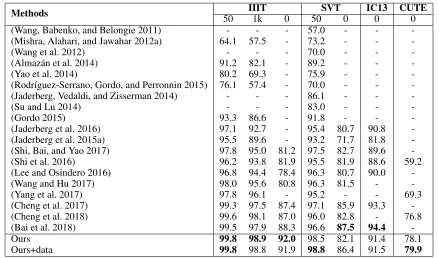
Quantitative results are listed in Tab. 1. Compared to previous methods, our proposed method achieves state-of-the-art performance on most of those benchmarks. More specifically, “Ours” outperforms the previous state-of-the-art by 3.7 percents on IIIT without lexicons. On irregular text dataset CUTE, 3.1 percents improvement is achieved by “Ours”. Note that no extra training data for curved text is included to achieve this performance. Comparable results are also performed on other datasets, including SVT, IC13.
Table 1: Results across different methods and datasets. “50” and “1k” indicate the sizes of the lexicons. “0” means no lexicon. “data” indicates using extra synthetic data to fine-tune the model.
Methods IIIT SVT IC13 CUTE
50 1k 0 50 0 0 0
(Wang, Babenko, and Belongie 2011) - - - 57.0 - -
-(Mishra, Alahari, and Jawahar 2012a) 64.1 57.5 - 73.2 - -
-(Wang et al. 2012) - - - 70.0 - -
-(Almaz´an et al. 2014) 91.2 82.1 - 89.2 - -
-(Yao et al. 2014) 80.2 69.3 - 75.9 - -
-(Rodr´ıguez-Serrano, Gordo, and Perronnin 2015) 76.1 57.4 - 70.0 - -
-(Jaderberg, Vedaldi, and Zisserman 2014) - - - 86.1 - -
-(Su and Lu 2014) - - - 83.0 - -
-(Gordo 2015) 93.3 86.6 - 91.8 - -
-(Jaderberg et al. 2016) 97.1 92.7 - 95.4 80.7 90.8
-(Jaderberg et al. 2015a) 95.5 89.6 - 93.2 71.7 81.8
-(Shi, Bai, and Yao 2017) 97.8 95.0 81.2 97.5 82.7 89.6
-(Shi et al. 2016) 96.2 93.8 81.9 95.5 81.9 88.6 59.2
(Lee and Osindero 2016) 96.8 94.4 78.4 96.3 80.7 90.0
-(Wang and Hu 2017) 98.0 95.6 80.8 96.3 81.5 -
-(Yang et al. 2017) 97.8 96.1 - 95.2 - - 69.3
(Cheng et al. 2017) 99.3 97.5 87.4 97.1 85.9 93.3
-(Cheng et al. 2018) 99.6 98.1 87.0 96.0 82.8 - 76.8
(Bai et al. 2018) 99.5 97.9 88.3 96.6 87.5 94.4
-Ours 99.8 98.9 92.0 98.5 82.1 91.4 78.1
Ours+data 99.8 98.8 91.9 98.8 86.4 91.5 79.9
algorithm of SynthText with the lexicon used in Synth90k. As shown in Tab. 1, after fine-tuning with the extra data, “Ours+data” also outperforms (Cheng et al. 2017) on SVT.
(Bai et al. 2018) improves (Cheng et al. 2017; Shi et al. 2016) by solving their misalignment problem and achieves excellent results in regular text recognition. However, it may fail in irregular text benchmarks such as CUTE due to its one-dimensional perspective. Moreover, we argue that our method can be further improved if the idea of (Bai et al. 2018) is well adapted to our word formulation module. Nev-ertheless, our method outperforms (Bai et al. 2018) on most of the benchmarks in Tab. 1, especially on IIIT and CUTE.
(Cheng et al. 2018) focuses on dealing with arbitrary-oriented text by introducing four one-dimensional feature sequences with different directions adaptively. Our method is more superior in recognizing the text of irregular shapes such as curve shape. As shown in Tab. 1, our method outper-forms (Cheng et al. 2018) on all benchmarks.
Ablation study
Scene text recognition is usually a following step of scene text detection, whose results may be not as accurate as ex-pected. Thus, performances of text spotting systems in real-world applications are significantly affected by the robust-ness of text recognition algorithms on expanded images. We conduct experiments with expanded datasets to show the ef-fect of text bounding box variance on recognition and prove the robustness of our method.
For the datasets which have the original background, such as IC13, we expand their bounding boxes and then crop them from the original images. If no extra background is provided
like IIIT, padding by repeating the border pixels is applied to these images. The expanded datasets are described below:
IIIT-pPadding the images in IIIT with extra10%height ver-tically and10%width horizontally by repeating the border pixels.
IIIT-r-p Separately stretching the four vertexes of the im-ages in IIIT with a random scale up to 20%of height and width respectively; border pixels are repeated to fill the quadrilateral images; images are transformed back to axis-aligned rectangles.
IC13-ex Expanding the bounding boxes of the images in IC13 to expanded rectangles with extra 10% height and width before cropping.
IC13-r-exExpanding the bounding boxes of the images in IC13 randomly with a maximum20%of width and height to form expanded quadrilaterals; The pixels in axis-aligned circumscribed rectangles of those images are cropped.
We compare our method with two representative sequence-based models including CRNN (Shi, Bai, and Yao 2017) and Attention Convolutional Sequence Model (ACSM) (Gao et al. 2017). The model of CRNN is pro-vided by its authors and the model of (Gao et al. 2017) is re-implemented by ourself with the same training data as ours. Qualitative results of the three methods are visualized in Fig. 7. As can be observed, the sequence-based models usually predict extra characters if the images are expanded while CA-FCN is stable and robust.
CRNN Image
ACSM
yest IIIT-p
yes
nestled
nestle
yes petit
IIIT-r-p
hheart
heart
rmotion
motion
suller depp
wword IC13-ex
word
hellmanni
hellmann
word hellmann place
IC13-r-ex
place
ivideos
videos
iideos splace
Ours
Figure 7: Visualization of the character prediction maps on expanded datasets. Red: wrong results; Green: correct results.
Table 2: Experimental results on expanded datasets. “ac”: accuracy; “gap”: the gap between the original dataset; “ratio” indicates the decreasing ratio compared to the accuracy on the original dataset. “a”: character attention; “d”: deformable convolution.
Methods IIIT IIIT-p IIIT-r-p IC13 IC13-ex IC13-r-ex
ac ac gap ratio ac gap ratio ac ac gap ratio ac gap ratio
CRNN 81.2 76.0 -5.2 6.4% 72.4 -8.8 10.8% 89.6 81.9 -7.7 8.6% 76.7 -12.9 14.4%
ACSM 85.4 79.1 -6.3 7.4% 74.9 -10.5 12.3% 88.0 81.2 -6.8 7.7% 70.0 -18.0 20.5%
baseline 90.5 87.0 -3.5 3.9% 85.7 -4.8 5.3% 90.5 83.2 -7.3 8.1% 82.3 -8.2 9.1%
baseline + a 91.0 86.7 -4.3 4.7% 85.7 -5.3 5.8% 90.1 85.6 -4.5 5.0% 83.0 -7.1 7.9%
baseline + d 91.4 87.6 -3.8 4.2% 86.7 -4.7 5.1% 91.1 87.4 -3.7 4.1% 84.2 -6.9 7.6%
baseline + a + d 92.0 89.3 -2.7 2.9% 87.6 -4.4 4.8% 91.4 87.2 -4.2 4.6% 83.8 -7.6 8.3%
is only2.6%. Note that even though our performances on the standard datasets are higher, the gaps of ours are still much smaller than CRNN. As shown in Tab. 2, both the de-formable module and the attention module can improve the performance and the former also contributes to the robust-ness of the model. It indicates the effectiverobust-ness of the de-formable convolution and the character attention module.
The possible reasons that our method is more robust than previous sequence-based models on expanded images could be: Sequence-based models are in one-dimensional perspec-tive, which are hard to endure extra background because the background noises are easy to encode into the feature se-quence. In contrast, our method predicts the characters in a two-dimensional space, where both the characters and the background are the targeted predicting objects. The extra background is less likely to mislead the prediction of the characters.
Conclusion
In this paper, we have presented a method called Character Attention FCN (CA-FCN) for scene text recognition, which models the problem in a two-dimensional fashion. By per-forming character classification at each pixel location, the al-gorithm can effectively recognize irregular as well as regular text instances. Experiments show that the proposed model outperforms existing methods on datasets with regular and irregular text. We also analyzed the impact of imprecise text localization to the performances of text recognition algo-rithms and proved that our method is much more robust. For future research, we will make the word formation module learnable and build an end-to-end text spotting system.
Acknowledgments This work was supported by National Key R&D Program of China No. 2018YFB1004600, NSFC 61733007, to Dr. Xiang Bai by the National Program for Support of Top-notch Young Professionals and the Program for HUST Academic Frontier Youth Team.
References
Almaz´an, J.; Gordo, A.; Forn´es, A.; and Valveny, E. 2014. Word spotting and recognition with embedded attributes.
IEEE Trans. Pattern Anal. Mach. Intell.36(12):2552–2566.
Bai, F.; Cheng, Z.; Niu, Y.; Pu, S.; and Zhou, S. 2018. Edit probability for scene text recognition. InProc. CVPR.
Bissacco, A.; Cummins, M.; Netzer, Y.; and Neven, H. 2013. Photoocr: Reading text in uncontrolled conditions. InProc. ICCV, 785–792.
Cheng, Z.; Bai, F.; Xu, Y.; Zheng, G.; Pu, S.; and Zhou, S. 2017. Focusing attention: Towards accurate text recognition in natural images. InProc. ICCV, 5086–5094.
Cheng, Z.; Xu, Y.; Bai, F.; Niu, Y.; Pu, S.; and Zhou, S. 2018. Aon: Towards arbitrarily-oriented text recognition. InProc. CVPR, 5571–5579.
Dai, J.; Qi, H.; Xiong, Y.; Li, Y.; Zhang, G.; Hu, H.; and Wei, Y. 2017. Deformable convolutional networks. InProc. ICCV, 764–773.
Gao, Y.; Chen, Y.; Wang, J.; and Lu, H. 2017. Reading scene text with attention convolutional sequence modeling. CoRR
abs/1709.04303.
Gordo, A. 2015. Supervised mid-level features for word image representation. InCVPR, 2956–2964.
Graves, A.; Fern´andez, S.; Gomez, F. J.; and Schmidhuber, J. 2006. Connectionist temporal classification: labelling un-segmented sequence data with recurrent neural networks. In
Proc. ICML, 369–376.
Gupta, A.; Vedaldi, A.; and Zisserman, A. 2016. Synthetic data for text localisation in natural images. InProc. CVPR, 2315–2324.
He, P.; Huang, W.; Qiao, Y.; Loy, C. C.; and Tang, X. 2016. Reading scene text in deep convolutional sequences. In
Hochreiter, S., and Schmidhuber, J. 1997. Long short-term memory.Neural computation9(8):1735–1780.
Jaderberg, M.; Simonyan, K.; Vedaldi, A.; and Zisserman, A. 2014. Synthetic data and artificial neural networks for natural scene text recognition.CoRRabs/1406.2227.
Jaderberg, M.; Simonyan, K.; Vedaldi, A.; and Zisserman, A. 2015a. Deep structured output learning for unconstrained text recognition. InProc. ICLR.
Jaderberg, M.; Simonyan, K.; Zisserman, A.; et al. 2015b. Spatial transformer networks. InProc. NIPS, 2017–2025. Jaderberg, M.; Simonyan, K.; Vedaldi, A.; and Zisserman, A. 2016. Reading text in the wild with convolutional neural networks. IJCV116(1):1–20.
Jaderberg, M.; Vedaldi, A.; and Zisserman, A. 2014. Deep features for text spotting. InProc. ECCV, 512–528. Karatzas, D.; Shafait, F.; Uchida, S.; Iwamura, M.; i Big-orda, L. G.; Mestre, S. R.; Mas, J.; Mota, D. F.; Almazan, J. A.; and de las Heras, L. P. 2013. Icdar 2013 robust read-ing competition. InProc. ICDAR, 1484–1493.
Kingma, D. P., and Ba, J. 2014. Adam: A method for stochastic optimization.CoRRabs/1412.6980.
Lee, C., and Osindero, S. 2016. Recursive recurrent nets with attention modeling for OCR in the wild. In Proc. CVPR, 2231–2239.
Liao, M.; Shi, B.; Bai, X.; Wang, X.; and Liu, W. 2017. Textboxes: A fast text detector with a single deep neural net-work. InProc. AAAI, 4161–4167.
Liao, M.; Zhu, Z.; Shi, B.; Xia, G.-s.; and Bai, X. 2018. Rotation-sensitive regression for oriented scene text detec-tion. InProc. CVPR, 5909–5918.
Liao, M.; Shi, B.; and Bai, X. 2018. Textboxes++: A single-shot oriented scene text detector. IEEE Trans. Image Pro-cessing27(8):3676–3690.
Lin, T.; Doll´ar, P.; Girshick, R. B.; He, K.; Hariharan, B.; and Belongie, S. J. 2017. Feature pyramid networks for object detection. InProc. CVPR, 936–944.
Liu, W.; Chen, C.; and Wong, K. K. 2018. Char-net: A character-aware neural network for distorted scene text recognition. InProc. AAAI, 7154–7161.
Long, J.; Shelhamer, E.; and Darrell, T. 2015. Fully convolu-tional networks for semantic segmentation. InProc. CVPR, 3431–3440.
Lyu, P.; Liao, M.; Yao, C.; Wu, W.; and Bai, X. 2018. Mask textspotter: An end-to-end trainable neural network for spot-ting text with arbitrary shapes. InProc. ECCV, 71–88. Mishra, A.; Alahari, K.; and Jawahar, C. V. 2012a. Scene text recognition using higher order language priors. InProc. BMVC, 1–11.
Mishra, A.; Alahari, K.; and Jawahar, C. V. 2012b. Top-down and bottom-up cues for scene text recognition. In
Proc. CVPR, 2687–2694.
Novikova, T.; Barinova, O.; Kohli, P.; and Lempitsky, V. S. 2012. Large-lexicon attribute-consistent text recognition in natural images. InProc. ECCV, 752–765.
Risnumawan, A.; Shivakumara, P.; Chan, C. S.; and Tan, C. L. 2014. A robust arbitrary text detection system for natural scene images.Expert Syst. Appl.41(18):8027–8048. Rodr´ıguez-Serrano, J. A.; Gordo, A.; and Perronnin, F. 2015. Label embedding: A frugal baseline for text recog-nition.Int. J. Comput. Vision113(3):193–207.
Rong, X.; Yi, C.; and Tian, Y. 2016. Recognizing text-based traffic guide panels with cascaded localization network. In
Proc. ECCV Workshops, 109–121.
Shi, B.; Bai, X.; and Yao, C. 2017. An end-to-end trainable neural network for image-based sequence recognition and its application to scene text recognition.IEEE Trans. Pattern Anal. Mach. Intell.39(11):2298–2304.
Shi, C.; Wang, C.; Xiao, B.; Zhang, Y.; Gao, S.; and Zhang, Z. 2013. Scene text recognition using part-based tree-structured character detection. InProc. CVPR, 2961–2968. Shi, B.; Wang, X.; Lyu, P.; Yao, C.; and Bai, X. 2016. Robust scene text recognition with automatic rectification. InProc. CVPR, 4168–4176.
Smith, D. L.; Feild, J. L.; and Learned-Miller, E. G. 2011. Enforcing similarity constraints with integer programming for better scene text recognition. InProc. CVPR, 73–80. Su, B., and Lu, S. 2014. Accurate scene text recognition based on recurrent neural network. InProc. ACCV, 35–48. Wang, J., and Hu, X. 2017. Gated recurrent convolution neural network for OCR. InProc. NIPS, 334–343.
Wang, K.; Babenko, B.; and Belongie, S. J. 2011. End-to-end scene text recognition. InProc. ICCV, 1457–1464. Wang, T.; Wu, D. J.; Coates, A.; and Ng, A. Y. 2012. End-to-end text recognition with convolutional neural networks. InProc. ICPR, 3304–3308.
Wang, F.; Jiang, M.; Qian, C.; Yang, S.; Li, C.; Zhang, H.; Wang, X.; and Tang, X. 2017. Residual attention network for image classification. InProc. CVPR, 6450–6458. Weinman, J. J.; Learned-Miller, E. G.; and Hanson, A. R. 2009. Scene text recognition using similarity and a lexicon with sparse belief propagation. IEEE Trans. Pattern Anal. Mach. Intell.31(10):1733–1746.
Wu, R.; Yang, S.; Leng, D.; Luo, Z.; and Wang, Y. 2016. Random projected convolutional feature for scene text recognition. InProc. ICFHR, 132–137.
Yang, X.; He, D.; Zhou, Z.; Kifer, D.; and Giles, C. L. 2017. Learning to read irregular text with attention mechanisms. InProc. IJCAI, 3280–3286.
Yao, C.; Bai, X.; Shi, B.; and Liu, W. 2014. Strokelets: A learned multi-scale representation for scene text recognition. InProc. CVPR, 4042–4049.
Zhu, Y.; Liao, M.; Yang, M.; and Liu, W. 2018. Cascaded segmentation-detection networks for text-based traffic sign detection. IEEE Trans. Intelligent Transportation Systems
19(1):209–219.