451
Copyright © 2011-15. Vandana Publications. All Rights Reserved.
Volume-5, Issue-3, June-2015
International Journal of Engineering and Management Research
Page Number: 451-457
Check Point Algorithm for Reducing Coordination Overhead in
Distributed System
Pallavi Kaura1, Dr. Mohita2 1
Research Scholar, North West Institute of Engineering & Technology, INDIIA 2Associate Professor, North West Institute of Engineering & Technology, INDIA
ABSTRACT
A distributed system is composed of multiple independent machines that communicate using messages. Faults in a large distributed system are common events. Without fault tolerance mechanisms, an application running on a system has to be restarted from scratch if a fault happens in the middle of its execution, resulting in loss of useful computation. Checkpoint and Recovery mechanisms are used in distributed systems to provide fault tolerance for such applications. A checkpoint of a process is the information about the state of a process at some instant of time. A checkpoint of a distributed application is a set of checkpoints, one from each of its processes, satisfying certain constraints. If a fault occurs, the application is started from an earlier checkpoint instead of being restarted from scratch to save some of the computation. The total running time of an application is depend on the execution time of the application and the amount of checkpointing overhead that incurs with the application. We should minimize this checkpointing overhead. Checkpointing overhead is the combination of context saving overhead and coordination overhead. Storing the context of application over stable storage also increases the overhead. In periodic interval checkpointing, sometimes processes takes checkpoints though it is not much useful. These unnecessary checkpoints increase the application’s running time. We have proposed an algorithm which determines checkpointing interval dynamically, based on expected recovery time, to avoid unnecessary checkpoints.
Keywords--- Checkpointing algorithms; parallel & distributed computing; shared memory systems; rollback recovery; fault-tolerant systems, Distributed system, coordinated checkpointing, causal dependence, nonblocking, consistent checkpoints.
I.
INTRODUCTION
1.1 DISTRIBUTED SYSTEM
A distributed system consists of a collection of independent computers that appears it’s user as a single coherent system. These computers are communicated with each other by exchanging messages over a communication network. The machines in Distributed System other their resources for collective computation. These resources can be of various types such as storage devices, printers, computational nodes etc. The main objectives of the distributed system are to achieve high throughput for distributed application and to increase accessibility to resources not commonly available to a single machine. A distributed application is composed of several processes running on different nodes of a distributed system and communicating through messages.
1.2 FAULT TOLERANCE IN DISTRIBUTED SYSTEM
Distributed systems are composed of multiple computing resources connected by co-communication links. Nodes in a Distributed System are susceptible to failures for many different reasons. Failure of nodes and links are assumed to be independent, larger the system, higher is its probability of failure. To provide fault tolerance, it is essential to understand the nature of the faults that occur in these systems. There are mainly two kinds of faults: permanent and transient [15]. Permanent faults are caused by permanent damage to one or more components and transient faults are caused by changes in environmental conditions. Permanent faults can be rectified by repair or replacement of components. Transient faults remain for a short duration of time and are difficult to detect and deal with. Hence, it is necessary to provide fault tolerance particularly for transient failures in distributed system.
1.3 MOTIVATION
452
Copyright © 2011-15. Vandana Publications. All Rights Reserved.
of its ability to recover a process from failure withoutcomplete restart of the application. In a failure prone environment, a checkpoint and recovery protocol saves recomputation and as a result reduces application completion time and increases throughput of the system. Better the performance of a checkpoint and recovery protocol better is the throughput of a system. The performance of a checkpoint and recovery protocol depends on the overheads it incurs against the amount of computation the protocol can save during recovery.
II.
CHECKPOINT
Checkpoint is defined as a designated place in a program
at which normal processing is interrupted specifically to preserve the status information necessary to allow resumption of processing at a later time. Checkpointing is the process of saving the status information. A checkpoint of a process is the information about the state of a process at some instant of time. Fault tolerance through checkpoint and recovery techniques includes taking checkpoint of an application process periodically and logging the checkpoint in a stable storage which is immune to failures.
2.1 ASPECTS OF CHECKPOINTING
Some of the aspects to be considered with checkpointing are frequency of checkpointing, contents of a checkpoint and methods of checkpointing [15].
2.1.1 Frequency of Checkpointing
A checkpointing algorithm executes in parallel with the underlying computation. Therefore, the overheads introduced due to checkpointing should be minimised. Checkpointing should enable a user to recover quickly and not to lose substantial computation in case of an error, which necessitates frequent checkpointing and consequently significant overhead. The number of checkpoints initiated should be such that the cost of information loss due to failure is small and the overhead due to checkpointing is not significant.
2.1.2 Contents of a Checkpoint
The state of a process has to be saved in stable storage so that the process can be restarted in case of an error. The state context includes code, data and stack segments along with the environment and the register contents. Environment has the information about the various files currently in use and the file pointers. In case of message passing systems, environment variables include those messages which are sent and not yet received.
2.1.3 Methods of Checkpointing
The methodology used for checkpointing depends on the architecture of the system. Methods used in multiprocessor systems should incorporate explicit coordination unlike uniprocessor systems. In a message passing system, the messages should be monitored and if necessary saved as part of the global context. The reason is that, messages introduce dependencies among the processors. On the other hand, a shared memory system
communicates through shared variables which introduce dependency among the nodes and thus, at the time of checkpointing, the memory has to be in a consistent state toobtain a set of concurrent checkpoints.
2.2 OVERHEADS OF CHECKPOINTING
During a failure free run, every global checkpoint incurs coordination overhead and context saving overhead in a distributed system. We define them as follows.
Coordination Overhead
In a distributed system, coordination among processes is needed to obtain a consistent global state. Special messages and piggy-backed information with regular messages are used to obtain coordination among processes. Coordination overhead is due to these special messages and piggy-backed information.
Context Saving Overhead
The time taken to save the global context of a computation is defined as the context saving overhead. Overhead for checkpoint storage in stable storage contributes a major part of the overhead of checkpoint and recovery protocols. This overhead is proportional to the size of the context.
III.
CHECKPOINTING ALGORITHM
FOR REDUCING COORDINATION
OVERHEAD
453
Copyright © 2011-15. Vandana Publications. All Rights Reserved.
congestion in the network. This is not desirable. Theseunnecessary messages are increasing congestion in the network. We should try to reduce the network congestion. This can be achieved by reducing the unnecessary messages. The algorithm in [16] is taking three messages per process for coordinating a single checkpoint. We should reduce the number of messages that are needed for coordination. This can be achieved by the following algorithm. The proposed algorithm is having the same assumptions that of the algorithm proposed by R. Koo and S. Toueg [16]. Messages that are not sent by the checkpoint algorithm are system messages. Every system message m contains a label m.l . Each process appends outgoing system messages with monotonically increasing labels.
The following notations are used in the algorithm. L: largest label; S: smallest label
Let m be the last message X received from Y after X’s last permanent checkpoint.
Last msg recdX [Y ] = m.l, if m exists. Otherwise, it is set to S.
Let m be the first message X sent to Y after checkpointing at X (permanent or tentative).
First msg sentX [Y ] = m.l, if exists. Otherwise, set to L. For a checkpointing request to Y, X sends Last msg recdX [Y ] . Y takes a temporary checkpointing
Last msg recdX [Y ] ≥ F irst msg sentY [X ] > S.
i.e., X has received 1 or more messages after checkpointing by Y and hence Y should take checkpoint. Ckpt cohortX is the set containing all the processes from which X has received messages after it has taken its last checkpoint.
Each process will maintain a variable W ill to take ckpt.
Algorithm:
Initial State at all processes: F irst msg sentX [Y ] = S. W ill to take ckptX = yes No
if X is willing; Otherwise
At initiator process Xi : for all Y in ckpt cohortX do
Send T ake a tentative ckpt(Xi, Last msg recdX [Y ]) message.
Wait for particular time period. if any process replied no then for all Y in ckpt cohortX do Send U ndo tentative ckpt. else
Send M ake tentative ckpt permanent. At all processes Y:
Upon receiving T ake a tentative ckpt message from X do if W ill to take ckptY = yes AND Last msg recdX [Y ] ≥ F irst msg sentY [X ]
> S
Take a tentative checkpoint.
for all processes Z in ckpt cohortY do
Send T ake a tentative ckpt(Y, Last msg recdY [Z ]) message.
Wait for particular time period . if any process Z replied no then W ill to take ckptY = no
and Send (Y, W ill to take ckptY ) to X.
Upon receiving M ake tentative ckpt permanent message do
Make tentative checkpoint permanent for all processes Z in ckpt cohortY do
Send M ake tentative ckpt permanent message. Upon receiving Undo tentative ckpt message do Undo tentative checkpoint.
for all processes Z in ckpt cohortY do Send U ndo tentative ckpt message
The proposed algorithm is reducing the number of messages that are needed for a checkpoint coordination as like this. The algorithm in [16] takes three messages per process (request message, reply message, final decision message) for coordinating the checkpoint process. But, the proposed algorithm will take only two messages for a successful checkpoint. One message is for request and one message is for final decision message. Here, there are no reply messages because the processes that are interested in taking checkpoint will not send any reply message and these processes will directly take tentative checkpoint. After receiving the final decision message, they will act according to the final decision message. But, according to our algorithm, only two messages per process are sufficient for checkpoint coordination. By decreasing one message per process, we can reduce checkpoint overhead and the network congestion significantly. Reply message will come into existence, only when a process is not interested in taking checkpoint. In an average case, if the half of the processes send replies, then the number of messages needed for checkpoint coordination will be less than three messages.
3.1 PERFORMANCE EVALUATION
454
Copyright © 2011-15. Vandana Publications. All Rights Reserved.
algorithm[ [16]. Below the upperline, remaining linesrepresents the values that are obtained by our proposed algorithm with 60%, 30% and none of the processes has send reply messages.
Figure 3.1: Total number of messages used for coordination of a checkpoint
EXPECTED EXECUTION TIME WITHOUT CHECKPOINTING
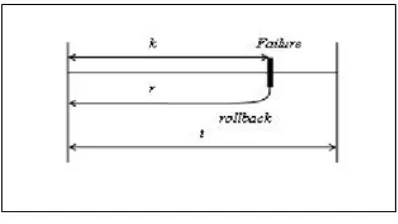
Clearly, the execution time t of a process is identical to T (t) in the absence of failures without checkpointing. However, in the presence of failure, if a failure occurs before the completion of a process, then a recovery cost r is incurred to resume its execution from its beginning of the process. Fig 4.2 shows an example of a process which is being executed without checkpointing and where a failure occurs.
In Fig 4.2, if a failure occurs before the end of execution (k < t ) , the expected execution time of a process without checkpointing T (t), can be calculated by the disjunct components, k, r and T (t). In this case, the process must restart from the beginning, which means that the remaining work requirement is t and its expected execution time is T (t).
We assumed that the failures occur according to a Poisson process at rate λ, thus F (K ) = 1 − e−λk and the f (k) = λe−λk, then the expected execution time of a process without checkpointing is given as Theorem 4.1.
Figure 4.2: Execution without checkpointing
Theorem 4.1: T he expected execution time T (t) of a process without checkpointing is given by
T (t) =eλt − 1 (1 + λr ) λ………(4.1)
PROOF: Formally, the conditional expected execution time is written as
T (t) =∞ By the law of total expectation, t if k ≥ t k + r + T (t) otherwise
T (t) = tf (k) dk +(k + r + T (t))f (k) dk
EXPECTED EXECUTION TIME WITH PAGE LEVEL INCREMENTAL CHECKPOINTING
Figure 4.3: Execution with Incremental Checkpointing
455
Copyright © 2011-15. Vandana Publications. All Rights Reserved.
checkpointing, then the expected execution time of theinterval i is identical to (ti + ci). However, if a failure occurs during a checkpoint interval i, recovery time r to roll back to the beginning of the interval is required. Therefore, if a failure occurs before the end of interval i, k < (ti + ci), the expected execution time of an interval with a page level incremental checkpoint, Tc(ti, ci) is given by Theorem 4.1.
Theorem 4.2: . If we assume the failures occur according to the Poisson process with rate λ and that failures can occur during checkpointing, the expected execution time Tc(ti, ci) of the interval i with a pagelevel incremental checkpoint is given by Tc(ti, ci) = eλ(ti +ci) − 1 (1 + λr) λ …(4.2) where ci = mcp
PROOF: . By substituting (ti + ci) for t in Eq.(4.l), we obtain Eq.(4.2).
When the expected total execution time Ti(ti, ci) is divided into n intervals and an incremental checkpoint is taken at the end of each interval, the expected total execution time with pagelevel incremental checkpoints can be expressed as follows.
Tc(t, c) = eλ(ti+ci ) − 1 (1 + λr) i=1
If we assume that the checkpoints are equally spaced, and the checkpointing cost is constant c, then the above equation becomes much easier. However, these assumptions do not reflect the actual characteristics of incremental checkpointing. In incremental checkpointing, the checkpointing cost ci is not a constant value, and furthermore, the checkpointing interval cannot be a constant duration. For instance, ci can vary under the modification pattern of a process memory pages that we dont know. Thus, this equation is not an appropriate way of deriving an efficient checkpointing interval.
IV.
PERFORMANCE EVALUATION
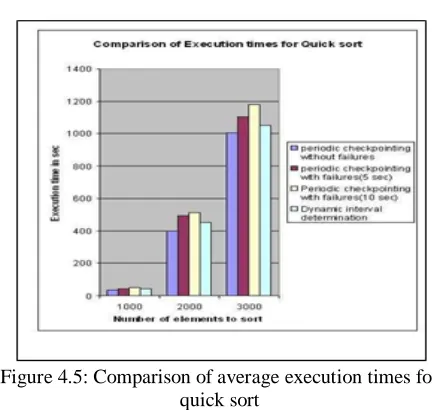
Here, we are going to discuss the performance of the dynamic interval determination for the pagelevel incremental checkpointing facility based on the efficient interval determination mechanism. We applied this algorithm, to Matrix Multiplication and Quick Sort, to compare the execution times of periodic interval checkpointing and dynamic interval checkpointing. To compare the checkpoint overhead, we measured the average execution time of a process for these applications. The average execution time of each application with periodic pagelevel incremental checkpointing and the dynamic pagelevel incremental checkpointing with efficient interval determination is shown in Fig(4.4, 4.5). Dec(ti, ci) is the calculated discriminant based on the expected recovery time of a process decision when skip or take an incremental checkpointing. Thus, it means the efficiency of checkpoint placement. In periodic checkpointing the process should take the checkpoint, though it is not needed. Where as in dynamic interval
determinism, it depends on the decide value which is calculated based on expected recovery time and it avoids unnecessary checkpoints. Obviously, it reduces the checkpoint overhead and execution time of the process. In Fig 4.4, the proposed algorithm is applied on Matrix Multiplication and is compared with periodic incremental checkpointing algorithm and same with Quick Sort in Fig 4.6. In this result, the checkpoint placement of the dynamic interval pagelevel incremental Checkpointing is more efficient than any other periodic pagelevel incremental checkpointing. These results shows that the execution time with dynamic interval pagelevel incremental checkpointing had been significantly reduced compared with periodic pagelevel incremental checkpointing. It is noted that the dynamic interval pagelevel incremental checkpointing with interval determination reduce the execution time of a process by about 20% more than using periodic pagelevel incremental checkpointing.
Figure 4.4: Comparison of average execution times for matrix multiplication
456
Copyright © 2011-15. Vandana Publications. All Rights Reserved.
V. CONCLUSION AND FUTURE WORK
This paper presents algorithm on checkpointing which is coordinated checkpoint algorithm for reducing the number messages per process that are needed for checkpoint coordination and there by reducing netwotk congestion. Checkpointing is a fault tolerant technique, which allows the system to run its applications in less time in the event of failures also. But checkpointing adds the overhead to the Distributed system. It adds the overheads like checkpointing overhead and context saving overhead. System is getting coodination overhead, mainly by the messages that are needed for checkpoint ordination. Existing algorithm is taking three messages per process( request,reply and final decision messages) for coordinating a single checkpoint. If the more number of process are in the system then more number of coordination messages will be there. Obviously, these unnessary messages increases the network traffic. This is not advisable. We should reduce the network traffic by reducing the number of coordination messages. The proposed algorithm is reducing the number of coordination messages by eliminating unnecessary reply messages. On succesful checkpoint proposed algorithm is taking only two messages per process for checkpoint coordination. In this we reduced number of messages that are needed for checkpoint coordination.
5.2 FUTURE WORK
5.2.1 Coordinated checkpoint algorithm
The coordinated checkpoint algorithm that we were proposed is reducing the number of messages that are needed for checkpoint coordination. In the proposed algorithm, the processes that are involved in taking checkpointing will stop their executions until the finishing of checkpoint process. Another thing in the proposed algorithm is some processes are forced to take the checkpoints.
This halting problem can be overcome by creating the child process for each process. The job of the child processes is saving parent process execution to the stable storage when the execution of the parent process is started. This will reduce the execution time of the process by performing the context saving in parallel with the execution.
REFERENCE
[1] ACHARYA A. and BADRINATH B. R., “Recording distributed snapshots based on causal order of message delivery,” Information Processing Letters 44, pp. 317–321, 1992.
[2] ALVISI and L., “Understanding the message logging paradigm for masking process crashes,” Ph.D. dissertation, Cornell University, January 1998.
[3] BORG A., BAUMBACH, J., and GLAZER S., “A
message system supporting fault tolerance.” In Proc. of the Symp. on Operating Systems Principles (ACM SIGOPS), Oct 1983, pp. 90–99.
[4] BORG A., BLAU W., HERRMANN F., and OBERLE W., “Fault tolerance under unix,” ACM Computing Surveys, vol. 7, pp. 1–24, Oct 1989.
[5] CAO G. and SINGHAL M., “On coordinated checkpointing in distributed system.” IEEE Trans, on Parallel and Distributed Systems 9, 12, pp. 1213–1225, December 1998.
[6] CAO G and SINGHAL M., “Mutable checkpoints: A new checkpointing approach for mobile computing systems.” IEEE Trans, on Parallel and Distributed Systems 12, 2, pp. 157–172, February 2001.
[7] CHANDY K. M. and LAMPORT, “Distributed snapshots: Determining global states in distributed systems,” ACM Trans on Computer Systems, vol. 3, no. 1, pp. 63–75, February 1985.
[8] CRITCHLOW C and TAYLOR K., “The inhibition spectrum and the achievement of causal consistency,” Cornell University,” Tech. Rep. TR 90-1101, February 1990.
[9] DANIEL NURMI, RICH WOLSKI, and JOHN BREVIK, “Modelbased checkpoint scheduling for volatile resource environments,” UCSB Computer Science, Technical Report 2004-25, 2004.
[10] ELNOZAHY and E. N. MaNetHo, “Fault tolerance in distributed systems using rollback-recovery and process replication,” Ph.D. dissertation, Rice University, Texas, Austin, October 1993.
[11] ELNOZAHY E. N., ALVISI L., WANG Y. M., and JOHNSON D. B, “A survey of rollback-recovery protocols in message-passing systems,” ACM Computing Surveys 34, 3, pp. 375–408, September 2002.
[12] ELNOZAHY E. N., JOHNSON D. B., and ZWAENEPOEL W. , “The performance of consistent checkpointing.”In Proc. of IEEE Symp. on Reliable Distributed Systems, October 1992, pp. 39–47.
[13] HELARY J. M., MOSTEFAOUI A., NETZER R. H., and RAYNAL M., “Preventing useless checkpoints in distributed computations.” In Proc. of the 16th Symposium on Reliable Distributed Systems, 1997, pp. 183–190. [14] K. Ll, J.F.NAUGHTON, and J.S.PLANK, “low latency, concurrent checkpointing for parallel programs,” IEEE Tran. on parallel and distributed systems, 5,8, pp. 874–879, August 1994.
[15] S. KALAISELVI and V. RAJARAMAN, “A survey of checkpointing algorithms for parallel and distributed computers,” Sadhana, vol. 25, no. 5, pp. 489–510., October 2000.
[16] KOO R. and TOUEG S., “Checkpointing and rollback-recovery for distributed systems,” IEEE Trans, on Software Engg. 13, 1, pp. 23–31, 1987.
457
Copyright © 2011-15. Vandana Publications. All Rights Reserved.
[18] LAMPORT L. and M. P. M., “Synchronizing clocksin the presence of faults.” Journal of the ACM 32, pp. 52– 78, January 1985.
[19] LEV FINKELSTEIN, SHAUL , and EHUD RIVLIN, “Optimal schedules for parallelizing anytime algorithms: The case of shared resources,” Journal of Artificial Intelligence Research 19, pp. 73–138, August 2003. [20] M. SINGHAL and N.G. SHIVARATRI, Advanced concepts in Operating Systems. New Delhi: TATA McGRAW-HILL, 2005.
[21] MANIVANNAN D. and SINGHAL M., “A low-overhead recovery technique using quasi-synchronous checkpointing,” in In Proc. of Distributed Computing Systems. ACM pub, May 1996, pp. 100–107.
[22] PLANK J., Li K., and PUENING M. A., “Diskless checkpointing,” IEEE Trans, on Software Engg. 9, 10, pp. 972–986, October 1998.
[23] PLANK J. S., “Efficient checkpointing on MIMD architechture,” Ph.D. dissertation, Princeton University, 1993.
[24] PLANK J. S., Xu J., and NETZER R. H., “Compressed differences: An algorithm for fast incremental checkpointing,” University of Tennessee at Knoxville,” Tech. Rep. CS-95-302, 1995.
[25] PRAKASH R. and SINGHAL M., “Low-cost checkpointing and failure recovery in mobile computing systems,” IEEE Trans, on Parallel and Distributed Systems 7, 10, pp. 1035–1048, October 1996.
[26] RANDELL B. , “System structure of software fault tolerance,” IEEE Trans, on Software Engg. 1, 2, pp. 220–
23, 1975.
[27] SILVA L. M. and SILVA J. G., “The performance of coordinated and independent checkpointing.”In Proc. of Intl. Parallel and Distributed Processing Symposium, 1999, pp. 88–94.
[28] SISTLA A. P. and WELCH J. L., “Efficient distributed recovery using message logging,” IEEE/ACM Trans, on Networking 4, 5, pp. 785–795, 1996.
[29] STROM R. E. and YEMINI S., “Optimistic recovery in distributed systems,” ACM Trans. on Computer Systems 3, 3, pp. 204–226, August 1985.
[30] T. A. WELCH, “A technique for high performance data compression,” IEEE Computer,17, pp. 8–19, June 1984.
[31] TAMIR Y. and SEQUIN C. H., “Error recovery in multicomputers using global checkpoints.” Intl. Conf. on Parallel Processing, 1984, pp. 32–41.
[32] WANG and Y. M., “Consistent global checkpoints that contain a given set of local checkpoints,” IEEE Trans, on Computers 46,4, pp. 456–468, April 1997.