147
Copyright © 2017. Vandana Publications. All Rights Reserved.
Volume-7, Issue-5, September-October 2017
International Journal of Engineering and Management Research
Page Number: 147-151
A Robust DWT-DCT Watermarking Technique with Double Chaotic
Maps
Sonam Vishwakarma1, Surendra Vishwakarma2
1
M.E. Computer Science, PIT Bhopal, (M.P), INDIA
2
Guide, M.E. Computer Science, PIT Bhopal, (M.P), INDIA
ABSTRACT
In this paper a proficient digital watermarking strategy is proposed for copyright insurance. The proposed watermarking algorithm embed a binary logo watermark into main image additionally the security of logo is kept up by utilizing the chaotic maps after which it is transformed to DCT domain and then inserted into main image by detecting the suitable sub-band component in the wavelet domain. The horizontal and vertical wavelet components of level 2, 3 or higher depending upon the size of watermark are used to implant the digital watermark. The approach can successfully embed a greatly invisible watermark due to the perfect selection of embedding components in wavelet domain which perfectly exploits the limitations of human visual perception system. The watermark is recovered by (1) contrasting the relationships between the wavelet coefficients of watermarked image (2) the public key codes generated during embedding process and (3) the private key generated data. The experimental result shows the robustness of the proposed watermarking technique against different of image modification operations for example, compression, noise, and geometric operations.
Keywords--- Digital Watermark, Discrete Wavelet Transform
(DWT), Chaotic Encryption, Discrete Cosine Transform (DCT)
I.
INTRODUCTION
As the Internet turns into the principle mean of transferring and data, individuals concern about the copyright assurance of digital information has been increased greatly, especially for, visual and multimedia documents. At the point, digital watermarking strategies are continuously increasing, to get the tradeoff amongst three properties:
information embedding capacity, detectability, and
robustness against image processing operations [10]. The watermarking is done either on spatial domain or in transform domain. The decision of a domain lies mainly on robustness required and processing resource availabilities.
Between these domains the spatial shows much robust behavior against geometrical transforms [9]. In the other, hand its poor data embedding capability with respect to the detection possibilities limits its applicability. For example in LSB embedding technique, the few bit simplanted in the host image which can be easily removed by simple image processing techniques. Numerous analysts have been concentrating on security and robustness [3], yet infrequently on the watermarking limit [4]. Surely, robustness and security will be key to acquire an irremovable and undetectable watermark; in any case, in the event that we can insert more information in the host image through mathematical transform, the applicability of watermark can be numerously increased in different areas. In the present work, anew strategy for spatial omain water marking is presented which overcomes the restrictions of the ordinary spatial systems as LSB or CDMA [5]. The strategy utilizes a scrambled information to implant it through wavelet domain.
II.
LITERATURE REVIEW
148
Copyright © 2017. Vandana Publications. All Rights Reserved.
watermarking algorithm for medical image authentication and protection. The scheme obtains the visual feature vectors of the medical image using DWT-DCT. The watermarking image is encrypted by Logistic Map to strengthen its security. Alessandra Lumini et al. [4] proposed a wavelet-based image watermarking scheme is proposed, wavelet-based on the insertion of pseudo-random codes in the frequency domain. The original image is required for the watermark detection. Zhao Dawei et al. [6] presented a chaos-based watermarking algorithm is developed in the wavelet domain for still images. In contrast to the conventional approach, they applied the wavelet transform only locally. Then transform the sub-image, which is extracted from the original image, in the frequency domain by using DWT and then embed the chaotic watermark into part of the sub-band coefficients. Hui Zhang et al. [1] proposeed a new watermarking approach which allows watermark detection and extraction under affine transformation attacks. The novelty of our approach stands on a set of affine invariants we derived from Legendre moments. Watermark embedding and detection are directly performed on this set of invariants. They also show how these moments can be exploited for estimating the geometric distortion parameters in order to permit watermark extraction. Hong Shenet al [8] proposes an effective approach to embed dual watermarks by extending the single watermarking algorithms in for numerical and logo watermarking, respectively.
III.
WATERMARK ENCRYPTION
The proposed algorithm uses the two levels of encryption in this section explains the first level encryption which is used to encrypt the original watermark image using chaotic map. In recent years, chaotic maps have been used for digital watermarking, to increase the security [6]. The most attractive features of chaos in information hiding are its extreme sensitivity to initial conditions and the outspreading of orbits over the entire space. These special characteristics make chaotic maps excellent candidates for watermarking and encryption, based on the classic Shannon’s requirement
of confusion and diffusion [6].The Cat’s map also known as
Arnold map is one of the simplest chaotic maps given by:
�𝑥𝑥𝑦𝑦�=��1112� �𝑥𝑥𝑦𝑦��𝑚𝑚𝑚𝑚𝑚𝑚𝑁𝑁, … … … … . . (1)
The values of square matrix �1
112�used in above equation can
be used as key to encryption and decryption.
Figure 1: Original Ubuntu Logo, Logo in Binary Form and Shuffled Binary Logo.
At the second level of encryption the Logistic map is used because at this level only one dimensional data is needed.
Logistic map is described by:
𝑥𝑥𝑘𝑘+1=𝜇𝜇𝑥𝑥𝑘𝑘(1− 𝑥𝑥𝑘𝑘), … … … (2)
Where 0≤ 𝜇𝜇 ≤4. When 3.5699456≤ 𝜇𝜇 ≤4, the map is in
the chaotic state. A sequence generated by the logistic map will be used to generate the public key.
4. THE DISCRETE WAVELET TRANSFORM (DWT) The wavelet transform, first proposed by S. Mallat in 1988,is a new signal analysis the or yandisa “time-frequency” method[5]. The basic idea of DWT is to analysis the signal
𝑓𝑓(𝑡𝑡)based on wavelet function 𝜓𝜓𝑎𝑎,𝑏𝑏(𝑡𝑡).
𝑊𝑊𝑓𝑓𝑎𝑎,𝑏𝑏=� 𝑓𝑓(𝑡𝑡)𝜓𝜓�𝑎𝑎,𝑏𝑏(𝑡𝑡)𝑚𝑚𝑡𝑡 𝑅𝑅
, … … … . (3)
Where, wavelet function𝜓𝜓𝑎𝑎,𝑏𝑏(𝑡𝑡) is a group of functions
obtained from the same base function 𝜓𝜓bytranslatingand
stretching.
𝜓𝜓𝑎𝑎,𝑏𝑏(𝑡𝑡) = |𝑎𝑎|
1
2𝜓𝜓 �𝑡𝑡 − 𝑎𝑎
𝑏𝑏 �,𝑎𝑎,𝑏𝑏 ∈ 𝑅𝑅,𝑎𝑎 ≠0, … … … . . (4)
Where, 𝜓𝜓is the dilated function,𝑎𝑎and 𝑏𝑏are the dilation factor
and the translation factor, respectively. The decomposing equation of the Mall at algorithm is as follows:
𝑐𝑐𝑗𝑗+1,𝑘𝑘=� 𝑐𝑐𝑗𝑗,𝑛𝑛ℎ�𝑛𝑛−2𝑘𝑘 𝑛𝑛∈𝑍𝑍
,𝑘𝑘 ∈ 𝑅𝑅, … … … . (5)
𝑚𝑚𝑗𝑗+1,𝑘𝑘 =� 𝑐𝑐𝑗𝑗,𝑛𝑛𝑔𝑔̅𝑛𝑛−2𝑘𝑘 𝑛𝑛∈𝑍𝑍
,𝑘𝑘 ∈ 𝑍𝑍, … … … . (6)
The reconstruction equation of the Mallat algorithm isgiven by:
𝑐𝑐𝑗𝑗,𝑘𝑘 =� 𝑐𝑐𝑗𝑗,𝑛𝑛ℎ𝑛𝑛−2𝑘𝑘 𝑛𝑛∈𝑍𝑍
+� 𝑐𝑐𝑗𝑗,𝑛𝑛𝑔𝑔𝑛𝑛−2𝑘𝑘 𝑛𝑛∈𝑍𝑍
,𝑘𝑘 ∈ 𝑍𝑍, … (7)
By the one-layer wavelet decomposition of the two-dimensional signal image, four sub-band image scanbe
acquired. Where, 𝐿𝐿𝐿𝐿1 is the approximated subband image
with low frequency characteristics. The others
(𝐿𝐿𝐻𝐻1,𝐻𝐻𝐿𝐿1, and𝐻𝐻𝐻𝐻1)with high frequency characteristics.
IV.
THE DISCRETE COSINE
TRANSFORM (DCT)
DCT for image coding is the standard of the Joint Photographic Experts Group (JPEG) and new Moving Picture Experts Group (MPEG). It is well known for the best balance between operation speed and high precision of
extracting the feature vector. The 𝑀𝑀×𝑁𝑁 medical image's
DCT is defined by:
𝐹𝐹(𝑢𝑢,𝑣𝑣)
=𝑐𝑐(𝑢𝑢)𝑐𝑐(𝑣𝑣)� � 𝑓𝑓(𝑥𝑥,𝑦𝑦)cos(𝜋𝜋(2𝑥𝑥+ 1)𝑢𝑢) 2𝑀𝑀 𝑁𝑁−1
𝑦𝑦=0
𝑀𝑀−1
𝑥𝑥=0
cos(𝜋𝜋(2𝑦𝑦+ 1)𝑣𝑣)
2𝑁𝑁 ,
… … … . . . (9)
149
Copyright © 2017. Vandana Publications. All Rights Reserved.
𝑐𝑐(𝑢𝑢) =� �1/𝑀𝑀,𝑢𝑢= 0�2/𝑀𝑀,𝑢𝑢= 1,2, . . ,𝑀𝑀 −1
𝑐𝑐(𝑣𝑣) =� �1/𝑁𝑁,𝑣𝑣= 0 �2/𝑁𝑁,𝑣𝑣= 1,2, . . ,𝑁𝑁 −1
Where 𝑥𝑥,𝑦𝑦are the spatial domain sampling;𝑢𝑢,𝑣𝑣are the
frequency domain sampling. Digital image pixels are usually
square, i.e.𝑀𝑀= 𝑁𝑁.
V.
PROPOSED ALGORITHM
The main strength of fered by transform domain techniques is that they can take advantage of special properties of alternate domains to address the limitations of
spatial domain or to support additional features.
Watermarking process is started by applying 3-leveles DWT on the host image. The agreement adopted by many DWT-based water marking methods is to embed the water mark in
the middle frequency
sub-bands𝐻𝐻𝐿𝐿𝑥𝑥and𝐿𝐿𝐻𝐻𝑥𝑥isbetterinperspective of imperceptibility
and robustness. Consequently, 𝐻𝐻𝐿𝐿𝑥𝑥 coefficient sets in level
three is chosentomaketoincreasetherobustnessofour watermarkagainstcommonwatermarkingattack, specially adding noise and blurring attacks, at little to no additional impact on image quality. Then, the block base DCT is performed on these selected DWT sub-band coefficient sets to embed the watermark. The detail water mark embedding procedure is as follows:
Step1: Perform DWT on the host image to decompose it into fourn on-over lapping multi-resolution coefficient sets:
𝐿𝐿𝐿𝐿 ,𝐻𝐻𝐿𝐿 ,𝐿𝐿𝐻𝐻𝑎𝑎𝑛𝑛𝑚𝑚𝐻𝐻𝐻𝐻.
Step 2: Perform DWT again on two 𝐻𝐻𝐿𝐿 and𝐿𝐿𝐻𝐻 coefficient
sets to get eight smaller coefficient sets and choose four
coefficient sets:𝐻𝐻𝐿𝐿𝐻𝐻𝐿𝐿,𝐻𝐻𝐿𝐿𝐿𝐿𝐻𝐻,𝐿𝐿𝐻𝐻𝐻𝐻𝐿𝐿𝑎𝑎𝑛𝑛𝑚𝑚𝐿𝐿𝐻𝐻𝐿𝐿𝐻𝐻.
Step 3: Perform DWT again on four coefficient sets:
𝐻𝐻𝐿𝐿𝐻𝐻𝐿𝐿,𝐻𝐻𝐿𝐿𝐿𝐿𝐻𝐻,𝐿𝐿𝐻𝐻𝐻𝐻𝐿𝐿𝑎𝑎𝑛𝑛𝑚𝑚𝐿𝐿𝐻𝐻𝐿𝐿𝐻𝐻 to get sixteen smaller
Coefficient sets and choose four coefficient sets:
𝐻𝐻𝐿𝐿𝐻𝐻𝐿𝐿𝐿𝐿𝐿𝐿,𝐻𝐻𝐿𝐿𝐿𝐿𝐻𝐻𝐿𝐿𝐿𝐿,𝐿𝐿𝐻𝐻𝐻𝐻𝐿𝐿𝐿𝐿𝐿𝐿𝑎𝑎𝑛𝑛𝑚𝑚𝐿𝐿𝐻𝐻𝐿𝐿𝐻𝐻𝐿𝐿𝐿𝐿.
Step 4: Divide four coefficient sets: 𝐻𝐻𝐿𝐿𝐻𝐻𝐿𝐿𝐿𝐿𝐿𝐿 ,𝐻𝐻𝐿𝐿𝐿𝐿𝐻𝐻𝐿𝐿𝐿𝐿 ,
𝐿𝐿𝐻𝐻𝐻𝐻𝐿𝐿𝐿𝐿𝐿𝐿and𝐿𝐿𝐻𝐻𝐿𝐿𝐻𝐻𝐿𝐿𝐿𝐿into 4 × 4 blocks.
Step 5: Perform DCT to each block in the chosen coefficient sets.
Step 6: Calculate the average of each DCT block.Now generate a binary sequence by comparing the subsequent blocks value as follows:
𝐵𝐵(𝑖𝑖) =�1, 𝑖𝑖𝑓𝑓𝐵𝐵𝐵𝐵𝑘𝑘𝑎𝑎𝑣𝑣𝑔𝑔(𝑖𝑖)− 𝐵𝐵𝐵𝐵𝑘𝑘𝑎𝑎𝑣𝑣𝑔𝑔(𝑖𝑖+ 1) >𝑡𝑡ℎ
0, 𝑚𝑚𝑡𝑡ℎ𝑒𝑒𝑒𝑒𝑒𝑒𝑖𝑖𝑒𝑒𝑒𝑒 Step 6: Scramble the watermark signal with Arnold map
using given 𝑘𝑘𝑒𝑒𝑦𝑦1and gain the shuffled watermark𝑊𝑊′, key
times can be seen as private key.
Step 7: now 𝑋𝑋𝑋𝑋𝑅𝑅 the 𝐵𝐵 with 𝑊𝑊′ to get the temporary public
key.
𝑃𝑃𝑢𝑢𝑏𝑏𝑡𝑡𝑒𝑒𝑚𝑚𝑡𝑡 =𝑋𝑋𝑋𝑋𝑅𝑅(𝐵𝐵,𝑊𝑊′)
Step 8: Generate a binary sequence (𝐿𝐿)of length equal to
𝑃𝑃𝑢𝑢𝑏𝑏𝑡𝑡𝑒𝑒𝑚𝑚𝑡𝑡by Logistic mapusinggiven 𝑘𝑘𝑒𝑒𝑦𝑦2and 𝑋𝑋𝑋𝑋𝑅𝑅it with
𝑃𝑃𝑢𝑢𝑏𝑏𝑡𝑡𝑒𝑒𝑚𝑚𝑡𝑡 to gain the final private key.
𝑃𝑃𝑢𝑢𝑏𝑏𝑓𝑓𝑖𝑖𝑛𝑛𝑎𝑎𝐵𝐵 =𝑋𝑋𝑋𝑋𝑅𝑅(𝑃𝑃𝑢𝑢𝑏𝑏𝑡𝑡𝑒𝑒𝑚𝑚𝑡𝑡,𝐿𝐿)
Step9: Perform in verse DCT(IDCT) on each block after its mid-band coefficients have been modified to embed the watermark bits as described in the previous step.
Step 10: Perform the inverse DWT (IDWT) on the DWT transformed image, including the modified coefficient sets, to produce the watermarked host image.
To extract we need just to perform in opposite direction hence no separate explanation is required.
VI.
EXPERIMENTAL RESULTS
For the testing of the proposed algorithm following measures are used for assessment of quality of image and watermark.
6.1 MEAN ABSOLUTE ERROR (MAE):
It is a quantity used to measure how close forecasts or predictions are to the eventual outcomes. The mean absolute error is given by
𝑀𝑀𝑀𝑀𝑀𝑀=1𝑛𝑛�|𝑓𝑓𝑖𝑖 − 𝑦𝑦𝑖𝑖| 𝑛𝑛
𝑖𝑖=1
=1𝑛𝑛�|𝑒𝑒𝑖𝑖| 𝑛𝑛
𝑖𝑖=1
As the name suggests, the mean absolute error is an average of the absolute errors, where is the prediction and the true value. Note that alternative formulations may include relative frequencies as weight factors. The mean absolute error is a common measure of forecast error in time series analysis, where the terms "mean absolute deviation" is sometimes used in confusion with the more standard definition of mean absolute deviation. The same confusion exists more generally.
6.2 PEAK SIGNAL-TO-NOISE RATIO (PSNR):
It is an engineering term for the ratio between the maximum possible power of a signal and the power of corrupting noise that affects the fidelity of its representation. Because many signals have a very wide dynamic range, PSNR is usually expressed in terms of the logarithmic decibel scale. It is most easily defined via the mean squared
error (MSE) which for two 𝑚𝑚×𝑛𝑛 monochrome images 𝐼𝐼 and
𝐾𝐾 where one of the images is considered a noisy
approximation of the other is defined as:
𝑀𝑀𝑀𝑀𝑀𝑀=𝑚𝑚𝑛𝑛1 � �[𝐼𝐼(𝑖𝑖,𝑗𝑗)− 𝐾𝐾(𝑖𝑖,𝑗𝑗)]2
𝑛𝑛−1
𝑗𝑗=0
𝑚𝑚−1
𝑖𝑖=0 The PSNR is defined as:
𝑃𝑃𝑀𝑀𝑁𝑁𝑅𝑅= 10∙ 𝐵𝐵𝑚𝑚𝑔𝑔10�𝑀𝑀𝑀𝑀𝑋𝑋𝐼𝐼 2
𝑀𝑀𝑀𝑀𝑀𝑀�
= 20∙ 𝐵𝐵𝑚𝑚𝑔𝑔10�𝑀𝑀𝑀𝑀𝑋𝑋𝐼𝐼
√𝑀𝑀𝑀𝑀𝑀𝑀�
150
Copyright © 2017. Vandana Publications. All Rights Reserved.
Here, 𝑀𝑀𝑀𝑀𝑋𝑋𝐼𝐼 is the maximum possible pixel value of the
image. When the pixels are represented using 8 bits per sample, this is 255.
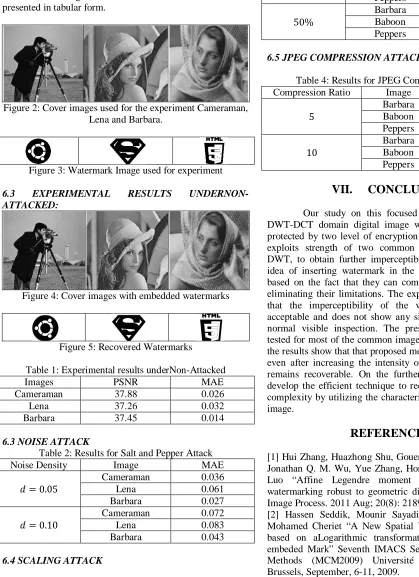
Theproposedalgorithmhasbeenextensivelytestedonv ariousstandardimages, and the summarized results are presented in tabular form.
Figure 2: Cover images used for the experiment Cameraman, Lena and Barbara.
Figure 3: Watermark Image used for experiment
6.3 EXPERIMENTAL RESULTS UNDERNON-ATTACKED:
Figure 4: Cover images with embedded watermarks
Figure 5: Recovered Watermarks
Table 1: Experimental results underNon-Attacked
Images PSNR MAE
Cameraman 37.88 0.026
Lena 37.26 0.032
Barbara 37.45 0.014
6.3 NOISE ATTACK
Table 2: Results for Salt and Pepper Attack
Noise Density Image MAE
𝑚𝑚= 0.05
Cameraman 0.036
Lena 0.061
Barbara 0.027
𝑚𝑚= 0.10
Cameraman 0.072
Lena 0.083
Barbara 0.043
6.4 SCALING ATTACK
Table 3: Results for Scaling Attack
Scaling% Image MAE
25% Barbara Baboon 0.12 0.16
Peppers 0.11
50% Barbara Baboon 0.22 0.24
Peppers 0.18
6.5 JPEG COMPRESSION ATTACK
Table 4: Results for JPEG Compression Attack
Compression Ratio Image MAE
5
Barbara 0.023
Baboon 0.026
Peppers 0.012
10
Barbara 0.082
Baboon 0.063
Peppers 0.069
VII. CONCLUSION
Our study on this focused on presenting a joint DWT-DCT domain digital image watermarking algorithm protected by two level of encryption. The proposed method exploits strength of two common transforms; DCT and DWT, to obtain further imperceptibilityandrobustness. The idea of inserting watermark in the combined transform is based on the fact that they can complement each other for eliminating their limitations. The experimental results show that the imperceptibility of the watermarked image is acceptable and does not show any sign on insertion during normal visible inspection. The presented method is also tested for most of the common image processing attacks and the results show that that proposed method is very robust and even after increasing the intensity of attack the watermark remains recoverable. On the further development we can develop the efficient technique to reduce the computational complexity by utilizing the characteristics of transforms and image.
REFERENCES
[1] Hui Zhang, Huazhong Shu, Gouenou Coatrieux, Jie Zhu, Jonathan Q. M. Wu, Yue Zhang, Hongqing Zhu, and Limin Luo “Affine Legendre moment invariants for image watermarking robust to geometric distortions”, IEEE Trans Image Process. 2011 Aug; 20(8): 2189–2199.
151
Copyright © 2017. Vandana Publications. All Rights Reserved.
[3] John N. Ellinas “A Robust Wavelet-Based Watermarking Algorithm Using Edge Detection” World Academy of Science, Engineering and Technology 34 2007.
[4] Alessandra Lumini, Dario Maio “A Wavelet-based Image Watermarking Scheme”, Image Processing, 2006 IEEE International Conference on8-11 Oct. 2006.
[5] Yaoli Liu, Jingbing Li “The Medical Image Watermarking Algorithm Using DWT-DCT and Logistic”, Computing and Convergence Technology (ICCCT), 2012 7th International Conference on3-5 Dec. 2012.
[6] Zhao Dawei,Chen Guanrong, Liu Wenbo “A chaos-based robust wavelet-domain watermarking algorithm”, Chaos, Solitons & FractalsVolume 22, Issue 1, October 2004, Pages 47–54.
[7] Romain Mavudila Kongo, Lhousaine Masmoudi, Nadia Idrissi, Najem Hassanain, Ahmed Roukhe “A medical image watermarking scheme based on Dual-Tree wavelet transform”, Innovative Computing Technology (INTECH), 2012 Second International Conference on 18-20 Sept. 2012. [8] Hong Shen, Bo Chen “From single watermark to dual watermark: A new approach for image watermarking”, Computers & Electrical EngineeringVolume 38, Issue 5, September 2012, Pages 1310–1324.
[9] Ibrahim Nasir, Ying Weng, Jianmin Jiang “A New Robust Watermarking Scheme for Color Image in Spatial Domain“Signal-Image Technologies and Internet-Based System, 2007. SITIS '07. Third International IEEE Conference on 16-18 Dec. 2007.
[10] Santi Prasad Maity, Malay Kumar Kundu “Robust and
Blind Spatial Watermarking in Digital”Image”http://www.isical.ac.in/~malay/Papers/
Conf/ICVGIP_02_WM.pdf.