The Thirty-Third AAAI Conference on Artificial Intelligence (AAAI-19)
Analyzing Compositionality-Sensitivity of NLI Models
Yixin Nie,
*Yicheng Wang,
*Mohit Bansal
Department of Computer ScienceUniversity of North Carolina at Chapel Hill {yixin1, yicheng, mbansal}@cs.unc.edu
Abstract
Success in natural language inference (NLI) should require a model to understand both lexical and compositional seman-tics. However, through adversarial evaluation, we find that several state-of-the-art models with diverse architectures are over-relying on the former and fail to use the latter. Further, this compositionality unawareness is not reflected via stan-dard evaluation on current datasets. We show that remov-ing RNNs in existremov-ing models or shufflremov-ing input words dur-ing traindur-ing does not induce large performance loss despite the explicit removal of compositional information. Therefore, we propose a compositionality-sensitivity testing setup that analyzes models on natural examples from existing datasets that cannot be solved via lexical features alone (i.e., on which a bag-of-words model gives a high probability to one wrong label), hence revealing the models’ actual com-positionality awareness. We show that this setup not only highlights the limited compositional ability of current NLI models, but also differentiates model performance based on design, e.g., separating shallow bag-of-words models from deeper, linguistically-grounded tree-based models. Our eval-uation setup is an important analysis tool: complementing currently existing adversarial and linguistically driven di-agnostic evaluations, and exposing opportunities for future work on evaluating models’ compositional understanding.
1 Introduction
Natural Language Inference (NLI) is a task in which a sys-tem is asked to classify the relationship between a pair of premise and hypothesis as one of either entailment, contra-diction, or neutral. This task is considered to be the basis of many downstream, higher-level NLP tasks that require complex natural language understanding such as question-answering and summarization. Large annotated datasets such as the Stanford Natural Language Inference Bowman et al. (2015) (SNLI) and the Multi-Genre Natural Language Inference Williams, Nangia, and Bowman (2018) (MNLI) have promoted the development of many different neu-ral NLI models, including encoding and co-attention mod-els using both sequential and recursive representations Nie and Bansal (2017); Choi, Yoo, and Lee (2017); Chen et
Copyright c2019, Association for the Advancement of Artificial Intelligence (www.aaai.org). All rights reserved.
*indicates equal contribution.
al. (2017); Gong, Luo, and Zhang (2017); Ghaeini et al. (2018); Parikh et al. (2016); Wang, Hamza, and Florian (2017), all achieving near human-level performance on stan-dard datasets.
Despite their high performance, it is unclear if these mod-els employ semantic understanding of natural language to classify these pairs, or are simply performing word/phrase-level pattern matching. We first conduct investigative ex-periments with rule-based adversaries and show empirically that seven state-of-the-art NLI models, spanning a variety of architectures, are all unable to recognize simple seman-tic differences when the word-level information remains un-changed (e.g., the swapping of the subject and object or the
addition of the same modifier to different governors).1Their
failure on these examples contrasts sharply with their high performance on the standard evaluation set, indicating that standard evaluation does not sufficiently assess sentence-level understanding.
Next, to further show the insufficiency of standard eval-uation for testing compositional understanding, we conduct two additional experiments in which the compositional in-formation is removed or diluted. Firstly, we train and eval-uate the state-of-the-art models with their RNNs replaced by fully-connected layers. Secondly, we train these models with input words shuffled and evaluate them on the origi-nal evaluation datasets. In both of the experiments, models are still able to achieve high performance on the standard evaluation datasets, demonstrating that standard evaluation is unable to sufficiently separate models with composition-ality understanding capabilities from those without.
We also show the limitation of adversarial evaluation se-tups by demonstrating their narrow scope: each type of ad-versary is only capable of testing a model’s ability to process one specific type of compositional semantics. We show via adversarial training that success on one type of adversary does not generalize to other types of adversaries, but instead induces errors caused by over-fitting the training data. Thus, while adversarial evaluation is useful for exposing the issue of lexical over-stability, it is not a robust measure of models’ ability to understand semantic compositional information.
1We release our adversaries and
Hence, in order to analyze a model’s abilities to rea-son beyond the lexical level and reveal its sensitivity to compositional differences, we present a ‘compositionality-sensitivity’ testing setup: we select examples for which a bag-of-words model is misguided (assigns a high probability to one wrong label), this allows us to directly measure how much compositional information the model takes into con-sideration. By effectively punishing models’ over-reliance on lexical features, this testing setup could encourage the development of models that are sensitive to compositional clues regarding the pairs’ logical relationships.
We show that although our seven models and their vari-ants have comparable performance on standard evaluation (SNLI and MNLI), our new compositionality-sensitivity testing differentiates them by their capability to capture compositional information (e.g., bag-of-words-like models perform worse than sequential models, which in turn per-form worse than syntactic-tree based models). Unlike ad-versarial evaluation, this setup uses natural examples that are not confined to any specific linguistic context or domain by leveraging existing NLI datasets to the largest extent possible for compositional testing. We hope that this new setup could inspire the collections of datasets that control for lexical-features, to explicitly evaluate the compositional ability of NLI models.
We end by discussing how our compositionality-sensitivity evaluation setup complements other recently proposed evaluation setups. Specifically, while certain linguistically-driven diagnostic datasets are useful in test-ing for a model’s performance in a specific realistic setttest-ing, model-driven evaluations such as ours gives insight into why models succeed and fail in these specific linguistic scenarios. The main contributions of this paper are three-fold: 1) we in-troduce two new adversarial setups that expose current state-of-the-art models’ inability to process simple sentence-level semantics when lexical features give no information; 2) we rigorously test and expose the limits of standard and adver-sarial evaluations; 3) we propose a novel compositionality-sensitivity test that analyzes a model’s ability to recognize compositional semantics beyond the lexical level, and show its effectiveness in separating models based on architecture.
2 Models and Motivation
In this section, we start with an overview of the designs of seven recently proposed, high-performing natural language inference models and outline several commonalities that are counter-intuitive. We argue that these shared traits hint at their over-reliance on lexical features for prediction, and they are not modeling the compositional nature of language. This motivates our further investigation in later sections.
2.1 NLI Models
Many different models have been proposed for the NLI task; they all fall under one of two broad categories: sentence encoding-based (sentence encoders) or co-attention based. Sentence encoders independently encode each sentence as a fixed-length vector, and then make a prediction, while co-attention models make inferences by jointly processing the
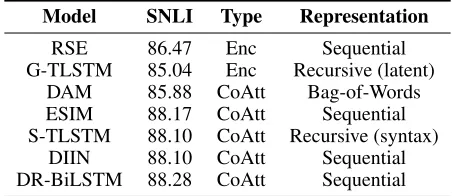
Model SNLI Type Representation
RSE 86.47 Enc Sequential
G-TLSTM 85.04 Enc Recursive (latent)
DAM 85.88 CoAtt Bag-of-Words
ESIM 88.17 CoAtt Sequential
S-TLSTM 88.10 CoAtt Recursive (syntax)
DIIN 88.10 CoAtt Sequential
DR-BiLSTM 88.28 CoAtt Sequential
Table 1: Summary of the models we evaluate, including their performance, type, and sentence representation.‘Enc’ = Sen-tence Encoder ‘CoAtt’ = Co-Attention Model
premise and hypothesis. The constraint of independent pro-cessing for sentence encoders was put in place to encourage the development of effective fixed-length sentence repre-sentations generalizable to higher-level tasks. However, co-attention models with recursive or sequential modeling have achieved much better performance on popular NLI datasets. In this paper, we analyze 7 different models spanning both categories, which are, or were, state-of-the-art in their
re-spective category.2We give a brief description of each model
below (see Table 1):
RSEResidual Sentence Encoder Nie and Bansal (2017) is
an encoding-based model that first uses multiple layers of residually-connected BiLSTM to encode the tokens in a sen-tence and then obtain the sensen-tence’s fixed-length represen-tation by max pooling over RNN’s hidden states from all timesteps. It is one of the top performing sentence encoders on the Multi-NLI dataset.
G-TLSTM Gumbel-TreeLSTM Choi, Yoo, and Lee (2017)
is a recursive encoding-based model that learns latent-tree representations for sentences via reinforcement learning.
DAM Decomposable Attention Model Parikh et al. (2016)
is a light-weight co-attention model that performs cross-attention at the word level with decomposable matrices.
ESIM Enhanced Sequential Inference Model Chen et al.
(2017) is a strong co-attention model that uses BiLSTM to encode tokens within each sentence, and perform cross-attention on these encoded token representations.
S-TLSTM Syntactic TreeLSTM Chen et al. (2017) is
iden-tical to ESIM except it encodes sentence tokens via a TreeL-STM based on the dependency parse instead of sequential BiLSTM. It is the highest performing NLI model with a re-cursive component.
DIIN Densely Interactive Inference Network Gong, Luo,
and Zhang (2017) is a novel co-attention model that ex-tracts phrase-level alignment features using densely con-nected convolutional layers a word-level interactive matrix.
DR-BiLSTM Dependent Reading Bidirectional LSTM
Ghaeini et al. (2018) is a model that modifies on ESIM with a dependent reading mechanism that encodes each sentence conditioned on the other.
We were able to obtain original implementations for RSE, G-TLSTM, S-TLSTM and DIIN. We used our own
im-2https://nlp.stanford.edu/projects/snli/
A cat sits alone in dry yellow grass. A yellow cat sits alone in dry grass. A woman is pulling a child on a sled in the snow.
A child is pulling a woman on a sled in the snow. ROOT subj obj ROOT amod amod
4
300 301 302 303 304 305 306 307 308 309 310 311 312 313 314 315 316 317 318 319 320 321 322 323 324 325 326 327 328 329 330 331 332 333 334 335 336 337 338 339 340 341 342 343 344 345 346 347 348 349 350 351 352 353 354 355 356 357 358 359 360 361 362 363 364 365 366 367 368 369 370 371 372 373 374 375 376 377 378 379 380 381 382 383 384 385 386 387 388 389 390 391 392 393 394 395 396 397 398 399 Confidential Review Copy. DO NOT DISTRIBUTE.Model
SNLI Acc.
Type
Sentence Representation
RSE
86.47
Sent. Encoder
Sequential
G-TLSTM
85.04
Sent. Encoder
Tree (learned)
DAM
85.88
Co-Attention
Bag-of-Words
ESIM
88.17
Co-Attention
Sequential
S-TLSTM
88.10
Co-Attention
Tree (syntax)
DIIN
88.10
Co-Attention
Sequential
DR-BiLSTM
88.28
Co-Attention
Sequential
Table 1
: Summary of the models we use, including their performance, type, and sentence representation
p
: People are throwing tomatoes at each other.
p
0:
Tomatoes
are throwing
people
at each
other.
p
0: A young
small
woman is singing into a
mi-crophone.
h
: A young woman is singing into a
small
mi-crophone.
Figure 1
: Examples of adversaries generated for our experiments. On the left, we have an example of the
SOS
WAPadversary, where the swapped subject and object are marked in red in
p
0. On the right, we have
an example of the A
DDA
MODadversary, where the added adjective modifier is marked in red.
ited ability to process even the simplest of
compo-sitional structure, we created adversarial test sets
composed of pairs of sentences whose logical
re-lations cannot be extracted from lexical
informa-tion alone. Specifically, we create the following
two evaluation setups:
SOS
WAPAdversaries
In this setup, we take a
premise from the SNLI dataset,
p
, that has the
subject-verb-object sentence structure, and create
the hypothesis
p
0by swapping the subject and
ob-ject. This results in a contradictory pair as the
se-mantic roles of the premise are swapped in the
hy-pothesis. An example of this is shown on the left
side of Fig.
1
. We were able to create 971
exam-ples of this type.
A
DDA
MODAdversaries
In this setup, we take
a premise from the SNLI dataset,
p
, that has at
least two different noun entities. We then pick a
modifier from the SNLI dataset that has been used
to describe both nouns, and create the premise
p
0by adding the modifier to one of the nouns and
create the hypothesis
h
by adding it to the other
noun. This results in a neutral pair as the
hypoth-esis contains more information and is neither
im-plied or refuted by the premise. An example of
this is shown on the right side of Fig.
1
. We were
able to create 1783 examples of this type.
Although both of the above strategies generate
pairs that exhibits non-entailment relations, they
are difficult to solve for models that ignore
com-positional structure, as the premise and hypothesis
are composed of the exact same words.
To create the data that meet the above
require-ments, we use the Stanford Parser (
Chen and
Man-ning
,
2014
) from CoreNLP 3.8.0 to get the
de-pendency parse of the sentences, decomposing the
sentences into small semantic units and then
rear-range them using the following two strategies.
3.2 Evaluation
We trained the aforementioned models on the
SNLI training set and tested them on the
adver-sarial test sets, the results are shown in Table
2
.
To ensure that the intuitions behind our
adversar-ial creation algorithms are correct, we conducted
human evaluation with a sampling of 100
exam-ples for each evaluation set. On both experiments,
despite majority of the examples being marked
as non-entail by our human evaluators, the
mod-els classified them overwhelmingly as entailment.
More interestingly, the models we use involve both
tree based and sequential sentence encoder and
co-attention models. And despite the varied
architec-ture, they all perform similarly on these
adversar-ial test sets, indicating that they might be using
similar patterns for inference (e.g., word overlap
suggests entailment).
The models’ poor performance on these
ad-versarial test sets constants sharply with their
high performance on standard evaluation, raising
doubts on its effectiveness and reliability.
How-4
300 301 302 303 304 305 306 307 308 309 310 311 312 313 314 315 316 317 318 319 320 321 322 323 324 325 326 327 328 329 330 331 332 333 334 335 336 337 338 339 340 341 342 343 344 345 346 347 348 349 350 351 352 353 354 355 356 357 358 359 360 361 362 363 364 365 366 367 368 369 370 371 372 373 374 375 376 377 378 379 380 381 382 383 384 385 386 387 388 389 390 391 392 393 394 395 396 397 398 399 Confidential Review Copy. DO NOT DISTRIBUTE.Model
SNLI Acc.
Type
Sentence Representation
RSE
86.47
Sent. Encoder
Sequential
G-TLSTM
85.04
Sent. Encoder
Tree (learned)
DAM
85.88
Co-Attention
Bag-of-Words
ESIM
88.17
Co-Attention
Sequential
S-TLSTM
88.10
Co-Attention
Tree (syntax)
DIIN
88.10
Co-Attention
Sequential
DR-BiLSTM
88.28
Co-Attention
Sequential
Table 1
: Summary of the models we use, including their performance, type, and sentence representation
p
: People are throwing tomatoes at each other.
p
0:
Tomatoes
are throwing
people
at each
other.
p
0: A young
small
woman is singing into a
mi-crophone.
h
: A young woman is singing into a
small
mi-crophone.
Figure 1
: Examples of adversaries generated for our experiments. On the left, we have an example of the
SOS
WAPadversary, where the swapped subject and object are marked in red in
p
0. On the right, we have
an example of the A
DDA
MODadversary, where the added adjective modifier is marked in red.
ited ability to process even the simplest of
compo-sitional structure, we created adversarial test sets
composed of pairs of sentences whose logical
re-lations cannot be extracted from lexical
informa-tion alone. Specifically, we create the following
two evaluation setups:
SOS
WAPAdversaries
In this setup, we take a
premise from the SNLI dataset,
p
, that has the
subject-verb-object sentence structure, and create
the hypothesis
p
0by swapping the subject and
ob-ject. This results in a contradictory pair as the
se-mantic roles of the premise are swapped in the
hy-pothesis. An example of this is shown on the left
side of Fig.
1
. We were able to create 971
exam-ples of this type.
A
DDA
MODAdversaries
In this setup, we take
a premise from the SNLI dataset,
p
, that has at
least two different noun entities. We then pick a
modifier from the SNLI dataset that has been used
to describe both nouns, and create the premise
p
0by adding the modifier to one of the nouns and
create the hypothesis
h
by adding it to the other
noun. This results in a neutral pair as the
hypoth-esis contains more information and is neither
im-plied or refuted by the premise. An example of
this is shown on the right side of Fig.
1
. We were
able to create 1783 examples of this type.
Although both of the above strategies generate
pairs that exhibits non-entailment relations, they
are difficult to solve for models that ignore
com-positional structure, as the premise and hypothesis
are composed of the exact same words.
To create the data that meet the above
require-ments, we use the Stanford Parser (
Chen and
Man-ning
,
2014
) from CoreNLP 3.8.0 to get the
de-pendency parse of the sentences, decomposing the
sentences into small semantic units and then
rear-range them using the following two strategies.
3.2 Evaluation
We trained the aforementioned models on the
SNLI training set and tested them on the
adver-sarial test sets, the results are shown in Table
2
.
To ensure that the intuitions behind our
adversar-ial creation algorithms are correct, we conducted
human evaluation with a sampling of 100
exam-ples for each evaluation set. On both experiments,
despite majority of the examples being marked
as non-entail by our human evaluators, the
mod-els classified them overwhelmingly as entailment.
More interestingly, the models we use involve both
tree based and sequential sentence encoder and
co-attention models. And despite the varied
architec-ture, they all perform similarly on these
adversar-ial test sets, indicating that they might be using
similar patterns for inference (e.g., word overlap
suggests entailment).
The models’ poor performance on these
ad-versarial test sets constants sharply with their
high performance on standard evaluation, raising
doubts on its effectiveness and reliability.
How-h:
<latexit sha1_base64="18TYQ2FFW5esQka7TqsevXuNqJs=">AAAB6XicbVBNS8NAEJ3Ur1q/qh69LBbBU0lEqHgqevFYxX5AG8pmu2mXbjZhdyKU0H/gxYMiXv1H3vw3btsctPXBwOO9GWbmBYkUBl332ymsrW9sbhW3Szu7e/sH5cOjlolTzXiTxTLWnYAaLoXiTRQoeSfRnEaB5O1gfDvz209cGxGrR5wk3I/oUIlQMIpWehhd98sVt+rOQVaJl5MK5Gj0y1+9QczSiCtkkhrT9dwE/YxqFEzyaamXGp5QNqZD3rVU0YgbP5tfOiVnVhmQMNa2FJK5+nsio5ExkyiwnRHFkVn2ZuJ/XjfF8MrPhEpS5IotFoWpJBiT2dtkIDRnKCeWUKaFvZWwEdWUoQ2nZEPwll9eJa2LqudWvfvLSv0mj6MIJ3AK5+BBDepwBw1oAoMQnuEV3pyx8+K8Ox+L1oKTzxzDHzifP0s8jTA=</latexit><latexit sha1_base64="18TYQ2FFW5esQka7TqsevXuNqJs=">AAAB6XicbVBNS8NAEJ3Ur1q/qh69LBbBU0lEqHgqevFYxX5AG8pmu2mXbjZhdyKU0H/gxYMiXv1H3vw3btsctPXBwOO9GWbmBYkUBl332ymsrW9sbhW3Szu7e/sH5cOjlolTzXiTxTLWnYAaLoXiTRQoeSfRnEaB5O1gfDvz209cGxGrR5wk3I/oUIlQMIpWehhd98sVt+rOQVaJl5MK5Gj0y1+9QczSiCtkkhrT9dwE/YxqFEzyaamXGp5QNqZD3rVU0YgbP5tfOiVnVhmQMNa2FJK5+nsio5ExkyiwnRHFkVn2ZuJ/XjfF8MrPhEpS5IotFoWpJBiT2dtkIDRnKCeWUKaFvZWwEdWUoQ2nZEPwll9eJa2LqudWvfvLSv0mj6MIJ3AK5+BBDepwBw1oAoMQnuEV3pyx8+K8Ox+L1oKTzxzDHzifP0s8jTA=</latexit>
<latexit sha1_base64="18TYQ2FFW5esQka7TqsevXuNqJs=">AAAB6XicbVBNS8NAEJ3Ur1q/qh69LBbBU0lEqHgqevFYxX5AG8pmu2mXbjZhdyKU0H/gxYMiXv1H3vw3btsctPXBwOO9GWbmBYkUBl332ymsrW9sbhW3Szu7e/sH5cOjlolTzXiTxTLWnYAaLoXiTRQoeSfRnEaB5O1gfDvz209cGxGrR5wk3I/oUIlQMIpWehhd98sVt+rOQVaJl5MK5Gj0y1+9QczSiCtkkhrT9dwE/YxqFEzyaamXGp5QNqZD3rVU0YgbP5tfOiVnVhmQMNa2FJK5+nsio5ExkyiwnRHFkVn2ZuJ/XjfF8MrPhEpS5IotFoWpJBiT2dtkIDRnKCeWUKaFvZWwEdWUoQ2nZEPwll9eJa2LqudWvfvLSv0mj6MIJ3AK5+BBDepwBw1oAoMQnuEV3pyx8+K8Ox+L1oKTzxzDHzifP0s8jTA=</latexit>
<latexit sha1_base64="18TYQ2FFW5esQka7TqsevXuNqJs=">AAAB6XicbVBNS8NAEJ3Ur1q/qh69LBbBU0lEqHgqevFYxX5AG8pmu2mXbjZhdyKU0H/gxYMiXv1H3vw3btsctPXBwOO9GWbmBYkUBl332ymsrW9sbhW3Szu7e/sH5cOjlolTzXiTxTLWnYAaLoXiTRQoeSfRnEaB5O1gfDvz209cGxGrR5wk3I/oUIlQMIpWehhd98sVt+rOQVaJl5MK5Gj0y1+9QczSiCtkkhrT9dwE/YxqFEzyaamXGp5QNqZD3rVU0YgbP5tfOiVnVhmQMNa2FJK5+nsio5ExkyiwnRHFkVn2ZuJ/XjfF8MrPhEpS5IotFoWpJBiT2dtkIDRnKCeWUKaFvZWwEdWUoQ2nZEPwll9eJa2LqudWvfvLSv0mj6MIJ3AK5+BBDepwBw1oAoMQnuEV3pyx8+K8Ox+L1oKTzxzDHzifP0s8jTA=</latexit>
p0 :
<latexit sha1_base64="wHM2oKdLWPTqAo3K5loY8hZ0M5U=">AAAB8nicbVDLSgNBEJz1GeMr6tHLYBA8hV0RFE9BLx4jmAds1jA7mU2GzGOZ6RXCks/w4kERr36NN//GSbIHTSxoKKq66e6KU8Et+P63t7K6tr6xWdoqb+/s7u1XDg5bVmeGsibVQptOTCwTXLEmcBCskxpGZCxYOx7dTv32EzOWa/UA45RFkgwUTzgl4KQwfcy7qeGSTa57lapf82fAyyQoSBUVaPQqX92+pplkCqgg1oaBn0KUEwOcCjYpdzPLUkJHZMBCRxWRzEb57OQJPnVKHyfauFKAZ+rviZxIa8cydp2SwNAuelPxPy/MILmKcq7SDJii80VJJjBoPP0f97lhFMTYEUINd7diOiSGUHAplV0IweLLy6R1Xgv8WnB/Ua3fFHGU0DE6QWcoQJeoju5QAzURRRo9o1f05oH34r17H/PWFa+YOUJ/4H3+AICNkWE=</latexit> <latexit sha1_base64="wHM2oKdLWPTqAo3K5loY8hZ0M5U=">AAAB8nicbVDLSgNBEJz1GeMr6tHLYBA8hV0RFE9BLx4jmAds1jA7mU2GzGOZ6RXCks/w4kERr36NN//GSbIHTSxoKKq66e6KU8Et+P63t7K6tr6xWdoqb+/s7u1XDg5bVmeGsibVQptOTCwTXLEmcBCskxpGZCxYOx7dTv32EzOWa/UA45RFkgwUTzgl4KQwfcy7qeGSTa57lapf82fAyyQoSBUVaPQqX92+pplkCqgg1oaBn0KUEwOcCjYpdzPLUkJHZMBCRxWRzEb57OQJPnVKHyfauFKAZ+rviZxIa8cydp2SwNAuelPxPy/MILmKcq7SDJii80VJJjBoPP0f97lhFMTYEUINd7diOiSGUHAplV0IweLLy6R1Xgv8WnB/Ua3fFHGU0DE6QWcoQJeoju5QAzURRRo9o1f05oH34r17H/PWFa+YOUJ/4H3+AICNkWE=</latexit> <latexit sha1_base64="wHM2oKdLWPTqAo3K5loY8hZ0M5U=">AAAB8nicbVDLSgNBEJz1GeMr6tHLYBA8hV0RFE9BLx4jmAds1jA7mU2GzGOZ6RXCks/w4kERr36NN//GSbIHTSxoKKq66e6KU8Et+P63t7K6tr6xWdoqb+/s7u1XDg5bVmeGsibVQptOTCwTXLEmcBCskxpGZCxYOx7dTv32EzOWa/UA45RFkgwUTzgl4KQwfcy7qeGSTa57lapf82fAyyQoSBUVaPQqX92+pplkCqgg1oaBn0KUEwOcCjYpdzPLUkJHZMBCRxWRzEb57OQJPnVKHyfauFKAZ+rviZxIa8cydp2SwNAuelPxPy/MILmKcq7SDJii80VJJjBoPP0f97lhFMTYEUINd7diOiSGUHAplV0IweLLy6R1Xgv8WnB/Ua3fFHGU0DE6QWcoQJeoju5QAzURRRo9o1f05oH34r17H/PWFa+YOUJ/4H3+AICNkWE=</latexit> <latexit sha1_base64="wHM2oKdLWPTqAo3K5loY8hZ0M5U=">AAAB8nicbVDLSgNBEJz1GeMr6tHLYBA8hV0RFE9BLx4jmAds1jA7mU2GzGOZ6RXCks/w4kERr36NN//GSbIHTSxoKKq66e6KU8Et+P63t7K6tr6xWdoqb+/s7u1XDg5bVmeGsibVQptOTCwTXLEmcBCskxpGZCxYOx7dTv32EzOWa/UA45RFkgwUTzgl4KQwfcy7qeGSTa57lapf82fAyyQoSBUVaPQqX92+pplkCqgg1oaBn0KUEwOcCjYpdzPLUkJHZMBCRxWRzEb57OQJPnVKHyfauFKAZ+rviZxIa8cydp2SwNAuelPxPy/MILmKcq7SDJii80VJJjBoPP0f97lhFMTYEUINd7diOiSGUHAplV0IweLLy6R1Xgv8WnB/Ua3fFHGU0DE6QWcoQJeoju5QAzURRRo9o1f05oH34r17H/PWFa+YOUJ/4H3+AICNkWE=</latexit> p: <latexit sha1_base64="6Y83u1x92A1Y43EPV/WHC1PYB+8=">AAAB6XicbVBNS8NAEJ3Ur1q/qh69LBbBU0lEqHgqevFYxX5AG8pmu2mXbjZhdyKU0H/gxYMiXv1H3vw3btsctPXBwOO9GWbmBYkUBl332ymsrW9sbhW3Szu7e/sH5cOjlolTzXiTxTLWnYAaLoXiTRQoeSfRnEaB5O1gfDvz209cGxGrR5wk3I/oUIlQMIpWekiu++WKW3XnIKvEy0kFcjT65a/eIGZpxBUySY3pem6CfkY1Cib5tNRLDU8oG9Mh71qqaMSNn80vnZIzqwxIGGtbCslc/T2R0ciYSRTYzojiyCx7M/E/r5tieOVnQiUpcsUWi8JUEozJ7G0yEJozlBNLKNPC3krYiGrK0IZTsiF4yy+vktZF1XOr3v1lpX6Tx1GEEziFc/CgBnW4gwY0gUEIz/AKb87YeXHenY9Fa8HJZ47hD5zPH1dkjTg=</latexit> <latexit sha1_base64="6Y83u1x92A1Y43EPV/WHC1PYB+8=">AAAB6XicbVBNS8NAEJ3Ur1q/qh69LBbBU0lEqHgqevFYxX5AG8pmu2mXbjZhdyKU0H/gxYMiXv1H3vw3btsctPXBwOO9GWbmBYkUBl332ymsrW9sbhW3Szu7e/sH5cOjlolTzXiTxTLWnYAaLoXiTRQoeSfRnEaB5O1gfDvz209cGxGrR5wk3I/oUIlQMIpWekiu++WKW3XnIKvEy0kFcjT65a/eIGZpxBUySY3pem6CfkY1Cib5tNRLDU8oG9Mh71qqaMSNn80vnZIzqwxIGGtbCslc/T2R0ciYSRTYzojiyCx7M/E/r5tieOVnQiUpcsUWi8JUEozJ7G0yEJozlBNLKNPC3krYiGrK0IZTsiF4yy+vktZF1XOr3v1lpX6Tx1GEEziFc/CgBnW4gwY0gUEIz/AKb87YeXHenY9Fa8HJZ47hD5zPH1dkjTg=</latexit> <latexit sha1_base64="6Y83u1x92A1Y43EPV/WHC1PYB+8=">AAAB6XicbVBNS8NAEJ3Ur1q/qh69LBbBU0lEqHgqevFYxX5AG8pmu2mXbjZhdyKU0H/gxYMiXv1H3vw3btsctPXBwOO9GWbmBYkUBl332ymsrW9sbhW3Szu7e/sH5cOjlolTzXiTxTLWnYAaLoXiTRQoeSfRnEaB5O1gfDvz209cGxGrR5wk3I/oUIlQMIpWekiu++WKW3XnIKvEy0kFcjT65a/eIGZpxBUySY3pem6CfkY1Cib5tNRLDU8oG9Mh71qqaMSNn80vnZIzqwxIGGtbCslc/T2R0ciYSRTYzojiyCx7M/E/r5tieOVnQiUpcsUWi8JUEozJ7G0yEJozlBNLKNPC3krYiGrK0IZTsiF4yy+vktZF1XOr3v1lpX6Tx1GEEziFc/CgBnW4gwY0gUEIz/AKb87YeXHenY9Fa8HJZ47hD5zPH1dkjTg=</latexit> <latexit sha1_base64="6Y83u1x92A1Y43EPV/WHC1PYB+8=">AAAB6XicbVBNS8NAEJ3Ur1q/qh69LBbBU0lEqHgqevFYxX5AG8pmu2mXbjZhdyKU0H/gxYMiXv1H3vw3btsctPXBwOO9GWbmBYkUBl332ymsrW9sbhW3Szu7e/sH5cOjlolTzXiTxTLWnYAaLoXiTRQoeSfRnEaB5O1gfDvz209cGxGrR5wk3I/oUIlQMIpWekiu++WKW3XnIKvEy0kFcjT65a/eIGZpxBUySY3pem6CfkY1Cib5tNRLDU8oG9Mh71qqaMSNn80vnZIzqwxIGGtbCslc/T2R0ciYSRTYzojiyCx7M/E/r5tieOVnQiUpcsUWi8JUEozJ7G0yEJozlBNLKNPC3krYiGrK0IZTsiF4yy+vktZF1XOr3v1lpX6Tx1GEEziFc/CgBnW4gwY0gUEIz/AKb87YeXHenY9Fa8HJZ47hD5zPH1dkjTg=</latexit>
p0:
<latexit sha1_base64="wHM2oKdLWPTqAo3K5loY8hZ0M5U=">AAAB8nicbVDLSgNBEJz1GeMr6tHLYBA8hV0RFE9BLx4jmAds1jA7mU2GzGOZ6RXCks/w4kERr36NN//GSbIHTSxoKKq66e6KU8Et+P63t7K6tr6xWdoqb+/s7u1XDg5bVmeGsibVQptOTCwTXLEmcBCskxpGZCxYOx7dTv32EzOWa/UA45RFkgwUTzgl4KQwfcy7qeGSTa57lapf82fAyyQoSBUVaPQqX92+pplkCqgg1oaBn0KUEwOcCjYpdzPLUkJHZMBCRxWRzEb57OQJPnVKHyfauFKAZ+rviZxIa8cydp2SwNAuelPxPy/MILmKcq7SDJii80VJJjBoPP0f97lhFMTYEUINd7diOiSGUHAplV0IweLLy6R1Xgv8WnB/Ua3fFHGU0DE6QWcoQJeoju5QAzURRRo9o1f05oH34r17H/PWFa+YOUJ/4H3+AICNkWE=</latexit>
<latexit sha1_base64="wHM2oKdLWPTqAo3K5loY8hZ0M5U=">AAAB8nicbVDLSgNBEJz1GeMr6tHLYBA8hV0RFE9BLx4jmAds1jA7mU2GzGOZ6RXCks/w4kERr36NN//GSbIHTSxoKKq66e6KU8Et+P63t7K6tr6xWdoqb+/s7u1XDg5bVmeGsibVQptOTCwTXLEmcBCskxpGZCxYOx7dTv32EzOWa/UA45RFkgwUTzgl4KQwfcy7qeGSTa57lapf82fAyyQoSBUVaPQqX92+pplkCqgg1oaBn0KUEwOcCjYpdzPLUkJHZMBCRxWRzEb57OQJPnVKHyfauFKAZ+rviZxIa8cydp2SwNAuelPxPy/MILmKcq7SDJii80VJJjBoPP0f97lhFMTYEUINd7diOiSGUHAplV0IweLLy6R1Xgv8WnB/Ua3fFHGU0DE6QWcoQJeoju5QAzURRRo9o1f05oH34r17H/PWFa+YOUJ/4H3+AICNkWE=</latexit>
<latexit sha1_base64="wHM2oKdLWPTqAo3K5loY8hZ0M5U=">AAAB8nicbVDLSgNBEJz1GeMr6tHLYBA8hV0RFE9BLx4jmAds1jA7mU2GzGOZ6RXCks/w4kERr36NN//GSbIHTSxoKKq66e6KU8Et+P63t7K6tr6xWdoqb+/s7u1XDg5bVmeGsibVQptOTCwTXLEmcBCskxpGZCxYOx7dTv32EzOWa/UA45RFkgwUTzgl4KQwfcy7qeGSTa57lapf82fAyyQoSBUVaPQqX92+pplkCqgg1oaBn0KUEwOcCjYpdzPLUkJHZMBCRxWRzEb57OQJPnVKHyfauFKAZ+rviZxIa8cydp2SwNAuelPxPy/MILmKcq7SDJii80VJJjBoPP0f97lhFMTYEUINd7diOiSGUHAplV0IweLLy6R1Xgv8WnB/Ua3fFHGU0DE6QWcoQJeoju5QAzURRRo9o1f05oH34r17H/PWFa+YOUJ/4H3+AICNkWE=</latexit>
<latexit sha1_base64="wHM2oKdLWPTqAo3K5loY8hZ0M5U=">AAAB8nicbVDLSgNBEJz1GeMr6tHLYBA8hV0RFE9BLx4jmAds1jA7mU2GzGOZ6RXCks/w4kERr36NN//GSbIHTSxoKKq66e6KU8Et+P63t7K6tr6xWdoqb+/s7u1XDg5bVmeGsibVQptOTCwTXLEmcBCskxpGZCxYOx7dTv32EzOWa/UA45RFkgwUTzgl4KQwfcy7qeGSTa57lapf82fAyyQoSBUVaPQqX92+pplkCqgg1oaBn0KUEwOcCjYpdzPLUkJHZMBCRxWRzEb57OQJPnVKHyfauFKAZ+rviZxIa8cydp2SwNAuelPxPy/MILmKcq7SDJii80VJJjBoPP0f97lhFMTYEUINd7diOiSGUHAplV0IweLLy6R1Xgv8WnB/Ua3fFHGU0DE6QWcoQJeoju5QAzURRRo9o1f05oH34r17H/PWFa+YOUJ/4H3+AICNkWE=</latexit>
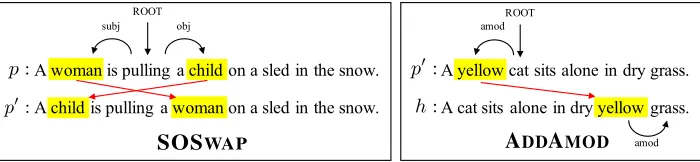
Figure 1: Examples of adversaries generated for our experiments. On the left, we have an example of the SOSWAPadversary,
where the swapped subject and object are marked in yellow inp0. On the right, we have an example of the ADDAMODadversary,
where the added adjective modifier is marked in yellow.
SNLI SOSWAP ADDAMOD
Model dev E C N E C N
RSE 86.5 92.5 2.1 5.5 95.2 0.2 4.6 G-TLSTM 85.9 97.2 1.2 1.5 95.9 1.2 2.9 DAM 85.0 99.7 0.3 0.0 99.9 0.0 0.1 ESIM 88.2 96.4 2.1 1.5 85.6 9.6 4.8 S-TLSTM 88.1 92.1 4.4 3.5 90.4 1.1 8.5 DIIN 88.1 84.9 4.5 10.6 55.0 0.4 44.6 DR-BiLSTM 88.3 89.7 5.5 4.8 82.1 8.9 9.0
Human - 2 84 14 10 2 88
Table 2: Model performance on SNLI and % of predictions on the adversarial test sets. E, C, N indicate the classifica-tion where E is entailment, C is contradicclassifica-tion and N is
neu-tral. (Note that SOSWAPmostly creates contradictory pairs,
while ADDAMODmostly creates neutral pairs).
plementation for the other three models and were able to achieve comparable results on standard evaluation sets.
2.2 Motivation
Many top-performing sentence encoders (such as RSE) use max-pooling as the final layer to encode the sentences Nan-gia et al. (2017), and except DIIN, most top-performing co-attention models calculate cross-alignment on the RNN hid-den state of each token. These design trends are counterin-tuitive because max-pooling and attention mechanisms are communicative operations which are not affected by word order, making the RNN layers the only way for the models to capture the compositional structure of sentences. How-ever, past studies have shown that RNNs (especially sequen-tial RNNs) are insufficient for effectively capturing logical compositional structure that is often present in NLI Evans et al. (2018); Nangia and Bowman (2018). These indicate an over-focus on lexical information in neural NLI approaches which is very different from how humans approach the task.
3 Adversarial Evaluation
We test our intuition that the models do not sufficiently capture the compositional nature of sentences by evaluat-ing them on a couple of rule-based adversaries, where we change the semantics of the sentences by perturbing the compositionality without modifying any lexical features. We found that none of the models were able to successfully use
the compositional difference to reason with these examples.
3.1 Adversarial Examples
To test our hypothesis that models are over-reliant on word-level information and have limited ability to process positional structures, we created adversarial test sets com-posed of pairs of sentences whose logical relations cannot be extracted from lexical information alone. Specifically, we conduct experiments with the following two types of adver-sarial data in which we change the semantics of the sentence by only modifying its compositional structure:
SOSWAPAdversaries We take a premise from the SNLI
dataset,p, that contains a subject-verb-object structure, and
create the hypothesisp0by swapping the subject and object.
This results in a contradictory pair as the semantic roles of the premise are swapped in the hypothesis. An example is shown on the left side of Fig. 1. We were able to create 971 examples of this type.
ADDAMODAdversaries In this setup, we take a premise
from the SNLI dataset,p, that has at least two different noun
entities. We then pick an adjective modifier from the SNLI dataset that has been used to describe both nouns, and create
the premisep0 by adding the modifier to one of the nouns,
and the hypothesishby adding it to the other. This results
in a neutral pair as the hypothesis contains additional infor-mation and is neither implied nor refuted by the premise. An example of this is shown on the right side of Fig. 1. We were able to create 1783 examples of this type.
The intuition behind both of the adversaries described above is that, while the semantic difference resulting from compositional change is obvious for humans, the two input sentences will be almost identical for models that take no
compositional information into consideration.3
3.2 Adversarial Evaluation Results
We trained our 7 models on the SNLI training set and tested them on the adversarial test sets – the results are shown in Table 2. To ensure that the intuitions behind our adver-sarial generation algorithms were correct, we conducted hu-man evaluation for a sample of 100 examples for each
eval-3To create the adversarial data, we used the Stanford Parser
Model SNLI MNLI Matched MNLI MisMatched
Original BoW WS Original BoW WS Original BoW WS
RSE 86.47 85.02 – 72.80 70.02 – 74.00 71.10 –
ESIM 88.17 82.37 86.79 76.16 68.98 73.70 76.22 69.77 74.20
DR-BiLSTM 88.28 82.81 86.90 76.90 70.11 73.27 77.49 70.70 73.25
Table 3: The ‘Original’ columns show results for vanilla models on the resp. validation sets. The ‘BoW’ column show results for BoW-like variants created replacing their RNNs with fully-connected layers. The ‘WS’ columns show results for models trained with shuffled input sentences.
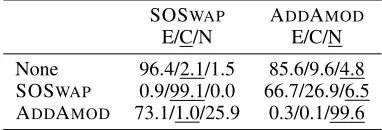
SOSWAP ADDAMOD
E/C/N E/C/N
None 96.4/2.1/1.5 85.6/9.6/4.8
SOSWAP 0.9/99.1/0.0 66.7/26.9/6.5
ADDAMOD 73.1/1.0/25.9 0.3/0.1/99.6
Table 4: The percentages of predicting E/C/N by ESIM with different types of adversarial training, where an underlined number indicates the accuracy on the correct label.
uation set.4 On both experiments, despite a majority of the
examples being marked as non-entail by our human eval-uators, the models classified them overwhelmingly as en-tailment, indicating the models’ inability to recognize or
process compositional semantic information5. The models’
poor performance on these adversarial test sets contrasts sharply with their high performance on standard evaluation, raising doubts on the effectiveness and reliability of standard evaluation. However, adversarial evaluation as done here has its own issues. We discuss problems with current evaluation further in the next section.
4 Limitations of Existing Evaluations
In this section, we show that models’ performance on stan-dard evaluation does not reflect their compositional under-standing capabilities, which we suspect leads to the lack of focus on this type of modeling in the current literature.
4.1 Regular Evaluation Limitations
The gap in model performance between standard evaluation and adversarial evaluation (see Table 2) indicates the limita-tions of regular evaluation at testing a model’s ability to pro-cess sentences’ compositional structure. More importantly,
regular evaluation fails to separate or differentiate
mod-els that are relying on lexical pattern-matching from those with deeper compositional understanding. To further illus-trate this point, we conduct the following two experiments 4The adversaries are intended to use to highlight models’
com-positional unawareness and motivate further analysis rather than to be a general-purpose evaluation set. Human evaluation results in-dicates that the the majority of the data are correct.
5Note that DIIN’s relatively high performance on ADDAMOD
is likely due to its convolutional structure successfully capturing the modifier relationship, but we see that it still fails on adversaries with longer-range dependency requirements such as SOSWAP.
in which we intentionally force the models to be unaware of compositional information by either removing RNN con-nections in their architectures or by randomizing word order during training.
RNN Replacement: We create strong bag-of-words-like
models by replacing RNN layers in RSE, ESIM, and DR-BiLSTM with fully-connected layers, and train them on the standard training set.
Word-Shuffled Training: We train the ESIM and
DR-BiLSTM models with the words of the two input sentences shuffled, such that the compositional information is diluted and hard to learn.
The results of these models and their corresponding vari-ants on SNLI, MNLI matched, and MNLI mismatched de-velopment set are shown in Table 3, where we see that their performance is not too far from that of their original, recur-rent counterparts. To be specific, there is roughly 6-7 points drop in accuracy when RNNs connections are removed and only 2-3 points drop when words are shuffled during train-ing. These counter-intuitive findings indicate that even a model which only considers shallow lexical features is able to get a decent result on standard evaluation, despite using a mechanism that is very different from human reasoning.
4.2 Adversarial Evaluation Limitations
Although, rule-based adversaries were able to expose the models’ lack of knowledge of compositional semantics, they have their own limitations and do not serve well as a general analysis tool. Due to the recursive nature of language, there are infinitely many ways for compositional information to affect a sentence’s meaning, but each type of rule-based ad-versary only tests for one specific compositional rule. Thus, success on one type of adversary only demonstrates edge of that single rule, and does not indicate general knowl-edge of compositionality rules. The easiest way to see this is via adversarial training and data-augmentation: we trained the ESIM model with data augmentation from either type
of adversaries,6 and re-evaluated the retrained models on
both SOSWAPand ADDAMOD. As shown in Table 4, while
adversarial data-augmentation leads to improvement on the same type of adversary, it does not generalize to other types of adversaries. In fact, we see that focusing on one type of adversarial performance may lead to over-fitting that
par-6We add 20,000 adversarial examples into training at each
ticular adversary, and hurt overall robustness. For example,
in Table 4, we see that adversarial training with SOSWAP
leads to an increase in incorrect ‘contradiction’ predictions
on ADDAMOD, and adversarial training with ADDAMOD
actually leads to a decrease in performance on SOSWAP
while incorrectly increasing ‘neutral’ predictions.7These
re-sults indicate that models’ success on an enumerable set of adversarial evaluation is still far from validating its general compositional ability.
Thus, we propose an alternative evaluation strategy that leverages existing data to evaluate a model’s general com-positional understanding capabilities.
5 Compositionality-Sensitivity Testing
In this section, we first formulate the role of composi-tionality in the context of NLI task, and then propose a compositionality-sensitivity testing setup as an analysis tool to explicit reveal how much compositional information the models take into consideration for inference.
5.1 Problem Formulation
NLI is a complex task with many variables – almost all
pre-vious approaches model the task as the distributionp(y|x)
of the logical relationyconditioned on the pair of input
sen-tences x = (P,H), where y ∈ {entailment, contradiction,
neutral} and P, H are the premise and hypothesis,
respec-tively. This conditional distribution is often parameterized by some neural models and trained end-to-end by maximiz-ing the probability of ‘ground-truth’ label. For the sake of studying models’ insensitivity to compositional information, we consider a factorization of the two input sentences as
tu-ples(Sp,Πh)and(Sh,Πh), where Sp andSh are the sets
of tokens that make up the premise P and hypothesis H as
lexical factors, andΠpandΠhare the sets of compositional
rules that combine those tokens into meaningful sentences
as compositional factors.8 A perfect modeling of NLI that
is capable of taking all lexical and compositional informa-tion into account is formalized as Eqn. 1, whereas a entirely bag-of-words (BoW) model is formalized as Eqn. 2.
p(y|x) =fθ(Sp, Sh,Πp,Πh) (1)
p(y|x) =gθ(Sp, Sh) (2)
The models we discuss are neither perfect models nor en-tirely BoW models, but rather a combination of both, where
7While it is true that we can use data augmentation from both
types of adversaries to improve performance on both types of eval-uations, we can easily come up with a third, different type of ad-versary (e.g., swapping the verbs between the main sentence and a clause) that is still difficult for the 2-adversarially trained model. Enumerating rule-based adversaries to cover all frequently-used compositional structural changes in a language is prohibitively costly, as generating high-quality (natural and grammatical) data following a single rule already takes tons of time and resources.
8Due to the complexity of language, lexical elements are often
intertwined with compositional rules and this factorization ofpwill makeΠpintractable in practice. However, we isolate compositional factors from lexical factors in order to analysis of model behavior.
they are able to detect and use some lexical features and some semantic rules:
p(y|x) = ˆfθ( ˜Sp,S˜h,Π˜p,Π˜h) (3)
whereS˜p ⊆ Sp andS˜h ⊆ Sh are the sets of lexical
fea-tures of the sentences that the model is capable of using, and
similarlyΠ˜p⊆ΠpandΠ˜h⊆Πhare sets of compositional
rules that the model is capable of using. The issue we ex-plored in previous sections is that current models are overly
relying onSpandSh, but have limited ability to detect and
useΠpandΠh. In other words,Π˜p ΠpandΠ˜h Πh.
For instance, the adversaries we created Sec. 3.2 have sen-tence pairs which have the same lexical elements but
differ-ent compositional structures, i.e.,Sp = Sh butΠp 6= Πh.
To an entirely BoW model (Eqn. 2), this looks identical to the scenario where the same sentence is repeated twice. Thus in those cases, inferences necessarily require knowl-edge of compositional information. This provides intuition
into our new evaluation setup:In order to evaluate models’
compositionality-sensitivity, we need to evaluate their per-formance on data which can not be solved by lexical fea-tures alone, i.e., cannot be solved by an entirely BoW model.
We thus seek to evaluate models on a subset of the standard evaluation set that fits this criterion.
5.2 Approximating BoW Model
To obtain such a subset, we must first approximate an en-tirely BoW model. Specifically, we use a softmax regression classifier that takes in only lexical features for prediction. More formally,
v=h(x) (4)
p(c|x) = exp(w>c v) P
c0∈Lexp(wc>0v)
(5)
wherehis a function that maps the raw input pairxto its
lexical feature vectorv∈Rd,p(c|x)is the probability given
to label c by the softmax regression classifier. The lexical
feature vectorvis an indicator vector that contains the
fol-lowing lexical features from the input pair:
• Unigrams appearance within the premise.
• Unigrams appearance within the hypothesis.
• Word pairs (cross-unigrams) where one appears in the
premise and the other in the hypothesis.
For unigram and cross-unigram features, we only pick words that are nouns, verbs, adjectives or adverbs to reduce spar-sity. We train the regression model on both SNLI and MNLI and use it to approximate an entirely BoW model.
5.3 Lexically-Misleading Score
regression model was confidently wrong, i.e., cases where they were ‘misled’ by lexical features. We do so because in cases where the regression has insufficient lexical knowl-edge (e.g., rare/unseen words), it is likely going to give a less confident prediction, whereas in cases where the model was misled, it had the lexical knowledge to make a decision, and hence a wrong prediction indicates the need for compo-sitional knowledge.
Formally, we define the Lexically-Misleading Score
(LMS) of an NLI datapoint(x, c∗)as:
fLM S(x, c∗) = max
c∈L\{c∗}p(c|x) (6)
where c∗ is the ground truth label, p(c | x) is the
prob-ability generated by our regression model, and L =
{entailment, contradiction, neutral}is the label set. In other
words,fLM Sof a data point is the maximum probability the
regression gave on an incorrect label. The idea behind LMS
is that:the more lexically misleading an example is, the more
confident we are that compositional information is required to solve it.We thus use LMS to select examples from
exist-ing evaluation sets for our evaluation.
5.4 Subsampling and Testing
Given a standard evaluation set and associated
‘ground-truth’ labels, D = {(xi, ci)}Ni=1, we create CSλ, the
compositionality-sensitivity evaluation set of confidenceλ:
CSλ={(xi, ci)∈D|fLM S(xi, ci)≥λ}
The choice of λ represents a trade-off between being
confident about the individual examples’ ability to test compositionality-sensitivity and keeping a decent sample
size of evaluation data. CS0is equivalent to testing on the
en-tire evaluation dataset, whereas CS0.95(in a 3-way classifier)
gives us an extremely small evaluation set (e.g. CS0.95 on
SNLI only has 148 examples) with highly misleading lexi-cal features. Empirilexi-cally, we found that for SNLI and MNLI,
λ= 0.7gives a good balance between size of the evaluation set and its ability to test compositionality-sensitivity (e.g.,
CS0.7on SNLI has 999 examples). Fig. 2 shows examples
of sentence pairs with high LMS from the SNLI validation
set that were in CS0.7for SNLI.9
5.5 Usage and Limitations
It is worth noting that we do not wish this subset to be used as a benchmark for models to compete on, but rather an analysis tool to explicitly reveal models’ compositionality-awareness. Even though the testing setup has its own limita-tions such as data sparsity and noisiness, it still serves as an initial step to highlight the problem of compositionality un-derstanding (and gain some important insights into models’ behaviors, as shown below), which has been largely unex-plored in the current neural literature. But more importantly, we hope that this inspires future works on data collection that explicitly address the issue by adding compositionality requirements and lexical-feature balancing into the collec-tion process.
9We release the LMS values of the SNLI and MNLI
develop-ment set in the suppledevelop-mentary materials.
5.6 Evaluation of Existing Models on CS
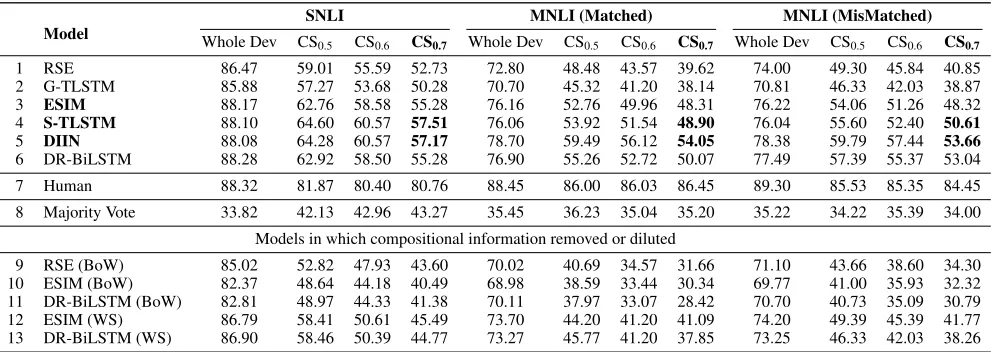
λTable 5 shows the performance of our seven models
re-evaluated with CSλat differentλvalues.
General Trend:We see that in general, model performance
decreases asλincreases, whereas human performance10
suf-fered much less with increasingλvalues. This is consistent
with our hypothesis that there are significant differences be-tween human-style deep reasoning (with both lexical and compositional knowledge) and inference by current models, which overly relies on lexical information. We also noticed that for all the models on SNLI, MNLI matched, and MNLI mismatch dev set, there is a big gap between the accuracy on the whole dev set and those on CS0.7. This demonstrates that our models have very limited ability to utilize or even recog-nize compositional information for semantic understanding. These findings indicate the space and need for further re-search on structured sentence modeling.
Seqential Model vs. Structured Model: The results on
CS0.7 differentiates models based on their architectures.
More importantly, it explicitly reveals models’ composi-tional understanding which is otherwise largely hidden on the standard evaluation. Specifically, the results for ESIM and S-TLSTM (row 3 and 4) give a clear comparison be-tween sequential and recursive modeling since the two mod-els have the same architecture with the exception that ESIM uses sequential RNN and S-TLSTM uses recursive RNN to encode the sentences. We see that S-TLSTM is better than
ESIM on CS0.7, despite ESIM getting better results on all
three standard evaluation datasets. This indicates that the re-cursive model with additional syntactic tree input does in fact induce more compostional understanding ability, which is completely invisible if we merely focus on the results of standard evaluation. Moreover, DIIN (row 5) obtains the
best results on all the CS0.7 subsets, substantially
surpass-ing that of DR-BiLSTM (row 6), the most powerful sequen-tial model in the table. This is also consistent with the in-tuition that DIIN’s convolutional network and phrase-level alignment provide much more compositional information than simple RNN-based sequential models. Another inter-esting fact is the difference in performance between a recur-sive model trained with explicit external linguistic supervi-sion (S-TLSTM) and one trained via latent tree learning (G-TLSTM). We see that S-TLSTM is able to capture composi-tional information more effectively than G-TLSTM (row 2), which is consistent with findings from diagnostic datasets regarding recursive modeling Nangia and Bowman (2018). Necessity of Compositional Information: In the lower side of the table (row 9-13), we evaluate models with either sev-ered RNNs connections or word-shuffled training data. The results represent models with limited compositional
acces-sibility or awareness. As expected, the results on CS0.7 are
similar to or even below the majority vote even though their performance on standard evaluation is on the same level as
10We approximate human performance by the mechanism
Premise: Two people are sitting in a station.
Hypothesis: A couple of people are inside and not standing.
True Label: entailment
Lexical Linear Model Prediction:
entailment contradiction neutral
Top 3 misleading features (sitting, standing)
not
standing
LMS:0.9632 (to contradiction)
Premise: A group of people prepare hot air balloons for takeoff. Hypothesis: There are hot air balloons on the ground and air.
True Label: neutral
Lexical Linear Model Prediction:
entailment contradiction neutral
Top 3 misleading features (hot, hot)
there
(balloons, balloons)
LMS:0.8643 (to entailment)
Figure 2: Two examples with high LMS. Correct prediction for the 1stexample requires recognizing that ‘not standing’ and
‘sitting’ are the same state, rather than focusing on the superficial lexical clues such as ‘not’ and the cross unigram (‘sitting’,
‘standing’) that both mislead to ‘contradiction’. For the 2ndexample, word-overlap misleads the classifier to predict ‘entailment’.
Model Whole Dev CSSNLI MNLI (Matched) MNLI (MisMatched)
0.5 CS0.6 CS0.7 Whole Dev CS0.5 CS0.6 CS0.7 Whole Dev CS0.5 CS0.6 CS0.7 1 RSE 86.47 59.01 55.59 52.73 72.80 48.48 43.57 39.62 74.00 49.30 45.84 40.85 2 G-TLSTM 85.88 57.27 53.68 50.28 70.70 45.32 41.20 38.14 70.81 46.33 42.03 38.87 3 ESIM 88.17 62.76 58.58 55.28 76.16 52.76 49.96 48.31 76.22 54.06 51.26 48.32
4 S-TLSTM 88.10 64.60 60.57 57.51 76.06 53.92 51.54 48.90 76.04 55.60 52.40 50.61
5 DIIN 88.08 64.28 60.57 57.17 78.70 59.49 56.12 54.05 78.38 59.79 57.44 53.66 6 DR-BiLSTM 88.28 62.92 58.50 55.28 76.90 55.26 52.72 50.07 77.49 57.39 55.37 53.04 7 Human 88.32 81.87 80.40 80.76 88.45 86.00 86.03 86.45 89.30 85.53 85.35 84.45 8 Majority Vote 33.82 42.13 42.96 43.27 35.45 36.23 35.04 35.20 35.22 34.22 35.39 34.00
Models in which compositional information removed or diluted
9 RSE (BoW) 85.02 52.82 47.93 43.60 70.02 40.69 34.57 31.66 71.10 43.66 38.60 34.30 10 ESIM (BoW) 82.37 48.64 44.18 40.49 68.98 38.59 33.44 30.34 69.77 41.00 35.93 32.32 11 DR-BiLSTM (BoW) 82.81 48.97 44.33 41.38 70.11 37.97 33.07 28.42 70.70 40.73 35.09 30.79 12 ESIM (WS) 86.79 58.41 50.61 45.49 73.70 44.20 41.20 41.09 74.20 49.39 45.39 41.77 13 DR-BiLSTM (WS) 86.90 58.46 50.39 44.77 73.27 45.77 41.20 37.85 73.25 46.33 42.03 38.26
Table 5: Results of models, human, and majority-vote baseline on different levels of compositionality-sensitivity testing. Results of models with limited compositional information are in the bottem on the table.
that of the original models, indicating that compositionality
understanding is required to obtain a good result on CS0.7.
6 Related Work and Discussion
Over-Stability: Jia and Liang (2017) used adversarial eval-uation to show that models trained on the Stanford QA Dataset Rajpurkar et al. (2016) were reliant on syntactic similarity for answering, revealing the over-stability of QA models. With similar motivation, we study the task of NLI by showing that models are overly focused on lexical fea-tures and have limited ability of compositionality.
Existing Analysis on NLI: Previous work on analyzing NLI models Glockner, Shwartz, and Goldberg (2018); Carmona, Mitchell, and Riedel (2018) has focused on models’ lim-ited ability in identifying lexical semantics that were rare or unseen during training. Our work complements theirs by demonstrating models’ limited understanding of composi-tionality encoded in the sentences. Gururangan et al. (2018), Poliak et al. (2018b) and Tsuchiya (2018) concurrently showed hypothesis bias in NLI and RTE datasets. In par-ticular, Gururangan et al. (2018) also proposed to evaluate models on a harder and better subset of standard evaluation. We instead focus on exposing models’ compositionality-insensitivity by selecting our evaluation dataset based on
LMS (lexically-misleading score).
Compositionality: Nangia and Bowman (2018) introduce a dataset to study the ability of latent tree models. Evans et al. (2018) introduce a dataset of logical entailments for mea-suring models’ ability to capture the structure of logical ex-pressions against an entailment prediction task. Dasgupta et al. (2018) study the inference behavior of models using sen-tence embedding on a compositional comparisons dataset. However, we conduct a rigorous study on compositionality-sensitivity, covering a broader range of NLI models and show how to use a filtered subset of existing NLI datasets to test models’ compositional ability.
processing the double negation. However, given that the ex-ample’s LMS score is only 0.2376 (which means our BoW regression model was able to solve this correctly), models can solve this particular example via a lexical feature short-cut. Thus, a model resolving of a specific linguistic problem does not necessarily indicate its understanding of the lin-guistic rule and its generalizability to other compositional-ity rules. Thus, our work complements linguistic diagnostic datasets well, since a model performing well on both our evaluation and the linguistic diagnostic setup is likely us-ing compositional rules (i.e., human-like reasonus-ing) rather than other pattern-matching procedures to obtain seemingly-compositional behavior.
7 Conclusion
In this paper, we show that current NLI models achieve mis-leadingly high results on standard evaluation due to its in-ability to test models’ compositional semantic understand-ing. We further show that typical adversarial evaluation is also limited in terms of evaluating generalizability. There-fore, to encourage the design of models with general un-derstanding capabilities, we propose our compositionality-sensitivity testing that evaluates using compositional infor-mation which is not confined to any specific type. Our work complements other recent advancements in evaluation in the community and we hope that this not only encourages the development of structured compositional-aware mod-els, but also highlights the need of more lexical-feature-controlled data collections for semantically demanding tasks (e.g. NLI), such that they will require not only distributional semantics, which is often captures via large scale unsuper-vised learning, but also compositional semantics, which tend to be overlooked but a harder problem in the community.
Acknowledgments
We thank the reviewers for their helpful comments. This work was supported by faculty research awards from Verisk, Google, and Facebook.
References
Bowman, S. R.; Angeli, G.; Potts, C.; and Manning, C. D. 2015. A large annotated corpus for learning natural language
inference. InEMNLP.
Carmona, V. I. S.; Mitchell, J.; and Riedel, S. 2018. Behav-ior analysis of nli models: Uncovering the influence of three
factors on robustness. NAACL.
Chen, D., and Manning, C. 2014. A fast and accurate
de-pendency parser using neural networks. InEMNLP.
Chen, Q.; Zhu, X.; Ling, Z.-H.; Wei, S.; Jiang, H.; and Inkpen, D. 2017. Enhanced lstm for natural language
in-ference. InACL.
Choi, J.; Yoo, K. M.; and Lee, S.-g. 2017. Learning to
compose task-specific tree structures. InAAAI.
Dasgupta, I.; Guo, D.; Stuhlm¨uller, A.; Gershman, S. J.; and Goodman, N. D. 2018. Evaluating compositionality in
sen-tence embeddings. arXiv preprint arXiv:1802.04302.
Evans, R.; Saxton, D.; Amos, D.; Kohli, P.; and Grefenstette, E. 2018. Can neural networks understand logical
entail-ment?ICLR.
Ghaeini, R.; Hasan, S. A.; Datla, V.; Liu, J.; Lee, K.; Qadir, A.; Ling, Y.; Prakash, A.; Fern, X. Z.; and Farri, O. 2018. Dr-bilstm: Dependent reading bidirectional lstm for natural
language inference. NAACL.
Glockner, M.; Shwartz, V.; and Goldberg, Y. 2018. Breaking nli systems with sentences that require simple lexical
infer-ences. NAACL.
Gong, Y.; Luo, H.; and Zhang, J. 2017. Natural language
inference over interaction space.ICLR.
Gururangan, S.; Swayamdipta, S.; Levy, O.; Schwartz, R.; Bowman, S. R.; and Smith, N. A. 2018. Annotation artifacts
in natural language inference data. NAACL.
Jia, R., and Liang, P. 2017. Adversarial examples for
evalu-ating reading comprehension systems. EMNLP.
Nangia, N., and Bowman, S. R. 2018. Listops: A diagnostic
dataset for latent tree learning. ACL-SRW.
Nangia, N.; Williams, A.; Lazaridou, A.; and Bowman, S. R. 2017. The repeval 2017 shared task: Multi-genre natural
language inference with sentence representations.RepEval.
Nie, Y., and Bansal, M. 2017. Shortcut-stacked sentence
encoders for multi-domain inference. RepEval.
Parikh, A. P.; T¨ackstr¨om, O.; Das, D.; and Uszkoreit, J. 2016. A decomposable attention model for natural language
inference. InEMNLP.
Poliak, A.; Haldar, A.; Rudinger, R.; Hu, J. E.; Pavlick, E.; White, A. S.; and Van Durme, B. 2018a. Towards a unified natural language inference framework to evaluate sentence
representations. arXiv preprint arXiv:1804.08207.
Poliak, A.; Naradowsky, J.; Haldar, A.; Rudinger, R.; and Van Durme, B. 2018b. Hypothesis only baselines in natural
language inference. *SEM.
Rajpurkar, P.; Zhang, J.; Lopyrev, K.; and Liang, P. 2016. Squad: 100,000+ questions for machine comprehension of
text. EMNLP.
Tsuchiya, M. 2018. Performance impact caused by hid-den bias of training data for recognizing textual entailment.
LREC.
Wang, A.; Singh, A.; Michael, J.; Hill, F.; Levy, O.; and Bowman, S. R. 2018. Glue: A multi-task benchmark and analysis platform for natural language understanding.
EMNLP.
Wang, Z.; Hamza, W.; and Florian, R. 2017. Bilateral
multi-perspective matching for natural language sentences.IJCAI.
Williams, A.; Nangia, N.; and Bowman, S. R. 2018. A broad-coverage challenge corpus for sentence understanding