316
Volume-4, Issue-4, August-2014, ISSN No.: 2250-0758
International Journal of Engineering and Management Research
Available at:
www.ijemr.net
Page Number: 316-320
Performance Analysis of WiMAX Physical Layer Model using Various
Techniques
Inderpreet Singh1, Er. Kapil Kaswan2
1M.Tech-Partime (CSE), Deptt. Of Computer Science & Applications CDLU,Sirsa, INDIA
2Assistant Professor, Deptt. Of Computer Science & Applications CDLU,Sirsa, INDIA
ABSTRACT
The Worldwide interoperability for microwave access (WiMAX) based on IEEE 802.16, is one of the most emerging broadband wireless technology. By using WiMAX technology we can overcome the limitations of the existing wireless communication like short coverage area, lack of security and low data rate
.
A simulator for the WiMAX physical layer is presented in this paper. The main aim of this paper is to analyze the performance of WiMAX physical layer under different modulation schemes using matlab simulink by calculating the SNR as well as BER. BER results are presented under different digital modulation schemes in AWGN channel.Keywords – WiMAX, OFDM, CHANNEL ENCODING, BER,LOS
I.
INTRODUCTION
WiMAX (also known as IEEE 802.16) is a wireless digital communications system that is intended for wireless "metropolitan area networks" (WMAN). It can provide broadband wireless access (BWA) up to 30 miles (50 km) for fixed stations, and 3 - 10 miles (5 - 15 km) for mobile stations. In contrast, the WiFi/802.11 wireless local area network standard is limited in most cases to only 100 - 300 feet (30 - 100m). WiMAX can be used for wireless networking in much the same way as the Wi-Fi protocol. WiMAX is a second-generation protocol that allows for more efficient bandwidth use, interference avoidance, and is intended to allow higher data rates over longer distances. The IEEE 802.16 group was formed in 1998 to develop an air-interface standard for wireless broadband. The group's initial focus was the development of a LOS-based point-to-multipoint wireless broadband system for operation in the 10GHz–66GHz millimeter wave band. The resulting standard—the original 802.16 standard, completed in December 2001—was based on a single-carrier physical (PHY) layer with a burst time division multiplexed (TDM) MAC layer.
The IEEE 802.16 group subsequently produced 802.16a, an amendment to the standard, to include NLOS applications in the 2GHz–11GHz band, using an orthogonal frequency division multiplexing (OFDM)-based physical layer [1]. Additions to the MAC layer, such as support for orthogonal frequency division multiple access (OFDMA),
were also included. Further revisions resulted in a new standard in 2004, called IEEE 802.16-2004, which replaced all prior versions and formed the basis for the first WiMAX solution. These early WiMAX solutions based on IEEE 802.16-2004 targeted fixed applications, and these will be referred to as fixed WiMAX [2]. In December 2005, the IEEE group completed and approved IFEEE 802.16e-2005,an amendment to the IEEE 802.16-2004 standard that added mobility support. The IEEE 802.16e-2005 forms the basis for the WiMAX solution for nomadic and mobile applications and is often referred to as mobile WiMAX [3]. Rest of this paper is organized as follows: Section II gives a brief overview about different WiMAX standards. WiMAX features are discussed in Section III. In Section IV detailed study about the WiMAX physical layer is presented. Section V shows our simulation results. Finally conclusion and future work are presented in section VI.
II.
WiMAX FEATURES
WiMAX is a revolutionary wireless technology that has a rich set of technological improvements compare to the other broadband access technology.
The set of features of WiMAX are listed below:
OFDM based physical layer: The WiMAX physical layer (PHY) is based on orthogonal frequency division multiplexing, a scheme that offers good resistance to multipath, and allows WiMAX to operate in NLOS conditions.
High data rate: WiMAX is capable of supporting very high peak data rates. In fact, the peak PHY data rate can be as high as 74Mbps when operating using a 20MHz wide spectrum.
Quality of service: The WiMAX MAC layer has a connection-oriented architecture that is designed to support a variety of applications, including voice and multimedia services.WiMAX system offers support for constant bit rate, variable bit rate, real-time, and non-real-time traffic flows, in addition to best-effort data traffic..
317
Support for mobility:The mobile WiMAX variantof the system has mechanisms to support secure seamless handovers for delay-tolerant full-mobility applications, such as VoIP.
Adaptive modulation and coding: Adaptive modulation and coding scheme can connect more users. It is a technique to maximize throughput and able to setup connection in a low signal strength and noisy environment. Mobility support: WiMAX offer optimized handover which support full mobility application such as voice over internet protocol (VOIP). It has also the power saving mechanism which increases the battery life of handheld devices. Scalability: WiMAX offer scalable network architecture that support user roaming in different networks. It also enhances the broadband access capability.
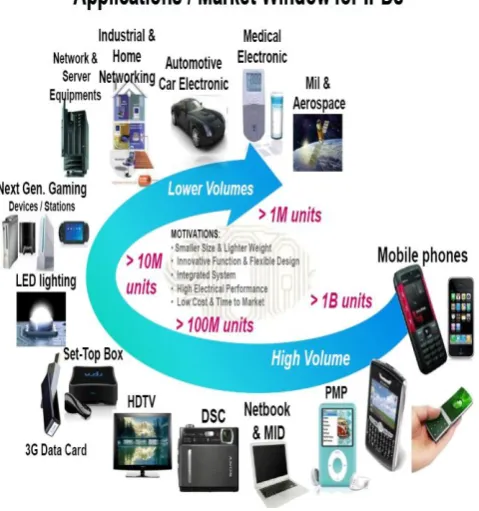
Fig. 1 WiMAX Applications [4]
Strong Security: WiMAX support extensible security feature for reliable data exchange. It uses Advanced Encryption Standard (AES) encryption for secure transmission and for data integrity, it use data authentication mechanism.
III.
WiMAX PHYSICAL LAYER
Physical layer is the most important layer. The role of the physical layer is to encode the binary digits that represent MAC frames into signal and transmit and receive these signals across the communication media. The WiMAX physical layer is based on OFDM which is used to enable high speed data, video and multimedia used by a variety of commercial application. Now we discuss about the WiMAX physical layer.
Fig.2 Physical Layer (Transmitter Side)
Randomizer
Randomization is the first process carried out in the physical layer after the data packet is received from the higher layers. The randomization process is used to minimize the possibility of transmissions of non-modulated subcarriers. The process of randomization is performed on each burst of data on the downlink and uplink, and on each allocation of a data block. The stream of packets is randomized using a pseudo-random binary sequence (PRBS) generator. The randomized bits are the modulo-2 summation of the data with the PRBS output.
Channel Encoding
The encoding process consists of a concatenation of an outer Reed-Solomon (RS) code and an inner convolutional code (CC) as a FEC scheme. That means that first data passes in block format through the RS encoder, and then, it goes across the convolutional encoder. The last part of the encoder is a process of interleaving to avoid long error bursts. Now we consider various blocks of channel encoder in detail.
Fig. 3 Encoding Process in WiMAX
RS Encoder
A Reed-Solomon code is specified as RS (n, k, t) with l-bit symbols. This means that the encoder takes k data symbols of l bits each and adds 2t parity symbols to construct an n-symbol codeword. Thus, n, k and t can be defined as:
• n: number of bytes after encoding, • k: number of data bytes before encoding, • t: number of data bytes that can be corrected.
The error correction ability of any RS code is determined by (n − k), the measure of redundancy in the block. If the location of the erroneous symbols is not known in advance, then a Reed-Solomon code can correct up to t symbols, where t can be expressed as t = (n − k)/2.
Convolutional encoder
After the RS encoding process, the data bits are further encoded by a binary convolutional encoder, which has a native rate of 1/2 and a constraint length of 7. A convolutional code is a type of FEC code that is specified by CC (m, n, k), in which each m-bit information symbol to be encoded is transformed into an n-bit symbol, where m/n is the code rate (n > m) and the transformation is a function of the last k information symbols, where k is the constraint length of the code [5].
Puncturing process
318
reduce the amount of data to be transmitted, thus forming ahigh-rate code.
Interleaver
Interleaving does not change the state of the bits but it works on the position of bits. Interleaving is done by spreading the coded symbols in time before transmission. The incoming data into the interleaver is randomized in two permutations. First permutation ensures that adjacent bits are mapped onto non-adjacent subcarriers. The second permutation maps the adjacent coded bits onto less or more significant bits of constellation thus avoiding long runs of less reliable bits. The block interleaver interleaves all encoded data bits with a block size corresponding to the number of coded bits per OFDM symbol.
IQ Mapper
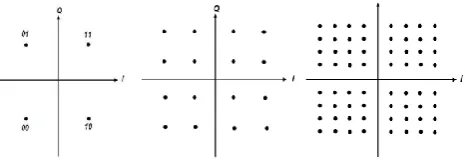
Once the signal has been coded, it enters the modulation block. All wireless communication systems use a modulation scheme to map coded bits to a form that can be effectively transmitted over the communication channel. Thus, the bits are mapped to a subcarrier amplitude and phase, which is represented by a complex in-phase and quadrature-phase (IQ) vector. The IQ plot for a modulation scheme shows the transmitted vector for all data word combinations. QPSK, 16QAM and 64QAM modulations are supported by the system.
QPSK
This is also known as four-level PSK where each element represents more than one bit. Each symbol contains two bits and it uses the phase shift of π/2, means 90º instead of shifting the phase 180º.
16-QAM
This is called 16-states Quadrature Amplitude Modulation which means four different amplitude levels would be used and the combined stream would be one of 16 = 4 * 4 states. In this mechanism, each symbol represents 4 bits [6].
64-QAM
This is same as 16 QAM except it has 64-states where each symbol represents six bits (26=64). It is a complex modulation techniques but with greater efficiency [6]. The total bandwidth increases according to the increasing number of states for each symbol. Mobile WiMAX uses this higher modulation technique when the link condition is high.
Fig. 4Constellation of QPSK, 16-QAM and 64-QAM
The use of variable or adaptive modulations to increase capacity is a trend also observed in other recently developed mobile phone and data standards like WCDMA [7], [8]. The constellation mapped data are assigned to all allocated data subcarriers of the OFDM symbol in order of increasing frequency offset index.
OFDM Modulator
In this section firstly inverse fast fourier transform is used to produce a time domain signal and then cyclic prefix is added to reduce the effect of multipath.
Channel
The channel that we used is pure AWGN.This is a noise channel. This channel effects on the transmitted signals when signals passes through the channel. It adds white Gaussian noise to the input signal. After adding Gaussian noise data is then passed to the receiver.
Fig. 5AWGN Channel
Receiver
The complementary blocks are implemented in the receiver: the CP is removed, sub-carriers are demodulated via the FFT transform, and then sub-carrier de-mapping is performed. After that Channel decoding process is performed with the help of de-interleaver, convolution decoder and RS decoder. Data is then de randomized and in last we get final data.
Fig.6 Physical Layer (Receiving side)
IV.
SIMULATION AND RESULTS
The Model for the WiMAX is built from the standard documents [9, 10]. The performance of the WiMAX-PHY layer was tested and evaluated at different noise levels. We performed our simulation in Matlab Simulink version 7.9. We have preferred the Matlab because it is adequate for the simulation of different signal processing methods used in wireless networks [11].
319
0 1 2 3 4 5 6 7 8 9 10
10-4 10-3 10-2 10-1 100
Signal to Noise Ratio
B
it
E
rr
o
r
R
a
te
BER Vs SNR For QPSK
Fig. 7BER vs. SNR plot for QPSK
0 2 4 6 8 10 12 14 16
10-4 10-3 10-2 10-1 100
Signal to Noise Ratio
B
it
E
rr
o
r
R
a
te
BER Vs SNR For 16-QAM
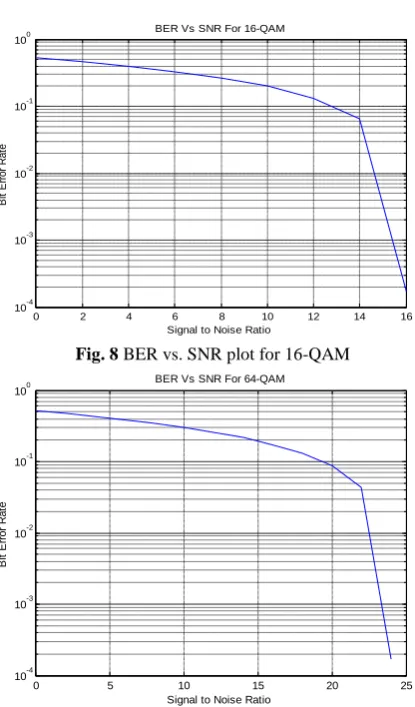
Fig. 8 BER vs. SNR plot for 16-QAM
0 5 10 15 20 25
10-4 10-3 10-2 10-1 100
Signal to Noise Ratio
B
it
E
rr
o
r
R
a
te
BER Vs SNR For 64-QAM
Fig. 9BER vs. SNR plot for 64-QAM
0 5 10 15 20 25
10-4 10-3 10-2 10-1 100
Signal to Noise Ratio
B
it
E
rr
o
r
R
a
te
Bit error rate for different modulation
QPSK 16 QAM 64 QAM
Fig. 10Comparison between three modulation schemes
Fig. 10 shows comparison between these three modulation schemes. From fig.10 it is clear that QPSK has lowest Bit Error Rate and 64-QAM has highest Bit Error Rate. Bit Error Rate of 16-QAM lies between these two modulation techniques.
V.
CONCLUSIONS
The wireless communications industry is gaining momentum in both fixed and mobile applications.The main focus of this paper is to implement the WiMAX physical layer using MATLAB in order to evaluate the physical layer performance. The performance of the WiMAX-PHY layer based on the IEEE 802.16e standard was evaluated and assessed at different modulation schemes and noise levels. A key performance measure of a wireless communication system is the BER. The BER curves are used to compare the performance of different modulation techniques. Thus we can conclude, lower modulation and coding scheme provides better performance with less SNR. As a result of the comparative study, it was found that: when channel conditions are poor, energy efficient schemes such as QPSK were used and as the channel quality improves, 16-QAM or 64-QAM was used.
A lot of work can be done for future optimization of wireless communication especially in WiMAX system. The IEEE 802.16 standard comes with many optional PHY layer features, which can be implemented to further improve the performance. As we used pure AWGN channel and channel coding rate ½, performance of Mobile WiMAX can be evaluated in other types of channel model at different coding rates.
REFERENCES
[1] WiMAX Forum, ―Mobile WiMAX – Part 1: A Technical Overview and Performance Evaluation‖, August 2006
320
[3] IEEE. Standard 802.16e-2005. ―Part16: Air interface forfixed and mobile broadband wireless access systems— Amendment for physical and medium access control layers for combined fixed and mobile operation in licensed band.‖ December 2005.
[4] C. Eklund, ―IEEE Standard 802.16: A Technical Overview of the WirelessMAN Air Interface for Broadband Wireless Access,‖ IEEE Commun. Mag., pp. 98107, June 2006
[5] Nuaymi Loutfi, 2007, ―WiMAX Technology for Broadband Wireless Access‖, Wiley, London
[6] William Stallings, ―Wireless: Communications and Networks‖, Page 139-146, Pearson Education, 2002.
[7] Y.Xiao, ―WiMAX-MobileFi: Advanced research and technology," Auerbach publications, 2008.
[8] R.B. Marks, K. Stanwood, D.Chang, et al., ―IEEE Standard for Local and Metropolitan Area Networks, Part 16: Air Interface for Fixed Broadband Wireless Access Systems,‖ October, 2004.
[9] ETSI TS 102177 Version 1.3. 1, February 2006, "Broadband Radio Access Networks (BRAN); HiperMAN; Physical (PHY) Layer"
[10] IEEE 802.16-2006:"IEEE Standard for Local and Metropolitan Area Networks-Part 16: Air Interface for Fixed Broadband Wireless Access Systems"
[11] J. C. Ikuno, M. Wrulich, M. Rupp, System level simulation of LTE networks, 2010 IEEE First Vehicular Technology Conference: VTCS2010, Taipei, Taiwan, 16-19May, 2010.