Tensingh et al. World Journal of Pharmaceutical and Life Sciences
CHARACTERIZATION OF PHOSPHATE SOLUBILIZING BACTERIA (PSB)
ISOLATED FROM RHIZOSPHERE SOILS OF SELECTED CROP PLANTS
*Dr. Tensingh Baliah N.and Kiruthiga R.
Center for Research and Post Graduate Studies in Botany, Ayya Nadar Janaki Ammal College, Sivakasi, Tamil Nadu, India.
Article Received on 10/09/2018 Article Revised on 01/10/2018 Article Accepted on 22/10/2018
INTRODUCTION
Phosphorus is a vital plant macronutrient that plays a significant role in plant metabolism, ultimately reflected on crop yields. It is estimated that about 98% of Indian soils contain insufficient amounts of available phosphorus, which is necessary to support maximum plant growth.[1] Only about 25% of the phosphorus applied to the soils is available for the crops in the year of its application and remaining part is converted into insoluble unavailable forms. The soil is rich in phosphorus as it contains about 0.05 per cent phosphorus but only one tenth of this is available to plants due to its poor solubility and chemical fixation in soil by aluminium, iron, magnesium etc.[2]
Indian soils are rich in P but more than 2.3 of the native phosphates are in a chemical form that cannot be absorbed by plants. Furthermore, applied P fertilizers are rendered unavailable due to its chemical fixation in the soil.[3] Phosphorus is applied to soil in the form of phosphatic fertilizers. However, a large portion of soluble inorganic phosphate applied to the soil as chemical fertilizer is immobilized rapidly and becomes unavailable to plants.[4] Tropical and subtropical soils are predominantly acidic and often extremely phosphorous deficient[5] with high phosphorous sorption (fixation) capacities. The low level of phosphorous is due to high reactivity of soluble phosphate with other elements.
Plants acquire P from soil solution as phosphate anions. However, phosphate anions are extremely reactive and may be immobilized through precipitation with cations such as Ca2+, Mg2+, Fe3+ and Al3+, depending on the particular properties of a soil. In these forms, P is highly insoluble and unavailable to plants. As the results, the amount available to plants is usually a small proportion of this total. Several scientists have reported the ability of different bacterial species to solubilize insoluble inorganic phosphate compounds such as tricalcium phosphate, dicalcium phosphate, hydroxyapatite and rock phosphate. Several reports have examined the ability of different bacterial species to solubilize insoluble inorganic phosphate compounds.
Phosphate Solubilizing Bacteria (PSB)
Phosphate solubilizing bacteria play an important role in converting low grade insoluble inorganic phosphate sources like rock phosphate, bone meal, basic slag and the chemically fixed soil phosphorus into available form. Therefore, the use of phosphate solubilizing microbes in agricultural practice would not only offset the high cost of manufacturing phosphatic fertilizers but would also mobilize insoluble phosphorus in the fertilizers and soils to which they are applied. The mechanism of solubilization of insoluble phosphate is ability to secrete organic acids and phosphatase enzyme.[6]
World Journal of Pharmaceutical and Life Sciences
WJPLS
www.wjpls.org SJIF Impact Factor: 5.088
*Corresponding Author: Dr. Tensingh Baliah N.
Center for Research and Post Graduate Studies in Botany, Ayya Nadar Janaki Ammal College, Sivakasi, Tamil Nadu, India.
ABSTRACT
The rhizosphere soils were collected from economically important crop plants such as sunflower, cotton, chilly, tomato, black gram, sorghum, brinjal, green gram, ladys’ finger and red gram. Isolation and enumeration of PSB was carried out following dilution plate technique using hydroxy apatite medium. The isolated PSB strains were screened in vitro by measuring the P solubilization zone in solid medium, determining pH change of the medium and estimating the phosphatase activity, organic acids production and available phosphorus. The population level of PSB was higher in the rhizosphere soil collected from green gram followed by sunflower. Based on the biochemical and morphological tests, PSB were identified at genus level. The selected strains differed in the solubilization zone formation in the solid medium, pH reduction in the culture medium, production of phosphatase enzyme, organic acids and available phosphorus.
PSB have attracted attention in semi arid regions and endowed to enhance the crop yields. They have established their role under nutrient inequity conditions. Secretion of organic acids and phosphatases to solubilize insoluble phosphate to soluble forms are common in this group. Although several phosphate solubilizing bacteria occur in soil, their numbers are not adequate to compete with other bacteria commonly established in the rhizosphere.[7] The PSBs are able to synthesize phytohormones like indole acetic acid, gibberellic acid and siderophores.[8,9] PSB are also enhances plant growth by increasing the efficiency of biological nitrogen fixation of other trace elements such as iron, zinc, etc.[10] Phytohormones play an important role as growth regulator such as auxins and cytokinin are responsible for division, extension and differentiation of plant cells and tissues.[11]
MATERIAL AND METHODS
Collection of samples
Soil and root samples were collected from economically important crop plants such as sunflower, cotton, chilly, tomato, black gram, sorghum, brinjal, green gram, ladys’ finger and red gram. The soil samples were air dried under shade and used for the isolation and enumeration of PSB.
Isolation and enumeration of PSB
Isolation and enumeration of PSB was carried out following dilution plate technique using hydroxy apatite medium. For the isolation of PSB, the soil samples were serially diluted up to 106 dilution and plated on petriplates and incubated at 35±2ºC for seven days. At the end of incubation, PSB colonies were visually identified from the clear zone around the bacterial colony. The colonies were sub cultured, purified and maintained in nutrient agar slants.
Characterization of PSB strains
Phosphate solubilization in the solid medium
The PSB strains were inoculated in solid hydroxy apatite medium and incubated for 7 days. After incubation period the diameter of the halo region produced around the colonies was measured.
Change in pH of the medium
Selected PSB strains were grown in LB broth and inoculated 1 ml to Pikovskaya’s broth. After incubation period the pH was measured at different period of growth.
Estimation of organic acids
The organic acid produced by PSB strain was estimated in terms of total titrable acidity of the culture filtrate.[12] The total titrable acidity was expressed by ml of 0.01 N NaOH consumed.
Estimation of phosphatase activity
The PSB isolates were grown in Pikovaskaya's broth where TCP was replaced with organic source
(p-glycerophosphate).[13] The phosphatase activity was expressed μ moles of PNP released/ml of filtrate/hour.
Estimation of available Phosphorus
The available phosphorus in the culture filtrate was estimated following the method of Olsen. [14]
Identification of bacterial strains
The selected bacterial strains were identified using standard biochemical tests as listed in the Bergey’s Manual of Determinative Bacteriology.[15]
RESULTS
Isolation and population dynamics of PSB
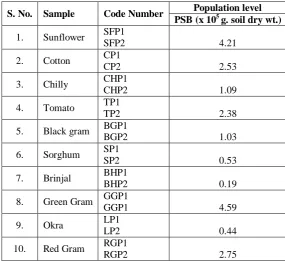
Based on the solubilization zone production in the solid medium, two isolates from each crop plants were selected and totally 20 PSB were isolated. These 20 PSB strains were used for further studies. The isolated PSB strains were maintained on the nutrient agar slants for further use. The population level of PSB was higher in the rhizosphere soil collected from green gram followed by sunflower. The population level of PSB was least in rhizosphere soil collected from the brinjal (Table 1).
Identification of PSB strains
Based on the biochemical and morphological tests, PSB were identified at genus level. Among 20 PSB strains, 9 strains (SFP1, SFP2, CP1, CP2, CHP1, CHP2, TP2, BP1 and RGP1) were identified as Bacillus spp. and remaining 11 strains as (SHP1, SHP2, TP1, BGP1, BGP2, BP2, GGP1, GGP2, LP1, LP2, RGP2) Pseudomonas spp (Table 2).
Characterization of PSB
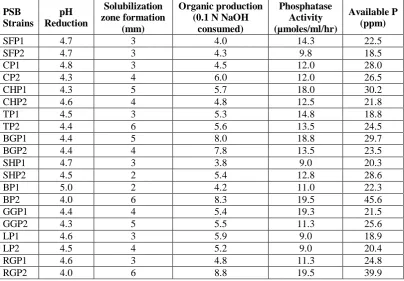
The isolated PSB strains were characterized in vitro by measuring the P solubilization zone in solid medium, determining pH change of the medium and estimating the phosphatase activity, organic acids production and available phosphorus. The nature of phosphate sources greatly affected P solubilization capacity of PSB strains. Further, the phosphate solubilization capacity was varied with strains to strains (Table 3 and 4).
pH reduction in the culture medium
All the PSB strains brought down the pH of the culture medium with tricalcium phosphate (TCP) and rock phosphate (RP) as phosphate source. Among 20 PSB strains, maximum reduction was noticed with SHP2 and RGP2 strains in the presence of TCP and strains BP2 and RGP2 the presence of RP.
Solubilization zone production by PSB
Organic acid production
In the culture medium, the addition of TCP as P source, the organic acid production was higher with the strain SHP1 followed by CHP1. In the case of RP, the strains RGP2 and BP2 were superior in organic acid production.
Phosphatase activity
The results revealed that estimation of phosphatase activity indicated that the activity was higher with TCP by CHP1 followed by SP2 strain. Further, the activity was superior with RP by BP2 and RGP2 strains.
Available Phosphorus
The P solubilization potential of selected strains of PSB was tested in vitro by estimating available phosphorus in the culture medium. The results indicated that a wide variation in the phosphate solubilization capacity with different strains in presence of both TCP and RP. Among 20 PSB strains, the strains CHP1 was released more phosphorus in the culture medium followed by SHP2 with TCP and BP2 followed by RGP2.
Table 1: Population dynamics of phosphate solubilizing bacteria.
S. No. Sample Code Number Population level PSB (x 105 g. soil dry wt.)
1. Sunflower SFP1
SFP2 4.21
2. Cotton CP1
CP2 2.53
3. Chilly CHP1
CHP2 1.09
4. Tomato TP1
TP2 2.38
5. Black gram BGP1
BGP2 1.03
6. Sorghum SP1
SP2 0.53
7. Brinjal BHP1
BHP2 0.19
8. Green Gram GGP1
GGP1 4.59
9. Okra LP1
LP2 0.44
10. Red Gram RGP1
RGP2 2.75
Table 2: Identification of Bacterial isolates.
S. No. PSB Strains Identified strains
Table 3: Characterization of PSB with Tri-Calcium Phosphate (TCP) as P source.
PSB Strains
pH Reduction
Solubilization zone formation
(mm)
Organic production (0.1 N NaOH
consumed)
Phosphatase Activity (µmoles/ml/hr)
Available P (ppm)
SFP1 4.26 3 5.8 12.30 26.25
SFP2 4.14 5 10.0 25.60 42.00
CP1 4.42 3 6.4 13.80 27.25
CP2 4.38 4 5.9 13.40 33.25
CHP1 4.09 6 10.5 25.90 44.30
CHP2 4.47 3 5.0 11.50 33.20
TP1 4.34 4 5.5 13.70 26.75
TP2 4.34 4 5.8 16.80 29.25
BGP1 4.54 2 7.7 19.10 36.75
BGP2 4.36 3 6.0 15.40 28.50
SHP1 4.20 5 8.5 19.80 36.75
SHP2 4.03 5 11.2 24.50 42.75
BHP1 4.65 3 9.4 12.30 32.80
BHP2 4.33 6 8.3 15.60 37.80
GGP1 4.20 6 6.0 16.80 39.30
GGP2 4.26 5 6.4 16.10 37.80
LP1 4.26 4 3.9 15.90 32.50
LP2 4.43 4 4.8 14.10 34.90
RGP1 4.91 3 6.4 11.50 22.30
RGP2 4.04 5 10.8 26.40 40.63
Table 4: Characterization of PSB with Rock Phosphate (RP) as P source.
PSB Strains
pH Reduction
Solubilization zone formation
(mm)
Organic production (0.1 N NaOH
consumed)
Phosphatase Activity (µmoles/ml/hr)
Available P (ppm)
SFP1 4.7 3 4.0 14.3 22.5
SFP2 4.7 3 4.3 9.8 18.5
CP1 4.8 3 4.5 12.0 28.0
CP2 4.3 4 6.0 12.0 26.5
CHP1 4.3 5 5.7 18.0 30.2
CHP2 4.6 4 4.8 12.5 21.8
TP1 4.5 3 5.3 14.8 18.8
TP2 4.4 6 5.6 13.5 24.5
BGP1 4.4 5 8.0 18.8 29.7
BGP2 4.4 4 7.8 13.5 23.5
SHP1 4.7 3 3.8 9.0 20.3
SHP2 4.5 2 5.4 12.8 28.6
BP1 5.0 2 4.2 11.0 22.3
BP2 4.0 6 8.3 19.5 45.6
GGP1 4.4 4 5.4 19.3 21.5
GGP2 4.3 5 5.5 11.3 25.6
LP1 4.6 3 5.9 9.0 18.9
LP2 4.5 4 5.2 9.0 20.4
RGP1 4.6 3 4.8 11.3 24.8
RGP2 4.0 6 8.8 19.5 39.9
DISCUSSION
Isolation of PSB
PSBs were found in almost all types of soils, although their number varies depending upon the soil and climatic conditions. A considerably higher concentration of phosphate solubilizing bacteria was commonly found in
higher concentration of phosphate solubilizing bacteria was commonly found in the rhizosphere in comparison with non rhizosphere soil. The soil bacteria belonging to the genera Pseudomonas and Bacillus and fungi were more common in organic agriculture.[18] The phosphate solubilizing bacteria belongs to the genus Bacillus spp, Citrobacter spp, Shigella spp, Klebsiella spp, from sea-grass rhizosphere soil.[19] Likewise,[20] bacterial spp. such as Bacillus amyloliquefaciens, Bacillus licheniformis, Bacillus atrophaeus, Paenibacillus macerans, Vibrio proteolyticus, Xanthobacter agilis, Enterobacter aerogenes, Enterobacter taylorae, Enterobacter asburiae, Kluyvera cryocrescens, Pseudomonas stutzeri and Chryseomonas luteola from mangrove soil. Population of PSB depends on different soil properties and cultural activities.[21] Larger populations of PSB were found in agricultural and range land soils.[22]
The rhizosphere was generally considered to be a narrow zone of soil subject to the influence of living roots, where root exudates stimulate or inhibit microbial populations and their activities of PSB.[23] Among the rhizosphere abundant bacterial genera Azotobacter, Bacillus, Beijerinckia, Burkholderia, Enterobacter, Erwinia, Flavobacterium, Microbacterium, Pseudomonas, Rhizobium and Serratia were most promising PSB.[24]
Identification of PSB
The bacterial cultures morphological, cultural and physiological and biochemical characteristics using the manual of microbiological methods and identified the organism Bacillus sp., using Bergey's manual of Determinative Bacteriology.[25] The phosphate solubilizing microorganisms such as Pseudomonas aeruginosa, P. cepacia, P. fluoresence and P. putida from therhizosphere of wheat and Bacillus licheniformis, B. mycoides, B. megaterium from the rhizosphere of paddy.[26] The morphological and biochemical characters of phosphobacteria were found to be gram negative with rod shaped and non motile characteristics. The organism showed positive results for indole production, methyl red and catalase test.[27]
PSB strains were in rod shape, Gram positive and motile in nature.[28] They were positive to catalase, acid from glucose, casein hydrolysis, gelatin hydrolysis, starch hydrolysis, citrate utilization and nitrate reduction and negative to anaerobic growth, gas from glucose, VP test, indole production and growth with lysozyme. Pseudomonas sp. was Gram negative and motile and growth was strictly aerobic and spores were absent. Pseudomonas were positive to oxidase, catalase, arginine dihydrolase, acid from glucose and growth on citrate agar and negative to growth at 41ºC, gelatin hydrolysis, starch hydrolysis and denitrification. In carbohydrate fermentation showed positive result for fructose and glucose where as negative for lactose and dextrose. The PSB isolates had the morphological features like colourless colonies which did not produce pigment, cells
were gram negative, rod shaped and on the basis of biochemical reactions it was found to be Pseudomonas fluorescens. Upon gram staining, it was found as gram negative characteristics. Isolate produced slimy, white colonies with irregular margins, cells were gram positive and on the basis of biochemical reactions this isolate was identified as Bacillus megaterium.[29]
Based on the biochemical tests, the PSB strains were identified up to species level. The results of various biochemical tests for ten PSB isolates were differed. Among ten PSB isolates, 6 strains (i.e.) CP1, TP1, TP2, CTP1, BP1 and BP2 were identified as Bacillus megaterium, 2 strains as Pseudomonas putida and CP2, CTP2 as Pseudomonas fluorescens. P. putida were rod shaped, 0.5 - 0.8 × 1.0 - 4.0 μm in size. They were Gram negative, motile and their growth was strictly aerobic and spores were absent in all pseudomonads. They were positive to oxidase, catalase, and arginine dihydrolase, acid from glucose and growth on citrate agar and negative to growth at 41ºC, gelatin hydrolysis, starch hydrolysis and denitrification. P. fluorescens were rod shaped and 0.5 - 1.0 × 1.5 - 5.0 μm in size. They were Gram negative, motile and growth was strictly aerobic and not producing spores. On King’s B medium they produced fluorescein, a water soluble pigment. Cells were positive to oxidase, catalase, lipase activity, arginine dihydrolase, gelatin hydrolysis, acid from glucose, urease and negative to growth at 41ºC and starch hydrolysis.[30]
Mechanism of phosphate solubilization
The mechanism of phosphate solubilization by PSB may involve the release of low molecular weight of organic acids, which chelate phosphate bound cations to convert P into soluble forms.[35] Highly efficient PSB have been shown to utilize the direct oxidation glucose pathway to produce gluconic and 2-ketogluconic acids. Microorganisms and their interactions in soil play a critical role in mediating the distribution of P between the available pool in soil solution and the total soil P through solubilization, mineralization and immobilization reactions of sparingly available forms of inorganic and organic soil P. Mechanism of phosphate solublizing includes production of organic acids and production of acid phosphatase.[37,36]
The high alkaline phosphatase enzyme produced by PSB and were responsible for organic solubilizion of insoluble phosphate.[38] However, phosphatase was not directly act on inorganic phosphate solubilization, though phosphatase activity may participate in lowering the pH of the culture medium by the dephosphorylating action and the production of acids.[39] The ability of PSB strains to quantitatively dissolve phosphate and pH of the liquid media was also measured spectrophotometrically. Decrease pH and increase soluble phosphate indicated that the isolates having ability to produce organic acids.[40,41,42] Those strains were able to produce more organic acids or having an effective phosphatase enzyme by which it solubilize maximum amount of phosphate.
Organic acids were found to be responsible for tricalcium phosphate and rock phosphate solubilization.[43] Addition of EDTA was found to increase solubilization of tricalcium phosphate. Organic acids were also found to mediate the release of phosphorus bound to iron oxides.[44] P-solubilizing microbes excrete inorganic acids, organic acids and phosphatase to dissolve phosphorus.[45] However, the mechanisms of P-solubilization not only differ among microorganisms but also dependent on the applied P sources.[46] Phosphate solubilization of most organic phosphorous compounds is carried out by means of phosphatase enzymes. The presence of a significant amount of phosphatase activity in soil has been reported[47]
Important levels of microbial phosphatase activity have been detected in different types of soils.[48,49] In fact, the major source of phosphatase activity in soil is considered to be of microbial origin.[50] In particular, phosphatase activity is substantially increased in the rhizosphere.[51] Phosphatase activity was considered as main contributor towards increased phosphorus and its availability. P-solubilizing activity was determined by the microbial biochemical ability to produce and release organic acids, which through their carboxylic groups chelate the cations, bound to phosphate converting them into the soluble forms.[52] A strain of Burkholderia cepacia, commercially used as biofertilizer which display significant mineral phosphate solubilization and
moderate phosphatase activity, also improve the yield of tomato, potato, onion, banana, coffee etc.[53] The logic behind higher alkaline phosphatase enzyme activity was presence of insoluble phosphate for which PSB can produce enzymes and organic acids to solubilize this unavailable phosphorus.[38] Phosphate solubilization by PSB was the action of phosphatase enzyme. The liberation of phosphorus from organic phosphate compounds was mainly due to the action enzyme esterase type. PSB produced the phosphatase enzyme which solubilized the phosphate in the aquatic environment.[54] Acid phosphatase promoted the hydrolysis of the synthetic organophosphatic substrates like p-nitrophenyl phosphate.[55]
CONCLUSION
The population dynamics of PSB was varied in the rhizosphere soils of selected crop plants. The isolated PSB strains were characterized under in vitro. All the PSBs isolates were able to solubilize the insoluble phosphate source (Tricalcium phosphate (TCP) and Rock phosphate (RP)) and the solubilizing capacity was varied with strains. PSB strains were able to produce organic acids and phosphatase enzyme and the production ability varied with strain to strain. These variations reflected in the phosphate solubilization.
ACKNOWLEDGEMENT
The authors are thankful to the Management and the Principal of Ayya Nadar Janaki Ammal College, Sivakasi, Tamil Nadu for providing laboratory facilities and financial assistance to carry out this research work.
REFERENCES
1. Tallapragada, P. and Seshachala, U., Phosphate solubilizing microbes and their occurrence in the rhizospheres of Piper betel in Karnataka, India., Turk. J. Biol., 2012;36: 25-35.
2. Wang, X., Wang, Y., Tian, J., Lim, B. L., Yan, X. and Liao, H., Over expressing AtPAP15 enhances phosphorus efficiency in soybean. Plant Physiol., 2009; 151: 233-240.
3. Vassilev, N., Vasileva, M. A. and Nikolaeva, L., Simultaneous P solubilizing and biocontrol activity of microorganisms: potentials and future trends. Appl. Microbiol. Biotechnol., 2006;71(2): 137-144. 4. Hu, X., Chen, J. and Guo, J., Two phosphate and
potassium solubilizing bacteria isolated from Tianmu xxvii Mountain, Zhejiang, China. World J. Microb. Biotehnol., 2006; 22: 983-990.
5. Gaume, A., Low phosphate tolerance of various maize cultivers; the contribution of root exudation, Ph.D. Dissertation, Swiss federal institute of Technology, Zurich, Switzerland, 2000.
7. Khan, M. S., Zaidi, A., Ahemad, M., Oves M. and Wani, P. A., Plant growth promotion by phosphate solubilizing fungi current perspective. Arch. Agron. Soil Sci., 2010; 56: 73-98.
8. Ramkumar, V. S. and Kannapiran, E., Isolation of total heterotrophic bacteria and phosphate solubilizing bacteria and in vitro study of phosphatase activity and production of phytohormones by PSB. Arch. Appl. Sci. Res., 2011; 3: 581-586.
9. Babana, A. H., Dicko, A. H., Maiga, K. and Traore, D., Characterization of rock phosphate-solubilizing microorganisms isolated from Wheat (Triticum aestivum L.) rhizosphere in Mali. J. Microbiol. Microbial. Res., 2013; 1(1): 1-6.
10. Ponmurugan, P. C. and Gopi, C., In vitro production of growth regulators and phosphates activity by phosphate solubilizing bacteria. Afr. J. Biotechnol., 2006;5: 348-350.
11. Tsavkelova, E. A., Klimova, S. Y., Cherdyntseva, T. A. and Netrusov, A. I., Microbial producers of plant growth stimulators and their practical use: a review. Appl. Biochem. Microbiol., 2006; 42: 117-126. 12. Sperber, J. I., Solution of apatite by soil
microorganisms producing organic acids. Aust. J. Agric. Res., 1958;9: 782-787.
13. Eivazi, F. and Tabatabai, M. A., Phosphatases in soils. Soil Biol. Biochem., 1977;9: 167-172.
14. Olsen, S. R., Cole, C. V., Watanabe, F. S. and Dean, L., Estimation of available phosphorus in soils by extraction with sodium bicarbonate U. S. D. A. Circular, U. S. Govt. Printing Office, Washington DC., 1954; 939.
15. Krieg, N. E, and Dobereiner, J., In: Bergey’s Manual of Systematic Bacteriology. Vol I. Eds: N. R. Krieg and J. G. Holt. Williams and Wilkins, Baltimore, London. 1984; 94-104.
16. Kundu, B. S. and Nehra, K., Biodiversity of phosphate solubilizing bacteria in rhizosphere of chickpea, mustard and wheat grown in different regions of Haryana. Ind. J. Microbiol., 2009; 49: 120-127.
17. Chen, Y. P., Rekha, P. D., Arun, A. B., Shen, F. T., Lai, W. A. and Young, C. C., Phosphate solubilizing bacteria from subtropical soil and their tricalcium phosphate solubilizing abilities., Appl. Soil Ecol., 2006;34(1): 33-41.
18. Mishra, P. K., Bisht, S. C., Jeevanandan, K., Kumar, S., Bisht, J. K. and Bhatt, J. C., Synergistic effect of inoculating plant growth-promoting Pseudomonas spp. and Rhizobium leguminosarum- FB1 on growth and nutrient uptake of Rajmash (Phaseolus vulgaris L.). Arch. Agron. Soil Sci., 2013;60(6): 799 815. 19. Ghosh, U., Subhasisni, P., Dilipan, E., Raja, S.,
Thangaradjou T. and Kanan, L., Isolation and characterization of phosphate solubilizing bacteria from sea-grass rhizosphere soil. J. Ocean Uni. China., 2012; 11(1): 86-92.
20. Vazquez, P., Holguin, G., Puerte, M. E., Lopez-Cortes, A. and Bashan, Y., Phosphate solubilizing
microorganisms associated with the rhizosphere of mangroves in a semiarid Coastal Lagoon. Biol. Fert. Soil., 2000; 30: 460-468.
21. Kim, K. Y., Jordan, D. and Mcdonald, G. A., Enterobacter agglomerans, phosphate solubilizing bacteria, and microbial activity in soil: Effect of carbon sources. Soil Biol. Biochem., 1998; 30(8-9): 995-1003.
22. Yahya, A. and Azawi, S. K. A., Occurrence of phosphate solubilizing bacteria in some Iranian soils. Plant Soil., 1998; 117: 135-141.
23. Brimecombe, M. J., De Leij, F. A. A. M. and Lynch, J. M., Rhizodeposition and microbial populations, In: Pinton, R., Varanini, Z. and Nannipieri, P. eds. The Rhizosphere Biochemistry and Organic Substances at the Soil-Plant Interface. New York, USA: Taylor and Francis Group., 2007; 41-93. 24. Bhattacharyya, P. N. and Jha, D. K., Plant growth
promoting rhizobacteria (PGPR): Emergence in Agriculture. World J. Microbiol. Biotechnol., 2012; 28(4): 1327-1350.
25. Gaur, A. C., Madan, M. and Ostwal, K. P., Solubilization of organic compounds by native microflora of rock phosphates. Ind. J. Expt. Biol., 1973; 11: 427-432.
26. Frietas, J. R. and Germide, J. J., PGPR for winter wheat. Can. J. Microbiol., 1990; 36: 265-273. 27. Amutha, R., Karunakaran, S., Dhanasekaran, S.,
Hemalatha, K., Monika, R., Shanmugapriya, P. and Sornalatha, T., Isolation and mass production of biofertilizer (azotobacter and phosphobacter) Inter. J. Res. Sci. Technol., 2014;3(1): 79-81.
28. Indira, M., Venkateswarulu, T., Chakravarthy, C., Reddy, K. R., Babu, A. J., Vidya, D. and Kodali, P., Morphological and biochemical characterization of exopolysaccharide producing bacteria isolated from dairy effluent. J. Pharm. Sci. Res., 2016; 8(2): 88-91.
29. Sharma, S., Kumar, V. and Tripathi, R. B., Isolation of Phosphate Solubilizing Microorganism (PSMs) from soil. J. Microbiol. Biotechnol., 2011; Res. 1(2): 90-95.
30. Tenzing baliah, N., Pandiarajan, G. and kumar, M., Isolation, identification and characterization of phosphate solubilizing bacteria from different crop soils of Srivilliputtur Taluk, Virudhunagar District, Tamil Nadu. Tropical Ecol., 2016;57(3): 465-474. 31. El-Komy, M. A. H., Co-immobilization of
Azospirillum lipoferum, Bacillus megaterium for successful phosphorus, nitrogen nutrition of wheat plants. Food Technol. Biotechnol., 2005; 43(1): 19-27.
32. Sagoe, C., Ando, T., Kouno, K. and Nagaoka, T., Relative importance of protons and solution calcium concentration in phosphate rock dissolution by organic acids. Soil Sci. Plant Nutr., 1998; 44: 617-625.
microorganisms under in vitro conditions. Pak. J. Biol. Sci., 2004; 7: 187-196.
34. Zaidi, A., Khan, M. S., Ahemad, M. and Oves, M., Plant growth promotion by phosphate solubilizing bacteria. Acta Microbiol. Immunol. Hungarica, 2009; 56: 263-284.
35. Castagno, L. N., Estrella, M. J., Sannazzaro, A. I., Grassano, A. E. and Ruiz, O. A., Phosphate solubilization mechanism and in vitro plant growth promotion activity mediated by Pantoea eucalypti isolated from Lotus tenuis rhizosphere in the Salado River Basin (Argentina). J. Appl. Microbiol., 2011; 110(5): 1151-1165.
36. Hu, J., Lin, X., Wang, J., Chu, H., Yin, R. and Zhang, J., Population size and specific potential of P-mineralizing and P-solubilizing bacteria under long term P-deficiency fertilization in a sandy loam soil. Pedobiologia., 2009; 53: 49-58.
37. Turner, B. L. and Haygarth, P. M., Phosphatase activity in temperate pasture soils: potential regulation of labile organic phosphorus turnover by phosphor di-esterase activity. Sci. Total Environ., 2005;344: 27-36.
38. Roca, A., Pizarro-Tobias, P., Udaondo, Z., Fernandez, M., Matilla, M. A., Molina-Henares, M. A., Molina, L., Segura, A., Duque, E. and Ramos, J. L., Aalysis of the plant growth-promoting properties encoded by the genome of the rhizobacterium Pseudomonas putida BRID- 1. Environ. Microbial., 2013; 15: 780–794.
39. Achal, V., Savant, V. V. and Reddy, M. S., Phosphate solubilization by a wild type strain and UV induced mutants of Aspergillus tubingensis. Soil Biol. Biochem., 2007; 39: 695-699.
40. Jeon, J., Lee, S., Kim, H., Ahn, T. and Song, H., Plant growth promotion in soil by some inoculated microorganisms. J. Microbiol., 2003; 41(4): 271-276.
41. Perez, E., Sulbaran, M., Ball, M. and Yarzabal, L., Isolation and characterization of mineral phosphate solubilizing bacteria naturally colonizing a limonitic crust in the south-eastern Venezuela region. Soil Biol. Biochem. 2007; 39: 2905-2914.
42. Ramachandran, K., Srinivasan, V., Hamza, S. and Anadaraj, M., Phosphate solubilizing bacteria isolated from the rhizosphere soil and its growth promotion on black Pepper (Piper nigram L.) cutting. Plant Soil Sci., 2007; 102: 325-331. 43. Kumari, A., Kapoor, K. K., Kundu, B. S. and Mehta,
R. K., Identification of organic acids produced during rice straw decomposition and their role in rock phosphate solubilization. Plant Soil Environ., 2008; 54: 72-77.
44. Johnson, S. E. and Loeppert, R. H., Role of organic acids in phosphate mobilization from iron oxide. Soil Sci. Soc. Amar. J., 2006; 70: 222-234.
45. Zhong, C. Q., Cao, G. X., Huang, W. Y., Luan, X. S. and Yang, Y. F., Dissolving mechanism of strain P17 on insoluble phosphorus of yellow-brown soil. Braz. J. Microbiol., 2014;45: 937-943.
46. De Oliveira Mendes, G., De Freitas, A. L. M., Pereira, O. L., da Silva, I. R., Vassilev, N. B. and Costa, M. D., Mechanisms of phosphate solubilization by fungal isolates when exposed to different P sources. Ann. Microbiol., 2014;64: 239-249.
47. Lynch, J. M., Wilson, K. L., Ousley, M. A. and Whipps, J. M., Response of lettuce to Trichoderma treatment. Lett. Appl. Microbiol., 1991; 12: 56-61. 48. Kirchner, M. J., Wollum, A. G. and King, L. D., Soil
microbial populations and activities in reduced chemical input agroecosystems. Soil Sci. Soc. Amer. J., 1993; 57: 1289-95.
49. Kucharski, J., Ciecko, Z., Niewolak, T. and Niklewska-Larska, T., Activity of microrganisms in soils of different agricultural usefulness complexes fertilized with mineral nitrogen. Acta Acad Agric Technicae-Olstenensis., 1996; 62: 25-35.
50. Garcia, C., Fernandez, T., Costa, F., Cerranti, B. and Masciandaro, G., Kinetics of phosphatase activity in organic wastes. Soil Biol. Biochem., 1992; 25: 361-5.
51. Tartdar, J. C. and Claassen, N., Organic phosphorus compounds as a phosphorus source for higher plants through the activity of phosphatases produced by plant roots and microorganisms. Biol. Fertil. Soils, 1987; 5: 308-12.
52. Kpomblekou, K. and Tabatabai, M. A., Effect of organic acids on release of phosphorus from phosphate rocks. Soil Sci., 1994; 158: 442-453. 53. Chabot, R., Antoun, H., Kloepper, J. W. and
Beauchamp, C. J., Root colonization of maize and lettuce by bioluminescent Rhizobium leguminosarum biovar phaseoli. Appl. Environ. Microbiol., 1996;62: 2767-72.
54. Al-ghazalli, R., Mustafa, S. H. Mohammad, K. and Algazawl, D., Some observations on P solubilization by aerobic microorganisms isolated from sediments of Al Khair river Baghdad (Iraq). J. Bio. Sci. Res., 1986;47: 157-172.