Approximation Vector Machines
for Large-scale Online Learning
Trung Le [email protected]
Tu Dinh Nguyen [email protected]
Vu Nguyen [email protected]
Dinh Phung [email protected]
Centre for Pattern Recognition and Data Analytics, School of Information Technology,
Deakin University, Australia, Waurn Ponds Campus
Editor:Koby Crammer
Abstract
One of the most challenging problems in kernel online learning is to bound the model size and to promote model sparsity. Sparse models not only improve computation and memory usage, but also enhance the generalization capacity – a principle that concurs with the law of parsimony. However, inappropriate sparsity modeling may also significantly degrade the performance. In this paper, we propose Approximation Vector Machine (AVM), a model that can simultaneously encourage sparsity and safeguard its risk in compromising the per-formance. In an online setting context, when an incoming instance arrives, we approximate this instance by one of its neighbors whose distance to it is less than a predefined threshold. Our key intuition is that since the newly seen instance is expressed by its nearby neigh-bor the optimal performance can be analytically formulated and maintained. We develop theoretical foundations to support this intuition and further establish an analysis for the common loss functions including Hinge, smooth Hinge, and Logistic (i.e., for the classifi-cation task) and`1, `2, andε-insensitive (i.e., for the regression task) to characterize the gap between the approximation and optimal solutions. This gap crucially depends on two key factors including the frequency of approximation (i.e., how frequent the approximation operation takes place) and the predefined threshold. We conducted extensive experiments for classification and regression tasks in batch and online modes using several benchmark datasets. The quantitative results show that our proposed AVM obtained comparable pre-dictive performances with current state-of-the-art methods while simultaneously achieving significant computational speed-up due to the ability of the proposed AVM in maintaining the model size.
Keywords: kernel, online learning, large-scale machine learning, sparsity, big data, core set, stochastic gradient descent, convergence analysis
1. Introduction
In modern machine learning systems, data usually arrive continuously in stream. To enable efficient computation and to effectively handle memory resource, the system should be able to adapt according to incoming data. Online learning represents a family of efficient and scalable learning algorithms for building a predictive model incrementally from a sequence
c
of data examples (Rosenblatt, 1958; Zinkevich, 2003). In contrast to the conventional learning algorithms (Joachims, 1999; Chang and Lin, 2011), which usually require a costly procedure to retrain the entire dataset when a new instance arrives, online learning aims to utilize the new incoming instances to improve the model given the knowledge of the correct answers to previous processed data (and possibly additional available information), making them suitable for large-scale online applications wherein data usually arrive sequentially and evolve rapidly.
The seminal line of work in online learning, referred to as linear online learning
(Rosen-blatt, 1958; Crammer et al., 2006; Dredze et al., 2008), aims at learning a linear predictor in the input space. The crucial limitation of this approach lies in its over-simplified linear modeling choice and consequently may fail to capture non-linearity commonly seen in many
real-world applications. This motivated the works in kernel-based online learning (Freund
and Schapire, 1999; Kivinen et al., 2004) in which a linear model in the feature space corre-sponding with a nonlinear model in the input space, hence allows one to cope with a variety of data distributions.
One common issue with kernel-based online learning approach, also known as the curse
of kernelization, is that the model size (i.e., the number of vectors with non-zero coefficients) may grow linearly with the data size accumulated over time, hence causing computational problem and potential memory overflow (Steinwart, 2003; Wang et al., 2012). Therefore in practice, one might prefer kernel-based online learning methods with guaranty on a limited and bounded model size. In addition, enhancing model sparsity is also of great interest to practitioners since this allows the generalization capacity to be improved; and in many cases leading to a faster computation. However, encouraging sparsity needs to be done with care since an inappropriate sparsity-encouraging mechanism may compromise the performance. To address the curse of kernelization, budgeted approaches (Crammer et al., 2004; Dekel et al., 2005; Cavallanti et al., 2007; Wang and Vucetic, 2010; Wang et al.,
2012; Le et al., 2016a,c) limits the model size to a predefined budgetB. Specifically, when
the current model size exceeds this budget, a budget maintenance strategy (e.g., removal,
projection, or merging) is triggered to recover the model size back to the budgetB. In these
approaches, determining a suitable value for the predefined budget in a principled way is important, but challenging, since setting a small budget makes the learning faster but may suffer from underfitting, whereas a large budget makes the model fit better to data but may dramatically slow down the training process. An alternative way to address the curse of kernelization is to use random features (Rahimi and Recht, 2007) to approximate a kernel function (Ming et al., 2014; Lu et al., 2015; Le et al., 2016b). For example, Lu et al. (2015) proposed to transform data from the input space to the random-feature space, and then performed SGD in the feature space. However, in order for this approach to achieve good kernel approximation, excessive number of random features is required which could lead to a serious computational issue. To reduce the impact number of random features, Le et al. (2016b) proposed to distribute the model in dual space including the original feature space and the random feature space that approximates the first space.
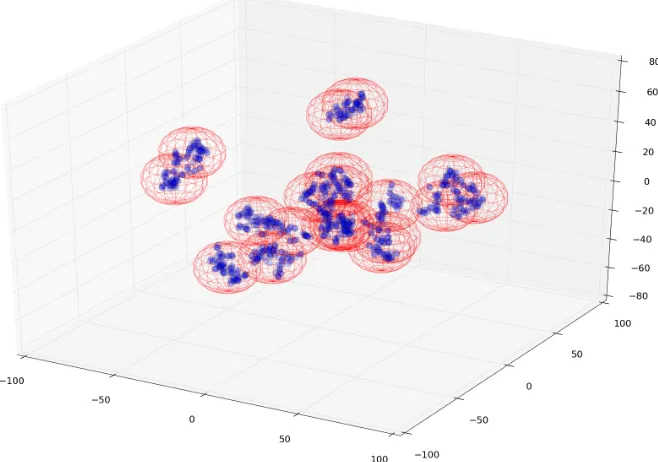
Figure 1: An illustration of the hypersphere coverage for 1,000 data samples which locate in
3D space. We cover this dataset using hyperspheres with the diameterδ= 7.0, resulting in
20 hypersphere cells as shown in the figure (cf. Sections (6.3,9)). All data samples in a same cell are approximated by a core point in this cell. The model size is therefore significantly
reduced from 1,000 to 20.1
In this paper, we propose Approximation Vector Machine (AVM) to simultaneously
encourage model sparsity2 while preserving the model performance. Our model size is
theoretically proven to be bounded regardless of the data distribution and data arrival
order. To promote sparsity, we introduce the notion ofδ-coverage which partitions the data
space into overlapped cells whose diameters are defined byδ (cf. Figure 1). This coverage
can be constructed in advance or on the fly. Our experiment on the real datasets shows
that the coverage can impressively boost sparsity; for example with datasetKDDCup99 of
4,408,589 instances, our model size is 115 withδ= 3 (i.e., only 115 cells are required); with
datasetairlines of 5,336,471 instances, our model size is 388 with δ= 1.
In an online setting context, when an incoming instance arrives, it can be approximated with the corresponding core point in the cell that contains it. Our intuitive reason is that when an instance is approximated by an its nearby core point, the performance would be largely preserved. We further developed rigorous theory to support this intuitive reason. In particular, our convergence analysis (covers six popular loss functions, namely Hinge,
smooth Hinge, and Logistic for classification task and`2,`1, andε-insensitive for regression
task) explicitly characterizes the gap between the approximate and optimal solutions. The analysis shows that this gap crucially depends on two key factors including the cell diameter
δand the approximation process. In addition, the cell parameterδcan be used to efficiently control the trade-off between sparsity level and the model performance. We conducted ex-tensive experiments to validate the proposed method on a variety of learning tasks, including classification in batch mode, classification and regression in online mode on several bench-mark large-scale datasets. The experimental results demonstrate that our proposed method maintains a comparable predictive performance while simultaneously achieving an order of magnitude speed-up in computation comparing with the baselines due to its capacity in maintaining model size. We would like to emphasize at the outset that unlike budgeted algorithms (e.g., (Crammer et al., 2004; Dekel et al., 2005; Cavallanti et al., 2007; Wang and Vucetic, 2010; Wang et al., 2012; Le et al., 2016a,c, 2017)), our proposed method is nonparametric in the sense that the number of core sets grow with data on demand, hence care should be exercised in practical implementation.
The rest of this paper is organized as follows. In Section 2, we review works mostly related to ours. In Section 3, we present the primal and dual forms of Support Vector Machine (SVM) as they are important background for our work. Section 4 formulates the proposed problem. In Section 5, we discuss the standard SGD for kernel online learning
with an emphasis on thecurse of kernelization. Section 6 presents our proposed AVM with
full technical details. Section 7 devotes to study the suitability of loss functions followed by Section 8 where we extend the framework to multi-class setting. Finally, in Section 9, we conduct extensive experiments on several benchmark datasets and then discuss experimental results as well as their implications. In addition, all supporting proof is provided in the appendix sections.
2. Related Work
One common goal of online kernel learning is to bound the model size and to encourage sparsity. Generally, research in this direction can be broadly reviewed into the following themes.
Budgeted Online Learning. This approach limits the model size to a predefined budget
B. When the model size exceeds the budget, a budget maintenance strategy is triggered
to decrement the model size by one. Three popular budget maintenance strategies are
projection onto the linear span of others in the feature space exceeds a predefined threshold, or otherwise its information is kept through the projection. Other works involving the pro-jection strategy include Budgeted Passive Aggressive Nearest Neighbor (BPA-NN) (Wang and Vucetic, 2010; Wang et al., 2012). The merging strategy was used in some works (Wang and Vucetic, 2009; Wang et al., 2012).
Random Features. The idea of random features was proposed in (Rahimi and Recht, 2007). Its aim is to approximate a shift-invariant kernel using the harmonic functions. In the context of online kernel learning, the problem of model size vanishes since we can store the model directly in the random features. However, the arising question is to determine the
appropriate number of random featuresD to sufficiently approximate the real kernel while
keeping this dimension as small as possible for an efficient computation. Ming et al. (2014) investigated the number of random features in the online kernel learning context. Recently, Lu et al. (2015) proposed to run stochastic gradient descent (SGD) in the random feature space rather than that in the real feature space. The theory accompanied with this work shows that with a high confidence level, SGD in the random feature space can sufficiently approximate that in the real kernel space. Nonetheless, in order to achieve good kernel approximation in this approach, excessive number of random features is required, possibly leading to a serious computational issue. To reduce the impact of the number of random features to learning performance, Le et al. (2016b) proposed to store core vectors in the original feature space, whilst storing remaining vectors in the random feature space that sufficiently approximates the first space.
Core Set. This approach utilizes a core set to represent the model. This core set can be constructed on the fly or in advance. Notable works consist of the Core Vector Machine (CVM) (Tsang et al., 2005) and its simplified version, the Ball Vector Machine (BVM) (Tsang et al., 2007). The CVM was based on the achievement in computational geometry
(Badoiu and Clarkson, 2002) to reformulate a variation of`2-SVM as a problem of finding
minimal enclosing ball (MEB) and the core set includes the points lying furthest away the current centre of the current MEB. Our work can be categorized into this line of thinking. However, our work is completely different to (Tsang et al., 2005, 2007) in the mechanism to determine the core set and update the model. In addition, the works of (Tsang et al., 2005, 2007) are not applicable for the online learning.
3. Primal and Dual Forms of Support Vector Machine
Support Vector Machine (SVM) Cortes and Vapnik (1995) represents one of the
state-of-the-art methods for classification. Given a training set D = {(x1, y1), . . . ,(xN, yN)}, the
data instances are mapped to a feature space using the transformation Φ (.), and then SVM
of SVM can be formulated as follows
min
w,b λ
2kwk
2+ 1
N N X
i=1
ξi !
(1)
s.t. :yi
wTΦ (xi) +b
≥1−ξi, i= 1, ..., N
ξi≥0, i= 1, ..., N
where λ > 0 is the regularization parameter, Φ (.) is the transformation from the input
space to the feature space, andξ= [ξi]Ni=1 is the vector of slack variables.
Using Karush-Kuhn-Tucker theorem, the above optimization problem is transformed to thedual form as follows
min
α
1
2α
TQα−eTα
s.t. :yTα= 0
0≤αi ≤
1
λN, i= 1, ..., N
where Q = [yiyjK(xi, xj)]i,jN=1 is the Gram matrix, K(x, x0) = Φ (x)TΦ (x0) is a kernel
function, e= [1]N×1 is the vector of all 1, andy= [yi]Ti=1,...,N.
The dual optimization problem can be solved using the solvers (Joachims, 1999; Chang and Lin, 2011). However, the computational complexity of the solvers is over-quadratic (Shalev-Shwartz and Srebro, 2008) and the dual form does not appeal to the online learning setting. To scale up SVM and make it appealing to the online learning, we rewrite the
constrained optimization problem in Eq. (1) in the primal form as follows
min
w
λ
2 kwk
2
+ 1
N N X
i=1
l(w;xi, yi) !
(2)
wherel(w;x, y) = max 0,1−ywTΦ (x)3 is Hinge loss.
In our current interest, the advantages of formulating the optimization problem of SVM in the primal form as in Eq. (2) are at least two-fold. First, it encourages the application of SGD-based method to propose a solution for the online learning context. Second, it allows us to extend Hinge loss to any appropriate loss functions (cf. Section 7) to enrich a wider class of problems that can be addressed.
4. Problem Setting
We consider two following optimization problems for batch and online settings respectively in Eqs. (3) and (4)
min
w f(w),
λ
2kwk
2+
E(x,y)∼PN[l(w;x, y)] , λ
2kwk
2+ 1
N N X
i=1
l(w;xi, yi) (3)
min
w f(w),
λ
2kwk
2
+E(x,y)∼PX,Y[l(w;x, y)] (4)
wherel(w;x, y) is aconvex loss function,PX,Y is the joint distribution of (x, y) overX × Y
with the data domainX and the label domainY, andPN specifies the empirical distribution
over the training setD={(x1, y1), . . . ,(xN, yN)}. Furthermore, we assume that the convex
loss function l(w;x, y) satisfies the following property: there exists two positive numbers
A and B such that
l
0
(w;x, y)
≤ Akwk
1/2 +B,∀w, x, y. As demonstrated in Section
7, this condition is valid for all common loss functions. Hereafter, for given any function
g(w), we use the notationg0(w0) to denote the gradient (or any sub-gradient) ofg(.) w.r.t
wevaluated atw0.
It is clear that given a fixed w, there exists a random variableg such that E[g|w] =
f0(w). In fact, we can specify g = λw + l0(w;xt, yt) where (xt, yt) ∼ PX,Y orPN.
We assume that a positive semi-definite (p.s.d.) and isotropic (iso.) kernel Rasmussen
and Williams (2005) is used, i.e., K
x, x0
= k
x−x
0
2
, where k : X → R is
an appropriate function. Let Φ (.) be the feature map corresponding the kernel (i.e.,
Kx, x0= Φ (x)TΦx0). To simplify the convergence analysis, without loss of generality
we further assume that kΦ (x)k2 =K(x, x) = 1,∀x ∈ X. Finally, we denote the optimal
solution of optimization problem in Eq. (3) or (4) by w∗, that is,w∗ = argminwf(w).
5. Stochastic Gradient Descent Method
We introduce the standard kernel stochastic gradient descent (SGD) in Algorithm 1 wherein
the standard learning rateηt= λt1 is used (Shalev-Shwartz et al., 2007, 2011). Let αtbe a
scalar such thatl0(wt;xt, yt) =αtΦ (xt) (we note that this scalar exists for all common loss
functions as presented in Section 7). It is apparent that at the iterationtthe modelwthas
the form of wt =Pti=1α
(t)
i Φ (xi). The vector xi (1≤i≤t) is said to be a support vector
if its coefficient α(it) is nonzero. The model is represented through the support vectors,
and hence we can define the model size to be α(t)
0 and model sparsity as the ratio
between the current model size and t (i.e.,α(t)
0/t). Since it is likely thatαt is nonzero
(e.g., with Hinge loss, it happens if xt lies in the margins of the current hyperplane), the
Algorithm 1 Stochastic Gradient Descent algorithm.
Input: λ, p.s.d. kernel K(., .) = Φ (·)TΦ (·)
1: w1 =0
2: for t= 1,2, . . . T do
3: Receive (xt, yt) //(xt, yt)∼PX,Y or PN
4: ηt= λt1
5: gt=λwt+l
0
(wt;xt, yt) =λwt+αtΦ (xt)
6: wt+1 =wt−ηtgt= t−t1wt−ηtαtΦ (xt)
7: end for
Output: wT = T1 PTt=1wt orwT+1
6. Approximation Vector Machines for Large-scale Online Learning
In this section, we introduce our proposed Approximation Vector Machine (AVM) for online learning. The main idea is that we employ an overlapping partition of sufficiently small
cells to cover the data domain, i.e.,X or Φ (X); when an instance arrives, we approximate
this instance by a corresponding core point in the cell that contains this instance. Our intuition behind this approximation procedure is that since the instance is approximated by its neighbor, the performance would not be significantly compromised while gaining
significant speedup. We start this section with the definition of δ-coverage, its properties
and connection with the feature space. We then present AVM and the convergence analysis.
6.1 δ-coverage over a domain
To facilitate our technical development in sequel, we introduce the notion of δ-coverage in
this subsection. We first start with the usual definition of a diameter for a set.
Definition 1. (diameter) Given a set A, the diameter of this set is defined as D(A) = sup
x,x0∈A
||x−x0||. This is the maximal pairwise distance between any two points in A.
Next, given a domain X (e.g., the data domain, input space) we introduce the concept
of δ-coverage forX using a collection of sets.
Definition 2. (δ-coverage) The collection of setsP = (Pi)i∈I is said to be anδ-coverage of
the domainX iffX ⊂ ∪i∈IPiandD(Pi)≤δ,∀i∈I whereI is the index set (not necessarily
discrete) and each element Pi ∈ P is further referred to as acell. Furthermore if the index
set I is finite, the collection P is called a finite δ-coverage.
Definition 3. (core set, core point) Given an δ-coverage P = (Pi)i∈I over a given domain
X, for each i∈I, we select an arbitrary pointci from the cellPi, then the collection of all
ci (s) is called the core set C of the δ-coverage P. Each point ci ∈ C is further referred to
as a core point.
We show that these definitions can be also extended to the feature space with the
Theorem 4. Assume that the p.s.d. and isotropic kernelK(x, x0) =k
||x−x0||2, where
k(.) is a monotonically continuous decreasing function with k(0) = 1, is examined and
Φ (.) is its induced feature map. If P = (Pi)i∈I is an δ-coverage of the domain X then
Φ (P) = (Φ (Pi))i∈I isalsoanδΦ-coverage of the domainΦ (X), whereδΦ=
p
2 (1−k(δ2)) is a monotonically increasing function and lim
δ→0δΦ= 0.
In particular, the Gaussian kernel given byK(x, x0) = exp(−γ
x−x
0
2
) is a p.s.d. and
iso. kernel and δΦ=
p
2 (1−exp (−γδ2)). Theorem 4 further reveals that the image of an
δ-coverage in the input space is anδΦ-coverage in the feature space and when the diameter
δ approaches 0, so does the induced diameterδΦ. For readability, the proof of this theorem
is provided in Appendix 11.
We have further developed methods and algorithms to efficiently construct δ-coverage,
however to maintain the readability, we defer this construction to Section 6.3.
6.2 Approximation Vector Machines
We now present our proposed Approximation Vector Machine (AVM) for online learning. In an online setting, instances arise on the fly and we need an efficient approach to incorporate incoming instances into the learner. Different from the existing works (cf. Section 2), our
approach is to construct anδ-coverageP = (Pi)i∈I over the input domainX, and for each
incoming instance x we find the cell Pi that contains this instance and approximate this
instance by a core point ci ∈Pi. The coverage P and core set C can either be constructed
in advance or on the fly as presented in Section 6.3.
In Algorithm 2, when receiving an incoming instance (xt, yt), we compute the scalar
αt such that αtΦ (xt) =l
0
(wt;xt, yt) (cf. Section 7) in Step 5. Furthermore at Step 7 we
introduce a Bernoulli random variable Zt to govern the approximation procedure. This
random variable could be either statistically independent or dependent with the incoming
instances and the current model. In Section 9.2, we report on different settings for Zt and
how they influence the model size and learning performance. Our findings at the outset
is that, the naive setting with P(Zt= 1) = 1,∀t (i.e., always performing approximation)
returns the sparsest model while obtaining comparable learning performance comparing with the other settings. Moreover, as shown in Steps 9 and 11, we only approximate the
incoming data instance by the corresponding core point (i.e., cit) ifZt= 1. In addition, if
Zt = 1, we find a cell that contains this instance in Step 8. It is worth noting that the δ
-coverage and the cells are constructed on the fly along with the data arrival (cf. Algorithms 3 and 4). In other words, the incoming data instance might belong to an existing cell or a new cell that has the incoming instance as its core point is created.
Furthermore to ensure thatkwtk is bounded for allt≥1 in the case of `2 loss, ifλ≤1
then we project wt−ηtht onto the hypersphere with centre origin and radius ymaxλ−1/2,
i.e.,B 0, ymaxλ−1/2
. Since it can be shown that with`2loss the optimal solutionw∗ lies in
B 0, ymaxλ−1/2
(cf. Theorem 23 in Appendix 12), this operation could possibly result in a faster convergence. In addition, by reusing the previous information, this operation can
be efficiently implemented. Finally, we note that with`2 loss andλ >1, we do not need to
is bounded by ymax
λ−1. Here it is worth noting that we have defined ymax = maxy∈Y|y| and
this notation is only used in the analysis for the regression task with the`2 loss.
Algorithm 2 Approximation Vector Machine.
Input: λ, p.s.d. & iso. K(., .) = Φ (·)TΦ (·),δ-coverageP = (Pi)i∈I
1: w1 = 0
2: for t= 1, . . . , T do
3: Receive (xt, yt) //(xt, yt)∼PX,Y or PN
4: ηt= λt1
5: l0(wt;xt, yt) =αtΦ (xt) //cf. Section 7
6: Sample a Bernoulli random variableZt
7: if Zt= 1 then
8: Findit∈I such that xt∈Pit
9: ht=λwt+αtΦ (cit) //do approximation
10: else
11: ht=λwt+αtΦ (xt)
12: end if
13: if `2loss is usedandλ≤1 then
14: wt+1=QB(0,ymaxλ−1/2) (wt−ηtht) 15: else
16: wt+1=wt−ηtht
17: end if
18: end for
Output: wT = PT
t=1wt
T orwT+1
In what follows, we present the theoretical results for our proposed AVM including the convergence analysis for a general convex or smooth loss function and the upper bound of the model size under the assumption that the incoming instances are drawn from an arbitrary distribution and arrive in a random order.
6.2.1 Analysis for Generic Convex Loss Function
We start with the theoretical analysis for Algorithm 2. Thedecision of approximation (i.e.,
the random variable Zt) could be statistically independent or dependent with the current
model parameter wt and the incoming instance (xt, yt). For example, one can propose an
algorithm in which thedecision of approximation is performed iff the confidence level of the
incoming instance w.r.t the current model is greater than 1, i.e.,ytwtTΦ (xt)≥1. We shall
develop our theory to take into account all possible cases.
Theorem 5 below establishes an upper bound on the regret under the possible assump-tions of the statistical relaassump-tionship among the decision of approximation, the data distribu-tion, and the current model. Based on Theorem 5, in Theorem 8 we further establish an inequality for the error incurred by a single-point output with a high confidence level.
Theorem 5. Consider the running of Algorithm 2 where(xt, yt)is uniformly sampled from
i) IfZtandwtare independent for allt(i.e., the decision of approximation only depends
on the data distribution) then
E[f(wT)−f(w∗)]≤
H(log (T) + 1)
2λT +
δΦM1/2W1/2
T
T X
t=1
P(Zt= 1)1/2
where H, M, W are positive constants.
ii) If Zt is independent with both (xt, yt) and wt for all t (i.e., the decision of
approxi-mation is independent with the current hyperplane and the data distribution) then
E[f(wT)−f(w∗)]≤ H(log (T) + 1)
2λT +
δΦM1/2W1/2
T
T X
t=1
P(Zt= 1)
iii) In general, we always have
E[f(wT)−f(w∗)]≤
H(log (T) + 1)
2λT +δΦM
1/2W1/2
Remark 6. Theorem 5 consists of the standard convergence analysis. In particular, if the
approximation procedure is never performed, i.e., P(Zt= 1) = 0,∀t, we have the regret
boundE[f(wT)−f(w∗)]≤ H(log(2λTT)+1).
Remark 7. Theorem 5 further indicates that there exists an error gap between the
opti-mal and the approximate solutions. When δ decreases to 0, this gap also decreases to 0.
Specifically, when δ= 0 (so does δΦ), any incoming instance is approximated by itself and
consequently, the gap is exactly 0.
Theorem 8. Let us define the gap by dT, which is δΦM
1/2W1/2
T
PT
t=1P(Zt= 1) 1/2
(if Zt is
independent with wt), δΦM1/2W1/2
T
PT
t=1P(Zt= 1) (if Zt is independent with (xt, yt) and wt), or δΦM1/2W1/2. Let r be any number randomly picked from {1,2, . . . , T}. With the probability at least 1−δ, the following statement holds
f(wr)−f(w∗)≤ H(log (T) + 1)
2λT +dT + ∆T
r 1
2log
1 δ
where ∆T = max
1≤t≤T(f(wt)−f(w ∗)).
We now present the convergence analysis for the case when we output the α-suffix
average result as proposed in Rakhlin et al. (2012). With 0< α <1, let us denote
wαT = 1 αT
T X
t=(1−α)T+1 wt
where we assume that the fractional indices are rounded to their ceiling values.
Theorem 9 establishes an upper bound on the regret for the α-suffix average case,
followed by Theorem 10 which establishes an inequality for the error incurred by aα-suffix
Theorem 9. Consider the running of Algorithm 2 where(xt, yt)is uniformly sampled from
the training setD or the joint distribution PX,Y, the following statements hold
i) IfZtandwtare independent for allt(i.e., the decision of approximation only depends
on the data distribution) then
E[f(wαT)−f(w ∗
)]≤ λ(1−α)
2α W
α T+
δΦM1/2W1/2
αT
T X
t=(1−α)T+1
P(Zt= 1)1/2+
Hlog (1/(1−α))
2λαT
where H, M, W are positive constants and WTα =E h
w(1−α)T+1−w∗
2i
.
ii) If Zt is independent with both (xt, yt) and wt for all t (i.e., the decision of
approxi-mation is independent with the current hyperplane and the data distribution) then
E[f(wαT)−f(w∗)]≤
λ(1−α)
2α W
α T+
δΦM1/2W1/2
αT
T X
t=(1−α)T+1
P(Zt= 1)+
Hlog (1/(1−α))
2λαT
iii) In general, we always have
E[f(wαT)−f(w ∗
)]≤ λ(1−α)
2α W
α
T +δΦM1/2W1/2+
Hlog (1/(1−α))
2λαT
Theorem 10. Let us once again define the induced gap by dT, which is respectively
λ(1−α)
2α W
α
T +
δΦM1/2W1/2
αT
T X
t=(1−α)T+1
P(Zt= 1)1/2 (if Zt is independent with wt),
λ(1−α)
2α W
α T+
δΦM1/2W1/2
αT
T X
t=(1−α)T+1
P(Zt= 1) (ifZt is independent with (xt, yt) and wt),
or λ(12−αα)Wα
T+δΦM1/2W1/2. Letrbe any number randomly picked from{(1−α)T+ 1,2, . . . , T}. With the probability at least 1−δ, the following statement holds
f(wr)−f(w∗)≤
Hlog (1/(1−α))
2λαT +dT + ∆
α T
r 1
2log
1 δ
where ∆αT = max
(1−α)T+1≤t≤T(f(wt)
−f(w∗)).
Remark 11. Theorems 8 and 10 concern with the theoretical warranty if rendering any
single-point output wr rather than the average outputs. The upper bound gained in
Theorem 10 is tighter than that gained in Theorem 8 in the sense that the quantity
Hlog(1/(1−α)) 2λαT + ∆
α T
q
1 2log
1
δ decreases faster and may decrease to 0 whenT →+∞ given a
6.2.2 Analysis for Smooth Loss Function
Definition 12. A loss function l(w;x, y) is said to be µ-strongly smooth w.r.t a normk.k
iff for allu,v and (x, y) the following condition satisfies
l(v;x, y)≤l(u;x, y) +l0(u;x, y)T(v−u) + µ
2 kv−uk
2
Another equivalent definition ofµ-strongly smooth function is
l
0
(u;x, y)−l0(v;x, y)
∗ ≤µkv−uk
wherek.k∗ is used to represent the dual norm of the normk.k.
It is well-known that
• `2 loss is 1-strongly smooth w.r.t k.k2.
• Logistic loss is 1-strongly smooth w.r.t k.k2.
• τ-smooth Hinge loss (Shalev-Shwartz and Zhang, 2013) is τ1-strongly smooth w.r.t
k.k2.
Theorem 13. Assume that `2, Logistic, or τ-smooth Hinge loss is used, let us denote
L= λ2 + 1, λ2 + 1, or λ2 +τ−1 respectively. Let us define the gap by dT as in Theorem 10.
Let r be any number randomly picked from {(1−α)T + 1,2, . . . , T}. With the probability at least (1−δ), the following statement holds
f(wr)−f(w∗)≤
Hlog (1/(1−α))
2λαT +dT +
LMTα 2
r 1
2log
1 δ
where MTα= max
(1−α)T+1≤t≤Tkwt−w ∗k.
Remark 14. Theorem 13 extends Theorem 10 for the case of smooth loss function. This allows the gap Hlog(12λαT/(1−α)) + LMTα
2
q
1 2log
1
δ to be quantified more precisely regarding
the discrepancy in the model itself rather than that in the objective function. The gap
Hlog(1/(1−α)) 2λαT +
LMα T 2
q
1 2log
1
Algorithms Regret Budget
Forgetron (Dekel et al., 2005) NA MB
PA-I, II (Crammer et al., 2006) NA NB
Randomized Budget Perceptron (Cavallanti et al., 2007) NA NB
Projection (Orabona et al., 2009) NA AB
Kernelized Pegasos (Shalev-Shwartz et al., 2011) O
log(T) T
NB
Budgeted SGD (Wang et al., 2012) Olog(TT) MB
Fourier OGD (Lu et al., 2015) O√1
T
MB
Nystrom OGD (Lu et al., 2015) O
1
√ T
MB
AVM (average output) Olog(TT) AB
AVM (α-suffix average output) O T1
AB
Table 1: Comparison on the regret bounds and the budget sizes of the kernel online
algo-rithms. On the column of budget size, NB stands forNot Bound (i.e., the model size is not
bounded and learning method is vulnerable to the curse of kernelization), MB stands for
Manual Bound (i.e., the model size is manually bounded by a predefined budget), and AB
is an abbreviation of Automatic Bound (i.e., the model size is automatically bounded and
this model size is automatically inferred).
To end this section, we present the regret bound and the obtained budget size for our AVM(s) together with those of algorithms listed in Table 1. We note that some early works on online kernel learning mainly focused on the mistake rate and did not present any theoretical results regarding the regret bounds.
6.2.3 Upper Bound of Model Size
In what follows, we present the theoretical results regarding the model size and sparsity level of our proposed AVM. Theorem 15 shows that AVM offers a high level of freedom to
control the model size. Especially, if we use the always-on setting (i.e.,P(Zt= 1) = 1,∀t),
the model size is bounded regardless of the data distribution and data arrival order.
Theorem 15. Let us denote P(Zt= 1) = pt, P(Zt= 0) = qt, and the number of cells
generated after the iteration t by Mt. If we define the model size, i.e., the size of support
set, after the iteration t by St, the following statement holds
E[ST]≤ T X
t=1
qt+ T X
t=1
ptE[Mt−Mt−1]≤ T X
t=1
qt+E[MT]
Specially, if we use some specific settings forpt, we can bound the model size E[St]
accord-ingly as follows
i) If pt= 1,∀t then E[ST]≤E[MT]≤ |P|, where |P| specifies the size of the partition P,
i.e., its number of cells. ii) If pt= max
0,1− βt,∀tthen E[ST]≤β(log (T) + 1) +E[MT].
iii) If pt= max
0,1− tβρ
,∀t, where 0< ρ <1, then E[ST]≤ βT
1−ρ
iv) Ifpt= max
0,1− tβρ
,∀t, where ρ >1, then E[ST]≤βζ(ρ) +E[MT]≤βζ(ρ) +|P|,
where ζ(.) is ζ- Riemann function defined by the integral ζ(s) = Γ(1s)R+∞
0 ts−1
es−1dt.
Remark 16. We use two parametersβ andρto flexibly control the rate of approximationpt.
It is evident that when β increases, the rate of approximation decreases and consequently
the model size and accuracy increase. On the other hand, when ρ increases, the rate of
approximation increases as well and it follows that the model size and accuracy decreases. We conducted experiment to investigate how the variation of these two parameters influence the model size and accuracy (cf. Section 9.2).
Remark 17. The items i) and iv) in Theorem 15 indicate that if P(Zt= 1) = pt =
max0,1−tβρ
, whereρ >1 orρ= +∞, then the model size is bounded byβζ(ρ) +|P|(by
convention we defineζ(+∞) = 0). In fact, the tight upper bound isβζ(ρ) +E[MT], where
MT is the number of unique cells used so far. It is empirically proven that MT could be
very small comparing withT and |P|. In addition, since all support sets of wt(1≤t≤T)
are all lain in the core set, if we output the average wT =
PT t=1wt
T or α-suffix average
wαT = αT1 PT
t=(1−α)T+1wT, the model size is still bounded.
Remark 18. The items ii) and iii) in Theorem 15 indicate that if P(Zt= 1) = pt =
max
0,1−tβρ
, where 0 < ρ ≤1 then although the model size is not bounded, it would
slowly increase comparing withT, i.e., log (T) or T1−ρ when ρ is around 1.
6.3 Construction of δ-Coverage
In this section, we return to the construction ofδ-coverage defined in Section 6.1 and present
two methods to construct a finite δ-coverage. The first method employs hypersphere cells
(cf. Algorithm 3) whereas the second method utilizes the hyperrectangle cells (cf. Algorithm 4). In these two methods, the cells in coverage are constructed on the fly when the incoming instances arrive. Both are theoretically proven to be a finite coverage.
Algorithm 3 Constructing hypersphere δ-coverage.
1: P =∅ 2: n= 0
3: for t= 1,2, . . . do
4: Receive (xt, yt)
5: it= argmink≤nkxt−ckk
6: if kxt−citk ≥δ/2 then
7: n=n+ 1
8: cn=xt
9: it=n
10: P =P ∪[B(cn, δ/2)]
11: end if
Algorithm 4 Constructing hyperrectangle δ-coverage.
1: P =∅ 2: a=δ/√d 3: n= 0
4: for t= 1,2, . . . do
5: Receive (xt, yt)
6: it= 0
7: for i= 1 to n do
8: if kxt−cik∞< a then
9: it=i
10: break
11: end if
12: end for
13: if it= 0 then
14: n=n+ 1 15: cn=xt
16: it=n
17: P =P ∪[R(cn, a)]
18: end if
19: end for
Algorithm 3 employs a collection of open hypersphere cell B(c, R), which is defined
as B(c, R) = x∈Rd:kx−ck< R , to cover the data domain. Similar to Algorithm 3,
Algorithm 4 uses a collection of open hyperrectangle R(c, a), which is given by R(c, a) =
x∈Rd:kx−ck
∞< a , to cover the data domain.
Both Algorithms 3 and 4 are constructed in the common spirit: if the incoming instance
(xt, yt) is outside all current cells, a new cell whose centre or vertex is this instance is
generated. It is noteworthy that the variable it in these two algorithms specifies the cell
that contains the new incoming instance and is the same as itself in Algorithm 2.
Theorem 19 establishes that regardless of the data distribution and data arrival order,
Algorithms 3 and 4 always generate a finiteδ-coverage which implies a bound on the model
size of AVM. It is noteworthy at this point that in some scenarios of data arrival,
Algo-rithms 3 and 4 might not generate a coverage for the entire space X. However, since the
generated sequence{xt}tcannot be outside the set∪iB(ci, δ) and∪iR(ci, δ), without loss
of generality we can restrictX to∪iB(ci, δ) or∪iR(ci, δ) by assuming thatX =∪i B(ci, δ)
orX =∪i R(ci, δ).
Theorem 19. Let us consider the coverages formed by the running of Algorithms 3 and 4. If the data domain X is compact (i.e., close and bounded) then these coverages are all finite
δ-coverages whose sizes are all dependent on the data domain X and independent with the sequence of incoming data instances (xt, yt) received.
Remark 20. Theorem 19 also reveals that regardless of the data arrival order, the model size of AVM is always bounded (cf. Remark 17). Referring to the work of (Cucker and
Smale, 2002), it is known that this model size cannot exceed
4D(X) δ
d
many possible data arrival orders, the number of active cells or the model size of AVM is significantly smaller than the aforementioned theoretical bound.
6.4 Complexity Analysis
We now present the computational complexity of our AVM(s) with the hypersphere δ
-coverage at the iteration t. The cost to find the hypersphere cell in Step 5 of Algorithm 2
is O d2Mt
. The cost to calculate αt in Step 6 of Algorithm 2 is O (St) if we consider the
kernel operation as a unit operation. If`2 loss is used andλ≤1, we need to do a projection
onto the hypersphere B 0, ymaxλ−1/2
which requires the evaluation of the length of the
vectorwt−ηtht (i.e.,kwt−ηthtk) which costsSt unit operations using incremental
imple-mentation. Therefore, the computational operation at the iteration t of AVM(s) is either
O d2Mt+St
= O d2+ 1St
or O d2Mt+St+St
= O d2+ 2St
(sinceMt≤St).
7. Suitability of Loss Functions
We introduce six types of loss functions that can be used in our proposed algorithm, namely
Hinge, Logistic, `2,`1,ε−insensitive, and τ-smooth Hinge. We verify that these loss
func-tions satisfying the necessary condition, that is, l
0
(w;x, y)
≤ Akwk
1/2
+B for some
appropriate positive numbersA, B (this is required for our problem formulation presented
in Section 4).
For comprehensibility, without loss of generality, we assume thatkΦ (x)k=K(x, x)1/2=
1,∀x ∈ X. At the outset of this section, it is noteworthy that for classification task (i.e.,
Hinge, Logistic, and τ-smooth Hinge cases), the label y is either −1 or 1 which instantly
implies |y|=y2= 1.
• Hinge loss
l(w;x, y) = max
n
0,1−ywTΦ (x) o
l0(w;x, y) =−I{ywTΦ(x)≤1}yΦ (x)
where IS is the indicator function which renders 1 if the logical statement S is true
and 0 otherwise.
Therefore, by choosing A= 0, B = 1 we have
l
0
(w;x, y)
≤ kΦ (x)k ≤1 =Akwk
1/2
+B
• `2 loss
In this case, at the outset we cannot verify that l
0
(w;x, y)
≤ Akwk
1/2 +B for
all w, x, y. However, to support the proposed theory, we only need to check that
l
0
(wt;x, y)
≤Akwtk
1/2+B for allt≥1. We derive as follows
l(w;x, y) = 1 2
l
0
(wt;x, y) =|w
T
tΦ (x) +y| kΦ (x)k ≤ |wTtΦ (x)|+ymax
≤ kΦ (x)k kwtk+ymax≤Akwtk1/2+B
whereB =ymax and A=
(
ymax1/2λ−1/4 ifλ≤1
ymax1/2 (λ−1)−1/2 otherwise
.
Here we note that we make use of the fact that kwtk ≤ ymax(λ−1)−1 if λ > 1
(cf. Theorem 25 in Appendix 12) and kwtk ≤ ymaxλ−1/2 otherwise (cf. Line 12 in
Algorithm 2 ).
• `1 loss
l(w;x, y) =|y−wTΦ (x)|
l0(w;x, y) = sign
wTΦ (x)−y
Φ (x)
Therefore, by choosing A= 0, B = 1 we have
l
0
(w;x, y)
=kΦ (x)k ≤1 =Akwk
1/2
+B
• Logistic loss
l(w;x, y) = log
1 + exp
−ywTΦ (x)
l0(w;x, y) = −yexp −yw
TΦ (x) Φ (x)
exp (−ywTΦ (x)) + 1
Therefore, by choosing A= 0, B = 1 we have
l
0
(w;x, y)
<kΦ (x)k ≤1 =Akwk
1/2+B
• ε-insensitive loss
l(w;x, y) = maxn0,|y−wTΦ (x)| −εo
l0(w;x, y) =I{|y−wTΦ(x)|>ε}sign
wTΦ (x)−yΦ (x)
Therefore, by choosing A= 0, B = 1 we have
l
0
(w;x, y)
≤ kΦ (x)k ≤1 =Akwk
1/2
+B
• τ-smooth Hinge lossShalev-Shwartz and Zhang (2013)
l(w;x, y) =
0 ifywTΦ (x)>1
1−ywTΦ (x)−τ
2 ifyw
TΦ (x)<1−τ
1
2τ 1−ywTΦ (x) 2
otherwise
l0(w;x, y) =−I{ywTΦ(x)<1−τ}yΦ (x) +τ−1I1−τ≤ywTΦ(x)≤1
Therefore, by choosing A= 0, B = 2, we have
l
0
(w;x, y)
≤ |y| kΦ (x)k+τ
−1|y| kΦ (x)kτ ≤2
=Akwk1/2+B
8. Multiclass Setting
In this section, we show that our proposed framework could also easily extend to the multi-class setting. We base on the work of Crammer and Singer (2002) for multimulti-class multi-classification to formulate the optimization problem in multi-class setting as
min
W f(W),
λ
2kWk
2 2,2+
1 N
N X
i=1
l
wyiTΦ (xi)−wziTΦ (xi)
!
where we have defined
zi = argmax
j6=yi
wTjΦ (xi),
W = [w1,w2, . . . ,wm],kWk22,2 = m X
j=1
kwjk2,
l(a) = (
max (0,1−a) Hinge loss
log (1 +e−a) Logistic loss
For the exact update, at the t-th iteration, we receive the instance (xt, yt) and modify
W as follows
w(jt+1)=
t−1
t w
(t) j −ηtl
0
(a) Φ (xt) ifj=yt t−1
t w
(t) j +ηtl
0
(a) Φ (xt) ifj=zt t−1
t w
(t)
j otherwise
wherea=wytTΦ (xt)−wTztΦ (xt) and l
0
(a) =−I{a<1} or−1/(1 +ea).
Algorithm 5 Multiclass Approximation Vector Machine.
Input: λ, p.s.d. & iso. kernel K(., .),δ-coverageP = (Pi)i∈I
1: W1 = 0
2: for t= 1, . . . , T do
3: Receive (xt, yt) //(xt, yt)∼PX,Y or PN
4: a=wytTΦ (xt)−max j6=ytw
T
jΦ (xt)
5: W(t+1) = t−1 t W(t)
6: Sample a Bernoulli random variableZt
7: if Zt= 1 then
8: Findit∈I such that xt∈Pit
9: w(ytt+1)=wyt(t+1)−ηtl
0
(a) Φ (cit) //do approximation
10: w(ztt+1)=wzt(t+1)+ηtl
0
(a) Φ (cit)
11: else
12: w(ytt+1)=wyt(t+1)−ηtl
0
(a) Φ (xt)
13: w(ztt+1)=wzt(t+1)+ηtl
0
(a) Φ (xt)
14: end if
15: end for
Output W(T) =
PT t=1W(t)
T orW(t+1)
9. Experiments
In this section, we conduct comprehensive experiments to quantitatively evaluate the capac-ity and scalabilcapac-ity of our proposed Approximation Vector Machine (AVM) on classification and regression tasks under three different settings:
• Batch classification4: the regular binary and multiclass classification tasks that follow a standard validation setup, wherein each dataset is partitioned into training set and testing set. The models are trained on the training part, and then their discriminative capabilities are verified on the testing part using classification accuracy measure. The computational costs are commonly measured based on the training time.
• Online classification: the binary and multiclass classification tasks that follow a purely online learning setup, wherein there is no division of training and testing sets as in batch setting. The algorithms sequentially receive and process a single data sample turn-by-turn. When an individual data point comes, the models perform prediction to compute the mistake rate first, then use the feature and label information of such data point to continue their learning procedures. Their predictive performances and computational costs are measured basing on the average of mistake rate and execution time, respectively, accumulated in the learning progress on the entire dataset.
• Online regression: the regression task that follows the same setting of online classifi-cation, except the predictive performances are measured based on the regression error rate accumulated in the learning progress on the entire dataset.
Our main goal is to examine the scalability, classification and regression capabilities of AVMs by directly comparing with those of several recent state-of-the-art batch and online learning approaches using a number of datasets with a wide range of sizes. Our models are implemented in Python with Numpy package. The source code and experimental scripts are
published for reproducibility5. In what follows, we present the data statistics, experimental
setup, results and our observations.
9.1 Data Statistics and Experimental Setup
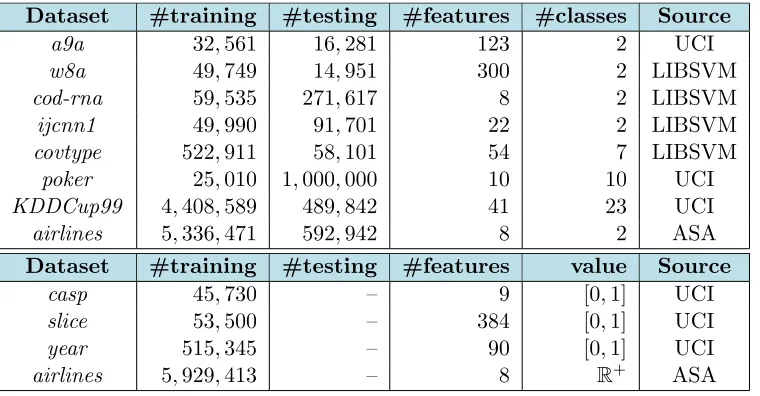
We use 11 datasets whose statistics are summarized in Table 2. The datasets are selected in a diverse array of sizes in order to clearly expose the differences among scalable capabilities
of the models. Five of which (year, covtype, poker, KDDCup99, airlines) are large-scale
datasets with hundreds of thousands and millions of data points, whilst the rest are
ordinal-size databases. Except theairlines, all of the datasets can be downloaded from LIBSVM6
and UCI7 websites.
Dataset #training #testing #features #classes Source
a9a 32,561 16,281 123 2 UCI
w8a 49,749 14,951 300 2 LIBSVM
cod-rna 59,535 271,617 8 2 LIBSVM
ijcnn1 49,990 91,701 22 2 LIBSVM
covtype 522,911 58,101 54 7 LIBSVM
poker 25,010 1,000,000 10 10 UCI
KDDCup99 4,408,589 489,842 41 23 UCI
airlines 5,336,471 592,942 8 2 ASA
Dataset #training #testing #features value Source
casp 45,730 – 9 [0,1] UCI
slice 53,500 – 384 [0,1] UCI
year 515,345 – 90 [0,1] UCI
airlines 5,929,413 – 8 R+ ASA
Table 2: Data statistics. #training: number of training samples; #testing: number of testing samples.
The airlines dataset is provided by American Statistical Association (ASA8). The dataset
contains information of all commercial flights in the US from October 1987 to April 2008. The aim is to predict whether a flight will be delayed or not and how long in minutes the flight will be delayed in terms of departure time. The departure delay time is provided in
the flight database. A flight is considereddelayed if its delay time is above 15 minutes, and
non-delayed otherwise. The average delay of a flight in 2008 was of 56.3 minutes. Following the procedure of (Hensman et al., 2013), we further process the data in two steps. First, we join the data with the information of individual planes basing on their tail numbers in order
5.https://github.com/tund/avm.
6.https://www.csie.ntu.edu.tw/~cjlin/libsvmtools/datasets/.
7.https://archive.ics.uci.edu/ml/datasets.html.
to obtain the manufacture year. This additional information is provided as a supplemental data source on ASA website. We then extract 8 features of many available fields: the age of the aircraft (computed based on the manufacture year), journey distance, airtime, scheduled departure time, scheduled arrival time, month, day of week and month. All features are
normalized into the range [0,1].
In batch classification experiments, we follow the original divisions of training and testing
sets in LIBSVM and UCI sites wherever available. For KDDCup99, covtype and airlines
datasets, we split the data into 90% for training and 10% for testing. In online classification and regression tasks, we either use the entire datasets or concatenate training and testing parts into one. The online learning algorithms are then trained in a single pass through the data. In both batch and online settings, for each dataset, the models perform 10 runs on different random permutations of the training data samples. Their prediction results and time costs are then reported by taking the average with the standard deviation of the results over these runs.
For comparison, we employ some baseline methods that will be described in the fol-lowing sections. Their C++ implementations with Matlab interfaces are published as a
part of LIBSVM, BudgetedSVM9 and LSOKL10 toolboxes. Throughout the experiments,
we utilize RBF kernel, i.e., Kx, x0 = exp
−γ
x−x
0
2
for all algorithms including
ours. We use hypersphere strategy to construct the δ-coverage (cf. Section 6.3), due to
its better performance than that of hyperrectangle approach during model evaluation. All experiments are conducted using a Windows machine with 3.46GHz Xeon processor and 96GB RAM.
9.2 Model Evaluation on The Effect of Hyperparameters
In the first experiment, we investigate the effect of hyperparameters, i.e., δ-coverage
di-ameter, sampling parameters β and ρ (cf. Section 6.2.3) on the performance of AVMs.
Particularly, we conduct an initial analysis to quantitatively evaluate the sensitivity of these hyperparameters and their impact on the predictive accuracy and model size. This analysis provides a heuristic approach to find the best setting of hyperparameters. Here the AVM with Hinge loss is trained following the online classification scheme using two datasets
a9a and cod-rna.
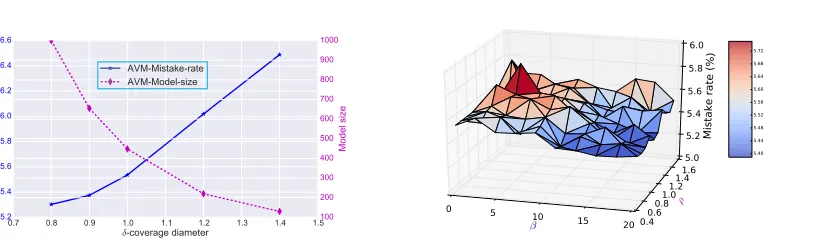
To find the plausible range of coverage diameter, we use a heuristic approach as follows. First we compute the mean and standard deviation of pairwise Euclidean distances between any two data samples. Treating the mean as the radius, the coverage diameter is then varied around twice of this mean bounded by twice of the standard deviation. Fig. 2a and Fig. 3a report the average mistake rates and model sizes of AVMs with respect to (w.r.t) these
values for datasets a9a and cod-rna, respectively. Here we setβ = 0 andρ= 1.0. There is
a consistent pattern in both figures: the classification errors increase for largerδ whilst the
model sizes decrease. This represents the trade-off between model performance and model size via the model coverage. To balance the performance and model size, in these cases, we
can choose δ= 7.0 for a9a data andδ= 1.0 for cod-rna data.
9.http://www.dabi.temple.edu/budgetedsvm/index.html.
(a) The effect ofδ-coverage diameter on the mis-take rate and model size.
(b) The effect of β and ρ on the classification mistake rate. β= 0 means always approximating.
Figure 2: Performance evaluation of AVM with Hinge loss trained using a9a dataset with
different values of hyperparameters.
(a) The effect ofδ-coverage diameter on the mis-take rate and model size.
(b) The effect of β and ρ on the classification mistake rate. β= 0 means always approximating.
Figure 3: Performance evaluation of AVM with Hinge loss trained using cod-rna dataset
with different values of hyperparameters.
Fixing the coverage diameters, we vary β and ρ in 10 values monotonically increasing
from 0 to 10 and from 0.5 to 1.5, respectively, to evaluate the classification performance. The
smallerβand largerρindicate that the machine approximates the new incoming data more
frequently, resulting in less powerful prediction capability. This can be observed in Fig. 2b and Fig. 3b, which depict the average mistake rates in 3D as a function of these values for
dataseta9a andcod-rna. Hereβ = 0 means that the model always performs approximation
without respect to the value of ρ. From these visualizations, we found that the AVM with
always-on approximation mode still can achieve fairly comparable classification results.
Thus we setβ = 0 for all following experiments.
9.3 Batch Classification
We now examine the performances of AVMs in classification task following batch mode.
(delayed and non-delayed labels). We create two versions of our approach: AVM with Hinge loss (AVM-Hinge) and AVM with Logistic loss (AVM-Logit). It is noteworthy that the Hinge loss is not a smooth function with undefined gradient at the point that the classification
confidenceyf(x) = 1. Following the sub-gradient definition, in our experiment, we compute
the gradient given the condition that yf(x)<1, and set it to 0 otherwise.
Baselines. For discriminative performance comparison, we recruit the following state-of-the-art baselines to train kernel SVMs for classification in batch mode:
• LIBSVM: one of the most widely-used and state-of-the-art implementations for batch
kernel SVM solver (Chang and Lin, 2011). We use the one-vs-all approach as the default setting for the multiclass tasks;
• LLSVM: low-rank linearization SVM algorithm that approximates kernel SVM
opti-mization by a linear SVM using low-rank decomposition of the kernel matrix (Zhang et al., 2012);
• BSGD-M: budgeted stochastic gradient descent algorithm which extends the Pegasos
algorithm (Shalev-Shwartz et al., 2011) by introducing a merging strategy for support vector budget maintenance (Wang et al., 2012);
• BSGD-R: budgeted stochastic gradient descent algorithm which extends the Pegasos
algorithm (Shalev-Shwartz et al., 2011) by introducing a removal strategy for support vector budget maintenance (Wang et al., 2012);
• FOGD: Fourier online gradient descent algorithm that applies the random Fourier
features for approximating kernel functions (Lu et al., 2015);
• NOGD: Nystrom online gradient descent (NOGD) algorithm that applies the Nystrom
method to approximate large kernel matrices (Lu et al., 2015).
Hyperparameters setting. There are a number of different hyperparameters for all methods. Each method requires a different set of hyperparameters, e.g., the regularization
parameters (C in LIBSVM, λ in Pegasos and AVM), the learning rates (η in FOGD and
NOGD), the coverage diameter (δ in AVM) and the RBF kernel width (γ in all methods).
Thus, for a fair comparison, these hyperparameters are specified using cross-validation on training subset.
Particularly, we further partition the training set into 80% for learning and 20% for val-idation. For large-scale databases, we use only 1% of training set, so that the searching can finish within an acceptable time budget. The hyperparameters are varied in certain ranges and selected for the best performance on the validation set. The ranges are given as
fol-lows: C ∈
2−5,2−3, ...,215 ,λ∈ {2−4
/N,2−2/N, ...,216/N},γ ∈2−8,2−4,2−2,20,22,24,28 , η ∈ {16.0,8.0,4.0,2.0,0.2,0.02,0.002,0.0002} where N is the number of data points. The
coverage diameterδ of AVM is selected following the approach described in Section 9.2. For
the budget sizeB in NOGD and Pegasos algorithm, and the feature dimensionDin FOGD
Results. The classification results, training and testing time costs are reported in Table 3. Overall, the batch algorithms achieve the highest classification accuracies whilst those of online algorithms are lower but fairly competitive. The online learning models, however, are much sparser, resulting in a substantial speed-up, in which the training time costs and model sizes of AVMs are smallest with orders of magnitude lower than those of the standard batch methods. More specifically, the LIBSVM outperforms the other approaches in most of datasets, on which its training phase finishes within the time limit (i.e., two hours),
except for the ijcnn1 data wherein its testing score is less accurate but very close to that
of BSGD-M. The LLSVM achieves good results which are slightly lower than those of the state-of-the-art batch kernel algorithm. The method, however, does not support multiclass classification. These two batch algorithms – LIBSVM and LLSVM could not be trained
within the allowable amount of time on large-scale datasets (e.g., airlines), thus are not
scalable.
Furthermore, six online algorithms in general have significant advantages against the batch methods in computational efficiency, especially when running on large-scale datasets. Among these algorithms, the BSGD-M (Pegasos+merging) obtains the highest classification scores, but suffers from a high computational cost. This can be seen in almost all datasets, especially for the airlines dataset on which its learning exceeds the time limit. The slow
training of BSGD-M is caused by the merging step with computational complexityO B2
(B is the budget size). By contrast, the BSGD-R (Pegasos+removal) runs faster than the
merging approach, but suffers from very high inaccurate results due to its naive budget maintenance strategy, that simply discards the most redundant support vector which may contain important information.
In terms of predictive performance, our proposed methods outperform the recent ad-vanced online learning algorithms – FOGD and NOGD in most scenarios. The AVM-based models are able to achieve slightly less accurate but fairly comparable results compared with those of the state-of-the-art LIBSVM algorithm. In terms of sparsity and speed, the AVMs are the fastest ones in the training and testing phases in all cases thanks to their remarkable smaller model sizes. The difference between the training speed of our AVMs and that of two approaches varies across datasets. The gap is more significant for datasets with higher dimensional feature spaces. This is expected because the procedure to compute
random features for each data point of FOGD involves sin and cos operators which are
costly. These facts indicate that our proposed online kernel learning algorithms are both efficient and effective in solving large-scale kernel classification problems. Thus we believe that the AVM is the fast alternative to the existing SVM solvers for large-scale classification tasks.
Table 3: Classification performance of our AVMs and the baselines in batch mode. The
notation [δ|S |B|D], next to the dataset name, denotes the diameterδ, the model sizeS
of AVM-based models, the budget sizeB of budgeted algorithms, and the number of random
features D of FOGD, respectively. The accuracy is reported in percent (%), the training
time and testing time are in second. The best performance is inbold. It is noteworthy that
the LLSVM does not support multiclass classification and we terminate all runs exceeding the limit of two hours, therefore some results are unavailable.
Dataset [δ|S|B|D] a9a [7.0|135|1,000|4,000] w8a [13.0|131|1,000|4,000]
Algorithm Train Test Accuracy Train Test Accuracy
LIBSVM 84.57 22.23 84.92 50.96 2.95 99.06
LLSVM 50.73 8.73 83.00 92.19 10.41 98.64
BSGD-M 232.59 2.88 84.76±0.16 264.70 5.16 98.17±0.07 BSGD-R 90.48 2.72 80.26±3.38 253.30 4.98 97.10±0.04 FOGD 15.99 2.87 81.15±5.05 32.16 3.55 97.92±0.38 NOGD 82.40 0.60 82.33±2.18 374.87 0.65 98.06±0.18 AVM-Hinge 4.96 0.25 83.55±0.50 11.84 0.52 96.87±0.28 AVM-Logit 5.35 0.25 83.83±0.34 12.54 0.52 96.96±0.00
Dataset [δ|S|B|D] cod-rna [1.0|436|400|1,600] ijcnn1 [1.0|500|1,000|4,000]
Algorithm Train Test Accuracy Train Test Accuracy
LIBSVM 114.90 85.34 96.39 38.63 11.17 97.35
LLSVM 20.17 19.38 94.16 40.62 54.22 96.99
BSGD-M 90.62 5.66 95.67±0.21 93.05 6.13 97.69±0.11
BSGD-R 19.31 5.48 66.83±0.11 41.70 7.07 90.90±0.18 FOGD 7.62 11.95 92.65±4.20 7.31 10.10 90.64±0.07 NOGD 9.81 3.24 91.83±3.35 21.58 3.68 90.43±1.22 AVM-Hinge 6.52 2.69 94.38±1.16 6.47 2.71 91.14±0.71 AVM-Logit 7.03 2.86 93.10±2.11 6.86 2.67 91.19±0.95
Dataset [δ|S|B|D] covtype[3.0|59|400|1,600] poker [12.0|393|1,000|4,000]
Algorithm Train Test Accuracy Train Test Accuracy
LIBSVM – – – 40.03 932.58 57.91
LLSVM – – – – – –
BSGD-M 2,413.15 3.75 72.26±0.16 414.09 123.57 54.10±0.22 BSGD-R 418.68 3.02 61.09±1.69 35.76 102.84 52.14±1.05 FOGD 69.94 2.45 59.34±5.85 9.61 101.29 46.62±5.00 NOGD 679.50 0.76 68.20±2.96 118.54 36.84 54.65±0.27 AVM-Hinge 60.27 0.26 64.31±0.37 3.86 8.21 55.49±0.13 AVM-Logit 61.92 0.22 64.42±0.34 3.36 7.54 55.60±0.17
Dataset [δ|S|B|D] KDDCup99 [3.0|115|200|400] airlines [1.0|388|1,000|4,000]
Algorithm Train Test Accuracy Train Test Accuracy
LIBSVM 4,380.58 661.04 99.91 – – –
LLSVM – – – – – –
BSGD-M 2,680.58 21.25 99.73±0.00 – – –
BSGD-R 1,644.25 14.33 39.81±2.26 4,741.68 29.98 80.27±0.06 FOGD 706.20 22.73 99.75±0.11 1,085.73 861.52 80.37±0.21 NOGD 3,726.21 3.11 99.80±0.02 3,112.08 18.53 74.83±0.20 AVM-Hinge 554.42 2.75 99.82±0.05 586.90 6.55 80.72±0.00
9.4 Online Classification
The next experiment investigates the performance of the AVMs in online classification task where individual data point continuously come turn-by-turn in a stream. Here we also use eight datasets and two versions of our approach: AVM with Hinge loss (AVM-Hinge) and AVM with Logistic loss (AVM-Logit) which are used in batch classification setting (cf. Section 9.3).
Baselines. We recruit the two widely-used algorithms – Perceptron and OGD for regular online kernel classification without budget maintenance and 8 state-of-the-art budget online kernel learning methods as follows:
• Perceptron: the kernelized variant without budget of Perceptron algorithm (Freund
and Schapire, 1999);
• OGD: the kernelized variant without budget of online gradient descent (Kivinen et al.,
2004);
• RBP: a budgeted Perceptron algorithm using random support vector removal strategy
(Cavallanti et al., 2007);
• Forgetron: a kernel-based Perceptron maintaining a fixed budget by discarding oldest
support vectors (Dekel et al., 2005);
• Projectron: a Projectron algorithm using the projection strategy (Orabona et al.,
2009);
• Projectron++: the aggressive version of Projectron algorithm (Orabona et al., 2009);
• BPAS: a budgeted variant of Passive-Aggressive algorithm with simple SV removal
strategy (Wang and Vucetic, 2010);
• BOGD: a budgeted variant of online gradient descent algorithm using simple SV
removal strategy (Zhao et al., 2012);
• FOGD and NOGD: described in Section 9.3.
Hyperparameters setting. For each method learning on each dataset, we follow the same hyperparameter setting which is optimized in the batch classification task. For time efficiency, we only include the fast algorithms FOGD, NOGD and AVMs for the experiments on large-scale datasets. The other methods would exceed the time limit when running on such data.
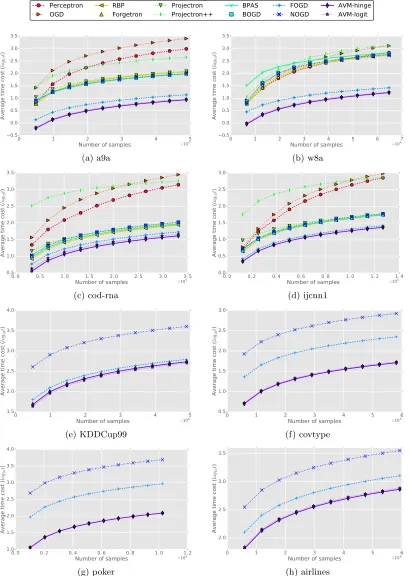
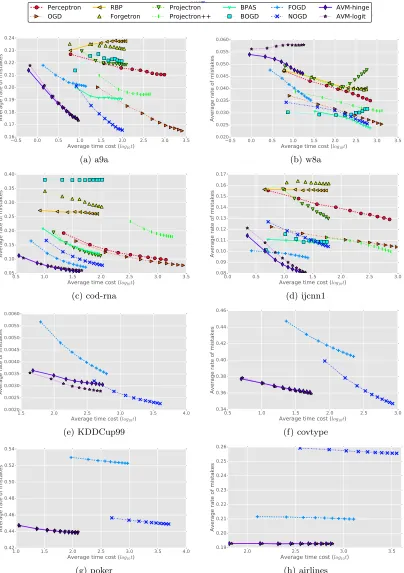
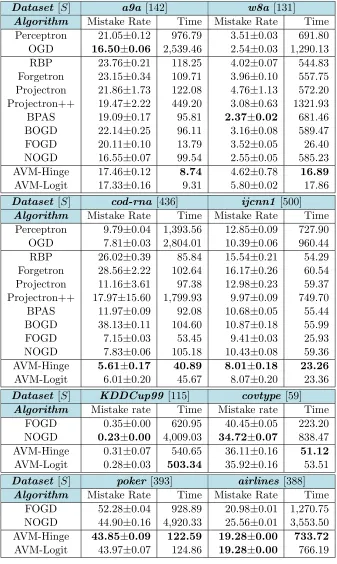
Results. Fig. 4 and Fig. 5 shows the relative performance convergence w.r.t classification error and computation cost of the AVMs in comparison with those of the baselines. Com-bining these two figures, we compare the average mistake rate and running time in Fig. 6. Table 4 reports the final average results in detailed numbers after the methods see all data
samples. It is worthy to note that for the four biggest datasets (KDDCup99,covtype,poker,
First of all, as can be seen from Fig. 4, there are three groups of algorithms that have different learning progresses in terms of classification mistake rate. The first group includes the BOGD, Projectron and Forgetron that have the error rates fluctuating at the beginning, but then being stable till the end. In the meantime, the rates of the models in the second group, including Perceptron, OGD, RBP, Projectron++ and BPAS, quickly saturate at a plateau after these methods see a few portions, i.e., one-tenth to two-tenth, of the data. By contrast, the last group includes the recent online learning approaches – FOGD, NOGD, and our proposed ones – AVM-Hinge, AVM-Logit, that regularly perform better as more data
points come. Exceptionally, for the dataset w8a, the classification errors of the methods in
the first group keep increasing after seeing four-tenth of the data, whilst those of the last group are unexpectedly worse.
Second, Fig. 6 plots average mistake rate against computational cost, which shows sim-ilar patterns as in the our first observation. In addition, it can be seen from Fig. 5 that all algorithms have normal learning pace in which the execution time is accumulated over the learning procedure. Only the Projectron++ is slow at the beginning but then performs faster after receiving more data.
According to final results summarized in Table 4, the budgeted online approaches show efficacies with substantially faster computation than the ones without budgets. This is more obvious for larger datasets wherein the execution time costs of our proposed models are several orders of magnitude lower than those of regular online algorithms. This is because the coverage scheme of AVMs impressively boost their model sparsities, e.g., using
δ= 3 resulting in 115 core points for datasetKDDCup99 consisting of 4,408,589 instances,
and usingδ = 1 resulting in 388 core points for datasetairlines containing 5,336,471 data
samples.
For classification capability, the non-budgeted methods only surpass the budgeted ones
for the smallest dataset, that is, the OGD obtains the best performance fora9a data. This
again demonstrates the importance of exploring budget online kernel learning algorithms. Between the two non-budgeted algorithms, the OGD achieves considerably better error rates than the Perceptron. The method, however, must perform much more expensive updates, resulting in a significantly larger number of support vectors and significantly higher computational time costs. This represents the trade-off between classification accuracy and computational complexity of the OGD.
Furthermore, comparing the performance of different existing budgeted online kernel learning algorithms, the AVM-Hinge and AVM-Logit outperform others in both discrimi-native performance and computation efficiency for almost all datasets. In particular, the
AVM-based methods achieve the best mistake rates – 5.61±0.17, 8.01±0.18, 43.85±0.09,
19.28±0.00 for the cod-rna, ijcnn1, poker and airlines data, that are, respectively, 27.5%,
17.5%, 2.4%, 8.8% lower than the error rates of the second best models – two recent
ap-proaches FOGD and NOGD. On the other hand, the computation costs of the AVMs are
significantly lower with large margins of hundreds of percents for large-scale databases
Approximation Vector Machines
0 1 2 3 4 5
Number of samples ×104
0.16 0.17 0.18 0.19 0.20 0.21 0.22
Average rate of mistakes
Perceptron
OGD RBPForgetron ProjectronProjectron++ BPASBOGD FOGDNOGD AVM-hingeAVM-logit
0 1 2 3 4 5
Number of samples ×104
0.16 0.17 0.18 0.19 0.20 0.21 0.22 0.23 0.24
Average rate of mistakes
(a) a9a
0 1 2 3 4 5 6 7
Number of samples ×104
0.020 0.025 0.030 0.035 0.040 0.045 0.050 0.055 0.060
Average rate of mistakes
(b) w8a
0. 0 0. 5 1. 0 1. 5 2. 0 2. 5 3. 0 3. 5
Number of samples ×105
0.05 0.10 0.15 0.20 0.25 0.30 0.35 0.40
Average rate of mistakes
(c) cod-rna
0. 0 0. 2 0. 4 0. 6 0. 8 1. 0 1. 2 1. 4
Number of samples ×105
0.08 0.09 0.10 0.11 0.12 0.13 0.14 0.15 0.16 0.17
Average rate of mistakes
(d) ijcnn1
0 1 2 3 4 5
Number of samples ×106
0.0020 0.0025 0.0030 0.0035 0.0040 0.0045 0.0050 0.0055 0.0060
Average rate of mistakes
(e) KDDCup99
0 1 2 3 4 5 6
Number of samples ×105
0.34 0.36 0.38 0.40 0.42 0.44 0.46
Average rate of mistakes
(f) covtype
0. 0 0. 2 0. 4 0. 6 0. 8 1. 0 1. 2
Number of samples ×106
0.42 0.44 0.46 0.48 0.50 0.52 0.54
Average rate of mistakes
(g) poker
0 1 2 3 4 5 6
Number of samples ×106
0.19 0.20 0.21 0.22 0.23 0.24 0.25 0.26
Average rate of mistakes
(h) airlines
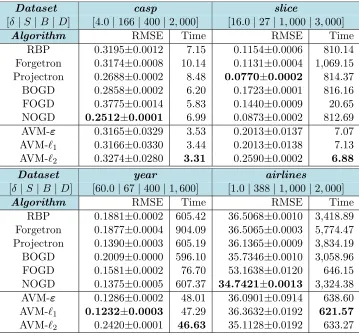
![Table 3: Classification performance of our AVMs and the baselines in batch mode. Thenotation [δ | S | B | D], next to the dataset name, denotes the diameter δ, the model size Sof AVM-based models, the budget size B of budgeted algorithms, and the number of](https://thumb-us.123doks.com/thumbv2/123dok_us/9787307.1964302/26.612.92.525.193.705/classication-performance-baselines-thenotation-dataset-diameter-budgeted-algorithms.webp)