Volume 2, Issue 11, November 2013
Page 452
Abstract
The paper aims to provide suitable RTL design for MAC Receiver. Here the receiver supplies receive data to the host system from the receive data stream. It detects the preamble and SFD, checks the length field, and executes CRC check. Status information on each received packet, such as the number of received bytes and occurrence of errors, is written to a register after reception has been completed.
What is Ethernet?
Ethernet is the most widely used local area network (LAN) technology. The original and most popular version of Ethernet supports a data transmission rate of 10 Mb/s. Newer versions of Ethernet called "Fast Ethernet" and "Gigabit Ethernet" support data rates of 100 Mb/s and 1 Gb/s (1000 Mb/s). Ethernet devices compete for access to the network using a protocol called Carrier Sense Multiple Access with Collision Detection (CSMA/CD)
System Diagram
Here we are using data sheets of 82595 TX-Ethernet Controller provided by Intel and µPD98431 10/100 Mbps Ethernet Controller by NEC corporation for specification.
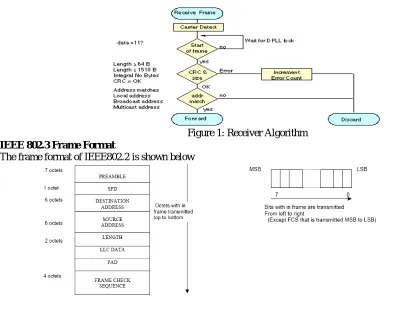
Receiver Processing Algorithm
Figure 1: Receiver Algorithm
IEEE 802.3 Frame Format
The frame format of IEEE802.2 is shown below
Figure 2: MAC Frame IEEE 802.2
Design and Simulation of Start Frame Delimiter
& Buffer of Ethernet MAC Receiver
Sandeep Kalundrekar 1 , Amit Singh Rajput2
1,2
Volume 2, Issue 11, November 2013
Page 453
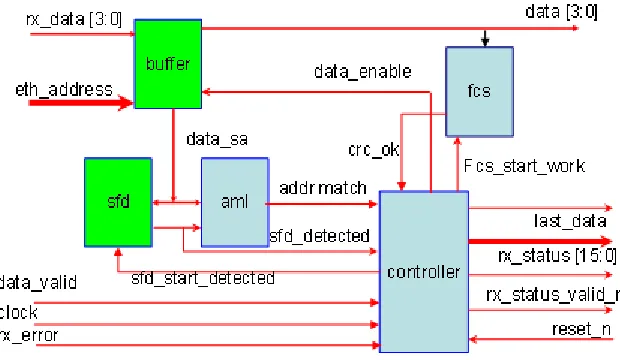
Block Diagram
Figure 3: Internal Block Diagram of Ethernet MAC Receiver
The Receiver Subsystem
1. SFD Detector: This component helps in the detection of the start of the packet.
2. Buffer: This is the buffer that forms the entry point of data into the receiver. This may or may not pass on the data to the memory based on the state of the receiver.
3. Address Matching Logic: This component verifies whether the data coming in is actually of concern or not. It compares the destination address of frame with host destination address.
4. FCS Checker: This component does the error checking by computing the CRC and then checking it with the trailer of the frame.
5. Controller: This is component that forms the glue between all the other component
Work
In this paper we are giving simulation Buffer & SFD.
Buffer
Signal Type Description
rx_data[3:0] In Data (nibble)transferred from MII
data [3:0] Out Data (nibble)transferred from buffer to FIFO
data_sa 3:0] Out Data (nibble)transferred from buffer to SFD detector and AML
data_enable In Enable signal from rx state machine to open the buffer and lets data[3:0] delivered to FIFO
Clock In Clock signals from MII
reset_n In Active low signals that initializes the receive MAC function
Table 1: Signal Descriptions of Buffer
Description
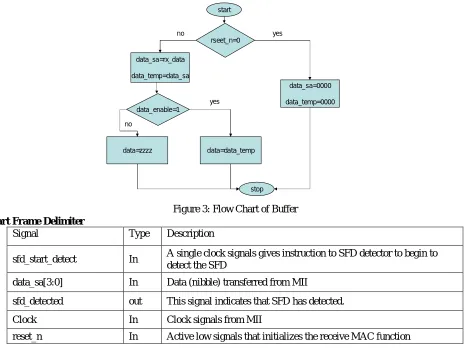
The function of this module to do data de capsulation. This module continues gives data to SFD detector and AML. And pass rx_data to the FIFO when darta_enable is high. It means it hold packet data .i.e. when data_enable is high then only it can pass data to FIFO.
Volume 2, Issue 11, November 2013
Page 454
rseet_n=0 data_sa=0000 data_temp=0000 data_sa=rx_data data_temp=data_sa data_enable=1 data=data_temp data=zzzz stop start yes no no yesFigure 3: Flow Chart of Buffer
Start Frame Delimiter
Signal Type Description
sfd_start_detect In A single clock signals gives instruction to SFD detector to begin to detect the SFD
data_sa[3:0] In Data (nibble) transferred from MII
sfd_detected out This signal indicates that SFD has detected.
Clock In Clock signals from MII
reset_n In Active low signals that initializes the receive MAC function
Table 2: Signal Descriptions of SFD
Description
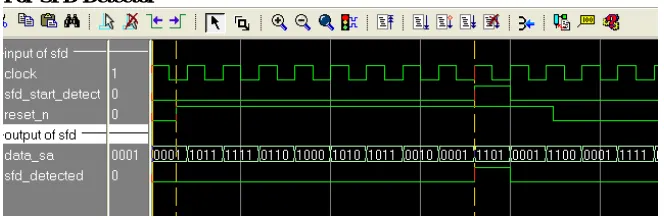
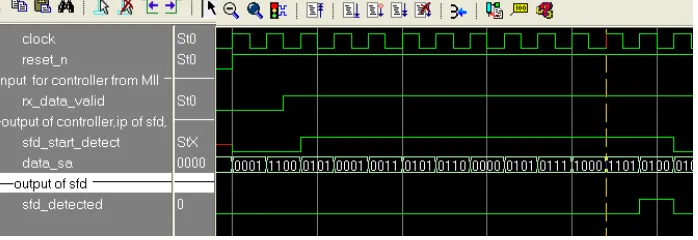
SFD_Detector has the data flowing in through the data_sa. When the module receives a sfd_start_detect signal, it starts detecting SFD bits in the preamble, when it detects the SFD, it enables the sfd_detected signal.the sfd_start_check signal come from controller State Machine that launched after rx_dv asserted This module is control by controller ,when ever MII sense carrier on cable it give rx_data_valid signal to controller, now controller know that some frame is coming ,and now it has to receive it. We can say that when rx_data is coming SFD_start_detect signal will high and will be high until SFD_detected equal to one, after that it will become zero.
Flow Chart rseet_n=0 sfd_detected=0 sfd_start_detect=0 stop start yes no no yes data_sa=1011 sfd_detected=1 yes no
Volume 2, Issue 11, November 2013
Page 455
Functional Simulation Results
For Buffer
Figure 5: Simulation Result of Buffer
When data_enable signal comes from controller
Figure 6: Simulation Result of Buffer When rx_error Come in Controller
Figure 7: Simulation Result of Buffer When rx_data_valid Low
For SFD Detector
Figure 8 : Simulation Result of SFD
Volume 2, Issue 11, November 2013
Page 456
Figure 9: Simulation Result of SFD
References
[1] http://developer.intel.com/design/network/datashts/28163001.pdf
[2] ftp.adelaide.edu.au/pub/rocksoft/crc_v3.txt
[3] ftp://rtfm.mit.edu/pub/faqs/LANs/ethernet-faq
[4] http://www.get2chip.com/index.asp
[5] 10/100 Mbps Ethernet LAN controller hardware reference manual, Intel, 1998.