Volume 2, Issue 1, 2015
90 Available online at www.ijiere.com
International Journal of Innovative and Emerging
Research in Engineering
e-ISSN: 2394 - 3343 p-ISSN: 2394 - 5494
A Review : Object Detection and Object Tracking Methods
Sarika Patel
a, Prof. Udesang K. Jaliya
b, Prof. Mahashweta J. Joshi
b.aMaster of Computer Engineering,Birla Vishwakarma Mahavidyalaya,Vallabh Vidyanagar, Gujarat, India. bDepartment of Computer Engineering,Birla Vishwakarma Mahavidyalaya,Vallabh Vidyanagar, Gujarat, India.
ABSTRACT:
Moving Object Tracking is one of the testing issues in the field of computer vision, surveillance, traffic monitoring and so forth. Distinguishing the objects in the video and tracking its motion to recognize its qualities has been a demanding examination zone in the field of image processing and computer vision. The objective of object tracking is to place a moving object in sequential video frames. The goal of this paper is to review of different moving object detection and object tracking systems. This paper includes various methods for object detection and object tracking. Comparing all the methods researcher can use the better method for their future research.
Keywords: Object detection, Object tracking, Point tracking, Kernel tracking, Silhouette tracking, HSV (hue, saturation, value).
I. INTRODUCTION
Object tracking in video frames is an important topic in the field of computer vision and various research fields. Video surveillance has been a very active research topic in the last few years due to its growing importance in security, military applications etc. The vast amount of data involved makes it infeasible to guarantee alert monitoring by human operations for long periods of time due to boredom and fatigue. As a result, video feeds are usually archived for forensic purposes in the event suspicious activities take place. Videos are actually sequences of images, each of which called a frame. The fundamental in object tracking is object detection, object classification and then finally object tracking. Moving object detection is the first and important step for many video analysis task. Moving object detection aims at extracting moving objects that are important in video sequences. Frequently used methods for moving object detection are background subtraction, temporal frame differencing. Background subtraction is an efficient method for object detection compare to frame differencing. The next step is object tracking. It is an important task within the field of computer vision. It is used not only for video surveillance but also for traffic control, medical imaging, gesture recognition etc. The approaches for object tracking are as follows.
A. Object Detection
Object Detection is to identify objects of interest in the video sequence and to cluster pixels of these objects. Object detection can be done by various techniques such as frame differencing, Optical flow and Background subtraction.
B. Object Classification
Moving regions detected in the video may matches to different objects in real world such as humans, vehicles etc. The approaches to classify the objects are Shape-based classification, Motion-based classification and Color based classification.
C. Object Tracking
The goal of a moving object tracking is to create the path for an object above time by detecting its position in every single frame of the video.
Following are the challenges that should be taken care in object tracking. • Noise in images.
• Complex object shapes / motion. • Partial and full object occlusions. • Scene illumination changes.
II. OBJECT DETECTION
Volume 2, Issue 1, 2015
91 to the objects. This process is referred to as the background subtraction.[9]. Below figure shows the detection of moving object using reference background.
Fig.1 The flow chart of moving object Detection
Background subtraction strategy gives exact results for object detection when the reference background is known. It has following approaches:
A. Mixture of Gaussians
The background is modeled pixel by pixel using a mixture of Gaussians. Each pixel location is represented by a number (or mixture) of Gaussian functions that sum together to form a probability distribution functions. This moving object detector has also the ability to detect and remove shadows, a great source of false alarms in this kind of visual detectors [1].
B. Median filtering
For finding foreground images, Median filtering [5] is the commonly used technique. The background estimation is done by the median at each pixel location of all the frames in the buffer because the value of the median at each pixel stays in the background for more than half of the frames in the buffer. The main advantage of this method is that, the computation speed is high[11].
III. OBJECT CLASSIFICATION
The Moving regions detected in the video may matches to different objects in real world such as humans, vehicles etc. It is very important to identify the type of a detected object to track it reliably. Object classification has the following approaches:
1. Shape based classification. 2. Motion based classification. 3.Color based classification.
A. Shape based classification
Common features used in shape-based classification schemes are the bounding rectangle, area, silhouette and gradient of detected object regions. Different descriptions of shape information of motion regions such as representations of points, box and blob are available for classifying moving objects. Input features to the network is mixture of image-based and scene-based object parameters such as image blob area, apparent aspect ratio of blob bounding box and camera zoom. Classification is performed on each blob at every frame and results are kept in histogram [8].
B. Motion based classification
Non-rigid articulated object motion shows a periodic property, so this has been used as a strong cue for moving object classification. Optical flow is also very useful for object classification. Residual flow can be used to analyze rigidity and periodicity of moving entities. It is expected that rigid objects would present little residual flow where as a non rigid moving object such as human being had higher average residual flow and even displayed a periodic component [8].
C. Color based classification
Image
Sequence
Current
Frame
Image
Reference
Background
Image
Volume 2, Issue 1, 2015
92 All video frame formats are based on different color spaces model. The data of different frame can be stored in distinctive color spaces ranging from gray scale, RGB, YCbCr and HSV (hue, saturation, value) color spaces. The data is stored in each frame is the brightness in each spectral band. Color images are denoted as red(R),green (G) and blue (B) layers or RGB. Other distinctive color spaces used in the area of object tracking are YcbCr and HSV[12].
IV.
OBJECT TRACKINGThe goal of a moving object tracking is to create the path for an object above time by detecting its position in every single frame of the video. Few object tracking methods are as below:
Fig 2. Object Tracking Methods
A. Point Tracking approach
Point Tracking can be defined as the correspondence of detected objects represented by points across the frames[9]. There are two methods of correspondence methods namely – deterministic and statistical methods [9]. Point Tracking is a difficult problem particularly in the existence of occlusions, false detections of object. Recognition of points can be done simply by thresholding, at of identification of these points. Point Tracking is capable of dealing with tracking very small objects only.
Fig 3.Point based tracking[9]
Some approaches of point tracking are as below:
a. Kalman Filter
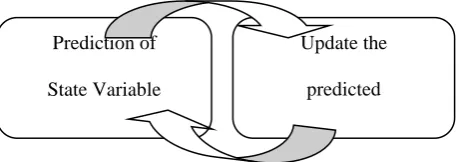
Kalman filter are based on Optimal Recursive Data Processing Algorithm [9]. Here Gaussian state distribution is assumed. Kalman filtering is composed of two stages, prediction and correction. Prediction of the next state using the current set of observations and update the current set of predicted measurements. The second step is gradually update the predicted values and gives a much better approximation of the next state. Kalman Tracking is capable of dealing with:
Kalman filters always give optimal solutions.
Another potential approach is to handling noise
Tracking is applicable only for single and multiple objects.
Fig 4. Basic step of Kalman Filter
b. Particle Filter
Particle Filter algorithm can solve object tracking under non-Gaussian or non-linear conditions, its core conception is Monte Carlo integration. In most cases, it can obtain a better tracking result compared to mean-shift[10]. In the method of staring with population of particle, each will assign value to no variables and weight of 1.
Object Tracking
Point Tracking
Kernel Tracking
Silhouette Tracking
Prediction of
State Variable
Update the
predicted
Volume 2, Issue 1, 2015
93 At each step, the procedure will be:
1. Generate samples to represent the initial probability 2. Using the prior equation, predict the next state
3. Using the observation, get the weights for the states computed. Predicted states (from step 2) along with the weights collectively represent the state distribution
4. Resample it so as to have the uniformly distributed current state omitting the least-significant representation 5. Continue steps 2 through 4, till all the observations are exhausted.
c. Multiple Hypothesis Tracking (MHT)
The MHT algorithm is based on motion correspondence of several frames together. Better results are obtained if correspondence is established observing several frames rather than using only two frames. The MHT algorithm upholds several suggestions for each object at each time. The final track of object is the most likely set of correspondences over time period of its observation [9]. MHT is an iterative algorithm. Emphasis starts with a set of existing track speculations. Every theories is a group of detach tracks. For every speculation, a prediction of object's movement in the succeeding casing is made. The predictions are then analyzed by computing a separation measure.
B. Kernel Based Tracking Approach
Kernel tracking is typically performed by computing the motion of the object, which is represented by a primitive object region, from one frame to the next. The object motion is generally in the form of parametric motion (translation, conformal, affine, etc.) or the dense flow field computed in subsequent frames[9].
a. Simple Template Matching
Template matching is a brute force technique for analyzing the Region of Interest in the feature. In template matching, a reference image is checked with the frame that is differentiated from the feature. Following could be possible for single question in the feature and covering of item is carried out incompletely. Layout Matching is a procedure for transforming computerized images to discover little parts of an image that matches, or identical model with an image (format) in each one frame. The matching strategy contains the image format for all conceivable positions in the source image and ascertains a numerical file that points out how well the model fits the picture that position. It capable of dealing with:
• Tracking single image. • Partial occlusion of object.
• Necessity of a physical initialization.
b. Mean Shift Method
Mean-shift tracking [13] tries to find the area of a video frame that is locally most similar to a previously initialized model. The image region to be tracked is represented by a histogram. A gradient ascent procedure is used to move the tracker to the location that maximizes a similarity score between the model and the current image region. In object tracking algorithms target representation is mainly rectangular or elliptical region. It contain target model and target candidate. To characterize the target color histogram is chosen. Target model is generally represented by its probability density function (pdf). Target model is regularized by spatial masking with an asymmetric kernel.
C. Silhouette Based Tracking Approach
Objects having composite shapes for instance, hands, head, and shoulders, are can't be decently characterized by geometric shapes. Silhouette based methodology will give flawless portrayal of state of those objects. The point of the silhouette based tracking is to discover the object area by method for an object model. This model checks the object district in each one casing. Model can be spoken to as color histogram, object edges or shape. We classify silhouette tracking into two classes, specifically, shape matching and form tracking.
a. Contour Tracking
Contour tracking techniques create an unique contour in the foregoing frame to its new position in the present edge, covering of object between the current and next casing.. Contour tracking is in the form of state space models[9].
b. Shape Matching
Volume 2, Issue 1, 2015
94
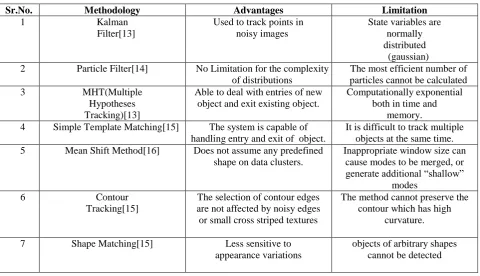
IV. COMPARISION BETWEEN VARIOUS TRACKING METHODS
Table 1. Comparison between various tracking methods
Sr.No. Methodology Advantages Limitation
1 Kalman
Filter[13]
Used to track points in noisy images
State variables are normally distributed
(gaussian) 2 Particle Filter[14] No Limitation for the complexity
of distributions
The most efficient number of particles cannot be calculated
3 MHT(Multiple
Hypotheses Tracking)[13]
Able to deal with entries of new object and exit existing object.
Computationally exponential both in time and
memory. 4 Simple Template Matching[15] The system is capable of
handling entry and exit of object.
It is difficult to track multiple objects at the same time. 5 Mean Shift Method[16] Does not assume any predefined
shape on data clusters.
Inappropriate window size can cause modes to be merged, or generate additional “shallow”
modes
6 Contour
Tracking[15]
The selection of contour edges are not affected by noisy edges or small cross striped textures
The method cannot preserve the contour which has high
curvature.
7 Shape Matching[15] Less sensitive to appearance variations
objects of arbitrary shapes cannot be detected
V. CONCLUSION
In this paper, an across the board literature survey on different moving object tracking routines has been introduced. Object is followed predominantly on the bases of object detection, object classification and tracking. Near examination is generally accomplished for point tracking, kernel and Silhouette tracking calculations. For example point tracking includes detection in every casing, while kernel based or shape based tracking requires detection when object first shows up in the scene. This survey highlights the features of algorithm for researchers in the area of moving object tracking.
ACKNOWLEDGMENT
This paper work would not have been possible without the guidance and the support of several individuals who in one way or another contributed and extended their valuable assistance in the preparation and completion of this study.
I would like to express my deep sense of gratitude to my guides Prof. Udesang K.Jaliya and Prof. Mahashweta J.Joshi for their valuable guidance and motivation .I would also thank to Dr. D.G.Thakore for giving me such an opportunity to explore new ideas.
Last but not least I would like to thank my family members ,who taught me the value of hard work by their own example .They provided me enormous support during this works directly and indirectly.
REFERENCES
[1] Carlos R. del-Blanco, Fernando Jaureguizar, and Narciso García, “An Efficient Multiple Object Detection and Tracking Framework for Automatic Counting and Video Surveillance Applications”, IEEE Transactions on Consumer Electronics, Vol. 58, No. 3, August 2012.
[2] Tran Thi Trang, Cheolkeun Ha, "Irregular Moving Object Detecting and Tracking Based on Color and Shape in Real-time System," International conference on Computing, Management and Telecommunications 978-1-4673-2088-7/13/$31.00 ©2013 IEEE.
[3] Malik M. Khan, Tayyab W. Awan, Intaek Kim, and Youngsung Soh, " Tracking Occluded Objects Using Kalman Filter and Color Information," International Journal of Computer Theory and Engineering, Vol. 6, No. 5, October 2014.
[4] Ms Jyoti J. Jadhav, "Moving Object Detection and Tracking for Video Surveillance," International Journal of Engineering Research and General Science Volume 2, Issue 4, June-July, 2014 ISSN 2091-2730.
Volume 2, Issue 1, 2015
95 [6] Tushar S. Waykole and Yogendra Kumar Jain, “Detecting and Tracking of Moving Objects from Video”,
International Journal of Computer Applications (0975 – 8887) Volume 81 –No 18, November 2013.
[7] Abhishek Kumar Chauhan, Prashant Krishan, “Moving Object Tracking Using Gaussian Mixture Model And Optical Flow”, International Journal of Advanced Research in Computer Science and Software Engineering Volume 3, Issue 4, April 2013 ISSN: 2277 128X.
[8] Hitesh A Patel, Darshak G Thakore ,“Moving Object Tracking Using Kalman Filter”, International Journal of Computer Science and Mobile Computing,April 2013, pg.326 – 332.
[9] Yilmaz Alper, Javed Omar and Shah Mubarak, 2006, “Object Tracking: A survey” ACM Compt. Surv.38,4, Article 13, December, pp.1-45.
[10] Da Tang, Yu-Jin Zhang," Combining Mean-shift and Particle Filter for Object Tracking", 2011 Sixth International Conference on Image and Graphics, 978-0-7695-4541-7/11 $26.00 © 2011 IEEE DOI 10.1109/ICIG.2011.118
[11] Modi Nirav D.," MOVING OBJECT DETECTION AND TRACKING IN VIDEO" ,International Journal of Electrical, Electronics and Data Communication, ISSN: 2320-2084 Volume-2, Issue-3, March-2014.
[12] Sebastian Patrick, Voon Yap Vooi, Comley Richard, “Color Space effect on Tracking in video Surveillance”, International Journal On Electrical Engineering and Informatics 2010, vol-2, number-4, pp. 298-312.
[13] Sandeep Kumar Patel, Agya Mishra "Moving Object Tracking Techniques: A Critical Review", Indian Journal of Computer Science and Engineering (IJCSE) ISSN : 0976-5166 Vol. 4 No.2 Apr-May 2013
[14] http://www.pst.ifi.lmu.de
[15] Ann Maria Jacob, Anitha J, "Inspection of Various Object Tracking Techniques", International Journal of Engineering and Innovative Technology (IJEIT) Volume 2, Issue 6, December2012.