1 | P a g e
Asian Journal of Pharmaceutical Science & Technology
e-ISSN: 2248 – 9185
www.ajpst.com
Print ISSN: 2248 – 9177
SAMPLE PREPARATION IN BIO ANALYTICAL METHODS - A
REVIEW
S. Vijayaraj* and N. Reddy Kumari
Department of Pharmaceutical Analysis,
Sree Vidyanikethan College of Pharmacy, Tirupathi, Andhra Pradesh, India.
ABSTRACT
This article reviews the recent developments in Bio-Analytical sample preparation techniques and gives an update on basic principles, Applications and comparative discussion on the advantages and limitations of each technique. Conventional Solid-Phase Extraction (SPE), Molecularly Imprinted Polymer SPE techniques are have been considered as methods of past. Developments in SPE techniques such as selective sorbents and in the overall approach to SPE, such as molecularly imprinted polymer SPE, have been addressed. Considerable literature has been published in the area of solid-phase micro-extraction and its different versions, e.g. stir bar sorptive extraction, and their application in the development of selective and sensitive bio analytical methods. Micro- Extraction by Packed Sorbent, Stir-Bar Sorptive Extraction(SBSP), Pressurized liquid Extraction(PLE) are the advanced techniques in the extraction they are also covered in this review article.
Keywords: Sample preparation, bio analysis, Solid-phase extraction.
INTRODUCTION
Analysis of drug/metabolites/biomarkers
(qualitative/ quantitative) in biological matrices such as plasma, serum, whole blood, urine, saliva, tissues, etc., is commonly termed ‘bioanalysis’. It is an imperative part of overall drug development process starting with in vitro/in situ testing, pre-clinical studies through to clinical studies. In today’s high-throughput drug discovery industry, bioanalytical laboratories usually operate under pressure to meet the demands and reduce development times. As the results of the bioanalysis directly affect the clinical decision-making process, bioanalytical processes are part of regulatory filings. Thus to improve and regulate these findings, regulatory agencies worldwide have issued guidelines and procedures to ensure the quality of bioanalytical data [1].
Sample preparation, also known as sample treatment/sample clean-up/sample extraction, is an integral part of bioanalytical method. In a clinical situation, the drug/metabolite/biomarker of interest is present in biological matrix which has a complex biochemical nature and comprises numerous components, viz. salts, acids, bases, proteins, cells, exogenous/endogenous small organic molecules like lipids and lipoproteins [2,3]. Effective sample preparation is a skill and accounts for up to 80% of
the total bioanalysis time [4,5]. It is also the most labour intensive and error-prone process in overall bioanalytical methodology. Conventionally, liquid–liquid extraction (LLE), protein precipitation (PP), solid-phase extraction (SPE) and dilute and shoot have been used as sample preparation techniques;
The analytical procedure usually comprises five steps: sampling, sample preparation, separation, detection, and data analysis. Each step is involved in obtaining correct results, but sampling and sample preparation are the key components of the analytical process. Over 80% of the analysis time is spent on these two steps. It is also important to keep in mind that all five of these analytical steps are consecutive, and the next step cannot begin until the preceding one has been completed. If one of these steps is not followed properly, performance of the procedure would be poor overall, errors would be introduced, and the results would be inconsistent [6,7].
There is therefore no doubt that proper sample preparation is a prerequisite for most analytical procedures. Analysts have responded to this challenge, so this article reviews recent sample-preparation techniques for analyzing pharmaceuticals in various samples. We give an overview of current developments in sample preparation and cite several applications in detail.
2 | P a g e
EXTRACTIONSolid-phase extraction (SPE)
SPE has gradually replaced classical liquid–liquid extraction (LLE) and become the most common sample preparation technique in environmental areas. SPE offers the following advantages over LLE:
1. Higher recoveries;
2. Improved selectivity, specificity and reproducibility; 3. Elimination of emulsions;
4. Less organic solvent usage;
5. Shorter sample preparation time; and,
6. Easier operation and the possibility of automation.
In SPE, the analytes to be extracted are partitioned between a solid phase and a liquid phase, and these analytes must have greater affinity for the solid phase than for the sample matrix. SPE is mostly used to prepare liquid samples and extracts of semi-volatile or non-volatile analytes, but it can be also used for solids pre extracted into solvents.
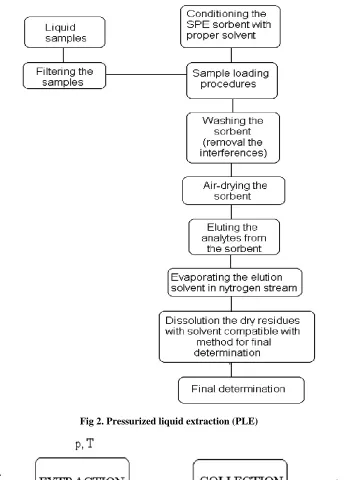
SPE products are excellent for extraction, concentration, and clean-up. Clean-up procedures on SPE sorbents are not limited to extracts from solid samples but could also be used for all the extracts obtained from environmental samples, especially wastewater samples. Clean-up is an important step in determination of analytes at low levels and depends, of course, on the complexity of the sample matrix and detection mode, especially when the analysis is performed by liquid chromatography (LC). Fig. 1 shows common SPE procedures and gives references for SPE procedures for extraction of pharmaceuticals from environmental samples.
Choice of sorbent is the key point in SPE because it can control parameters such as selectivity, affinity and capacity. This choice depends strongly on the analytes of interest and the interactions of the chosen sorbent through the functional groups of the analytes. However, it also depends on the kind of sample matrix and its interactions with both the sorbent and the analytes [8]. Classical SPE sorbents range from chemically-bonded silica with the C8 or C18 organic group among others and carbon or ion-exchange materials to polymeric materials (St-DVB), immunosorbents (ISs), molecularly-imprinted polymers (MIPs) and restricted access materials (RAMs).
Silica sorbents have several disadvantages
compared with polymeric sorbents. They are unstable in a broader pH range and contain the silanols, which are not a good choice for tetracyclines because they have been found to bind irreversibly [9], but, for estrogens, silica-gel cleanup is followed by C18 SPE enrichment [10] .
Pharmaceuticals of adequate hydrophobicity (log Kow in the range 1.5–4.0) can easily be preconcentrated using any reversed-phase material. Deprotonation of acidic compounds and protonation of basic compounds should be suppressed to ensure sufficient hydrophobicity of the analytes. Acidic pharmaceuticals should therefore be preconcentrated under acidic conditions opposite to basic
analytes [11] . Whereas silica-based sorbents as well as St-DVB are not a good option for polar compounds, new materials have been developed in the past few years, so there are many commercially available polymeric sorbents with high specific surface areas [10].
Weigel et al. [13] have compared several sorbents for the extraction efficiency of a group of acidic, neutral and basic pharmaceuticals from water samples. Among these sorbents, most presented similar recoveries for neutral analytes whereas the largest differences have been observed for acidic analytes (bezafibrate, ibuprofen, diclofenac and clofibric acid). For these acidic as well as all other
pharmaceuticals mentioned in this article (except
paracetamol), the highest retentions (>80%) were realized with Oasis HLB. Lindsey and co–workers [9] reached the same conclusion on Oasis HLB in the extraction of tetracyclines and sulfonamides from groundwater and surface water.
Another sorbent, Strata-X, was compared [15,16] with other commercially available sorbents for the retention of pharmaceutical compounds from water samples. In these studies, Strata-X was selected as the best phase for
extracting sulfonamides, tetracyclines [15,16],
fluoroquinolones, penicillin G procaine and trimethoprim in mixture [16] by off-line SPE. For example, with this type of sorbent material, high recoveries were obtained for all the pharmaceuticals investigated (i.e. >80%). A big challenge was solving the extraction problem of sulfaguanidine (e.g., C18, C8, St-DVB, CN, and ion-exchange sorbents, except Strata-X, gave poor recoveries for sulfaguanidine). The reason for the problem was probably because sulfaguanidine is a polar molecule with extremely high pKa value and is the smallest molecule.
In many of the analytical methods described in the
literature, the target compounds are analyzed
3 | P a g e
Molecularly Imprinted Polymer SPEA molecular approach towards developing more specific and selective stationary phases for SPE is molecularly imprinted polymer SPE (MISPE). Molecularly imprinted polymers (MIPs) are highly cross-linked polymers which have artificially generated recognition sites that are intentionally engineered and specific to the chemistry of a target analyte or class of analytes to provide high selectivity [18]. The MISPE offers three mechanisms for the selective analyte retention viz. covalent, noncovalent and semi-covalent [19]. The intricacies, rationale, methods and protocols for the preparation of selective MIPs are well discussed in the literature [20,21].The MISPE is claimed as one of the most selective sample preparation techniques among all the available SPE approaches [22].
For MISPE, through careful design of the imprinting site through molecular modelling, experimental design or screening methods, the binding of analytes of interest can be engineered to offer multiple interactions. Interactions such as ion-exchange, reversed-phase with polymer backbone and hydrogen bonding between the MIP stationary phase and analyte functional groups enable MISPE methods to achieve higher selectivity. The elution of analytes form the binding site can be optimized by use of solvent characteristics (hydrophilicity/hydrophobicity, pH, ionic strength, etc.). As selectivity is significantly improved, the interfering background can be reduced and much lower detection limits relative to other less selective sample preparation techniques can be achieved with MISPE [23]. MISPE can be operated in both on-line and off-line mode for the convenience [19].
MISPE has been shown to have plenty of applications in the fields of environmental [38], food [24] and veterinary [25] sample analysis. However, its use in bioanalysis of drugs /metabolites /biomarkers is area of recent research interest. This may have been due to availability of analyte-specific MIPs and their commercial availability on large scale. Gives an account of recent literature on MISPE and its applications for bioanalysis of drugs/ metabolites. It can be noted from the table that most of the MIPs and MISPE are custom made and are prepared at laboratory scale only. However, many MISPE cartridges are commercially available. These are available as a class of compounds rather than being analyte-specific. The classes of compounds (of various therapeutic areas) for which MISPE cartridges are available are nitroimidazoles,
non-steroidal anti-inflammatory drugs (NSAIDs),
fluoroquinolones, amphetamines, clenbuterol, b-agonists (class selective), full b-receptors (agonists and blockers), chloramphenicol and triazines (class selective) (source: Supelco Analytical Inc.).
MISPE is powerful sample preparation tool. The ability to use MISPE columns directly with the detection system leads to very simple analytical methods. One of the important advantages of MISPE is that, being highly selective in nature, detection and quantitation can be carried
out with simple analytical techniques such as HPLC-UV rather than costlier LC-MS systems (except when higher sensitivity is required).
Micro-extraction by Packed Sorbent
Miniaturization is trend of today’s science. Micro-extraction by packed sorbent (MEPS) is a miniature SPE, originally designed at AstraZeneca, Sweden [26]. The purpose of MEPS is to reduce the sorbent bed volume, making it suitable for large sample volume range (from as low as 10–1000 mL), reducing the number of steps typically involved in conventional SPE and providing easy automation [27]. Typical MEPS is designed in the syringe format, wherein approximately 1mg of the sorbent is packed inside a syringe (100–250 mL) as a plug or between the barrel and the needle as a cartridge. Similar to other sample preparation techniques such as MISPE/dSPE/DPX, novel sorbent materials such as silica-based material (C2, C8, C18, strong cation exchanger, SCX), restricted access material (RAM), carbon, polystyrene divinylbenzene copolymer (PS-DVB) or MIPs can be used in the MEPS cartridge. It is also possible to use coated sorbents to improve selectivity for a given analyte [28].
4 | P a g e
bio-matrices such as plasma, serum, urine, whole blood,hair and saliva. Moreover, MEPS has also been applied for drugs and metabolites screening using monolithic, polymer and silica-based sorbents [34]. Commercially MEPS is available from SGE Analytical Science (Melbourne, Australia; http://www.sge.com). It can be concluded that, MEPS offers selectivity and sensitivity to bioanalytical methods and is available in off-line and on-line sample preparation modes.
A critical survey of literature further shows modification of the concept of the MEPS syringes. Recently, it has been reported that further miniaturization is possible for the SPE as compared with MEPS. reported use of carbon nanotubes (CNTs) as the sorbent for integrating micro-solidphase extraction within the needle of a syringe. In this approach, 0.3 mg of CNTs was introduced into the 100 mm-long capillary plugged with glass wool at both ends. Mechanical shaking with a vibrator was used to obtain a uniform packing. Acetonitrile and distilled water were used to activate the sorbent phase prior to extraction. The
analytes (2-nitrophenol, 2,6-dichloroaniline and
naphthalene) were concentrated by drawing several millilitres of water into the syringe through the needle, and then desorbing/concentrating them in a few microlitres of solvent. Similarly, have reported CNT-reinforced hollow fibre solid–liquid phase microextraction of caffeic acid.
Stir-bar sorptive extraction (SBSE)
This sorptive and solventless extraction technique is based on the same principles as SPME, but, instead of a polymer-coated fiber, a large amount of the extracting phase is coated on a stir-bar. The most widely used sorptive extraction phase is polydimethylsiloxane (PDMS) (as in SPME). Extraction of an analyte from the aqueous phase into an extraction medium is controlled by the partitioning coefficient of the analyte between the silicone phase and the aqueous phase (KPDMS/w). Recent studies have correlated this partitioning coefficient with octanol–water distribution coefficients (Kow). Due to the similarity of KPDMS/w to Kow, chemists can predict extraction efficiencies (SBSE can be used only for hydrophobic compounds with log Kow P 2; and, a high enrichment factor could be obtained for analytes even with log Kow > 5). However, in SPME, the amount of extraction medium (e.g., the amount of PDMS coated on the fiber) is very limited. For a typical 100-lm PDMS fiber, the volume of the extraction phase is approximately 0.5 lL. However, the amounts of the extraction phase in SBSE are 50–250 times greater.
After extraction and thermal desorption, the analyte can be introduced quantitatively into the analytical system. This process provides high sensitivity, since the complete extract can be analyzed. In contrast to SPME, the desorption process is slower because the extraction phase is extended, so desorption needs to be combined with cold trapping and reconcentration. Alternatively, analysts can use
liquid desorption.
In the past few years, SBSE has been developed rapidly and successfully applied to the trace analysis of various target analytes in environmental and biological samples with extremely low limits of detection (LODs) of 0.1 ng/L.
Tienpont et al. [35] successfully applied SBSE to
the analysis of drugs (e.g., barbiturates and
benzodiazepams) and metabolites in urine and blood. For that purpose, they used a glass stir bar coated with a thick layer (24 lL) of PDMS.
Pressurized liquid extraction (PLE)
PLE (Fig. 2) employs a closed flow-through system that uses conventional organic solvents at elevated temperatures above their atmospheric boiling points. A restriction or backpressure valve ensures that a solvent remains liquid but with enhanced solvation power and lower viscosities and hence higher diffusion rates. Both changes increase the extraction rate, and both static and flow-through designs can be used. In the latter, a fresh solvent is introduced to a sample, improving the extraction but diluting the extract [36].
PLE has advantages over other methods (e.g., better reproducibility, reduced use of extraction solvent and reduced time for sample preparation). Extracts are generally much more concentrated than with conventional extraction methods. Depending on author or instrument manufacturer, the technique has been also referred to as pressurized fluid extraction (PFE), pressurized solvent extraction (PSE), enhanced solvent extraction (ESE) and accelerated solvent extraction (ASE).
PLE has been applied to a number of matrices. Many applications for soil and environmental samples have been reviewed [36]. Stoob et al. [37] have developed a method for the PLE of sulfonamide antibiotics from aged agricultural soils. The optimal extraction conditions are as follows: temperature of extraction, 200_C; pressure, 100 bar; extraction time, 9 min; pH of soil samples, 8.8; and, extraction solvent, 15% acetonitrile in water.
For antimicrobials, PLE has been a very effective technique for isolating analytes from fat-containing matrices. It can use water at high pressure and high temperature to extract polar drugs [39].
5 | P a g e
Fig 1. common procedures for solid phase Extraction (SPE)6 | P a g e
CONCLUSIONIt is well known that sample preparation is one of the most critical steps in the determination of trace pollutants in different environmental matrices. Recently, sample-preparation methods have been significantly improved.
As the use of pharmaceuticals is increasing, more sample-preparation procedures are being developed. Among
them, SPE is the most popular for drug analysis and has become an essential tool in laboratories all over the world. It has also largely replaced older techniques. The development of SPE has been fast and accompanied with many improvements. One of these improvements is MIPs. Because of their specific and selective properties, their use will probably be broader in the future, especially in forensic, clinical, pharmaceutical and bio chemical analyses.
REFERENCES
1. Xu RN, Fan L, Rieser MJ and El-Shourbagy TA. Recent advances in high throughput quantitative bioanalysis by
LC-MS/MS. Journal of Pharmaceutical and Biomedical Analysis, 44(2), 2007, 342–355.
2. Anderson NL, Polanski M, Pieper R, Gratlin T, Tirumalai RS, Conrads TP, Veenstra TD, Adkins JN, Pounds JG, Fagan R
and Lobley A. The human plasma proteome. A nonredundant list developed by combination of four separate sources.
Molecular and Cellular Proteomics, 3(4), 2004, 311–326.
3. Vuckovic D, Zhang X, Cudjoe E and Pawliszyn J. Solid-phase microextraction in bioanalysis: new devices and directions.
Journal of ChromatographyA, 1217(25), 2010, 4041–4060.
4. Fu X, Liao Y and Liu H. Sample preparation for pharmaceutical analysis. Analytical and Bioanalytical Chemistry, 381(1),
2005, 1618–2642.
5. Pavlovic DM, Babica S, Horvata AJM and Macana MK. Sample preparation in analysis of pharmaceuticals. TrAC Trends in
Analytical Chemistry, 26(11), 2007, 1062–1075. 6. Kataoka H. Trends Anal. Chem, 22, 2003, 232.
7. Wardencki W, Curyło J, Namies´nik J. J. Biochem. Biophys. Methods, 70, 2007, 275.
8. Fontanals N, Marce´ RM, Borull F. Trends Anal. Chem, 24, 2005, 394.
9. Lindsey ME, Meyer M, Thurman EM. Anal. Chem, 73, 2001, 4640.
10. Beausse J. Trends Anal. Chem, 23, 2004, 753.
11. Buchberger WW. Anal. Chim. Acta, 593, 2007, 129.
12. Weigel S, Kallenborn R, Hu¨ hnerfuss H. J. ChromatogrA, 1023, 2004, 183.
13. Hilton MJ, Thomas KV. J. Chromatogr A, 1015, 2003, 129.
14. Mutavdzˇic´ D, Babic´ S, Asˇperger D, Horvat AJM, Kasˇtelan- Macan M. J. Planar Chromatogr, 19, 2006, 454.
15. Hernando MD, Go´mez MJ, Agu¨ era A, Ferna´ndez-Alba. Trends Anal Chem, 26, 2007, 581.
16. Widstrand C, Bjork H and Yilmaz E. Analysis of analytes—the use of MIPs in solid-phase extraction increases efficiency
and improves detection limits. Laboratory News, 2006a, 14–15.
17. Turiel E and Martin-Esteban A. Molecularly imprinted polymers for sample preparation: a review. Analytica Chimica Acta,
668(2), 2010, 87–99.
18. Widstrand C, Yilmaz E, Boyd B and Rees A. Selective extractions by molecularly imprinted polymers (MIPs). The Column,
2006b, 20– 24.
19. Boyd B, Bjork H, Billing J, Shimelis O, Axelsson S, Leonora M and Yilmaz E. Development of an improved method for
trace analysis of chloramphenicol using molecularly imprinted polymers. Journal of Chromatography A, 1174(1–2), 2007,
63–71.
20. Masque N, Marce RM and Borrull F. Molecularly imprinted polymers: new tailor-made materials for selective solid-phase
extraction. TrAC Trends in Analytical Chemistry, 20(9), 2001, 477–486.
21. Chena S and Zhang Z.Molecularly imprinted solid-phase extraction combined with electrochemical oxidation fluorimetry
for the determination of methotrexate in human serum and urine. Spectrochimica ActaPart A: Molecular and Biomolecular
Spectroscopy, 70(1), 2008, 36–41.
22. Mohajeri SA, Hosseinzadeh H, Keyhanfar F and Aghamohammadian J. Extraction of crocin from saffron (Crocus sativus)
using molecularly imprinted polymer solid-phase extraction. Journal of Separation Science, 33(15), 2010, 2302–2309.
23. Qiao F and Sun H. Simultaneous extraction of enrofloxacin and ciprofloxacin from chicken tissue by molecularly imprinted
matrix solid-phase dispersion. Journal of Pharmaceutical and Biomedical Analysis, 53(3), 2010, 795–798.
24. Stoob K, Singer HP, Stettler S, Hartmann N, Mueller SR, Stamm CH. J. Chromatogr A, 1128, 2006, 1.
25. Abdel-Rehim M. New trend in sample preparation: on-line microextraction in packed syringe for liquid and gas chromatography applications:I. Determination of local anaesthetics in human plasma samples using gas chromatography–
mass spectrometry. Journal of ChromatographyB, 801(2), 2004, 317–321.
26. Abdel-Rehim M. Current advances in microextraction by packed sorbent (MEPS) for bioanalysis applications. LCGC Asia
7 | P a g e
27. Abdel-Rehim M. Recent advances in microextraction by packed sorbent for bioanalysis. Journal of Chromatography A,1217(16), 2010, 2569–2580.
28. Chaves AR, Leandro FZ, Carris JA and Queiroz ME. Microextraction in packed sorbent for analysis of antidepressants in
human plasma by liquid chromatography and spectrophotometric detection. Journal ofChromatography B, 878(23), 2010,
2123–2129.
29. Altun Z, Blomberg L, Jagerdeo E and Abdel-Rehim M. Drug screening using microextraction in a packed syringe (MEPS)/mass spectrometry utilizing monolithic-, polymer-, and silica-based sorbents. Journal ofLiquid Chromatography and Related Technologies, 29(6), 2006, 829–839.
30. Majors RE. LCGC Eur, 20, 2007, 266.
31. Zheng N et al. Microchem. J, 69, 2001, 153.
32. Hu sg, Li L, He XW. Anal. Chim. Acta, 537, 2005, 215.
33. Caro E, Marce´ RM, Cormack PAG, Sherrington DC, Borrull F. Anal. Chim. Acta, 552, 2005, 81.
34. David F, Tienpont B, Sandra P. LCGC Eur, 16, 2003, 410.
35. Tienpont B et al. J. Pharm. Biomed. Anal, 32, 2003, 569. 36. Zougagh M et al. Trends Anal. Chem, 23, 2004, 399.
37. He J, Lv R, Zhan H, Wang H, Cheng J, Lu K and Wang F. Preparation and evaluation of molecularly imprinted solid-phase
micro-extraction fibers for selective extraction of phthalates in an aqueous sample. Analytica Chimica Acta, 674(1), 2010, 53–58.
38. Gentili A. Trend. Anal. Chem, 26, 2007, 595. 39. Barker SA. J. Chromatogr A, 885, 2000, 115.
40. Barker SA. J. Biochem. Biophys. Methods, 70, 2007, 151. 41. Kishida K. Food Control, 18, 2007, 301.
42. Posyniak A, Zmudzki J, Mitrowska K. J. Chromatogr A, 1087, 2005, 259.
43. Mandal V et al. Phcog Rev, 1, 2007, 7.
44. Akhtar MH, Croteau LG. Analyst (Cambridge, U.K.), 121, 1996, 803.
45. Koesukwiwat U, Jayanta S, Leepipatpiboon N. J. Chromatogr A, 1140, 2007, 147.
46. Blackwell PA et al. Talanta, 64, 2004, 1058.
47. Fontanals N et al. Trends Anal. Chem, 24, 2005, 394.