IJHR
Open Access
Abstract
Background and Objectives: Monitoring of nursing performance on a regular basis is crucial for continuous improvement of nursing services management. The aim of this study was to propose an assessment model for the monitoring and evaluating the performance of the nursing services by nursing services managers.
Methods: A Delphi-based qualitative research method was adopted. Based on the literature data, 120 questions were formulated. Three Delphi rounds were held and eight experts were referred to for their opinions in each Delphi round. The data derived from experts’ opinions was analyzed using of the content validity index.
Findings: The assessment form comprises of 63 indicators related to patient care, nursing services, and nurse qualification. The visit form allows inquiring not only on the quality of services, but the process of services delivery, as well.
Conclusions: The evaluation model developed in this study can facilitate continuous monitoring and as-sessment of nursing services performance.
Keywords: Nursing performance; Health Care; Visit form
Background and Objectives
The universally spread competition of today has driven hospitals to offer high quality services. Quality health services, following and evaluating the performance of the services provided by hospital, enables develop-ment. It also requires the use of resources in an ef-fective and efficient manner. The gathering of data in respect of each phase of the service produced at the service fields of a hospital (operating theatres, labora-tories, outpatient clinics, departments) and the deter-mination of the performance level of each department through and on the basis of such data gathered pose
importance for the determination of the overall qual-ity of the services offered [1-3]. In nursing services, as quality indicators, indicators must be fallowed falls, infections, pressure sores, medication errors, identifi-cation, hematoma, infant mortality rate, etc.). In the lit-erature, there is no scale or prepared listing service in order to monitor the performance of nursing services. There are some work, which is discussed criteria (in-dicators) to determine in order to monitor the quality of nursing care [3-6]. Some hospitals develop their own indicators on the basis of clinical literature or findings of expert consensus panel.
Evaluation of the performance of nursing services offered in hospitals should facilitate the development of the needed change and development for the quality of care. At the hospital, fallowing the performance of nursing services offered unit, (weak and strong aspects of the service) provide the necessary improvements
Development of an Assessment Model
for Evaluating the Performance of
Nursing Services
Tuğba Mert
1, Dilek Ekici
2 *1 TOBB ETU Hospital, Ankara, Turkey 2 Nursing Department, Health Sciences Faculty, Gazi University, Besevler/Ankara, Turkey
by determining the difference between units [7-9]. It is, thus, critical to determine what should be known and be so monitored with a view to monitor the perfor-mance and the quality of the nursing service offered at hospitals. The scope of the nursing service includes numerous service – specific indicators such as the emergence of bedsores, thrombophlebitis, extravasa-tion, footdrop, urinary or venous-catheter infection and impairment of oral mucosal integrity due to the treat-ment administered [9]. Therefore; the nursing service offered throughout the period between the admission to and the discharge from the hospital of the patient is monitored, employing a set of specified, measurable, valid, reliable and evidence-based indicators [4, 7, 8, 10]. For example, if the necessary nursing care is not given to a patient confined to bed, are faced with many negative care outcomes such as bedsores, lung and circulatory problems, etc. The level of emergence of bedsores in bedbound in patients treated at a hospital department, thus, stands as an indicator of the qual-ity of the care provided. Therefore; it is important to identify the risk of emergence of bedsores for the inpa-tients of a hospital department, to clearly describe the nursing practices for the prevention of the emergence of bedsores on the inpatients, and to actually put such practices in performance. Bedsore development in the patient, provide information about the patient care re-sults and also about the quality of the service offered nursing services. The conduct of performance assess-ments for hospital departassess-ments provides critical guid-ance for managing (head) nurses about how and in what aspects the nursing service management should be improved, to which end the mid- and senior-level nursing service managing staff should regularly moni-tor the service departments. On the hand, the data related to the patient care results derived from the de-partment would not, alone, suffice for the sound moni-toring of the services provided. It would, thus, be cru-cially important for the mid- and senior-level managing staff to make calls at the units on regular basis, ob-serve on-site whether or not the nurses on duty act in conformity to the identified and established standards and the issues encountered, and to receive feedback from the staff members on such matters [9]. Conse-quently; a managing staff member should focus not only on the service results but also on the process of production of the services. Nurse executive; focus on the process and outcomes of nursing services offered in service gives employees the responsibility to do the right thing the right way. Nursing service managers, can manage the nursing service to the extent that they can monitor the services offered in nursing service, they can control and they are assessed [4, 7-9]. In
other words; a manager would not be able to manage
what s/he cannot measure and monitor. Therefore; this
study is intended to propose a model for the senior-level nursing service managers to monitor and assess the performance of the nursing service at the
hospi-tal’s departments and to compare the departments in
terms of their performance levels. In that regards; the performances of hospital departments, where nursing services are offered, are proposed to be monitored on the basis of the following questions:
• What performance criteria should be applied for monitoring and assessment of the direct patient care services?
• What performance criteria should be applied for monitoring and assessment of the indirect patient care services?
• What performance criteria should be applied for
monitoring and assessment of the department’s ser -vice performance?
• What performance criteria should be applied for the management and leadership performance of Head Nurses?
Methods
The “Delphi Method”, being a qualitative method of research, has been employed in the creation of a per-formance monitoring form for the monitoring of the performance of the nursing services at hospital de-partments. Delphi method is a method that is used to ensure agreement about a specific topic to different
experts without coming face to face. By utilizing quali -tative data obtained from the expert opinion,
quantita-tive data analyzed. In other words; the qualitaquantita-tive data derived from the experts’ opinions can be employed for
quantitative data analysis by means of the content va-lidity index (CVI). Content vava-lidity is essential to deter-mine the comprehensive validity of the items at issue, the legibility of the items, the measurability of the same and the applicability of the same for the target audi-ence. Having been developed by Lawshe, the content validity index method, which is employed to establish
the coherence amongst the experts’ opinions, is also
known as the Lawshe technique [11-13].
contained in the service visit form. The methodology of this study has been designed to include 6 steps, relying on the Lawshe method:
Constitution of domain expert groups
In our work we have planned, in order to determine the performance indicators of nursing services in a ser-vice, the opinions of experts on the subject has been taken. Our experts; is composed of 13 people three of them are academics who have a PhD degree in sci-ence of universities “management in nursing”, ten of them are upper or middle managers in who work in JCI accredited hospitals (a total of 10 hospitals). We get an expert opinion, which have been passed from the control of hospital administrators JC, is one of the important criteria for us. Because for a hospital to be accredited by JCI is important in terms of developing
a set of standards set by the hospital patient care JCI, monitoring the quality of patient care to create indica-tors and the presence of a managerial culture in or-der to ensure continuous improvement. Eight experts in the group have been referred for their opinions for each Delphi round.
Preparation of measurement forms
Examining the literature on the establishment of the indicators to be monitored, assessed and compared for the measurement of the performance of the nurs-ing services offered at hospital departments; an item poll of 120 questions has been created [10, 14-17]. The set of nursing service performance indicators is, thus, comprised of 62 indicators related to direct nursing care of the patient (catheter infection, decu-bitus, wound infection, fall risk, training of the patient Table 1 Distribution of inquiries according to Delphi rounds
Sub-dimension Number of items
Initial Delphi 1 Delphi 2 Delphi 3 Final Version
Criteria for patient care 62 43 28 28 28
Criteria for indirect patient care 15 8 8 8 8
Service criteria 13 7 4 4 4
Criteria for head service nurse 30 22 23 23 23
Total 120 80 63 63 63
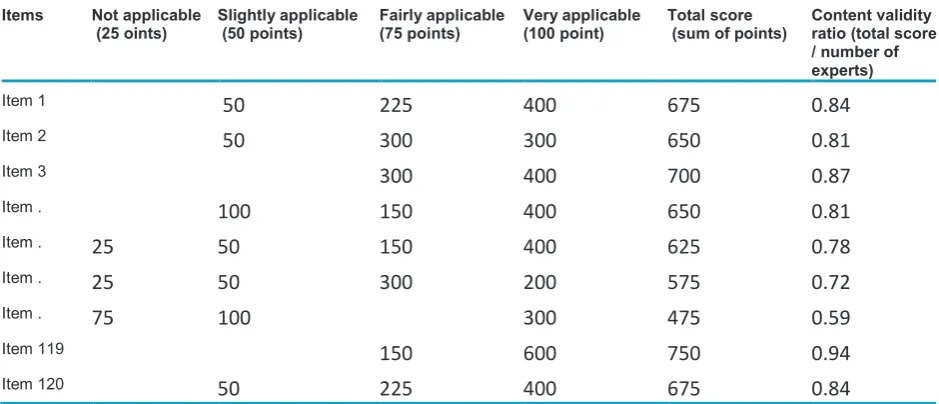
Table 2 Content validity ratios (Delphi round 1)
Items Not applicable
(25 oints) Slightly applicable (50 points) Fairly applicable (75 points) Very applicable (100 point) Total score (sum of points) Content validity ratio (total score
/ number of experts)
Item 1
50
225
400
675
0.84
Item 2
50
300
300
650
0.81
Item 3
300
400
700
0.87
Item .
100
150
400
650
0.81
Item .
25
50
150
400
625
0.78
Item .
25
50
300
200
575
0.72
Item .
75
100
300
475
0.59
Item 119
150
600
750
0.94
and his/her family etc.), 15 indicators related to indi -rect patient care (vital findings of the patient, record-ing of the treatments administered, recordrecord-ing of the time of implantation of catheter, recording of the
train-ings provided to the patient and his/her family etc.),
13 indicators related to service department (inspec-tion on a certain regular basis of the narcotics, the crash trolley and the dressing trolley, inspection of the medicines and supplies used at the service de-partment for their expiry dates etc.), and 30 indica-tors related to the Head Nurse (knowledge about the job descriptions and applicable performance criteria, competence in ensuring the orientation of other nurs-es to the applicable patient care standards, capabil-ity to establish and maintain justice in work lists etc.) (Table 1).
Delphi in the first round was prepared item pool consisting of 120 material by taking expert opinions. The items developed have so been sent to the iden-tified experts, who have been asked to assess the extent of applicability and legibility of each item of the item pool in terms of the assessment of nursing ser-vice performance of the relevant serser-vice department. The poll form prepared to that end contemplated four grades, namely “Not applicable” (25 points), “Slightly applicable” (50 points) (meaning; the item should be articulated in a rather appropriate fashion), “Fairly ap-plicable” (75 points) (meaning; applicable but requires slight revision), and “Very applicable” (100 points), for the assessment. Each item could be assigned 100 points at maximum and 25 points at minimum. Ac-cording to the Lawshe method, the acceptance of an item requires to have been assigned minimum 70 points on overall basis. A dedicated field has been reserved under the line of each item so the experts can insert their suggestions and recommended word-ing revisions in respect of each item. In addition, the experts have been asked to evaluate each item for its association with the subject matter of the study and for the measurement purposes contemplated herein
(essential/ non-essential).
Results
Obtainment of experts’ opinions
Created Delphi scale form, was sent to the experts for e-mail each round (1, 2. and 3). According to received answers by evaluating each item individually, neces-sary changes and corrections were made and a new form was created.
Yielding of content validity ratios for the items The opinions on each item of the experts have been summed up and so the content validity ratio of each item has been yielded. For each round of Delphi, in line with expert opinion an example of how the calcula-tion of the ratio of content validity of the items shown in Table 2. Content validity ratio at the end of Delphi rounds (minimum value) in the first round respectively 0.41, 0.66 in the second Delphi round and is defined as 0.93 in the final round. (Table 3). The average of the points assigned by eight experts to each item should be 0.78 at minimum. Therefore, the items assigned points lower than 0.78 have been excluded from the form for the purpose of the subsequent round. Hence; out of 120 items submitted for Delphi round 1, 40 items, which were assigned points lower than 0.78, have been excluded, and a revised form of 80 items has so been created. At the end of the 2nd round Delphi, 19 questions raisedA form consisting of 63 questions was developed by adding two questions. No questions have been removed at the end of the 3rd round Delphi only by amending the 5 questionnaire has been
final-ized form consisting of 63 questions.
Yielding of content validity ratios for the scale & creation of final version of the form
The content validity ratio of each item has, in each Delphi round, been determined by averaging the rel-evant item, individually (Table 2). Once the validity ratios have been determined; the items posing values under such criterion (0.78) have been either revised or excluded from the form in line with the suggestions Table 3 Content validity ratios of items according to Delphi rounds
Delphi rounds Number of
experts Content Validity Criterion Values for items Overall content validity ratio (sum of content validity ratios
/ number of items)
Min Max
Delphi round 1 8 0.78 0.41 0.97 0.81
Delphi round 2 8 0.78 0.66 100 0.96
of the experts. According to Table 2; the content valid-ity ratio for Delphi round 1 is 0.81, the same for Delphi round 2 is 0.96, and that for Delphi round 3, being the final round, is 0.99. In the last round, out of five the question, 100% conformity assessment made all other questions, has proposed an amendment to the expression of five questions.The validity ratio of the items recommended to be revised has been calcu-lated as 0.93. Thus, Delphi round 3 has represented the final round for the creation of the final version of the poll form.
Discussion
The fulfillment of the criteria set for the quality of the service constitutes a major responsibility for all nursing service managers, primarily including the senior mana-gerial staff of nursing services. Therefore; the manag-ers should regularly monitor the actual practice of the nursing services, and supervise the staff members, who provide services in immediate and direct contact with the patients [7, 8, 18]. This study has been intend-ed to set forth the nursing service performance criteria in order for the monitoring of the performance of the nursing services rendered at service departments, the assessment of whether or not the nurses follow the key performance criteria applicable for patient care, and the analysis of the differences amongst individual de-partments. Besides; the criteria established have also been employed to create a form to guide the mid- and senior-level managerial staff members for their service department visits (Additional File 1).
Nurse Managers with this proposed model, patient care standards in service and related to service meth-od, to ask questions to all employees gives an idea about what is important in institutions. Thus, in ser-vice is provided to work according to nurses identified nursing care standards.Moreover; the model not only ensures the gathering of department-specific data but also enables the observation on site of problems en-countered by the staff members and the discussion of the proposed solutions.
The frequency and duration of the visits to be paid by the mid- and senior-level managers to the service departments may be affected by a number of factors such as the number of service departments at the
hospital, the size of each service department and the
geographical dispersion of the service departments. The more frequent the service department visits (once a week at minimum) and the more diversified the resources (observation, interviews, patient files, records, documents etc.), the more effective and
ef-ficient would the model be.
On the basis of the visit form created as a conse-quence of the Delphi rounds; each form item is to be graded and assigned points as “performed” (10 points), “partially performed” (5 points), “not per-formed” (0 points), or as yes (10 points) and “no” (0 points), whereby the overall score is to be yielded. The value yielded by the division of the sum of the values derived through the evaluation of the form items by the total number of items (63) represents the grade of suc-cess of the service performance out of 10.
Conclusions
The mid- or senior-level advanced nurses may, utilizing
the outcomes of the present study, assess the mana-gerial performances of Head Nurses and compare the performance of each department with that of other de-partments. While service performances are compar-ing, structural features should be considered. Having prior knowledge of managers about whether structural features are similar to the service is important.Com-paring the performances of service departments, the performances should be assessed with due consider-ation of the structural characteristics, including:
• Whether or not the works performed at a depart-ment fit to the knowledge and skills of the nurses as-signed to such department,
• Whether or not the nursing workload is at an
ap-propriate level (patient/ nurse ratio, care needs of pa -tients, intensity of the nursing service provided),
• Whether or not the headcount of nurses in service suffices to meet care needs of the inpatients at the department,
• Whether or not at least one nurse works overtime at each working week within a period of one month,
• Whether or not normal working hours suffices for the completion of the works to be performed,
• Whether or not the materials and supplies essential for the provision of the nursing service are available,
• Whether or not the department is an appropriate working environment in terms of lighting, heating, ad-equate space, noise, security and cleaning,
• Whether or not a safe working environment has been established at the department.
Our study results also recommend that:
• Regular department visits should be paid at least once a month (or more frequently),
• The executive nurses should determine the dates and times their visits in advance, and the monthly visit schedule should be announced to all staff members,
• Any willing department staff member should be enabled to attend the visits,
• The fields dedicated to each item as a part of the model form should be completed on the basis of the outcomes of the observation of patients and other in-dividuals, the interviews and the records,
• The performance scores should be calculated for each department both on overall basis and on sub-division basis,
• The score so yielded for each service department should be assessed by comparison with that of other departments.
References
1. Dubois CA, D’Amour D, Pomey MP, Girard F, Brault I. Con-ceptualizing performance of nursing care as a prerequisite for better measurement: a systematic and interpretive re-view. BMC Nurs 2013, 12:7.
2. Sarwar A. Healthcare services quality in Malaysian pri-vate hospitals: A qualitative study. Int J Hosp Res 2014, 3(3):103-12.
3. Mardani S, Tabibi SJ, Riahi L. Relationship between safety and staff performance in hospital. Int J Hosp Res 2013, 2(4):205-12.
4. Younsi M. Performance of Tunisian public hospitals: A com-parative assessment using the Pabón Lasso Model. Int J Hosp Res 2014, 3(4):159-66
5. Kapu AN, Kleinpell R. Developing nurse practitioner associ-ated metrics for outcomes assessment. J Am Assoc Nurse Pract 2013, 25(6):289-96.
6. Swansburg RC, Swansburg RJ. Introduction to manage-ment and leadership for nurse managers. Burlington: Jones & Bartlett Learning; 2002.
7. Tavakoli N, Taherizade AR, Tahmasbi A, Amini M, Ghafurian N. A survey on factors contributing to hospital patient read-mission. Int J Hosp Res 2013, 2(2):85-90.
8. Tabatabaee SS, Kohpeima Jahromi V, Asadi M, Kalhor R, Sharifi T. Ranking factors contributing to medication error incidents in private hospital: A nurse’s perspective. Int J Hosp Res 2013, 2(4):187-94.
9.
Ekici ÖD. Total Quality Management in Healthcare Servic-es. CA: Sim Press; 2013.10. Elverson CA, Samra HA. Overview of structure, process, and outcome indicators of quality in Neonatal care. New-born Infant Nurs Rev 2012, 12(3):154-61.
11. Rubio DM, Berg-Weger M, Tebb SS, Lee ES, Rauch S. Objectifying content validity: Conducting a content va-lidity study in social work research. Soc Work Res 2003, 27(2):94-104.
applications. Volume 29. MA: Addison-Wesley Reading; 1975.
13. Lawshe CH. A quantitative approach to content validity1. Pers Psychol 1975, 28(4):563-75.
14. Patrician PA, Loan L, McCarthy M, Brosch LR, Davey KS. Towards evidence-based management: creating an infor-mative database of nursing-sensitive indicators. J Nurs Scholarsh 2010, 42(4):358-66.
15. Vituri DW, Matsuda LM. Content validation of quality indi-cators for nursing care evaluation. Rev Esc Enferm USP 2009, 43(2):429-37.
16. Needleman J, Kurtzman ET, Kizer KW. Performance mea-surement of nursing care: state of the science and the cur-rent consensus. Med Care Res Rev 2007, 64(2 Suppl):10s-43s.
17. Greenslade JH, Jimmieson NL. Distinguishing between task and contextual performance for nurses: development of a job performance scale. J Adv Nurs 2007, 58(6):602-11. 18. Ekici ÖD. Healthcare Services Management. CA: Sim
Press; 2013.
Please cite this article as: