[Ramesh* 7(1): January, 2020] ISSN 2349-4506
Impact Factor: 3.799
G
lobal
J
ournal of
E
ngineering
S
cience and
R
esearch
M
anagement
APPLICATION OF ADOPTIVE NEUERO FUZZY INTERFACE SYSTEM (ANFIS)
IN PREDICTING REFLECTION COEFFICIENT OF A PERFORATED QUARTER
CIRCLE BREAKWATER
N Ramesh*, Subba Rao, Arkal Vittal Hegde
*
PhD Scholar, National Institute of Technology Karnataka, Surathkal, Manglore, India
Professor, National Institute of Technology, Surathkal, Manglore, India
Professor (Retired), National Institute of Technology, Surathkal, Manglore, India
DOI: 10.5281/zenodo.3604840
KEYWORDS
:
Quarter Circular Breakwater, Reflection coefficient, Loss coefficient, Adoptive Neuro Fuzzy Interface System and MATLAB.ABSTRACT
Breakwaters are constructed for creating tranquil zone on the lee side to minimize the motion on ships due to the wave for easy handling of goods, apart from shoreline protection work etc. Due to the increase in demand for the coastal development all over the world, number of innovative Breakwaters was evolved as against the rubble mound. Recently, in order to further economize these innovative structures, Quarter Circular Breakwater (QCB) has been evolved. The coastal structure is subjected to hydrodynamic forces, involving various parameters while designing a safe and economical structure. The laboratory experiments are conducted in the wave flume in the National Institute of Technology, Surathkal Karnataka, India. In the present paper reflection coefficient (Kr) of a perforated QCB with S/D-3 (spacing to perforation diameter ratio) is predicted applying Adoptive Neuro Fuzzy Interface System (ANFIS) in MATLAB. The predicted values of reflection coefficient are compared with the experimental values.
INTRODUCTION
The main purpose of a Breakwater is to minimize the wave effect and provide a calm area for the development of a Port or Harbor. A Quarter Circular Breakwater (QCB) is a hollow caisson with flat horizontal base with a vertical face on its lee side and curvature towards the sea side. Due to its hollowness, the material required is considerably less enabling easy handling and placing the structure in the desired location. The whole structure is generally placed on a rubble mound base. The QCB can be impermeable or with perforation on the curved surface. Studies related to QCB are in the initial stages. Very few institutes have taken laboratory studies related to QCB because of time involved in each set of experiments. Due to the availability of fast computing technique, an attempt is made to predict the hydrodynamic performance of QCB by ANFIS using MATLAB.
LITERATURE REVIEW
Xi et al. (2005) studied the behavior of Quarter circular caisson type Breakwater (QCB). The caisson type of structures are hallow and even be placed on a weaker sub-strata.
Jiang et al. (2008) examined the performance of SBW and QCB in a 2D flume. It was noticed that no significant change in wave reflection coefficient of both QCB and SBW. As the depth of water decreased the value of Kr increased. During overtopping, a vortex near the rear walls of QCB is attributed to sharp corner and sudden expansion of flow around QCB.
[Ramesh* 7(1): January, 2020] ISSN 2349-4506
Impact Factor: 3.799
G
lobal
J
ournal of
E
ngineering
S
cience and
R
esearch
M
anagement
Hegde and Ravikiran (2013) conducted experimental study on QCB to understand the effect of radius on reflection characteristics of submergence QCB. The study indicated Kr increases logarithmically as wave steepness increases.Hafeeda (2014) conducted experiments in a two dimensional monochromatic wave flume on a seaside perforated QCB model. The data is analyzed by plotting the non-dimensional graphs of reflection coefficient for various values of wave steepness. The study indicated that Kr decreased with increase in d/hs and also as the free board is reduced effect of the curvature is less pronounced, thus, resulting, lesser dissipation energy and hence reflection. Binumol (2014) conducted physical model studies of QCB with three different radii and S/D (spacing to diameter of perforations) ratio, and analyzed dimensionless wave run-up and dimensionless wave run-down characteristics for different wave steepness. They reported that wave run-up increases with increase in wave steepness. At larger water depths, effect of curvature plays an important role resulting in lower run up and hence increases in wave rundown.
Balakrishna et al. (2015) reported that energy dissipation coefficient decreased with increase in wave steepness for different radii with same S/D ratio. Also, observed that as hS/D (significant wave height to water depth) increases, dissipation increases which is an opposite trend in the case of reflection.
Generally, computational intelligence techniques viz., Artificial Neural Network (ANN), support vector machine regression, genetic algorithm, etc., have been efficaciously proposed as an efficient tool for modelling and predictions in coastal engineering problems (Amr et al., 2011). In the present study, ANFIS is applied and model performance index are compared between experimental and predicted values of both reflection coefficient of a perforated QCB.
METHODOLOGY
The data used in the present study is from the Laboratory experiments are carried out National Institute of Technology, Surathkal Mangalore, in a wave flume of length 45.0 m x 1.0 m x 1.5 m on a Quarter circle Breakwater, fabricated with a steel plate having perforation of 0.016 m diameter with different spacing coveted with cement slurry, with the following as input parameters wave height (hi), water depth (d), wave period (T),Radius of the Quarter Circle varying its porosity below the water depth reduced as per the dimensional analysis, by Binumol et al at department of Applied Mechanics and Hydraulics, NITK, Surathkal, Mangaluru. Fiver parameters, such as incident wave height (hi), reflected wave height (hr), depth of water (d), radius of the breakwater and porosity below the water level (S/D) are considered. Principle component analysis (PCA) on all the five parameters is carried out to know effect of each input variable in obtaining reflection coefficient.
ANFIS model is developed by taking three variables which play prominent role as per PCA is used in predicting the reflection coefficient of QCB.
Adaptive Neuro Fuzzy Interface System
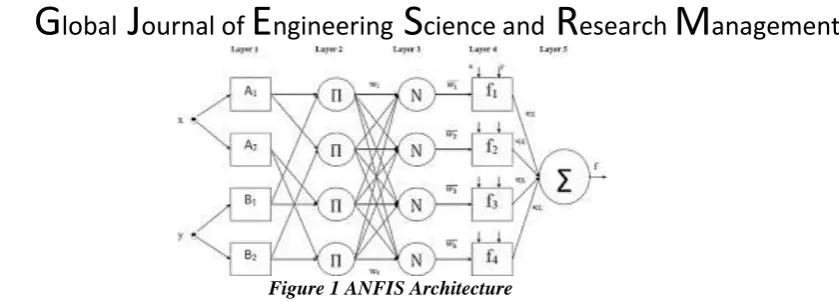
ANFIS is a kind of soft computing technique that is based on Takagi–Sugeno fuzzy interface system. The technique was developed in the early 1990s [1]. It integrates both neural networks and fuzzy logic principles and has the potential to capture the benefits of both in a single framework. The inference system corresponds to a set of fuzzy IF–THEN rules that have learning capability to approximate nonlinear functions [5].
[Ramesh* 7(1): January, 2020] ISSN 2349-4506
Impact Factor: 3.799
G
lobal
J
ournal of
E
ngineering
S
cience and
R
esearch
M
anagement
Figure 1 ANFIS Architecture
Layer 1
Every node in this layer is an adaptive node with a node function
Ol,i=μAi(x), for i=1,2 (1)
Ol,i=μBi-2(x), for i=3,4 (2)
x (or y) is the input node and Ai (or Bi−2) is a linguistic variable associated with the membership function of a fuzzy set (A1,A2,B,B2). A typical membership function:
𝜇𝐴(𝑥) = 1 1+(𝑐𝑖 𝑎𝑖)
2 𝑏𝑖 (3)
Where 𝑎𝑖, and 𝑐𝑖the parameter set. Parameters are called as premise parameters.
Layer 2
Each node in this layer is a fixed node, indicated by Π Norm. The output is the product of all the incoming signals.
O2,i=wi=μAi(x)∙μBi(y), i=1,2 (4) Output signal 𝑤𝑖 represents the fire strength of a rule.
Layer 3
Each node in this layer is a fixed node N form. The ith node calculates the ratio of the firing strength to the sum of the firing strength.
O3,i=w̅i=wiw1+w2, i=1,2 (5) Output signal 𝑤̅𝑖 is called normalized firing strengths.
Layer 4
Each node in this layer is an adaptive node, indicated by square node with a node function:
O4,i=wifi=wi(pix+qiy+ri) (6)
Where𝑤𝑖 is the normalized firing strength from layer 3. {pi, qi, ri} is the parameter set which are called as consequent parameters.
Layer 5
Each node in this layer is a fixed node, indicated by circle node which computes the overall output as the summation of all incoming signals:
Overall output, S=O5,1=∑ 𝑤𝑖𝑓𝑖 =
∑ 𝑤𝑖𝑓𝑖
𝑤𝑖 (7)
The different membership functions assigned for input parameters are: Gauss membership function:
[Ramesh* 7(1): January, 2020] ISSN 2349-4506
Impact Factor: 3.799
G
lobal
J
ournal of
E
ngineering
S
cience and
R
esearch
M
anagement
Triangular membership function:𝑓 (𝑥, 𝑎, 𝑏, 𝑐) = max(min( 𝑥−𝑎 𝑏−𝑎 ,
𝑐−𝑥
𝑐−𝑏 ), 0) (9)
the feet of the triangle and b locate the peak.
Generalized bell-shaped membership function:
𝑓 (𝑥, 𝑎, 𝑏, 𝑐) = 1
1+]𝑥− 𝑐𝑎[2𝑎 (10)
where, x is input parameter, c locates the center of the curve.
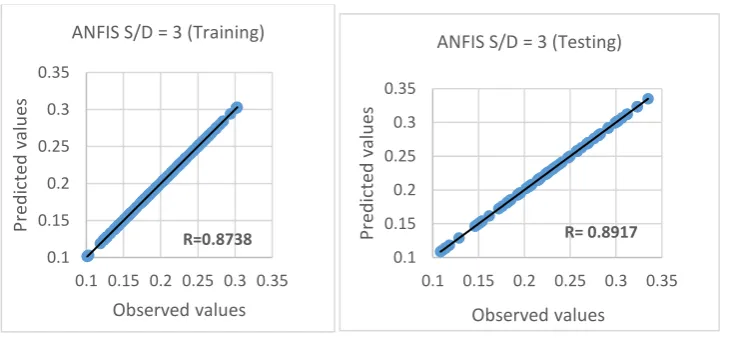
Figure 2.Plot showing observed and predicted values of Kr
(a) Testing set (b)Testing set
Figure 3. (a) and (b) Observed Vs Predicted (Kr) 0.1
0.2 0.3
0 50 100 150 200
Re
fle
ctio
n
Coe
ff
(K
r)
Number of points
ANFIS S/D= 3 Training
Obs Pre
R=0.8738
0.1 0.15 0.2 0.25 0.3 0.35
0.1 0.15 0.2 0.25 0.3 0.35
P
red
icted
v
alu
es
Observed values ANFIS S/D = 3 (Training)
R= 0.8917
0.1 0.15 0.2 0.25 0.3 0.35
0.1 0.15 0.2 0.25 0.3 0.35
Predicted
v
alu
es
[Ramesh* 7(1): January, 2020] ISSN 2349-4506
Impact Factor: 3.799
G
lobal
J
ournal of
E
ngineering
S
cience and
R
esearch
M
anagement
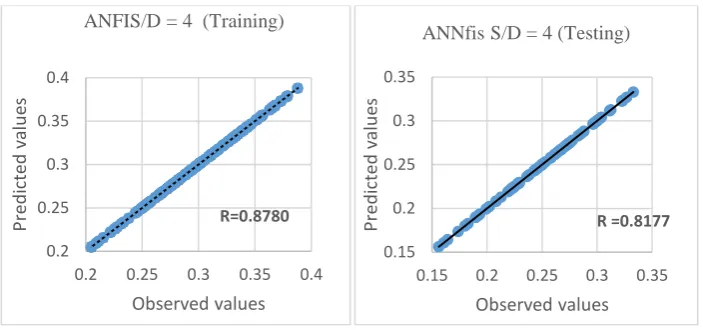
Figure 4.Plot showing observed and predicted values of Kr
(a)Training set (b) Testing set
Figure 5. (a) and (b) Observed Vs Predicted (Kr)
Summary and Conclusions
The paper presented a study on application of ANFIS model with triangular membership functions for two different perforation conditions on the curvature of QCB for predicting the reflection QCB. The results obtained during training and testing process were evaluated by using statistical measures (Table 1) viz., coefficient of
regression (R2), root mean squared value (RMSE) and absolute mean error (ABS). On the basis of evaluation of
the model results, the conclusions drawn from the study are given as below:
Table1 Statistical parameter of ANFIS models for predicting (Kr)
Statistical measures
S/D-3 S/D-4
Training Testing Training Testing
R2 0.814 0.802 0.878 0.873
MAE (%) 0.005 0.005 2.432 2.444
RMSE 0.004 0.003 0.009 0.008
a. The R2 value of S/D-4 is comparatively better than the corresponding values of S/D-3, which confirms the
lesser porosity has higher reflection from the breakwater surface.
b. The MAE of S/D-3 is less than its value of S/D-4 and the difference between the MAE values is computed
as 2%.
0.2 0.3 0.4
0 50 100 150 200
Re
fle
ctio
n
Coe
ff
(K
r)
Number of points
ANFIS S/D= 4 Training
oBS Pre
R=0.8780
0.2 0.25 0.3 0.35 0.4
0.2 0.25 0.3 0.35 0.4
P
red
icted
v
alu
es
Observed values
ANFIS/D = 4 (Training)
R =0.8177
0.15 0.2 0.25 0.3 0.35
0.15 0.2 0.25 0.3 0.35
Predicted
v
alu
es
Observed values
[Ramesh* 7(1): January, 2020] ISSN 2349-4506
Impact Factor: 3.799
G
lobal
J
ournal of
E
ngineering
S
cience and
R
esearch
M
anagement
d. RMSE value of S/D-4 is higher than its values of S/D-3 during training and testing of the model.
On the basis of MAE and RMSE values, it is suggested that the scenario based on S/D-3 could be considered for
computing the reflection coefficient though the R2 value of S/D-3 is slightly less than the corresponding value of
S/D-4.
ACKNOWLEDGEMENTS
The authors are thankful to the Director of National Institute of Technology Karnataka, Surathkal, Director, Central Water and Power Research Station, Pune and Head of the Department of Applied Mechanics and Hydraulics, NITK, Surathkal for the facilities provided to carry out the studies and granted permission to publish the paper.
REFERENCES
1. Azmathulla H Md and Ghani A A (2011) - “ANFIS based approach for predicting the scour depth at
culvert outlets” Journal of Pipeline System Engineering and Practice 2h, (1) pp 35-40.
2. Balakrishna K, Hegde AV (2015) Reflection and dissipation characteristics of non-overtopping quarter
circle breakwater with low-mound rubble base. J Adv Res Ocean Eng 1(1):44–054
3. Binumol S, Rao S, Hegde AV (2015) Runup and rundown characteristics of an emerged seaside
perforated quarter circle breakwater. Aquat Procedia 4(1):234–239
4. Binumol S, Hegde AV, Rao S (2016) “Effect of water depth on reflection and loss characteristics of a
Quarte circle breakwater” - Int. J. Ecol. Dev. Volume 31, Issue No. 3, ppp13-22
5. Bryant, M.A et al (2016) “ Evaluation statistics computed for wave information studies”
www.dtic.mil/dtic/tr/fulltext/u2/1013235 pdf
6. Geeta, S et al. (2017) “Performance Evaluation of ANFIS and SVM model in prediction of wave
transmission over submerged reef of tandem breakwater” - Int. J. Ecol. Dev. Volume 32, Issue No. 2, pp141-155
7. Goyal, R., Singh, K., Hegde, A. V., and Thakur, G. S. (2015). “Prediction of Hydrodynamic
Characteristics of Quarter Circular B Xie SL, Li YB, Wu YQ, Gu HB (2006) Preliminary research on wave forces on quarter circular breakwater. Ocean Eng 24(1):14–18reakwater Using Stepwise Regression.” Int. J.Ocean Clim. Syst., 6(1), pp. 47–54.
8. Hafeeda V, Binumol S, Hegde AV, Rao S (2014) Wave reflection by emerged sea side perforated quarter
circle breakwater. Int J Earth Sci Eng 7(2):454–460
9. Hegde AV, Ravikiran L (2013)Wave structure interaction for submerged quarter circle breakwaters of
different radii-reflection characteristics. World Acad Sci Eng Technol 7(7):1367–137
10. Hodaei et al (2016) “Experimental study on reflection coefficient of a curved perforated plate” Journal
of Marine science Appl.15(4) pp382-387
11. Jiang, X et al(2017) “Wave load on submerged Quarter circle breakwater and semicircular breakwater
under irregular waves” Coastal Engg 121 pp265-277
12. Karthik S, Rao S (2017) Application of soft computing in breakwater studies—a review. Int J Innov Res
Sci Eng Technol 6(5):8355–8359
13. Narayana Harish, Sukomal Mandal, Subba Rao , S.G. Patil (2015) “Particle Swarm Optimization based
support vector machine for damage level prediction of non-reshaped berm breakwater- Applied Soft computing Elsevier.
14. Raju, B., Hegde, A. V., and Chandrashekar, O. (2015). “Computational Intelligence on Hydrodynamic
Performance Characteristics of Emerged Perforated Quarter Circle Breakwater.” Procedia Eng., Elsevier B.V., 116(1), pp. 118–124.
15. Ramesh, N, Hegde, A V, Rao, S and Vivekanandan, N (2017) “Comparison of Hydrodynamic
Performance of Quarter Circular Breakwater Using ANN and Auto Regression Methods“ -Hydro 2017,
16. Ramesh, N, Hegde, A V and Rao S (2018) “Prediction of Hydrodynamic Performance of Emerged
Perforated Quarter Circular Breakwater Using ANN” INCOE (2018), IIT Chennai Elsevier
17. Ramesh, N, Hegde, A V and Rao, S (2018) “Prediction of reflection coefficient of a perforated quarter
[Ramesh* 7(1): January, 2020] ISSN 2349-4506
Impact Factor: 3.799
G
lobal
J
ournal of
E
ngineering
S
cience and
R
esearch
M
anagement
18. Shi YJ, Wu Mi-Ling, Xue-Lian Jiang, Yan-bao Li (2011) Experimental research on reflection and
transmitting performance of quarter circle breakwater under regular and irregular waves. China Ocean Eng 25(3):469–478
19. Xie SL, Li YB, Wu YQ, Gu HB (2006) Preliminary research on wave forces on quarter circular
breakwater. Ocean Eng 24(1):14–18
20. YU'AO, H. E., &Jianjun, W. (1998). “Prediction of Structural Response by Self-recurrent Neural