[Purnomo* 5(5): May, 2018] ISSN 2349-4506
Impact Factor: 3.799
G
lobal
J
ournal of
E
ngineering
S
cience and
R
esearch
M
anagement
A PROPOSED DESIGN FOR A SCHOOL LIBRARY DESK USING THE
AXIOMATIC DESIGN METHOD
Hari Purnomo*, Mohammad Sobirin, Fikrihadi Kurnia
*Industrial Engineering Department, Universitas Islam Indonesia
DOI: 10.5281/zenodo.1250332
KEYWORDS
:
Design, Furniture, Library, Axiomatic Design Method.ABSTRACT
Students spend significant time sitting; thus, the suitability of school furniture for meeting students’ needs is a requirement of safety and comfort. To mitigate ergonomic risks, appropriate anthropometric measurements and furniture dimensions are needed. As such, this study proposed a design for a library desk for use by high school students. Data collected included empirical data, questionnaires, and interviews from 150 respondents consisting of 75 students and 75 librarians in Central Java. Design analysis was conducted using the axiomatic design method, which revealed three consumer requirements for furniture design: safety, adjustability, and comfort. Based on these results, a furniture design concept was created, for which a comfort level test showed improvements in comparison to the previous desk. This study can be used as a reference by school management when choosing school facilities in accordance to the student body dimension.
INTRODUCTION
Convenience in the process of conducting school activities is an influential factor of improving student performance [1,2]. Because students spend significant time sitting [3,4], supportive facilities are needed, one of which is school furniture of appropriate dimensions based on the anthropometry of students’ bodies to avoid incorrect ergonomic postures that disrupt the learning process [5,6,4,7,8]. Previous studies have shown that furniture dimensions based on the anthropometry of students improves posture health and comfort and that most school furniture is inappropriate for meeting the needs of student health [3,9]. Thus, improving school facilities and infrastructure is an important concern, although school management often ignores how the needs of students affect student learning [5]. In particular, the non-conformity of desk dimensions to anthropometry of students’ bodies in elementary and junior and senior high schools creates poor desk user posture [2,7,10,11].
One important piece of school furniture that should be improved is the library desk, at which many students spend significant time completing school tasks [12, 4,13]. Initial observations in high schools related to the inconvenience of library desks showed that 87% of students felt uncomfortable using such desks, with discomfort occurring most commonly in the upper extremities. Research on school furniture has been based on student anthropometry [14,8,11] and furniture design [7,15,2]. The study was conducted to analyze the mismatch of dimension table used with student dimension. Mismatch affects the occurrence of complaints in the use of furniture in the classroom [3], and the frequent mismatch is at table height and seating height [4, 13].
This study proposes a library desk design for high school students to improve student performance and productivity. A mapping process and hierarchy based on axiomatic design (AD), which is a method widely used by engineers to describe designs [16], were used. AD has been used to solve many problems related to decision making and product design because it takes consumer needs into account [17,18,19,20]. Based on such needs, abstract ideas are incorporated into the design parameters (DPs) of product functions. This research is different from previous research in its objective and methodology, and the design proposal considers how school management provides appropriate facilities to high school students.
MATERIALS AND METHODS
Subjects and Objective
[Purnomo* 5(5): May, 2018] ISSN 2349-4506
Impact Factor: 3.799
G
lobal
J
ournal of
E
ngineering
S
cience and
R
esearch
M
anagement
(4) a healthy condition; The objective of this research was to design a library desk for use by students in senior high school.Tools and Materials
The tools used in this research were (1) an open questionnaire for collecting subject responses to product design expectations; (2) a meter stick to measure the dimensions of furniture; (3) an anthropometric tool to measure students’ body dimensions; and (4) Computer Aided Design (CAD) software to draw a three-dimensional prototype. The prototype was made of (1) plywood, for the desk’s pedestal and rear support; pine wood, for foot poles; and Kalimantan wood for the feet of the desk; (2) 8–10 mm thick glass, for the side border; (3) hinges, bolts, nails, and wood adhesives, for construction; (4) and paint, for decoration.
Research Procedure
Data Collection
Data were collected by questionnaire to determine the criteria that respondents identified as being necessary for the facilities being researched. Respondents were interviewed to measure the dimensions of the current library desk in use and to measure subjects’ body dimensions. Questionnaires and interviews presented general complaints about the non-conformity of furniture dimensions with user anthropometry, as well as subjects’ expectations for desk improvements that met customer need and were convenient. The dimensions of the desk design are presented in Figure 1, while anthropometry data for students are shown in Figure 2.
[Purnomo* 5(5): May, 2018] ISSN 2349-4506
Impact Factor: 3.799
G
lobal
J
ournal of
E
ngineering
S
cience and
R
esearch
M
anagement
Figure 2. Representation of the anthropometric measurements of students; sitting elbow height (SEH), sitting height (SH), popliteal height (PH), shoulder breadth (SB), and upper limb length (ULL)
The relationships between Figures 1 and 2 include a (1) DW measurement based on SB measurement; (2) DD measurement based on ULL measurement; (3) DH measurement based on PH and SEH (PH + SEH) measurements; and (4) HDB measurement based on SH minus SEH (SH – SEH) measurements.
Design Stage
Desk design was conducted using the AD method to map customer, functional, physical, and process domains. The customer domain contains criteria for customer needs, the functional domain contains abstract consumer functional requirements (FRs), the physical domain contains DPs for interconnecting functions, and 4) the process domain contains process variables for DPs [20,16].
RESULTS AND DISCUSSION
AD Analysis
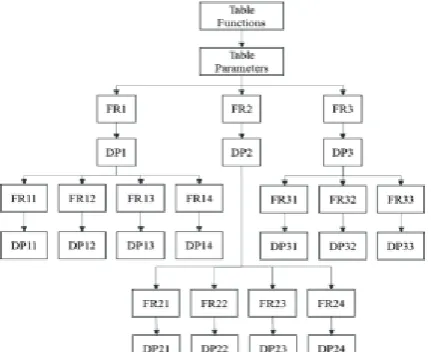
In general, library desks are no different from classroom desks, but furniture design should be tailored to the users’ needs; thus, a library desk should include space for books and for work and a table separator. Product design based on AD requires compatibility between FRs and DPs (Figure 3). The design concept for the library desk is shown below.
[Purnomo* 5(5): May, 2018] ISSN 2349-4506
Impact Factor: 3.799
G
lobal
J
ournal of
E
ngineering
S
cience and
R
esearch
M
anagement
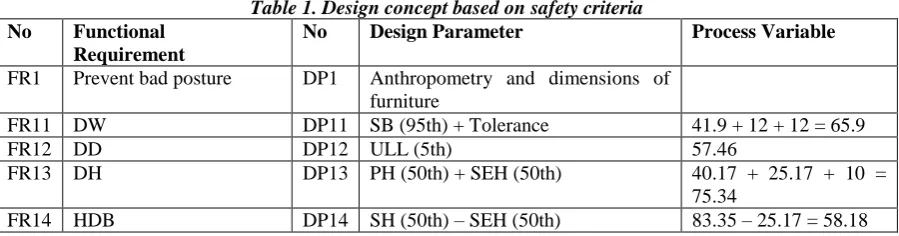
The design needs of consumers of library desks include the following.Safety: Library desks must be safe and comfortable, allowing users to adjust desk dimensions to agree with anthropometry. Desks should prevent poor posture during use. Table 1 compares FRs and DPs for safety criteria.
Table 1. Design concept based on safety criteria
No Functional Requirement
No Design Parameter Process Variable
FR1 Prevent bad posture DP1 Anthropometry and dimensions of furniture
FR11 DW DP11 SB (95th) + Tolerance 41.9 + 12 + 12 = 65.9
FR12 DD DP12 ULL (5th) 57.46
FR13 DH DP13 PH (50th) + SEH (50th) 40.17 + 25.17 + 10 = 75.34
FR14 HDB DP14 SH (50th) – SEH (50th) 83.35 – 25.17 = 58.18
Dimensions for DW (FR11) and DD (FR12) were determined based on user requirements and suitability for required functions [21,1]. Anthropometric measurements used for FR11 were the 95th percentile for SB plus tolerance (DP32 + tolerance); for FR12 was the 5th percentile for ULL; for FR13 were PH and SEH plus tolerance 10 cm; and for FR14 was the difference between SH and SEH. These dimensions provide a limited perspective and prevent work tool failure, with the percentile used was the 50th percentile.
Adjustability: The furniture design must be adjustable with an inclining reading base (DP21), table pads (DP22) to avoid wall damage, a book buffer to prevent falling books (DP23), and storage for students’ bags (DP24) [22,23].
Table 2. Design concept based on adjustability criteria
No Functional Requirement No Design Parameter
FR2 Compliance with user requirements DP2 Design adjustment attributes FR21 Reasonable desk incline DP21 5o–10o inclination
FR22 Prevents damage to walls DP22 Addition of desk-back padding FR23 Books do not fall when reading DP23 Book buffer
FR24 Bags do not fall DP24 Space for bags
Use 20-point-bold Garamond font for the paper title. Author’s names (12-point Garamond bold) and affiliations (11-point Garamond regular) are aligned left. Separate addresses for different affiliations and add a space between authors’ names and affiliations.
Comfort: Comfort is based on safety, convenience, adaptability, and product suitability [9,2]. Table 3 presents the draft concept for the desk based on comfort criteria.
Table 3. Design concept based on comfort criteria
No Functional Requirement No Design Parameter Process Variable
FR3 Convenience during use DP3 Designing additional attributes
FR31 Desk mat DP31 The normal book area 42 x 30 FR32 Space for work tools DP32 Adjustment needs 12 FR33 Space for books DP33 Standard book width 21
[Purnomo* 5(5): May, 2018] ISSN 2349-4506
Impact Factor: 3.799
G
lobal
J
ournal of
E
ngineering
S
cience and
R
esearch
M
anagement
Proposed Design
The proposed design (Figure 4) used anthropometric data from high school students [25] adapted to the drafted concept (sub-theme A). The proposal was compared to the original product (Figure 5) to determine differences and potential improvements (Table 4).
Front view Top view Side view
Figure 4. Proposed design
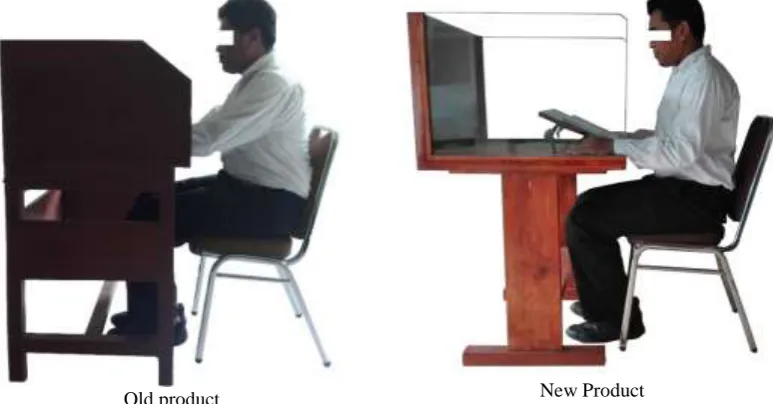
In the proposed design, improvements had to meet requirements for inconsistent anthropometric dimensions, while taking into account safety, convenience, and effective product use. A comparison of the new and old products is shown in Figure 5.
Old product New Product
Figure 5. Comparison of products
Table 4. Comparison of functions between new and old products
Old Product New Product
Limited space Wider space
[Purnomo* 5(5): May, 2018] ISSN 2349-4506
Impact Factor: 3.799
G
lobal
J
ournal of
E
ngineering
S
cience and
R
esearch
M
anagement
Scratched walls if affixed Table backrest prevents wall scratchesNarrow foot room Wider foot room Lack of aesthetic Aesthetic design No bag storage Effective bag storage
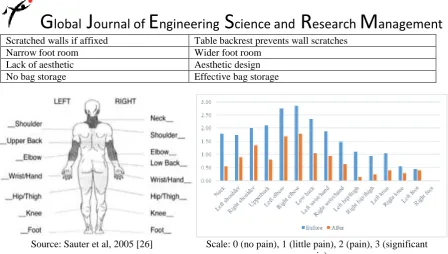
Source: Sauter et al, 2005 [26] Scale: 0 (no pain), 1 (little pain), 2 (pain), 3 (significant pain)
Figure 6. Test results
The convenience test results using the National Institute for Occupational Safety and Health (NIOSH) Nordic body map are shown in Figure 6. Pain ratings provided by desk users were used to determine improvements for the proposed desk design. Based on experimental data, eight parts of the body experienced significant pain, which included the neck, lower back, upper back, left wrist and hand, right and left elbows, and right and left shoulders. These ratings indicate a mismatch between desk dimensions and anthropometric measurements of users’ bodies; thus, the old desk did not agree with anthropometry. In particular, the SEH affected shoulder, elbow, hand, and back pain, while neck pain was caused by incorrect neck posture when reading or writing [22,23]. During desk use, the back rotates, moves forward and backward, and performs asymmetric movements, causing the elbows and hands to experience flexion and extension during work, which should not exceed 60O to prevent pain [27].
Upper arm, forearm, and elbow comfort, back comfort, and buttock pressure while sitting are also common complaints that can be prevented by ensuring a suitable table height [28,4,11]. Figure 6 shows the data validation process, which was completed by calculating differences in test results for user comfort for the old and new products. The calculation method was a t-test dependent statistic test using a two-tailed hypothesis with a significance level of 0.05 (Table 5).
Table 5. T-test results
Problem Mean p-value Sig. Result
Left elbow -0.8 0.022 0.05 H1 Accepted
Right elbow -0.7 0.025 0.05 H1 Accepted
Lower back -0.8 0.011 0.05 H1 Accepted
Upper back -0.6 0.024 0.05 H1 Accepted
Left wrist and hand -0.8 0.011 0.05 H1 Accepted
Left shoulder -1.1 0.003 0.05 H1 Accepted
Right shoulder -0.8 0.011 0.05 H1 Accepted
Neck -0.9 0.009 0.05 H1 Accepted
Note:
H0 = no difference in complaints between old and new products
H1 = difference in complaints between old and new products
[Purnomo* 5(5): May, 2018] ISSN 2349-4506
Impact Factor: 3.799
G
lobal
J
ournal of
E
ngineering
S
cience and
R
esearch
M
anagement
negative, indicating that there was a significant reduction in user complaints for six body parts after using the new product. Based on the results presented in Figure 6 and Table 5, the new product provided significantly improved user comfort and satisfaction compared to the old product.CONCLUSION
Product suitability and user needs are primary factors that influence product design. In this case, the proposed desk design should prevent bad posture leading to pain and musculoskeletal disorders by adjusting desk dimensions to anthropometric measurements of users. Analysis of the product design cannot be separated from empirical data collected from users to avoid design failure, and improvements in desk safety, comfort, and adjustability should be based on such data. Using the AD method, a new desk design was created, and experimental results proved that the new desk was safer and more comfortable than the old desk. These results can be used by high school management to obtain new school furniture.
REFERENCES
1. Castellucci, HI, Arezes, PM, Molenbroek, JFM. Equations for defining the mismatch between students and school furniture: A systematic review. International Journal of Industrial Ergonomics. 2015;48: 117–126.
2. Taifa, IW, Desai, DA. Anthropometric measurements for ergonomic design of student furniture in India.
Engineering Science and Technology an International Journal. 2017;20: 232–239.
3. Dhara, PC, Khaspuri, G, Sau, SK. Complaints arising from a mismatch between school furniture and anthropometric measurements of rural secondary school children during classwork. Environmental Health and Preventive Medicine. 2009;14: 36–45.
4. Castellucci, HI, Arezes, PM, Viviani, CA. Mismatch between classroom furniture and anthropometric measures in Chilean schools. Applied Ergonomics. 2010;41: 563–568.
5. Parcells, C, Stommel, M, Hubbard, RP. Mismatch of classroom furniture and student body dimensions.
Journal of Adolescent Health. 1999;24: 265–273.
6. Gouvali, MK, Boudolos, K. Match between school furniture dimensions and children’s anthropometry.
Applied Ergonomics. 2006;37: 765–773.
7. Dianat, I, Karimi, MA, Hashemi, AA, Bahrampour, S. Classroom furniture and anthropometric characteristics of Iranian high school students: Proposed dimensions based on anthropometric data.
Applied Ergonomics. 2013;44: 101–108.
8. Castellucci, HI, Arezes, PM, Molenbroek, JFM. Applying different equations to evaluate the level of mismatch between students and school furniture. Applied Ergonomics. 2014;45: 1123–1132.
9. Thariq, MGM, Munasinghe, HP, Abeysekara, JD. Designing chairs with mounted desktop for university students: Ergonomics and comfort. International Journal of Industrial Ergonomics. 2010;40: 8–18. 10. Castellucci, HI, Arezes, PM, Molenbroek, JFM. Analysis of the most relevant anthropometric
dimensions for school furniture selection based on a study with students from one Chilean region.
Applied Ergonomics. 2015;46: 201–211.
11. Castellucci, HI, Arezes, PM, Catalan, M, Molenbroek, JFM. Evidence for the need to update the Chilean standard for school furniture dimension specifications. International Journal of Industrial Ergonomics. 2016;56: 181–188.
12. Saarni, LA, Rimpela, AH, Nummi, TH, Kaukiainen, A, Salminen, JJ, Nygard, CH. Do ergonomically designed school workstations decrease musculoskeletal symptoms in children? A 26-month prospective follow-up study. Applied Ergonomics. 2009;40: 491–499.
13. Yanto, Lu, CW, Lu, JM. Evaluation of the Indonesian National Standard for elementary school furniture based on children's anthropometry. Applied Ergonomics. 2017;62: 168–181.
14. Niekerk, SM, Louw, QA, Somers, KG, Harvey, J, Hendry, KJ. The anthropometric match between high school learners of the Cape Metropole area, Western Cape, South Africa and their computer workstation at school. Applied Ergonomics. 2013;44: 366–371.
15. Purnomo, H, Fajriyanto, Mulyati, R. Design of school furniture for first- to sixth-grade classrooms in special region of Yogyakarta, Indonesia. Journal Ergonomics. 2016;6(3): 1–8.
[Purnomo* 5(5): May, 2018] ISSN 2349-4506
Impact Factor: 3.799
G
lobal
J
ournal of
E
ngineering
S
cience and
R
esearch
M
anagement
17. Lo, S, Helander, MG. Use of axiomatic design principles for analyzing the complexity of human–machine systems. Theoretical Issues in Ergonomics Science. 2017; 8(2):147-169.
18. Liu, A., Lu, S. Lessons learned from teaching axiomatic design in engineering design courses. Proceedings of ICAD2013. 2013; June 27-28:1-8.
19. Liu, J, Chen, B, Xie, Y. An improved axiomatic design approach in distributed resource environment, part 1: Toward functional requirements to design parameters transformation. The 10th ICAD 2016: Procedia CIRP. 2016;53: 35–43.
20. Suh, NP. Axiomatic design theory for systems. Research in Engineering Design. 1998;10: 189–209. 21. Mokdad, M, al-Ansari, M. Anthropometrics for the design of Bahraini school furniture. International
Journal of Industrial Ergonomics. 2009;39: 728–735.
22. Freudenthal, A, Riel, MJPM, Molenbroek, MFJ, Snijders, JC. The effect on sitting posture of a desk with a ten-degree inclination using an adjustable chair and table. Applied Ergonomics. 1991;22(5): 329–336. 23. Pheasant, S. Bodyspace: Anthropometry, Ergonomics and the Design of Work. 2nd Edition. Taylor &
Francis e-Library, London; 2003.
24. International Organization for Standardization (ISO). Writing paper and certain classes of printed matter — Trimmed sizes — A and B series, and indication of machine direction. ISO. Report number: ISO 216:2007(E), 2007.
25. Dawal, SZM, Zadry, HR, Azmi, SNS, Rohim, SR, Sartika, SJ. Anthropometric database for the learning environment of high school and university students. International Journal of Occupational Safety and Ergonomics. 2012;18(4): 461–472.
26. Sauter, SL, Swanson, NG, Waters, TR, Hales, TR, Chadwick, RD. Handbook of Human Factors and Ergonomics Methods: Musculoskeletal Discomfort Surveys Used at NIOSH. CRC Press LLC, London; 2005.
27. Chander, DS, Cavatorta, MP. An observational method for postural ergonomic risk assessment (PERA).
International Journal of Industrial Ergonomics. 2017;57: 32–41.
28. Agha, SR, Alnahhal, MJ. Neural network and multiple linear regression to predict school children.