The Graduate Virtual Classroom Webinar:
A Collaborative and Constructivist Online Teaching Strategy
Michael Power
Associate Professor of Educational Technology Faculty of Education
Université Laval
Quebec, QC G1V 0A6 CANADA
Annie St-Jacques Associate Researcher
Technology integration and evaluation (TIE) Research Lab University of Victoria
Victoria, BC V8W 3N4 CANADA
Abstract
Based on research findings derived from interviews and questionnaires collected between 2009 and 2012, this concept paper proposes blended online learning design (BOLD) as a solution to some widespread online learning challenges in higher education. More specifically, it defines the pedagogical underpinnings of the blended online learning design (or BOLD) webinar, a hybrid instructional design and delivery model which maintains quality of instruction while increasing accessibility to higher education and cost-effectiveness in graduate-level courses, all elements that contribute to sustainability in online learning. Set against a backdrop of the graduate seminar, learning activity sequencing, based on a combination of individual, team and group work, is presented, design and delivery solutions are described and student, faculty and administration satisfaction levels reported. Preliminary results point favorably to the BOLD webinar model as increasing sustainability in online graduate studies.
Keywords: Graduate seminar, graduate studies, online learning, blended learning, blended online learning, faculty development.
Background
Recent research emphasizes the need for interaction and collaboration in online learning (OL)
(Benbunan-Fich, Hiltz, & Harasim, 2005; Bower, Dalgarno, Kennedy, Lee & Kinney, 2014; Goodyear & Zenios, 2007), the reason being that knowledge-building occurs in a social environment and is greatly influenced by mutual interaction (Brown & Duguid, 2000). Interaction allows students to collectively construct meaning by integrating various perspectives (Barr & Tagg, 1995) while collaboration provides them with the opportunity to “expand their knowledge base together” (Angelino, Williams & Natvig, 2007, p. 10).
interaction of group members” (Lopez & Gallifa, 2008, p. 475). As a result, it is considered a teaching strategy of choice in order to promote reflection and discussion in the classroom (Rudduck, 1978). Despite the seminar being an effective teaching strategy in graduate studies, its more contemporary online application within constructivist settings has not been widely studied (Lang, 2005). In typically forum-based online teaching models, “interaction is not spontaneous due to the asynchronous nature of text based discussion forum postings and e-mail” (Disbrow, 2008, p. 226). Numerous studies have concluded that the synchronous (as in a real-time webconference) mode is better adapted to
spontaneous, immediate interaction in online learning (Martin & Parker, 2014; Rockinson-Szapkiw, 2009; Schullo, 2005; Stewart, 2008; Tolu, 2010; Wang & Hsu, 2008). The higher level of interaction allowed for by synchronous communication can enhance online communities of inquiry (Tolu, 2010) which, at the beginning of online learning, were mainly developed within asynchronous learning environments. Indeed, these online learning communities were built on “a collaborative, constructivist approach to teaching and learning” (Akyol, Garrison & Ozden, 2009, p. 1834) but available technology at the time did not allow for synchronous communications. Integrating synchronous communications into a learning environment is a recommended online educational practice (Larramendy-Joerns & Leinhardt, 2006) in light of emerging constructivist teaching practices that are recognized as being more learner-centered in guiding the design and delivery of online courses in higher education (Bangert, 2010; O’Brien, Millis & Cohen, 2009) and in sustaining a learning community. Therefore, from a constructivist perspective, it can be argued that the synchronous online seminar has the potential to stimulate interaction and contribute to the establishment of a vibrant community of inquiry (CoI, http://coi.athabascau.ca/) in the same way its physical, classroom-based equivalent has contributed to quality higher education in the past (Saint-Jacques, 2012). From this perspective, this paper outlines and discusses some of the pedagogical foundations of the graduate seminar and presents an innovative model for its synchronous online application, the webinar. Origin of the Seminar
With the goal of helping people clarify their thoughts, the Greek philosopher Socrates (469-399 B.C.) is at the origin of a “conversational type of teaching” (Skinner, 1979), the Socratic method. Derived from the Latin word seminarium (seed plot), the academic seminar – das seminar – is rooted in the German medieval university (Watt, 1964). In the 19th century Germany, it becomes a strategy of choice to teach classics to the elite (id.). The creation of the John Hopkins University, the first graduate university in the United States, marks the implementation of the seminar in American programs. According to Eble (1988), the seminar is renowned as a teaching method due to the fact that it is usually a graduate activity – hence its prestige – and limited to a small number of students.
Origin of the Synchronous Virtual Seminar
The first attempts at defining the synchronous virtual seminar date back to the end of the 1990s. Power (1998) presents his combined-mode synchronous- and asynchronous-based instructional design model for dual-mode universities, concluding that stand-alone asynchronously-delivered, forum-based online courses are often too costly and too time-consuming for faculty to develop and, at times, lack sufficient student-professor interactivity. Chou (1999) describes the graduate seminar offered through a
webconference supported by asynchronous discussions. She concludes that in-depth online discussions help students gain a new understanding of course-related subjects, emphasizing an increased motivation due to real time interaction and feedback, as well as increased interpersonal connections. Interestingly, she also notes that “shy students tend to speak up more in online seminars than in face-to-face meetings” (p. 230). Cogburn and Levinson (2003) also promote the virtual graduate seminar, seeing in it benefits for active learning when supported by more reflective, asynchronous discussions. “Students become active participants and co-creators of every online session” (p. 44). In their study, a majority of students (54%) indicate a preference for more synchronous interaction in their seminars whereas 13% prefer entirely synchronous online seminars in their course. Chen, Ko, Kinshuk, & Lin (2005) use synchronous instructor-student (n = 70) interaction at the Cyber University in Taiwan and results show that the latter are satisfied with the level of interaction in the synchronous environment.
Carter-Wells, Worden, Boynton & Schools, 2012). Hence, there is a contemporary interest in studying a teaching strategy implementing both synchronous and asynchronous components.
Pedagogical Foundations of the Synchronous Virtual Graduate Seminar
A meaningful educational experience is based on two integrated processes: reflection and discourse (Garrison, 2006) and a learner-centered approach based on just such a discourse with a focus on learning, as opposed to more instructivist models where the focus is more on teaching. The very concept of the seminar refers to higher-order reflection, critical thinking and discussion taking place in an
academic setting (Owen, 1970). According to Garrison, Anderson and Archer (1999) “oral critical discourse can facilitate critical thinking, at least in well-moderated small seminar groups” (p. 89). This form of critical thinking – so sought after in higher education as an ongoing quest for alternative hypotheses – is embedded in most of our theories of education (Swann, 2010) and is supported in online discussions (Buraphadeja & Dawson, 2008). Therefore, the study of the seminar offered in a virtual format is interesting for its own sake but it is also interesting in light of new forms of social interaction and collaboration supported by today’s technology. Indeed, the seminar can now effectively be offered in a real-time online format by means of an electronic meeting system. The terms Webinar, Web seminar, virtual meeting and webconference are all synonyms to describe the virtual gathering of students with a facilitator (Stephens & Mottet, 2008). According to Safko (2012), Korb coined the term “webinar” in 1998 and even registered it with the United States Patent and Trademark Office. In their qualitative study of the webinar, Wang and Hsu (2008) describe it as “a nearly face-to-face environment that increases
participants’ social presence and facilitates multi-level interaction” (p. 175).
It is important to note that the process of negotiating meaning i.e. back and forth dialogue, is based on direct learner participation (Fejes, Johansson, & Abrandt Dahlgren, 2005). As high withdrawal and drop-out rates in distance education attest, especially in MOOCs (Jordan, 2013;Kizilcec, Piech & Schneider, 2013), a majority of students appear to be unable to make sufficient progress through self-directness and a dialogical process can have a significant impact on meaningful learning (Garrison, 2009). From that perspective, the seminar is based on “a process of collective construction of knowledge from the interaction of group members in equality and with a tutor that facilitates this process” (Lopez & Gallifa, 2008, p. 475). When high-level collaboration occurs within a problem-based learning environment, the seminar group dynamics (individual and team hypothesis enunciating, followed by peer and faculty critiquing, followed by individual and team repositioning of their hypothesis) contribute to individual learning (Oberst, Gallifa, Farriols, & Villaregut, 2009) which is also closely related to the establishment of a learning community (Zhao, Bentley, Reames, & Reeds, 2002), all the while contributing to the
development of discourse within a discipline (Ma, 2008).
In order to hold efficient virtual graduate seminars integrating reflection and discourse, it is necessary to establish a learning climate which is conducive to developing a community of inquiry, “a cohesive and interactive community of learners whose purpose is to critically analyze, construct, and confirm worthwhile knowledge” (Garrison & Vaughan, 2008, p. 9). In light of its constructivist and collaborative views congruent with a learner-centered approach, the community of inquiry (CoI) theoretical framework (Garrison, Anderson, & Archer, 2000), provides the conceptual coherence to pursue such an online collaborative inquiry (Akyol & Garrison, 2011). A learner-centered approach essentially relies on a high level of student choice and students being active within an environment where the initiative lies primarily with them as opposed to with the professor (O’Neill & McMahon, 2005). These authors cite group discussion, debates, peer mentoring and role play as examples of student-centered learning methods. For their part, Hubball & Poole (2003) emphasize the need for students to “demonstrate critical thinking, apply ethical principles and problem-solving skills” (p. 12). Such activities are closely associated with the problem-based, collaborative graduate seminar (Oberst, Gallifa, Farriols, & Villaregut, 2009). In a related development, problem-based learning in medicine was first documented as originating at McMaster University in 1969 (Karimi, 2011) and is defined as “an instructional approach that challenges students to seek solutions to real-world (open-ended) problems by themselves or in groups, rather than learn
primarily through lectures or textbooks” (Sonmez & Lee, 2003). As for collaborative learning, it is rooted in the social constructivist theory whereby social interaction is the foundation of meaningful cognitive
1981), that is, the extent to which the action of a group member impacts other members and responsibility is shared.
As a teaching strategy, the seminar allows for student preparation, discussion of one’s problems and questions, sharing of common interests and concerns, consideration of alternative views and
collaboration on solutions (Owen, 1970). As such, it is a strategy of choice in integrating active learning in the online environment as a learner-centered approach “in which students are actively engaged in the process of constructing their own knowledge, rather than having it transferred to them through rote memorization” (Finkelstein, 2006, p. 21). Additionally, by addressing student interests and concerns, the seminar provides for authentic learning opportunities. Authentic learning is another important
consideration from a socioconstructivist standpoint (Jonassen, Howland, Marra & Crismond, 2008) wherein knowledge is group-generated, yet individually acquired. Additionally, collaboration and constructivism are at the core of social learning and the notion that learning is primarily a social
phenomenon has been generally accepted by contemporary researchers (Swan & Shea, 2005). Although social learning theories do vary, there appears to be a consensus in the literature on three common themes: “cognition is situated in particular social contexts, knowing is distributed across groups, and learning takes place in communities” (Swan & Shea 2005, p. 240). In light of these pedagogical foundations on social learning and the collaborative components of a socioconstructivist approach, the next section addresses specific teaching strategies within a synchronous virtual graduate seminar. Teaching Strategies within a Webinar
Within the CoI model, the educational experience lies at the intersection of the teaching, social and cognitive presences. “Teaching presence” is defined by Anderson, Rourke, Garrison and Archer (2001) as “the design, facilitation and direction of cognitive and social processes for the purpose of realizing personally meaningful and educationally worthwhile outcomes” (p. 5). Design strategies include
scaffolding for a CoI within the online seminar (Tolu, 2010), scaffolding for the integration and resolution phases of the cognitive presence (Garrison, 2006), building on a combination of individual, team and group activities (Power, 2007, 2008), and planning learning activities to bring students on par with a socioconstructivist orientation (Garrison & Arbaugh, 2007). Facilitation strategies include creating a safe learning environment (Meyers, 2008), facilitating interaction (Chen, Ko, Kinshuk & Lin, 2005), being an egalitarian participant (Viechnicki, 1997), promoting social presence (Wang & Hsu, 2008), fostering collaboration (Vaughan & Garrison, 2006) and engaging students through authentic learning (Rahman, 2009). Instructional strategies include focusing discussion on relevant issues (Garrison & Arbaugh, 2007), fostering group synergy (Akyol & Garrison, 2011) and ensuring useful feedback (Bangert, 2010).
Based on the above considerations, the next section provides a model for the design, development and delivery of a constructivist-inspired, collaborative webinar which is, in essence, a composite model in that it borrows and mixes components from both blended learning and online learning.
The Blended Online Learning Design (BOLD) Webinar
The Blended Online Learning Design model has been documented in earlier publications (Power, 2008; 2009; 2010; 2013; 2014; Power and Morven-Gould, 2011; Morven-Gould & Power, 2015) but its
pedagogical underpinnings have not yet been fully described. BOLD-based courses have been designed and/or delivered by one of the authors since 1997 and BOLD webinars since 2007. Numerous groups of students and several faculty members and administrators have thus experienced the BOLD webinar. Findings are and have been based on results from both action research and qualitative studies carried out since the beginning of the 2000s.
1. Leveraging faculty strengths: there has been a history of wide-scale and sustained faculty resistance to distance education (Perry, 1972) as there continues to be to online learning (Shea, Pickett & Li, 2005). This resistance has been addressed by numerous authors and seems to boil down to what may be termed “faculty deskilling” (Feenberg, 2001). Indeed, faculty are expected to undertake tasks (such as instructional design) for which they have neither the training, nor any real incentive given the university reward system in place which emphasizes research (Bower, 2001). Contrary to the classical,
asynchronous-mode, forum-based, online learning design model, the BOLD synchronous/asynchronous-mode synchronous/asynchronous-model emphasizes the leveraging of existing faculty skills such as, for instance, group dynamics, discussion leadership, critique, triggering and stimulating reflection, prompting student response and providing clear analogies (Garrison & Vaughan, 2008).
2. Implementing appropriate educational technology: This simply means using the right technology for the right purpose, or fitness for purpose (Jarvis, 1998). Up until now, online learning (OL) has usually been delivered using asynchronous technology as a stand-alone solution, this despite the fact that there is a huge corpus of research on learner isolation (Liu, Magjuka, Bonk, & Lee, 2007; Schullo 2005; Slagter van Tryon & Bishop 2006) in asynchronous-delivered courses. BOLD implements a combination of both asynchronous and synchronous learning environments in order to better respond to two types of learner needs: those related to more individual-based tasks which require pressure-free, reflective thinking which are best met through asynchronous exchanges. and those related to group activities requiring peer and faculty support, just-in-time feedback and learner community presence which are best met through synchronous exchanges (Chen, Ko, Kinshuk & Lin, 2005; Ellis & Romano, 2008; Schullo, 2005; Stewart, 2008; Wang & Hsu 2008;).
3. Minimising institutional cost of design and delivery. The overall cost of OL course design (or rather, redesign, in the typical university setting) and development has become increasingly prohibitive for universities because it monopolizes rare resources and can extend over long periods of time, with as high as a 220:1 (required design and development time: per-hour-of-instruction) ratio (Chapman, 2010; Clarey, 2008). The BOLD model upholds the same business model as is currently applied in most universities, i.e. course delivery is directly linked to course enrollments. By drastically reducing front-end instructional design costs and implementing standardized, completely scalable, institution-wide synchronous and asynchronous learning platforms which allow for huge cost avoidances and/or transfers. Cost avoidance occurs, for instance, because the BOLD model provides courses which are delivered completely online, contrary to the blended course model which requires students to come on campus, at least part of the time. Cost transfer occurs when, for instance, students, being no longer on campus, assume the totality of expenses related to connectivity.
In the next section, the BOLD model will be described within the seminar setting. BOLD webinar activity sequencing
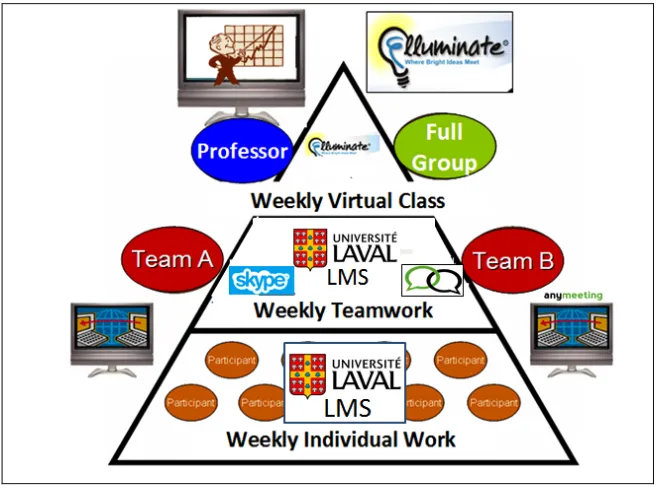
As described in the first section of this article, the webinar is the online equivalent of a typical graduate seminar which, in a nutshell, brings faculty and students together to discuss and critique discipline-based content. The BOLD webinar is thus based on three essential kinds of learning activities: individual, team and group. The first two occur prior to the weekly webinar, the third occurs during the webinar (See Figure 1).
Table 1.
Item typology and criteria
TEAMWORK: Also prior to the weekly webinar, students, usually in teams of two, discuss their individual items and then produce two or three team items (for instance, unresolved, rewritten individual items) which are then also posted online 48 hours prior to the webinar. With regard to communications among team members, students are free to use whichever technology or combination of technologies they deem most useful in completing their assignment. Some teams reportedly use the online forum and the
telephone whereas others use a combination of Skype or Facetime and Google Docs.
Figure 1. The BOLD activities-based webinar
based on time-of-posting in the forum, that is, the first team having posted their items critiques the second team’s items, etc. until the last team posting their items is required to critique the first team’s items.
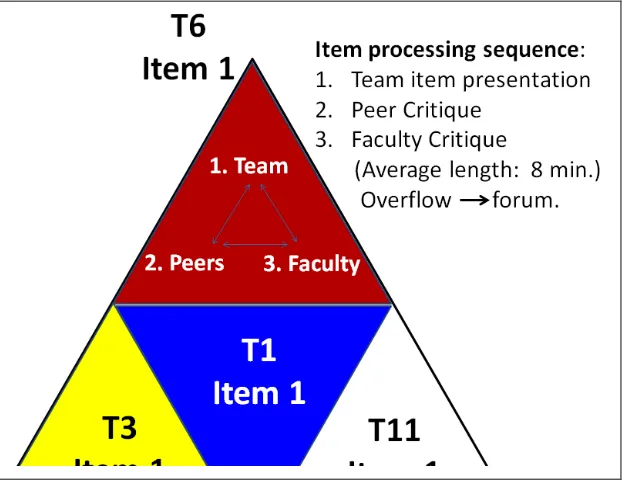
Figure 2. A micro-view of in-webinar team item processing
In the scenario in Figure 2, Team 6’s item 1 is brought up on the shared screen and the team spokesperson briefly explains its relevance (1). Then the assigned peer review team spokesperson critiques/enhances said item. Completing the sequence, the faculty member then adds to what has been said, perhaps clarifying certain aspects, explaining finer nuances and/or providing resources for further reading, as one would do in a classroom-based seminar. Time must be managed carefully so as to be able to cover all team items within the three-hour webinar (less a twenty-minute break in the middle). For items that are either particularly difficult or beyond the scope of the seminar, a useful technique is to invite the team raising the item to “take it online” to the discussion forum where they may expand on it at will. This avoids lengthy in-webinar discussions which may or may not be of interest to all students. Students generally see this method of item processing as appropriate to their needs in that all of their items are dealt with in class. Moreover, it keeps the webinar moving forward at a predictable rate and, more importantly, at a dynamic pace, students having to stay alert to address their team’s items as they come up on the screen. For faculty, proceeding in this manner allows them to leverage existing group
discussion skills rather than spending hours in an online forum, typing answers to questions and generally attempting to create some modicum of order from imminent chaos.
In reference to the importance of leveraging existing faculty strengths rather than attempting to “train” faculty in new skills acquisition, St-Jacques (2012) has identified several associated design and delivery solutions for facilitating a synchronous virtual seminar. Design solutions include clearly explaining to students what a vibrant, synchronous-based, online community is because students often associate online learning with its asynchronous form only and therefore may lack a frame of reference for it. Other facilitating tactics include opening the weekly class with a social component, catering to students’ “virtual vital space” by keeping numbers small (as any quality seminar should be), implementing the required technology to give students a voice, as well as collectively creating new content through items
Satisfaction Levels
Below is an overview of satisfaction levels with regard to key BOLD webinar indicators (accessibility, quality and cost-effectiveness) (Power, 2011) as provided by students (obtained through students’ post-course evaluations) and by faculty and administrators (obtained during semi-structured interviews) conducted between 2007 and 2013. It must be stressed that, given that this is a concept paper, no attempt at exhaustive results reporting has been undertaken. The purpose of the section below is simply to provide an overview of general satisfaction levels as experienced by the main stakeholders.
The quality of the BOLD webinar
STUDENTS: In general, students reported experiencing the same quality of instruction in webinars as in on-campus seminars, i.e. direct and regular weekly contact with a faculty member being the main source of satisfaction. Numerous students also said they benefited from faculty members’ spontaneous,
immediate and personalized feedback during webinars. Moreover, students living off-campus, sometimes being hundreds, if not thousands, of miles away from campus, saw BOLD webinars as the opportunity to actively and effectively network professionally by interacting in real-time with peers and professors, as opposed to the more solitary experience of online courses (i.e. asynchronous and largely forum-based courses). A small number of students who reported having previously taken multi-access courses (Irvine, Code & Richards, 2013) reported feeling neglected by faculty who were seemed more focused on their on-campus students. Multi-access appears to equate with unequal access with a resulting unequally distributed opportunity for learning among students.
FACULTY: For regular faculty used to campus-bound seminars, the BOLD webinar allowed them to effectively apply their own pedagogy rather than an online, industrial model-inspired one. They reported that time (being together at the same time), and not space, was the defining characteristic of a quality seminar/webinar and that the technology now available allowed them continuity in their pedagogical practice. Most of them also reported lower levels of front-end course design in that they generally didn’t spend any more time preparing for a webinar than they would have for an on-campus seminar.
Furthermore, among those who had already build online courses, there were reports of a large decrease in workload. They said that BOLD courses were more empowering than forum courses, that they allowed them to address student concerns on the spot and that they were less of an “assault on academic freedom” than were online courses (an excerpt from an interview of one respondent (9XF2) who was quite adamant that classical, asynchronous online learning required changes to his pedagogy which were unacceptable). This latter remark came from an academic who had ceased his involvement in online courses, considering them “boring” and “hell”. Other faculty reported that teaching in synchronous mode considerably removed the intellectual property (IP) issue, often a sticking-point between faculty and administration in that recordings were for the use of enrolled students and during the course only and were usually erased a month after the end of the course.
ADMINISTRATORS: By and large, administrators tended not to comment much on quality, other than to say that they had received anecdotal evidence from students and faculty seeming to be very satisfied with the quality of BOLD courses. This feedback contrasted with their receiving complaints from students on the quality of student support in online courses.
Accessibility of the BOLD webinar
STUDENTS: They were virtually unanimous in saying that course accessibility is higher when taking a BOLD webinar as compared with on-campus courses and blended learning courses. Geographic accessibility appeared to be foremost in their minds, in that students reported being suddenly able to enroll in otherwise inaccessible courses/programs and that, by being able to do so, “new career
Enhanced accessibility for disabled students was also reported as a source of satisfaction in that a number of home-bound students said they could finally fully participate in a university graduate program on an equal footing with other students, not feeling singled out or different in any way.
FACULTY and ACCESSIBILITY: For regular faculty used to campus-bound seminars, the BOLD webinar represented a new type of accessibility, i.e. access to a new teaching space. Some, having already experienced and rejected the limitations of online courses, spoke of acceding to a more natural kind of access to students by means of an intuitive and user-friendly, synchronous-based teaching environment. Another form of access mentioned was that of accessibility to new students, faculty realizing that they were suddenly in touch with a more diversified student body since any program-qualifying student from anywhere could enroll in their seminars-cum-webinars. Moreover, some faculty excitedly reported that, no longer being spatially-bound, they are able to go to class from wherever they were, thus discovering a new level of freedom of access.
ADMINISTRATORS: Administrators who were used to deploying anytime-anywhere online courses reported initially having misgivings about whether or not students would accept to enroll in an online course with scheduled and compulsory virtual classes. As it turned out, administrators reported sustainable levels of enrolment and high student satisfaction levels with BOLD-course deployment as compared with graduate-level online course deployment. Their interpretation of these results, admittedly often based on fragmentary, sporadic and informal feedback, was that students seemed to enjoy regularly-scheduled, live sessions with peers and faculty more than the more solitary and isolating individualized study available through online courses. Another apparent advantage in favor of BOLD courses seemed to be that, since these course were 100% online, they did not require any on-campus presence with everything that such entails (scheduling, limited travelling opportunities, transportation and parking), unlike blended courses. Hence, key elements of cost are avoided or transferred in such
situations. In other comments on accessibility, administrators focussed on new recruitment possibilities and on sustaining enrolments in some programs which had limited local appeal. By taking a program entirely online, the status of some programs was said to be elevated in that students could vie with each other to enter them whereas in other, perhaps more niche, programs, sustainability was simply achieved by casting the net further (i.e. wider outreach).
The cost-effectiveness of the BOLD webinar
STUDENTS: This did not appear to be a major issue for students in that tuition fees are generally the same for them whether they enroll in on-campus courses, online courses, blended courses or BOLD courses (in the country where this study was conducted). Students used to studying on campus did report that BOLD seminars save them time and money. In particular, they avoided the cost associated with travelling to campus.
FACULTY: With regard to cost-effectiveness, faculty did not express any deep-felt opinions, presumably because it was not an issue for them. Being for the most part tenured, regular faculty, they really only heard about such issues at department meetings or when one of their courses was cancelled due to a lack of enrolments. Those who did comment on this emphasized effectiveness over cost. A majority of faculty reported on the robustness of the virtual class environment, of there being no glitches, describing it as being very reliable and efficient. Others stated that, being able to deliver their seminar straight from their office or home or even hotel room and not having to go to a designated room on campus was a more efficient way of delivering a course. Some also mentioned the benefit of avoiding overcrowding on campus and having to teach in windowless basement classrooms (which a few mentioned finding
depressing). Several respondents mentioned the luxury of simply clicking on a link and being ushered into an electronic meeting system as being space-age, convenient and a no-brainer.
investment in course production). For instance, the additional cost of adding a student to a webinar was estimated, by one administrator, to be approximately $3 (CAD) per student, per term. The webinar also reportedly freed up valuable classroom space for undergraduate courses by leveraging existing student-owned computer equipment and connectivity (which produces cost avoidance for the university).
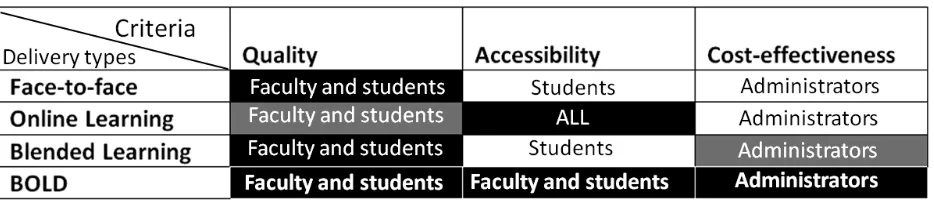
To sum up, Table 2 provides a comparative summary of both satisfaction and dissatisfaction levels with the main course delivery systems (F2F, OL, BL and BOLD) in light of the three above-mentioned criteria (quality, accessibility and cost-effectiveness) as reported by the three target populations (students, faculty and administrators). Boxes in black refer to high-level satisfaction; boxes in grey to mid-level satisfaction and boxes in white to low-level satisfaction as reported by target populations.
Table 2.
Criteria for population satisfaction with regard to various delivery systems
This table highlights the following strengths and weaknesses of each delivery system:
- F2F has high satisfaction levels among students and faculty for generally high quality instruction but low satisfaction levels among students due to low accessibility, given the on-campus requirement. As well, it has low satisfaction levels among administrators given its high per capita cost (i.e. low cost-effectiveness, compared with other delivery systems).
- OL has high satisfaction levels among students for its greater accessibility but only average satisfaction levels apparently due to doubts over quality and learner isolation, resulting in comparably higher
withdrawal and drop-out rates. Moreover, high-level upfront design costs make for relatively low satisfaction levels among administrators, who are most concerned with cost-effectiveness.
- BL, thought to be a panacea for universities in the early 2000s, suffers from extremely low satisfaction levels among students with regard to accessibility. Indeed, BL excludes the true distant (i.e. off-campus) learner who is unable to attend on-campus sessions yet regular students and faculty reported high satisfaction levels with regard to quality and administrators with cost-effectiveness (as campus capacity can often be doubled).
- BOLD. Based on existing data, which admittedly is far from reaching saturation, BOLD is the only system that achieves high satisfaction levels for all three criteria among all three populations. Satisfaction levels among students and faculty are highest for BOLD among all systems with regard to quality in that the synchronous component, recreating the F2F nature of the didactic relationship between faculty and students, combining with the asynchronous component make for a more complete learning experience (as opposed to asynchronous only OL). Students also report higher satisfaction levels with accessibility for BOLD than they do in other systems; apparently because courses are entirely online (as opposed to F2F and BL). Finally, administrators report higher satisfaction for cost-effectiveness with BOLD than with F2F, BL and even OL, because BOLD avoids costly and low access F2F and BL teaching. Moreover, by leveraging existing faculty strengths (given the 3-level approach), BOLD reduces the need for costly front-end design (OL) while increasing faculty satisfaction levels.
Conclusion
This paper has presented the BOLD webinar, its origins, main characteristics, organisational components and general field-based results. It has focussed on key indicators of system sustainability including accessibility, quality and cost-effectiveness. Although this is an active and ongoing field of study,
existing educational technology, opens up new vistas of accessibility at the graduate study level, achieves a higher level of quality in course delivery and, ultimately, produces a better model for cost-effectiveness than competing course design and delivery models. Taken together, the arguments made here are in favor of an emerging model of heightened sustainability for graduate studies, be they offered on a local, regional, national or international scale.
References
Akyol, Z., Garrison, D. R., & Ozden, M. Y. (2009). Development of a community of inquiry in online and blended learning contexts. Procedia Social and Behavioral Sciences, 1, 1834-1838.
Akyol, Z., & Garrison, D. R. (2011). Understanding cognitive presence in an online and blended community of inquiry: Assessing outcomes and processes for deep approaches to learning. British Journal of Educational Technology, 42(2), 233-250.
Allen, I. & Seaman, J. (2014). Grade Change: Tracking Online Learning in the United States. Wellesley, MA: Babson College/Sloan Foundation. http://onlinelearningconsortium.org/survey_report/2013-survey-online-learning-report/
Anderson, T., Rourke, L., Garrison, D. R., & Archer, W. (2001). Assessing teaching presence in a computer conferencing environment. Journal of Asynchronous Learning Networks, 5(2).
Angelino, L. M., Williams, F. K., & Natvig, D. (2007). Strategies to engage online students and reduce attrition rates. The Journal of Educators Online, 4(2), 1-14.
Bangert, A. W. (2010). Building a validity argument for the community of inquiry survey instrument. The Internet and Higher Education, 12, 104-111.
Barr, R. B., & Tagg, J. (1995). From teaching to learning: A new paradigm for undergraduate education, Change, 27(6), 13-25.
Benbunan-Fich, R., Hiltz, S. R., & Harasim, L. (2005). The online interaction learning model: An integrated theoretical framework for learning networks. In S. R. Hiltz and R. Goldman, Learning together online. Mhwah, NJ: Lawrence Erlbaum Associates.
Bower, B.L. (2001). Distance education: Facing the faculty challenge. The Online Journal of Distance Learning Administration. IV (II). Retrieved from
http://www.westga.edu/~distance/ojdla/summer42/bower42.html
Bower, M., Dalgarno, B., Kennedy. G., Lee, M. J. W. & Kinney, J. (2014). Blended Synchronous Learning: A Handbook for Educators. Office for Learning and Teaching. Sydney, AU: Department of Education.
https://blendsync.org/handbook
Brown, J. S., & Duguid, P. (2000). The Social Life of Information. Boston: Harvard Business School Press.
Buraphadeja, V., & Dawson, K. (2008). Content Analysis in Computer-Mediated Communication: Analyzing Models for Assessing Critical Thinking through the Lens of Social Constructivism. The American Journal of Distance Education, 22(3), 130-145.
Chapman, B. (2010). How long does it take to create learning? Retrieved from
http://www.chapmanalliance.com/howlong/
Chen, N.-S., Ko, H.-C., Kinshuk, & Lin, T. (2005). A model for synchronous learning using the Internet. Innovations in Education and Teaching International, 42(2), 181-194.
Chou, C.C. (1999). From Simple Chat to Virtual Reality: Formative Evaluation of Synchronous
Communication Systems for Online Learning. In Proceedings of WebNet World Conference on the WWW and Internet 1999 (pp. 225-230). Chesapeake, VA: AACE.
Cogburn, D. L., & Levinson, N. (2003). U.S.-Africa virtual collaboration in globalization studies: Success factors for complex, cross-national learning teams. International Studies Perspectives, 4, 34-51. Disbrow, L. M. (2008). The overall effect of online audio conferencing in communication courses: What do
students really think? MERLOT Journal of Online Learning and Teaching, 4(2). Retrieved from
http://jolt.merlot.org/vol4no2/disbrow0608.htm
Eble, K. E. (1988). The craft of teaching – A guide to mastering the professor’s art. San Francisco and London: Jossey-Bass Publishers.
Eisenberg, A. F. (1999). Forms of Socialization: Graduate education and the graduate seminar. Response to “Rethinking the graduate seminar”. Teaching Sociology, 27(2), 187-191.
Ellis, J. & Romano, D. (2008). Synchronous and asynchronous online delivery: How much interaction in e-learning is enough in higher education? In G. Richards (Ed.), Proceedings of World Conference on E-Learning in Corporate, Government, Healthcare, and Higher Education (2615-2620), Chesapeake, VA: AACE.
Feenberg, A. (2001). Whither Educational Technology? International Journal of Technology and Design Education, (11) 83-91.
Fejes, A., Johansson, K., & Abrandt Dahlgren, M. (2005). Learning to play the seminar game: Students’ initial encounters with a basic working form in higher education. Teaching in Higher Education, (10)1, 29-41.
Finkelstein, J. (2006). Learning in real time: Synchronous teaching and learning online. San Francisco, CA: Jossey-Bass Publishers.
Garrison, D. R. (2006). Online collaboration principles. Journal of Asynchronous Learning Networks, 10(1), 25-34.
Garrison, D. R. (2009). Implications of online and blended learning for the conceptual development and practice of distance education. The Journal of Distance Education, 23(2). Retrieved from
http://www.ijede.ca/index.php/jde/article/view/471
Garrison, D. R., Anderson, R. T., & Archer, W. (2000). Critical inquiry in a text-based environment: Computer conferencing in higher education. The Internet and Higher Education. 2(2-3), 87-105.
Garrison, D. R., & Arbaugh, J.B. (2007). Researching the community of inquiry framework: Review, issues, and future directions. The Internet and Higher Education, 10(3), 157-172.
Garrison, D. R., & Vaughan, N. (2008). Blended learning in higher education. San Francisco: Jossey-Bass Publishers.
Gautreau, C., Glaeser, B.C., Renold, L.C., Ahmed, S., Lee, J., Carter-Wells, J., Worden, M., Boynton, E. D. & Schools, J. (2012). Video Conferencing Guidelines for Faculty and Students in Graduate Online Courses. MERLOT Journal of Online Learning and Teaching, 8(4). Retrieved from
http://jolt.merlot.org/vol8no4/gautreau_1212.htm
Goodyear, P. & Zenios, M. (2008) Discussion, collaborative knowledge work and epistemic fluency. British Journal of Educational Studies. 55(4), 351-368.
Hubball, H., & Poole, G. (2003). Learning-centred education to meet the diverse needs and
circumstances of university faculty through an eight-month programme on teaching and learning in higher education. International Journal for Academic Development, 8(1-2), 11-24.
Irvine, V., Code, J. & Richards, L. (2013). Realigning Higher Education for the 21st-Century Learner through Multi-Access Learning. Journal of Online Learning and Teaching, 9(2). Retrieved from
http://jolt.merlot.org/vol9no2/irvine_0613.htm
Jaques, D. (2000). Learning in groups. London: Kogan Page Ltd.
Johnson, D. W. (1981). Student-student interaction: The neglected variable in education. Educational Research, 10, 5-10.
Jonassen, D., Howland, J., Marra, R. M., & Crismond, D. (2008). Meaningful learning with technology (3rd ed.), Upper Saddle River: Pearson Education Inc.
Jordan, K. (2013). MOOC Completion Rates: The Data. Retrieved from
http://www.katyjordan.com/MOOCproject.html
Karimi, R. (2011). Interface between problem-based learning and a learner-centered paradigm. Advances in Medical Education and Practice, 2, 117-125.
Kizilcec, R.F., Piech, C. & Schneider, E. (2013). Deconstructing disengagement: Analyzing learner subpopulations in Massive Open Online Courses. Paper presented at LAK13. Leuven, Belgium. Lang, S. (2005). Replicating and Extending Dialogic Aspects of the Graduate Seminar in Distance
Education. In Cargile Cook, K. and Grant-Davie, K., Online Education, Amityville, New York: Baywood Publishing Company Inc.
Larramendy-Joerns, & J., Leinhardt, G. (2006). Going the distance with online education. Review of Educational Research, 76 (4), 567-605.
Liu, X., Magjuka, R., Bonk, C., & Lee, S. (2007). Does sense of community matter? Quarterly Review of Distance Education, 8 (1), 9-24.
Lo, H.-C. (2009). Utilizing Computer-mediated Communication Tools for Problem-based Learning. Educational Technology & Society, 12 (1), 205–213.
Lopez, P., & Gallifa, J. (2008). Improving cognitive complexity via seminar methodology in higher education. Higher Education in Europe, 33 (4).
Ma, W., (2008). Participatory dialogue and participatory learning in a discussion-based graduate seminar. Journal of Literacy Research, 40(2), 220-249.
Martin, F. & Parker, M. A. (2014). Use of Synchronous Virtual Classrooms: Why, Who, and How? Journal of Online Learning & Teaching (10) 2. http://jolt.merlot.org/vol10no2/martin_0614.pdf
Maurer, S. B. (1999). The role of the area seminar in graduate education. Response to “Rethinking the graduate seminar”. Teaching Sociology, 27, 174-179.
Meyers, S. A. (2008). Using transformative pedagogy when teaching online. College Teaching, 56(4), 219-224.
Morven-Gould, A. & Power, M. (2015). Leaving the Cocoon: university course design and delivery vis-a-vis competitive strategy. On the Horizon, Volume 23, Issue 1, Emerald Insight.
http://www.emeraldinsight.com/doi/pdfplus/10.1108/OTH-10-2014-0034
Oberst, U., Gallifa, J., Farriols, N., & Villaregut, A. (2009). Training emotional and social competences in higher education: The Seminar methodology. Higher Education in Europe, 34, 3-4.
O’Brien, J.G., Millis, B.J. & Cohen, M.W. (2008). The Course Syllabus: A Learning-Centered Approach, 2nd Ed. New York, NY: Wiley.
O’Neill, G., & McMahon, T. (2005) Student centred learning: What does it mean for students and lecturers? Emerging issues in the practice of university learning and teaching. Dublin: All Ireland Society for Higher Education (AISHE). Retrieved from http://www.aishe.org/readings/2005-1/oneill-mcmahon-Tues_19th_Oct_SCL.html
Owen, C. M. (1970). The seminar. Improving College and University Teaching, 18, 203-205.
Pennington, J. P. (2005). Reverse benefits: How teaching online benefits face-to-face teaching for higher education faculty. Unpublished doctoral dissertation, University of Cincinnati, Cincinnati, Ohio. Perry, W. (1972). The early development of the Open University: report of the Vice-Chancellor, January
Phillips, H. J., Powers, R. B. (1979). The college seminar: Participation under instructor-led and student-led discussion groups. Teaching of Psychology, 6 (2).
Power, M. (1998). Proposition d’un modèle de design pédagogique spécifique à l’enseignement à distance dans les universités bimodales, Actes du 2e Congrès international de l’AFIRSE, Université de Lisbonne, Portugal, pp. 113-21.
Power, M. (2002). Générations d'enseignement à distance, technologies éducatives et médiatisation de l'enseignement supérieur. Revue de l'éducation à distance/Journal of Distance Education. 17(2), 57-69.
Power, M. (2005). Le design pédagogique dans un contexte de bimodalisation de l'enseignement supérieur : une étude multicas. Unpublished doctoral thesis, Université Laval, Québec, Québec. Power, M. (2007) From distance education to e-learning: A multiple case study on instructional design
problems. E-Learning, 4(1), 64-78.
Power, M. (2008). The emergence of blended online learning. MERLOTJournal of Online Teaching & Learning, 4(4). http://jolt.merlot.org/vol4no4/power_1208.htm
Power, M. (2008). A dual-mode university instructional design model for academic development. International Journal for Academic Development. 13 (1) 5 – 16:
http://dx.doi.org/10.1080/13601440701860185
Power, M. (2009). A designer’s log: Case studies in instructional design, Calgary: Athabasca University Press. http://www.aupress.ca/index.php/books/120161
Power, M., Vaughan, N. (2010). Redesigning online learning for graduate seminar delivery. Journal of Distance Education, 24(2). http://www.ijede.ca/index.php/jde/article/view/649
Power, M., Gould-Morven, A. (2011). Head of gold, feet of clay: The online learning paradox, International Review of Research in Open and Distance Learning, 12(2).
http://www.irrodl.org/index.php/irrodl/article/view/916/1739
Power, M. (2013). Designing an Online Graduate Seminar. In P. Ertmer, J. Quinn & K. Glazewski. The ID CaseBook: Case studies in instructional design (4th Ed.). Upper Saddle River, NJ: Prentice Hall. Power, M. (2014). Comment recréer l’ambiance propre au séminaire dans un cours en ligne? In Potvin,
C., Power, M. & Ronchi, A. La formation en ligne, conseillers et ingénieurs pédagogiques : vingt études de cas. Québec, QC: Presses de l’Université Laval.
Potvin, C., Power, M. & Ronchi, A. (2014). Formation en ligne et conseillers et ingénieurs pédagogiques : 20 études de cas. Québec , QC: Presses de l’Université Laval.
Rahman, H. (2009). Collaborative learning: An effective Tool to Empower Communities. International Journal of Information Communication Technologies and Human Development, 1(2).
Rockinson-Szapkiw, A. G. (2009). The impact of asynchronous and synchronous instruction and discussion on cognitive presence, social presence, teaching presence and learning. Unpublished doctoral thesis, Regent University, Virginia Beach, Virginia.
Rudduck, J. (1978). Learning through small group discussion. Guilford, Surrey: Society for Research into Higher Education.
Safko, L. (2012). The social media bible: Tactics, tools, and strategies for business success. Hoboken, NJ: John Wiley & Sons Inc.
Saint-Jacques, A. (2012). Pédagogie efficiente vers l'implantation d'une communauté d'apprentissage dans un séminaire d'études supérieures virtuel en mode synchrone: une analyse de cas. Unpublished doctoral thesis, Université Laval, Quebec.
Shea, P., Pickett, A & Li, C.S. (2005). Increasing access to Higher Education: A study of the diffusion of online teaching among 913 college faculty. International Review of Research in Open and Distance Learning, 6 (2). Retrieved from http://www.irrodl.org/index.php/irrodl/article/view/238/493
Skinner, A. F. (1979). Teacher’s heritage – An Introduction to the study of education, Toronto: Guidance Centre, Faculty of Education, University of Toronto.
Slavin, R. E. (1980). Effects of individual learning expectations on student achievement. Journal of Educational Psychology, 72, 520-524.
Slagter van Tryon, P. J., & Bishop, J. M. (2006). Identifying e-mmediacy strategies for Web-based instruction. Quarterly Review of Distance Education, 7(1), 49-62.
Sonmez, D., & Lee, H. (2003). Problem-based learning in science. Columbus OH: Eric Clearinghouse for Science Mathematics and Environmental Education. Retrieved from
http://www.vtaide.com/png/ERIC/PBL-in-Science.htm
Steen, S., Bader, C., & Kubrin, C. (1999). Rethinking the graduate seminar. Teaching Sociology,27(2), 167-193.
Stephens, K. K., & Mottet, T. P. (2008). Interactivity in a Webconference training context: Effects on trainers and trainees, Communication Education, 57(1), 88-104.
Stewart, S. (2008). A study of instructional strategies that promote learning centered synchronous dialogue online. Unpublished doctoral thesis, University of South Florida, Florida.
Strijbos, J.W., & De Laat, M. F. (2010). Developing the role concept for computer-supported collaborative learning: An explorative synthesis. Computers in Human Behavior, 26(4), pp. 495-505.
Swan, K. & Shea, P. (2005). The development of virtual learning communities. In. S. R. Hiltz & R. Goldman, Asynchronous Learning Networks: The Research Frontier. New York: Hampton Press, pp. 239-260.
Swann, J. (2010). A dialogic approach to online facilitation. Australasian Journal of Educational Technology, 26(1), pp. 50-62.
Tolu, A. T. (2010). An exploration of synchronous communication in an online preservice ESOL course: Community of inquiry perspective. Unpublished doctoral thesis, University of South Florida, Floride.
Tournier, M. (1981).Typologie des formules pédagogiques. Montréal: Collège de Maisonneuve, Direction générale de l'enseignement collégial.
Vaughan, N. D., & Garrison, R. D. (2006). A blended faculty community of inquiry: Linking leadership, course redesign, and evaluation. Canadian Journal of University Continuing Education, 32(2), 67-92. Viechnicki, G. B. (1997). An empirical analysis of participant intentions: Discourse in a graduate seminar.
Language & Communication, 17(2).
Wang, S. K., & Hsu, H. (2008). Use of the webinar tool (Elluminate) to support training: The effects of webinar-learning implementation from student-trainers’ perspective. Journal of Interactive Online Learning, 7(3), 175-194.
Watt, I. (1964). The seminar. Universities Quarterly, 18(4), 369-389.
Zhao, F., Bentley, T., Reames, E., Reeds, C. (2002). Theory, research and practice: Bridging the gap in a doctoral candidate seminar, Auburn University, AL. Retrieved from
http://www.eric.ed.gov/PDFS/ED470842.pdf
This work is published under a Creative Commons Attribution-Non-Commercial-Share-Alike License