Vol. 11, No. 3, 2019 Article ID IJIM-0801, 12 pages Research Article
Effects of Technical and Organizational Activities on Redundancy
Allocation Problem with Selecting Redundancy Strategies Using
Memetic Algorithm
M. Sharifi ∗†, MR. Shahriari ‡, A. Zaretalab §
Received Date: 2016-12-19 Revised Date: 2018-02-12 Accepted Date: 2019-02-07
————————————————————————————————–
Abstract
Redundancy allocation problem is one of the most important problems in reliability area. This problem involves the suitable redundancy levels under certain strategies to maximize system reliability under some constraints. However, it has undergone many changes to come closer to the real situations. Selecting the redundancy strategy and using different system configuration are some of these changes. In this paper, we studied the effects of technical and organizational activities on this problem and showed the difference between the system reliability with and without using these activities. Also, we worked on a system containing s subsystems connected serially. Each subsystem containsni, i= 1,2, . . . , sparallel components that can be selected frommi , i= 1,2, . . . , sdifferent component types and all subsystem components must be identical. Because redundancy allocation problem belongs to Np. Hard problems, we used a new metaheuristic algorithm called memetic competition algorithm for solving the presented problem and compared the results of this algorithm with other solving methods.
Keywords: Reliability; Redundancy allocation problem; Memetic algorithm; Technical and Organiza-tional activities.
—————————————————————————————————–
1
Introduction
I
ning s subsystems which are serially connected.this paper, we investigated a system contain-Each subsystem containsni , i= 1,2, . . . , sparal-lel components that can be selected frommi , i=
∗Corresponding author. [email protected], Tel: +98(912)2825776.
†Department of Industrial & Mechanical Engineering, Qazvin Branch, Islamic Azad University, Qazvin, Iran.
‡Department of Management & Accounting, South Tehran Branch, Islamic Azad University, Tehran, Iran.
§Department of Industrial Engineering, Amir Kabir University of Technology, Tehran, Iran.
1,2, . . . , sdifferent component types and all sub-system components must be identical.
In 1968, Fyffe et al. [5] presented the mathe-matical model of RAP (Redundancy Allocation Problem) with active strategy. The presented model aimed to maximize system reliability un-der cost and weight constraints and solved their model using dynamic programing. Nakagawa and Miyazaki [10] presented a nonlinear programing of reliability optimization with solving method. In fact they made some changes on Fyffe problem and solved the model with surrogate constraints algorithm. They showed that this model was more effective than dynamic programing. Coit [3]
presented a solving method based on linear pro-graming for an RAP with cold-standby strategy in 2001 and then Ramirez-Marquez and Coit [11] presented a heuristic algorithm for RAP. Tian et al. [15] presented a model based on physical pro-gramming and genetic algorithms and Ramirez-Marquez et al. [12] used max-min approach for a series-parallel RAP. In all presented studies, two issues are obvious. First in all mentioned works, the redundancy strategies of subsystems are pre-defined. Tillman et al. [16] reviewed 144 pa-pers in this area and only 14 papa-pers worked on cold-standby strategy. Considering redundancy strategy as system variable is one way to draw RAP nearer to real situations that Coit [4] car-ried out. The second issue is that redundancy allocation is considered as the only way to in-crease system reliability. Tian et al. [14] pre-sented a new approach for optimizing system reli-ability. Their approach was based on redundancy optimization and effective on performance rates of system components. They also presented a common reliability-redundancy optimization. In this paper, we considered four bases for reliability optimization problem; the number of redundant components in each subsystem, type of redundant components in each subsystem, redundancy strat-egy of each subsystem, and technical and organi-zational activities. The last base affects failure rate of a single component or all components of a subsystem. Chern [1] proved that RAP belongs to Np. Hard problems and after that many re-searchers used metaheuristic algorithms for solv-ing this problem. Coit and Smith [2] used genetic algorithm for solving a series-parallel RAP. Gen and Kim [6] used a GA-based hybrid algorithm. Kulturel-Konak et al. [7] used Tabu search al-gorithm. Liang and Smith [8] used ant colony algorithm and Liang and Chen [9] used variable neighborhood search algorithm for solving RAP. In this paper, we used MA (Memetic Algorithm) for solving an RAP. The paper is divided into five sections. The second part defines the prob-lem. Third section deals with solving method and in fourth part, we present a numerical example. The last section is conclusion and further studies.
2
Problem definition
2.1 Nomenclature
The parameters that we used in this paper are:
s: Number of subsystems,
ni: Number of components in subsystemsi,
nM ax,i : Upper bound of allocated
compo-nent in subsystem i,
mi: Number of available components in
subsys-tem i,
zi: Selected component index in subsystem i,
zi∈(1,2, . . . , mi),
Z : Set of zi,Z = (z1, z2, . . . , zs),
t: Operation time,
R(t, z, n) : System reliability at the time t for design vectorz and n,
˜
R(t, z, n) : An estimate for R(t, z, n) :,
ri j(t) : Reliability of jth component type in
subsystem iat the timet,
λi j: Shape parameter of Gama p.d.f,
ki j: Scale parameter of Gama p.d.f,
C: Maximum acceptable cost of the system,
W : Maximum acceptable weight of the system,
ci j: Cost of j th component in subsystem i,
wi j: Weight ofj th component in subsystemi,
ρi (t) : Continuous detect switch in
subsys-tem iat the timet,
ρi : Failure detect switch in subsystemi,
tkhi j : Binary variables related to technical
activities of jsty component in subsystemi,
tki : Binary variables related to organizational
ac-tivities of components in subsystem i,
ckhi j : Cost of technical activities ofjsty component
cki : Cost of organizational activities of
com-ponents in subsystemi,
σi(t, j) =
1 ; P erf ect switch ρi(t) ; Switch reliability at
time t
ρji−1 ; Switch active when a def ect causes
2.2 Basic mathematical model
The mathematical model presented by Coit [4] is as follows:
max : R(t, z, n) s.t :
s ∑ i=1
cizini ≤C,
s
i=1wizini ≤W
ni ∈(1,2, . . . , nmax,i)
zi ∈(1,2, . . . , mi)
(2.1)
The system reliability in objective function of equation 2.1 depends on switch type and calcu-lated using equations2.2 (for continuous detect-ing switch SP1) and (for failure reacted switch SP2).
R(t, z, n) =∏
i∈A {
1−(1−ri,zi(t)) ni
}
× ∏
i=N
ri,zi(t)×
∏
i∈S {
ri,zi(t)
+
n∑i−1
j=1 t ∫
0
ρi(u)fi,z(j)i(u)ri,zi(t−u)du
}
(2.2)
R(t, z, n) =∏
i∈A
{1−(1−ri,zi(t)) ni}
× ∏
i=N
ri,zi(t)×
∏
i∈S {
ri,zi(t)
+
n∑i−1
j=1
ρji
t ∫
0
fi,z(j)i(u)ri,zi(t−u)du
}
(2.3)
In equations 2.2 and 2.3, fi,zj
i(t) is the sum of
j time failure of zi th component in subsystemi.
Parameter A defines the set of subsystems with active redundancy strategy, parameter S refers to the set of subsystems with cold-standby redun-dancy strategy and N refers to the set of a sub-system with only one component (No redundancy
strategy). Coit approximated the system reliabil-ity as follows:
R(t, z, n) =∏
i∈A
{1−(1−ri,zi(t)) ni}
× ∏
i=N
ri,zi(t)×
∏
i∈S {
ri,zi(t) +σi(t, ni)
×exp (−λi,zit)
ki,zi∑ni−1
l=ki,zi
(λi,zit) l
l!
}
(2.4)
ri,zi(t) = exp (−λi,zit) ki,zi∑−1
l=0
(λi,zit) l
l! (2.5)
Example 2.1 For clarifying this system, Fyffe et al. [15] example has been solved. The presented system contains 14 subsystems and for each sub-system 3 or 4 different component types are allo-cated.
The parameter of components and k-Erlang dis-tribution can be found in Fyffe et al. study [15]. The object is to maximize system reliability in 100 hours working time. The upper limits of sys-tem cost and weight are C = 130 and W = 170. The system has a continuous detecting switch and the switch reliability in 100 hours working time is considered asP = 0.99. The maximum number of components in each subsystem is 6 and two ac-tive and cold-standby redundancy strategies are available for each sub-system. The optimal solu-tion presented for only Active strategy that pre-sented in Fyffe et al. (1968) is R= 0.9700, only cold-standby strategy that presented in Coit [10] is R = 0.9863, considering redundancy strategy as the system variable [3] isR = 0.9875 and the results that presented by Tavakoli-Moghaddam et al. [13], using a hybrid GAR= 0.9705.
2.3 Technical and organizational ac-tivities
These activities affect components performance rate and decrease their failure rate. These activ-ities are presented as follows.
2.3.1 Technical activities
of affected components. Parametertkhi j is a
bi-nary variable. If the value of this parameter is equal to 1, the technical activity will be done on component type j in subsystemi.
2.3.2 Organizational activities
This activity effects all components of the subsys-tem and its cost is fixed and does not depend on the number of affected components. Parameter tki is a binary variable. If the value of this
pa-rameter is equal to 1, the organizational activity will be done on all components in subsystem i.
We add these activities to the basic model to draw the RAP nearer to real situations.
2.4 Assumptions
• System consists of s serially connected sub-systems and the components in each subsys-tem are parallel,
• Only one type of components can be allo-cated to each subsystem,
• Redundancy strategy of each subsystem is a system variable and can be active or cold-standby,
• All components are binary, non-repairable with k-Erlang distribution,
• All system parameters are fixed and pre-defined,
• Components failures are independent,
• Technical and organizational activities effect components failure rates.
2.5 Mathematical model
The presented mathematical model is as follows:
max R(t, z, n) s.t :
s ∑ i=1
{
ni(cizi
+ckhizi.tkhizi) +cki.tki
}
≤C,
s ∑ i=1
wizi.ni≤W
λizi =λizi(1−αizi.tkhizi),
λizi =λizi(1−βi.tki)
0≤ni ≤nmax,i, zi ≥0, λij ≥0,
tkhij = 0,1, tki = 0,
1, i= 1,2, . . . , s, j= 1,2, . . . , mi
(2.6)
In Equation 2.6, parameters αi,zi and βi are the
technical and organizational activities influencing on components failure rates. These parameters are constant and their values are αi,zi = 0.3 and
βi = 0.1 for i= 1,2, . . . , s.
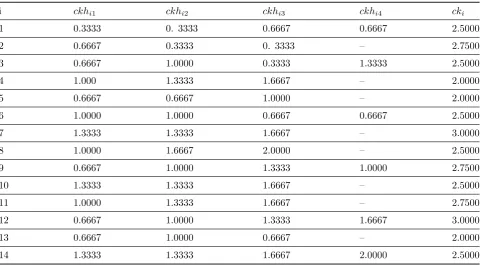
Example 2.2 In this example we add technical and organizational activities to example2.1. The cost of technical and activities are presented in Table 1. The other problem parameters are simi-lar to problem 2.1 parameters.
Memetic algorithm
One of the most popular methods in RAP is GA. Memetic Algorithm (MA) is an algorithm com-bining GA with a local search, i.e., GA + Local search=MA. The pseudo code of MA is shown in Figure 1.
Table 1: Cost of technical and organizational activities.
i ckhi1 ckhi2 ckhi3 ckhi4 cki
1 0.3333 0. 3333 0.6667 0.6667 2.5000
2 0.6667 0.3333 0. 3333 – 2.7500
3 0.6667 1.0000 0.3333 1.3333 2.5000
4 1.000 1.3333 1.6667 – 2.0000
5 0.6667 0.6667 1.0000 – 2.0000
6 1.0000 1.0000 0.6667 0.6667 2.5000
7 1.3333 1.3333 1.6667 – 3.0000
8 1.0000 1.6667 2.0000 – 2.5000
9 0.6667 1.0000 1.3333 1.0000 2.7500
10 1.3333 1.3333 1.6667 – 2.5000
11 1.0000 1.3333 1.6667 – 2.7500
12 0.6667 1.0000 1.3333 1.6667 3.0000
13 0.6667 1.0000 0.6667 – 2.0000
14 1.3333 1.3333 1.6667 2.0000 2.5000
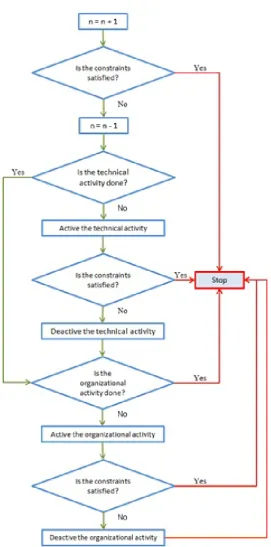
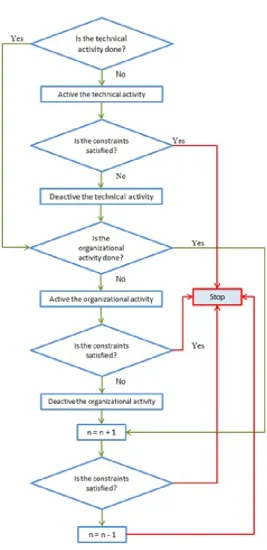
sth rank to the subsystem with the highest reli-ability. Each subsystem randomly selects an im-proved policy based on its rank. There is two dif-ferent improved policies. The flowcharts of these two policies are presented in figures 2 and 3. In this flowchart, n is the number of subsystem com-ponents.
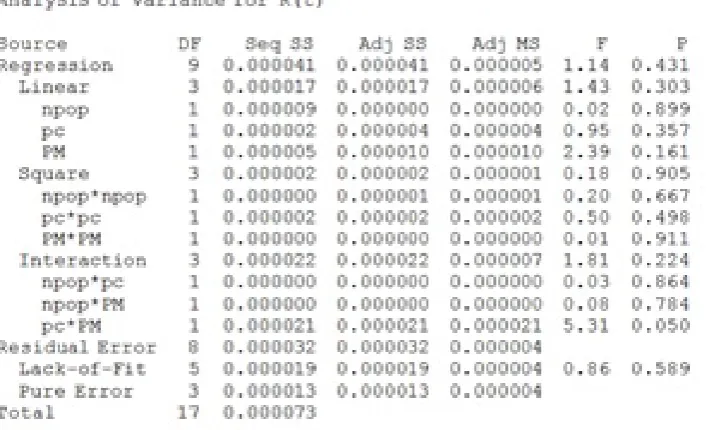
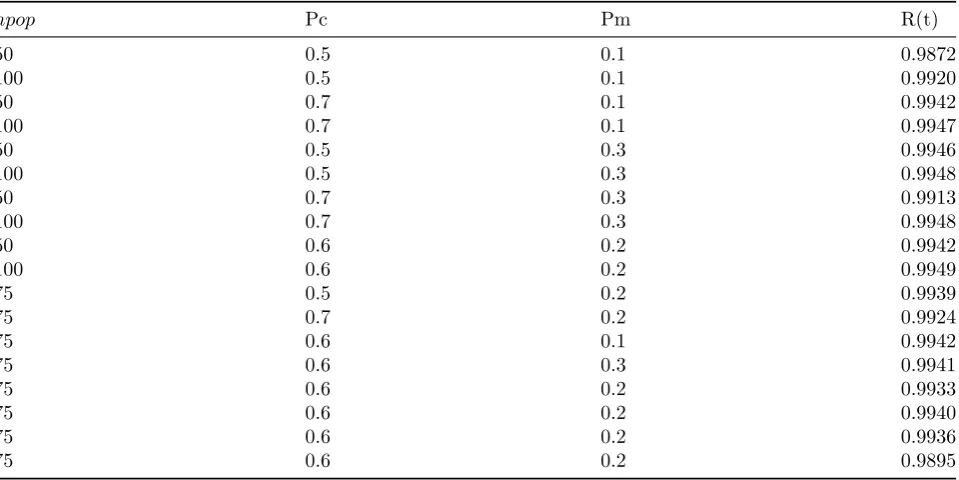
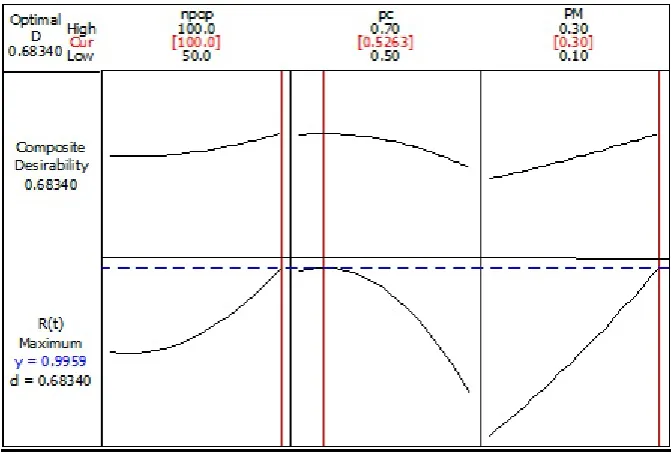
Using these two types of improved policies, the obtained solutions are equal or better that the old ones. The ranges of MA parameters are pre-sented in Table2and the results in Table3. Also the results of RSM are shown in figures 4, 5and the optimal parameters are presented in Figure 6. In this tables and figures, npop refers to the population size, PC is the crossover probability
and PM is the mutation probability.
Improved policy type 1
In this type of improved policy, the algorithm at-tempts to improve the subsystem reliability first by redundancy allocation and then by technical and organizational activities.
Improved policy type 2
In this type of improved policy, the algorithm attempts to improve the subsystem reliability first by technical and organizational activities and then by redundancy allocation.
3
Response surface
methodol-ogy
RSM1 is a set of statistical methods for
improv-ing and optimizimprov-ing processes. In this method, the response of a process is optimized by altering some input parameters. We used this method to optimize the algorithm parameters. The ICA al-gorithm has 5 parameters, so for parameter tun-ing of algorithm we need 24 = 16 corner points, 2×4 = 8 axial points, and 5 central points. Using RSM, 28 combinations of parameters are consid-ered and the stop condition of algorithm is 200 iterations. The parameter boundaries and opti-mal parameters are presented in Tables 2 and 3. Based on RSM, the optimal parameters are found asnpop= 100, pc= 0.5, nm= 0.3.
1
Figure 4: Memetic estimated regression coefficients forR(t)
Table 2: Memetic parameters range.
Lower value Upper value
npop 50 100
Pc 0.5 0.7
pm 0.1 0.3
Table 3: Optimal values of Memetic algorithm.
npop Pc Pm R(t)
50 0.5 0.1 0.9872
100 0.5 0.1 0.9920
50 0.7 0.1 0.9942
100 0.7 0.1 0.9947
50 0.5 0.3 0.9946
100 0.5 0.3 0.9948
50 0.7 0.3 0.9913
100 0.7 0.3 0.9948
50 0.6 0.2 0.9942
100 0.6 0.2 0.9949
75 0.5 0.2 0.9939
75 0.7 0.2 0.9924
75 0.6 0.1 0.9942
75 0.6 0.3 0.9941
75 0.6 0.2 0.9933
75 0.6 0.2 0.9940
75 0.6 0.2 0.9936
75 0.6 0.2 0.9895
Table 4: Memetic parameters range.
tkh
i Zi ni RS i1 i2 i3 i4 tk1
1 3 2 C 0 0 1 0 0
2 1 2 C 1 0 0 0 0
3 3 2 C 0 0 1 0 1
4 2 2 C 0 1 0 0 0
5 2 3 A 0 0 0 0 0
6 3 2 C 0 0 1 0 0
7 2 2 C 0 1 0 0 0
8 3 2 C 0 0 1 0 0
9 2 2 C 0 0 0 0 0
10 2 2 C 0 1 0 0 1
11 2 2 C 0 0 0 0 1
12 3 2 C 0 0 1 0 1
13 2 2 A 0 0 0 0 1
14 1 2 C 1 0 0 0 0
R(t) = 0.9917 w= 165 c= 129.25
4
Problem solving
Figure 6: Memetic optimal parameters
4. The optimal solution with technical and or-ganizational activities is R(100) = 0.9917 that is better than the optimal solution without using these activities.
5
Conclusion and further
stud-ies
In this paper, we showed that adding techni-cal and organizational activities increases the reliability of the system besides other technics like redundancy allocation. In other word, in a series-parallel system not only redundancy al-location can increase the system reliability, im-proving the components performance rate is a helpful way, too. In example 2.2, after adding technical and organizational activities, the op-timal solution increases from R(100) = 0.9875 toR(100) = 0.9917. For further studies, other metaheuristic algorithms can be used to get bet-ter solutions. Also these activities can be added to other models to evaluate their effects.
References
[1] M. S. Chern, On the computational complex-ity of reliabilcomplex-ity redundancy allocation in a
series system,Operations research letters 11 (1992) 309-315.
[2] D. W. Coit, A. E. Smith, Reliability op-timization of series-parallel systems using a genetic algorithm, IEEE Transactions on Reliability 45 (1996) 254-260.
[3] D. W. Coit, Cold-standby redundancy op-timization for nonrepairable systems, Iie Transactions 33 (2001) 471-478.
[4] D. W. Coit, Maximization of system relia-bility with a choice of redundancy strategies,
Iie Transactions 35 (2003) 535-543.
[5] D. E. Fyffe, W. W. Hines and N. K. Lee, System reliability allocation and a computa-tional algorithm,IEEE Transactions on Re-liability 17 (1968) 64-69.
[6] M. Gen, J. R. Kim, GA-based reliability de-sign: state-of-the-art survey, Computers & Industrial Engineering 37 (1999) 151-155.
[7] S. Kulturel-Konak, A. E. Smith, D. W. Coit, Efficiently solving the redundancy allocation problem using tabu search, Iie Transactions
[8] Y. C. Liang, A. E. Smith, An ant colony op-timization algorithm for the redundancy al-location problem (RAP),IEEE Transactions on Reliability 53 (2004) 417-423.
[9] Y.-C. Liang, Y. C. Chen, Redundancy allo-cation of series-parallel systems using a vari-able neighborhood search algorithm, Relia-bility Engineering & System Safety92 (2007) 323-331.
[10] Y. Nakagawa, S. Miyazaki, Surrogate con-straints algorithm for reliability optimization problems with two constraints,IEEE Trans-actions on Reliability 30 (1981) 175-180.
[11] J.E. Ramirez-Marquez, D. W. Coit, A heuristic for solving the redundancy alloca-tion problem for multi-state series-parallel systems, Reliability Engineering & System Safety 83 (2004) 341-349.
[12] J.E. Ramirez-Marquez, D. W. Coit, A. Konak, Redundancy allocation for series-parallel systems using a max-min approach,
Iie Transactions 36 (2004) 891-898.
[13] R. Tavakkoli-Moghaddam, J. Safari, F. Sassani, Reliability optimization of series-parallel systems with a choice of redundancy strategies using a genetic algorithm, Relia-bility Engineering & System Safety93 (2008) 550-556.
[14] Z. Tian, G. Levitin, M. J. Zuo, A joint relia-bility redundancy optimization approach for multi-state series parallel systems, Reliabil-ity Engineering & System Safety 94 (2009) 1568-1576.
[15] Z. Tian, M. J. Zuo, H. Huang, Reliability-redundancy allocation for multi-state series-parallel systems, IEEE Transactions on Re-liability 57 (2008) 303-310.
[16] F. A. Tillman, C.-L. Hwang, W. Kuo, De-termining component reliability and redun-dancy for optimum system reliability,IEEE Transactions on Reliability 26 (1977) 162-165.
Mani Sharifi was born in 1973 in Tehran, Iran. Mani is an associate professor at Qazvin Islamic Azad University (QIAU). Mani holds a B.Sc. degree from Qazvin Islamic Azad University in 1996, M.Sc. de-gree from south Tehran branch Is-lamic Azad University in 1998, and Ph.D. degree from Tehran Research and Science Islamic Azad University in industrial engineering filed in 2006. He is a member of the industrial engineering de-partment at QIAU and he was senior advisor to the president of Iran National Steel Industrial Group (INSIG) and vice-president and member of board of directors of Esteghlal Khouzestan F.C.
Mohammadreza Shahriari received his Ph.D. in Operational Research from the Islamic Azad University in 2009. He worked out more than 2 years to find out he how can present and solve a Time -Cost Trade off problem based on time value of money, considering to each crashing. He was also six years in charge of chancellor of Is-lamic Azad University in Dubai (UAE) and more than one year at the same position in Islamic Azad University in Oxford (UK). He has had another executive academic mandate, like, es-tablishing an Irani University in Germany, Italy, Russia and Oman. After almost running the abovementioned mandate, he again backed to his academic and teaching activities in the university.