Vol. 11, No. 4, 2019 Article ID IJIM-1314, 11 pages Research Article
Experimental study of The Performance and e xhaust gas emissions
Response of A Spark Ignition Engine to Adding Natural Gas to
Gasoline in CR=11
S. K. Yekani ∗, E. Abdi Aghdam †‡, F. Sadegh Moghanlo §
Received Date: 2019-01-04 Revised Date: 2019-06-29 Accepted Date: 2019-09-07
————————————————————————————————–
Abstract
The problem of polluting the internal combustion engine in the urban community’s breathing space and the scarcity of hydrocarbons has forced researchers to focus specifically on presenting solutions and plans to address this challenge. One of these solutions is to introduce a suitable alternative fuel with good capability to reduce pollutants. The idea of using mixed fuel in poor mixing mode can be useful for achieving the stated goals. In the present work of a single-cylinder CT300 research engine with adjoining laboratory equipment, the experimental results of normal combustion (without harmful knocking) at three compression ratios, three engine speeds, and three equivalence ratios at several different advances (minimum 6 advances) for the mode G100, G87.5, G75 and G62.5 were extracted (100%, 87.5%, 75% and 62.5% gasoline and the rest were natural gas, respectively). Under normal combustion conditions, at least 350 cycles were recorded and stored in each experiment. The results revealed that by increasing the amount of natural gas in the mixture, the CO pollutant reduced however the amount of HC initially increased which was followed by a decreasing trend. The amount of NOx had a direct relation with the appearance of the natural gas. In the lean-burn condition, a better performance was observed for G75 in compare with G100 and the other mixtures
Keywords: SI engine; Lean-burn; Pollutant; Dual fuel; Gas.
—————————————————————————————————–
∗Department of Mechanical Engineering, Faculty of Engineering, University of Mohaghegh Ardabili, Ardabil, Iran.
†Corresponding author. [email protected], Tel: +98(45)31505000.
‡Department of Mechanical Engineering, Faculty of Engineering, University of Mohaghegh Ardabili, Ardabil, Iran.
§Department of Mechanical Engineering, Faculty of Engineering, University of Mohaghegh Ardabili, Ardabil, Iran.
1
Introduction
A
significant index measuring the economicand social developments in todays world is the research on internal combustion engines. These engines play key roles in various indus-tries, including the transportation industry. In addition, given the worlds population growth and the ever increasing need for clean air to preserve the societys health level, the emission produced by such engines is among the most important factors contributing to the decisionmade regarding the urban transportation. A modern and efficient approach toward reducing the emission produced by spark-ignition (SI) engines is to change the fuel to alternative fuels that produce lower emissions or to dual fuels. In recent years, most of theoretical and experimental research works performed on the SI engines have been focused on the development of alternative fuels, enhancement of the engine effi-ciency, and reduction of the produced emissions. The number of natural gas vehicles (NGVs) in the world has reached about 23,000,000 units, with the largest fleet of such vehicles developed in Iran [1]. The compressed natural gas (CNG) engines offer numerous advantages, among which one may refer to less knocking compared to that of the fossil fuels, possibility for incriteeasing the compaction ratio, easy mixing with air, reduced emission, and cost-efficiency (economic benefit) [2]. This is why the natural gas (NG) has been used as an alternative fuel in originally gasoline-consuming engines even without bothering to analyze and optimize such engines for the new fuel. This is while the lower burn-rate of the NG affects output power of the engine aversely. On the other hand, it must be noted that the NG is a slow-burning fuel, so that introduction of a fast-burning fuel to the NG can provide an effective solution for combustion issues while lowering the level of emissions [3]. Thanks to the advantages of the NG, bi-fuel (gasoline and NG) engines have been largely utilized during the recent past. The freedom to selectively choose between the NG and gasoline is a key feature of the bi-fuel engines. However, the design and control of such engines are associated with particular complexities as these engines are originally designed for gasoline as the fuel [4,5].
Accordingly, simultaneous use of gasoline and NG can be a good solution for reducing the fuel-associated problems. A dual fuel can reduce the knocking compared to that with the gasoline alone. Considering the disadvantages associated with the use of either gasoline or NG alone as fuel in the SI engines, researchers have undertaken to combine the two in a special engine to improve the resultant combustion in terms of increased performance and reduced
emission level. Accordingly, it seems that the use of a combination of them (gasoline NG) in the SI engines following a lean-burn strategy offers the advantages of both of the fuels while keeping the entire process cost-effective.
Asieh Ab et al. [6] investigated a SI engine fueled by a combination of gasoline and ethanol and concluded that an increase in the content of ethanol can increase the brake thermal efficiency of the engine. Yu et al. [7] performed a study on the effect of adding normal butanol to the gasoline and reported subtle changes in the IMEP. They further investigated the amount of exhaust gases with the mixed fuel. Pipiten et al. [8] analyzed the effect of simultaneous injection of gasoline and NG on a commercial four-cylinder SI engine and compared the results to the case where the gasoline was used as single fuel. Their results showed lower tendency toward knocking when the dual fuel was used, as compared to the single fuel (gasoline), by slightly retarding the ignition. In their work, the engine type and the governing conditions were in such a way that the comparisons were made without equalizing the equivalence ratio; accordingly, the gasoline tests were conducted with a gasoline-rich mixture at λ = 0.84−0.9 and the mixed-fuel tests were performed with a stoichiometric mixture. Moreover, the examined engine provided the user with no option for managing the spark advance. The four-cylinder nature of the engine further questions the accuracy of the results due to the chances of inconsistency in the quality of the mixture, combustion products, and heat exchanges in the cylinders as well as possible slippage of the cylinder spark advances due to elastic angular deformations of the crankshaft under mechanical loading. Therefore, these authors of the current work believe that more accurate research works can be done on the specially designed single-cylinder engines with user-adjustable parameters.
re-ported some improvement in the thermal efficacy and output power of the engine. Theoretical studies have been performed on the gasoline-liquid petroleum gas (LPG) fuel mixture [10]. The effect of the fuel type (NG and gasoline) on the engine performance in the fully loaded state with a single fuel [11] and NG only [12] has been studied in four-cylinder and single-cylinder engines [13].
An alternative method for controlling the emissions while enhancing the efficiency, fuel economy, and future development of SI engines is the use of lean mixture (lean-burn combustion). However, it must be noted that, for leaner mix-tures, the slow combustion rate results in serious cyclic changes in the combustion process that can even make the process unstable. This affects the engine efficiency and emissions significantly and further limits the potential of the lean-burn engines. The inappropriate combustion of lean mixture is determined by not only the engine design, but also the fuel type. Run et al. [14] in-vestigated the incomplete combustion threshold in an engine operating at 1200 RPM for three alternative fuels with lower emissions, namely NG, alcohol, and syngas. Their results showed that, among the common fuels, the NG exhibits lower incomplete combustion threshold than the gasoline and alcohol. Under the test conditions, they found that the gasoline outperforms the alternative fuels in terms of output power and fuel conversion efficiency.
Based on the literature review, it is evident that the use of a lean-burn gasoline-NG mixed fuel has not been considered yet. In the present work, in order to develop an alternative fuel offering the advantages of the gasoline in terms of high power output together with the idea of lean burning, the performance of and the emission from a single-cylinder research engine were studied under lean condition at an equivalence ratio of 0.9, compaction ratio of 11, and engine speed of 1800 RPM with different combinations of gasoline and NG (dominated by gasoline). On a mass base, the studied combinations were made up of gasoline at 100%, 87.5%, 75%, and 62.5%, with the remaining portion of the fuel
being the NG.
2
Experimental setup
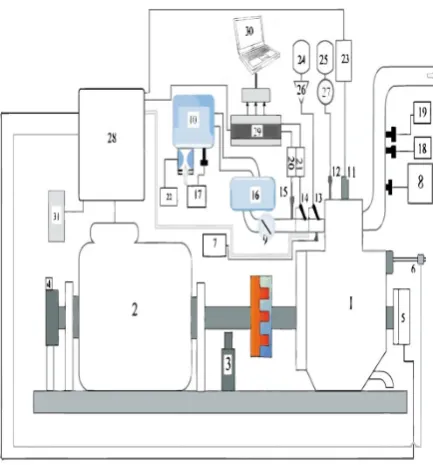
An experimental single-cylinder SI engine was used in this study. The engine was designed to be fueled by either gasoline, NG, or a combination of both (gasoline-NG). Figure 1 demonstrates the engine schematically and Table1presents its technical specifications. The engine was coupled with an electrical dynamometer to keep its speed controllable. A dynamic pressure transducer (Kistler 6025C) was used to measure the pres-sure changes within the cylinder chamber, and a Model-5011 amplifier was used to amplify the recorded signal. Analogue data including the pressure inside the cylinder, inlet manifold absolute pressure and the shaft encoder pulses of crankshaft angle and TDC were received through four input channels of an ADLINK DAQ-2005 data logger and converted to digital data at a sampling rate of 120 kHz.
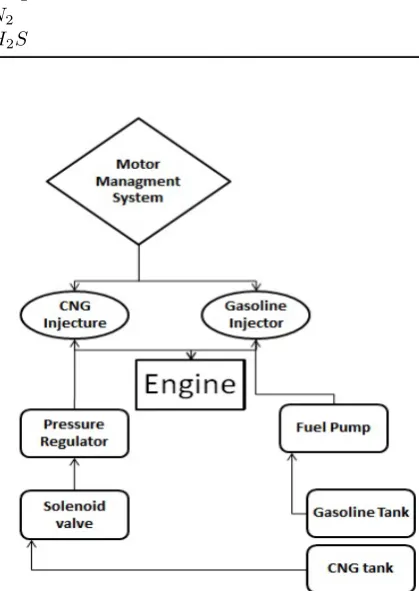
In the experiments performed in this research, the gasoline pressure behind the injector was provided by a fuel pump at about 3.5 bar. Stored in a high-pressure tank at 200-250 bar, the CNG was dispatched to the injector upon activation of the NG regulator at a pressure of 2.5 bar. Figure
2 presents the flow diagram of the fuel injection system. The engine system developed by the authors was designed to let the user adjust the injection period and the crank angle of injection start of the NG and gasoline injectors, and the spark advance. In this work, two sets of analyzer (Saxon Infralit-CL and Testo 350XL) were used to characterize the exhaust gases in terms of the air-to-fuel ratio (λ) and the contents of CO, HC, CO2, O2, NO, and NO2. The quantity could be used to adjust the equivalence ratio by changing the injection period of the fuels.
comprising the NG, an average chemical formula and lower heating rate of C1.04H3.97 and 45.5 MJ/kg were obtained for the hydrocarbon frac-tion of the NG, respectively [16]. About 94.797% of the composition of the NG was made up of hy-drocarbons, with the remaining impurities being composed of CO2 and N2. Assuming that the volumetric fractions are directly representative of the respective molar fractions in the NG, the stoichiometric equation describing the mixing of the air with the gasoline-NG mixed fuel can be expressed as Eq. (2.1),
χ7.76H13.1+
(1−χ)(0.94797C1.04H3.97+0.00694CO2+0.4509N2) (2.1) +αs(O2+ 3.76N2)
where χ is the molar fraction of the gasoline in the dual fuel and is the required number of moles of oxygen per mole of the dual fuel. The relation-ship between the molar (χ) and mass (x) fractions of the gasoline in the dual fuel can be expressed using the molecular masses of the gasoline (MG)
and NG (MN G), as given in Equation (2.2):
χ= M x
G
MN G + (1−
MG
MN G)x
(2.2)
3
Experimental methodology
In the tests performed in this study, the compres-sion ratio and the engine speed were adjusted to 11 and 1800 rpm, respectively. The engine was initially started in gasoline-burn mode, and once warmed up, the data logging was performed at an equivalence ratio of 0.9 and different spark advances with 2 degree crank angle step for 350 consecutive cycles. The same procedure was con-ducted with simultaneous injection of the two fu-els at different ratios containing gasoline at 100%, 87.5%, 75%, and 62.5%.
During the tests, data logging was performed to collect the data on the inlet manifold absolute pressure, pressure inside the cylinder, crankshaft angle, and TDC, with the originally analogue data converted to digital data using an A/C con-verter software.
The dataset corresponding to each test was de-composed into successive cycles using a computer
Figure 1: Schematic diagram of the experimental platform.
1: Engine, 2: dynamometer, 3: engine speed sen-sor, 4: torque sensen-sor, 5: shaftencoder, 6: suction TDC sensor, 7: inlet mixture temperature sensor, 8: exhaust gas temperature sensor, 9: throttle, 10: primary air comfort chamber, 11: spark plug, 12: dynamic pressure transducer, 13: NG injector, 14: gasoline injector, 15: absolute pressure transducer, 16:secondary air comfort chamber, 17: primary comfort tank temperature sensor, 18: gas analyzer A, 19: gas analyzer B, 20: the absolute pressure transducer amplifier, 21: dynamic pressure trans-ducer amplifier, 22: inlet air flow sensor, 23: igni-tion system, 24: NG tank, 25: gasoline tank, 26: NG pressure regulator, 27: gasoline pump, 28: en-gine management system, 29: AD-Logger, 30: PC, 31: electricity input of the system.
code written in the Fortran to provide for extract-ing the changes in the pressure versus crank angle inside the cylinder and the IMEP for the individ-ual cycles and calculate the average values over the cycles.
Table 1: Specifications of the CT300 research engine
Parameter Value
Cylinder diameter 90 mm
Piston cylinder 74 mm
Compression ratio 11
Ignition system Electrical with adjustable ignition timing
Fuel injection system Adjustable port fuel injector for gasoline and NG Number and position of valves 2 OHV
Opening and closing angle of inlet valve Open at intake TDC and close at 50oCA aBDC Opening and closing angle of exhaust valve Open at 40oCA bBDC and close at 8oCA aTDC
Table 2: Constituents of NG [16]
Constituent Percentage in NG/%
CH4 88.323%
C2H6 4.672%
C3H8 1.137%
C4H10 0.484%
C3H12 0.181%
CO2 0.694%
N2 4.5%
H2S 0.849%
Figure 2: Flow diagram of the fuel injection con-trol system.
inverse FFT (IFFT). Details of these processes are discussed in the Ref. [18]. The changes in the knocking pressure signal were used to
eval-uate the MAPO knocking index. The IMEP of any cycle was computed from the smoothed sig-nal of the cylinder pressure. Subsequently, using the variations of the IMEP and output torque versus the spark advance for each combination and its percentage of knocking cycle, an optimal knocking-free advance was determined. In each test, the emission was measured by detecting and recording the contents of CO, HC, and NOx using two gas analyzers.
4
Findings and discussion
Results of the experimental tests on the single-cylinder CT300 engine were obtained for different gasoline-NG fuel compositions containing gaso-line at 100%, 87.5%, 75%, and 62.5% at an equivalence ratio of 0.9,two-degree crank angle step different spark advances. In the literature, the knocking-induced maximum amplitude of pressure oscillations (MAPO) has been used as an index of knocking [19,20].
(a)
(b)
Figure 3: Cylider pressure versus crank angle for (a) 350 successive cycles with G75 and their average value, and (b) hypothetical average cy-cles corresponding to the four different combina-tions, namely, G100, G87.5, G75, and G62.5, at knocking-free optimal advances.
cycles and if the fraction of the knocking cycles of any test condition is more than 10%, the condition is subject to knock [20]. In SI engines, the spark advance is retarded to avoid such operating condition. In the present work, the knocking-free condition was identified based on the MAPO index.
Accordingly, the cycles during which the knocking percentage remained below 3% were identified as knocking-free cycles, with the knocking percentages in the range of 3-10%
(a)
(b)
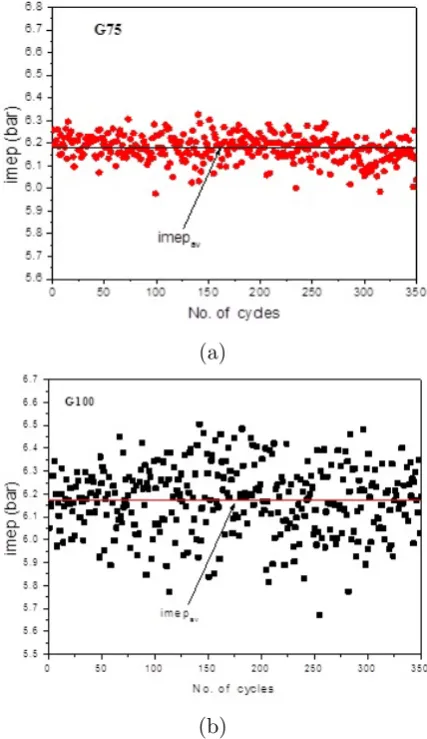
Figure 4: Variations of the IMEP during 350 suc-cessive cycles at a compression ratio of 11, engine speed of 1800 RPM, and equivalence ratio of 0.9 for the (a) G75 and (b) G100 at optimal spark advance.
Figure 5: Variations of the and COV values for G100, G87.5, G75, and G62.5 at the knocking-free optimal spark advance.
Figure 6: The IMEPav values for the G100, G87.5, G75, and G62.5 at knocking-free optimal spark advances.
the respective output torque. Figure 3a shows the variations of the cylinder pressure with the crank angle at the optimal spark advance for the G75 during 350 successive cycles as well as a hypothetical average cycle. The hypothetical average cycle was developed by averaging the pressure over different cycles at each crank angle [15].
The hypothetical average cycles were similarly developed at optimal spark advance for other combinations as well. Figure (3b) shows the
Figure 7: The output torque values for the G100, G87.5, G75, and G62.5 mixes at knocking-free op-timal spark advances.
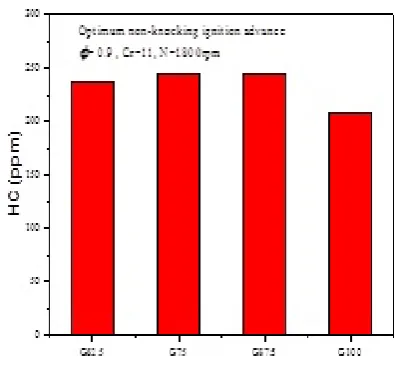
Figure 8: HC emissions from the G100, G87.5, G75, and G62.5 mixes at knocking-free optimal spark advances.
Figure 9: Emitted amount of CO for the G100, G87.5, G75, and G62.5 at knocking-free optimal spark advances.
Figure 10: Output NOx emission for the G100, G87.5, G75, and G62.5 at knocking-free optimal spark advances.
position tends toward the TDC at an increasing rate.
Knowing that applying a fixed operating condition to the engine via the management sys-tem, in-cylinder flow field, the amounts of fuel, air, and residual gases, heat exchange through the cylinder walls, turbulence and quality of the mixture in the vicinity of the spark plug at the spark and initial flame formation may not
necessary identical in the successive operating cycles, cyclic variations on the p-θ plots were expected.
In order to extract the results and identify such variations more conveniently, the cylinder pres-sure was meapres-sured for 350 successive cycles per test. Figure 4shows the IMEP values of the 350 successive cycles under lean-burn condition along with the average values versus the frequency of occurrence for the G100 and G75.
On this figure, it is observed that the devi-ation of the IMEP values of different cycles from the IMEPav is wider with the G100 rather than the G75. In order to analyze the deviation in more details, the values of standard deviation, , and coefficient of variation (COV) were evaluated at optimal spark advance for the different fuel combinations.
Figure 5 shows the variations of the and COV for the combinations. This figure shows that the G75 exhibits more limited cyclic variations compared to the other fuel combinations, re-turning 62% and 61% lower values of and COV compared to the G100. The difference could be attributed to the sensitivity of the fuel type to subtle local variations of the burn rate with the equivalence ratio and homogeneity of the fuel-air mixture.
Figure 6 demonstrates the variations of the IMEPav versus the gasoline percentage of the considered combinations at optimal spark ad-vances. Given that the IMEPav for each blend was evaluated over 350 successive cycles, the obtained values were adequately accurate. It was observed that the value of IMEPav shows no significant change upon reducing the gasoline percentage down to the G75, while further decresing in the gasoline percentage to the G62.5 led to some 5% decrease in the IMEPav.
to G62.5 lowered the output torque by 7.
Figure 8 shows the HC emissions in the ex-haust gases produced upon the combustion. According to this figure, with decreasing the gasoline percentage, the HC emissions showed an initial increase followed by a decrease. A major cause contributing to increased HC emission of the dual fuels compared to the G100 was the longer spark advances corresponding to the dual fuels, which extends the interval between the end of combustion and the end of expansion stage, thereby reducing the chance of burning the returned HC into the cylinder through the crevices. This is while the extension of the combustion period with G100 beyond the TDC, as is evident from the p-θ plot in Figure (3b) (a lower peak pressure at some position farther from the TDC), adds to the chances that the returned HC through the fissures is burnt. This ten-dency with G100 occurs due to the retardation of the spark timing to avoid the knocking condition.
Figure 9 shows the output CO emission for different combinations at knocking-free optimal spark advances. It is herein observed that the CO emission is maximal with the G100 and decreases with decreasing the gasoline percentage to a minimal value with G62.5. The reason behind the increase in CO emission with increasing the gasoline percentage in the mixture can be the longer period of combustion in early expansion stage which would add to the presence of CO in the middle burnt stage (where the expansion rate is high). Moreover, the increased C/H ratio may contribute to this outcome.
Figure 10 shows the output amounts of NOx for different fuel blends at an equivalence ratio of 0.9 and engine speed of 1800 RPM. The NOx values were seen to decrease with increasing the gasoline percentage, so that the minimum NOx emission was observed with G100 and the maximum value was that of the G62.5. Knowing that an increase in the gasoline fraction of the fuel composition further retards the optimal spark advance away from the MBT optimal to avoid the knocking, especially for the G100, lower maximum temperature of burnt gas is observed, and given the large dependency of the NOx to
the temperature, its formation is attenuated.
5
Conclusion
In the present work, four different combinations of gasoline and natural gas were experimentally investigated at an equivalence ratio of 0.9, com-pression ratio of 11, and engine speed of 1800 RPM in an experimental single-cylinder spark-ignition engine. The data recorded from 350 suc-cessive cycles per test were analyzed to draw the following conclusions and remarks:
Variations of the IMEP corresponding to the cyclic data from each test were investigated and the values of standard deviation (σ) and coeffi-cient of variation (COV) were evaluated at opti-mal spark advances for different blens. The ob-tained results showed that the cyclic changes were minimal with the G75, as compared to other com-binations, with its and COV values being about 62% and 61% lower than those of the G100. In-vestigation of the values of IMEP and output torque for different combinations at an equiva-lence ratio of 0.9 showed that the G75 outper-formed the G100 (pure gasoline). Addition of the natural gas to the gasoline in lean-burn mode at the considered compression ratio confirmed the improved performance of the engine with G75, while further increase in the natural gas percent-age lowered the performance criteria of the en-gine significantly. Investigating the output emis-sions from different combinations at an equiva-lence ratio of 0.9, it was observed that an increase in the percentage of the natural gas in the mix-ture lowered the produced amount of CO emis-sions. With increasing the percentage of natural gas in the mixture, an increase followed by a de-crease was observed in the HC emissions. The results obtained regarding the NOx emissions un-der lean-burn mode indicated an increase in the emitted amount of NOx with increasing the mass fraction of the natural gas in the fuel composition.
References
Iran,Renewable and Sustainable Energy Re-views 26 (2013) 805-821.
[2] H. M. Cho, H. Bang-Quan H, Spark ignition natural gas engines a review, Energy Con-vers Manage 48 (2007) 608618.
[3] S. O. Akansu, Z. Dulger, N. Kahraman, T. N. Veziroglu, Internal combustion engines fueled by natural gas hydrogen mixtures,Int. J. Hydrogen Energy, 29 (2004) 15271539.
[4] M. I. Jahirul, H. H. Masjuki, R. Saidur, M. A. Kalam, M. H. Jayed, M. A. Wazed, Com-parative engine performance and emission analysis of CNG and gasoline in a retrofitted car engine, Appl. Therm. Eng. 30 (2010) 22192226.
[5] M. A. Kalam, H. H. Masjuki, An experimen-tal investigation of high performance natural gas engine with direct injection, Energy 36 (2011) 35633571.
[6] Ab. Asiah, A. Nik Rosli, Effect of alcohol-gasoline blends (ethanol) on performance and emission of si engine,ARPN Journal of Engineering and Applied Sciences 11 (2016) 12-29.
[7] Y. Xiumin, G. Zezhou, H. Ling, D. Wei, S. Ping, S. Weibo, D. Yaodong, H. Feng-shuo, Effect of gasoline/n-butanol blends on gaseous and particle emissions from an SI di-rect injection engine,Fuel.229 (2018) 110.
[8] E. Pipitone, S. Beccari, Performances im-provement of a S.I. CNG bi-fuel engine by means of double-fuel injection,SAE Techni-cal Paper 24 (2009) 34 42.
[9] V. Delpech, J. Obiols, D. Soleri, L. Mis-preuve, E. Magere, S. Kermarrec, Towards an innovative combination of natural gas and liquid fuel injection in spark ignition engines,
SAE Int J Fuels Lubricants 3 (2010) 196209.
[10] A. A. Yontar, Y. Dou, 1-D modelling com-parative study to evaluate performance and emissions of a spark ignition engine fuelled with gasoline and LNG,MATEC Web Conf.
6 (2016) 50-63.
[11] M. I. Jahirul, H. H. Masjuki, R. Saidur, M. A. Kalam, M. H. Jayed, M. A. Wazed, Com-parative engine performance and emission analysis of CNG and gasoline in a retrofitted car engine,Appl Therm Eng 30 (2010) 2226.
[12] Y. Putrasari, A. Praptijanto, A. Nur, B. Wa-hono, W. B. Santoso, Evaluation of perfor-mance and emission of SI engine fuelled with CNG at low and high load condition,Energy Procedia 68 (2015) 147156.
[13] J. Y. Ha, J. S. Park, J. S. Kang, Effects of the throttle opening ratio and the injection timing of CNG on the combustion character-istics of a DI engine, Int. J. Automot Tech-nol.11 (2010) 1117.
[14] Z. Ran, D. Hariharan, B. Lawler, S. Ma-malis, Experimental study of lean spark igni-tion combusigni-tion using gasoline, ethanol, nat-ural gas, and syngas,Fuel235 (2019) 530537.
[15] J. B. Heywood, Internal combustion engine fundamentals,Mcgraw-hill New York (1988).
[16] E. Abdi Aghdam, E. Sarabi, M. Mehrbod Khomeyrani, Experimental study of laminar burning velocity for dual fuel (Gasoline-NG)-Air mixture using pressure record in a spher-ical combustion bomb at higher primary pressure, Fuel and Combustion 11 (2018) 121-134.
[17] L. Tie, Y. Tao, W. Bin, A phenomenologi-cal model of knock intensity in spark-ignition engines, Energy Conversion and Manage-ment 148 (2017) 12331247.
[18] A. Ahmadi, Study of knock intensity of gasoline-and natural gas-air Mixtures at 10 compression ratio in a CT300 research en-gine,MSc thesis in University of Mohaghegh Ardabili (2016).
[20] W. Haiqiao, F. Dengquan, P. Jiaying, Sh. Aifang, Mingzhang Pan, Knock character-istics of SI engine fueled with n-butanol in combination with different EGR rate, En-ergy 118 (2017) 190-196.
Seyyd Kazem Yekani is a PhD can-didate in Department of Mechani-cal Engineering, Faculty of Engi-neering, University of Mohaghegh Ardabili, Ardabil, Iran. His re-search interests spark ignition en-gine in lean-burn condition.
Ebrahim abdi aghdam is Associate Professor of mechanical engineer-ing in Department of Mechanical Engineering, Faculty of Engineer-ing, University of Mohaghegh Ard-abili, Ardabil, Iran. His research interests include numerical and ex-perimental investigation of the performance re-sponse of a spark ignition engine. He received his Ph.D. from University of Leeds, UK in 2001.