Programme
www.communities.gov.uk
Programme
Department for Communities and Local Government Eland House
Bressenden Place London
SW1E 5DU
Telephone: 020 7944 4400 Website: www.communities.gov.uk
© Queen’s Printer and Controller of Her Majesty’s Stationery Office, 2008
Copyright in the typographical arrangement rests with the Crown.
This publication, excluding logos, may be reproduced free of charge in any format or medium for research, private study or for internal circulation within an organisation. This is subject to it being reproduced accurately and not used in a misleading context. The material must be acknowledged as Crown copyright and the title of the publication specified.
Any other use of the contents of this publication would require a copyright licence. Please apply for a Click-Use Licence for core material at www.opsi.gov.uk/click-use/system/online/pLogin.asp, or by writing to the Office of Public Sector Information, Information Policy Team, Kew, Richmond, Surrey TW9 4DU
e-mail: [email protected]
If you require this publication in an alternative format please email [email protected] Communities and Local Government Publications
PO Box 236 Wetherby West Yorkshire LS23 7NB
Tel: 08701 226 236 Fax: 08701 226 237 Textphone: 08701 207 405 Email: [email protected]
Online via the Communities and Local Government website: www.communities.gov.uk September 2008
Contents
1. Introduction
5
Background
5
Purpose of the report
5
2.
How do NDC Partnerships communicate?
7
Strategic
approach
7
Key
audiences
7
Communication
tools
11
Management and delivery
14
3.
What type of messages have NDC Partnerships
communicated? 16
Raising awareness and increasing involvement
18
Programme and project development, progress and success
21
Sustainability and the legacy of the programme
23
Specific issues and ‘hot topics’
25
Rebuttal and management of bad publicity
27
4.
What works well in communicating with different
stakeholders and audiences?
30
How was success measured?
30
What worked well?
32
How do communications strategies address diversity and
equalities issues?
35
How do communications strategies interact with community
development strategies?
36
How do NDC Partnership Boards link with communications
activity? 37
How do communications activities link to and coordinate
How do communications strategies relate to succession
planning? 39
5.
Conclusions and key messages
41
Critical success factors
41
Barriers to success and how to tackle them
42
1.
Introduction
Background
1.1 In 1998 the Government launched The New Deal for Communities (NDC) Programme, a flagship component in their National Strategy for Neighbourhood Renewal (NSNR). The NDC Programme is a significant Area Based Initiative (ABI) in that it is:
• implemented by dedicated NDC Partnerships charged with transforming 39 deprived English localities over ten years
• designed to achieve change in six key outcome areas: education, health, crime, worklessness, housing and the physical environment, and liveability
• driven through strategic plans drawn up by NDC Partnerships in cooperation with existing delivery agencies
• premised on the assumption that the ‘community is at the heart’ of neighbourhood renewal.
1.2 The need for the programme to develop partnerships that not only deliver change but do so by working in co-operation with existing delivery agencies and, most importantly, with the local community means that effective communication is central to their success.
Purpose of the report
1.3 The purpose of this report is to ‘show and tell’ how NDC Partnerships have communicated their messages to different audiences by taking lessons from what a sample of NDCs have learnt about communication and presenting them in a form that is of use to other neighbourhood based regeneration initiatives and regeneration practitioners. The report is not, however, a comprehensive exploration of all that NDCs have done in terms of communication.
1.4 The report answers three broad research questions:
• How have NDC Partnerships spread messages about what they have done, and achieved, to different stakeholders and audiences?
• What type of messages have NDC Partnerships communicated?
• What works well in communicating with different stakeholders and audiences?
– How do communications strategies interact with community development strategies?
– How do NDC Partnership Boards link with communications activity?
– How do communications activities link to and coordinate with mainstream providers?
– How do communications strategies relate to succession planning?
1.5 The report looks at communication in it broadest sense and includes all forms of marketing, promotion and public relations whether it be planned or unplanned; tactical or reactionary; formal or informal.
1.6 The report primarily draws on the experiences of four case study areas as well as wider knowledge of the NDC programme and other literature. The four case study areas are:
• Hathershaw and Fitton Hill NDC in Oldham. An area with approximately 9,000 residents, made up of the two distinct neighbourhoods of
Hathershaw and Fitton Hill.
• eb4U in East Brighton (as of April 2007 eb4U is now called the East Brighton New Deal for Communities Partnership). An area with a population of around 17,500 people covering six separate and distinct estates.
• Coventry NDC (Wood End, Henley Green, Manor Farm and Deedmore). An area with around 7,000 residents covering four residential estates.
• South Kilburn NDC. An area with approximately 7,500 residents across a group of estates.
2.
How do NDC Partnerships
communicate?
2.1 A key element in transforming an area, and a local community, is to inform and communicate to a wide a variety of stakeholders and audiences what has been done and achieved. This chapter considers the way in which NDCs have tackled the following:
• the development of their approach to communications
• categorisation of their key audiences
• communication with different audiences and the tools to be used
• management of communications activities within the NDCs.
Strategic approach
2.2 It is evident from all four of the case study areas that communication does not just happen and that it is important to develop a strategic approach. The NDCs have addressed this by committing time and resources, through project funding, to develop communications strategies.
2.3 In general, communications strategies have outlined the aims and objectives of communications activity, detailing the different audiences the NDC needs to communicate with, the different messages it wants to convey and the tools it will use to do this.
2.4 These strategies have also been clearly separate and distinct from community development strategies. Although, because of the commonality of aims around the need to raise awareness of the NDC and engage people in the activities of the NDC there has inevitably been some cross over between the work of the communications team and the community development team (an issue that is explored in more detail in Chapter 4).
Key audiences
2.5 Identifying and agreeing the key audiences are central to any form of communication activity. A comprehensive understanding of who the NDCs are trying to communicate with is the first step in the process of developing communication tools (see below) and beginning to communicate key messages (see next section).
As a result NDC Partnerships have a wide variety of key audiences. Audiences that between them have starkly different experiences, knowledge, interests and (perhaps most importantly) agendas.
2.7 Box 2-1 sets out how each of the four case study Partnerships categorises their different audiences.
Box 2-1: Categorisation of Audiences
South Kilburn saw their audiences in terms of ‘key targets’ for communications materials and as a result identified the following groups:
• Board members and staff
• Residents of South Kilburn and the London Borough of Brent
• Partnership organisations and other interested parties
• Relevant government officials
• Local MPs, MEP’s and councillors
• Other local authorities (in particular the surrounding Boroughs of Harrow, Ealing, Camden and Westminster)
• Local businesses
• Local voluntary organisations
• Local activists
• Excluded groups (to be identified by the Widening Participation Group)
• Local institutions such as colleges, schools, community centre’s and emergency services
• Faith groups
• Young and old
• Families
Hathershaw and Fitton Hill felt that their target audience were all those that ‘had a stake’ in the area and could ‘influence its future’, and therefore identified the following groups:
• The local community
• The NDC board and resident board members
• NDC employees
• Project providers
• Investors, funders and partner organisations
• Other NDCs
• Local media
eb4U focused on five key audience groups:
• Residents
• Staff/projects
• Partners (organisations hosting and managing NDC funded projects)
• National and regional opinion formers
• Wider city (including the community and voluntary and business sectors)
Coventry had a different approach and viewed their audiences at three different levels:
• Primary – which included the NDC community/residents; the Partnership Board; and Internal Staff
• Secondary – which included Partner Organisations; local agencies; local businesses; local organisations; the media; and local/national opinion formers
• Tertiary – the wider Coventry Community.
2.8 Whilst each NDC has a broadly similar range of audiences and stakeholders, they group or categorise them in different ways. These fall in to seven broad groups that are key to all NDC partnerships – groups that would no doubt be common amongst most if not all neighbourhood based regeneration initiatives:
• The Local Community – all residents including all the associated sub-groups: families, BME groups, older and younger people, disabled people, the long term unemployed and other community groups or resident associations.
• Partnership Board members – including resident members, agency members and those who are members through other responsibilities such as being a local councillor or MP (see Box 2-2 below).
• Staff and project providers – all those involved in commissioning, managing or delivering project activity.
• Local Investors, Funders and Partner Organisations – including the local authority, the Government Office, the Police, the Primary Care Trust (PCT), local primary and secondary Schools, the Learning and Skills Council (LSC), Higher Education (HE) and Further Education (FE) institutions,
social services, housing associations, Job Centre Plus, community and voluntary sector (CVS) organisations and the private sector (including local businesses).
• National and Regional Opinion Formers – including local and national MPs, Councillors, the Regional Development Agency (RDA), other local authorities and celebrities or personalities with links to the areas.
• People in the Wider Area – all those resident in the areas surrounding the regeneration area.
Box 2-2: The Partnership Board
Each NDC has a Partnership Board in place which provides strategic direction for the organisation and is usually the structure through which programme spend receives final approval. There are a number of different models that have been adopted by NDCs in relation to the legal structure of the organisation, e.g. some NDCs have established themselves as companies limited by guarantee whereby Board members are Directors of the company. In such cases the NDC is subject to Memorandum and Articles of association which clearly govern the structure of the organisation and set out the rules and procedures for making decisions.
Whilst there are variations between the legal structures of NDCs and their Boards, there is broad commonality with respect to the composition of Partnership Boards. Each NDC Board is typically made up of 12–20 people. These are made up of elected local residents (usually in the majority) and other stakeholders relating to each of the NDC’s key themes. This usually comprises representation from the Police, Jobcentre Plus, the Primary Care Trust, local business community, voluntary sector, schools sector and the local authority. Other Board members might
include other relevant stakeholder groups with an interest in the area, e.g. local Councillors or an MP.
2.9 Each different audience also has different communication requirements, a factor that all of the case study areas formally acknowledges. This means a ‘one size fits all’ approach is not possible. Each group, and even the sub-groups within them, will often need to be communicated with in a different way. For instance, the Partnership Board require detailed information about finance, projects’ progress and performance management, where as the local community does not need such detail but rather the headline information about progress and performance.
2.10 It is not just the form of communication that differs between different groups but also the actual purpose of communication: some forms of communication will be designed to engage, others to inform and others to influence. For instance it is important that communication to the local community encourages them to engage with the Partnership whereas it is important that communication to the local media positively influences its (often) negative portrayal of the area.
2.11 These differences in requirement and purpose mean that it is also possible, and sensible, to categorise audiences further. Firstly they could be
2.12 Secondly, and linked to the first, it is important to understand the level of commitment and engagement that exists amongst the different audiences and whether communications need to focus on increasing the engagement and commitment of a particular audience.
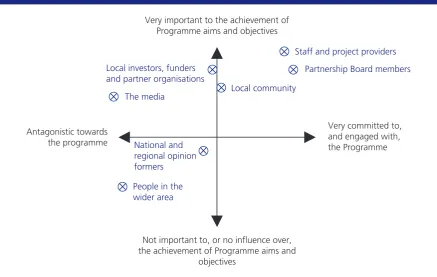
2.13 Figure 2-1 is an example of how partners/audiences might be viewed in terms of their role within and commitment to the Programme. This could be used to assess where partners are in relation to where the Programme needs them to be. The communications strategy could then be developed – along with other activities – to help move people to where they need to be, in order for the Programme to succeed. For example, moving the media from being antagonistic to at least being neutral about the Programme.
[image:13.595.86.524.346.623.2]2.14 None of the case studies used the model in an explicit form, however, some of their activity can be understood in relation to the model
Figure 2-1: Axis for assessing the engagement and commitment of key audiences
Local investors, funders and partner organisations
National and regional opinion formers
Local community
Very important to the achievement of Programme aims and objectives
Not important to, or no influence over, the achievement of Programme aims and
objectives
Very committed to, and engaged with, the Programme Antagonistic towards
the programme
Staff and project providers
Partnership Board members
People in the wider area The media
Communication tools
c NDC Community News
September 2006 All enquiries: NDC Programme, 1st Floor Borough Mill, Neild Street, Hathershaw, Oldham, OL8 1QG T: 0161 785 9716 F: 0161 785 7839 e: [email protected]
NDC
Community News
growing into a brighter future
Hathershaw + Fitton Hill New Deal for Communities
www.oldhamndc.org.uk
CONGRATULATIONS RACHEL & ROXY
Thank you to all those residents who entered our cutest pet competition. After several hours of difficult deliberation, our judges eventually chose a winner.
Congratulations to Rachel and her pet Roxy, who won a £50 voucher to spend in Spindles Shopping Centre and a £25 voucher kindly donated by Pet Care Oldham (198 Ashton Road). Our winner was chosen by the Mayor of Oldham and NDC’s own Chief Executive, Gordon Roscoe.
CONGRATULATIONS RACHEL & ROXY Thank you to all those residents who entered our cutest pet competition. After several hours of difficult deliberation, our judges eventually chose a winner.
Congratulations to Rachel and her pet Roxy, who won a £50 voucher to spend in Spindles Shopping Centre and a £25 voucher kindly donated by Pet Care Oldham (198 Ashton Road). Our winner was chosen by the Mayor of Oldham and NDC’s own Chief Executive, Gordon Roscoe.
NDC
CUTEST PET
COMPETITION WINNER
• Literature – NDCs publish a wide variety of literature aimed at communicating with different groups including newsletters, annual reports, project directories and brochures. The primary product is the Newsletter which all four case study areas produced, in a ‘glossy’ and attractive format, on either a monthly or bi-monthly basis. The Newsletter is seen as the key tool for communicating with the local community and through short, colourful and interesting articles aims to promote the work of the NDC Partnership.
• e-communications – The website is often the key ‘portal’ into the NDC for both residents and other audiences providing a wide variety of information in a relatively easy and accessible form. Emails and e-bulletins also provide an effective way of getting information out to a wide
audience. They are often the key means for communicating with partner organisations and project providers.
• Board meetings – Are a means for the staff to communicate with Board members about performance and delivery issues across the programme. In turn Board members representing local residents, key agencies and other stakeholders are able to disseminate this information within the wider community and amongst mainstream service providers.
• Press releases – In a proactive attempt to address local negative press coverage and spread the messages about the work of the NDC Partnership all four case study areas use regular press releases. The production of press releases provides a very effective means to communicate the key activities, good news stories and upcoming events or issues occurring within the NDC Partnership. The four case study areas produce between three and eight press releases a month with between 50 and 80 per cent subsequently reported on in the local press.
• Events – The use of large events or fun days, often around a particular theme, takes place throughout the year. These events provide a good opportunity to bring together the local community and enable them to interact with project and Partnership staff to raise the profile of the NDC Partnership.
• Branding – The use of a wide variety of different products with the NDC logo on, all aimed at raising the awareness of the NDC amongst both the community and other stakeholders. The case study areas all use a wide range of different products from the small: pens, mouse-mats, calendars and T-shirts. To the big: bins and lamp-post banners. The Partnerships also ensure that their logo is displayed by any project they fund.
• Campaigns – In order to publicise and communicate information about a specific event or meeting a number of posters and fliers are produced and distributed throughout the area.
• Word of mouth – Using direct face to face communication. This occurs either formally through meetings or groups such as ‘Walker Talkers’
Box 2-3: Walker Talkers
Both eb4U and South Kilburn have developed ‘Walker Talker’ projects or groups as a means of formalising and encouraging word of mouth communication.
eb4U has set up Walker Talkers to act as a two way communication channel for issues and information. Outreach focused projects, including community development projects and neighbourhood wardens, are responsible for talking with residents to promote eb4U and agreed key messages and also to get feedback and identify any particular issues that exist within the community on a three weekly cycle.
South Kilburn’s Walker Talkers was started by a group of three residents involved in the NDC Partnership. These residents would go around the area and talk to other local residents, telling them about NDC projects, handing out leaflets, undertaking survey work and getting general feedback from the community, acting as a conduit for information sharing between the NDC and residents.
Management and delivery
2.16 The processes used and responsibility for management and delivery of
communications varies. It can be managed ‘in-house’ by the NDC Partnership outsourced to a specialist PR and media firm, or it can be a combination of the two.
2.17 All four of the case study areas used a different approach to management and delivery. These different approaches are illustrated in Boxes 2.4 to 2.7.
Box 2-4: eb4U (East Brighton)
Box 2-5: Hathershaw and Fitton Hill (Oldham)
All of Hathershaw and Fitton Hill’s communication is managed through the communications team – a Manager and an assistant - which was established in 2005. Up until that point there had been no strategy or programme in place. The team is responsible for all elements of communication and are currently putting together a new project bid for more funding so that as well as continuing the existing work they can run more events and develop multi-media campaigns.
Box 2-6: Coventry
For the first three years of Coventry’s NDC programme the communications activity was carried out through an external PR and marketing company. This was changed in 2005 with the appointment of a Communications Manager (and assistant) and the development of a communications project which brought the management and delivery of communications ‘in house’. The Communications Team was also strengthened in 2006 with the addition of a Web and Graphics Officer to the team to develop the NDC website and e-communications.
Box 2-7: South Kilburn
Communications activity in South Kilburn has been delivered in-house by a Communications Manager and Project Officer. The Communications Manager joined in September 2002 and her first job was to put together the communications project in order to release funding. Prior to this communications activity had focused on the setting up of a small scale NDC newsletter. The first communications project was developed through a steering group of 7-8 Board members. They agreed the aims and objectives for communication activity. A communications strategy was established as part of the first
3.
What type of messages
have NDC Partnerships
communicated?
3.1 Effectively communicating key messages is fundamental to the success of NDC Partnerships and as can be expected, there is a clear link between the messages communicated and the process of growth and development experienced by the NDC Partnership. Therefore, as the focus of the
programme changes and the NDC matures so do the messages that need to be communicated.
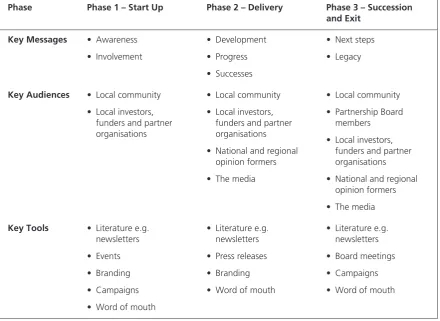
3.2 It is apparent from the four case study areas that there are three basic
stages in the ‘lifecycle’ of NDC Partnerships, each of which requires different messages to be communicated (Table 3-1):
• Raising awareness and increasing involvement – As new
organisations, in some of the most deprived areas in the country, they faced significant challenges in terms of communication as they not only needed to inform people of their ‘existence’ as an organisation but also why they existed, how they wanted to work and what they sought to achieve.
• Programme and project development, progress and success – As
they developed and grew as organisations the messages that needed to be communicated changed, beginning to focus more on what was being done and what had been achieved and less on profile and awareness raising.
Table 3-1: The NDC lifecycle and the messages that need to be communicated
Phase Phase 1 – Start Up Phase 2 – Delivery Phase 3 – Succession
and Exit
Key Messages • Awareness
• Involvement
• Development • Progress • Successes
• Next steps • Legacy
Key Audiences • Local community
• Local investors, funders and partner organisations
• Local community • Local investors,
funders and partner organisations
• National and regional opinion formers • The media
• Local community • Partnership Board
members • Local investors,
funders and partner organisations
• National and regional opinion formers • The media
Key Tools • Literature e.g.
newsletters • Events • Branding • Campaigns • Word of mouth
• Literature e.g. newsletters • Press releases • Branding • Word of mouth
• Literature e.g. newsletters • Board meetings • Campaigns • Word of mouth
Source: SQW
3.3 In addition to the messages that sit alongside the development of the
programme there are also those issues that require effective communication throughout the lifetime of the NDC programme. From the four case study areas two broad issues are particularly apparent:
• communication of specific issues and ‘hot-topics’, such as particular issues of anti-social behaviour and actions to be taken
• the rebuttal and management of bad publicity, such as, local media coverage of delays in achieving outcomes.
3.4 Communication on these different messages would have been difficult in most circumstances, but they have been further complicated by the fact that they had to be communicated against a backdrop of high, and invariably long-term, deprivation; negative perceptions of the area amongst residents, stakeholders and the local media; and a general dissatisfaction amongst those who lived in the area with ‘the government’, ‘the council’ and other public services.
3.5 The remainder of this chapter looks in more detail these different messages, thinking particularly about: what the message was and how it was
Raising awareness and increasing involvement
3.6 One of the first messages that NDCs have sought to communicate is their existence. In order to succeed it was fundamental that the NDCs established themselves as organisations that were central to the future regeneration of the area. Therefore, one of the key communication aims has been to raise people’s awareness: awareness that the NDC exists as an organisation and awareness of what they are seeking to achieve and how they want to do it. It is a priority that has remained central to their communication throughout the lifetime of the programme.
3.7 However, the aim is not just to ensure that people have ‘heard’ about the NDC but to translate this awareness into involvement. Therefore, the message communicated does not just end at ‘this is who we are’ or ‘this is what we do’ but continues with ‘this is what you can do’, ‘this is how you can get involved’ or ‘this is what role you can play’.
3.8 In communicating this message the NDC has two target audiences. The first is the local community, those people who lived within the NDC area. In order for NDCs to succeed as both a programme and as a means of intervention, the local community has to be aware of them and has to be involved in the process. In the early stages, the NDCs needed to recruit residents to be on the partnership board, understand residents’ needs and desires for the area and to engage residents in the different projects developed in order to impact positively upon their lives.
3.9 The second target audience is local and regional mainstream public service providers and stakeholders including the local authority, the police, the PCT, the LSC, local schools and Jobcentre plus. Many of these organisations were involved at the ‘bidding stage’ of the NDC process, but it was important from the outset of the programme that these organisations and their employees (at differing seniority levels) knew what the NDC was doing and how their work could link to it, in order to ensure the greatest impact and benefit.
Recognisable logos, that can also be used to ‘brand’ different products, help to raise awareness of the NDC
3.11 The focus on raising local awareness of the NDC has had a measurable positive impact, with the Ipsos-MORI Household surveys generally showing progressive increases in the numbers who were ‘aware’ of the NDC (Table 3-2). The levels of awareness and willingness to be involved amongst the local community has also been reflected by stable, if not increasing, numbers involved in different NDC projects and a continual, if small, stream of
[image:22.595.73.512.98.407.2]residents who are willing to be part of the Partnership board or members of different theme/steering groups.
Table 3-2: Proportion of residents aware of NDC 2002–2006
NDC 2002 2004 2006 Change 02–06
All NDCs 63% 79% 80% 17%
Coventry 21% 67% 81% 60%
eb4U (Brighton) 52% 75% 79% 27% Hathershaw and Fitton Hill
(Oldham)
69% 86% 90% 21%
South Kilburn 55% 70% 76% 21%
3.12 The communication of this message has also helped to maintain the
involvement of a wide variety of local stakeholders and agencies particularly by ensuring that new members of agency staff have the appropriate
background information and knowledge of the NDC.
Programme and project development, progress and
success
3.13 During the early years of the programme the NDC Partnerships faced a significant challenge as often both the area and the Partnership were viewed negatively by a range of different audiences including residents, key stakeholders and the local media who all seemed to be questioning what difference the money was making. Therefore, a key need was to highlight the things that were developing, that changes were being made and that the area was improving.
3.14 It was vital that the NDCs communicated their progress and their successes to a range of audiences particularly those dissatisfied with the work of the NDCs to date. This work tended to focus on residents and the local media but did include some other stakeholders and partners as well as regional opinion formers. The communication of positive messages was closely linked to engagement and involvement, as NDCs thought there was a positive correlation between the level to which people were involved and the perceptions that people had about both the NDC area and the NDC Partnership: the more they were involved the more positive they felt, the more changes they saw and the more they felt that a difference was being made.
3.15 In order to communicate this the NDC used a variety of different tools:
• Newsletters – were a key tool for all four of the case study areas in showcasing successful projects, reporting positive changes and
highlighting the wide scope of activity that was being undertaken by the NDC. As the newsletters were delivered to every household in the NDC areas they provided an effective means of communicating success and impact to all local residents.
• Press releases – provided a good means of informing a very wide range of audiences, because of the wide circulation of the local press, about the work and impact of the NDC. There was also a sense that their publication in the press gave them extra kudos amongst local residents. The use of ‘personal’ good news stories also provided an effective means of showing that the NDC does impact at a personal and individual level.
• Word of mouth – was perhaps the most effective method of
communicating success particularly amongst residents and mainstream providers. Whether it occurred formally or informally getting people to tell others about and share their positive experiences of the NDC and its projects, provided one of the most effective means of spreading ‘good news’, especially as people were more likely to ‘trust’ the views of their peers and colleagues than they might written articles and reports.
3.16 Whilst there are many different factors that can and do affect the popularity of and satisfaction with an area, effective communication – especially
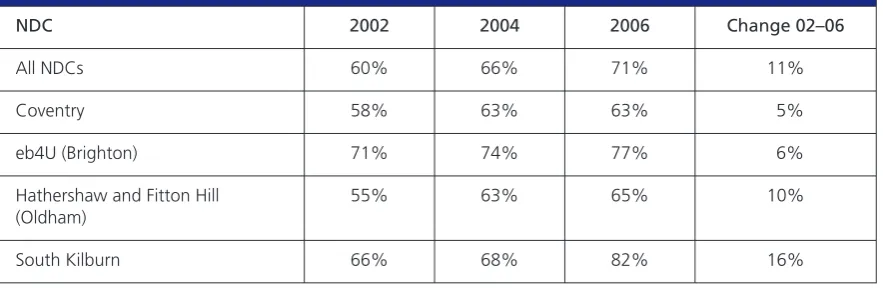
[image:25.595.86.528.303.447.2]about how the area is improving and the changes that are occurring – can contribute to increased satisfaction. There is a sense that the different forms of communication have had a positive impact on how people view and perceive their NDC area and Partnership. This is perhaps illustrated by the higher satisfaction levels found in the Ipsos-MORI household survey (Table 3-3). The consultations also showed that partner organisations and stakeholders now have a much more positive view of the NDC and the work that it does than they did when they first got involved. Other indicators of improved perceptions of the area, such as increases in house prices and the numbers of people moving into the area have also generally increased.
Table 3-3: Proportion of residents very/fairly satisfied with the NDC area 2002–2006
NDC 2002 2004 2006 Change 02–06
All NDCs 60% 66% 71% 11%
Coventry 58% 63% 63% 5%
eb4U (Brighton) 71% 74% 77% 6% Hathershaw and Fitton Hill
(Oldham)
55% 63% 65% 10%
South Kilburn 66% 68% 82% 16%
Source: Ipsos-MORI
Sustainability and the legacy of the programme
3.17 NDC Partnerships have now moved into their final stage of delivery and the focus of the programme is now on sustainability and the legacy that will be left behind. At this final stage there are a number of important messages that need to be communicated to a variety of different audiences.
3.18 The main messages that need to be communicated by the NDCs relate to what will happen in the future. It is important that all of the different audiences understand, firstly, that the NDC funding will cease, and that secondly – as a result – there will be changes to how the NDC Partnership operates (if they continue to operate at all) and what activity occurs in the area. The exact change will vary between NDC Partnerships but all Partnerships need to communicate (often far-reaching and radical) change clearly.
• The need to communicate to the local community that there will not be as much activity and that some of the different projects they currently benefit from will stop. Good communications can play a key role in not only preparing residents and users for this event but in signposting them to other similar mainstream activities.
• There is also the need to communicate to the local community any new structure/organisation that is being developed, especially if it requires community involvement and membership. The success of these new structures, like the NDC Partnerships themselves, will rely in part on their ability to engage with the local community. Therefore, it is important that the community is aware of the new structure/organisation that is proposed and the specific role that members of the community can play in it.
• The need to ensure that project providers and community groups are aware that they will need to find other funding sources once the NDC funding ceases. It is important that this message is communicated early so that these providers and groups begin looking at different sustainability options sooner rather than later.
• Highlighting to mainstream providers and funders those successful projects that need mainstream funding to continue. It is important that this communication focuses on the impact and difference made by the individual projects. Integrated communication strategies are necessary to ensure that staff at all levels, and particularly those in regular contact with service providers, are supported with evidence and advice on key messages to clearly demonstrate where mainstream provision is needed to fill those gaps left by the completion of NDC funding of projects.
3.20 Communicating about the sustainability and legacy of the programme requires a variety of tools including different forms of literature, specific campaigns and word of mouth. The challenge, regardless of the tool employed, is to ensure that all the different audiences understand what is going to happen and how it might affect them.
Box 3-1: Communicating plans for sustainability
eb4U has established a community development trust and neighbourhood management arrangements to take some of its work forward. It involved Board members – residents and partner agencies – in the process and communicated options to them via a focused Board meeting, which was preceded by some one-to-one consultations.
The Board Briefing was supported by a presentation, which took Board members through: triggers for change, changes in the policy environment, the life cycle of the programme, issues raised by succession, options and costs for taking the NDC’s work forward, the timetable, governance issues and costs.
Following the Board briefing, a newsletter was published that focused on the ‘way forward’ for eb4U and provided details on the new arrangements the residents who would be on the Trust’s board. This was followed by a press release, published in the regeneration press, detailing the new arrangements.
Coventry NDC has established the Moat House Community Trust as the successor body for the NDC. The Trust is currently working towards gaining charitable status and hopes to have this in place by the time the NDC programme ends. In these early stages the NDC has sought to communicate the work and vision of the Moat House Community Trust through briefings and presentations to local stakeholders and mainstream providers as well as including information about the Trust in the NDC ‘news bulletins’.
3.22 This apparent ‘gap’ in communication and the reasons why it has developed are explored in more detail in the next chapter.
Specific issues and ‘hot topics’
Box 3-2: Communicating a specific issue or ‘hot topic’
In Hathershaw and Fitton Hill a comprehensive programme was developed to communicate to residents the Hathershaw and Fitton Hill Spatial Masterplan, “an ambitious and exciting long term vision to transform and modernise the area”. This communication programme included: initial consultation with residents about their ideas and preferences for the area; detailed newsletters outlining the masterplan process, the preferred options and diagrams about the development; media briefings to the local press about the plans; letters and the offer of a one to one interview to those residents directly affected in terms of their house being rebuilt; and ‘road shows’ and events providing further opportunities to comment and ask questions. (A similar process has also occurred in Coventry and South Kilburn where similar large redevelopment and masterplanning programmes are occurring).
In Coventry an issue of the Newsletter focused on the problem of troublesome motorbikes and dangerous driving. The front page of the Newsletter used a dramatic photo of motorcycles being crushed under the headline of “CRUSHING ISSUE” “‘Your Shout’ [the Newsletter] gets to the bottom of problem bikes”. Inside there was then a double page spread detailing the facts as well as
identifying, with pictures, the four bikes that were still causing trouble in the area along with a number to call to report owners in complete confidence. Immediately after the article the police received calls from a number of different residents. Following this good response the Police, in partnership with the NDC, then produced a leaflet that specifically targeted the bike problem along with further details on how to report problem bikes.
3.24 The primary aim of communicating about these different issues is to inform the local community and either to provide the ‘facts’ about something that is happening or to raise the awareness about a particular issue and what the NDC is doing to address it.
3.25 In order to communicate these different messages to the local community a number of different communication tools are used. Firstly, information is often communicated through existing routes such as the Newsletter where the issue or topic in question would be the ‘theme’ of an issue and, therefore, addressed in a number of articles. Secondly, information is communicated through new and special routes, for example, where larger housing and masterplanning issues had to be addressed (an issue in three of the four case study areas).
3.26 In the case studies with major housing and master planning issues a variety of different methods of communication were used, including:
• specific events that allowed residents to ask questions, see architects’ models and plans, feed ideas into the process and raise any other concerns that they had
• door-knocking throughout the whole area so that every resident knew what was happening (had they ignored the other information), could ask questions and were aware of the implications to them personally – a fact that was particularly pertinent for those residents who would have to move home.
3.27 The communications on issues of ‘personal significance’ or ‘public concern’ had a notably greater impact than communication around other lesser or more general programme issues. For example, communications around specific issues and ‘hot topics’ attracted more people to events, got greater responses to consultation requests and engaged more people in the work of the NDC.
3.28 In terms of housing redevelopment issues, the involvement of the NDC also greatly assisted the work of those partners leading the redevelopment and masterplanning process, as the NDCs provided: ‘ready-made’ and often strong links to the local community; existing structures and methods for communicating with local residents and for getting information out to them; and a respected avenue through which to provide the ‘facts’ and quash rumours associated with major redevelopments and, therefore, minimise residents’ fears.
3.29 Effective communication of housing redevelopment or masterplanning issues is also extremely important because the redevelopment scheme will invariably form a significant part of the legacy left by the NDC Partnership. Therefore, it is key that the NDC not only communicates its role in the process but that the local community feels positive about and are generally supportive of the scheme.
Rebuttal and management of bad publicity
3.30 Negative press coverage can severely damage any organisation’s reputation and this was especially the case with NDC Partnerships in their early years of the programme. The difficulty of setting up a new organisation coupled with the high profile the NDC programme had at a national level and the wide-spread awareness that that the areas were receiving ‘significant’ amounts of funding, quickly resulted in negative coverage in the local press. It seemed that there was an unrealistic expectation amongst the local community and media that the funding would begin to change the area ‘over-night’. Therefore when this did not happen there were a number of negative stories about the failure of the organisation itself, about the failure to involve
to an exaggeration of problems resulting in more negative coverage than was necessary.
3.31 This negative coverage was extremely damaging for two broad reasons. Firstly, the fact that it was in local or regional press meant that it was read by a far greater audience of both residents and stakeholders than the NDC’s own communication, and for many it was their only source of information about the NDC. Secondly, it undermined positive stories or progress reported by the NDC, so much so that positive coverage was often simply regarded as ‘spin’.
3.32 Therefore the challenge for the NDC Partnerships was to develop an
approach and messages that enabled them not only to rebut negative press but address the negative views and opinions held by many of the journalists involved in reporting on the area. To do this, NDC partnerships adopted a two pronged approach. The first was to improve their ability to communicate programme and project development, success and progress (see above) both directly to the local community but also to the local press particularly through the regular production of press releases (Box 3-3).
Box 3-3: Press Releases
Press releases provide an effective means of informing the local media about what is happening in the area. All of the case study areas aimed to produce a number of different positive press releases each month.
The press releases would publicise events and projects; highlight a particular achievement (such as a drop in burglary figures) or area of success; promote the launch of new initiatives (such as the creation of a new Job Shop); provide information on capital projects or masterplan processes; and anything else that is deemed newsworthy. Press releases were also produced in reaction to negative or untrue stories as they provided a good opportunity to outline the facts.
The press releases outlined very clearly what was happening in the area with specific dates, times and venues (if appropriate). They also always included: a clear reference, often in the first or second paragraph, to the NDC Partnership and the NDC area; quotations from the key people involved, at least one of which would be a local resident; and details of other funders and partner organisations involved.
4.
What works well in
communicating with
different stakeholders and
audiences?
4.1 It is clear that NDCs have used different approaches and tools to
communicate a variety of different messages. The key question, therefore, is how successful have the different approaches and tools been? It is a question that this chapter seeks to answer by firstly examining how success was
measured and then looking not just at what has worked well, but also at:
• how communications have addressed the key issues of equalities and diversity
• how communications interact with community development strategies
• how Partnership Boards link with communications activity
• how communications impact on the relationships with mainstream providers and stakeholders
• how communications strategies relate to succession planning.
How was success measured?
4.2 NDC Partnerships have found evaluating the success of different communication approaches and tools difficult. So many different communication methods are used that it is often hard to differentiate between the impact of one particular method. A further complexity is the fact that for a number of tools such as the newsletters or poster/flier campaigns it is very difficult to know how many people are actually reading and benefiting from them.
provide the detailed information required to know which tools are more successful than others, what methods work best with which audiences, or what different messages need to be communicated.
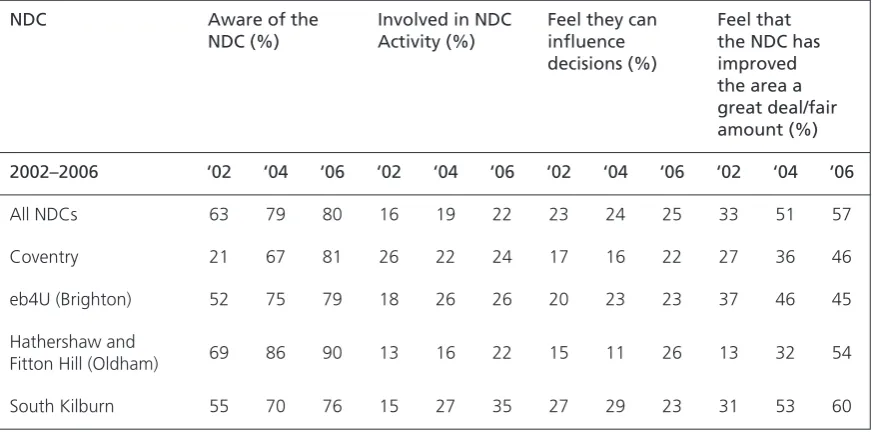
Table 4-1: Proportion of residents: aware of the NDC, involved in NDC activity; feel they can influence decisions; and feel that the NDC has improved the area a great deal/fair amount 2002–2006
NDC Aware of the
NDC (%)
Involved in NDC Activity (%)
Feel they can influence decisions (%)
Feel that the NDC has improved the area a great deal/fair amount (%)
2002–2006 ‘02 ‘04 ‘06 ‘02 ‘04 ‘06 ‘02 ‘04 ‘06 ‘02 ‘04 ‘06
All NDCs 63 79 80 16 19 22 23 24 25 33 51 57 Coventry 21 67 81 26 22 24 17 16 22 27 36 46 eb4U (Brighton) 52 75 79 18 26 26 20 23 23 37 46 45 Hathershaw and
Fitton Hill (Oldham) 69 86 90 13 16 22 15 11 26 13 32 54 South Kilburn 55 70 76 15 27 35 27 29 23 31 53 60
Source: Ipsos-MORI
4.4 In addition to the household survey a number of different measures have also been developed and used by the case study areas to evaluate success (Box 4-1).
Box 4-1: Methods for measuring success
South Kilburn and eb4U have both included ‘reader surveys’ as part of their newsletters. The survey asked people for feedback on both the different communications methods used by the NDC and the NDC in general. The positive of this method is that it enables direct feedback from residents although the drawback is the generally low response rate.
South Kilburn’s survey found that: 70% of respondents always read the magazine and that 30% would like to get more involved with the work of the NDC but it also found the 59% of respondents have never visited the NDC website and the 74% had never used an NDC project.
South Kilburn set up an interactive forum where 100 residents were invited and simultaneously answered questions about the NDC including its communications using interactive pads. This method was successful and proved to by a really quick, open, transparent and popular way of getting feedback.
eb4U commissioned an independent company to conduct an analysis of media coverage. This review looked at the volume of coverage and ‘name checks’; positive versus negative coverage; the proportion of coverage related to each theme; and the level of coverage in each media category.
The analysis found that in 2003 there was a total of 48,736 words in the Argus [local paper] and national and specialist press compared to 30,850 in 2002. There were also 1.31 million “opportunities to see” positive articles in 2003 compared to 0.05 million in 2002.
Both Coventry and Hathershaw and Fitton Hill have set up Communications Groups as a means of not only guiding the communications work but in order to regularly get feedback and comments on different communication methods and tools. In Coventry the group meets monthly and consists of between 15 and 20 residents. Whereas in Hathershaw and Fitton Hill the group meets bi-monthly and consists of NDC theme managers, a resident board member, partner organisations and project staff.
Several of the case study areas also analysed website ‘hits’ which enabled them to assess how many people used the website as well as which pages were most popular.
What worked well?
than others. However, it is possible to draw out from the four case studies those areas of communication that have worked well or proved particularly effective. It is also clear that effective communication does require a range of products.
Word of mouth or one to one communication
4.7 From the different focus groups and interviews it was clear that word of mouth and/or one to one personal communication was considered to be the most popular and effective means of communication amongst all audiences: residents, project partners, mainstream providers and other local stakeholders.
4.8 For residents it tended to occur either ‘formally’, through projects or outreach workers, or ‘informally’ through conversations between friends – both of which could deliver successful results. The formal methods worked because it made the work of the NDC seem ‘real’ and they helped to build relationships between the NDC and the community and engage them in NDC activity. Whereas the informal methods worked because they not only spread messages around the community far quicker than any formal communication but there was also a higher degree of trust about what was being communicated because it was coming from a friend.
4.9 For project partners, mainstream service providers and other local stakeholders the key benefit of one to one communication was the
development of a strong working relationship with the NDC: a relationship that enabled regular contact through meetings, emails and telephone calls. This regular contact and professional understanding meant that an effective two-way relationship developed whereby any information that was required could be easily obtained from the NDC whilst the NDC could communicate, through the same structures, any messages that they wanted to send out. These working relationships were then often enhanced and strengthened through the co-location of staff (Box 4-2).
Box 4-2: Co-location of staff as an effective means of enhancing communication
In Hathershaw and Fitton Hill, Oldham College seconded some of its staff to work in the NDC area and to be based in the NDC offices. This co-location of staff provided the College with significantly more information than they had previously. Through close working with the NDC Theme Manager the College were now more acutely aware of the different issues that the NDC faced as well as the different opportunities for joint working that existed in the area. The close working relationship also helped facilitate and improve communication through all levels of staff at both the College and the NDC.
Sussex Police felt that they benefited from having Police Officers based in eb4U’s
offices as the co-location not only helped improve working relationships between key staff in the police and the NDC and greatly aid information transfer, but it also enabled the Police to develop effective working relationships with other projects and mainstream providers in the NDC area. A further benefit of being located in the area was that it also enhanced the relationship that the police had with the local community.
In Coventry the NDC has adopted a slightly different approach and created a Multi Agency Task Team (MATT) consisting of an officer from the NDC, the police, the fire service, the housing association and the council. The team meets weekly and is committed to quickly tackling the ‘current’ problems in the area. By having a ‘fixed’ team the different organisations are able to communicate and work together to fast track specific issues without having to go through the channels and procedures that would usually delay a multi agency response.
Communication around specific issues or ‘hot-topics’
4.11 Communication on those issues that were of most concern to local residents had, as was noted in the previous chapter, a notably greater impact in galvanising the public interest and prompting a response amongst residents. The use of ‘one-off’ communication tools or existing tools to focus on
specific issues proved an effective means of communicating to local residents.
4.12 The two examples in the previous chapter (Box 3-2) show that despite being at very different scales in terms of catching people’s interest, what matters is not so much what the issue is but rather whether it affects local residents – although obviously the bigger the issues, like the masterplanning process, the greater the engagement and interest.
Relationships with the local press
regular press releases, tours of the area and one to one contact has been particularly effective and beneficial. As a result of this communication local press coverage is now not just fairer but much more positive and actually influential, because of its wide circulation, in raising the profile of the NDC in the wider area.
The Newsletter, website and branding
4.14 It was clear from the four case study areas that their newsletters, websites and branding, whilst not being groundbreaking in terms of communication tools, did all have an important role to play.
4.15 The newsletters provided a very effective means of informing the community about what the NDC was doing across all of its themes. It was also seen by project partners and mainstream service providers as a good tool for communicating with the local community about their respective projects or services (Box 4-3).
Box 4-3: Newsletters as an effective means of informing the community
The Police in Oldham regularly used Hathershaw and Fitton Hill’s newsletter to pass police messages out to the community because it helped to overcome the fact that the community generally avoid or ignore direct communication from the police.
4.16 Whilst, the newsletters provided an effective means of informing the community it was the website that proved more useful to partners,
stakeholders and other interested parties as it was invariably their first port of call for a wide variety of information – a source that would be missed had it not existed and a source that helped ‘mainstreaming’ in unexpected ways.
4.17 Finally, the ability of the NDC Partnership to ‘brand’ those projects that it was partnering or funding was an important means of highlighting its activity in the area as well as raising the awareness of the community that they existed.
How do communications strategies address diversity and
equalities issues?
4.18 Ethnically diverse communities do present a specific challenge to
Box 4-4: Addressing diversity issues
South Kilburn used a variety of different methods to communicate with their BME population. These included tailoring events and activities to specific ethnic groups; translation services for the six most frequently spoken languages covering the key content of the newsletters, board elections and the website.
Hathershaw and Fitton Hill devote one page in the Newsletter to Urdu – providing an overview of the articles in the newsletter
For Coventry the need to address diversity issues is relatively new as the minority ethnic community in the area has grown significantly over the past year (from 4% of the population to 20%). In order to address this issue the communications team are currently speaking with a variety of different organisations who have contact with this population, including the Housing Association and local Job Shop, to try and get a better understanding of what nationalities and languages exist in the area so that they can develop specific tools to communicate with these different groups.
4.19 In terms of other equalities issues, such as sight impairment, newsletters were often available in brail or on tape. However, perhaps the biggest communication challenge exists because of the low literacy rates and limited reading ability and language skills that are common in many deprived areas. In order to address these issues NDC Partnerships have made a concerted effort to ensure that not all communication occurs through literature but that when it does key publications for the community, such as the Newsletter, are written in a simple, easy to understand form, do not use jargon and are accompanied by a large number of pictures. The combination of which is hoped to make the Newsletter more appealing and less intimidating.
How do communications strategies interact with
community development strategies?
How do NDC Partnership Boards link with
communications activity?
4.21 NDC Partnership Boards have a major role to play in overseeing the strategic direction of the programme, and in approving programme delivery and spend. As described earlier, the Board will usually comprise a mix of locally elected residents, representatives of mainstream service providers, and other relevant stakeholders. As decision makers, Board members must be able to communicate how and why decisions have been made. Resident Board members are usually elected representatives of the local community and as such have a role to play in communicating the work of the NDC. Agency Board members have a key role in conveying to their organisations, the work of the NDC and the implications of this for service delivery and joint working.
4.22 It is generally acknowledged that all Board members have a role to play in positively promoting the NDC and its work. In a number of NDCs media training has been provided for Board members. This has helped to equip Board members with the skills to handle enquiries from the press, including having the confidence not to feel they have to comment directly if this is not appropriate, and to refer the query onto the NDC delivery team. A number of NDCs have been the subject to negative publicity and giving Board members the skills to deal with press enquiries is important.
4.23 Linked to the above is the need for the NDC delivery team to ensure that they communicate effectively with members of the Board. It is impossible for Board members to have detailed knowledge of every element of the NDC’s activity, however, they do need to be aware of key issues as they arise and to have a strong grasp of how and why the NDC’s strategy has developed and evolved.
4.24 In our consultations with Board members a number of factors were identified in ensuring good communication between the NDC delivery team and the Partnership Board:
• Board induction – members of the Board do change over time. It is essential that new members are effectively inducted so they can
understand the organisation, and what is expected of them in their role as a Board member
• Timely and succinct communication – ensuring that Board members
receive relevant papers and agendas well in advance of meetings so they have the time to digest information. The need to ensure that information was relevant was also identified, i.e. information should not just be circulated for the sake of it.
• Media training – a useful tool to develop Board members’ confidence in dealing with press enquiries
• Managing significant problems and the related communications
addressed, as soon as possible. Sometimes issues need to be raised and communicated outside of the formal Board meeting, if they are critical to the organisation, and the perception of the organisation and Board members need to feel confident in ‘spreading the word’.
How do communications activities link to and coordinate
with mainstream service providers?
4.25 Successfully working in partnership with mainstream service providers is fundamental to the success of NDC Partnerships. It is therefore very important that they are closely involved in, and communicated with about both NDC activity and NDC operations. As has already been noted above this communication occurs best through the development of strong working relationships that combine both informal regular contact via emails or
telephone calls and formal contact through meetings (often involving a number of different service providers). It is important this communication also occurs at a variety of different seniority levels so that information can be passed efficiently between the two organisations and decisions can be made quickly.
4.26 The NDC have also regularly worked together with mainstream providers to communicate ‘joint’ messages. This joint working has been beneficial in not only raising awareness of the issue but in highlighting to the local community that both the NDC and the service provider are working to address the problem. This has proved particularly advantageous when the communication is around a key issue or ‘hot topic’.
4.27 Joint working has also benefited mainstream service providers by:
• Providing them with ‘access’ to and a portal into the local community through the different communication tools and routes that the NDC have already developed, such as the Newsletter (see Box 4-3 above) or events.
• Reducing the level of suspicion or doubt amongst the community that often surrounds communication and messages from service providers – often joint communication is seen as more ‘trustworthy’ than it would be if it was from the service provider alone, a real issue for the Police and the Local Authority.
How do communications strategies relate to succession
planning?
4.29 As the NDC Programme draws to a close, NDC partnerships have begun to think about the future, about the legacy they will leave and about how they will sustain some activity beyond the lifetime of the programme. The level of communication on these issues varies across the case study areas – in part linked to how far the partnership has gone down the road of implementing its succession strategy. Some steps have been taken to persuade mainstream providers to carry on funding different activities; however, the focus in some areas is still on communicating the success of the programme, rather than making the case for the future.
4.30 The four case study areas highlighted two broad reasons why the messages around sustainability and the legacy of the programme were not yet the main focus of communication. It was either because the succession strategy for the whole programme was still being developed and therefore there was no ‘message’ to communicate. Or, it was the result of a combination of both a slow start to the programme and failure to develop a communications strategy from the start, both of which meant that there is risk that a ‘lag’ has developed between what is happening ‘on the ground’ and the messages that are being communicated: when NDCs should have been raising awareness they were not communicating; when they should have been communicating progress and success they were raising awareness; and now when they should be communicating about succession they are communicating about progress and success.
4.31 The communication of future plans is a notable challenge for NDC
Partnerships. For some, like eb4U and Coventry, they need to communicate a complete change in organisation and structure whilst for others it is simply a matter of communicating that the NDC will not exist beyond a certain point – neither of which is easy.
4.32 The failure to communicate early enough about succession and legacies has a number of implications:
• Firstly, as the funding draws to a close and projects finish there is a danger that, without proper communication, this will be seen negatively as the NDC ‘letting the community down’ – severely damaging the good reputation that has been built up during the previous years.
• Secondly, the NDC needs to ensure that its most successful projects are sustained beyond the lifetime of the Programme by mainstream providers. However, by not communicating this message early enough the NDC runs the risk that good projects will have to finish because no alternative funding sources have been identified.
in its development. Without a good level of community engagement the success of any new structure will be hindered.
5. Conclusions and key messages
5.1 The following two sections set out the key findings from the study on the basis of critical success factors and barriers to success with recommendations for partnerships under each of the factors.
Critical success factors
5.2 Having looked in detail at the communication strategies, tools and messages of the four case study areas it is possible to identify a number of common factors that are critical to developing and delivering effective communications – factors that would be relevant and important to any neighbourhood based regeneration initiative. They are:
• A variety of different communication methods and tools are employed by the NDC, as a one size fits all approach is not possible for diverse audiences.
– Partnerships should develop a suite of tools to meet the needs of different audiences and address different communication issues.
• Ensure that the impact had (and the difference made) is communicated clearly and from the earliest possible point. It is this evidence of change that will raise the profile of the NDC Partnership and help engage residents and stakeholders in the work of the NDC.
– Partnerships need to be aware of the importance of timing – they need to get stories out quickly.
• Programmes change and develop and successful communications are in line with the phase of the overall programme.
– Partnerships should make sure that they understand the phase of the programme they are in and ensure their communications reflect this.
• An adequately resourced team is in place from the start of the
programme. Without it communication will always ‘lag’ behind what is happening with the programme.
– Partnerships need to treat ‘communications’ as an integral part of the programme and not a separate project, which is subject to the vicissitudes of the programme.
• The development of positive word of mouth networks provides a strong base of awareness and a means of identifying and addressing problems. Word of mouth communication between residents is one of, if not the most effective means of communication and encouraging resident engagement.